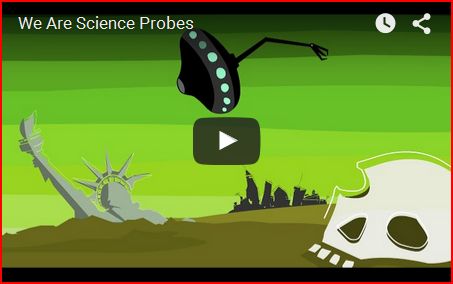
Still from “We Are Science Probes.” Full clip of movie below.
In animation, a parable about the dangers of being intentionally ignorant of science. In the not-distant-enough future, a probe from another planet arrives on Earth after the demise of human civilization. Unfortunately, the probes land in Kansas, the land of creationism and woo. The plot thickens.
[My apologies — the version I found did not come with a “pause” button. It will play automatically when you open this post. Fortunately, it’s almost perfectly safe-for-work. If you don’t like the music, turn it off. There is no spoken dialogue in the cartoon. If you wish to pause the playing of the cartoon, right click to get to the Adobe Flash Player controls. To pause the playing click the checkmark next to “play.”]
[Update August 18 — Okay, I give up — 100% of comments I’ve been getting ran against the video without the “start” or “pause” buttons. You’ll have to go see it at another site — here, for example.]
Sure would love this group to turn their creative faculties to hard history — say, the Progressive Movement and Gilded Age. (Probably less chance of commercialization there, and perhaps less chance of awe-striking art, too.)
As Scott points out in the post immediately below, the news that President Obama tasked NASA head Bolden, as perhaps his foremost mission, with raising Muslim self-esteem is entirely absent from the New York Times and the Washington Post, as well as the nightly newscasts of ABC, NBC, and CBS. Why?
It might be, as Mirengoff goes on to speculate wildly and without reason, because the news agencies are taking payoffs from Obama, or just so enthralled with him that they can’t bring themselves to report bad news.
Think about that for a moment: News agencies unwilling to report bad news? Is your Hemingway Sh__ Detector working yet? Mine’s clanging something fierce.
Does Mirengoff seriously think the Poobahs at Disney sit around issuing orders that ABC news gatherers ignore bad news about Obama? Has Mirengoff been in some sort of plastic bubble, deprived of newspapers and television for the past four years?
Why the silent treatment? Because it’s very much a not-much-news story, Paul. It doesn’t say what you think it says, or worse, what you know it doesn’t say, but claim it does for whatever trouble you can stir up.
Charles Bolden, NASA’s administrator, explained for a news channel that broadcasts to the Middle East, what his job is with regard to the Arabic and Islamic populations (this is the version reported by York):
“When I became the NASA administrator, [Obama] charged me with three things,” NASA head Charles Bolden said in a recent interview with the Middle Eastern news network al-Jazeera. “One, he wanted me to help re-inspire children to want to get into science and math; he wanted me to expand our international relationships; and third, and perhaps foremost, he wanted me to find a way to reach out to the Muslim world and engage much more with dominantly Muslim nations to help them feel good about their historic contribution to science, math, and engineering.”
Good reporters would look at the interview, and realize the PowerLine guys got the story dead wrong. Not bothering to speculate on why part-time yahoos misreported the story, they’d go on to real news.
Note carefully what Bolden said, and then note carefully what he did not say. Bolden didn’t say the mission of NASA had changed. Bolden didn’t say Obama told him to ignore the mission of NASA. Bolden said NASA, arguably our nation’s most famous and vanguard science agency, has a top duty to inspire children to do well in science in math, to cooperate with other nations in exploring space as we have done since at least the Reagan administration, and, for audiences in Arabic nations, to help them understand Arabic contributions to science.
“Let go of the power line, step back, and no one else will get hurt.” Downed powerline in New Jersey, in summer 2011. Photo by Saed Hindash, The Star-Ledger
Bolden did not say, as Hot Air misreported, “NASA’s spaced-out mission no longer includes . . . space.” Hot Air isn’t reporting. This is a time-tested propaganda technique they engage in: MSU, “making [stuff] up.”
Which of those goals does Power Line disagree with? Each of them is a noble enterprise on its own.
But, pausing for just a moment to make liars out of Power Line and the Examiner, and others, ABC News got it right. How soon do you think Mirengoff or Scott Johnson at Power Line will update their story to note ABC reported it? How much longer before others do?
If ABC can get it right, why not these other guys?
Yellow journalism was bad enough the first time around. PowerLine, could you at least take the time to get the story right? If you don’t have a Hemingway to help you out, you can always use the old Cheech and Chong Excrement Detection Method. I don’t recommend it, but it tends to make reporters more careful if they ever use it once.
You gotta wonder why these people spread easily-falsified, malignant rumors. Who are they working for? It’s pretty clear they don’t have much respect for their readers.
This is a hoax, people. NASA has not changed its mission. The president cannot change NASA’s mission since that is dictated by law (it requires an “act of Congress,” literally). NASA’s chief did not say that stupid thing others claim — he’s not stupid. Don’t pretend it’s news, don’t pretend it’s a problem when the head of NASA says he’s trying to promote interest in science, math and history, and international cooperation. That’s his job.
No one was assigned the job to get the story wrong. I wish people would quit working so hard at it.
Pam Geller at Atlas Shrugged stumbled into the error, too (When Geller reports such a story, that’s often a clue that what she claims is dead wrong; any reporter worth her or his salt would have to be putting the Hemingway on “vibrate only” at this point.)
Rand Simberg at Pajamas Media got it wrong –– but that doesn’t stop him from waxing malevolently about the problems with things, had he been accurate (can we really trust someone who doesn’t spell it “pyjamas?”)
At the Fort Wayne (Indiana) News-Sentinel, columnist Kevin Leininger not only didn’t listen to the entire interview (and so get the story wrong), he reaches back to add the racist complaint that Obama put Martin Luther King, Jr.’s bust in the Oval Office, replacing a bust of Churchill borrowed from England. Leininger appears to be anti-American and racist both with that one, and now he shows religious intolerance. Somebody will send me a copy of Leininger’s column and say, “See, this is why we need to license journalists.” Hey, Leininger — why shouldn’t America honor American heroes like Martin Luther King, Jr.?
The International Astronomical Union (IAU) recently approved the name Rachmaninoff for an intriguing double-ring basin on Mercury. This basin, first imaged in its entirety during MESSENGER’s third Mercury flyby, was quickly identified as a feature of high scientific interest, because of its fresh appearance, its distinctively colored interior plains, and the extensional troughs on its floor. The basin’s name honors the Russian composer, pianist and conductor, Sergei Rachmaninoff (1873-1943).
IAU names craters on Mercury after “deceased artists, musicians, painters and authors who have made outstanding or fundamental contributions to their field and have been recognized as art historically significant figures for more than 50 years.” The process of proposing a new crater name includes gathering fundamental information about the crater, such as the crater’s central latitude, central longitude, and diameter. Justification is provided as to why the crater is of sufficient scientific importance to be named, and details are provided about the name choice, including sources that support the worthy contributions made by that individual. Ten newly named craters join 42 others named since MESSENGER’s first Mercury flybyin January 2008.
Image Credit: NASA/Johns Hopkins University Applied Physics Laboratory/Carnegie Institution of Washington
Tip of the old scrub brush to Eric Koenig.
Spread the word; friends don't allow friends to repeat history.
Uh-oh. Did P. Z. Myers see the name of the commanding officer of the space shuttle Atlantis on the current flight, STS-132?
Short press release from NASA:
Sun, 16 May 2010 06:48:08 -0500
Commander Ken Ham [emphasis added] and the crew of Atlantis performed the Terminal Initiation burn at 7:40 a.m. EDT, firing the left Orbital Maneuvering System engine for nine seconds to place the shuttle on the final path for its 10:27 a.m. docking to the International Space Station. When Atlantis is about 600 feet from the station, Ham will maneuver Atlantis through a backflip rotation to expose the heat shield to station crew members who will use digital cameras to photograph Atlantis’ upper and lower surfaces through windows of the Zvezda Service Module. Oleg Kotov will use a 400mm lens, and T.J. Creamer, Soichi Noguchi and Tracy Caldwell Dyson all will use 800mm lenses. The photos will be transmitted to Mission Control for evaluation by imagery experts and mission managers to determine whether the heat shield sustained any damaged during launch.
Not only is it not the same Ken Ham, I’ll wager they are completely unrelated, and that they’ve never met. I wonder how the astronaut lives with people confusing him with the Ken Ham of the creationism cult. Perhaps creationists stray into the real process of space exploration so rarely that no one has made the connection yet.
. . . this Ken Ham, who doesn't "believe" in much of the science that gets the other Ken Ham into orbit.
This Ken Ham, the astronaut (NASA photo), is not to be confused with . . .
Spread the word; friends don't allow friends to repeat history.
Tomorrow, April 14, Mission Specialists Dottie Metcalf-Lindenburger is scheduled to talk with students at Eastern Guilford High School in North Carolina, and all of the 71,000 students in Eastern Guilford School District.
Caption from NASA: STS-131 Mission Specialist Dorothy Metcalf-Lindenburger, attired in a training version of her shuttle launch and entry suit, poses for a photo prior to the start of an ingress/egress training session in the Space Vehicle Mock-up Facility at NASA's Johnson Space Center. Photo Credit: NASA
Metcalf-Lindenburger is one of three teachers selected in 2004 as astronauts. NASA is committed to help education out. After the Challenger disaster, and the death of “teacher in space” Christa McAuliffe, NASA finally determined to make teachers into astronauts rather than fly “civilians.”
Haley Miller
Guilford Public Schools, Guilford, N.C.
336-370-3200 millerh3@gcsnc.com
April 12, 2010
MEDIA ADVISORY : M10-048
Orbiting Space Shuttle Astronauts — Including Former Teacher — Call North Carolina Students
WASHINGTON — Astronauts orbiting 220 miles above Earth will speak with students in Gibsonville, N.C., on Wednesday, April 14. The call with the students and space shuttle Commander Alan Poindexter and Mission Specialists Dottie Metcalf-Lindenburger, Stephanie Wilson and Clay Anderson will take place at 1:06 p.m. EDT at Eastern Guilford High School in Gibsonville.
Eastern Guilford High School is hosting students from Eastern Guilford Middle School, Gibsonville Elementary, McLeansville Elementary, Rankin Elementary and Sedalia Elementary for the downlink. The school also will broadcast the event to the entire Guilford County Schools district, which serves more than 71,000 students.
The astronauts launched Monday, April 5, aboard space shuttle Discovery from NASA’s Kennedy Space Center in Florida. During the 13-day mission to the International Space Station, the crew will deliver science experiments and supplies; take three spacewalks to switch out a gyroscope on the station’s truss, or backbone; install a spare ammonia storage tank and return a used one; and retrieve a Japanese experiment from the station’s exterior.
Metcalf-Lindenburger is one of three teachers selected to fly as shuttle mission specialists in the 2004 Educator Astronaut Class. She operates the shuttle’s robotic arm. Without robotics, major accomplishments like building the station, repairing satellites in space and exploring other worlds would not be possible.
Students have been preparing for the downlink by conducting NASA engineering design challenges and implementing agency robotics resources and activities into K-12 classrooms. A science, technology, engineering and math, or STEM, club was organized to increase participation and interest, particularly by female students.
The school’s guidance department also is collaborating with local universities to help students investigate and explore STEM opportunities beyond graduation. During follow up in-district workshops in April and May, a NASA Aerospace Education Services Program specialist will demonstrate how to access and use NASA resources in K-12 curricula.
Eastern Guilford High School employee Michael Woods, a former Aerospace Education Services Project specialist at NASA’s Goddard Space Flight Center in Greenbelt, Md., and the agency’s Langley Research Center in Hampton, Va., is leading the downlink effort. In December 2009, NASA awarded Guilford County Schools a two-year grant of nearly $1 million to help middle and high school teachers develop science lessons using the space agency’s content.
The event is part of a series with educational organizations in the U.S. and abroad to improve teaching and learning in science, technology, engineering and mathematics. The in-orbit call is part of Teaching From Space, a NASA project that uses the unique environment of human spaceflight to promote learning opportunities and build partnerships with the kindergarten through 12th grade education community.
NASA Television will air video of the astronauts during the downlink. For NASA TV downlink, schedule and streaming video information, visit:
Bob Park is probably right (he usually is). The International Space Station doesn’t have enough science value to justify the expense of it. A lot of the work we do in space exploration could better be done by robots. But you know, I grew up in that era when a manned space launch was a school-stopping experience. I was still in high school when Neil Armstrong set foot on the Moon. So I will be saddened when the shuttle launches come to an end.
Let’s hope the next chapter of space exploration will be at least as cool.
Spread the word; friends don't allow friends to repeat history.
Ultraviolet image of the Andromeda Galaxy, first known to be a galaxy by Edwin Hubble on December 30, 1924 - Galaxy Evolution Explorer image courtesy NASA
On December 30, 1924, Edwin Hubble announced he’d discovered other galaxies in distant space. Though it may not have been so clear at the time, it meant that, as a galaxy, we are not alone in the universe (whether we are alone as intelligent life is a separate question). It also meant that the universe is much, much bigger than most people had dared to imagine.
Hubble was the guy who showed us the universe is not only bigger than we imagined, it’s probably much bigger and much more fantastic than we can imagine. Hubble is the guy who opened our imaginations to the vastness of all creation.
How does one celebrate Hubble Day? Here are some suggestions:
Easier than Christmas cards: Send a thank-you note to your junior high school science teacher, or whoever it was who inspired your interest in science. Mrs. Hedburg, Mrs. Andrews, Elizabeth K. Driggs, Herbert Gilbert, Mr. Willis, and Stephen McNeal, thank you.
Rearrange your Christmas/Hanukkah/Eid/KWANZAA lights in the shape of the Andromeda Galaxy — or in the shape of any of the great photos from the Hubble Telescope (Andromeda Galaxy pictured above; Hubble images here)
A few of the images from the Hubble Telescope
Go visit your local science museum; take your kids along – borrow somebody else’s kids if you have to (take them along, too)
Spend two hours in your local library, just looking through the books on astronomy and the universe
Anybody got a good recipe for a cocktail called “The Hubble?” “The Andromeda?” Put it in the comments, please
In 1924, he announced the discovery of a Cepheid, or variable star, in the Andromeda Nebulae. Since the work of Henrietta Leavitt had made it possible to calculate the distance to Cepheids, he calculated that this Cepheid was much further away than anyone had thought and that therefore the nebulae was not a gaseous cloud inside our galaxy, like so many nebulae, but in fact, a galaxy of stars just like the Milky Way. Only much further away. Until now, people believed that the only thing existing outside the Milky Way were the Magellanic Clouds. The Universe was much bigger than had been previously presumed.
Later Hubble noted that the universe demonstrates a “red-shift phenomenon.” The universe is expanding. This led to the idea of an initial expansion event, and the theory eventually known as Big Bang.
Hubble’s life offered several surprises, and firsts:
Hubble was a tall, elegant, athletic, man who at age 30 had an undergraduate degree in astronomy and mathematics, a legal degree as a Rhodes scholar, followed by a PhD in astronomy. He was an attorney in Kentucky (joined its bar in 1913), and had served in WWI, rising to the rank of major. He was bored with law and decided to go back to his studies in astronomy.
In 1919 he began to work at Mt. Wilson Observatory in California, where he would work for the rest of his life. . . .
Hubble wanted to classify the galaxies according to their content, distance, shape, and brightness patterns, and in his observations he made another momentous discovery: By observing redshifts in the light wavelengths emitted by the galaxies, he saw that galaxies were moving away from each other at a rate constant to the distance between them (Hubble’s Law). The further away they were, the faster they receded. This led to the calculation of the point where the expansion began, and confirmation of the big bang theory. Hubble calculated it to be about 2 billion years ago, but more recent estimates have revised that to 20 billion years ago.
An active anti-fascist, Hubble wanted to joined the armed forces again during World War II, but was convinced he could contribute more as a scientist on the homefront. When the 200-inch telescope was completed on Mt. Palomar, Hubble was given the honor of first use. He died in 1953.
“Equipped with his five senses, man explores the universe around him and calls the adventure Science.”
(Does anyone have a suitable citation for that video? Where did it come from? Who produced it? Is there more somewhere?)
Happy Hubble Day! Look up!
Resources:
Journey to Palomar site (production currently being broadcast on PBS affiliates – wonderful story of George Ellery Hale and the origins of modern astronomy at Palomar; that’s where Hubble worked)
Meteors from the Leonid shower could have been good viewing — generally, as I predicted, it was not spectacular. At least BBC said so.
But if you can make the time, it’s almost always profitable — psychologically and spiritually — to look up at the sky.
Some who did look up got great photographs of the not-spectacular views.
"A fireball seems to shoot right through a house in Grafton, Ontario. Malcolm Park captured the image as he was setting up to photograph meteors on Monday night." (MSNBC caption)
If this isn’t spectacular, can you imagine what would be?
Spread the word; friends don't allow friends to repeat history.
Sputnik model, at the Smithsonian Air & Space Museum (Wikimedia image)
The Union of Soviet Socialist Republics (USSR) launched the world’s first artificial satellite into orbit. After successfully putting the shiny ball into orbit, the Soviets trumpeted the news that Sputnik traced the skies over the entire planet, to the shock of most people in the U.S. (Photo of the model in the Smithsonian’s Air & Space Museum in Washington, D.C.)
New Scientist magazine’s website provides significant details about how awake America became, including very good coverage of the Moon landings that were nearly a direct result of Sputnik’s launch — without Sputnik, the U.S. probably wouldn’t have jump started its own space program so, with the creation of NASA and the drive for manned space flight, and without the space race President John F. Kennedy probably wouldn’t have made his dramatic 1961 proposal to put humans on the Moon inside a decade.
Texas Essential Knowledge and Skills (TEKS) lists 1957 as among the dozen dates students need to know in U.S. history, for Sputnik. It is the only date Texas officials list for U.S. history that is really an accomplishment by another nation. (The first time I encountered this requirement was in a meeting of social studies teachers gearing up for classes starting the following week. The standards mention the years, but not the events; I asked what the event was in 1957 that we were supposed to teach, noting that if it was the Little Rock school integration attempt, there were probably other more memorable events in civil rights. No one mentioned Sputnik. It was more than two weeks before I got confirmation through our district that Sputnik was the historic event intended. Ouch, ouch, ouch!)
Sputnik was big enough news to drive Elvis Presley off the radio, at least briefly, in southern Idaho. My older brothers headed out after dinner to catch a glimpse of the satellite crossing the sky. In those darker times — literally — rural skies offered a couple of meteoroids before anyone spotted Sputnik. But there it was, slowly painting a path across our skies, over the potato fields, over the Snake River, over America.
Sputnik’s launch changed our lives, mostly for the better.
John F. Kennedy at Rice University, Houston, Texas, Sept 12, 1962 – photo from NASA
There is no strife, no prejudice, no national conflict in outer space as yet. Its hazards are hostile to us all. Its conquest deserves the best of all mankind, and its opportunity for peaceful cooperation many never come again. But why, some say, the moon? Why choose this as our goal? And they may well ask why climb the highest mountain? Why, 35 years ago, fly the Atlantic? Why does Rice play Texas?
We choose to go to the moon. We choose to go to the moon in this decade and do the other things, not because they are easy, but because they are hard, because that goal will serve to organize and measure the best of our energies and skills, because that challenge is one that we are willing to accept, one we are unwilling to postpone, and one which we intend to win, and the others, too.
President John F. Kennedy, September 12, 1962, at Rice University, Houston, Texas
Why this speech in Houston? There’s more here than just a speech in a football stadium. Kennedy was working to save the space initiative, and to make America more secure.
In this quest, Kennedy lays out the reasons we need strong science research programs funded by our federal government, and strong science educational achievement in all of our schools.
President John F. Kennedy (1961-1963) awoke on April 12, 1961, to the news that the Soviet Union had won the race to put a man into space. Kennedy immediately met with Vice President Lyndon Johnson in the White House to discuss the embarrassment of the Soviets beating America again. “Can we put a man on the moon before them?” Kennedy asked. A few weeks later, Kennedy challenged the nation to “commit itself to achieving the goal, before this decade is out, of landing a man on the moon and returning him safely to earth.”
Kennedy challenged Congress and the imaginations of all Americans a few weeks later, when on May 25, in a special Joint Session of Congress, he proposed a Moon exploration program. In a speech outlining defense and foreign policy needs to make the U.S. secure and safe against threats from Soviet communism, or any other nation or faction, Kennedy spoke openly about the space race that had been waged since October 4, 1957, when the Soviet Union became the first nation on Earth to orbit an artificial satellite, Sputnik.
Finally, if we are to win the battle that is now going on around the world between freedom and tyranny, the dramatic achievements in space which occurred in recent weeks should have made clear to us all, as did the Sputnik in 1957, the impact of this adventure on the minds of men everywhere, who are attempting to make a determination of which road they should take. Since early in my term, our efforts in space have been under review. With the advice of the Vice President, who is Chairman of the National Space Council, we have examined where we are strong and where we are not, where we may succeed and where we may not. Now it is time to take longer strides–time for a great new American enterprise–time for this nation to take a clearly leading role in space achievement, which in many ways may hold the key to our future on earth.
I believe we possess all the resources and talents necessary. But the facts of the matter are that we have never made the national decisions or marshalled the national resources required for such leadership. We have never specified long-range goals on an urgent time schedule, or managed our resources and our time so as to insure their fulfillment.
Recognizing the head start obtained by the Soviets with their large rocket engines, which gives them many months of leadtime, and recognizing the likelihood that they will exploit this lead for some time to come in still more impressive successes, we nevertheless are required to make new efforts on our own. For while we cannot guarantee that we shall one day be first, we can guarantee that any failure to make this effort will make us last. We take an additional risk by making it in full view of the world, but as shown by the feat of astronaut Shepard, this very risk enhances our stature when we are successful. But this is not merely a race. Space is open to us now; and our eagerness to share its meaning is not governed by the efforts of others. We go into space because whatever mankind must undertake, free men must fully share.
I therefore ask the Congress, above and beyond the increases I have earlier requested for space activities, to provide the funds which are needed to meet the following national goals:
First, I believe that this nation should commit itself to achieving the goal, before this decade is out, of landing a man on the moon and returning him safely to the earth. No single space project in this period will be more impressive to mankind, or more important for the long-range exploration of space; and none will be so difficult or expensive to accomplish. We propose to accelerate the development of the appropriate lunar space craft. We propose to develop alternate liquid and solid fuel boosters, much larger than any now being developed, until certain which is superior. We propose additional funds for other engine development and for unmanned explorations–explorations which are particularly important for one purpose which this nation will never overlook: the survival of the man who first makes this daring flight. But in a very real sense, it will not be one man going to the moon–if we make this judgment affirmatively, it will be an entire nation. For all of us must work to put him there.
The race was on. The Soviet Union’s massive rocket engines gave them a decided advantage. Kennedy’s challenge captured the imagination of Americans and America. Necessary money flowed from Congress, but not in a completely free flow. Some opposed the nation’s efforts in space exploration because they thought spending on space exploration detracted from the nation’s defense efforts. Kennedy continued to stress the connection between space exploration and defense. He was backed by successes — Navy Commander Alan Shepard, Jr., had successfully launched into space and returned safely; and on February 20, 1962, pilot Marine Capt. John Glenn orbited the Earth three times, catching the U.S. up almost to where the Soviet Union was in manned space exploration.
Kennedy understood that constant attention, constant selling of the space program would be necessary. So in September 1962 he found himself in Houston, the newly-designated home of the manned space program, and he took the opportunity to cast the American goals in the space race as peaceful, good for all mankind, and definitely worth the massive costs.
Notice in how he casts putting a human on the Moon in league with other great achievements of civilization. Kennedy was truly shooting for the stars.
Notice also how he relates space exploration to practical applications then in existence, such as communication, navigation of ships at sea, and weather forecasting. This was years before geosynchronus satellites were used for everyday telephone conversations, years before quantum theory was harnessed for Global Positioning Systems (GPS) and digital personal, handheld telephones, and before the newly-invented printed circuits were miniaturized to make computer calculating a possibility in space — the Moon landing was done with slide rules and hand calculations.
Just over 14 months later Kennedy would die in Texas, in Dallas, on November 22, 1963. On July 20, 1969, Neil Armstrong and Buzz Aldrin landed the Eagle Lunar Module on the Moon, at the Sea of Tranquility. A few hours later, on July 21, they stepped out on the Moon. From Kennedy’s speech to Congress, the task had taken 8 years, one month and 26 days.
Buzz Aldrin on the Moon, with Neil Armstrong, the U.S. flag, and the Eagle Lunar Module reflected in his helmet visor, July 21, 1969 – NASA photo via Wikimedia
Please share.
Spread the word; friends don't allow friends to repeat history.
Ultraviolet image of the Andromeda Galaxy, first known to be a galaxy by Edwin Hubble on December 30, 1924 - Galaxy Evolution Explorer image courtesy NASA
Today is a good day to celebrate the universe in all it’s glory – December 30. Below, mostly an encore post.
This year for Hubble Day, Wired picked up on the story (with a gracious link to last year’s post here at the Bathtub). Wired includes several links to even more information, a good source of information.
Hubble was the guy who showed us the universe is not only bigger than we imagined, it’s probably much bigger and much more fantastic than we can imagine. Hubble is the guy who opened our imaginations to the vastness of all creation.
How does one celebrate Hubble Day? Here are some suggestions:
Easier than Christmas cards: Send a thank-you note to your junior high school science teacher, or whoever it was who inspired your interest in science. Mrs. Hedburg, Mrs. Andrews, Elizabeth K. Driggs, Herbert Gilbert, Mr. Willis, and Stephen McNeal, thank you.
Rearrange your Christmas/Hanukkah/KWANZAA lights in the shape of the Andromeda Galaxy — or in the shape of any of the great photos from the Hubble Telescope (Andromeda Galaxy pictured above; Hubble images here)
A few of the images from the Hubble Telescope
Go visit your local science museum; take your kids along – borrow somebody else’s kids if you have to (take them along, too)
Spend two hours in your local library, just looking through the books on astronomy and the universe
Anybody got a good recipe for a cocktail called “The Hubble?” “The Andromeda?” Put it in the comments, please
In 1924, he announced the discovery of a Cepheid, or variable star, in the Andromeda Nebulae. Since the work of Henrietta Leavitt had made it possible to calculate the distance to Cepheids, he calculated that this Cepheid was much further away than anyone had thought and that therefore the nebulae was not a gaseous cloud inside our galaxy, like so many nebulae, but in fact, a galaxy of stars just like the Milky Way. Only much further away. Until now, people believed that the only thing existing ouside the Milky Way were the Magellanic Clouds. The Universe was much bigger than had been previously presumed.
Later Hubble noted that the universe demonstrates a “red-shift phenomenon.” The universe is expanding. This led to the idea of an initial expansion event, and the theory eventually known as Big Bang.
Hubble’s life offered several surprises, and firsts:
Hubble was a tall, elegant, athletic, man who at age 30 had an undergraduate degree in astronomy and mathematics, a legal degree as a Rhodes scholar, followed by a PhD in astronomy. He was an attorney in Kentucky (joined its bar in 1913), and had served in WWI, rising to the rank of major. He was bored with law and decided to go back to his studies in astronomy.
In 1919 he began to work at Mt. Wilson Observatory in California, where he would work for the rest of his life. . . .
Hubble wanted to classify the galaxies according to their content, distance, shape, and brightness patterns, and in his observations he made another momentous discovery: By observing redshifts in the light wavelengths emitted by the galaxies, he saw that galaxies were moving away from each other at a rate constant to the distance between them (Hubble’s Law). The further away they were, the faster they receded. This led to the calculation of the point where the expansion began, and confirmation of the big bang theory. Hubble calculated it to be about 2 billion years ago, but more recent estimates have revised that to 20 billion years ago.
An active anti-fascist, Hubble wanted to joined the armed forces again during World War II, but was convinced he could contribute more as a scientist on the homefront. When the 200-inch telescope was completed on Mt. Palomar, Hubble was given the honor of first use. He died in 1953.
“Equipped with his five senses, man explores the universe around him and calls the adventure Science.”
(Does anyone have a suitable citation for that video? Where did it come from? Who produced it? Is there more somewhere?)
Happy Hubble Day! Look up!
Resources:
Journey to Palomar site (production currently being broadcast on PBS affiliates – wonderful story of George Ellery Hale and the origins of modern astronomy at Palomar; that’s where Hubble worked)
But, what the heck! There’s enough cool history for two celebrations every year!
Teachers might take this opportunity to stock up on photos and information for bell-ringer quizzes and other presentations on October 1, 2008, when NASA celebrates the 50th anniversary of NASA’s opening its doors, and school is actually in session.
Photos from NASA on the 47th birthday, in 2005 Image Details: First row, from left: A 1931 photo shows the original hangar at NASA’s predecessor, the National Advisory Committee for Aeronautics (NACA). The first American satellite in orbit, Explorer 1, launches in January 1958. The “Original Seven” Mercury astronauts were selected in 1959. The experimental Echo project used large metallic balloons to bounce signals from one point on Earth to another.Second row, from left: The X-15 hypersonic research aircraft flew for nearly 10 years, from June 1959 to October 1968. Apollo 11 astronauts left the first bootprints on the moon in July 1969. Jupiter’s Great Red Spot, seen from one of the twin Voyager spacecraft that launched in 1977. NASA satellites helped create the “blue marble,” a detailed image of Earth.
Third row, from left: Columbia launches on the first shuttle mission in April 1981. Image of the Eagle Nebula from the Hubble Space Telescope. The Mars rover Opportunity looks back at its tracks on the red planet. The international space station is humanity’s first permanent orbital outpost.
Fourth row, from left: The Cassini spacecraft has been sending back images of Saturn, it’s rings and moons since July 2004. Discovery returns the space shuttle fleet to flight in July 2005. NASA satellites help scientists and forecasters watch powerful hurricanes. Artist’s concept of NASA’s next spaceship, the crew exploration vehicle, docked with a lander in lunar orbit.
Photo credit: NASA
Congress created a civilian agency to honcho space exploration as part of the body of reform actions after the Soviet Union beat the U.S. with orbiting an artificial satellite, in 1957.
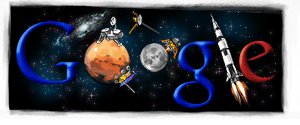
Google has another of its arty Google Logos in honor of the day:
NASA has its own logo for the 50th anniversary:
NASA’s 50th anniversary logo
Spread the word; friends don't allow friends to repeat history.
The Union of Soviet Socialist Republics (USSR) launched the world’s first artificial satellite into orbit. After successfully putting the shiny ball into orbit, the Soviets trumpeted the news that Sputnik traced the skies over the entire planet, to the shock of most people in the U.S. (Photo of the model in the Smithsonian’s Air & Space Museum in Washington, D.C.)
New Scientist magazine’s website provides significant details about how awake America became, including very good coverage of the Moon landings that were nearly a direct result of Sputnik’s launch — without Sputnik, the U.S. probably wouldn’t have jump started its own space program so, with the creation of NASA and the drive for manned space flight, and without the space race President John F. Kennedy probably wouldn’t have made his dramatic 1961 proposal to put humans on the Moon inside a decade.
Texas Essential Knowledge and Skills (TEKS) lists 1957 as among the dozen dates students need to know in U.S. history, for Sputnik. It is the only date Texas officials list for U.S. history that is really an accomplishment by another nation. (The first time I encountered this requirement was in a meeting of social studies teachers gearing up for classes starting the following week. The standards mention the years, but not the events; I asked what the event was in 1957 that we were supposed to teach, noting that if it was the Little Rock school integration attempt, there were probably other more memorable events in civil rights. No one mentioned Sputnik. It was more than two weeks before I got confirmation through our district that Sputnik was the historic event intended. Ouch, ouch, ouch!)
Sputnik was big enough news to drive Elvis Presley off the radio, at least briefly, in southern Idaho. My older brothers headed out after dinner to catch a glimpse of the satellite crossing the sky. In those darker times — literally — rural skies offered a couple of meteoroids before anyone spotted Sputnik. But there it was, slowly painting a path across our skies, over the potato fields, over the Snake River, over America.
Sputnik’s launch changed our lives, mostly for the better.
1968 brought one chunk of bad news after another to Americans. The year seemed to be one long, increasingly bad disaster. In several ways it was the mark of the times between the feel-good, post-war Eisenhower administration and the feel-good-despite-the-Cold-War Reagan administration. 1968 was depressing.
What was so bad? Vietnam manifested itself as a quagmire. Just when Washington politicians predicted an end in sight, Vietcong militia launched a nationwide attack in South Vietnam on the Vietnamese New Year holiday, Tet, at the end of January. Civil rights gains stalled, and civil rights leaders came out in opposition to the Vietnam war. President Johnson fared poorly in the New Hampshire primary election, and eventually dropped out of the race for the presidency (claiming he needed to devote time to making peace in Vietnam). Labor troubles roiled throughout the U.S., including a nasty strike by garbage collectors in Memphis. It didn’t help to settle the strike that the sanitation workers were almost 100% African American, the leadership of Memphis was almost 100% white, and race relations in the city were not so good as they might have been – the strike attracted the efforts of the Southern Christian Leadership Conference, and Martin Luther King, Jr. – who was assassinated there in early April. In response, riots broke out in 150 American cities.
Or, until that account is unsuspended by the forces supporting Donald Trump: Follow @FillmoreWhite, the account of the Millard Fillmore White House Library
We've been soaking in the Bathtub for several months, long enough that some of the links we've used have gone to the Great Internet in the Sky.
If you find a dead link, please leave a comment to that post, and tell us what link has expired.
Thanks!
Retired teacher of law, economics, history, AP government, psychology and science. Former speechwriter, press guy and legislative aide in U.S. Senate. Former Department of Education. Former airline real estate, telecom towers, Big 6 (that old!) consultant. Lab and field research in air pollution control.
My blog, Millard Fillmore's Bathtub, is a continuing experiment to test how to use blogs to improve and speed up learning processes for students, perhaps by making some of the courses actually interesting. It is a blog for teachers, to see if we can use blogs. It is for people interested in social studies and social studies education, to see if we can learn to get it right. It's a blog for science fans, to promote good science and good science policy. It's a blog for people interested in good government and how to achieve it.
BS in Mass Communication, University of Utah
Graduate study in Rhetoric and Speech Communication, University of Arizona
JD from the National Law Center, George Washington University


 Posted by Ed Darrell







 Millard Fillmore's Bathtub