10 things about Judge Sonia Sotomayor

May 27, 2009

Those people over at MoveOn.org move quickly:

Ten Things To Know About Judge Sonia Sotomayor

  1. Judge Sotomayor would bring more federal judicial experience to the bench than any Supreme Court justice in 100 years. Over her three-decade career, she has served in a wide variety of legal roles, including as a prosecutor, litigator, and judge.
  2. Judge Sotomayor is a trailblazer. She was the first Latina to serve on the Court of Appeals for the Second Circuit and was the youngest member of the court when appointed to the District Court for the Southern District of New York. If confirmed, she will be the first Hispanic to sit on the U.S. Supreme Court.
  3. While on the bench, Judge Sotomayor has consistently protected the rights of working Americans, ruling in favor of health benefits and fair wages for workers in several cases.
  4. Judge Sotomayor has shown strong support for First Amendment rights, including in cases of religious expression and the rights to assembly and free speech.
  5. Judge Sotomayor has a strong record on civil rights cases, ruling for plaintiffs who had been discriminated against based on disability, sex and race.
  6. Judge Sotomayor embodies the American dream. Born to Puerto Rican parents, she grew up in a South Bronx housing project and was raised from age nine by a single mother, excelling in school and working her way to graduate summa cum laude from Princeton University and to become an editor of the Law Journal at Yale Law School.
  7. In 1995, Judge Sotomayor “saved baseball” when she stopped the owners from illegally changing their bargaining agreement with the players, thereby ending the longest professional sports walk-out in history.
  8. Judge Sotomayor ruled in favor of the environment in a case of protecting aquatic life in the vicinity of power plants in 2007, a decision that was overturned by the Roberts Supreme Court.
  9. In 1992, Judge Sotomayor was confirmed by the Senate without opposition after being appointed to the bench by George H.W. Bush.
  10. Judge Sotomayor is a widely respected legal figure, having been described as “…an outstanding colleague with a keen legal mind,” “highly qualified for any position in which wisdom, intelligence, collegiality and good character would be assets,” and “a role model of aspiration, discipline, commitment, intellectual prowess and integrity.”

Sources for each of the 10 things:

1. White House Statement, May 26, 2009.
http://www.moveon.org/r?r=51451&id=16226-5763840-nrcJckx&t=1

2. White House Statement, May 26, 2009.
http://www.moveon.org/r?r=51451&id=16226-5763840-nrcJckx&t=2

3. Cases: Archie v. Grand Cent. Partnership, 997 F. Supp. 504 (S.D.N.Y. 1998) and Marcella v. Capital Dist. Physicians’ Health Plan, Inc., 293 F.3d 42 (2d Cir. 2002).

4. Cases: Flamer v. White Plains, 841 F. Supp. 1365 (S.D.N.Y. 1993), Ford v. McGinnis, 352 F.3d 382 (2d Cir. 2003), and Campos v. Coughlin, 854 F. Supp. 194 (S.D.N.Y. 1994).

5a. “Sotomayor’s Notable Court Opinions and Articles,” The New York Times, May 26, 2009.
http://www.moveon.org/r?r=51454&id=16226-5763840-nrcJckx&t=3

5b. Cases: Bartlett v. N.Y. State Board, 970 F. Supp. 1094 (S.D.N.Y. 1997), Greenbaum v. Svenska Hendelsbanken, 67 F.Supp.2d 228 (S.D.N.Y. 1999), Raniola v. Bratton, 243 F.3d 610 (2d Cir. 2001), and Gant v. Wallingford Board of Education, 195 F.3d 134 (2d Cir. 1999).

6. “Sonia Sotomayor: 10 Things You Should Know,” The Huffington Post, May 26, 2009.
http://www.moveon.org/r?r=51452&id=16226-5763840-nrcJckx&t=4

7. “How Sotomayor ‘Saved’ Baseball,” Time, May 26, 2009.
http://www.moveon.org/r?r=51455&id=16226-5763840-nrcJckx&t=5

8. “Sotomayor’s resume, record on notable cases,” CNN, May 26, 2009.
http://www.moveon.org/r?r=51453&id=16226-5763840-nrcJckx&t=6

9. “Sotomayor’s resume, record on notable cases,” CNN, May 26, 2009.
http://www.moveon.org/r?r=51453&id=16226-5763840-nrcJckx&t=7

10a. Judge Richard C. Wesley, a George W. Bush appointee to the Second Circuit.
http://www.moveon.org/r?r=51451&id=16226-5763840-nrcJckx&t=8

10b. “Sotomayor is Highly Qualified,” The Wall Street Journal, May 9, 2009.
http://www.moveon.org/r?r=51456&id=16226-5763840-nrcJckx&t=9

10c. Honorary Degree Citation, Pace University School of Law, 2003 Commencement.

  • Judge Sotomayor is a widely respected legal figure, having been described as “…an outstanding colleague with a keen legal mind,” “highly qualified for any position in which wisdom, intelligence, collegiality and good character would be assets,” and “a role model of aspiration, discipline, commitment, intellectual prowess and integrity.”ere are the sources for the ten statements:

  • Supreme Court tryouts

    March 20, 2009

    Elena Kagan took the oath of office to be the nation’s top lawyer, the Solicitor General, last Friday.  The Associated Press is running a story (here from the Sacramento Bee) on whether this is a tryout for the Supreme Court itself, “Obama could make top high court lawyer a justice.”  (Isn’t that a tortured headline?)

    Three justices may want to retire soon:  Justice John Paul Stevens is 88 years old.  Justice Ruth Bader Ginsburg is 76, and back on the court in record time after surgery for pancreatic cancer.  Justice David Souter is third oldest, at 69.

    So, this AP story could be a good article for use in government classes.  Consider these questions:

    • Is Solicitor General a stepping stone to the Supreme Court’s bench?
    • What is the role of the Solicitor General?
    • How important is Supreme Court experience, or experience in other courtrooms, to success in arguing before the Supreme Court?
    • What are some of the top cases before the Supreme Court this term, and what are the potential and likely results of these appeals?
    • What is the role of the U.S. Senate in selection of federal judges, and especially in the selection of Supreme Court justices?
    • Kagan clerked for Justice Thurgood Marshall.  What do law clerks do for justices?  What does her clerking suggest for Kagan’s advocacy of Voting Rights Act issues, since she worked with Justice Thurgood Marshall?

    Resources:


    Meanwhile, back in reality, Obama’s election certified

    January 9, 2009

    It’s one of those arcane and many argue archaic things the “founders” left us, but the electoral college’s process of electing the president of the U.S. rumbled to completion yesterday when Congress opened the ballots from the electors, and then certified that Barack Obama will be the next president of the U.S.

    Preparations for the inauguration continue unabated.

    But for those still clinging to their tinfoil hats, even as the deadline rapidly approaches to go to High Definition Television, January 9 and January 16 offer chances for the Supreme Court to overturn the election, by ruling Obama’s birth was invalid.  Some, confusing the Supreme Court with Congress, urge a landslide of letters to the Court itself (“that’ll show ’em!”).

    I’ve managed to get myself banned at that last website.  I asked the author to make a case, to provide the evidence and arguments against Obama’s eligibility.  Such an appearance of gravity and Newtonian physics scares the bejeebers out of these groups.

    One of the most intrigueing questions now:  What will the Bergites and Dononfrions do after inauguration? Are there enough of them that Pfizer is working on a treatment, or cure?


    FAIL repeated: Challenges to Obama’s eligibility

    December 26, 2008

    Some weeks ago we visited six hurdles that the case against Barack Obama’s eligibility for the presidency would have to overcome to disqualify him.

    All six hurdles still remain.  No one has made any serious response to any of the six.

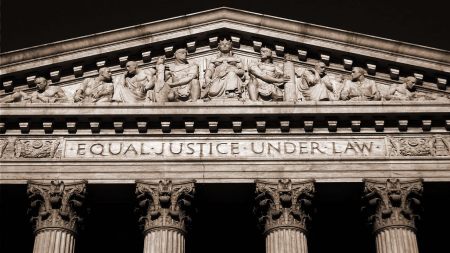
    Above the West Entrance to the U.S. Supreme Court is engraved Equal Justice Under Law

    Above the West Entrance to the U.S. Supreme Court is engraved "Equal Justice Under Law"

    But the Birth Certificate Obsessed (BCO) people go on and on.

    Let me note that the six hurdles still stand — six reasons why the objections to Obama’s eligibility will fail:

    1. Obama has a U.S. passport (claims that he doesn’t have a passport were put to rest when it was revealed, in March 2008, that State Department workers had illegally accessed his passport records).
    2. Because we know Obama has a U.S. passport, we can be quite sure his draft status was verified before it was issued — which puts to bed any issue about his registering for the draft (which he wouldn’t have been required to do in any case until 1980 — draft registration had been suspended in 1973 until the Afghanistan/Soviet crisis).
    3. Obama’s a lawyer; the National Conference of Bar Examiners, or the Illinois Bar, would have checked on any problems that surfaced when verifying his fitness to practice law.
    4. Obama was a U.S. senator; as a matter of course, the FBI does a background check on every U.S. senator to verify they may view top secret material. Security clearances are absolutely necessary for members of the Intelligence Oversight Committee, the Foreign Relations Committee, and the Armed Services Committee.  Obama was a member of the Foreign Relations Committee, chairing the subcommittee that deals with U.S. relations with NATO — a post that requires top secret clearances.
    5. Obama has been getting the full national security briefing every day that the president gets; CIA and Homeland Security would have to verify his top secret clearances, and then some.  There is absolutely no indication that this top, top check was not carried out.
    6. Perhaps most important, Obama posted an image of his birth certificate on-line in June; experts who checked the actual document verify it is real, and therefore authoritative.

    Each of these six circumstances creates a rebuttable presumption that Obama is a citizen, and a natural born citizen under the somewhat ambiguous requirements of Article II of the Constitution.  In order to make a case that Obama is ineligible, contestants would need to make a strong showing, with clear evidence, to rebut the presumptions created by by these official actions.

    Professional poker player Leo Donofrio has made no such evidentiary showing, anywhere, at any time.  Nor has any other Obama critic presented any evidence to overcome any of these six presumptions.

    Recently a poster named Carlyle complained that my previous post had been unknown to him. While I posted trackbacks to his post at Texas Darlin’, that blog censors my posts and trackbacks, and thereby deprived this BCO from knowing about the facts (indeed, trackbacks are automatic, since Texas Darlin’ is also a WordPress blog; the only way the trackbacks and comments don’t show up at TD’s blog is because she censors them).  With some fury, Carlyle and others found that post from November 27 and complained I was unfair to them.  However, none has presented any serious challenge to the six hurdles.

    How can I be unfair when they won’t make a case?

    Here, below the fold, is an example of the heated and off-target responses I’ve gotten.  Of course, I offer comments as we go.

    Read the rest of this entry »


    Supreme Court won’t review challenge to Obama

    December 15, 2008

    The Associated Press reports that the Supreme Court refused for the second time to take a second case challenging the eligibility of Barack Obama to be president.

    Cort Wrotnowski alleged that Obama’s father’s British citizenship made Obama’s birth citizenship different from “natural born” citizenship as the Constitution says the president must be.

    There was no comment on the case from the Court, just a note that the appeal was not taken.

    Tinfoil hat concessionaires on Capitol Hill were disappointed.

    In other news, electors are meeting today to elect Obama president.


    Baltimore Sun: Obama eligibility challenge likely to be refused

    December 7, 2008

    Responsible media, generally called in denigrating styel “mainstream media” by many of our more nutty nut cases, have held off in commenting on the Supreme Court’s position on the case against Obama’s election discussed in conference last Friday, December 5.

    Except the Baltimore Sun, which notes as the Bathtub did, that the appeal is likely to go no further.

    We won’t know for sure until tomorrow.

    Meanwhile, Eric Zorn at The Chicago Tribune says “enough already,” and calls for the conservative moonbats to give up the nasty, fruitless calumny.  (Also see this Tribune story.)


    Supreme Court: No review of Obama eligibility

    December 6, 2008

    Generally the orders coming out of Friday conferences at the Supreme Court issue the following Monday. So, for Obama critics and dedicated Obama haters, there is still some hope that the Supreme Court might answer part of their wildest dreams. But it doesn’t look good for them.

    [Saturday night update: Donofrio’s blog acknowledges the orders don’t include his case. He’s holding out for Monday. Technically, he’s right — the orders usually would issue Monday. But if Friday’s orders issued from Friday’s conference, it doesn’t speak well of the chances that an age discrimination case took precedence over a case challenging the election still in process. We won’t know for sure, until Monday.]

    [Monday morning update, December 8: It’s official. Donofrio’s case was not accepted for a hearing. As the Washington Post noted, there are other pending cases, but nothing likely to be acted on soon. I’ve noted in other posts, I think it unlikely any of the cases has a signficant chance of success.]

    No order issued from the Supreme Court to further discuss the appeal of the dismissal of a New Jersey lawsuit challenging Barack Obama’s eligibility to be president. Instead, the Court granted certiorari to an accused terrorist to challenge President George W. Bush’s authority (which will fall to President Barack Obama, really), and the Court granted cert and an okay for an amicus brief on a labor case (age discrimination).

    (writ of certiorari: [Law Latin “to be more fully informed”] An extraordinary writ issued by an appellate court, at its discretion, directing a lower court to deliver the record in the case for review. ♦ The U.S. Supreme Court uses certiorari to review most of the cases it decides to hear.) Black’s Law Dictionary, 7th ed. (Bryan Garner, ed.)

    Assuming this listing to be accurate, the shotgun arguments against Obama’s eligibility appear to be dead issues. The electoral college balloting occurs on December 15 in 50 state capitals and the District of Columbia.

    Short of a mass exodus of Obama electors in states where law does not bind them to vote as they pledged to vote, Obama’s selection by the electoral college appears to be fait accompli.

    The Wall Street Journal’s Law Blog noted the lack of order in the case, late yesterday.

    For thousands of people addicted to the tubes of the internet, this will pose interesting problems as to what they can whine about for the next several weeks.

    Previous comments on the Bathtub:

    Over the front door of the U.S. Supreme Court:

    Over the front door of the U.S. Supreme Court: “Equal Justice Under Law.” Wikipedia image by UpStateNYer


    Without hysterics, the Obama eligibility issue

    December 5, 2008

    In a conference today [December 5, 2008] the Supreme Court will reconsider together whether to take on a suit challenging the eligibility of Barack Obama to be president of the United States under a sometimes-arcane  section of Article II of the Constitution.

    Is Barack Obama a “natural born” citizen of the U.S.?

    In the building where “Equal Justice Under Law” is engraved high over the front door, poker-player Leo Donofrio’s challenge will be examined to see whether at least four of the nine justices of the Court think he has enough of a case to actually merit a hearing.  Justice David Souter rejected Donofrio’s case earlier, so this is a hail-Mary play on the part of Obama’s opponents.

    Equal Justice Under Law, the West Pediment of the U.S. Supreme court. AAPF image

    Equal Justice Under Law, the West Pediment of the U.S. Supreme court. AAPF image

    The Court takes seriously the principle engraved over the door, however.  This is the same Court that ruled earlier this year an accused terrorist and all-around bad guy held at Guantanamo Bay has the right to a writ of habeas corpus over the objections of the Most Power Man in the World, U.S. President George W. Bush.  The humble, gritty, or even unsavory history of litigants does not limit their rights under the law.

    Leo Donofrio in his usual office. Leo Donofrio image

    Leo Donofrio in his usual office. Leo Donofrio image

    So the question is, what sort of case does Donofrio have against Obama’s eligibility?

    Would Justice Clarence Thomas have agreed to bring this case to the conference if it doesn’t have a chance to succeed?

    I’ve not lunched with Thomas in more than two decades, so I can’t speak with any inside knowledge.  Historically, the Court, and indeed all the federal courts, have agreed to examine cases like this often simply to provide an authoritative close to the issue.  In this case, the outright hysteria of the anti-Obama partisans suggests the issue should be put to bed if possible.

    Under usual Court procedures, we won’t learn the results of the conference until Monday.  I would not be surprised if the results are announced today, just to promote the settling of the issue.

    Does Donofrio have a case?

    I don’t see a case.  It’s clear that Obama is a U.S. citizen now.  Donofrio’s argument is rather strained, and sexist.  He claims that Obama’s father having been a British subject in 1961 (Kenya was not yet independent), Obama had dual citizenship at birth — and, further, Donofrio alleges, this dual citizenship trumps both Obama’s birth on U.S. soil (which should be dispositive) AND Obama’s mother’s U.S. citizenship, conferring a special status that doesn’t meet the intentions of the framers of the Constitution.

    Donofrio’s claim is odd in that it would grant a lesser-status to children of legal immigrants than is allowed by law to children of illegal immigrants, or temporary visitors.  It also is bizarre, to me, in the way it dismisses Obama’s mother’s existence as a factor in Obama’s citizenship status — and while equal rights for women were not wholly obtained in 1961, no one has successfully argued that the citizenship of the father trumps that of the mother in citizenship cases.

    Donofrio is arguing that Obama’s dual citizenship at birth disqualifies him from holding the presidency, technically, in a very narrow reading — though Obama would have absolutely every other right of a natural born citizen.

    A couple of observations:

    First, this is not an easy issue to litigate. Standing is the easiest way for a federal court to avoid a decision — what harm can a citizen claim from letting Obama be president?  It’s difficult to find an injury even were Donofrio’s claims valid.  No blood, no foul.  No injury, no standing to sue.  It is upon this basis that most of the cases against Obama’s eligibility have been tossed out, as Donofrio’s has been tossed, twice already.

    Second, it is unclear what entity enforces the eligibility clause of the Constitution, or indeed, whether any entity can. For most of the summer Obama’s critics were pressuring the Federal Election Commission (FEC) to do something, even though the FEC lacks a quorum of members to do anything.  More to the point, there is nothing in any law that confers on the FEC the function of checking the citizenship status of any candidate.  Sometime in October they finally figured out that state secretaries of state might have a role, since they set up the ballots in each state.

    I admit I thought that, until I reflected on the issue of the electoral college.  In U.S. presidential elections, voters do not vote directly for president and vice president.  Instead, we vote to elect people who will be the electors who decide — electors of the electoral college.  The history of this institution can be found elsewhere.  For the sake of these suits, however, it means that the secretaries of state have no role at all in the eligibility of the candidates.  They rule on the eligibility of the electors, which is an entirely different kettle of fish. Some states even list the electors on the ballot.

    But in any case, it means Donofrio is suing the wrong entity, even if we can’t tell him what the correct entity is.

    Third and most important, Donofrio is asking for U.S. citizenship law to be overturned in a most inconvenient time and place. Dual citizenship is a bar to very little in American life.  There is an assumption that people who hold that status are fully American citizens, absent a showing of contrary facts.  There are no contrary facts in evidence from Donofrio, nor from anyone else, despite promises of the revelation of conspiracies.

    In short, Donofrio is arguing that there is, somewhere, somehow, some information that Barack Obama is not the shining patriot his life story reveals.  Donofrio doesn’t know what that information is, or where it might be found, but he thinks maybe the State of Hawaii is complicit in a conspiracy to hide this information, which is hidden on the hand-written records of Obama’s birth in 1961.  You might think Donofrio has watched “National Treasure” a few too many times, and whether it’s that movie or some other source, you’d be right — paranoid suspicions of conspiracy are not the stuff good court cases are made of.

    The dozen or more cases against Obama’s eligibility all suffer from this astounding, dramatic lack of evidence.  Is there an affidavit from someone who alleges that Obama’s citizenship should be called into question?  If so, they’ve not been presented to any court.  (Obama tormentor Corsi claims to have interviewed Obama’s Kenyan grandmother, and he alleges she said through an interpreter that Obama was born in Kenya; oddly, he didn’t bother to get an affidavit from the woman, nor from anyone else — and others who listen to the tape think she thought Corsi was asking about the birth of her son, not grandson.  This is not solid evidence.)

    I argued earlier there is a long chain of evidence creating rebuttable presumptions that Obama’s a natural born U.S. citizen.  To contradict this chain of evidence, contestants should provide extraordinary, clear evidence of contradiction.  What is offered by Donofrio is neither extraordinary, nor clear, nor necessarily contradictory to the presumptions.

    This is not an issue solely for the hysterical.  Lawyers and scholars have looked at the issue through the years, and intensely this year, and arrived at the conclusion that Obama is perfectly eligible for the presidency.

    Will sanity ever prevail?

    Resources you may want to consult:

    Vodpod videos no longer available.


    Marriage rights and civil rights giant, Mildred Loving, 68

    May 5, 2008

    We learned today that Mildred Loving died Friday in Milford, Virginia.  She was 68.

    2007 was the 40th anniversary of the Supreme Court Decision in which she played a key role, Loving vs. Virginia. In that decision, the U.S. Supreme Court ruled that state laws against interracial marriage are unconstitutional.

    The romance and marriage of Mildred and Richard Loving demonstrate the real human reasons behind advances in civil rights laws.  They left Virginia to avoid facing prosecution for having gotten married; but when they wanted to be closer to family, they wrote to then-Attorney General Robert F. Kennedy. He referred them to the American Civil Liberties Union, who financed the case to get the law changed.

    Richard and Mildred Loving, screen capture photo from HBO documentary,

    Richard and Mildred Loving, screen capture photo from HBO documentary, “The Loving Story.”

    See the post from last year on the anniversary of the decision. The Associated Press wrote today:

    Peggy Fortune [daughter] said Loving, 68, died Friday at her home in rural Milford. She did not disclose the cause of death.

    “I want (people) to remember her as being strong and brave yet humble — and believed in love,” Fortune told The Associated Press.

    Loving and her white husband, Richard, changed history in 1967 when the U.S. Supreme Court upheld their right to marry. The ruling struck down laws banning racially mixed marriages in at least 17 states.

    “There can be no doubt that restricting the freedom to marry solely because of racial classifications violates the central meaning of the equal protection clause,” the court ruled in a unanimous decision.

    Her husband died in 1975. Shy and soft-spoken, Loving shunned publicity and in a rare interview with The Associated Press last June, insisted she never wanted to be a hero — just a bride.

    “It wasn’t my doing,” Loving said. “It was God’s work.”

    Mildred Jeter was 11 when she and 17-year-old Richard began courting, according to Phyl Newbeck, a Vermont author who detailed the case in the 2004 book, “Virginia Hasn’t Always Been for Lovers.”

    Richard died in 1975.

    History loses another hero.

    Update: Just as one more showing of how things have changed, this is the headline of the story of Mrs. Loving’s death in the Fredericksburg, Virginia, Free Lance-Star, the local newspaper in Mrs. Loving’s home county, Caroline County:  “CAROLINE HEROINE DIES

    I’ll wager the Virginia headlines were quite not so glowing in 1967.


    Death penalty: Cruel and unusual punishment?

    December 31, 2007

    A note today from the Legal Information Institute (LII) at Cornell University’s Law Library notes that a big death penalty case is set for argument on Monday, January 7.

    The issue in Baze v. Rees is whether lethal injection is cruel and unusual punishment, and therefore prohibited under the 8th Amendment to the Constitution. Plaintiffs Thomas Baze and Thomas K. Bowling argue that there is an impermissible chance of pain from the execution process.

    Two lower courts ruled against the plaintiffs. In a rather surprise move, the Supreme Court granted a writ of certiorari on September 25 to hear the case, which some interpret as the Court’s willingness to review the cruel and unusual argument in the light of a majority of the states now refusing to use the death penalty, while others think it means the more conservative Roberts Court is willing to quash death penalty appeals with a ruling that injection is not cruel and unusual.

    This highlights the 8th Amendment. Discussion of this topic may help students cement their knowledge of the amendment and Bill of Rights. News on this case generally highlights court procedures, procedures, legal and constitutional principles that students in government classes need to understand.

    News on the arguments in this case should go into teacher scrapbooks for later classroom exercises. Teachers may want to note that the decision will come down before the Court adjourns in June, but it may come down before the end of the school year. Teachers may want to have students review information about the case and make predictions, which predictions can be checked with the decision issues.

    Below the fold I copy LII’s introduction to the case in their Oral Argument Previews, with the links to the full discussion, which you may use in your classes.

    LII operates off of contributions. I usually give $10 or so when I think of it — these resources are provided free. You should be using at least $10 worth of stuff in your classrooms — look for the donation link, and feel free to use it in the support of excellent legal library materials provided free of cost to teachers and students.

    Read the rest of this entry »


    Christian nation trap ensnares John McCain

    October 5, 2007

    Let’s put an end to the silly “Christian nation” notion once and for all. Can we?

    I am a hopeful person. Of course, I realize that it is highly unlikely we would ever be able to disabuse people of the Christian nation myth.

    Okay — then let’s at least lay some facts on the table.

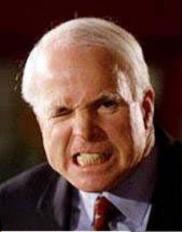
    John McCain, perhaps as Popeye

    First, some background. John McCain, U.S. Senator from Arizona and candidate for U.S. president, granted an exclusive interview to a reporter from Belief.net. Read excerpts here.

    In the interview McCain falls into the Christian nation trap:

    Q: A recent poll found that 55 percent of Americans believe the U.S. Constitution establishes a Christian nation. What do you think?
    A: I would probably have to say yes, that the Constitution established the United States of America as a Christian nation. But I say that in the broadest sense. The lady that holds her lamp beside the golden door doesn’t say, “I only welcome Christians.” We welcome the poor, the tired, the huddled masses. But when they come here they know that they are in a nation founded on Christian principles.

    Second, David Kuo properly, but gingerly, takes on McCain′s argument (hooray for Belief.net).

    Then, third, Rod Dreher (the Crunchy Con from the Dallas Morning News) agrees with McCain, mostly.

    McCain’s blithe endorsement of this myth, based in error and continued as a political drive to shutting down democratic processes. McCain may be starting to understand some of the difficulties with this issue. His remarks are a week old, at least, and there’s been a wire story a day since then. Will it make him lean more toward taking my advice?

    Below the fold, I post a few observations on why we should just forget the entire, foolish claim. Read the rest of this entry »


    Odd historical fact: Shortest term on the Supreme Court

    August 4, 2007

    Who served the shortest term as a justice on the U.S. Supreme Court?

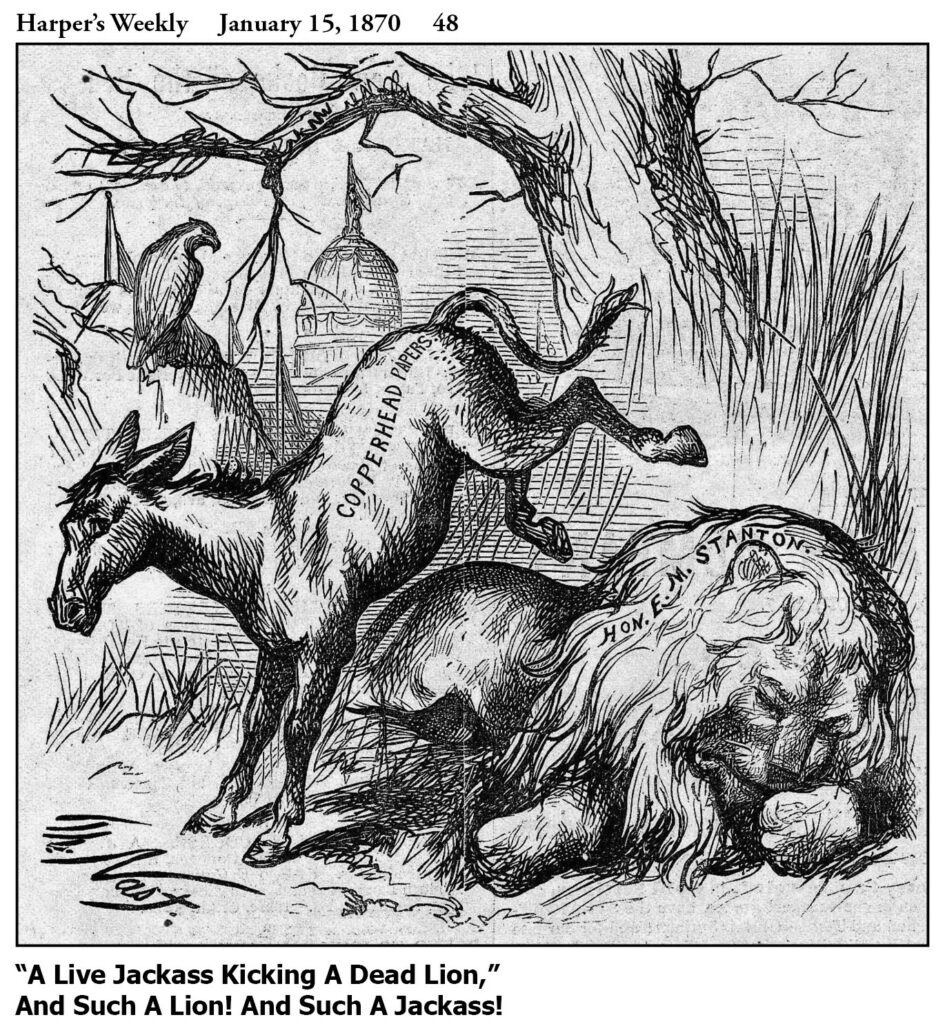
    There is a clue in this famous cartoon by Thomas Nast (okay — the cartoon really gives it away, doesn’t it?):

    Thomas Nast, Live Jackass kicking a Dead Lion,Harper's Bazaar, January 15, 1870

    Cartoon depicting Democrats Thomas Nast, Live Jackass kicking a Dead Lion. Edwin Stanton was fired as Secretary of War by President Andrew Johnson, contrary to the Tenure of Office Act, and that action brought on the impeachment and trial of Johnson (who was acquitted by one vote). Later, President U. S. Grant appointed the financially and health ailing Stanton to the Supreme Court. Stanton was confirmed, but went home and died that night, December 24. Stanton’s opponents continued to try to smear him. Nast’s cartoon was the result. Harper’s Bazaar, January 15, 1870

    Watch for the answer in a future post.

    Image: Thomas Nast cartoon from Harper’s Weekly, January 15, 1870. Nast’s use in cartoons greatly popularized the use of a donkey as a symbol of the Democratic Party, whose official animal mascot is a rooster. Image in public domain, this one from the Thomas Nast Portfolio of The Ohio State University.

    Also, note the explanation by Ray in comments, for historical accuracy.


    40 years of Loving — the changes we see

    June 15, 2007

    1968 propelled history in dramatic fashion, much of it tragic. History teachers might await the 40th anniversary stories of 1968’s events, knowing that the newspapers and television specials will provide much richer material than any textbook could hope for.

    Was 1967 less momentous? Perhaps. But an anniversary this week only serves to highlight how the entire decade was a series of turning points for the United States. This week marks the 40th anniversary of the Supreme Court’s issuing the decision in Loving v. Virginia. The Lovings had been arrested, convicted and exiled from the state of Virginia for the crime of — brace yourself — getting married.

    Richard and Mildred Loving, Bettman-Corbis Archive

    Photo of Richard and Mildred Loving from Bettman-Corbis Archive.

    You see, Virginia in those days prohibited marriage between a black person and a white person. So did 15 other states. In language that is quaint and archaic to all but Biblical literalist creationists, the trial judge said:

    “Almighty God created the races white, black, yellow, malay and red, and he placed them on separate continents. And but for the interference with his arrangement there would be no cause for such marriages. The fact that he separated the races shows that he did not intend for the races to mix.”

    The Lovings appealed their conviction. They appealed to the U.S. Supreme Court. And on June 12, 1967, the Supreme Court of the United States struck down laws that prohibit a person of one “race” from marrying a person of another. (I put “race” in quotes because, as we have since learned from DNA studies, there is just one race among us, the human race. Science verifies that the Supreme Court got it right, as did the Americans before them who wrote the laws upon which the Supreme Court’s decision was based.)

    From 1958 to 1967 — nine years the case wended through the courts. Oral argument was had on April 10 — the decision coming down in just two months seems dramatically quick by today’s standards. This was one of the cases that angered so many Americans against the Court presided over by Chief Justice Earl Warren.

    Ed Brayton at Dispatches from Culture Wars points to a statement from Mildred Loving on this anniversary. The statement is below the fold. Read the rest of this entry »