Sputnik’s 50th

October 4, 2007

America woke up on October 4, 1957.

Sputnik, model hanging in Smithsonian Air & Space Museum

The Union of Soviet Socialist Republics (USSR) launched the world’s first artificial satellite into orbit. After successfully putting the shiny ball into orbit, the Soviets trumpeted the news that Sputnik traced the skies over the entire planet, to the shock of most people in the U.S. (Photo of the model in the Smithsonian’s Air & Space Museum in Washington, D.C.)

New Scientist magazine’s website provides significant details about how awake America became, including very good coverage of the Moon landings that were nearly a direct result of Sputnik’s launch — without Sputnik, the U.S. probably wouldn’t have jump started its own space program so, with the creation of NASA and the drive for manned space flight, and without the space race President John F. Kennedy probably wouldn’t have made his dramatic 1961 proposal to put humans on the Moon inside a decade.

Sputnik really did change the world.

Much of the progress to the 1969 Moon landing could not have occurred without the reform of education and science prompted by the Soviets’ triumph. With apathetic parents and the No Child Left Behind Act vexing U.S. education and educators from both sides, more than nostalgia makes one misty-eyed for the National Defense Education Act (NDEA), a direct product of Sputnik-inspired national ambition. Coupled with the GI Bill for veterans of World War II and Korea, NDEA drove U.S. education to be the envy of the world, best in overall achievement (and also drove creationists to try to block such improvements).

(Today NDEA gets little more than a footnote in real historyWikipedia’s entry is short and frustrating, the U.S. Department of Education gives little more. Educators, you have got to tell your history.)

Texas Essential Knowledge and Skills (TEKS) lists 1957 as among the dozen dates students need to know in U.S. history, for Sputnik. It is the only date Texas officials list for U.S. history that is really an accomplishment by another nation. (The first time I encountered this requirement was in a meeting of social studies teachers gearing up for classes starting the following week. The standards mention the years, but not the events; I asked what the event was in 1957 that we were supposed to teach, noting that if it was the Little Rock school integration attempt, there were probably other more memorable events in civil rights. No one mentioned Sputnik. It was more than two weeks before I got confirmation through our district that Sputnik was the historic event intended. Ouch, ouch, ouch!)

Sputnik was big enough news to drive Elvis Presley off the radio, at least briefly, in southern Idaho. My older brothers headed out after dinner to catch a glimpse of the satellite crossing the sky. In those darker times — literally — rural skies offered a couple of meteoroids before anyone spotted Sputnik. But there it was, slowly painting a path across our skies, over the potato fields, over the Snake River, over America.

Sputnik’s launch changed our lives, mostly for the better.

Resources:

Phil Plait at Bad Astronomy provides a series of links teachers can rely on for good information, especially if you’re composing a lesson plan quickly.

New Scientist’s broad range of coverage of the space race, up to the current drive to go to Mars, is well worth bookmarking.

google_sputnik.gif

Google’s anniversary logo, in use today only, gets you to a good compilation of sources.

Fifty nano-satellites launched in honor of the 50th anniversary of Sputnik.

NASA’s history of the event. You can listen to a .wav recording of the telemetry signal from the satellite there, too.

How will you mark the anniversary?

[More links below the fold.]

Read the rest of this entry »


Henry F. Phillips — when do we celebrate?

August 10, 2007

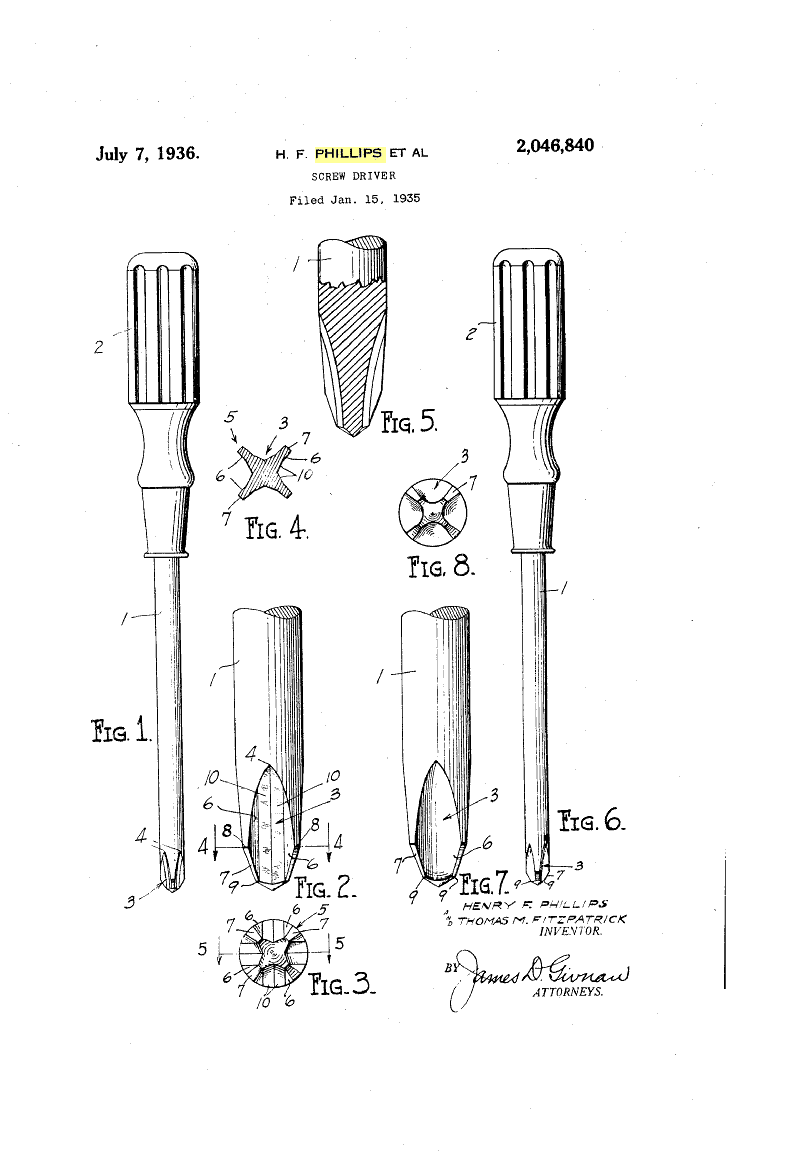
Herny Phillips' patent for the Phillips screw and screwdriver (Google Patents)

Patent drawings for the Phillips screw and screwdriver, 1936

Only Crook in Town was alerted to the work of Henry F. Phillips by an alert and helpful librarian (well — aren’t they all?). She worries –January 15 is Martin Luther King, Jr., Day, and July 7 is the middle of the summer — what day would be appropriate to celebrate the invention and patenting of the Phillips Screwdriver? (If image above does not display, click the thumbnail picture at the end of the post.)

Ah, history teachers, you noticed that the drawing comes from Google’s files of patent applications. And now you wonder: What other wonderful illustrations can we legally rip off to use in class? Wonderful question — what do you find?

The Phillips screwdriver came along in time for World War II and the mass assembly of aircraft, and aircraft instrument panels. The Phillips screw head helped aircraft assemblers keep from scratching the black metal of the rest of the panel while securing instruments into the forms.

Read the rest of this entry »


Typewriter of the moment: William Faulkner

June 24, 2007

Faulkner at typewriter, Aug 12, 1954 - AP Photo, ShelfLife

William Faulkner at his typewriter, August 12, 1954, at his home in Oxford, Mississippi. Associated Press photo, via Eons website.

The photo was probably posed; the two books to the left of the typewriter are Faulkner books. Faulkner may have written in a pressed shirt and tie.

Faulkner won the Nobel Prize for Literature in 1950, and delivered a memorable speech about “the human condition” and the importance of art, especially poetry and prose, at his acceptance. His 1954 book, A Fable, won both the National Book Award and the Pulitzer Prize for Fiction, in 1955.

The typewriter is a Royal KHM.

Faulkner was born September 25, 1897 — 2007 marks the 110th anniversary of his birth.

“The past is never dead. It’s not even past.”

—Gavin Stevens

Act I, Scene III, Requiem for a Nun


PowerPoint templates for students

June 18, 2007

I really don’t like assignments to “do a PowerPoint presentation” for kids who are not expert at all on their subjects — there is too much room for too much unintentional mischief when people who know little about a topic are to use a tool designed for people who know too much about a topic.

Among other things, kids who have never had to do a five-page report, nor an outline of a report, do not have the experience to stick to five bullets of less than five words per slide. And don’t get me going on “fireworks” animation of letters to explain things like the death of Medgar Evers, or the evils of child labor.

But if you want some ideas, the Paducah, Kentucky, school system offers some templates for student reports, and a few presentations teachers could use as foundations, here at “Connecting Teachers and Students.” There is advice, too. *

Use these as starting points, please. If you can’t improve on them, you’re not trying (no offense, Paducah — I hope).

A good exercise for you would be to spend an hour reading suggestions from Presentation Zen, and then edit a couple of those presentations from Paducah to make them more, um, zen reflective.

Remember, “template” is just a part of “contemplate.”

(I hope I don’t regret having pointed out that Paducah site to you.)

Update, November 24, 2007: Take a look at the video included in this post to see an effective use of a presentation tool like PowerPoint — though this one was done with Apple’s Keynote. Check the links in the post, too.
Update March 8, 2008:  Paducah’s school district archived the PowerPoint stuff.  I have changed the links above to link to the archive sites.  I replaced “www” with “old” in the URL.

Gold from rust: Tulsa shines, Plymouth doesn’t

June 16, 2007

The story could fuel jokes for years. Or it could cause tears, as indeed it did from the woman who organized the festivities around the unearthing of the 50-year-old Plymouth buried at Tulsa’s courthouse.

The headline in The Tulsa World shows pluck, determination and a good sense of humor: Tulsa celebrates anyway, but the Plymouth is a bucket of rust.

Tarnished gold,” is the headline.

Now we know what 50 years in a hole does to a Plymouth Belvedere.

The tires go flat. The paint fades. Hinges and latches stiffen, upholstery disintegrates, the engine becomes a very large paperweight.

But what the heck. None of us is what we used to be.

1957? Eisenhower sent U.S. Marshalls, and then the U.S. Army, into Little Rock, Arkansas, so 9 African-Americans could register to go to Central High School. That was so long ago that the Little Rock 9 graduated, became doctors, lawyers and businessmen, and even an undersecretary of Labor, and got very gray; Central High is now a National Historic Monument (though still a high school). Greg Morrell wipes grime from Plymouth bumper, Tulsa Convention Center, Tulsa World Photo by Michael Wyke


American Civil War in 4 minutes

May 23, 2007

Citations get lost on the internet. Not only do people send copies of e-mails to everyone on their list, not only is there spam beyond all measure, but good stuff gets stripped of attribution. Someone sends you a good poem, or a genuinely funny story — and if you want more of the same, you’re completely at sea about where to look. Author? That information got stripped away several forwardings earlier.

“Must be Lincoln, Einstein, or Jefferson,” some wag says, and the piece is misattributed ever after.

A fellow posted this interesting film on YouTube — The Civil War in Four Minutes. One second of the film equals one week of the war. It’s a fascinating pictorial map presentation, with a lot of information packed into 240 seconds.

Who did it? Are there others like it? How do we get the rights for classroom use?

YouTube can be likened to grave robbers who invade Egyptian royal tombs — they bring important material to light, but the context is lost, and perhaps the meaning.

Can you help track down the creator of this film? This film was created for the Abraham Lincoln Presidential Library and Museum in Springfield, Illinois. (Now — how can we get legal copies?)

Update, June 15, 2007: Every YouTube version of the video has been pulled — probably a copyright thing. In the interim, I’ve checked with the Abraham Lincoln Presidential Library and Museum to see if it is available. One person said there is discussion for making it available in the next two years. Ain’t that the way? Why not strike while the iron is hot and sell it now? Somebody, please wake me if it’s ever released.

Update, October 4, 2007: ABLPLM explains the creation of the movie. Nice shot of the screen, still not available for classrooms. Alas.

Update December 20, 2007: If that one doesn’t work, try this one for a while:

Vodpod videos no longer available. from www.idkwtf.com posted with vodpod


Mencken’s typewriter

January 10, 2007

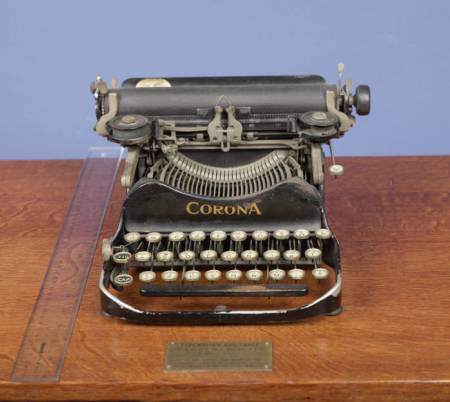
Mencken's Corona Typewriter, Enoch Pratt Library

Mencken's Corona Typewriter, at the Mencken Room in the Enoch Pratt Library, Baltimore, Maryland

The typewriter that belonged to H. L. Mencken. Photo by the Enoch Pratt Free Library, Baltimore, Maryland. [Update, April 15, 2007: The photo has moved, and is restricted by copyright; you may follow the links to view the original photo of the typewriter, at the site of the Enoch Pratt Free Library. E.D.]

Was this the machine upon which Mencken composed the Millard Fillmore/Bathtub hoax?  Perhaps.  It was used prior to 1930.


History of Resisting Technology

July 6, 2006

techdirt has this wonderful short compilation of bad predictions about new technologies ruining entertainment industries — print the page and put it in your copy of Christopher Cerf’s and Victor Navasky’s The Experts Speak.

I attended a presentation of education guru Harry Wong two weeks ago. He had probably a dozen slides featuring quotations from the experts from this book and other sources, and each comment was met with “oohs” and “ahhs.” My first use of these wrongway predictions was in 1988 and 1989 in the “Committing to Leadership” program at AMR (American Airlines). It’s amazing to me that they still seem new to so many — but they are funny, and thought provoking, even if they are not new.