Cinco de Mayo explained

May 5, 2009

You thought Cinco de Mayo was Independence Day for Mexico?

No, it’s not.

History.com has a nice explanation, with a nice little video.

Perhaps the U.S. should celebrate the day, too, at least in those states who were not in the old Confederacy.  On May 5, 1862, Mexicans under the command of 33 year old Commander General Ignacio Zaragoza Seguín stopped the quick advance of superior French forces trying to invade Mexico to take it over, at the Battle of Puebla.  While France did eventually defeat Mexican forces (after getting 30,000 men in reinforcements), the spirit of May 5 inspired Mexicans to continue to fight for freedom.  And ultimately, Mexican forces overpowered and captured the French forces and Emperor Maximilian, who was executed.

Thus ended a great hope for the Confederacy, that French-supported Mexican Army would lend aid to the Confederates in their struggle to secede from the Union.

It is one of the great what-ifs of history:  What if France had kept Mexico, and what if French-led Mexican forces backed up the Confederate Army?

One thing is rather sure:  Had that happened, and had the Confederacy been successful, we wouldn’t be celbrating Cinco de Mayo in Texas today.

Also in Texas, on May 5, 2009, AP Spanish tests.  Good luck, kids!

Battle of Puebla, Wikimedia (artist?)

Battle of Puebla, Wikimedia (artist?)

Mexican Independence Day is September 16.


No, Texas cannot secede; no, Texas can’t split itself

April 18, 2009

Rick Perry put his foot into something during one of the Astro-turf “tea parties” on April 15.  Someone asked him about whether Texas should secede from the United States, as a protest against high taxes, or something.

The answer to the question is “No, secession is not legal.  Did you sleep through all of your U.S. history courses?  Remember the Civil War?”

Alas, Perry didn’t say that.

Instead, Perry said it’s not in the offing this week, but ‘Washington had better watch out.’

He qualified his statement by saying the U.S. is a “great union,” but he said Texans are thinking about seceding, and he trotted out a hoary old Texas tale that Texas had reserved that right in the treaty that ceded Texas lands to the U.S. in the switch from being an independent republic after winning independence from Mexico, to statehood in the U.S.

So, rational people want to know:  Does Perry know what he’s talking about?

No, he doesn’t.  Bud Kennedy, columnist for the Fort Worth Star-Telegram (still one of America’s great newspapers despite the efforts of its corporate owners to whittle it down), noted the error and checked with Gov. Perry’s history instructors at Texas A&M and his old high school, both of which said that Perry didn’t get the tale from them.  (Score one for Texas history teachers; rethink the idea about letting people run for state office without having to pass the high school exit history exam.)

A&M professor Walter L. Buenger is a fifth-generation Texan and author of a textbook on Texas’ last secession attempt. (The federal occupation lasted eight years after the Civil War.)

“It was a mistake then, and it’s an even bigger mistake now,” Buenger said by phone from College Station, where he has taught almost since Perry was an Aggie yell leader.

“And you can put this in the paper: To even bring it up shows a profound lack of patriotism,” Buenger said.

The 1845 joint merger agreement with Congress didn’t give Texas an option clause. The idea of leaving “was settled long ago,” he said.

“This is simple rabble-rousing and political posturing,” he said. “That’s all it is.  . . .  Our governor is now identifying himself with the far-right lunatic fringe.”

Three false beliefs about Texas history keep bubbling up, and need to be debunked every time.  The first is that Texas had a right to secede; the second is that Texas can divide itself into five states; and the third is that the Texas flag gets special rights over all other state flags in the nation.

Under Abraham Lincoln’s view the Union is almost sacred, and once a state joins it, the union expands to welcome that state, but never can the state get out.  Lincoln’s view prevailed in the Civil War, and in re-admittance of the 11 Confederate states after the war.

The second idea also died with Texas’s readmission.  The original enabling act (not treaty) said Texas could be divided, but under the Constitution’s powers delegated to Congress on statehood, the admission of Texas probably vitiated that clause.  In any case, the readmission legislation left it out.  Texas will remain the Lone Star State, and not become a Five Star Federation. (We dealt with this issue in an earlier post you probably should click over to see.)

Texas’s flag also gets no special treatment.  I cannot count the number of times I’ve heard Texans explain to Boy Scouts that the Texas flag — and only the Texas flag — may fly at the same level as the U.S. flag on adjacent flag poles.  Under the flag code, any flag may fly at the same level; the requirement is that the U.S. flag be on its own right.

Gov. Perry is behind Sen. Kay Bailey Hutchison in polling of a head-to-head contest between the two to see who will be the Republican nominee for governor in 2010 — Hutchison is gunning to unseat Perry.  He was trying to throw some red meat to far-right conservative partisans who, he hopes, will stick by him in that primary election.

Alas, he came off throwing out half-baked ideas instead.  It’s going to be a long, nasty election campaign.

_____________

Update: A commenter named Bill Brock (the Bill Brock?) found the New York Times article from 1921 detailing John Nance Garner’s proposal to split Texas into five.  Nice find!

Another update: How much fuss should be made over the occasional wild hare move for some state to secede?  Probably not much.  A few years ago Alaska actually got a referendum on the ballot to study secession.  The drive to secede got nowhere, of course.  I was tracking it at the time to see whether anyone cared.  To the best of my knowledge, the New York Times never mentioned the controversy in Alaska, and the Washington Post gave it barely three paragraphs at the bottom of an inside page.


Texas Independence Day, March 2

March 2, 2009

The place to be today is Washington-on-the-Brazos State Historical Site, looking back 173 years.

Here on March 2 of that year [1836], 59 delegates signed the six-page document that declared the Republic of Texas free and independent of Mexico.

As related in the Dallas Morning News, it was a fretful time in Texas.

The convention delegates actually gathered on March 1, 1836, a month after they were elected and sent to Washington, a growing town on the Brazos River less than 100 miles northwest of what now is Houston.

The convention within weeks would adopt a constitution amid a swift series of events. While they were meeting, Travis and his men were killed at the Alamo. And just over another month later, Gen. Sam Houston’s army would defeat the Mexicans in the famous Battle of San Jacinto.

And, just in time for this year’s celebration, researchers announced they have recovered a document lost from the Texas State Archives for a century, the order for copies of the Texas Declaration to be copied and printed.  Jim Bevill found the scrap of paper placed haphazardly in a file now housed at Southern Methodist University (SMU).

Michael Paulsen Chronicle  Author Jim Bevill found the order issued on March 2, 1836, for the first copies of the Texas Declaration of Independence in a collection donated to the Southern Methodist University library. The order had long been missing from the state archives

Author Jim Bevill found the order issued on March 2, 1836, for the first copies of the Texas Declaration of Independence in a collection donated to the Southern Methodist University library. The order had long been missing from the state archives. Photo by Michael Paulsen, Houston Chronicle

Bevill was doing research for his upcoming book, The Paper Republic, a history of the Republic of Texas from the viewpoint of economics rather than the usual military perspective.

The new Texas government was desperately short of money. Investors in New Orleans refused to give the fledgling country a loan until Texas officially declared independence from Mexico.

The document Bevill found was an order sent to San Felipe to have printers make five handwritten copies and 1,000 printed copies of the declaration.

Hope you have a good Texas Independence Day.  We have grades due.

See also:

Resources:


50 years since the music died: Buddy Holly

February 4, 2009

Buddy Holly died 50 years ago, February 3.  NPR gives the basics:

Morning Edition, February 3, 2009 – Fifty years after his death at 22, rock ‘n’ roll founding father Buddy Holly is still cool. On Feb. 3, 1959, Buddy Holly, along with J.P. “The Big Bopper” Richardson and Ritchie Valens, died in a plane crash while touring the Midwest. Holly would have been 72 by now — and probably still rocking and rolling. Bob Dylan, The Rolling Stones, The Beatles and Elvis Costello have all paid tribute to Holly as a major influence.

But the music itself wasn’t his only contribution. Holly was among the first artists to use the studio as an instrument: He spent days crafting songs and experimenting with techniques that were still new in the recording business.

History is an odd business.  Holly’s old hometown is Lubbock, Texas.  Lubbock, itself in an odd, welcomed Prairie Renaissance, features a Rock and Roll Museum and a set of Buddy Holly glasses that would dwarf the Colossus at Rhodes.  But his family is at odds with the city on the use of his name on local streets and promotional materials.

Sculpture of Buddy Hollys glasses, at the Buddy Holly Center, Lubbock - Roundamerica.com

Sculpture of Buddy Holly's glasses, at the Buddy Holly Center, Lubbock - Roundamerica.com

Waylon Jennings, probably the most famous survivor in Holly’s old band, died in 2002 (on February 13).  Who is left to study Holly and his work, to keep the flame of historic remembrance alive?


September 16, Independence Day: The Grito de Dolores

September 16, 2008

An encore post:

It’s amazing what is not available on video for use in the classroom.

Texas kids have to study the “Grito de Dolores” in the 7th grade – the “Cry from Dolores” in one translation, or the “Cry of Pain” in another (puns in Spanish! Do kids get it?). Father Miguel Hidalgo y Castillo made the speech on September 16, 1810, upon the news that Spanish authorities had learned of his conspiracy to revolt for independence. The revolution had been planned for December 8, but Hidalgo decided it had to start early.

This date is celebrated in Mexico as Independence Day. Traditionally the President of Mexico issues an update on the Grito, after the original bell that Father Hidalgo used is rung, near midnight.

Hidalgo himself was captured by the Spanish in 1811, and executed.

It’s a great story. It’s a good speech, what little we have of it (Hidalgo used no text, and we work from remembered versions).

Why isn’t there a good 10- to 15-minute video on the thing for classroom use? Get a good actor to do the speech, it could be a hit. Where is the video when we need it?Father Hidalgo issues the Grito

Statue of Father Hidalgo in Dolores, Mexico.

Update for 2008: Glimmerings of hope on the video front:  Amateur videos on YouTube provide some of the sense of what goes on in modern celebrations.

And, see this re-enactment from Monterrey:


Ft. Worth light bulb’s 100th anniversary!

July 20, 2008

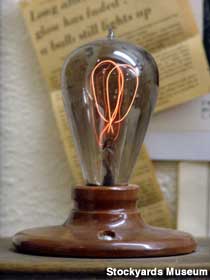
So, the second-oldest light bulb, the famous Ft. Worth, Texas, Palace Theater light bulb, first lighted up in 1908. For some odd reason the last post that mentioned the bulb keeps having difficulties. It took me four or five times before I realized that this year is the 100th anniversary year. As Robert Frost wondered more poetically, how many times did the apple have to hit Newton before he took the hint?

100 years old in September, 2008 -- the Palace Theatre Lightbulb, Stokyards Museum, Fort Worth, Texas

100 years old in September, 2008 -- the Palace Theater Light Bulb, Stokyards Museum, Fort Worth, Texas

The Stockyards Museum is on the ball, however.

Our famous old light bulb began burning in 1908 as a backstage light at the old Byers/Greenwald Opera House south of the Tarrant County Courthouse. It was never turned off. As the city grew and changed the old Opera House was rebuilt in 1919 into the more modern Palace Theater. All the work was done with the bulb illuminated. In 1977 the Palace Theater was replaced as Fort Worth continued to grow and eventually the Stockyards Museum was selected as its permanent home in retirement.

With any luck, we will be able to hold a super birthday celebration on September 21, 2008.

Mark your calendars:  September 21, 2008. How many other lightbulbs do you know that have been burning for a century?

Photo from the Stockyards Museum.


Weird history sites in Fort Worth, Texas

July 16, 2008

The Fort Worth Star Telegram lists five sites for Texans vacationing close to home to visit, to promote their knowledge of local history.

Of course, out-of-towners might want to see the sights, too:

  • A Prohibition-era, underground casino to the stars – Top O’ the Hill Terrace, in Arlington (now a Baptist college)
  • A sign in Mineral Wells reputed to be the inspiration for the Hollywood sign in California — though it’s probably not
  • The graves of the infamous outlaws, Bonnie and Clyde, made famous by the 1967 movie of the bandits starring Faye Dunaway and Warren Beatty, directed by Arthur Penn
  • A photography studio in Fort Worth where Butch Cassidy and the Sundance Kid had their picture taken, with the Hole in the Wall Gang — made famous in George Roy Hill’s movie, “Butch Cassidy and the Sundance Kid” starring Paul Newman and Robert Redford (with the brilliant script by William Goldman)

    2nd longest burning light bulb, Fort Worth, Texas, Stockyards Museum

    World’s 2nd longest burning light bulb, Fort Worth, Texas, Stockyards Museum

  • The world’s second-longest burning light bulb, still going after more than a century, at the Stockyards Museum (take that you CFLs!)

Texas history teachers might want to note these sites — field trips! Extra credit! (The entire article is preserved below the fold, in the event of the folding of McClatchy Newspapers, or the paper’s deleting the story from their archives.)

Read the rest of this entry »


Handbook of Texas on-line

June 20, 2008

Question: Where do you find good Texas history in a hurry?

Answer: The Handbook of Texas.

Question: What about Texas history on-line?

Answer: Same thing, different format:

Tip of the old scrub brush to Will’s Texas Parlor. Crossposted at the Wayback Machine.


San Jacinto Day in the rearview mirror

April 22, 2008

Have I been distracted by work? Here’s one way to tell: Yesterday was San Jacinto Day. And I forgot to note it here.

Fortunately, the celebration is set for April 26 — at the San Jacinto Battleground State Historic Site, near LaPorte, Texas. The battle reenactment is scheduled for 3:00 p.m. — be there early to get the benefit of all the exhibits, sideshows, and Texas cooking. (Press release on the celebration below the fold. Note the press release says admission is free, while the story from Houston’s KTRK-13 says there are admission charges.)

San Jacinto Day? April 21 is the anniversary of the Battle of San Jacinto, where Sam Houston and the Texian Army got the drop on Gen. Santa Anna and his much larger force, and in the course of a half-hour put the well-trained Mexican regulars on the run, and won Texas independence.

It’s a time to remember — or puzzle about — the true story of the Yellow Rose of Texas, a woman to whom Texans owe a great deal, or one of the better hoaxes of history. It’s a time to fume over the way Anglo Texians pronounced the J as J in “Jacinto,” distancing Texas from a small part of its Spanish-language heritage.

Unfortunately, it’s also a day most Texas students get smothered with reviews from their teachers for the Texas Assessment of Knowledge and Skills (TAKS), the state exam that had just ended last year on this date, and looms in the future this year. Instead of learning Texas history, Texas seventh graders spend this great day reviewing what educators are supposed to teach them. Nuts.

Hey, Texas teachers: Download the teachers’ guide to the Battle of San Jacinto right now — have it ready for next year. The kids need a break to study real history. You know they will need that break next year, too.

The late Hoyt Axton sings “The Yellow Rose of Texas,” with John Hartford and others:

Other resources:

Read the rest of this entry »


Bogus history: Engraved in stone

March 3, 2008

Quotes from patriots engraved on the walls greet visitors to the Texas State History Museum in Austin.

Unfortunately, in one case the engraved quote is now known to be bogus, a piece of fiction originally created for a children’s book.

Kent Biffle’s weekly article on Texas History in the Dallas Morning News reports the story:

Scholarly sleuth James E. Crisp will formally reveal to historians this week a jarring error literally carved in stone at the Bob Bullock Texas State History Museum.

In the sweeping lobby of the 6-year-old museum, a few steps from the state Capitol, visitors read on the wall stirring words of Tejano hero José Antonio Navarro:

“I will never forsake Texas and her cause. I am her son.”

The quote is a permanent feature of the museum – or was. Dr. Crisp says Señor Navarro (1795-1871) didn’t utter those words. But he will tell us who did.

Dr. Crisp reports his findings at the 2008 convention of the Texas State Historical Association, in Corpus Christi.

Read the rest of this entry »


Texas Independence Day, March 2

March 2, 2008

Happy Texas Independence Day.

Tall flag, from Texas cooking

The Texas Declaration of Independence was produced, literally, overnight. Its urgency was paramount, because while it was being prepared, the Alamo in San Antonio was under seige by Santa Anna’s army of Mexico.

Immediately upon the assemblage of the Convention of 1836 on March 1, a committee of five of its delegates was appointed to draft the document. The committee, consisting of George C. Childress, Edward Conrad, James Gaines, Bailey Hardeman, and Collin McKinney, prepared the declaration in record time. It was briefly reviewed, then adopted by the delegates of the convention the following day.

As seen from the transcription, the document parallels somewhat that of the United States, signed almost sixty years earlier. It contains statements on the function and responsibility of government, followed by a list of grievances. Finally, it concludes by declaring Texas a free and independent republic.

Prior to statewide testing, this used to be a key part of 7th grade and other curricula in social studies.

There must be a celebration somewhere in Texas today, but I can’t find it.

Here’s one way to celebrate appropriately, from eHow to:

Things You’ll Need:

Step 1:
Visit Washington-on-the-Brazos, where the Texas Independence Convention signed the Republic into being. It’s now a state park with state-of-the-art interactive exhibits open year round, with plenty of rousing events during the week of March 2.

Step 2:
Travel to San Antonio and tour the Alamo.

Step 3:
Watch “The Alamo” starring John Wayne as Davy Crockett.

Step 4:
Throw a Happy Birthday Texas party. Suggest that guests come dressed as cowboys or Alamo freedom fighters; serve cowboy camp grub and Tex-Mex goodies, play songs about Texas and tell Texas jokes.

Sources:

Tall flag image from Texas Cooking.com.

Read the rest of this entry »


Cronkite narrates Texas water supply programs

February 10, 2008

And they are available for classroom use at a very modest price.

A couple of weeks ago I caught most of a program on water resources in Texas, from the Texas Parks and WildlifeDepartment. What caught my ear was the voice of Walter Cronkite, I thought.

Sure enough, it was Cronkite.

Texas Springs trailer image

TP&W produces a weekly program on the lands it manages, recreation and other issues dealing with land and environmental protection in Texas. The weekly programs come packed full of information and great photography — wise Texas history and geography teachers will see whether their local PBS station carries this program and tape it regularly.

Several times in the past five years TP&W produced special programs on Texas water resources. This one was produced in 2007:

Texas, the State of Springs: This hour-long documentary, narrated by Walter Cronkite, examines the alarming decline of Texas’ natural springs and addresses the current issues that directly impact spring flow and what can be done to save these vital resources.

Texas the State of Springs, initially aired on PBS stations across Texas on Thursday, February 15, 2007.

You may purchase a DVD copy of the documentary — and of two previous editions, one narrated by Cronkite and an earlier one narrated by Ray Benson of Asleep at the Wheel. They are available for $12.00 each, a bargain. Copyright expressly encourages use of these productions in classrooms.

Every middle school and high school in Texas should have a copy of these programs in their libraries. Perhaps your PTA would donate the $36.00 to put all three of them there?

Walter Cronkite, recording for Texas Parks & Wildlife

That’s the way it is!


Texas teachers: 9th Legacies Dallas History Conference, January 26

January 20, 2008

You’re not registered yet?

Students learn history best when it affects them directly, or when they can see the stuff close up. The Legacies Dallas History Conferences focus on history in and around Dallas, Texas. This is prime material for Texas and Dallas history, economics and government classes.

The 9th Annual Legacies Dallas History Conference is set for next Saturday, January 26, in the half-day from 8:30 a.m. to 1:10 p.m: “Dallas Goes to War: Life on the Homefront.” $40 for nine presentations — or $100 brings an invitation to schmooze with the presenters on Friday night, before the conference. The conference will be at the Hall of State at Fair Park. The conference was assembled by Dr. Michael V. Hazel.

If you’re teaching at a high school or middle school in the Dallas area, print this off for every social studies and English teacher at your school, and pass it out to them Tuesday (or Monday if you’re open then).

Nancy Harkness Love and Betty Huyler Gillies, first women to fly B-17, during WWII

Many of the conference presentations roll down that alley of a topic most Texas students need more of, the events around World War II. One session dives into Vietnam, one goes back to the Civil War, and World War I is remembered.

Bob Reitz, the public historian who curates the amazing Jack Harbin Museum of Scout History at Dallas’s Camp Wisdom, alerted me to the conference with a plug to his colleague’s presentation. Anita Mills-Barry will present her paper, “Homefront Scouting During World War II: Participation by Boy Scouts and Girl Scouts in the Civilian Effort in Dallas County.”

A copy of the web invitation to the conference below the fold.

Read the rest of this entry »


Texas History Day, and National History Day 2008

November 12, 2007

Your classes are gearing up for the competition, no?

Alfie Kohn might not like the idea of competition in history. In a state famous for competition in almost everything, but most famous for athletic competitions to the detriment of academics, I find great appeal in a contest that requires kids to find, analyze and write history.

Then the students get together to present and discuss history — and usually about 60 Texas kids go on to the National History Day festival. (Details here from the Texas State Historical Association)

Q. What is Texas History Day?

A. Texas History Day, a part of the National History Day program, is a yearlong education program that culminates in an annual state-level history fair for students in grades six through twelve. It provides an opportunity for students to demonstrate their interest in, and knowledge of, history through creative and original papers, performances, documentaries, individual interpretive web sites, or three-dimensional exhibits.

Over the course of the school year, students research and produce a History Day entry, the results of which are presented at a regional competition in early spring. From there, some students advance to the state fair in May, or even to the national contest held each June at the University of Maryland at College Park. At each level of competition, outstanding achievement may be recognized through certificates, medals, trophies, or monetary awards. The most important rewards are the skills and insight that students acquire as they move through the History Day program.

As many as 33,000 young Texans are involved in the program at the regional and state level each year. More than 900 students participate in Texas History Day, and approximately 60 students represent Texas at National History Day each year.

The 2008 National History Day Theme is “Conflict and Compromise in History.”

Texas has 23 regions for preliminary rounds. Details here. A list of sample topics for Texas students should give lots of good ideas.

The topics and the papers promise a lot. These projects could make good lesson plans. (Who publishes the winning entries? I have not found that yet.)

Don’t forget the Texas History Day T-shirt Design Contest — entries are due by December 14, 2007.


A Texas History syllabus

October 28, 2007

It’s a toe in the water of internet-using instruction.  Here’s a syllabus for a 7th grade Texas history class at Pin Oak Middle School in the Houston Independent School district.

Notice that this class, as many in Texas do, puts the geography unit up front, not quite isolated from the rest of the class.  Regardless of how well geography is covered, I think we end up shorting the subject its due.

Kudos to Pin Oak MS, to Mr. Gomez, and I hope to see more.

(Surely there is a class in Texas that is farther along in integrating the internet into the Texas history curriculum — point them to us, Dear Readers?)