John Lennon used many different typewriters for many different purposes. This photo gets passed around because Lennon had photos of the Beatles in the lid to the case.
John Lennon hunting and pecking away at a typewriter, a portable SCM, with a photo of the Beatles in the lid. Year and location unknown to me.
I found the photo on Reddit. Consensus is it’s an SCM Galaxie model typewriter, a manual. More details? If you got them, let me know.
Spread the word; friends don't allow friends to repeat history.
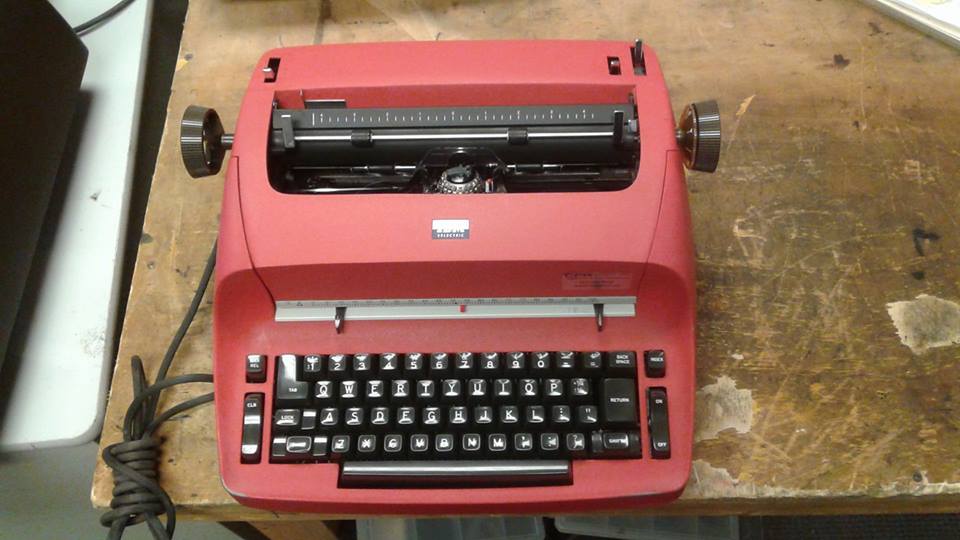
Difficult to identify in that photo; “typewriter used by Neil Simon from the 1970s to 2010s. Simon used the IBM Personal Wheel Writer Electronic 6781 typewriter in his New York City apartment, writing plays, scripts, and books including Brighton Beach Memoirs, Biloxi Blues, and Lost in Yonkers.” Image from the Smithsonian’s National Museum of American History.
Spread the word; friends don't allow friends to repeat history.
Young John F. Kennedy as a foreign correspondent for Hearst Newspapers, in 1945. Photo may be in Berlin. The book he appears to be consulting is his book about allied dithering about entering the war. Typewriter is an Underwood, common issue to reporters and standard equipment in many newsrooms of the time.
Michael Beschloss’s posting of historic photos on his Twitter feed turns up some real gems. Sometimes, other gems get posted in response. The photo above is a publicity photo of a young John Kennedy, perhaps in Berlin, in 1945 after the end of the war. He was hired as foreign correspondent by Hearst Newspapers, about the time his book, Why England Slept,was published.
Tip of the old scrub brush to @BeschlossDC and @keoni999 on Twitter.
Who knew? JFK was a journalist in Berlin in 1945 covering the Pottsdam conference. https://t.co/taM15we8yJ
Armstrong said his client tells the provenance: The typewriter upon which John Irving wrote The World According to Garp. “It was completely worn out but after a complete rebuild my customer couldn’t be happier.”
This year marks 40 years since Garp was published — difficult to believe the time gone by. This may be the last novel I devoured in a day or so.
This year I’m celebrating the 40th anniversary of the publication of my novel, The World According to Garp. I remember thinking the title of my fourth novel would change; The World According to Garp was always just a working title until something better came along. I was still looking for “something better” when I delivered the manuscript to Henry Robbins, my editor. Henry, and everyone else at Dutton who read Garp in manuscript form, declared that the title had to be The World According to Garp. I was stuck with it.
More importantly, it is a bittersweet feeling to have only recently written a teleplay of Garp, a miniseries in five episodes, because I always imagined — more than forty years ago — that the sexual hatred in the novel might become dated soon after it was published. Sadly, sexual hatred is still with us — it hasn’t gone away. The suspicion of sexual differences, the discrimination against sexual minorities — including flat-out bigotry and violence — haven’t become the extinct dinosaurs I thought these things would (and should) become.
In part, The World According to Garp depicts the struggles of the writing process — the false starts, the blocks, the disappointments. Yet Garp never loses conviction in his purpose as a writer, “because he knew what every artist should know: as Garp put it, ‘You only grow by coming to the end of something and by beginning something else.’ Even if these so-called endings and beginnings are illusions.”
There are days I sorely miss my old Selectric.
Spread the word; friends don't allow friends to repeat history.
From Pinterest, The Antikey Chop: “Photo of legendary musician Stevie Wonder typing on an aptly named Underwood Rhythm Touch typewriter.” (Is it a Rhythm Touch?)
I actually ran into Ray Charles once, in the Concorde Lounge at Dulles Airport, back in the days when one could accompany friends to the gates. Charles was famous for singing and leading a great band, for great piano playing, and for doing things most people would think blind people can’t or don’t do. Like drive a car.
Should we be surprised that a blind musician would use a typewriter? Is Stevie Wonder a good typist, putting down lyrics so others can sing his songs? Or is this a set-up shot for fun?
There is a series of typewriters by Underwood listed as “Rhythm Touch.” The machine pictured may well be one. Can anyone tell? The image seems to have originated from Greg Fudacz at the Antikey Chop.
The image shows up several times on Pinterest, but nowhere else I can find. Anyone got details on it?
Spread the word; friends don't allow friends to repeat history.
You have seen some of those photos, some of those artists, and some of those typewriters in other posts at Millard Fillmore’s Bathtub. There are some sparkling photos there I had not seen before.
Thank you, Dean Frey.
Spread the word; friends don't allow friends to repeat history.
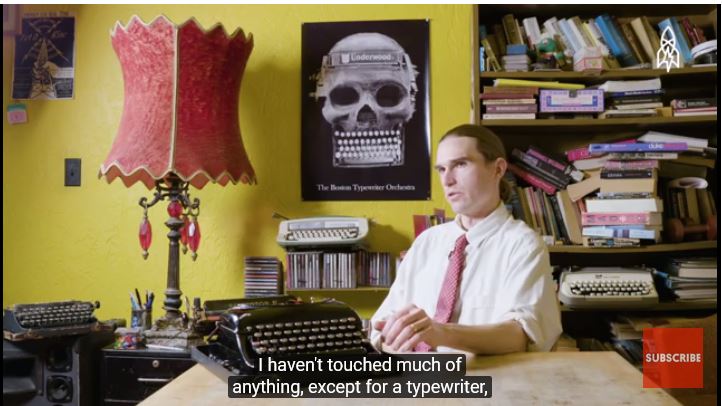
Alex Holman, first tenor Smith-Corona, Boston Typewriter Orchestra
Seems to be.
I note they use non-typewriter bells instead of the return bell on the typewriter. Bells fell out of favor with later electrics. Is that a problem?
Do activities like this preserve the culture of the typewriter, or burn out actual working typewriters at greater speed? The eternal problem of art versus conservation.
Ethnographer? It’s a person who makes a systematic study of a people and its culture, a subdivision of anthropology, sociology, history and geography all at once.
Milan Karanovic, trained as a priest, studied folk and cultural trends of Bosnians, roughly from 1900 to World War II.
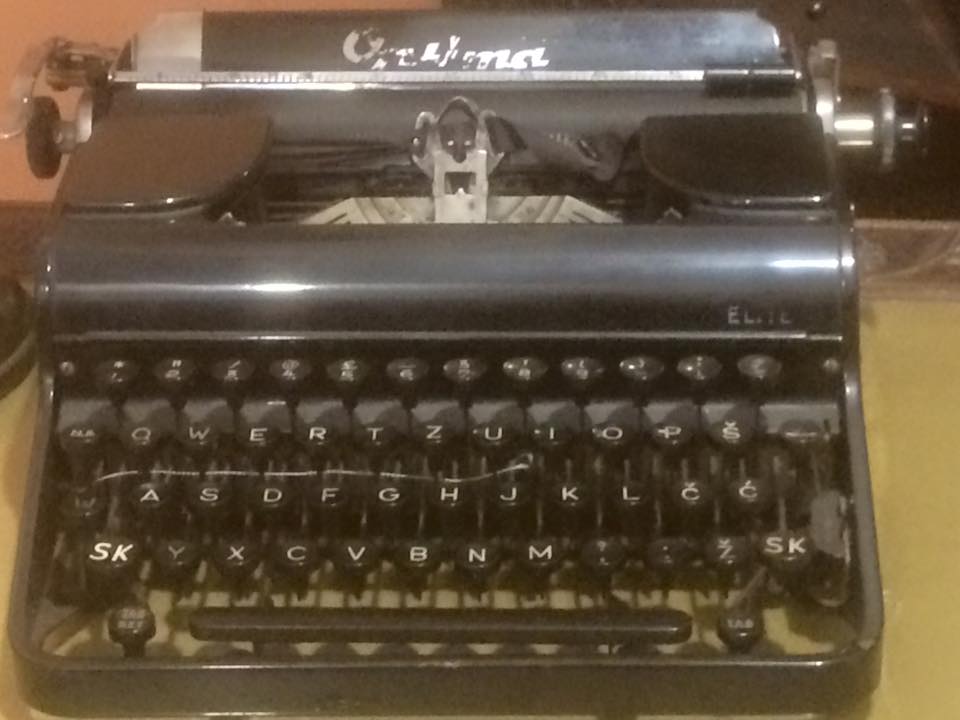
And this is his typewriter:
Typewriter of Bosnian ethnographer Milan Karanovic. Take careful note of special keys to accommodate Bosnian spellings. Typewriter on display in the National Museum of Bosnia and Herzegovina. Photo courtesy of Jonathan Halabi.
Photo of Milan Karanovich, National Museum of Bosnia and Herzegovina. “Zivot i rad” translates to “life and work.” Image by Jonathan Halabi.
Milan Karanovic was born in 1883 in Great Novljansko Rujiška. In his teens he moved to Sarajevo, graduated high school and attended seminary, graduating by 1909 and assuming duties as a parish priest (Orthodox?) in the Krajina region village of Rujnić. We know he published a study of the “village” of Sarajevo in 1907. On the wrong side of local authorities in World War I, he spent much of the war in prison. His publications resumed by 1925, and proliferated through 1937. He died in 1955.
Wikipedia caption: Polar explorer Apsley Cherry-Garrard in front of his typewriter in the Terra Nova hut at Cape Evans (Ross Island, Antarctica). August 30, 1911. British Antarctic Expedition 1910-13 (Ponting Collection)
Even in the Antarctic, scientists and explorers need to write their findings down. A typewriter was the state-of-the-art tool in 1911. Here we see Apsley Cherry-Garrard with his typewriter, on expedition.
Cherry-Garrard probably used that machine to write the notes, if not the actual text, for his account of the expedition, The Worst Journey in the World:
The Worst Journey in the World is a memoir of the 1910–1913 British Antarctic Expedition led by Robert Falcon Scott. It was written and published in 1922 by a member of the expedition, Apsley Cherry-Garrard, and has earned wide praise for its frank treatment of the difficulties of the expedition, the causes of its disastrous outcome, and the meaning (if any) of human suffering under extreme conditions.
From the U.S. National Archives Administration: Dated June 23, 1868, this is the printed patent drawing for a “Type-Writer” invented by Christopher L. Sholes, Carlos Glidden, and J. W. Soule. Drawing for a Typewriter, 06/23/1868 Drawing for a Typewriter, 06/23/1868 (ARC Identifier: 595503); Patented Case Files, 1836 – 1956; Records of the Patent and Trademark Office; Record Group 241; National Archives.
Links below can get us into position to commemorate the day adequately. Maybe celebrate with ribbons, without the wrapping paper and boxes? (Okay, maybe puns aren’t the way.)
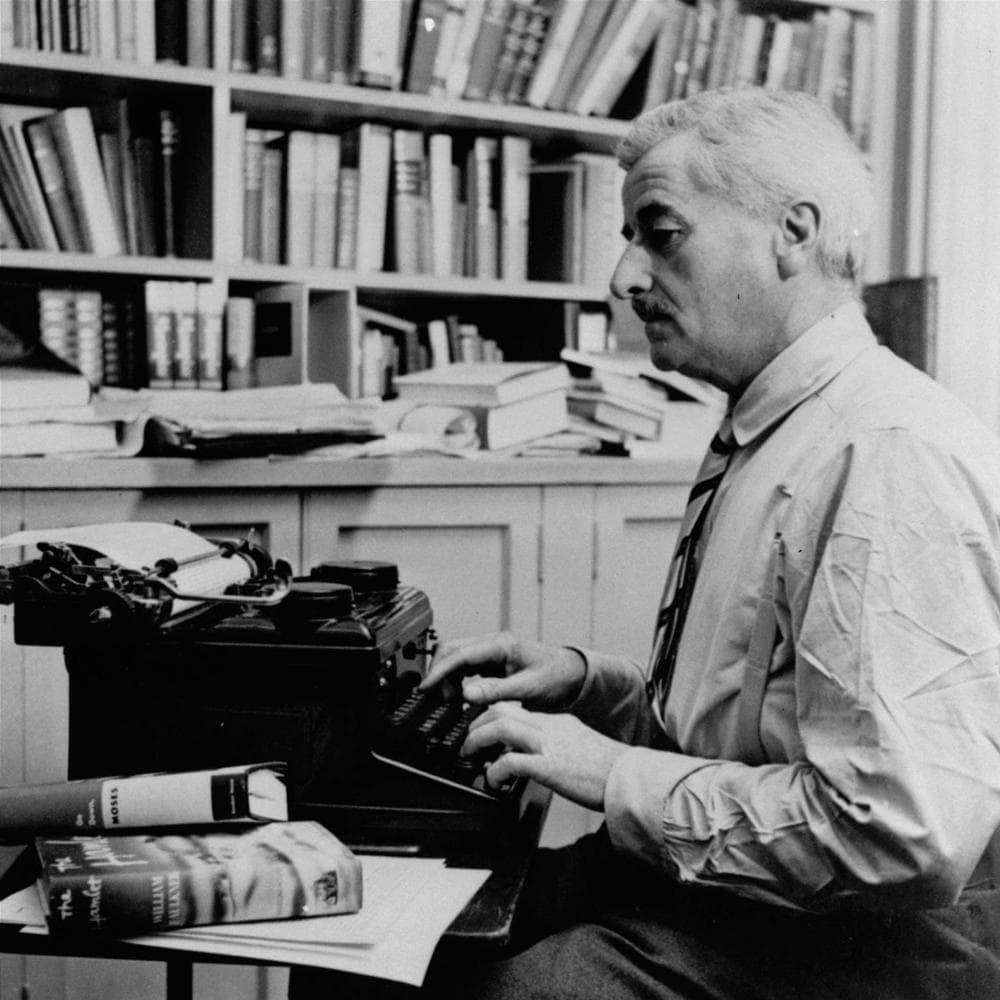
William Faulkner at his typewriter, August 12, 1954, at his home in Oxford, Mississippi. Associated Press photo, via ShelfLife
William Faulkner at his typewriter, August 12, 1954, at his home in Oxford, Mississippi. Associated Press photo.
The photo was probably posed; the two books to the left of the typewriter are Faulkner books. Faulkner may have written in a pressed shirt and tie, but I doubt it.
At IMDB: Billy Wilder and I.A.L. Diamond at work on the screenplay for Irma la Douce
Billy Wilder’s reputation as a great film director would not be possible, but for the typewriter. It is fate, perhaps, that we find several photographs of Mr. Wilder with various typewriters. In the photo above, he’s pictured working with I. A. L. Diamond, “Izzy.” The pair collaborated on at least 17 different screenplays.
This one is clearly a Royal; Hollywood Legacy’s Pinterest site: “BILLY WILDER and frequent screenwriter partner, I.A.L. DIAMOND. “Izzy” is seated at the typewriter, with Wilder standing, as usual. Wilder liked to “think on his feet” and was a notorious pacer. Wilder & Diamond wrote 17 films together, including: SOME LIKE IT HOT, THE APARTMENT, LOVE IN THE AFTERNOON, IRMA LA DOUCE”
Wilder’s scripts often featured writers and others who used typewriters. He had almost a fetish for featuring typewriters in his movies. How could we not like a guy who loved typewriters like that?
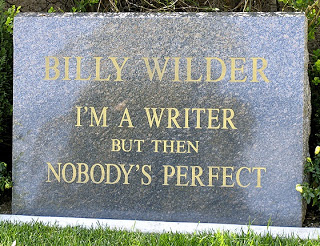
From the great Oz Typewriters site: “Wilder died in Beverly Hills on March 27, 2002. Here is what is on his tombstone
Or, until that account is unsuspended by the forces supporting Donald Trump: Follow @FillmoreWhite, the account of the Millard Fillmore White House Library
We've been soaking in the Bathtub for several months, long enough that some of the links we've used have gone to the Great Internet in the Sky.
If you find a dead link, please leave a comment to that post, and tell us what link has expired.
Thanks!
Retired teacher of law, economics, history, AP government, psychology and science. Former speechwriter, press guy and legislative aide in U.S. Senate. Former Department of Education. Former airline real estate, telecom towers, Big 6 (that old!) consultant. Lab and field research in air pollution control.
My blog, Millard Fillmore's Bathtub, is a continuing experiment to test how to use blogs to improve and speed up learning processes for students, perhaps by making some of the courses actually interesting. It is a blog for teachers, to see if we can use blogs. It is for people interested in social studies and social studies education, to see if we can learn to get it right. It's a blog for science fans, to promote good science and good science policy. It's a blog for people interested in good government and how to achieve it.
BS in Mass Communication, University of Utah
Graduate study in Rhetoric and Speech Communication, University of Arizona
JD from the National Law Center, George Washington University


 Posted by Ed Darrell

/https://public-media.smithsonianmag.com/filer/1b/9b/1b9b29ea-ec4c-47cf-9d89-e98c2b764cdc/be035749.jpg)








 Millard Fillmore's Bathtub