It’s cruel to people who want to fly U.S. flags often, but only on designated flag-flying dates. (April is also National Poetry Month, so it’s a good time to look up poetry references we should have committed to heart).
For 2018, these are the three dates for flying the U.S. flag; Easter is a national date, the other two are dates suggested for residents of the states involved.
One date, nationally, to fly the flag. That beats March, which has none (in a year with Easter in April and not March). But March has five statehood days, to April’s two.
Take heart! You may fly your U.S. flag any day you choose, or everyday as many people do in Texas (though, too many do not retire their flags every evening . . .).
April usually sees the opening of Major League Baseball’s season — some teams jumped into March in 2018. In this photo, U.S. Navy sailors assigned to the USS Bonhomme Richard practice for the San Diego Padres’ opening day flag ceremony in San Diego on April 5, 2011. The ship sent nearly 300 volunteers to unfurl an 800-pound U.S. flag that covered the entire field. The Bonhomme Richard was in dry-dock for maintenance and upgrades. Defense Department photo via Wikimedia.
Lots of flag waving in February of Winter Olympics years, like 2018. Caption from the U.S. Army: Todd Lodwick carries the flag of the United States of America, which flies directly over the head of former U.S. Army World Class Athlete Program bobsledder Steven Holcomb, reigning Olympic champion four-man bobsled driver, as Team USA marches into Fisht Olympic Stadium during the Opening Ceremony of the 2014 Olympic Winter Games, Feb. 7, 2014, in Sochi, Russia. Army WCAP luger Sgt. Preston Griffall (right behind lady in white) and WCAP bobsledders Sgt. Justin Olsen, Capt. Chris Fogt and Sgt. Dallas Robinson also are among the lead group of Americans (Photo Credit: Tim Hipps, IMCOM Public Affairs)
You want to mark your calendar so you remember to put your U.S. flag up on those dates designated by law and tradition, right?
Massachusetts statehood, February 6 (6th state, 1788)
Lincoln’s birthday, February 12 (yes, it’s still designated in law as a date to fly the flag)
Oregon statehood, February 14 (33rd state, 1859)
Arizona statehood, February 14 (48th state, 1913)
Washington’s birthday, now designated President’s Day, the third Monday in February, February 19 in 2018
You may fly your flag on state holidays, too — which of those dates do we see in February? Is there a good list?
Though we don’t mark it usually, February 14 is the anniversary of the first recognition of the Stars and Stripes by a foreign government, in 1778. The French fleet recognized the ensign carried by Capt. John Paul Jones, at Quiberon Bay — painting of the event is at the top of this post.
February 23 is the anniversary of the raising of the U.S. flag on Iwo Jima, in 1945 — 72 years ago. We should probably watch for proclamations to fly the flag on that date, an anniversary made more important simply because so few survivors of from among the veterans of that war and that fight can be expected to live to see the 80th anniversary. Regardless any official, formal proclamation to fly the flag for the Iwo Jima events, you may always fly your flag.
Winter Olympics kick off in South Korea in early February — there will be much U.S. flag waving, especially if the U.S. athletes perform as well as many expect and win medals. Olympics events, both summer and winter, often provide large public forums for improper flag display, too — but we ignore that, since no disrespect is intended, usually.
Caption from the U.S. Navy, via Wikipedia: Photo #: 80-G-K-21225 (color) “First Recognition of the American Flag by a Foreign Government,” 14 February 1778. Painting in oils by Edward Moran, 1898. It depicts the Continental Navy Ship Ranger, commanded by Captain John Paul Jones, receiving the salute of the French fleet at Quiberon Bay, France, 14 February 1778. Earlier in the month, after receipt of news of the victory at Saratoga, France recognized the independence of the American colonies and signed a treaty of alliance with them. The original painting is in the U.S. Naval Academy Museum, Annapolis, Maryland. Official U.S. Navy Photograph, now in the collections of the National Archives. [A larger version is available for download at Wikipedia.]
Yes, this is an encore post. Defeating ignorance takes patience and perseverance.
Spread the word; friends don't allow friends to repeat history.
I don’t think I ever knew anyone in Utah who had a Utah state flag.
But on Utah Statehood Day, the Flag Code says to fly the U.S. flag, so it’s okay.
Giant U.S. flag flies over Grovecreek Canyon, near Pleasant Grove, Utah (July 4, 2016). KSL News photo by Devan Dewey
Utah’s statehood came on January 4, 1896, after 49 years of attempts to join the union.
Utah is also one of those states that actually celebrates statehood day. The government calendar starts on January 4, the day new officials are sworn into office.
I chose the photo above partly because it demonstrates Utahns unusual love for the U.S. flag, and partly because it’s from my Utah hometown of Pleasant Grove. Not sure why they chose Grovecreek Canyon for this display — I think it would have been more spectacular a few miles south, at the mouth of Battlecreek Canyon, with a better view of Mt. Timpanogos in the background.
Utah Valley is very patriotic – sort of like Texas except that Texas doesn’t have mountains large enough to fly the largest flag ever flown in the U.S.! (According to http://followtheflag.org/) This flag is over 1/4 acre in size – that’s bigger than the lot my house sits on. See this flag for yourself until July 10 in the mouth of Grove Creek Canyon (http://utahhighways.com/utah-hiking/g…) above Pleasant Grove, Utah.
Spread the word; friends don't allow friends to repeat history.
Baltimore Sun caption: The U.S. flag is reflected in the window of a police car as a police man stands guard in Times Square ahead of New Year’s Eve celebrations in New York, December 31, 2013. Security has been stepped up in the area around where the celebrations will take place. (REUTERS/Carlo Allegri)
Of course you’re flying your flag today, as the U.S. Flag Code recommends.
Is every holiday going to be taken over by flag-waving?
Spread the word; friends don't allow friends to repeat history.
U.S. flag flies at the U.S. Capitol in a snow storm. Photo by Victoria Pickering, Creative Commons license, from Flickr. (This photo was actually taken in March.)
November offers several flag flying days, especially in years when there is an election.
But December may be the month with the most flag-flying dates, when we include statehood days.
December 25 is Christmas Day, a federal holiday, and one of the score of dates designated in the Flag Code. If you watch your neighborhood closely, you’ll note even some of the most ardent flag wavers miss posting the colors on this day, as they do on Thanksgiving and New Years.
Other dates?
Nine states attained statehood in December, so people in those states should fly their flags (and you may join them). Included in this group is Delaware, traditionally the “First State,” as it was the first colony to ratify the U.S. Constitution:
Illinois, December 3 (1818, 21st state)
Delaware, December 7 (1787, 1st state)
Mississippi, December 10 (1817, 20th state)
Indiana, December 11 (1816, 19th state)
Pennsylvania, December 12 (1787, 2nd state)
Alabama, December 14 (1819, 22nd state)
New Jersey, December 18 (1787, 3rd state)
Iowa, December 28 (1846, 29th state)
Texas, December 29 (1845, 28th state)
December 15 is Bill of Rights Day, marking the day in 1791 when the Bill of Rights was declared ratified; but though this event generally gets a presidential proclamation, there is no law or executive action that requires flags to fly on that date, for that occasion.
Eleven flag-flying dates in December. Does any other month have as many flag flying opportunities?
Have I missed any December flag-flying dates? 11 events on 10 days (Delaware’s statehood falls on the anniversary of the Pearl Harbor attack).
Here’s a list of the days to fly the flag, under national law, in chronological order:
Delaware, December 7 (1787, 1st state) (shared with Pearl Harbor Remembrance Day)
Mississippi, December 10 (1817, 20th state)
Indiana, December 11 (1816, 19th state)
Pennsylvania, December 12 (1787, 2nd state)
Alabama, December 14 (1819, 22nd state)
New Jersey, December 18 (1787, 3rd state)
Christmas Day, December 25
Iowa, December 28 (1846, 29th state)
Texas, December 29 (1845, 28th state)
Fly your flag with respect to the flag, for the republic it represents, and for all those who sacrificed that it may wave on your residence.
And if you travel for the holidays? You’re away from home?
Astronauts Eugene Cernan and Harrison Schmitt took a flag with them when they visited the Moon in December 1972. Maybe you could carry a small travel flag, too.
NASA caption: Apollo 17 commander Eugene A. Cernan is holding the lower corner of the American flag during the mission’s first EVA, December 12, 1972. Photograph by Harrison J. “Jack” Schmitt. Image Credit: NASA
Spread the word; friends don't allow friends to repeat history.
A giant American flag is unfurled at Wrigley Field before World Series Game 3, October 28, 2016 (Cubs won the Series, remember?) Will 2017’s World Series push into November for the first time? Wikimedia Commons image
Nine events spread over seven different days come with urgings to fly the U.S. flag in November: Six states celebrate statehood, Veterans Day falls as always on November 11, and Thanksgiving Day on November 23.
Did I say eight? 2017 is an election year in many states, like Texas; we fly flags at polling places on election day, so that makes nine events. You may fly your flag at home on election day, too.
Two states, North Dakota and South Dakota, celebrate their statehood on the same date. Washington’s statehood day falls on Veterans Day, November 11 — so there are only seven days covering eight events.
In calendar order for 2017, these are the seven days:
North Dakota statehood day, November 2 (1889, 39th or 40th state)
South Dakota statehood day, November 2 (1889, 39th or 40th state) (shared with North Dakota)
Election day, November 7 (several states)
Montana statehood day, November 8 (1889, 41st state)
Veterans Day, November 11
Washington statehood day, November 11 (1889, 42nd state) (shared with Veterans Day)
Oklahoma statehood day, November 16 (1907, 46th state)
North Carolina statehood day, November 21 (1789, 12th state)
Thanksgiving Day, fourth Thursday in November (November 24 in 2016)
Most Americans will concern themselves only with Veterans Day and Thanksgiving Day. Is flying the U.S. flag for statehood day a dying tradition?
October is not a big month for dates to fly the U.S. flag. Only one state joined the union in October, and only two other dates received Congress’s designation for flag-flying.
Here are October’s three flag-flying days, in chronological order:
Columbus Day, October 8 — tradition puts Columbus Day on October 12, but in law it is designated as the second Monday in October (to make a three-day weekend for workers who get a holiday); in 2017, October 8 is the second Monday of the month.
Nevada Statehood Day, October 31; Nevada joined the union during the Civil War, in 1864, the 36th state.
Federal law also designates October 9 as Leif Erickson Day, a concession to Scandanavian-descended Americans who argue Erickson beat Columbus to the Americas by a few hundred years. Congress’s recognition does not include an urging to fly the flag, though the President may issue such a proclamation.
The photograph by Senior Airman Dennis Sloan, above, may suggest a suitably spooky theme for flying Old Glory on Halloween. While you are free to fly your flag on any day, Halloween, a religious or holy day for Christians, Celts and perhaps a few others, is not designated by Congress as a day to fly the flag. If you fly it at night, it must be lighted, as is the flag in the photograph.
A new flag for September: Flag patched up with pieces from many flags, including the flag from Ft. McHenry; displayed at the National 9-11 Memorial Museum in New York City. Photo by Ed Darrell, please use with attribution.
September features few dates to fly the U.S. flag in an average year. Labor Day is the only national holiday. Only California joined the union in a past September, so that’s the only statehood date. Gold Star Mothers Day had fallen out of regular honors, until our two wars in Iraq and Afghanistan.
School reform efforts after 2000 turned to adding patriotism to the curriculum. Most states now require something be said about the Constitution in social studies classes, and that has increased focus on Constitution Day on September 17.
Attacks on the U.S. on September 11, 2001, led to a new day honoring patriots, on that day of the month every year.
The dates are few, but the sobriety and somberness are great.
Here are the dates to fly the U.S. flag in September 2017. In order:
Labor Day, first Monday in September
California statehood, September 9 (1850, the 31st state)
It’s cruel to people who want to fly U.S. flags often, but only on designated flag-flying dates. (April is also National Poetry Month, so it’s a good time to look up poetry references we should have committed to heart).
For 2017, these are the three dates for flying the U.S. flag; Easter is a national date, the other two are dates suggested for residents of the states involved.
One date, nationally, to fly the flag. That beats March, which has none (in a year with Easter in April and not March). But March has five statehood days, to April’s two.
Take heart! You may fly your U.S. flag any day you choose, or everyday as many people do in Texas (though, too many do not retire their flags every evening . . .).
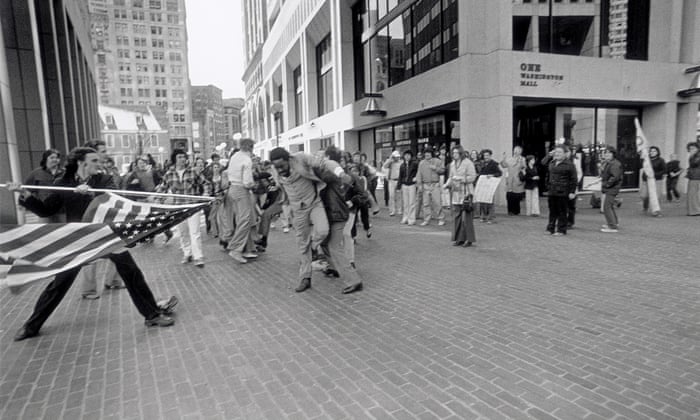
Caption from The Guardian: Ted Landsmark (centre): ‘I had a sense that something really significant had happened.’ Boston, April 5, 1976. Photograph: stanleyformanphotos.com
Caption from the U.S. Navy, via Wikipedia: Photo #: 80-G-K-21225 (color) “First Recognition of the American Flag by a Foreign Government,” 14 February 1778. Painting in oils by Edward Moran, 1898. It depicts the Continental Navy Ship Ranger, commanded by Captain John Paul Jones, receiving the salute of the French fleet at Quiberon Bay, France, 14 February 1778. Earlier in the month, after receipt of news of the victory at Saratoga, France recognized the independence of the American colonies and signed a treaty of alliance with them. The original painting is in the U.S. Naval Academy Museum, Annapolis, Maryland. Official U.S. Navy Photograph, now in the collections of the National Archives. [A larger version is available for download at Wikipedia.]
You want to mark your calendar so you remember to put your U.S. flag up on those dates designated by law and tradition, right?
Massachusetts statehood, February 6 (6th state, 1788)
Lincoln’s birthday, February 12 (yes, it’s still designated in law as a date to fly the flag)
Oregon statehood, February 14 (33rd state, 1859)
Arizona statehood, February 14 (48th state, 1913)
Washington’s birthday, now designated President’s Day, the third Monday in February, February 20 in 2017
You may fly your flag on state holidays, too — which of those dates do we see in February? Is there a good list?
Though we don’t mark it usually, February 14 is the anniversary of the first recognition of the Stars and Stripes by a foreign government, in 1778. The French fleet recognized the ensign carried by Capt. John Paul Jones, at Quiberon Bay — painting of the event is at the top of this post.
February 23 is the anniversary of the raising of the U.S. flag on Iwo Jima, in 1945 — 72 years ago. We should probably watch for proclamations to fly the flag on that date, an anniversary made more important simply because so few survivors of from among the veterans of that war and that fight can be expected to live to see the 80th anniversary. Regardless any official, formal proclamation to fly the flag for the Iwo Jima events, you may always fly your flag.
Most Utah citizens regard themselves as patriots. It’s a state where almost every home has at least one U.S. flag, and where many neighborhoods will be festooned with them on any U.S. holiday.
January 4 is Utah’s statehood day. I ran across this photo of the picturesque McPolin Barn in Park City, Utah, up in the Wasatch Mountains in ski country.
For Utah Statehood day, I pass it along:
U.S. flag displayed on the McPolin Barn, Park City, Utah. Date unknown, photographer unknown (if you can identify the photographer, please do!)
Save
Save
Spread the word; friends don't allow friends to repeat history.
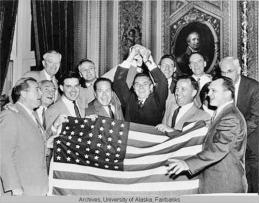
On Jan. 3, 1959, President Dwight Eisenhower signed a proclamation admitting Alaska to the Union as the 49th state. The New York Times noted that the signing included the unveiling of the new 49-star American flag.
The land that became Alaska came into U.S. possession in 1867, when William Seward, secretary of state under President Andrew Johnson, negotiated a deal to buy the 586,000-square-mile area from Russia for $7.2 million, less than 2 cents per acre. Seward’s decision was ridiculed in the American press, who saw no potential in the vast, inhospitable and sparsely populated area.
For decades after its purchase, Alaska was derided as “Seward’s folly” or “Seward’s icebox.” This opinion changed in 1896 with the discovery of gold in the neighboring Yukon Territory, which spurred tens of thousands of people to head to Alaska in search of gold. The gold rush also brought about a boom in mining, fishing and trapping.
Though the first statehood bill had been presented to Congress in 1916, there was little desire in either Alaska or Washington for Alaskan statehood until after World War II. During the war, the U.S. established multiple military bases to resist Japan’s attacks on Alaska’s Aleutian Islands and prevent a potential invasion of the mainland. The military activity, along with the completion of a major highway from Montana, led to a large population growth.
In 1946, Alaskans voted in favor of statehood in a referendum and Alaskan delegates began to lobby Congress for statehood. After years of debate, Congress voted in June 1958 to admit Alaska.
Eight months after Alaska’s admission, on Aug. 21, 1957 [should be 1959, no?], Hawaii became the 50th state. The 49-star remained in place until the following July 4, when it was replaced by the now-familiar 50-star flag.
49-star flags were produced only until August 1959, so there are few of them around. I love this photo of the unveiling of the flag with President Eisenhower:
“Quartermaster General MG Andrew T. McNamara and President Eisenhower examine new 49 star flag” – image and caption from the Quartermaster Foundation. Photo by Bob Schutz, Associated Press (Who are the other two people? The guy on the right looks to me a bit like is Pennsylvania’s Sen. Hugh Scott.)
How did the nation survive for 170 years without firm, decisive and conclusive orders on what the U.S. flag should look like? Isn’t it a great story that we went so long without law setting the requirements?
Alaska’s state flag design came from 13-year old Benny Benson. Benny Benson holding the Alaska flag at the Jesse Lee Home, Seward, Alaska. ASL-P01-1921, Alaska State Library-Historical Collections.
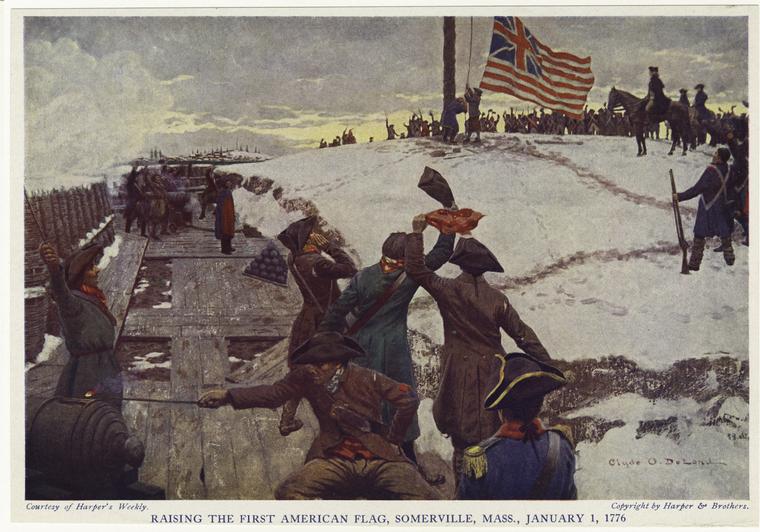
“Raising the first American flag, Somerville, Mass., January 1, 1776.” Harper’s Weekly painting by Clyde Osmer DeLand, 1897. From the digital collections of the New York Public Library
January is loaded with flag flying dates, when we add in statehood days, dates those states are invited to fly their U.S. flags.
In January 2017, the U.S. Flag Code urges citizens to fly flags on these dates, listed chronologically:
New Year’s Day, January 1, a federal holiday
January 2, Georgia Statehood Day
January 3, Alaska Statehood Day
January 4, Utah Statehood Day
January 6, New Mexico Statehood Day
January 9, Connecticut Statehood Day
Martin Luther King’s Birthday, a federal holiday on the third Monday of January; that date is January 16, in 2017; King’s actual birthday is January 15, and you may fly your flag then, too
Inauguration Day, January 20, the year after election years, as 2017 is
January 26, Michigan Statehood Day
January 29, Kansas Statehood Day
You may fly your flag any other day you wish, too; flags should not be flown after sundown unless they are specially lighted, or at one of the few places designated by Congress or Presidential Proclamation for 24-hour flag flying. According to Wikipedia’s listing, those sites include:
Fort McHenry, Baltimore, Maryland (Presidential Proclamation No. 2795, July 2, 1948).
Flag House Square, Albemarle and Pratt Streets, Baltimore, Maryland (Public Law 83-319, approved March 26, 1954).
Lexington Battle Green, Lexington, Massachusetts (Public Law 89-335, approved November 8, 1965).
White House, Washington, D.C. (Presidential Proclamation No. 4000, September 4, 1970).
Washington Monument, Washington, D.C. (Presidential Proclamation No. 4064, July 6, 1971, effective July 4, 1971).
Any port of entry to the United States which is continuously open (Presidential Proclamation No. 413 1, May 5, 1972).
Grounds of the National Memorial Arch in Valley Forge State Park, Valley Forge, Pennsylvania (Public Law 94-53, approved July 4, 1975).
Flag House in 1936, where Mary Pickersgill sewed the garrison-sized, 15-star flag that flew over Fort McHenry at the Battle of Baltimore in 1814; one of the sites where the U.S. flag may be flown 24 hours. The house is at 844 East Pratt & Albemarle Streets (Baltimore, Independent City, Maryland). Cropped image courtesy of the federal HABS—Historic American Buildings Survey of Maryland.
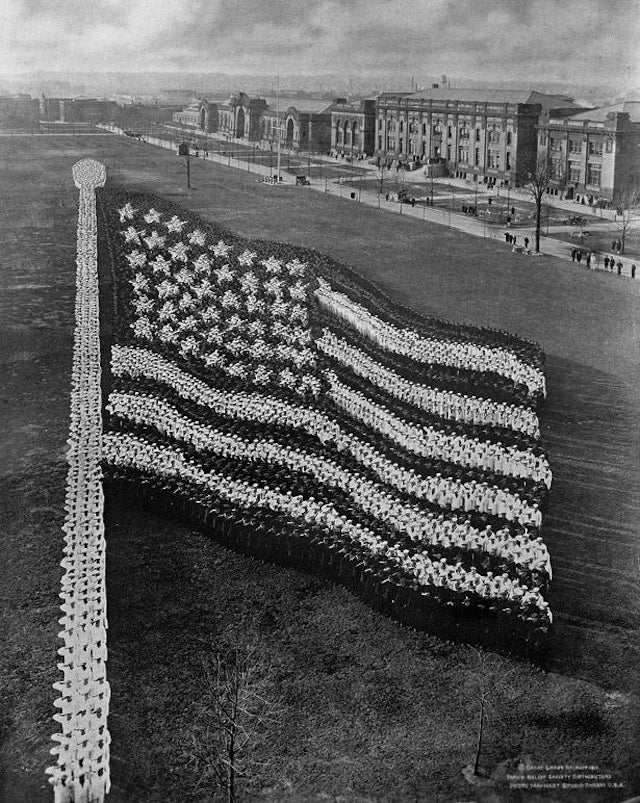
A “living flag” composed of 10,000 sailors, or “Blue Jackets at Salute,” by the Mayhart Studios, December 1917; image probably at the Great Lakes training facility of the Navy. Gawker media image
November offers several flag flying days, especially in years when there is an election.
But December may be the month with the most flag-flying dates, when we include statehood days.
December 25 is Christmas Day, a federal holiday, and one of the score of dates designated in the Flag Code. If you watch your neighborhood closely, you’ll note even some of the most ardent flag wavers miss posting the colors on this day, as they do on Thanksgiving and New Years.
Other dates?
Nine states attained statehood in December, so people in those states should fly their flags (and you may join them). Included in this group is Delaware, traditionally the “First State,” as it was the first colony to ratify the U.S. Constitution:
Illinois, December 3 (1818, 21st state)
Delaware, December 7 (1787, 1st state)
Mississippi, December 10 (1817, 20th state)
Indiana, December 11 (1816, 19th state)
Pennsylvania, December 12 (1787, 2nd state)
Alabama, December 14 (1819, 22nd state)
New Jersey, December 18 (1787, 3rd state)
Iowa, December 28 (1846, 29th state)
Texas, December 29 (1845, 28th state)
December 15 is Bill of Rights Day, marking the day in 1791 when the Bill of Rights was declared ratified; but though this event generally gets a presidential proclamation, there is no law or executive action that requires flags to fly on that date, for that occasion.
Eleven flag-flying dates in December. Does any other month have as many flag flying opportunities?
Have I missed any December flag-flying dates? 11 events on 10 days (Delaware’s statehood falls on the anniversary of the Pearl Harbor attack).
Here’s a list of the days to fly the flag, under national law, in chronological order:
Delaware, December 7 (1787, 1st state) (shared with Pearl Harbor Remembrance Day)
Mississippi, December 10 (1817, 20th state)
Indiana, December 11 (1816, 19th state)
Pennsylvania, December 12 (1787, 2nd state)
Alabama, December 14 (1819, 22nd state)
New Jersey, December 18 (1787, 3rd state)
Christmas Day, December 25
Iowa, December 28 (1846, 29th state)
Texas, December 29 (1845, 28th state)
Fly your flag with respect to the flag, for the republic it represents, and for all those who sacrificed that it may wave on your residence.
Appropriate to a snowy December. “The Barn on Grayson-New Hope Road. This barn with its old truck and ever-present American flag, is often the subject of photographs and paintings by the locals.” Photo and copyright by Melinda Anderson
Yes, this is mostly an encore post. Fighting ignorance requires patience, and it’s taking much longer than I thought.
Encore
Save
Save
Spread the word; friends don't allow friends to repeat history.
An election day in Philadelphia, 1815. Display of the national flag runs to the earliest days of the U.S. republic. “John Lewis Krimmel, ELECTION DAY AT THE STATE HOUSE, (1815). Courtesy the Historical Society of Pennsylvania”
Eight events spread over six different days come with urgings to fly the U.S. flag in November: Six states celebrate statehood, Veterans Day falls as always on November 11, and Thanksgiving Day on November 24.
Did I say eight? 2016 is a federal election year; we fly flags at polling places on election day, so that makes nine events — but election day falls on Montana’s statehood day, so it’s still just six days. You may fly your flag at home on election day, too.
Two states, North Dakota and South Dakota, celebrate their statehood on the same date. Washington’s statehood day falls on Veterans Day, November 11 — so there are only six days covering eight events.
In calendar order for 2015, these are the seven days:
North Dakota statehood day, November 2 (1889, 39th or 40th state)
South Dakota statehood day, November 2 (1889, 39th or 40th state) (shared with North Dakota)
Election day, November 8 (nationwide)
Montana statehood day, November 8 (1889, 41st state)
Veterans Day, November 11
Washington statehood day, November 11 (1889, 42nd state) (shared with Veterans Day)
Oklahoma statehood day, November 16 (1907, 46th state)
North Carolina statehood day, November 21 (1789, 12th state)
Thanksgiving Day, fourth Thursday in November (November 24 in 2016)
Most Americans will concern themselves only with Veterans Day and Thanksgiving Day. Is flying the U.S. flag for statehood day a dying tradition?
Or, until that account is unsuspended by the forces supporting Donald Trump: Follow @FillmoreWhite, the account of the Millard Fillmore White House Library
We've been soaking in the Bathtub for several months, long enough that some of the links we've used have gone to the Great Internet in the Sky.
If you find a dead link, please leave a comment to that post, and tell us what link has expired.
Thanks!
Retired teacher of law, economics, history, AP government, psychology and science. Former speechwriter, press guy and legislative aide in U.S. Senate. Former Department of Education. Former airline real estate, telecom towers, Big 6 (that old!) consultant. Lab and field research in air pollution control.
My blog, Millard Fillmore's Bathtub, is a continuing experiment to test how to use blogs to improve and speed up learning processes for students, perhaps by making some of the courses actually interesting. It is a blog for teachers, to see if we can use blogs. It is for people interested in social studies and social studies education, to see if we can learn to get it right. It's a blog for science fans, to promote good science and good science policy. It's a blog for people interested in good government and how to achieve it.
BS in Mass Communication, University of Utah
Graduate study in Rhetoric and Speech Communication, University of Arizona
JD from the National Law Center, George Washington University


 Posted by Ed Darrell


.jpg)













 Millard Fillmore's Bathtub
_Read_more,_http-www.dvidshub.net-image-675376-american-flag-lit-full-moon.UGyISa5jcdU%5Eixzz28GOdWQR5.jpg)