History tells us vaccines are wonderful things. Vaccines cut horrible, disifiguring, crippling and fatal diseases, and extended the life span of entire populations across the entire world.
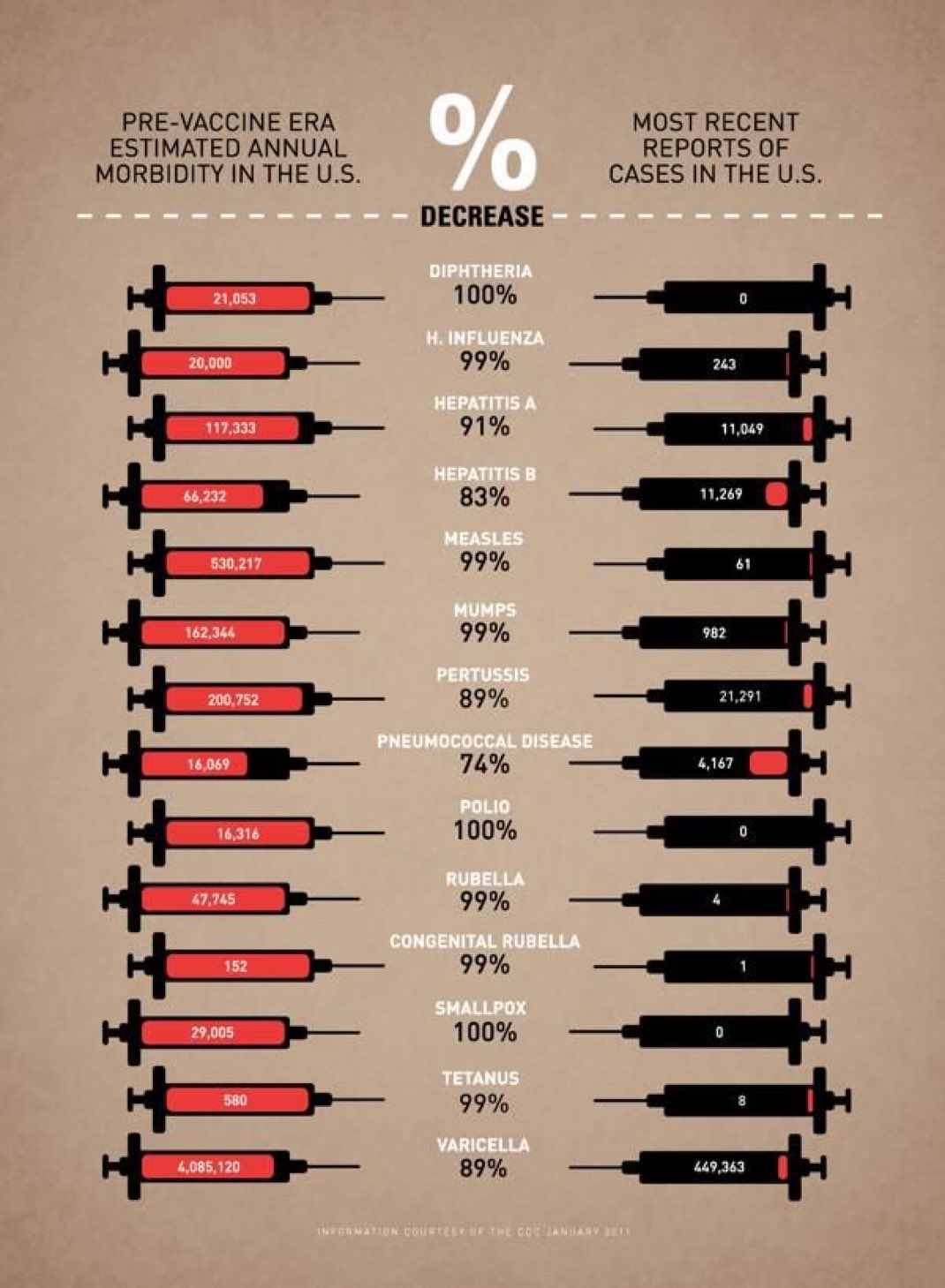
History tells us vaccines are wonderful things. Vaccines cut horrible, disifiguring, crippling and fatal diseases, and extended the life span of entire populations across the entire world.
 Leave a Comment » |
  History, History of Science, medicine, Science, Vaccinations | Tagged: health, Health care, medicine, Science, Vaccines |
  Permalink
 Posted by Ed Darrell
Dr. Andrew Wakefield’s license to practice medicine in Britain was stripped away by British authorities earlier today, due to his “ethical lapses” in conducting research against measles vaccines.
Wakefield’s research claims, published in the distinguished medical journal Lancet in 1998, sparked a worldwide hysteria over the claimed link of Mumps-Measles-Rubella vaccine (MMR) to autism. The journal earlier withdrew the article when the research was exposed as faulty and reaching erroneous conclusions.
Lancet retracted the paper earlier this year.
Effects of Wakefield’s errors ripple across the globe, as children pay the price with measles rates up worldwide, especially in Africa, and in North America. Rob Breckenridge described the damage for the Calgary Herald:
However, Wakefield’s foul legacy is very much consequential. His latest comeuppance is hopefully a small step in undoing that legacy’s damage, but much damage has already been done.
Wakefield authored a now-discredited paper published in 1998 in The Lancet, which implied that the MMR (measles-mumps-rubella) vaccine was linked to autism.
Numerous studies have shown no such link exists, but Wakefield’s research had the predictable effect of scaring people away from the MMR vaccine. Vaccination rates plummeted in the U.K., and the number of measles cases soared.
In 2008 in the U.K., there were almost 1,400 cases of measles compared with 56 the year Wakefield’s paper was published. In 2006, a 13-year-old boy died from measles — the first time in 14 years such a death had been recorded.
On top of the multiple studies rejecting the MMRautism link, The Lancet issued a formal retraction of Wakefield’s paper in February, citing his unethical and irresponsible conduct.
Once a disease like measles becomes rare, we tend to drop our guard, either forgetting how serious it is or assuming it can never come back. As we’ve seen in the U.K. it can come back with a vengeance. Unfortunately, it’s not only the U.K. where we’re learning that lesson.
This month, Alberta Health Services confirmed five cases of measles in the Calgary area. Given our lack of recent experience with measles — there was only one case provincewide in 2009 — AHS offered a primer on the disease.
Measles is extremely contagious, meaning one need not have close contact with an infected person. There is no cure, but vaccination can prevent it. There are still pockets of the province where vaccination rates are low and measles cases there have been higher.
Southwestern Alberta is one of those regions. Not only has measles made a comeback there — a 2000 outbreak closed a Lethbridge-area private school — but cases of mumps and whooping cough have been documented over the past two years.
In B.C., 87 measles cases have been confirmed this year. It’s believed many stem from infected out-of-country visitors at the Vancouver Olympics.
All cases involve people who were either not vaccinated, or only partially vaccinated. Eight cases were associated with a single household, where no one had been vaccinated.
3 Comments | Disease, History, Hoaxes, medicine, Public health, Research, Science | Tagged: Autism, Disease, Health care, Hoaxes, Measles, medicine, MMR, Mumps, Public health, Research, Rubella, Science, Vaccines, Wakefield | Permalink
Posted by Ed Darrell
Why would people fail to inoculate their kids against measles, and thereby contribute to deadly epidemics?
There was this guy in Britain, Andrew Wakefield, who published a study suggesting a link between measles vaccines and autism. But it turned out his research didn’t support that claim. Then it turned out he was under contract to produce a paper that made that claim regardless the science, for a lawsuit.

A page from Darryl Cunningham's graphic account of measles vaccine hysteria, "The Facts in the Case of Dr. Andrew Wakefield." TallGuyWrites (Darryl Cunningham)
Darryl Cunningham created a concise, 15-page graphic accounting of the story of how the misdeeds of one physician led to a world-wide, child-killing panic. If you do not know the story, go read it. You should be troubled by the story it tells. Be sure to read it through. Cunningham is thorough in his debunking of the hysteria the anti-vaxxers promote, and you should know it all.

Another page from Darryl Cunningham's graphic story, "The Facts in the Case of Dr. Andrew Wakefield" about the motivations behind the hysteria.
Then send a copy to Jenny McCarthy, or anyone else who carries the torch of ignorance-based hysteria against vaccines and in favor of disease.
Dr. Wakefield’s original paper was retracted by the publisher — it’s no longer considered valid science. It’s a hoax. No subsequent research confirmed any links to autism. Serious, large-scale follow-up studies revealed no connection whatsoever between measles vaccine and autism.
Measles is a nasty disease, tough to eradicate, and working hard to come back and get your children and grandchildren. Don’t be suckered.
Andrew Wakefield created a hoax. Those who rely on his study rely on bogus science, voodoo science. History tells us that, if we stop the fight against measles, people will die.
Would you contribute to publishing this comic for distribution in pediatrician’s waiting rooms?
More:
Leave a Comment » | Books, children, Disease, Health care, History, Hoaxes, Public health, Voodoo history, Voodoo science | Tagged: Andrew Wakefield, Autism, bogus science, children, Graphic Novel, Hoaxes, Measles, Science, Vaccines, Voodoo science | Permalink
Posted by Ed Darrell
Those people who warn against vaccinating kids? They are laying low today. They didn’t pick up the New York Times as they usually do on a Sunday — they don’t want to know.
You may want to know, however.
More than 1,100 deaths from measles have been reported among 64,000 known cases in Africa the last year, it said. Chad, Nigeria and Zimbabwe have had the largest outbreaks.
“There is a widespread resurgence of measles with these outbreaks in over 30 African countries, some of which are seeing very high case fatality ratios,” WHO expert Peter Strebel told a news briefing.
Some 8,000 migrant children in Bulgaria also had the highly-contagious disease during the period, he said.
Measles deaths among children under five years old fell to 118,000 in 2008 from 733,000 in 2000, according to the United Nations agency’s latest figures.
But the WHO warned that a lack of funding and political commitment could result in a return to more than 500,000 cases measles deaths per year by 2012, wiping out the gains to date.
Avoiding vaccinations for measles suddenly may not be a great idea.
2 Comments | Africa, Disease, Health care, History, medicine | Tagged: Africa, Disease, epidemics, Measles, U.S.A., Vaccines | Permalink
Posted by Ed Darrell
Here’s Nathan Wolfe explaining how viruses work, quickly and at a high enough level to be entertaining, and explaining why we need to worry about H1N1.
Vodpod videos no longer available.
Wolfe also explained a lot at the TED Blog:
Take us back a step or two: How did swine flu enter into the human population?
Swine flu has been known since at least the early part of the 20th century, since the 1930s. It was originally a virus of bird origin — all influenza viruses were originally bird viruses — and it probably spread to humans before it was in pigs.
Now, we still haven’t received definitive information on the underlying genetics of this particular virus. But initial reports suggest that it may be what’s known as a “mosaic virus,” which includes components of swine influenzas, bird influenzas and human influenzas. A cosmopolitan virus like that wouldn’t be unprecedented. (Editor’s Note: see Joe DeRisi’s 2006 TEDTalk for more on state-of-the-art virus detection.)
But in any case, this is a virus that appears to come from pigs, and pigs in close proximity spread the flu in much the same way that humans do — coughing, sneezing, and so on. The virus probably initially entered into human populations through people who work with livestock.
Is swine flu here to stay?
Whether this particular virus will sustain itself and become a permanent part of the human landscape is unclear, but that’s certainly what we’re watching for. As it is, the virus may just disappear because of the weather; summers aren’t good for flu viruses.
So this heat wave is working in our favor?
It might be. The virus has had a good start, from the flu perspective, considering that this is really the end of the season. But the unseasonably hot weather may bode poorly for this virus’ potential to establish itself definitively and cause a pandemic. Had this happened in September or October, it would be much more concerning.
Having said that, it’s not impossible that a virus like this might “go into hiding” — in the southern hemisphere or the tropics — and might come to light again next year. So there will be a lot of discussion about expanding the fall flu vaccine to try to control it next cycle.
Is it really possible for us to prevent future outbreaks like this?
Yes, I believe it is. We spend tons of money trying to predict complex phenomena like tsunamis, hurricanes, earthquakes. There’s no reason to believe that a pandemic is harder to predict than a tsunami. And we’d be foolish not to include forecasting and prevention as part of our overall portfolio to fight these pandemics.
More resources:
Help this post go viral:


Leave a Comment » | Disease, Health care, History, medicine, Science | Tagged: Disease, H1N1, Health care, Malaria, medicine, Science, Vaccines, Viruses | Permalink
Posted by Ed Darrell
You can see it in this little-noted blog. Someone drops by to tell me I’m in error, that Rachel Carson really did plot with Pol Pot to murder millions, and then they also show up in the creationism threads defending the view that dinosaurs never existed, or in a tangentially-related note on climate change, perhaps arguing that ocean levels rising are either not a problem, or the product of Atlantis’s rising from the depths (and therefore no problem, since the denizens of that city had better science than we do and will be able to fix things, never mind their being dead for 5,000 years). [That last description is mostly fictional – mostly.]
What is it that makes one person deny reality on so many different fronts?
Mark Hoofnagle hit the research journals, listing results at denialism blog, demonstrating that crankery can be studied. This raises in my mind the interesting little question of whether such crankery is a pathology, and perhaps treatable or curable.
Our recent discussions of HIV/AIDS denial and in particular Seth Kalichman’s book “Denying AIDS” has got me thinking more about the psychology of those who are susceptible to pseudoscientific belief. It’s an interesting topic, and Kalichman studies it briefly in his book mentioning the “suspicious minds”:
At its very core, denialism is deeply embedded in a sense of mistrust. Most obviously, we see suspicion in denialist conspiracy theories. Most conspiracy theories grow out of suspicions about corruptions in government, industry, science, and medicine, all working together in some grand sinister plot. Psychologically, suspicion is the central feature of paranoid personality, and it is not overreaching to say that some denialists demonstrate this extreme. Suspicious thinking can be understood as a filter through which the world is interpreted, where attention is driven towards those ideas and isolated anecdotes that confirm one’s preconceived notions of wrong doing. Suspicious thinkers are predisposed to see themselves as special or to hold some special knowledge. Psychotherapist David Shpairo in his classic book Neurotic Styles describes the suspicious thinker. Just as wee see in denialism, suspiciousness is not easily penetrated by facts or evidence that counter individuals’ preconceived worldview. Just as Shapiro describes in the suspicious personality, the denialist selectively attends to information that bolsters his or her own beliefs. Denialists exhibit suspicious thinking when they manipulate objective reality to fit within their beliefs. It is true that all people are prone to fit the world into their sense of reality, but the suspicious person distorts reality and does so with an uncommon rigidity. The parallel between the suspicious personality style and denialism is really quite compelling.
Denialism may be a little greater problem than is generally acknowledged, in my opinion. When it infects policy makers it causes legislative and executive crackups, like Oklahoma’s Sen. Tom Coburn, who held up the naming of the Rachel Carson Post Office for a year under the bizarre misconception that she played a role in spreading malaria (ditto for Utah Rep. Rob Bishop, who shared the view but was unable to stop the bill in the House), or like the Bush administration officials at the U.S. Agency for International Development who kept refusing to authorize spending for pesticides in Africa, claiming environmental groups would oppose them while the environmental groups were lobbying the agency to spend the money on those pesticides.
Former South Africa President Thabo Mbeki denied that HIV causes AIDS. Mbeki’s refusal to act on the best science available may have led to as many as 350,000 deaths, some accounts say. Ashley Montagu told the story of Adolf Hitler’s odd views of heritage being spread by blood transfusions — to avoid any possibility of his soldiers’ being turned Jewish by a blood transfusion, Hitler forbade the use of blood banks. Tens of thousands of German soldiers died unnecessarily from lack of blood for transfusing during World War II. Partisans and scientists still debate whether and how much Ronald Reagan’s belief that AIDS was a syndrome caused by sin rather than a virus early in the AIDS crisis created a cascade of actions that still frustrates the development of a vaccination or cure.
Denialism in high school students is interesting, but most often a classroom problem. When kids take great issue with the course material the class can get derailed. Even when a teacher is able to keep the class on track, the denialist student may feel marginalized. A colleague reported a student had informed that historians now concur that George Washington was African-American. She could not be dissuaded from the view. I had a student who insisted well into the second semester than Adolf Hitler was a great leader, smart and humanitarian, framed for war crimes of the British and Americans. Unfortunately, I could not put him in contact with the earlier student who believed Hitler had been framed by the Soviet Union, and that the Americans and British were victims of the cruel hoax.
As the nominal head of public relations in the old (Pleistocene?) office of Sen. Orrin Hatch, my crew and I got the brunt of denialists and crazies. We had one woman in Salt Lake City, “Mrs. B,” who regularly called the Salt Lake office to complain about Hatch’s actions and what she assumed his beliefs must be. For a while she complained that, as someone born outside of Utah, he could never appreciate the views of the Latter-day Saints in Utah. When at last we persuaded her that he was also a Mormon, she began complaining that he ignored Utah’s non-Mormon population. Her ability to switch sides in an argument so as always to remain on the opposite side of Sen. Hatch got noticed.
Near the end of a summer session just before the recess the Senate had a lot of late-night meetings. The news of these sessions did not always make the morning papers. On one issue of some Utah import, Hatch had suggested he would probably vote one way, because of some issue of agency direction that had him concerned. In the end the agency agreed to amendments that assuaged all of Hatch’s concerns and he was happy to support the bill (I forget what it was — the issue is absolutely irrelevant to the story).
I had caught a late-night flight to Salt Lake, and arrived at the SLC office early enough to catch our Utah problem solver Jack Martin explaining to Mrs. B that Hatch did indeed care about Utah . . . Jack and I could carry on a conversation with only his occasional remarks to Mrs. B keeping her going, a scene out of a Cary Grant comedy, perhaps. “Yes, Mrs. B . . . No, Mrs. B . . . I think I see your point.” What he said was unimportant. I could hear her rant on the telephone, while I was on the other side of the room. I finally asked Jack what her issue was, and he explained it was the bill that Hatch had reveresed his position on. She was complaining at great length about his original position. I explained to Jack that an accommodation had been reached and that Hatch changed his vote in the final tally.
Jack smiled broadly as he handed me the phone. “You tell her!” It took a long time to get her to stop talking so I could explain who I was and that I had new information. Finally she fell silent and I explained that she should be happy because Hatch had come around to her position. There was a silence of a few more seconds, and she started in again: “Hatch is an idiot! Only a fool would vote that way.” And she was off again on a rant against Hatch, eviscerating the views that she herself had held less than a minute earlier.
The issue wasn’t important to her. Hatch was wrong, whatever he did, even when he supported her views.
That’s denialism in full force, a raw, unmitigated power of nature.
Hoofnagle concludes at denialism:
So what do these studies mean for our understanding of cranks? Well, in addition to providing explanations for crank magnetism, and cognitive deficits we see daily in our comments from cranks, it suggests the possibility that crankery and denialism may be preventable by better explanation of statistics. Much of what we’re dealing with is likely the development of shoddy intellectual shortcuts, and teaching people to avoid these shortcuts might go a long way towards the development and fixation on absurd conspiracy theories or paranormal beliefs.
Wouldn’t you love to see that study replicated on readers of Watt’s Up With That?, Texas Darlin’ , Junk Science, or one of the anti–vaxxer blogs?
You may also want to read:
4 Comments | Barack Obama, Cargo Cults, Creationism, denialism, Dissent, Education, Health care, History, Reason, Science, Texas, Woo | Tagged: Climate change, Crank Science, Creationism, DDT, Gardasil, Junk science, Obama Birth Certificate, Science, Vaccines, Voodoo science | Permalink
Posted by Ed Darrell
Copy a couple of these articles and give them to your school nurse to pass out to people who say they don’t want to inoculate their kids.
In 1991, we could have inoculated every unvaccinated child under the age of 10, in Dallas County, for much less than $20,000. Then the epidemic hit. One of the early hospitalizations for the company I worked with was $100,000. One kid went in, and after $1 million of care, spent the rest of his life in a local hospital (another decade).
The economic arguments for measles vaccination should be clear.
Update: Bug Girl is right (see her comment below): Go check out Orac’s post on the issue, “Antivaccinationsim versus measles in the U.S.: Are the chickens coming home to roost.” I was posting in a hurry; Orac is posting after visiting the issue several times. Contrast Orac’s views as a physician with those of people who tend to get herded into panics without the facts, only through the fault of not having the facts about the dangers of the diseases they let off the hook (make no mistake: most of these people are well-meaning).
My more complete measles story, below the fold.
2 Comments | History, Public education, Public health, Science, Voodoo science | Tagged: Education, health, Measles, Public health, Schools, Science, Vaccines | Permalink
Posted by Ed Darrell
Yeah, it was a bit tacky of Merck to create a campaign to get government officials to require inoculations against human papilloma viruses that cause cancer — but, people!, we’re talking about preventing cancer here.
The Texas legislature voted for cancer, overturning Gov. Rick Perry’s ill-considered good idea to require vaccinations for school kids in Texas. In a state with top-notch anti-cancer research at M. D. Anderson Cancer Center in Houston and UT’s Southwest Medical Center in Dallas, it was an odd, odd thing to witness.
The debates are skewed by a general distrust and dislike of big pharmaceutical companies, and by the religious right’s view that it’s better that a young mother die of cancer than she should get even the faintest idea that might in only the most perverse mind promote pre-marital sex. Still, we shouldn’t fall victim to voodoo science claims against vaccines.
Are my views, tempered by years of work promoting public health and fighting disease, clear enough for you?
Owlhaven wins popularity contests among mothers who read blogs, and it often is tender and touching — hey, I read it from time to time. But recently Mary, Owlhaven’s author, fell victim to a propaganda campaign from Judicial Watch, a far-right-wing bunch that campaigns against the U.S. justice system and generally makes a conservative-gratuitous-poke-in-the-butt out of itself. Judicial Watch claims to have some secrets from having filed a Freedom of Information Act Request with FDA to get Merck’s reports to FDA of adverse events known about Gardasil, Merck’s proprietary anti-cancer vaccine.
I responded, of course — but my response didn’t show on Owlhaven’s comments. Blackballed? Spam filtered due to the number or length of links? I can’t tell. Mary said she emptied the spam filter without checking. So, I repost my response, below the fold, for your benefit. Read the rest of this entry »
14 Comments | Family, Politics, Public education, Public health, Religion, Research, Science, Voodoo science, Women's rights | Tagged: Gardasil, health, Religion, Science, Vaccines | Permalink
Posted by Ed Darrell


Ed Darrell on Texas's Colorado River


Come on in, the water's fine. Come often: Cleanliness is next to godliness.


 Millard Fillmore's Bathtub