More bad news than good news from the Texas State School Board: Yes, the board failed to reintroduce the creationist sponsored “strengths and weaknesses” language in high school science standards; but under the misleadership of Board Chair Don McLeroy, there is yet <i>another</i> series of amendments intended to mock science, including one challenging Big Bang, one challenging natural selection as a known mechanism of evolution, and, incredibly, one challenging the even the idea of common descent. It’s a kick in the teeth to Texas teachers and scientists who wrote the standards the creationists don’t like.
Do you live in Texas? Do you teach, or are you involved in the sciences in Texas? Then please send an e-mail to the State Board of Education this morning, urging them to stick to the science standards their education and science experts recommended. Most of the recent amendments aim to kill the standards the scientists and educators wrote.
TFN tells how to write:
You can still weigh in by sending e-mails to board members at sboeteks@tea.state.tx.us. Texas Education Agency staff will distribute e-mails to board members.
You don’t think it’s serious? Here’s Don McLeroy explaining the purpose of one of his amendments:
Texas Freedom Network is live-blogging the hearings and proceedings from Austin, again today, before the Texas State Board of Education (SBOE). [I’ve changed the link to go to the TFN blog — that will take you to the latest post with latest news.] Testimony yesterday showed the coarse nature of the way SBOE treats science and scientists, and offered a lot of “balancing” testimony against evolution from people who appeared not to have ever read much science at all. The issue remains whether to force Texas kids to study false claims of scientific error about evolution.
I will be live blogging the Texas State Board of Education meeting of 2009 March 25-27 in this column. This includes the hearing devoted to public testimony beginning at 12:00 noon on Wednesday, March 25. I will stay through the final vote on Friday, March 27.
Go to the following webpages for further information:
Cargo cult science has deep roots among those who deny global warming or who allow that warming is occurring, but claim we can do nothing about it. So, it’s no surprise that, at the voodoo science 2nd International Conference on Climate Change, somebody would trot out the old falsehoods about DDT.
Speaking at the conference hosted by the Heartland Institute in New York City,[Dr. Arthur Robinson, Director of the Oregon Institute of Science and Medicine] said, “There is a current example of genocide by the removal of technology, and that is the ban on DDT, and that has resulted in the deaths of 30 to 40 million people and has left half a billion infected with malaria.”
It’s malaria that kills people, not a lack of DDT. The removal of DDT from spraying cotton crops in Texas and California did absolutely nothing to promote malaria in Africa. Dr. Robinson needs a basic geography course. Mosquitoes do not migrate from the U.S. to Africa or Asia.
Stopping the spraying of DDT in the U.S. in 1972 wasn’t a factor in the cessation of usage of DDT in Africa seven years earlier, either. Dr. Robinson could use some basic math sequencing and calendar reading remediation, too.
Dr. Robinson could use some history and public policy instruction, too. DDT was never banned in Africa, nor was it banned in India or China which together now produce almost all the DDT used in the world, which is a lot. There’s no ban on DDT in Uganda, where Dr. Robinson’s friends in the business world are suing to stop the spraying of DDT in huts in affected regions — because they are afraid it will harm their tobacco business.
It’s a heckuva lot easier to throw darts at health care workers and disease fighters than it is to talk about real solutions with these guys.
If Robinson is dead wrong on a one-liner about DDT, how wrong do you think he is in the rest of his presentation on climate change?
Is there any crackpot “scientist” who was not at the Heartland Institute’s wing-ding?
Spread the word; friends don't allow friends to repeat history.
Anthony Watts want to make a case that rising ocean levels aren’t connected to human activities, there’s nothing we can do about it, there’s nothing we should do about it, or something. Looking for a touchstone in history, Watts said:
In 2002, the BBC reported that a submerged city was found off the coast of India, 36 meters below sea level. This was long before the Hummer or coal fired power plant was invented. It is quite likely that low lying coastal areas will continue to get submerged, just as they have been for the last 20,000 years.
Submerged city? Hmm. Not in the textbooks published since 2002. What’s up with that?
NASA Earth Observatory photo of the Gujarat Gulfs, including the Gulf of Cambay (Khambhat), where a "lost city" was thought to have been found in 2001; later research indicates no city underwater.
Oh, this is what’s up: Watts links to a BBC news story, not a science journal — one of the warning signs of Bogus Science and Bogus History, both. The news story talks about preliminary findings in 2002 that did not hold up to scrutiny. Measurement error was part of the problem — the pattern of the scanning radar sweep was mistaken for structures found on the sea floor. Natural formations were mistaken for artificial formations. When the news announcement was made, archaeologists and other experts in dating such things had not be consulted (and it’s unclear when or whether they were ever brought in). The follow-up didn’t support the story, notes Bad Archaeology. Terrible archaeology to support pseudo climate science? Why not?
This doesn’t deny Watts’ general claims in his post, but it is too indicative of the type of “find anything to support the favored claim of denial” mindset that goes on among denialists. (There is evidence of a much lower waterline in the area during the last ice age; water levels have risen, according to physical evidence, but probably not inundating the what would be the oldest civilization on Earth.)
It will be interesting to watch what happens. Will Watts note an oopsie and apologize, or will the entire group circle their Radio Super wagons around the issue and call it a mainstream science plot against them? Will Watts correct his citation, or will they move on to cite the disappearance of Atlantis as evidence that warming can’t be stopped?
Anybody want to wager?
What sort of irony is there in a guy’s complaining about a scientific consensus held by thousands of scientists with hundreds of publications supporting their claims, and his using one news report almost totally without any scientific corroboration in rebuttal?
Why not teach our children the best we know, rather than junk we don’t know at all?
Mr. Bratteng’s 13 Questions
Why does giving vitamin and mineral supplements to undernourished anemic individuals cause so many of them to die of bacterial infections?
Why did Dr. Heimlich have to develop a maneuver to dislodge food particles from people’s wind pipes?
Dr. Henry Heimlich
Why does each of your eyes have a blind spot and strong a tendency toward retinal detachment? But a squid whose eyesight is just as sharp does not have these flaws?
Why are depression and obesity at epidemic levels in the United States?
When Europeans came to the Americas, why did 90 percent of the Native Americans die of European diseases but not many Europeans died of American diseases?
Why do pregnant women get morning sickness?
Why do people in industrialized countries have a greater tendency to get Crohn’s disease and asthma?
Why does malaria still kill over a million people each year?*
Why are so many of the product Depends sold each year?
Why do people given anti-diarrheal medication take twice as long to recover from dysentery as untreated ones?
Why do people of European descent have a fairly high frequency of an allele that can make them resistant to HIV infection?
Close to home: Why do older men often have urinary problems?
Cedar tree near Austin, Texas
And why do so many people in Austin get cedar fever?
Of course, I don’t have the list of all the answers! (Can you help me out, Dear Reader? List what you know in comments.)
American Red Cross poster on Heimlich Maneuver, from BusinessInsider
* Update November 2016: Actually, malaria death rates have been below a million/year worldwide since 2000; in 2015, fewer than 470,000 people died. At other posts on this blog you can learn that most of this great progress against malaria has been accomplished without DDT. Mr. Bratteng’s question remains valid, despite the happy decline in malaria deaths.
Save
Spread the word; friends don't allow friends to repeat history.
I noted the errors in a post at Reformed Musings. Then I noodled around Mr. Mattes’s site, and I dropped this note into his “about” thread, frustrated that I couldn’t just politely note the errors at his posts, where he’s disabled comments.
I said:
I wish you’d take comments on your posts. For example, you’ve got a couple of errors dealing with DDT in your post on climate change. It looks as though you’re hoping to sneak them past readers, rather than get the science right. I hope that’s not so. By: Ed Darrell on December 31, 2008 at 7:41 pm
So, noting Mattes’s aggravation of his errors, I wrote again on his blog, a bit more sternly:
Shame on you. If you really think DDT is safe and that there was no science behind its “ban,” open comments, let us discuss.
But to compound your errors, and then to fail to approve comments from those who offer you correct information — well, reformation only goes so far, I guess. By: Ed Darrell on January 2, 2009 at 11:56 am
Rather than open comments to discuss, and rather than respond to the post at the Bathtub, he sent me e-mail:
Shame on me? Excuse me, but I’m a bit amazed at your arrogance. You’ll offer correct information? Why, because others have a different opinion than you they have to be wrong? What are your technical qualifications and applicable experience, besides having a blog and a keyboard? Have you been to Africa? I have. Is racial eugenics your thing? Is that why third-world inhabitants are expendable to you?
Whatever you think you know, DDT is being successfully employed in Africa and elsewhere to save lives every day. No bad effects evident. None. Their public health officials are literally begging for more. But then, their only agenda is survival. Selective and misleading reporting doesn’t interest them, only results.
Did Mattes miss many of the Tinfoil Hat Brigade’s concerns?
For the record, I don’t share Mattes’s fascination with eugenics as applied to race (and I’ll wager Mattes has no record fighting it); that tends to be a concern of the anti-science, historical revisionists (wrong about history, too). I said nothing disparaging about third world peoples, and there are a dozen or more posts here to confirm my concerns about health in the third world, in contrast to only the junk science, “Let’s poison the hell out of Africa” attitude from Mattes.
In his second paragraph, he contradicts one of the main points of his first post. He says DDT is being used successfully in Africa — while his first post complained that environmentalists had successfully stopped it from being used.
That’s rather the mark of the true DDT sycophant, someone who suffers seriously from internet DDT poisoning: The only reason they mention DDT is to find a cudgel to use against brave and smart women like Rachel Carson, or otherwise to criticize people who call for an end to pollution, or the preservation of water, air, trees or animals. Unanchored by any fact or any need or desire to be accurate, they attack environmenalists, damn the inconsistency of the attacks.
Oy.
He’s followed up today with a new post that assaults science at every turn, claiming to follow science journals, but instead citing the chemical industry supporters like Richard Tren, opposing the Centers for Disease Control and World Health Organization. While complaining about “eco-socialism,” he approvingly cites the experts of Lyndon Larouche, the late Dr. Gordon Edwards, in all of his errors and all of the political wankery of Larouche.
Mattes has gone back to the false claims that Edmund Sweeney exhonerated DDT, and that “evil” William Ruckelshaus banned DDT anyway — completely murdering Sweeney’s analysis and the law behind it, and completely avoiding the law, the court cases, and the history behind Ruckleshaus’s actions.
In his frantic, apoplectic dance to avoid discussing whether he might be in error, Mattes has dived so deeply into the depths of tinfoil hat sourcery (no, it’s spelled as I intended it) that in the end, he’s not jus twrong, he’s not even wrong.
If someone criticized any translation of the Bible as carelessly and wildly as Mattes criticizes science, he’d be out recruiting neighbors with pitchforks and torches to march.
Mattes claims he’s done with the issue. We can only hope. To continue in his current trend, he’d need to deny gravity (both Newton and Einstein), atomic theory, and Linneaus. But I also suppose it means he’ll never check here to see the facts. Just when we thought we were making progress . . .
The real story about DDT, a few of the posts at Millard Fillmore’s Bathtub:
Ada County, Idaho, is home to the state capital, Boise.
As with most county governments in the U.S., a lot of work is delegated to groups that are governed or advised by citizen boards. Volunteers make up these boards. In many municipalities, it’s difficult to recruit good citizens to do the work.
The Ada County Courthouse, in Boise Idaho. HPB photo by LCA Architects
Feeling disenfranchised? Not happy with how the elections turned out? Well, there is still a way for you to impact the body politic in Ada County—the County Board of Commissioners is calling for volunteers to serve as advisors on a number of boards.
The County Commissioners, Paul Woods, Rick Yzaguirre, and Fred Tilman, made the appeal for volunteer advisors in the most recent edition of Ada County’s monthly newsletter.
“The county has numerous volunteer boards and advisory committees that help the Ada County Board of Commissioners in policy development and general operations in areas ranging from housing, planning and zoning, social work and recreation. The unpaid volunteer positions give citizens a unique, insider look at county government while they roll up their sleeves to help their local community. While each board has its own bylaws and varying terms of service, interested parties are always encouraged to apply for a position on any volunteer board,” the county said.
The county went on to describe eight examples of boards that rely on volunteer participation, I’ve profiles the three coolest boards here.
Historic Preservation Council—Are you one of those folks that loves to see historical photos from Ada County’s storied past? Would you love to help identify sites of historical significance or help with education efforts? When then consider helping out with the Ada County Historic Preservation Council where, according to the county, “members must demonstrate an interest, competence, or knowledge in history or historic preservation” and can have a positive effect on how the county coordinates its preservation activities.
Mosquito Abatement Advisory Board—I’m a huge advocate for bringing back DDT (dichloro-diphenyl-trichloroethane) that insecticide extraordinaire which got a bad rap in the 1960’s when it was panned in Rachel Carson’s inaccurate book, Silent Spring. Turns out that DDT is safe for humans and Silent Spring, “contains certain statements at variance with the facts as we now understand them”, as Cecil Adams so eloquently put it in his The Straight Dope column from December 13, 2002. If you feel like I do about slaughtering mosquitoes and ending West Nile Virus in Idaho, then consider volunteering for the Ada County Mosquito Abatement Advisory Board wherein you can meet to discuss our collective war on these blood-sucking bugs. If you are a mosquito-lover who thinks bugs are people too, I would not recommend this board for you. [emphasis added]
Board of Community Guardians—Finally, if you have a heart for the disabled or the mentally ill, you might be the right sort of volunteer for this important board. According to the county, “The Board of Community Guardians manages the Community Guardian Program, which assists individuals who cannot make decisions for themselves because of mental and/or physical impairments or disabilities. These individuals, who are either legally incapacitated or destitute with no financial security or family support., can be determined a ward of the county, and court-appointed volunteers oversee those wards.
If you are interested in volunteering for any of these advisory boards contact:
Board of Ada County Commission office
200 W. Front St., Third Floor, Boise.
Even the vaunted Cecil Adams writes a clunker from time to time, and his agreement with the wholly unsupportable claim that Rachel Carson was wrong is one of those clunkers (but his description of Lyndon Larouche will make you smile). The facts differ from the claim in this ad:
DDT’s “bad rap” was well deserved. In the past three years dozens of news articles matched the science journals commemorating the recovery of bald eagles, brown pelicans, osprey and pergrine falcons — recoveries made possible by ending the use of DDT in the wild. DDT kills entire ecosystems, starting with the predators at the top. It’s dangerous stuff.
Rachel Carson’s book, Silent Spring, pioneered the use of good, hard scientific data in popular writing. In its 53 pages of footnotes to scientific studies, science journals and correspondence, critics have been unable to find inaccuracies. Especially on the issue of DDT’s effects on wildlife, more than a thousand follow-up studies vindicated Carson. I have not found a contrary study, not one.
DDT is NOT the pesticide of choice for West Nile, in any case. It’s almost like arguing that DDT is the pharmaceutical of choice to use against malaria — confusing the pesticides used to kill insects with the pharmaceuticals used to treat disease in humans. DDT is unsuitable for outdoor use, illegal for outdoor use under the 1958 Federal Insecticide, Fungicide and Rodenticide Act (FIFRA) and its subsequent amendments because it is “uncontrollable.” DDT kills non-target species, often better than it kills target species. For mosquito abatement, DDT kills mosquito predators much more effectively than it kills mosquitoes. Plus, it sticks around for years, and it bioaccumulates up food chains, multiplying poison doses to predators, sometimes millions of times.
West Nile mosquitoes can be effectively treated as larva, if their water homes are known; but DDT is particularly ill-suited for use in water. DDT works best when its spread can be confined indoors, which is where malaria-carrying mosquitoes usually bite. West Nile carriers live and bite outdoors.
I hope Ada County gets volunteers for the mosquito abatement board who know a little bit more about DDT, or who are open to listening to the mosquito abatement experts.
Spread the word; friends don't allow friends to repeat history.
Point being, of course, that evolution occurs in the real world. Creationists rarely exhibit the faith of their claims when their life, or just nagging pain, is on the line. They’ll choose the evolution-based medical treatment almost every time. There are no creationists in the cancer or infectious disease wards.
At one point I responded to a comment loaded with typical creationist error. It was a long post. It covered some ground that I’ve not written about on this blog. And partly because it took some time to assemble, I’m reposting my comments here. Of course, without the Trudeau cartoon, it won’t get nearly the comments here.
I’ll add links here when I get a chance, which I lacked the time to do earlier. See my post, below the fold.
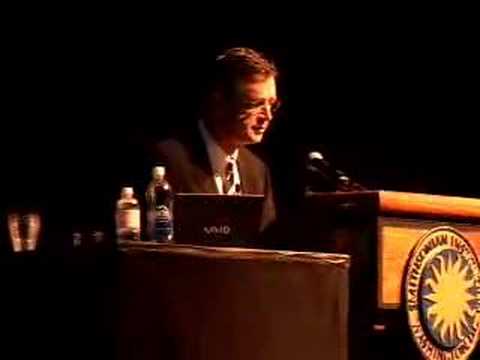
Author Michael Crichton railing against environmental protection and science he politically disagreed with, at the Smithsonian Institution, about the same time as his Commonwealth Club presentation.
I have been asked to talk about what I consider the most important challenge facing mankind, and I have a fundamental answer. The greatest challenge facing mankind is the challenge of distinguishing reality from fantasy, truth from propaganda. Perceiving the truth has always been a challenge to mankind, but in the information age (or as I think of it, the disinformation age) it takes on a special urgency and importance.
We must daily decide whether the threats we face are real, whether the solutions we are offered will do any good, whether the problems we’re told exist are in fact real problems, or non-problems. Every one of us has a sense of the world, and we all know that this sense is in part given to us by what other people and society tell us; in part generated by our emotional state, which we project outward; and in part by our genuine perceptions of reality. In short, our struggle to determine what is true is the struggle to decide which of our perceptions are genuine, and which are false because they are handed down, or sold to us, or generated by our own hopes and fears.
As an example of this challenge, I want to talk today about environmentalism.
The promise was short-lived.
Crichton described his learnings from studying anthropology, including an observation that religions always arise, and cannot be stamped out. From there he makes an astounding leap, to claim that environmentalism is religion. From that failed leap, the speech rapidly deteriorates. He adopts tenets of American Christian and political fundamentalism, rapidly following up with a disavowal of fundamentalism, as if to try to hide what he’s done, or deny it, at least for himself:
So I can tell you some facts. I know you haven’t read any of what I am about to tell you in the newspaper, because newspapers literally don’t report them. I can tell you that DDT is not a carcinogen and did not cause birds to die and should never have been banned. I can tell you that the people who banned it knew that it wasn’t carcinogenic and banned it anyway. I can tell you that the DDT ban has caused the deaths of tens of millions of poor people, mostly children, whose deaths are directly attributable to a callous, technologically advanced western society that promoted the new cause of environmentalism by pushing a fantasy about a pesticide, and thus irrevocably harmed the third world. Banning DDT is one of the most disgraceful episodes in the twentieth century history of America. We knew better, and we did it anyway, and we let people around the world die and didn’t give a damn.
I can tell you that second hand smoke is not a health hazard to anyone and never was, and the EPA has always known it. I can tell you that the evidence for global warming is far weaker than its proponents would ever admit. I can tell you the percentage the US land area that is taken by urbanization, including cities and roads, is 5%. I can tell you that the Sahara desert is shrinking, and the total ice of Antarctica is increasing. I can tell you that a blue-ribbon panel in Science magazine concluded that there is no known technology that will enable us to halt the rise of carbon dioxide in the 21st century. Not wind, not solar, not even nuclear. The panel concluded a totally new technology-like nuclear fusion-was necessary, otherwise nothing could be done and in the meantime all efforts would be a waste of time. They said that when the UN IPCC reports stated alternative technologies existed that could control greenhouse gases, the UN was wrong.
I can, with a lot of time, give you the factual basis for these views, and I can cite the appropriate journal articles not in whacko magazines, but in the most prestigious science journals, such as Science and Nature. But such references probably won’t impact more than a handful of you, because the beliefs of a religion are not dependent on facts, but rather are matters of faith. Unshakeable belief.
From the promising start of claiming we must be skeptical and carefully sort out what is true from what is not true, he rapidly plunges from the stratosphere into the depths of the ocean of misinformation. Count the errors:
Newspapers have been regular carriers of claims that restrictions on DDT are unnecessary. You won’t find such claims in science journals, in fact — they appear almost without exception in newspapers. Crichton is wrong about where you’d learn that DDT is harmless. You can’t learn it from people who know.
DDT is a “probable human carcinogen” listed by every cancer-fighting agency on Earth. Fortunately for humans, it appears to be weakly carcinogenic. Recent studies indicate it’s devious in its carcinogenicity, too — it gives cancers not to the people who were exposed, but to their children. Research into this path is only about a decade old. Recent studies confirm carcinogenicity in humans. Carcinogenicity in almost every other animal exposed has been long known. It is highly unlikely that a compound known to cause cancer in every mammal tested, would not be carcinogenic in humans. Again, you can’t learn this stuff in science journals. You’ll have to learn it as dogma from cranks and crackpots.
DDT’s links to the deaths of young birds is rock solid. The links were clear by 1962, and no study has been done since 1962 to question those conclusions. In fact, more than 1,000 studies have been done on the links, and published in peer-review journals. Each one supports Rachel Carson’s conclusions that DDT is deadly to young birds. The mechanisms are now known by which DDT causes eggshell-thinning, which increases the chick mortality. Recovery of the bald eagle, osprey, and brown pelican correlate exactly with the decline of DDT in the tissues of the birds. No scientist who has studied the matter doubts that DDT kills birds.
DDT was banned because it disrupts eco-systems. In the wild, it is uncontrollable. Yes, it kills pests. But it also kills all the pest predators, too. The pests use reproduction as a survival tool, and outreproduce predators, and even DDT. An application of DDT, then, kills off the predators that protect an ecosystem from the pests, and the pests come roaring back, unchecked by nature. The poison is magnified as it rises through the food chain (trophic levels, if you want the science term). By the time an eagle or predator fish eats, it gets a crippling dose of the stuff. By the mid-1960s, insects and arachnid pests around the world had begun to show resistance and even immunity to DDT (bedbugs demonstrated resistance by 1950; some are completely immune to DDT; almost all mosquitoes now carry multiple copies of a gene which allows mosquitoes to digest DDT as a nutrient, doing no harm). The restrictions on DDT had nothing to do with human cancers, but everything to do with saving crops and forests, and the wildlife that lives there. Crichton pulls an old bait-and-switch when he claims regulators knew DDT “wasn’t carcinogenic and banned it anyway.” The regulators knew it might be a weak carcinogen, but they did not know it spreads through the environment and lasts almost forever, contaminating even human breast milk for at least six decades after application. But this was not their concern. The dangers of carcinogenicity were on top of the concerns about agriculture and forests and prairies. Regulators acted to save the world we live in, and noted that such action also produced a minor reduction in cancer risk.
DDT use in Africa never reached the nations where most malaria victims die today, at least not by 1972. The ban on spraying DDT on cotton has nothing to do with malaria rates today, except that contrary to Crichton’s claim, it was the DDT use that aided malaria, not its cessation. So for Crichton to claim that stopping the use of DDT on U.S. cotton crops led to a rise in malaria in Africa is a stretch of evidence way, way beyond any logical link. Chaos theory only jokingly suggests the butterfly’s fluttering in Beijing last month affects weather in New York this month. Boll weevils in the U.S. don’t carry malaria anyway, let alone fly to Africa to infect children there.
Crichton dogmatically insists smoke is not a health hazard to non-smokers. You won’t find much research to back his claim. It’s another claim he makes religiously, on belief, not on evidence. He can tell us second-hand smoke is not dangerous, but he can’t back the claim with evidence. (Dangers of second-hand smoke have been well known since the 1970s; when Orrin Hatch got the law passed to switch to four, rotating warnings on cigarette packages, the debate was whether to include a fifth warning of second-hand smoke.)
Urbanization figures cited by Crichton are low, and do not consider the damage done by urbanization to non-urban lands. Low? In one study, planners looked at Tippecanoe County, Indiana. Recently, urban land use there rose from 8% to 12% — starting from a baseline larger than Crichton allows. Crichton might argue that counties in North Dakota lose people, but the pollution and erosion from the urbanization in West LaFayette, Indiana, cannot be offset by relatively stable rural areas 600 miles away (I’m plucking a figure out of my hat), in a completely different watershed, in a completely different airshed, in a completely different climate, in a different economy. Any soldier or farmer can tell you that concentrating activities of people in a smaller area multiplies the impacts. If you have 40 cows roaming over 6 acres, you don’t need to worry so much about where they leave their pies, or the concentration of ammonia in their urine. If you put those same 40 cows in one small pen, however, you’ve just created a runoff problem, and health problems for the cows and the people who handle them. Wholly apart from the numbers games, the facts show that urbanization increases the need for green and wild space for the people who move into the cities. Two different presidential commissions reporting 25 years apart noted the needs, and the needs are only more fierce now (the link is to an article by Charles Jordan, who was one of the commissioners on the President’s Commission on Americans Outdoors which reported in 1987, the second of the two studies referred to — see Jordan’s article for full details).
The total ice on Antarctica is increasing because the waters around the icy continent are warming — “lake effect” increases snowfall when increased evaporation from warmer waters is carried by the air over land. The rather dramatic increases in ice pack on parts of Antarctica are stark testimony to the ill effects of global warming.
If Crichton is right, and no existing technology will allow us to reduce carbon emissions, then we need to hit the panic button, not the snooze button.
Those are just the factual errors in two paragraphs. Environmentalism as religion? Maybe that would be a good idea, if the religion honored accuracy and truth telling, rather than fictional accounts of what is going on on Dear Old Planet Earth.
I enjoyed Michael Crichton’s writing, and I hope his stories inspire kids to work at a life in science. But, as with Caesar, as Antony noted, the bad stuff people do lives on past them. Let’s change that for Crichton – kill the bad stuff, keep the good stuff.
The evil that men do lives after them;
The good is oft interred with their bones.
William Shakespeare
Julius Caesar, Act III, Scene 2
Update: Teachers may sign up to get CEU credits for this event. Check in at the sign-in desk before the event — certificates will be mailed from SMU later.
It will be one more meeting of scientists that Texas State Board of Education Chairman Dr. Don McLeroy will miss, though he should be there, were he diligent about his public duties.
Dr. Barbara Forrest,one of the world’s foremost experts on “intelligent design” and other creationist attempts to undermine the teaching of evolution, will speak in the Faith and Freedom Speaker Series at Southern Methodist University (SMU) in Dallas. Her evening presentation will serve as a warning to Texas: “Why Texans Shouldn’t Let Creationists Mess with Science Education.”
Dr. Forrest’s presentation is at 6:00 p.m., in the Hughes-Trigg Student Center in the Hughes-Trigg Theatre, at SMU’s Campus. The Faith and Freedom Speaker Series is sponsored by the Texas Freedom Network’s (TFN) education fund. Joining TFN are SMU’s Annette Caldwell Simmons School of Education and Human Development, Center for Teaching Excellence, Department of Anthropology, Department of Biological Sciences, and Department of Philosophy.
Dr. Barbara Forrest
is Professor of Philosophy at Southeastern Louisiana University. She is the co-author with Paul R. Gross of Creationism’s Trojan Horse: The Wedge of Intelligent Design (2004; 2007), which details the political and religious aims of the intelligent design creationist movement. She served as an expert witness in the first legal case involving intelligent design, Kitzmiller et al. v. Dover Area School District. She is a member of the Board of Directors for the National Center for Science Education and Americans United for Separation of Church and State. Widely recognized as a leading expert on intelligent design, she has appeared on Larry King Live, ABC’s Nightline, and numerous other television and radio programs.
Can it get much more weird, more divorced from reality?
How about we marry bizarre, untrue beliefs about religion with bizarre, untrue beliefs about science? And then — God save us, please — how about let’s put that person on the state school board during a rewrite of science standards?
So we can imagine the blatant disregard for our Constitution, but what other threats does an Obama administration pose?We have been clearly warned by his running mate, Joe Biden, that America will suffer some form of attack within the first 6 months of Obama’s administration.However, unlike Joe, I do not believe this “attack” will be a test of Obama’s mettle.Rather, I perceive it will be a planned effort by those with whom Obama truly sympathizes to take down the America that is threat to tyranny.
Dunbar was not worried about martial law when President George W. Bush actually took the steps she claims to worry about now, assigning troops to domestic crowd control in the U.S. It’s the marriage of presidential power with the bizarre phantasms of “the Christian worldview” that makes Ms. Dunbar’s views so nutty. It’s her position on the Texas State Board of Education that makes her views troubling, if not downright dangerous.
Her statement is as crazy as if she had accused John McCain of being a communist sympathizer, and Manchurian candidate, for ‘having spent so much time schmoozing with North Vietnamese officials.’ It’s also every bit as offensive as such a claim would be.
One mystery remains: Do wacko views produce creationism, or does creationism produce these wacko views? We await the creationist who can make an argument in favor of creationism without making a detour off the deep end.
It’s going to take more than tinfoil to protect Texas’s children, and Barack Obama, from these nuts.
If you want to pray, pray that God grants us reason, to save us and our children from such nuts, and this one especially.
Recent research and assessments of anti-malaria campaigns in Africa show dramatic results from the use of bed nets and other non-DDT spraying methods.
Rachel Carson was right.
I was compelled to jump into this issue when Utah’s U.S. Rep. Rob Bishop made a silly and incorrect statement against Rachel Carson, after his failed attempt to derail a bill to rename a post office in her honor on the 100th anniversary of her birth. The slam-Rachel-Carson effort turned out to include Oklahama U.S. Sen. Tom Coburn (who has since recanted), and an array of anti-science types who rail against “environmentalists” and made astoundingly false claims against Carson’s work and Carson herself.
Incidence of malaria in Gambia has plunged thanks to an array of low-cost strategies, offering the tempting vision of eliminating this disease in parts of Africa, a study published Friday by The Lancet said.
At four key monitoring sites in the small West African state, the number of malarial cases fell by between 50 percent and 82 percent between 2003 and 2007, its authors found.
The tally of deaths from malaria, recorded at two hospitals where there had been a total of 29 fatalities out of 232 admissions in 2003, fell by nine-tenths and 100 percent in 2007. A fall of 100 percent means that no deaths attributed to malaria occurred that year.
“A large proportion of the malaria burden has been alleviated in Africa,” the study concludes.
Also see:
Reuters article on the study, which cautions that reductions mean people still die of malaria, so more needs to be done.
“We had to stay home and tend the sick – you can never leave them to go and work in the fields – and then there was no income and we were hungry. So truly, that 100 shillings was a great investment.”
The family heard about the importance of using a bed net to fend off malaria in a sermon at church, and then on the radio. Now, a year later, they would be able to get them for free, as Kenya ramps up its efforts to get every single citizen sleeping under a net.
Already, two-thirds of Kenyan children are sleeping beneath them and, as a result, child malaria deaths have fallen by 40 per cent in the past two years.
This remarkable success story has been repeated across much of Africa: Deaths of children under 5 declined 66 per cent in Rwanda from 2005 to 2007 and by 51 per cent in Ethiopia.
“This really is the one global public-health story that is simply and straightforwardly positive,” said Jon Lidén, spokesman for the Global Fund to Fight AIDS, Tuberculosis and Malaria, which has been behind much of the push.
“It’s not a gradual change. It’s a fundamental change in the fight against malaria.”
Yet the decidedly unglamorous innovations responsible for the change – spraying houses, treating standing water to kill larvae, mass distribution of cheap polyester nets and better drugs, and simple public education on the need to treat suspected malaria quickly – receive almost no attention.
“We never make the headlines with this stuff,” said Shanaaz Sharif, head of disease control for Kenya’s Ministry of Health, which has thus far given out 11 million nets at a cost to the government of $6 each.
From the Toronto Globe and Mail: “Sulay Momoh Jongo, 7, is seen inside a mosquito net in a mud hut is seen inside a mosquito net in a mud hut in Mallay village, southern Sierra Leone, on April 8, 2008. Although free treatment is sometimes available in Sierra Leone to fight the mosquito-borne disease — whose deadliest strain is common in the country’s mangrove swamps and tropical forests — many cannot get to health clinics in time. Worldwide, more than 500 million people become severely ill with malaria every year. One child dies of the disease every 30 seconds. Picture taken April 8, 2008. (Katrina Manson/Reuters)”
Despite pledges from the U.S. to signficantly increase funding to fight malaria, money has not flowed from the U.S., especially for bed nets. Ironically, Canada is the chief donor of the nets.
Canada has had a key role in this success: The Canadian International Development Agency is the single largest donor of bed nets to Africa – nearly 6.4 million by the end of last year. In addition to government support, Canadian individuals and charities – notably the Red Cross – have embraced the issue by making donations and fundraising.
“Canadians … haven’t got the credit they deserve,” said Prudence Smith, head of advocacy for Roll Back Malaria, a partnership between key global-health agencies and donors such as the Bill and Melinda Gates Foundation.
You’ll note Monton’s science background is not front and center: He’s a philosopher.
No matter how often the philosophers tell us that somebody should be watching out for all the damage flying pigs could do to aircraft and parked cars, we are obligated to point out that pigs don’t fly.
Monton will argue for federal regulation of flying pigs intelligent design at Old Main Chapel in Boulder, Tuesday, October 28, at 7:30 p.m. Douglas Groothuis, the Constructive Curmudgeon and philosopher at a Denver seminary, may be there to lead the standing ovation, and to distribute newspapers to protect the audience from flying pigs as they go back to their cars.
(The lecture series is hosted by Alistair Norcross, a philosophy prof at Colorado University who usually argues for scalar utilitarianism. I guess he’s not bothered to check out the usefulness of intelligent design — or, more accurately, its uselessness.)
Spread the word; friends don't allow friends to repeat history.
October 2008 — Uganda is nearing the end of the season when the national health service sprays DDT inside homes to discourage mosquitoes from biting, and spreading malaria. Results from DDT use this year show no improvement over the previous year, and in some cases malaria rates are higher.
BBC map of Uganda, showing Apac Province. Apac is victim to terrorism by the “Lord’s Resistance Army” and other armed bandits, as well as being the most malaria-ridden area of the world.
The story from The Observer in Kampala, via All-Africa.com news, provides some of the details, but little analysis to be debated. Is the failure of the program due to partial implementation, since implementation was resisted by businesses and cotton farmers? Or is DDT simply ineffective? It’s nearly impossible to tell from data available so far.
Sure enough, as soon as we turned the gas on to the computer and the screen warmed up, what should pop up but a group claiming to be opposed to junk science and arrogant ignorance, but arrogantly spreading the ignorance of junk science: Climate Change Fraud, “The Crichtonian Green.”
I caught the site with a news reader that looks for idiocy about DDT. This is the line the automoton caught:
“DDT is not a carcinogen…the DDT ban has caused the deaths of tens of millions of poor people…”
Among the anti-science crowds, this stuff is holy writ. Dogma insists that scientists are craven political creatures driven to silly programs that waste money and hurt poor people. Never mind the facts. They believe it religiously — and they treat efforts to educate them as assaults on their faith.
DDT is a well-established carcinogen in animals, including mammals, and every cancer-fighting agency on Earth lists DDT as a probable human carcinogen. The various “bans” on DDT all allow DDT to be used to protect poor people against disease, but DDT’s overuse by its advocates led to rapid evolution of resistance and immunity in insects targeted by DDT — DDT use was stopped when it stopped being effective. Inaction on the part of DDT advocates, and their unwillingness to use other methods to fight malaria, have been culprits in the too-slow program to reduce malaria among poor people. Spraying DDT advocates with DDT will do absolutely nothing to get them off their butts to act.
(Go to the search feature on this blog, search for “DDT.” The truth is out there.)
Oy. This is how the week starts?
__________
* No, I never did get a Millard Fillmore soap-on-a-rope; but it makes a good gambit to open a post, don’t you think?
Spread the word; friends don't allow friends to repeat history.
Or, until that account is unsuspended by the forces supporting Donald Trump: Follow @FillmoreWhite, the account of the Millard Fillmore White House Library
We've been soaking in the Bathtub for several months, long enough that some of the links we've used have gone to the Great Internet in the Sky.
If you find a dead link, please leave a comment to that post, and tell us what link has expired.
Thanks!
Retired teacher of law, economics, history, AP government, psychology and science. Former speechwriter, press guy and legislative aide in U.S. Senate. Former Department of Education. Former airline real estate, telecom towers, Big 6 (that old!) consultant. Lab and field research in air pollution control.
My blog, Millard Fillmore's Bathtub, is a continuing experiment to test how to use blogs to improve and speed up learning processes for students, perhaps by making some of the courses actually interesting. It is a blog for teachers, to see if we can use blogs. It is for people interested in social studies and social studies education, to see if we can learn to get it right. It's a blog for science fans, to promote good science and good science policy. It's a blog for people interested in good government and how to achieve it.
BS in Mass Communication, University of Utah
Graduate study in Rhetoric and Speech Communication, University of Arizona
JD from the National Law Center, George Washington University


 Posted by Ed Darrell







 Millard Fillmore's Bathtub