WSJ on oral histories: A hoax in the family line

August 6, 2007

Jay Gould told everybody he knew about his work recording the memories from the working people of Manhattan, real history. In 1942 he told The New Yorker of his work, and the phrase “oral history” leapt out of the story.

It was a great idea. But Gould made up everything about his work. At his death, friends discovered he left no oral histories behind.

It’s still a good idea, though, and it makes for good student project. Barry Weiss wrote a quick history of oral history for the Wall Street Journal last week. You can pull it off of JSTOR and use it as an introduction to the projects you assign to students.

You’ve never heard of him, but Robert Rush may be a modern-day Herodotus. Mr. Rush, who jokes that “he got his B.A. from the back of a Humvee,” is an oral historian with the U.S. Army. A retired command sergeant major who spent 30 years on active duty before getting his doctorate in history, Mr. Rush believes that recorded testimonies “can flesh out details that aren’t present in the paper histories.” In 2006, he was stationed in Iraq, where he spent seven months interviewing everyone from “engineers to bricklayers to military officers,” all with his handheld Olympus.

A century ago, historians might have laughed at Mr. Rush’s desire to spend time talking to construction workers. Today, the populist impulse is everywhere in the study of history.

Veteran interviews need to be done quickly for any veterans left from World War I, and for the few remaining veterans from World War II and Korea. There is a crying need for interviews of the women who performed the “Rosie the Riveter” work building airplanes, tanks, bombs, and other manufactured items, especially interviews of those women who worked in heavy industries and then went home to raise families when the men returned from foreign fronts. Rush got the soldiers while they were in Iraq — many of them are home now, and provide a source of oral history.

Veterans of Gulf War I, and Vietnam, have stories that need to be told and recorded. There is much to be done.

These stories would be perfect for podcasts, by the way.

Today, digital technology has allowed for every fisherman and every member of Parliament to immortalize their stories. With folks from all walks of life now making autobiographical podcasts, historians in the future will be presented with the issue of how to separate the wheat from the chaff.

Storycorps, an ambitious national oral- history project whose results can occasionally be heard on NPR, does some of this sorting, providing a more structured opportunity for such recordings than YouTube. In soundbooths across the country, Americans can come in and record their stories for 40 minutes, which then get archived in the Library of Congress. David Isay, the founder of Storycorps, describes the act of listening to the voice as “an adrenaline shot to the heart.” The physical experience of hearing another’s words can bring an understanding that reading those words on a page simply cannot.

If you go to the Library of Congress Web site you can listen to Lloyd Brown, the last U.S. Navy veteran of World War I, who died earlier this year. On the 71-minute recording, which he made at age 103, Mr. Brown offers a confession for posterity. “I lied about my age; I told them I was 18,” he recalls in a Southern drawl. At 16, he couldn’t wait two years to join the Navy. “It was a matter of patriotism.” So says the voice from history.

Weiss’s story, in the on-line version, briefly linked to this blog last week, bringing in at least two readers. Alas for the blog, but good for readers, the links at the bottom of the page change. Follow what’s there, see what you find.


Dodd, 1, O’Reilly, 0

August 6, 2007

Bloggernista linked to a video where Sen. Chris Dodd, D-Conn., pins Bill O’Reilly for his scurrilous attacks on bloggers.  O’Reilly fans shouldn’t watch.


Cool tool: Tag clouds of presidents’ thoughts

August 5, 2007

Only Crook pointed this out in a comment — and it’s neat enough to raise to a headline:

 . . . have you seen the U.S. Presidential Speeches Tag Cloud http://chir.ag/phernalia/preztags/ I happened upon a speech by Millard Fillmore, so naturally I thought of this blog. I can’t link you directly to the speech I looked at, which was his 1850 State of the Union Address, (you have to use the slider to get there) but these were the most common words in that speech according to the tag cloud:

appropriations california constitution negotiation pacific ports revenue territory treasury treaty war

Go try it out.   It’s a very interesting tool for the visual portrayal of information — visual portrayals that I don’t know how to copy for display here.

For example, notice the arrival of the word “California” in presidential speeches, circa 1848.  Note how the word grows over the next few years, but then disappears just prior to the Civil War — what might that suggest to students about events in California, compared to events in the rest of the U.S.?  Or, track the word “Constitution” from the earliest speeches/writings listed to the latest.  Or track the use of the word “Iraq” in President Bush’s speeches, between 2000 and 2007.

The tool is ahead of its time, a fun device now.  The key question is, how should we be using such information?

Chirag Mehta created the program. Browsing his site will give teachers good ideas about what can be done by a decent programmer.  Does any school have a programmer to make such things for the classroom?  And we’re supposed to be using technology?  (Mehta’s stuff may be as good as it looks — see this article about the tag cloud device, in the Wall Street Journal, no less.)


Shortest term on the Supreme Court, and an unexpected controversy

August 5, 2007

Real history has enough mystery and controversy in it that one need not make up fictions.

I posed a question about who served the shortest term on the Supreme Court.

I had stumbled across the fact, and found it interesting: Edwin McMasters Stanton was a Supreme Court Associate Justice for one day in 1869.

Edwin M. Stanton, Lincoln's Sec. of War, Or was he? In the comments to my previous post, Ray from Anything Goes Discussions Edutechation (or Education Technology, more formally) pointed out that the official list of members from the Supreme Court Historical Association denies that Stanton took the oath of office, and so does not list him as a Member of the Court. What are the facts?

One source I have said Stanton took the oath of office on his deathbed, and died within hours. (Wikipedia agrees, but on such an issue, without reference, one should not trust it unconditionally.) The list from the Supreme Court specifically mentions the need to take the oath of office to be a Member, and leaves Stanton off the list, suggesting that he did not take the oath. What’s the truth in this matter? I do not know.

Read the rest of this entry »


Brainwashing for politics and profit: Global warming denial

August 5, 2007

Newsweek cover, August 13, 2007

We are plagued by industries set up to deny reality. It’s impossible to discuss public policy without smashing into organizations set up specifically to question history and hard science, and plant seeds of doubt in the minds of the public about the way things really are. When my job was to fight them, with essentially no budget, as late as 1985 there was a well-funded lobby in Washington that cranked out weekly “news” and opinion columns for smaller and less discriminating news outlets like weekly papers and local television stations, extolling the virtues of tobacco and claiming that no scientist had any real evidence that smoking is unhealthy.

A lot of those disinformation artists have moved on — not to the Soviet Union, since it collapsed and took most its propaganda machine with it — to denial of reality on global warming, evolutionary biology, pesticides and chemicals, and a host of other issues.

Sharon Begley’s story in the August 13, 2007, Newsweek pulls back the veil on the well-funded industry that tries to plant doubt about the reality of global warming: “The Truth about Denial.” If this is news to you, that people get paid well to hoax the public, you really need to read the story:

If you think those who have long challenged the mainstream scientific findings about global warming recognize that the game is over, think again. Yes, 19 million people watched the “Live Earth” concerts last month, titans of corporate America are calling for laws mandating greenhouse cuts, “green” magazines fill newsstands, and the film based on Al Gore’s best-selling book, “An Inconvenient Truth,” won an Oscar. But outside Hollywood, Manhattan and other habitats of the chattering classes, the denial machine is running at full throttle—and continuing to shape both government policy and public opinion.

Since the late 1980s, this well-coordinated, well-funded campaign by contrarian scientists, free-market think tanks and industry has created a paralyzing fog of doubt around climate change. Through advertisements, op-eds, lobbying and media attention, greenhouse doubters (they hate being called deniers) argued first that the world is not warming; measurements indicating otherwise are flawed, they said. Then they claimed that any warming is natural, not caused by human activities. Now they contend that the looming warming will be minuscule and harmless. “They patterned what they did after the tobacco industry,” says former senator Tim Wirth, who spearheaded environmental issues as an under secretary of State in the Clinton administration. “Both figured, sow enough doubt, call the science uncertain and in dispute. That’s had a huge impact on both the public and Congress.”

Do these deniers affect public policy? Gullibles, political opponents, handmaidens of error, and even well-meaning suckers fall for spin on science, over and over again: On global warming (see this one, too), on DDT and malaria, teaching science in public schools, alternative medicine and preventive vaccines, and other issues including (who could make this up?) riding a bicycle.

No, I don’t have a solution.


A Scout is . . . Friendly, Courteous, Kind . . . Reverent: 100 years of Scouting

August 4, 2007

Scouts at the World Jamboree renew their oaths, Wednesday, August 1, 2007

  • Scouts from many nations renew their oaths, August 1, at Brownsea Island, off the south coast of England — the 30th World Jamboree of Scouting, marking the founding of Scouting 100 years ago. Photo by Ron Neal, AFP/Getty Images.

The rowdies who like to claim all shows of manners are just ‘wussy PC boojum’ got their knickers all atwist because Scouts at the 30th World Jamboree eat vegetarian.

Why not? It’s a World Jamboree. If the menu that best fits Scouts from 80 nations is vegetarian, why not? In the U.S., the fourth, fifth and sixth points of the Scout Law are “Friendly, Courteous, Kind.” If the menu offends a quarter of the Scouts, can they live up to those three points of the law? What about the twelfth point, which says a Scout is Reverent, especially to the religious views of others?

Here’s the post that set me off, at Innocent Bystanders.  (And here’s the same sort of bluster at a very Scout-unfriendly site — warning, site contains cheesecake NSFW.)

Here’s the news story from ThisIsLondon.com that probably inspired that post: “Scouts banned from eating burgers and bangers — because of religious belief.”

Here’s the AP story in the Bryan-College Station Eagle, in Texas, that notes the fire ban at the Jamboree:

LONDON – Scouts around the world celebrated the 100th anniversary of their movement Wednesday, but those at its birthplace couldn’t show off one of their fundamental skills – firebuilding.

While observances took place from the Kingdom of Bhutan to Ecuador, the symbolic focus was on Brownsea Island, off the coast of southern England. That’s the site where Robert Baden-Powell organized a camp for 20 boys that developed into the worldwide Scouting movement.

Baden-Powell, a lieutenant-general in the British army, organized that camp to teach boys outdoor skills and physical fitness. He detailed the experiences in a book called Scouting For Boys, and the movement gained footing when boys organized themselves into groups, persuaded adults to become their leaders and used Baden-Powell’s ideas as the basis for camps, treks and other activities.

Older girls were allowed to join during the 1970s. Membership was extended to all girls, ages 6 to 25, in 1991.

“When [Baden-Powell] first ran the camp, he brought together different social classes from public schools and less fortunate backgrounds,” said scout Jon Grimes, 19. “It was about crossing the social divide and making friends. Our camp this year will be about making friends between people from different cultures.”

But unlike Baden-Powell’s boys, today’s Scouts are banned from lighting campfires on Brownsea Island. The National Trust acquired the island in 1962 and forbids fires in order to protect the wildlife.

The campfire ban did not dampen the spirit of the 300 Scouts on Brownsea Island who celebrated the centennial canoeing, hiking, making pottery, learning archery and participating in workshops.

Our troop, Troop 355, didn’t send anyone to the World Jamboree, but five boys have already attained their Eagle rank this year — we had an Eagle Court of Honor this afternoon. Scouts devised several interesting ways to celebrate the 100th anniversary of Scouting, regardless of where they are:

Some centennial celebrations began as early as Saturday, when Prince William opened the 21st World Scout Jamboree, in eastern England, with 40,000 youngsters from more than 160 countries.

Scouts from around the world are taking part in events. About 1,000 Scouts are cooking a huge campfire breakfast in Namibia, and groups from all over Malawi will be camping at the top of Mulanje mountain, one of the highest peaks in Africa.

Scouting in the U.S. marks its centennial in 2010.

Other coverage:


Odd historical fact: Shortest term on the Supreme Court

August 4, 2007

Who served the shortest term as a justice on the U.S. Supreme Court?

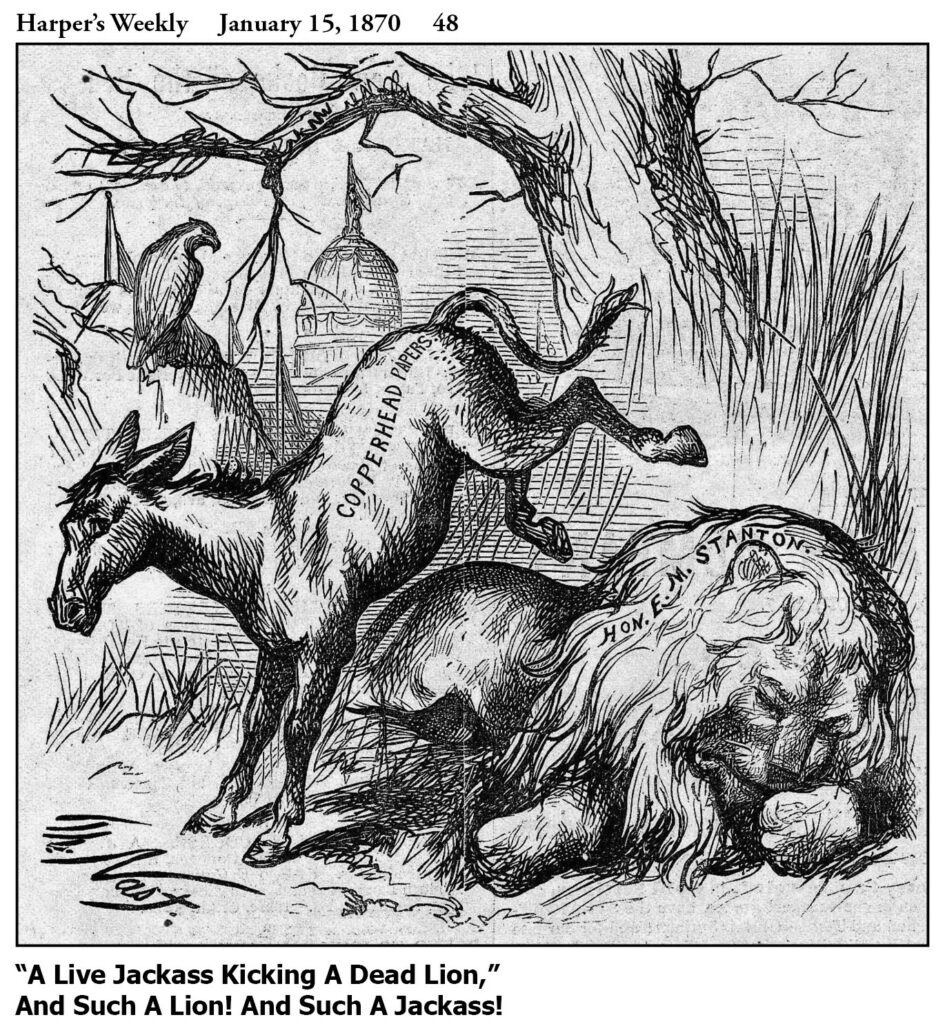
There is a clue in this famous cartoon by Thomas Nast (okay — the cartoon really gives it away, doesn’t it?):

Thomas Nast, Live Jackass kicking a Dead Lion,Harper's Bazaar, January 15, 1870

Cartoon depicting Democrats Thomas Nast, Live Jackass kicking a Dead Lion. Edwin Stanton was fired as Secretary of War by President Andrew Johnson, contrary to the Tenure of Office Act, and that action brought on the impeachment and trial of Johnson (who was acquitted by one vote). Later, President U. S. Grant appointed the financially and health ailing Stanton to the Supreme Court. Stanton was confirmed, but went home and died that night, December 24. Stanton’s opponents continued to try to smear him. Nast’s cartoon was the result. Harper’s Bazaar, January 15, 1870

Watch for the answer in a future post.

Image: Thomas Nast cartoon from Harper’s Weekly, January 15, 1870. Nast’s use in cartoons greatly popularized the use of a donkey as a symbol of the Democratic Party, whose official animal mascot is a rooster. Image in public domain, this one from the Thomas Nast Portfolio of The Ohio State University.

Also, note the explanation by Ray in comments, for historical accuracy.


Accuracy: A good bias (DDT again)

August 4, 2007

Jay Ambrose retired from editing newspapers, and now writes commentary for the Scripps News chain of papers. Because of his experience in editing, I was suprised to see his commentary from last week which takes broad, inaccurate swipes at environmental groups (here from the Evansville, Indiana, Courier & Press).

Ambrose is victim of the “DDT and Rachel Carson bad” hoax.

His column addresses bias in reporting, bias against Christians, which he claims he sees in reporting on issues of stem cell research, and bias “in favor” of environmentalists, which has resulted in a foolish reduction in the use of DDT. I don’t comment here on the stem cell controversy, though Ambrose’s cartoonish presentation of how federally-funded research works invites someone to correct its errors.

Relevant excerpts of Ambrose’s column appear below the fold, with my reply (which I have posted to the Scripps News editorial section, and in an earlier version, to the on-line version of the Evansville paper).

Read the rest of this entry »


Saving Texas’s only natural lake

August 3, 2007

Aptly named, Salvinia molesta threatens to choke Caddo Lake to death. As Caddo Lake is the only natural lake in Texas, and a site of outstanding beauty and great natural treasure, the friends of Caddo Lake are fighting back.

Spraying Salvinia molesta on Caddo Lake - NY Times photo by Michael Stravato

The New York Times features a lengthy story on the lake and the fight to save it in this week’s Science section (July 31, 2007 – Science is part of the Times every Tuesday).

Every Texas social studies teacher should know Caddo Lake and its stories as well as anything else. It’s the stuff memorable classes are made of.

1. It’s the only “natural” lake in Texas, though it is formed by a dam. The “only honest lake in Texas,” in the local lingo. The original lake was formed by a monumental log jam on the Red River, probably trees blown down by a massive hurricane several hundred years ago.

2. Caddo Lake is named after the Caddo Tribe, the tribe whose word for friend, “tejas,” gave the state its name. (See my earlier post on Caddoland.)

3. Caddo Lake straddles what was once “no man’s land,” or the Neutral Territory, a buffer zone between English/French, then American, and Spanish, then Mexican settlements. It was a haven for criminals, scalawags, filibusterers and revolutionaries. The area plays a large role in the decades of fighting to steal Texas from the Spain, and later from Mexico. Texas history is much better understood when one knows the lake.

4. Caddo Lake once was the means to make Jefferson, Texas, a port city. Until Col. Shreveport dynamited the logjam that made the lake in 1873, Jefferson was a bustling center of commerce. Today Jefferson boasts some wonderfully preserved historic remnants of that era, many converted to bed and breakfast inns, a great weekend getaway. Fishing is good, photography is great.

5. Ladybird Johnson was born nearby, and her family still lives in the area.

6. The Hughes Tool Company had its beginnings on Caddo Lake, where Howard Hughes, Sr., tested his drill bit, “the rock eater,” designed to cut through mud and rock to where the oil was; this is the home of the fortune that Howard Hughes, Jr., inherited, to build to one of the greatest fortunes in the world. That the younger Hughes was a rake, a mechanical genius, an air pioneer, daring movie producer, and weird as hell only makes the story better. Hughes named his movie production company after the lake, Caddo Productions.

6. Contrary to most of Texas’s political leanings, local people around Caddo Lake have rallied to efforts to protect the lake and conserve its rare beauty. The area is designated for protection as a Ramsar Treaty critical wetlands site — a designation that most conservative Texans ridicule and fear (at one point the Texas Republican Party platform opposed conservation easements to protect the lake bizarre). Latter-day Caddoans welcome the designation, and when we toured the area they sang the praises of Don Henley, the rock and roll musician who is aiding their efforts to save the lake. It’s an odd combination for any political work — uniquely Texas. (Here’s your chance to play the Eagles for your classes, teachers!)

7. When it comes to Texas botany, zoology, and biology in general, Caddo Lake provides the local angle for water quality, water shortages (one proposal is to steal water from the lake for Texas cities far away), wildlife management, and of course, the invasion of exotic species.

8. Everything about this area screams Texas quirkiness. Uncertain, Texas? An often-told story (accurate?) is that when the town applied for a post office, there was a dispute about what to call the town. The fellow who filled out the application wrote “uncertain” in the blank for the town’s name — and that’s how the U.S. Postal Service approved it. Another story holds that the name “Uncertain Landing” caught on because the landing was treacherous mooring for boats. You got a better story about your town’s name? I doubt it.

Save the article from the Times, teachers! You’ll be glad you have it later this year.

Add to FacebookAdd to NewsvineAdd to DiggAdd to Del.icio.usAdd to StumbleuponAdd to RedditAdd to BlinklistAdd to TwitterAdd to TechnoratiAdd to Furl


Heather Burcham, 31 — campaigner for HPV vaccinations

August 3, 2007

Then-Texas Gov. Rick Perry introducing Heather Burcham to Texas reporters, in Austin, Texas, Feb. 19, 2007 (AP Photo/LM Otero)

Then-Texas Gov. Rick Perry introducing Heather Burcham to Texas reporters, in Austin, Texas, Feb. 19, 2007 (AP Photo/LM Otero, via Houston Chronicle)

From The Dallas Morning News of July 25, 2007:

Heather Burcham, HPV vaccine advocate, who died July 21, 2007

Face of state’s HPV vaccine debate dies from cervical cancer

Burcham worked to keep girls from getting cancer that killed her

08:20 AM CDT on Tuesday, July 24, 2007

Associated Press AUSTIN – The 31-year-old woman who put a human face on the state debate over whether to require that schoolgirls be vaccinated against the virus that causes cervical cancer has died from the disease.

* * * * *

Earlier in this year’s legislative session, Ms. Burcham spoke to reporters about the issue at Mr. Perry’s request. She also tried to testify before a House committee considering the vaccine ban, but the hearing ran so late that she was unable to stay at the Capitol.

In a news conference to announce that he would not veto the bill, Mr. Perry closed with a video of Ms. Burcham speaking from her hospice bed.

With oxygen tubes snaking out of her nose, she spoke of the pain she had endured for four years. She also mourned for the husband she’ll never meet and the children she’ll never raise. “If I could help one child, take this cancer away from one child, it would mean the world to me,” she said. “If they knew what I was going through, how incredibly painful that this was … then I feel like I’ve done my job as a human on this earth.”

The governor said that Ms. Burcham “was intent on making a difference. Her life, she said, would not be in vain.”

The strains of HPV that the vaccine prevents cause 70 percent of cervical cancer cases. But opponents said the vaccine was still unproven, and some objected to a state mandate involving a sexually transmitted virus. Mr. Perry’s order would have allowed parents to decline to have their daughters inoculate.

_______________

I post this notice more than a week late. A discussion at Pharyngula revealed that many people either had not learned from the Texas discussion, or had already forgotten the key points. Then Only Crook provided the link to a homeschooler’s rant against the vaccine (read, “in favor of our children getting cancer”). Dear Reader: Remember Heather Burcham, and remember the facts about HPV vaccines.

Heather Burcham waiting to testify to the Texas lege

A thumbnail version of Heather Burcham’s photo by Eric Schlegelman

Update September 23, 2011:  Lots of hits on this post today, probably because of the association of Rick Perry with this issue.   Welcome, new readers.  I regret that the larger version of the photograph of Heather Burcham, by Eric Schlegelman of the Dallas Morning News, is no longer available at their website, to which I linked.  If you need a photo to publish, I urge you to contact the paper or Mr. Schlegelman to get a copy.


Quote of the Moment: “What is an American?” – Ferrara

August 3, 2007

This was written by Peter Ferrara, who was then an associate professor of law at George Mason University’s law school; it appeared in National Review Online on September 25, 2001, just two weeks after the attack on the World Trade Center.  Ferrara has moved from George Mason, but his opinion piece lives on.

Copies of the article circulate around the internet, claiming to have been written by an “Australian dentist,” or by some other non-American — to add authenticity, I suppose.  Here is the original, attributed the real author, as best I can determine.  

_________________________________

What is an American?  A primer 

ou probably missed it in the rush of news last week, but there was actually a report that someone in Pakistan had published in a newspaper there an offer of a reward to anyone who killed an American, any American.

So I just thought I would write to let them know what an American is, so they would know when they found one.

An American is English…or French, or Italian, Irish, German, Spanish, Polish, Russian or Greek. An American may also be African, Indian, Chinese, Japanese, Australian, Iranian, Asian, or Arab, or Pakistani, or Afghan.

An American is Christian, or he could be Jewish, or Buddhist, or Muslim. In fact, there are more Muslims in America than in Afghanistan. The only difference is that in America they are free to worship as each of them choose.

An American is also free to believe in no religion. For that he will answer only to God, not to the government, or to armed thugs claiming to speak for the government and for God.

Read the rest of this entry »


Instapundit plays politics with Iraq policy

August 3, 2007

Glenn Reynolds wants to be able to blame Democrats regardless what happens in Iraq. Instapundit jumps on a stretched, absurd claim that Democrats will “be in trouble” in the 2008 election if the surge in Iraq works.

Santayana’s ghost laughs.

First, one needs to remember what happened to George Bush I, whose approval ratings were north of 80% at the conclusion of the Persian Gulf War, which liberated Kuwait from Iraqi occupation. On February 28, 1991, George H. W. Bush looked to be a solid lock for winning the 1992 election campaign.

Bill Clinton defeated Bush handily just 22 months later. Among many other factors, with the nation not focused on war in the Middle East, the economy became a key issue. There are a few people deep in Democratic strongholds who are cynical enough to say the Iraq War could have been over by the end of 2003, but Karl Rove wanted a war to be sure Bush won in 2004, Rove having observed the lessons of 1992.

Read the rest of this entry »


Disasters, on sale

August 3, 2007

Cover of NYTimes book on disastersFollow-up on yesterday’s post on disasters:  Looking at the sale books at the New York Times site, I discovered this one on sale:  The New York Times Book of Natural Disasters.  $8.48, while supplies last.

Tuesday’s Science sections in the Times are weekly delights.  This series of books on one topic contains several that I use regularly (especially archaeology and fossils).  Generally these books hold some of the best articles by the stable of thoroughbred science writers on the topic at hand.

Did I say “science?”  Social studies teachers need to know science, too.


Disasters!

August 2, 2007

Popular Mechanics features the “Ten Worst Disasters of the Century,” showing how Americans fought back after natural disasters in — roughly — the 20th century.

It’s an odd century used — it leaves out the Galveston, Texas, hurricane disaster of 1900, but it includes Hurricane Katrina in 2005 (maybe it would more accurately be titled “disasters of the last 100 years”). The list is limited to natural disasters, so the Texas City harbor disaster of 1947 isn’t even considered, and the New London, Texas, school explosion doesn’t make the list. Those are quibbles; Texas teachers, and others, can supplement the list to accommodate other local, national and man-made disasters.

The Dust Bowl, which I would argue was greater than any of the other disasters listed, is also left off — too long a disaster?

The Popular Mechanics list is still a treasure trove for geography and history teachers. You might want to go out today to find the magazine at a newsstand, and pick up a copy or two. Throughout this post I sprinkled several links to the website of Popular Mechanics.

Here is the Popular Mechanics list of top 10 natural disasters, in chronological order:

1. 1906 San Francisco Earthquake

2. The Big Burn of 1910

3. 1918 Spanish Flu Epidemic

4. Tri-state tornado of 1925 (one tornado across Missouri, southern Illinois and Indiana)

5. The New England Hurricane of 1938

6. The Great Alaskan Earthquake and Tsunami of 1964

7. 1974 Super Tornado Outbreak

8. Mt. St. Helens Eruption, 1980

9. 1993 Storm of the Century (snow)

10. Hurricane Katrina, 2005

There you have ten disasters of the 100 years between 1905 and 2005. For a geography or history class, that could be ten days of study — a map each day, a history timeline each day featuring especially who was president at the time (and how the president reacted), a story of geology or meteorology or public health each day. At the end of a ten-day unit the class could have made ten different maps covering most of the U.S. but Hawaii, covering the technology developments of the 20th century, especially the development of radio, air travel, and space technology (weather satellites), and covering the development of human institutions to cope with disasters and prevent future disaster, especially communication, transporation, medical care, banking and other investments (the rise of the Bank of America from the San Francisco Earthquake is a great little piece of history all by itself), and government.

This is not the curriculum most of the state testing authorities envision. Students will remember the geography, history and technology of these ten days with a lot more clarity and depth than most other units a teacher might cover.

Alternatively, these could be ten Disaster Fridays, reinforcing geography and history in particular. I’m sure I’ve just scratched the surface — how do you use disasters, especially these ten, in your classroom now? Tell us about it in the comments, please.

Other disasters?

No rule says you have to stick with ten, or that you need to stick with the 20th century, or with natural disasters. Here are several other disasters that you may want to include in your curricula, again in chronological order:

The Great Chicago Fire of 1871 (October 8), which every school kid ought to know about; coupled with the fire in Peshtigo, Wisconsin, the same night, which was the deadliest fire in American history; news was slow to get out because nearly every person in Peshtigo died, and the town was literally burned off the map.

The blizzards of 1888 — the Schoolhouse Blizzard of January 12, which killed more than 200, mostly school students, and the Great Blizzard of 1888 which paralyzed much of the nation a couple of months later, from March 12 to March 14.

The Johnstown Flood, May 31, 1889 — a disaster seriously compounded by the folly of men and a leaky dam.  2,200 dead.

The Galveston Hurricane of 1900, memorialized in the best-selling history Isaac’s Storm. At least 8,000 people died in Galveston, Texas’s largest city — and maybe as many as 15,000. There were too many bodies to count. Galveston invented a new form of government to help recover from the storm, the city commission style of government, which has been adopted widely throughout the U.S. Another large hurricane struck Galveston in 1915, killing 235 people — but it was so small in comparison, it is usually forgotten.

The 1909 Cherry Mine Fire (Bureau County, Illinois) — 259 men and boys died in a coal mine fire.

Dawson, New Mexico, Mine Disaster, October 22, 1913. 263 dead.

The Sinking of the Steamer Eastland on Lake Michigan, July 24, 1915. 840 people died.

The Boston Molasses Disaster of 1919, which featured walls of hot molasses 35 feet high careening through the streets of Boston — 21 died.

The Tulsa Riot, 1921 — a race riot that killed 300 people and destroyed the African American “Wall Street.”

The Great Mississippi Flood of 1927, which shook the social and civic foundations of riverside cities and towns.

The Dust Bowl, 1931-1939

The Ohio River Flood of 1937, which killed over 200 and pushed a million people out of their homes.

The New London, Texas, School Explosion, March 18, 1937.  In Texas’s richest school district, a gas pipeline heated the building for free.  In the era before odorfactants were added to natural gas to alert people of leaks, no one suspected the leak.  Nearly 300 died in the explosion, mostly children.

The 1946 Aleutian Islands Earthquake and Tsunami, and the April Fools Tsunami in Hawaii. An earthquake registering 7.8 struck the Aleutian Islands in far western Alaska. Six people died there. 159 people died in Hawaii when the resulting tsunami struck several hours later — the death toll perhaps increased because many people thought the warnings of a coming wave to be an April Fool’s prank.

The Texas City Explosion, 1947

The Montana-Yellowstone Earthquake, 1959, a 7.3 shaker which killed 28 people and created a new lake, Quake Lake, on the Madison River.

The Watts Riots, August 1965.

The Detroit and Newark Riots, 1967. Yes, it was “the Summer of Love.” Still, there were 164 “civil disorders” (riots) in 128 different U.S. cities. Detroit and Newark were the worst.

The Yellowstone Fires, 1988.

The Great Flood of 1993 (Mississippi River).

The 1997 Red River Flood (North Dakota, Minnesota and Manitoba, Canada).

Good heavens. That’s a depressing list. Still, I wonder — have I left anything off? Tell me in the comments, if you see something missing.

Other sources:


When things get tough, the patriotic listen to Barbara Jordan

August 2, 2007

Whose voice do you hear, really, when you read material that is supposed to be spoken by God? Morgan Freeman is a popular choice — he’s played God at least twice now, racing George Burns for the title of having played God most often in a movie. James Earl Jones?

Statue of Barbara Jordan at the Austin, Texas, Airport

Statue of Rep. Barbara Jordan at the Austin, Texas airport that bears her name. Photo by Meghan Lamberti, via Accenture.com

For substance as well as tone, I nominate Barbara Jordan’s as the voice you should hear.

I’m not alone. Bill Moyers famously said:

When Max Sherman called me to tell me that Barbara was dying and wanted me to speak at this service, I had been reading a story in that morning’s New York Times about the discovery of forty billion new galaxies deep in the inner sanctum of the universe. Forty billion new galaxies to go with the ten billion we already knew about. As I put the phone down, I thought: it will take an infinite cosmic vista to accommodate a soul this great. The universe has been getting ready for her.

Now, at last, she has an amplifying system equal to that voice. As we gather in her memory, I can imagine the cadences of her eloquence echoing at the speed of light past orbiting planets and pulsars, past black holes and white dwarfs and hundreds of millions of sun-like stars, until the whole cosmic spectrum stretching out to the far fringes of space towards the very origins of time resonates to her presence.

Virgotext carried a series of posts earlier in the year, commemorating what would have been Jordan’s 71st birthday on February 21. (Virgotext also pointed me to the Moyers quote, above.)

Now, when the nation seriously ponders impeachment of a president, for the third time in just over a generation, Ms. Jordan’s words have more salience, urgency, and wisdom. It’s a good time to revisit Barbara Jordan’s wisdom, in the series of posts at Virgotext.

“There is no president of the United States that can veto that decision.”

“My faith in the Constitution is whole.”

“We know the nature of Impeachment. We’ve been talking about it a while now.”

“Indignation so great as to overgrow party interests.”

And finally:

The rest of the hearing remarks are all here. It’s a longer clip than the others but honestly, there is not a good place to cut it.

This is Barbara Jordan on the killing floor.

This was a woman who understands history, who illustrates time and again that we are, with every action, with every syllable, cutting the past away from the present.

She never mentions Nixon by name. There is the Constitution. There is the office of the Presidency. But Richard Nixon the president has already ceased to exist. By the time she finishes speaking, he is history.

“A President is impeachable if he attempts to subvert the Constitution.”

Also see, and hear:

Virgotext’s collection of Barbara Jordan stories and quotes is an excellent source for students on Watergate, impeachment, great oratory, and Barbara Jordan herself. Bookmark that site.

Barbara Jordan, in a pensive moment, in a House Committee room

Rep. Barbara Jordan sitting calmly among tension, at a House Committee meeting (probably House Judiciary Committee in 1974).

Update 2019: Here is the full audio of Barbara Jordan’s speech. It is still salient, and if you listen to it you will understand better what is going on in Congress today.

Barbara Jordan, Statement on the Articles of Impeachment, at AmericanRhetori.com.