Skirmishes before the war? Creationist assault on Texas

September 21, 2007

Intelligent design advocates’ chief claim holds that where a pattern may be discerned, there is someone with intelligence scheming away.

That explains a recent spattering of activities in Texas that otherwise are just blots of minor, irritating news. It points to animus against science in top religious and political circles in Texas — if, of course, there is anything at all to intelligent design’s chief premise.

Scientists and citizens for good government, and parents concerned about good education, should note these recent actions:

First, ID advocates tried to establish a stealth toehold at Baylor University. The Waco Tribune explained the otherwise odd events surrounding Bill Dembski’s latest foray into Baylor — he got himself designated as a “post-doc” student for an engineer’s project, and a website featuring a new sciency term, “informatics,” quickly appeared. School administrators were not satisfied with the transparency and legitimacy of funding for the project, and pulled the plug on it, producing wails of “oppression” from the ID harpy chorus.

Dembski is a professor at the Southwestern Theological Seminary in Fort Worth. Had he been collaborating with Robert Marks at Baylor, one would think that collaboration from his professorial position would carry more clout, attract more funding, and generally make a lot more sense than having the multiple-degreed Dembski do post-doc work in engineering, a field he’s not yet got a degree in. Apart from the sheer humor of Dembski pursuing one more degree that is not biology in order to try to get the credentials to assault biology, the sheer stupidity of the affair has put scientists off-guard, satisfied that Baylor’s integrity watchdogs have protected science adquately. I’m not so sure.

Second, without much fanfare outside extreme fundamentalist circles, the Institute for Creation Research moved most of its operation from California to Dallas. The stated reasons include proximity to DFW Airport, which makes sense for a corporation like J. C. Penney or Exxon-Mobil, but doesn’t really make a lot of sense for a “school” that has fought to get the right to grant graduate degrees in California.

Third, Texas Gov. Rick Perry’s appointment of a stiff-necked creationist to be the chairman of the Texas State Board of Education produced concern among educators and scientists, especially remembering Chairman Don McLeroy’s positions on creationism and evolution in the last biology textbook approval round, in 2003 (not to mention his anti-disease prevention stance on health books in 2004). Concern was defused by a Dallas Morning News article in which McLeroy and other creationists on the board said they would not work to put intelligent design into the curriculum.

But reports from meetings of the SBOE in the past week make it clear that the creationist agenda is still very much alive, with McLeroy working with other creationists to break standard procedures for curriculum review, and to stack panels reviewing science standards with people who will work against evolution, cosmology, environmental protection and wildlife management, and disease prevention. Politics of Christian dominionists appear to dominate the discussions at the education board, rather than the rigor of the curriculum or how best to teach students so they can ace federally-mandated state tests. Pedagogy takes a back seat to religious politics.

Individually, each of these events is just another in a long string of nuttiness.  The moving of ICR to Texas, however, means that ICR representatives would have the Texas citizen’s right to testify at textbook hearings.  These may be unconnected events of wingnuttery, or they may be initial moves to be in the right place to gut science textbooks in the next round of Texas textbook approvals.

It is best not to assume intelligent design where mere incompetence also provides an sufficient answer.

But watch what happens next.


West Nile 2007: DDT not needed

September 21, 2007

Kern County, California, is ground zero for West Nile virus trouble in 2007. It’s a still-partly rural area, with many farms, around Bakersfield. California so far this year has more than 200 cases of human infection from West Nile reported, and 115 of those cases are in Kern County. Eight people died from the infections, all of them elderly.

So, were DDT the answer to West Nile virus problems, Kern County would be the first place from which we would expect to hear a plea for DDT.

Not so.

Kern County officials hope they’ve turned a corner. There were only eight new cases reported last week, and officials think that their spraying program may have contributed a lot.

Yes, you read that correctly: The spraying program in Kern County is credited with reducing West Nile virus infections in humans.

Occasional readers of this outlet might well ask: What are they spraying with, if not DDT?

Despite the Snake-oil Salesmen™ claim that the U.S. needs to poison itself with DDT in order to fight West Nile, officials in public health use other substances to fight mosquitoes directly, when there is an outbreak of West Nile virus-related disease in humans, or sometimes just in birds.

[Notice: Original reporting ahead]

The Kern County Department of Public Health Services actively fights West Nile, with public education, help to medical care professionals, and information to decision makers on what steps need to be taken. People at the agency were anxious to talk about their work against West Nile.

What do they use to spray for mosquitoes? Not DDT.

I checked with two other mosquito abatement groups, including Dallas County’s.  They were anxious to talk about their work, though not for attribution without approval of their PR managers, who have so far not returned calls (public relations is impossible when you don’t relate to the public, guys).

Those who do the spraying emphasize that spraying is rather a last resort, and done only after significant research shows it is necessary. Spraying kills more than the mosquitoes, including a lot of creatures that would normally eat the mosquitoes and keep them in check.  So spraying is done only when the mosquitoes seem to have an unnatural tipping of the balance in their favor.

Public health departments set traps for mosquitoes.  These traps are checked regularly, and the mosquitoes are sorted by species.  This is vitally important, because West Nile virus is carried only by certain species of mosquito, and different species require different abatement plans, and different insecticides.

Once sorted by species, the mosquitoes are sampled to see which are carrying pathogens, if any.  In addition, most public health agencies also monitor birds, by reports of bird carcasses (almost always a sign of disease or poisoning), and by captive populations of chickens, whose blood is sampled to see whether viruses are present.

After the species are identified, the viruses are identified, and it is determined that there is virus activity, a decision is made on whether to spray.

For West Nile, the chief vector is a species of Culex.  Culex mosquitoes are generally controlled by larvacides, not spraying for adults.  If spraying for adults is determined necessary, most health departments are using synthetic pyrethroids, synthetic versions of insecticides plants manufacture.  While they are not as environmentally friendly as natural pyrethrins, they are much less dangerous than DDT.

The sprayers I spoke with also made this point:  The old model of DDT spraying of entire neighborhoods is outdated.  “It is not a good use of the product,” as one gently put it.

For West Nile virus control, here’s what you need to tell Henry I. Miller, up in the ivory towers at the Hoover Institute promoting voodoo science:

1.  No one thinks West Nile virus is out of control (but it’s a problem).

2.  Health official thinks current, non-DDT methods of mosquito control are adequate to control for West Nile virus.

3.  Even when spraying is required, DDT is the wrong stuff to use Culex is generally controlled with a larvacide, and DDT spraying would be much less effective, and much more destructive.

I asked the abatement people if they were concerned about killing birds with spraying, or killing other things that eat mosquitoes.  Basically, they said it’s not their job, but the chemicals they use are much gentler on birds and other mosquito predators than DDT is.  One fellow said about collateral bird deaths:  “I have bigger finch to fry.”


Historic maps: Florida and the Gulf of Mexico

September 21, 2007

Go to the University of Florida Smathers Library site, and admire the beauty of these old maps of Florida and the Gulf of Mexico. (While I think fair use would cover it, I’m holding back on posting an image until copyright permission comes through — you’re licensed to use them in the classroom, however.)

What else would you expect from a library named after Sen. George A. Smathers, who was part of that legendary 1950 Senate campaign in Florida?

The maps featured on the first page include Spanish, Dutch, English, Belgian, French and Italian maps of the early explorers, suitable certainly for Texas history courses, and also for Florida, Louisiana and U.S. history units on European exploration.

This site is quite Florida-centric, but it’s links also provide some interesting and valuable resources, such as the link to satellite imagery of the areas, like the NOAA map, below.

NOAA map of ocean water temperatures around Florida, satellite image

Tip of the old scrub brush to A Cracker Boy Looks at Florida


DDT damages plants, too?

September 20, 2007

A columnist for The Christian Science Monitor argues that DDT damages plants, too — more reasons not to release it into the wild.

DDT stunts food crops? Plants?  Is that accurate?

Go see:

For the past several years, Jennifer E. Fox at the University of Oregon in Eugene has used test tube experiments to study the subtle way pesticides impede this nitrogen-fixing process. Last June she joined several colleagues to report research with real plants. Their paper, published in the Proceedings of the National Academy of Sciences, shows that the pesticides block the bacteria recruitment “signal” that legumes emit. “In essence,” Dr. Fox says, “the agrichemicals are cutting the lines of communication between the host plants and symbiotic bacteria.”

This has serious implications for farmers. Heavy use of commercial nitrogen fertilizers is showing diminishing returns in terms of crop yields, while fertilizer runoff contaminates streams, lakes, and even coastal ocean areas. If legumes can’t do their natural fertilizing job, even more artificial fertilizer will be required.


1872 Mining Act – Amend it now?

September 20, 2007

Sherffius cartoon on Bush administration mining regulations

Few people know about the law. Since 1872, mineral extraction from the public lands of the United States has been governed by a law designed to make it easy for miners to get minerals out. The law is essentially unchanged, though some mining operations are now bound by other laws to protect the environment and other uses of public lands, such as grazing, tourism, scientific study, wood production, grazing, wildlife management and hunting.

The Senate Committee on Energy and Natural Resources opens hearings on reforming the law next Thursday, September 27. The hearing will be webcast, most likely.

The House of Representatives has already had a couple of field hearings.

Watch your claims!

Resources:


Hijacking science in Texas

September 20, 2007

It looks a lot like inside baseball. It’s conducted away from classrooms, while teachers struggle to deliver science to students in crowded classrooms without adequate textbooks, without adequate science labs and without adequate time. The perpetrators hew to Otto von Bismark’s claim that the public shouldn’t see their laws or sausages being made.

Since Bismark, in the U.S. we have food safety laws to protect our sausage. In Texas, the political scheming in the State Board of Education (SBOE) continues to spoil science education.

Science standards for Texas Essential Knowledge and Skills (TEKS) — the Texas state science education standards — are being rewritten by the Texas Education Agency, under direction of the SBOE. While procedures have been consistent over the past 15 years or so, and the state legislature reined in SBOE from political shenanigans in textbook selection, SBOE members are fighting back to get the right to skew science standards. For weeks the selection of committees to review specific standards have been held up so members of the SBOE can stack the committees to put their political views in.

Board members are insisting on stacking the review committees now, weeks after the deadline for members to nominate qualified teachers and experts to review the standards.  This is the gateway to the path of bad standards through which we earlier watched other school boards frolic — Cobb County, Georgia, Dover, Pennsylvania, and the State of Ohio.  Taxpayers in Cobb County and Dover paid the price when courts correctly noted that the changes proposed violated  the religious freedom clauses of the state constitutions and the First Amendment.  Ohio’s board backed down when a new governor cleaned house, and when it became clear that their position would lose in court.

Simply gutting the standards, however, may not rise to the standard of illegal religious influence.  Keeping kids in the dark may not violate federal or state law.  It’s immoral, but would the Texas State Board stick to that side of morality?  Many observers doubt it, given the track record of recent years striking important health information from texts that might save a few lives, and the legislature’s pro-cancer legislation this year.

Some observers have provided detailed reports that to many of us look like simple foot dragging. In the past week it has become more clear that the foot dragging is really political positioning.

If anyone was lulled to sleep by the Dallas Morning News article a few weeks ago which touted board members’ claims they would not advocate putting intelligent design into the biology curriculum, the greater fears now seem to be coming true:  Board members did NOT say they would stand for good science, or that they would not try to cut evolution, Big Bang, astronomy, geology, accurate medicine and health, and paleontology out of curricula.  The Corpus Christi Caller-Times warned:

Board chairman Don McLeroy, though indicating that he won’t support the teaching of intelligent design, says he would like to see more inclusion in textbooks of what he called weaknesses in the evolutionary theory, a sentiment expressed by many of the predominantly Republican 15-member board.

This only sounds like another version of a common tactic by religious pressure groups that seek to create a controversy about evolution that only exists in their opposition. That nicely covers their ultimate goal of converting classrooms into pulpits for religious teachings.

Texas schoolchildren will be the losers if the teaching of science, or health, or history — all subjects that have been the target of pressure groups — is based on something other than the best known and most widely accepted bodies of knowledge. In a pluralistic nation with many creeds and religions, letting personal faith become the guiding force for the public school curriculum invites creation of a battleground.

Texans should watch the State Board of Education in the months to come.

Just over a month ago one of the chief theorists behind Big Bang theory died in Austin, Ralph Alpher. His death went largely unnoticed. In 2003, with the Nobel Prize winning-physicist Ilya Prigogine of the University of Texas not yet cool in the grave, charlatans felt free to misrepresent his work on thermodynamics, saying he had “proved” that evolution could not occur.  In fact, his prize-winning work showed that on a planet like Earth, evolution is a virtual certainty.  Prigogine, Alpher: A greater tragedy is brewing: Will Big Bang survive the hatchets of anti-science forces on the SBOE? Many hard theories of science are unpopular with religious fanatics in Texas. Those fanatics are over-represented on the SBOE.

Don’t just watch.  Write to your board member, to the TEA director, to the governor, to the legislature.  One way to keep “no child left behind” is by holding all children back.   Texas and America cannot afford such Taliban-like enforcement of ignorance.


Political cartoons: Powerful images, powerful ideas

September 20, 2007

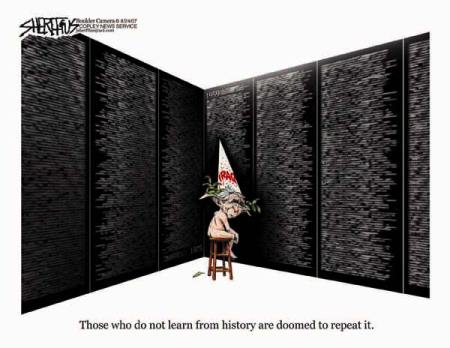
Sherffius in the Boulder Daily Camera, August 2007 - copyright Sherffius

Sherffius in the Boulder Daily Camera, August 2007 - copyright Sherffius

Sherffius, in the Boulder (Colorado) Daily Camera

The deadline for cartoonists to enter the Ranan Lurie Prize competition at the United Nations is October 1. The winning cartoon from 2006, from Argentinian cartoonist Alfredo Sabat, is one of the most popular images in Google’s image search for “cartoon.”

Images pack a punch. If a pen is mightier than a sword, a cartoonist’s pencil and ink drawing can be more powerful than a cannon.

While we wait for the winners of the Lurie competition, we can look around to see other great cartoonists’ work. Earlier I tried to call attention to the work of John Sherffius at the Boulder (Colorado) Daily Camera. Since then, he’s won the James Aronson Social Justice Award for Graphics for the body of his work. The power of his drawings should be clear from the cartoon above.

Do you have a favorite cartoonist, especially one from a smaller newspaper who has not yet received the kudos she or he is due? Tell us about it in comments — and give links, if you can.

And share the word with others:

Add to FacebookAdd to NewsvineAdd to DiggAdd to Del.icio.usAdd to StumbleuponAdd to RedditAdd to BlinklistAdd to TwitterAdd to TechnoratiAdd to Furl


Science history slips away: Ralph Alpher and Big Bang

September 20, 2007

Looking for something else in an old newspaper, I came across a small obituary for Ralph Alpher. Alpher died August 12, 2007, in Austin, Texas, at the home of his son, Dr. Victor S. Alpher.

Ralph Alpher, physicist who co-hypothesized the Big Bang

Ralph Alpher, physicist who co-hypothesized the Big Bang

Ralph Alpher gave us the Big Bang. We let him slip away, almost unnoticed. Odds are you don’t recall ever hearing of Alpher. Here’s your mnemonic: The alphabet paper.

In 1948, as a graduate student under George Gamow at the George Washington University, Alpher and Robert Herman of Johns Hopkins laid the groundwork for what would become Big Bang theory, calculating how matter could arise in the Universe. Gamow, exhibiting the sense of humor for which physicists are famous, listed the authors of the paper as Alpher, Bethe, Gamow and Herman — a play on the Greek alphabet’s first three letters (alpha, beta, gamma), and a joke invoking the name of the great physicist Hans Bethe. Bethe liked the joke, consulted on the paper, and the theory of Big Bang was published.

Ralph Alpher, in Florida, 2006; Alpher home page

The name “Big Bang” was applied a few years later; Sir Frederick Hoyle and his colleagues favored a “steady state” universe, and at the time both hypotheses could accurately predict most of what was observed, and neither could be disproven. Hoyle, hoping to poke ridicule at the competing hypothesis, belittled it as “a big bang.” The name stuck. The name misleads the unwary; the theory posits a rapid expansion at the beginning of the universe and time, but not an explosion, per se.

Alpher wrote the mathematical model; the model predicted Big Bang, and specifically, it predicted the cosmic background radiation that would have been left over; it was this background radiation, the “echo” of Big Bang, that Arno Penzias and Robert Wilson stumbled across in 1965. Robert H. Dicke had invested several years in trying to discover this signature, and had to explain to Penzias and Wilson what they had found. Penzias and Wilson won the Nobel Prize for their discovery; Dicke, Alpher, Herman and Gamow, did not get Nobel Prizes. This is generally regarded as one of the great miscarriages of justice in Nobel Prize awards, not that Penzias and Wilson did not deserve an award, but that the chief theorists and the man who unveiled the discovery were overlooked.

This is another story of rejection leading to great discovery; it is also a rather sad story of a momentous achievement, mostly overlooked through the years.

Alpher was the son of Jewish émigrés from the Russian pogroms. His high school achievements merited a scholarship to the Massachusetts Institute of Technology, in 1937. MIT had a rule at the time that scholarship recipients could not work outside the school. Alpher assisted his father in building houses in the Washington, D.C. area; the family had little money, and Alpher would be unable to pay room and board without working. Discussions with MIT broke down — the offer of a scholarship was withdrawn, according to most accounts when MIT discovered he was a Jew. As so many great people of the post World War II era, he enrolled at the George Washington University.

At GWU, Alpher found Gamow as a mentor, and much of the rest is history.

The New York Times:

The paper reported Dr. Alpher’s calculations on how, as the initial universe cooled, the remaining particles combined to form all the chemical elements in the world. This elemental radiation and matter he dubbed ylem, for the Greek term defining the chaos out of which the world was born.

The research also offered an explanation for the varying abundances of the known elements. It yielded the estimate that there should be 10 atoms of hydrogen for every one atom of helium in the universe, as astronomers have observed.

Months later, Dr. Alpher collaborated with Robert Herman of the Applied Physics Laboratory at Johns Hopkins University on a paper predicting that the explosive moment of creation would have released radiation that should still be echoing through space as radio waves. Astronomers, perhaps thinking it impossible to detect any residual radiation or still doubting the Big Bang theory, did not bother to search.

The Alpher-Bethe-Gamow paper, or αβγ paper, as explained by the American Institute of Physics:

When Alpher and Gamow prepared a paper on the subject, Gamow mischievously added the name of the noted nuclear physicist Hans Bethe to the list of authors so it would be called the “Alpher-Bethe-Gamow paper,” mimicking the “alpha-beta-gamma” of the first letters of the Greek alphabet. Unknown to Gamow, Bethe was a reviewer for the journal to which Gamow submitted the article. Bethe took it in good humor, later explaining, “I felt at the time that it was rather a nice joke, and that the paper had a chance of being correct, so that I did not mind my name being added to it.” Gamow also urged Herman to change his name to Delter to match delta, the next letter in the Greek alphabet. Despite Herman’s refusal, in a paper in a major scientific journal Gamow referred to “the neutron-capture theory…developed by Alpher, Bethe, Gamow and Delter.” Not least among his notable characteristics was his sense of humor.

Alpher continued in this work for a time, but joined General Electric’s labs in the 1950s. When he retired from GE, in 1986 he joined the faculty at Union College in Schenectady, New York, and taught there until 2004.

Alpher was largely overlooked for awards even while his theory was big news in astronomy and physics for the last 40 years of the 20th century. I regret that I was wholly unaware he was in Austin; how many other great contributors to science and history live among us, unrecognized, uncelebrated, and their stories unrecorded?

Alpher, Herman and Gamow - and the famous Cointreau bottle

Photo caption from AIP: A 1949 composite picture with Robert Herman on the left, Ralph Alpher on the right, and George Gamow in the center, as the genie coming out of the bottle of “Ylem,” the initial cosmic mixture of protons, neutrons, and electrons from which the elements supposedly were formed. [The Cointreau bottle from which the three drank a toast upon the acceptance of the paper, is now in the collection of the Smithsonian Institution.]

Alpher was an Eagle Scout. I wonder whether anyone has a history of his time in Scouting?

While the Nobel Prize eluded Alpher, he collected a host of other prestigious awards and honors. Earlier this year, President Bush announced that Alpher had been awarded the National Medal of Science, which is administered by the National Science Foundation and is the highest honor for science.

. . . [T]he citation reads in part:

“For his unprecedented work in the areas of nucleosynthesis, for the prediction that universe expansion leaves behind background radiation, and for providing the model for the Big Bang theory.”

Note from George Gamow, on confirmation of Big Bang Gamow’s humor again on display — an undated note from Gamow upon the confirmation of the Big Bang, with a punny reference to Steady State backer Sir Frederick Hoyle. Image from the American Institute for Physics.

Online sources for Ralph Alpher:

More:

Help others hear the echo:

Add to FacebookAdd to NewsvineAdd to DiggAdd to Del.icio.usAdd to StumbleuponAdd to RedditAdd to BlinklistAdd to TwitterAdd to TechnoratiAdd to Furl


Soon to be famous rejection: Harvard to Warren Buffett

September 19, 2007

A California woman donated $128 million to a Quaker boarding school.  Her fortune is the result of her father’s wise investment with one of his former students, Warren Buffett.

Barbara Dodd Anderson made the gift to the George School in Bucks County, Pennsylvania.  She is the daughter of Buffett’s former professor at Columbia University’s graduate business program, David L. Dodd.  Dodd invested with Buffett, having been impressed with Buffett’s acumen as a student.

But Buffett owed Dodd a lot, too.  It was Dodd who got Buffett into Columbia, after Harvard rejected him.  Here’s the gist of that part of the story, from the New York Times:

In an interview, Mr. Buffett said Professor Dodd had turned his life around in 1950, when he graduated from the University of Nebraska and was applying to business school. Harvard rejected his application, and that August, well after Columbia’s application deadline, Mr. Buffett wrote to Professor Dodd, whom he admired as the author of a respected financial text.

“Dear Professor Dodd, I thought you were dead, but now that I know that you’re alive, I’d like to come study with you,” Mr. Buffett said he wrote in his letter.

“And he admitted me to Columbia!” Mr. Buffett said. “I would not be who I am today without David Dodd. If in response to my letter he’d said, ‘Sorry, its too late,’ I’d never be where I am.”

“Harvard did me a big favor by turning me down,” he said. “But I haven’t made any contributions to them in thanks for that.”


J. D. Williams, 1926-2007

September 18, 2007

Dr. J. D. Williams

Dr. J. D. Williams, the founding director of the Robert H. Hinckley Institute of Politics at the University of Utah, died at his home in Salt Lake City on September 4.

Links to news articles are provided from the Hinckley Institute’s website.

The Hinckley Institute provides powerful education, usually in the form of on-the-knife-edge training, in practical politics, the kind of politics that can change things.  Utah enjoys the benefits of many active people in politics who learned how to make things work better through a Hinckley Institute internship.

Dr. Williams led the Institute for its first ten years, from 1965 to 1975.  He was an active Democrat, but the Institute trained people of all parties, and he enjoyed good working relations with politicians of all stripes.  His personal interventions pushed many elected officials and other good citizens off to a good start.

I served two internships with the Utah House of Representatives, and got the benefit of Williams’ and Bae Gardner’s personal attention when they copied my application for a Washington intership with the National Wildlife Federation, and submitted it to the Secretary of the U.S. Senate, too.  I lost out on the NWF internship to woman I knew who had a tenth of a point better GPA in biology than I did.  But I got the internship in the office of Frank Valeo, who worked closely with his friend, Sen. Mike Mansfield of Montana, the Majority Leader.

It was a grand time in Washington in that spring of 1974, as Richard Nixon’s Watergate escapades were unfolding in the House Judiciary Committee, as the U.S. faced the first oil embargo from OPEC, as the peace in Vietnam was unraveling, and as a variety of other issues simmered across the nation.

Later I had the benefit of several great interns from the Hinckley Institute to help me out.

Robert H. Hinckley’s idea of practical political training was a great one.  The Institute could easily have sunk into mediocrity, as just a clearing house for cheap labor for bad politicians.  Under Dr. Williams’ leadership, instead it became a force for good political action, a focal point for ethical public officials.

It was a sad week for Democrats generally, in Utah.  Former Gov. Calvin L. Rampton died today.  He was 93.


Edjicatin’ like it’s 1925

September 18, 2007

Tennessee’s education poobahs have removed the word “evolution” from the title of their state biology standards section that deals with evolution. It’s now “biological change” (see Standard 6.0) Natural selection, you see, causes “biological change.”

Evolution is still mentioned, but the title is changed.

Santayana’s ghost stepped out for moment, said something about finding the ghost of John T. Scopes.

<hoax>In other Tennessee news, the legislature is debating whether to call a shovel a “spade,” or to call it  a “rake.” One side says it doesn’t matter what you call it, so long as you call it something other than what it is. One legislator made a long, impassioned speech against “a rake’s progress,” saying it isn’t mentioned in the Bible. </hoax>

Tip of the old scrub brush to Mama Tried.


UC-Irvine, Chemerinsky patch it up

September 18, 2007

Erwin Chemerinsky has agreed, again, to take the post of dean at the new law school at the University of California at Irvine.

Leaping off a bit from what Brian Leiter said earlier, that deans really don’t have any academic freedom of their own, we should note that being dean occupies more than every waking moment of a person’s life.  There are few who can do the dean’s job and continue their previous scholarship output at the same high level.  Anyone who might have been concerned about Chemerinsky’s politics can take some solace in the fact that he will certainly have to cut back on his studies and writing at least a little, in order to do his duties.

UC-Irvine’s school will open with very high expectations.  If Chemerinsky does half the job as dean that he is capable of doing, the entering class will carry with it some jealousy, or at least some wistfulness, from a lot of attorneys who will wish they could have had the experience.

If egos as big as those involved in this affair can shake hands and patch over a serious disagreement, there is hope for mankind.


Good news for history teachers: NY Times drops fees

September 18, 2007

The New York Times announced it will stop charging for access to much of its archives, from 1987 to the present, and from the paper’s inception through 1922.

Other articles from 1922 to 1987 will be available for a reduced fee, or free.

Access opens to much of the archived material at midnight tonight, September 18, 2007 (probably Eastern Time).

History, economics and science teachers especially now can get news stories of key events that were previously difficult to find and often expensive. Now-free periods of history include the periods covering the Spanish-American War, the entire administrations of Theodore Roosevelt and Woodrow Wilson, World War I, the administrations of George H. W. Bush, Bill Clinton and the current administration, the end of the Cold War, nullification and destruction of the Berlin Wall and reunification of Germany, breakup of the Soviet Union, the first Gulf War, and much more.

Still behind a proprietary shield will be World War II, the Great Depression and the New Deal, the rise of the Cold War, the Korean War, the development of atomic bombs and nuclear reactors, the discovery of the structure of DNA, the trial of John Scopes, the trial of the Rosenbergs, the McCarthy era, and the administrations of John F. Kennedy and Lyndon Johnson.

The Times said the policy change makes sense because of links from other internet sources that drive people to the Times’ site. The newspaper can make more money from advertising to those referral clicks than from charging an access fee.

This makes a great deal of high quality information about events in history available to teachers and students. One danger for the light-hearted: It may confuse students about the meaning of “free press.”


History online, from Oxnard HS

September 18, 2007

Complete outline of U.S. history, high school version from Civil War to the present, for on-line use.  Be sure to note the disclaimer!

From Oxnard High School, Oxnard, California.


Geography alert! This APOD is for you

September 18, 2007

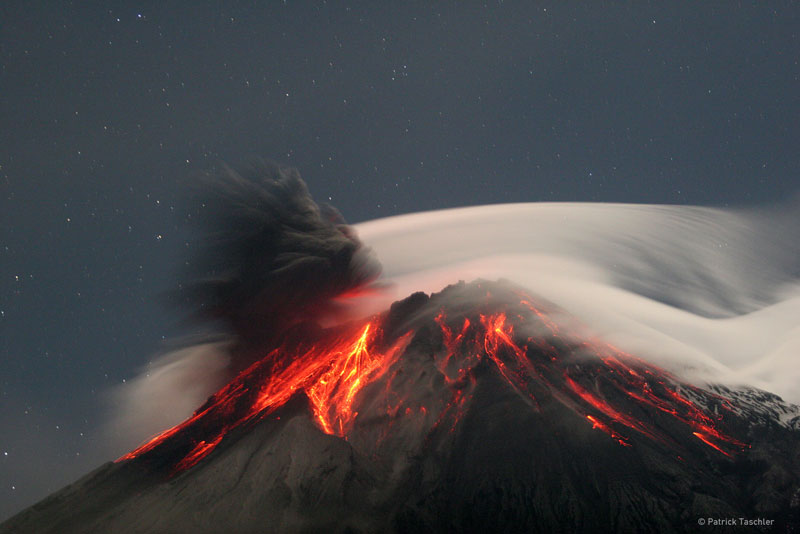
Astronomy Picture of the Day for September 18, 2007:

Tungurahua Volcano, in 2006 eruption

[Text from APOD website, edited]

Tungurahua Erupts
Credit & Copyright: Patrick Taschler
Explanation:
Volcano Tungurahua erupted spectacularly last year. Pictured above, molten rock so hot it glows visibly pours down the sides of the 5,000-meter high Tungurahua, while a cloud of dark ash is seen being ejected toward the left. Wispy white clouds flow around the lava-lit peak, while a star-lit sky shines in the distance. The above image was captured last year as ash fell around the adventurous photographer. Located in Ecuador, Tungurahua has become active roughly every 90 years since for the last 1,300 years. Volcano Tungurahua has started erupting again this year and continues erupting at a lower level even today.

Tungurahua, Ecuador, c Patrick Taschler

Click thumbnail for larger image

More information:

Tungurahua, Ecuador
Location: 1.467 S, 78.44 W
Elevation: 16,475 ft. (5023 m)

Tungurahua is an active stratovolcano also known as the “The Black Giant.” It has a 600 ft. (183 m) wide crater. Most of the volcano is covered by snow. It causes many tremors in the nearby city of Banos. Tungurahua’s lava is mostly composed of basalts. Tungurahua has had at least seventeen eruptions in historical times, its most recent occurring in 1944 when it erupted explosively from its central crater. Located about 25 miles (~40 km) west of Tungurahua is the largest volcano in Equador, Chimborazo and to the north about 50 miles(~80 km ) is Cotopaxi volcano.

APOD banner graphic