A Texas History syllabus

October 28, 2007

It’s a toe in the water of internet-using instruction.  Here’s a syllabus for a 7th grade Texas history class at Pin Oak Middle School in the Houston Independent School district.

Notice that this class, as many in Texas do, puts the geography unit up front, not quite isolated from the rest of the class.  Regardless of how well geography is covered, I think we end up shorting the subject its due.

Kudos to Pin Oak MS, to Mr. Gomez, and I hope to see more.

(Surely there is a class in Texas that is farther along in integrating the internet into the Texas history curriculum — point them to us, Dear Readers?)


Reason makes progress in malaria/DDT discussions

October 28, 2007

It’s one ray of sunshine in a sky of darkened clouds, but here’s evidence that reason occasionally overcomes bias in discussions about malaria and DDT: “More on Malaria – And Good Karma For Bill Gates,” by Scott Kirwan, at Dean’s World.

That’s good, because the nattering nabobs of negativism still pull out their long knives for Rachel Carson unjustly, unwisely, and invoking all the old junk science and hoaxes in other venues, like Collecting My Thoughts, and “DDT: Behind the Scare Stories,” at the noble-intentioned but temporarily-off-the-tracks Hawaii Reporter.

DDT is still a deadly poison, and still not a panacea against malaria. It’s nice to see reason having sway, probably due to the efforts of the Gates Foundation and its allies.


NBC video — free from HotChalk, through December

October 27, 2007

Teacher magazine reports that NBC News made available to teachers more than 5,000 chunks of news video and still photos from their news archives, for use in the classroom.

The service requires a free subscription to HotChalk through December. After that, a school subscription to HotChalk is necessary, starting in 2008.

Great resources, but I predict few teachers will have the connections to put these to work in the classroom. Comments are open, of course, for you to share your experience. Please comment on how useful you find these images, and how you use them.

Woman on cell phone, NBC News photo Historic photo of woman on early cellular telephone, NBC News photo, from HotChalk.


Global warming a piffle by comparison

October 26, 2007

Plant in drought-riven soil

Here’s the word from Bob Parks’ great e-letter, “What’s New,”October 26, 2007 edition; I’ve highlighted some stuff:

2. ENVIRONMENT: MAJOR U.N. REPORT SAYS IT’S “UNSUSTAINABLE.” According to a story in the New York Times this morning, a report issued by the United Nations yesterday in Paris is so frightening that French President Nicolas Sarkozy immediately put $1.4 billion into new energy sources and biodiversity. Unsustainable consumption of resources and population growth is taking Earth beyond the point of no return. As an example, the report says, two and a half times as many fish are being caught as the oceans can produce in a sustainable manner. No word yet from Washington on the U.S. response. No steps taken to protect the environment will help in the long run if population continues to grow.

Denialists will start whining in just a few seconds. Three . . . two . . . one . . .

Considering the weather (everywhere), fires in California, droughts in Georgia, the Nobel Peace Prize this year, you’d think this would be front page news.  Where did it run in your local paper?

Sources:


NY Times backs overhaul of mining law

October 26, 2007

Congress seriously considers changes in mining laws in the U.S. — the General Mining Act of 1872 is 135 years old with no serious changes since its passage. President Ulysses S Grant signed the law.

The law affected much of the development of the U.S. west of the Mississippi River, but this issue is generally ignored. The New York Times editorial page endorses the change process in an editorial today.

Originally enacted to encourage economic development in the West, the law gives precedence above all other land uses to mining for hard-rock minerals like gold, uranium and copper. It requires no royalties from companies that mine on public lands and contains no environmental safeguards. It has left a sad legacy of abandoned mines, poisoned streams and damaged landscapes throughout the West.

Now, at last, there is real hope for reform. Representative Nick Rahall, a West Virginia Democrat who has been trying to modernize this law for two decades, has persuaded the Natural Resources Committee to approve a major rewrite.

The law is a major study in economics, government intervention and free markets. It would make a good topic for warm-ups or government intervention lesson plans in high school economics classes.


History text accuracy: Okinawa mass suicides

October 25, 2007

Controversy surrounds history textbooks all over the world. Texans may be a bit more sensitive to the issues while the Texas Education Agency is revising curricula, but others are even more sensitive – such as Turkey, where controversy over the Armenian Genocide threatens to derail Turkey’s 40-year project to join the European Union; Japan, where citizens and other nations protest failures to mention harms done to people by the Japanese Imperial Army during World War II; and even Europe in general, where controversy surrounds efforts to find a unifying, Europe-wide culture.

History is important in our relations with other nations. With increasing globalization, it becomes ever more important that all citizens have basic understanding of their local history, their national history, and world history, if only to avoid the social faux pas in socializing with people from other nations.

The issue is hot in Japan right now. Okinawa, a formerly independent kingdom annexed by Japan in the 19th century (did you know that?), hosted the biggest protest demonstration the island prefecture has ever seen, earlier this month – a protest over the changing of a few words in Japanese school history texts, removing the responsibility for mass suicides on Okinawa from the Japanese Imperial Army.

A story in the New York Times describes the anguish felt by Okinawans:

Brainwashed by Japanese Imperial Army soldiers into believing that victorious American troops would rape all the local women and run over the men with their tanks, Mr. Kinjo and others in his village here in Okinawa thought that suicide was their only choice. A week before American troops landed and initiated the Battle of Okinawa in March 1945, Japanese soldiers stationed in his village gave the men two hand grenades each, with instructions to hurl one at the Americans and then to kill themselves with the other.

Most of the grenades failed to explode. After watching a former district chief break off a tree branch and use it to kill his wife and children, Mr. Kinjo and his older brother followed suit.

”My older brother and I struck to death the mother who had given birth to us,” Mr. Kinjo said in an interview at the Naha Central Church, where he is the senior minister. ”I was wailing of course. We also struck to death our younger brother and sister.”

Mr. Kinjo agreed to tell his story again because the Japanese government is now denying, in new high school textbooks, that Okinawans had been coerced by Imperial troops into committing mass suicide.

The proposed changes to the school textbooks — the deletion of a subject, the change to the passive voice — amounted to just a couple of words among hundreds of pages. But the seemingly minor grammatical alterations have led to swelling anger in the Okinawa islands in Japan, cresting recently in the biggest protest here in at least 35 years and stunning the Japanese government.

How should texts deal with such issues?

China and Korea also protested the rewrite. Hot button issues involve the Japanese invasion and taking of Nanking in 1937, generally known to western historians as “the rape of Nanking;” Japanese treatment of Prisoners of War (POWs), including the Bataan Death March in the Philippines, what amounted to slave labor using POWs in Japan, and Korean women impressed into service as prostitutes to the Japanese Army, at what are euphemistically called “comfort stations.”

Texas history standards writers may benefit from taking a look at some of these other controversies, in other places. These lessons can apply to Texas and U.S. history, where Anglo and European colonist treatment of aboriginal natives is certainly an issue, but also to subjects such as biology and the treatment of evolution, health and the treatment of preventing sexually-transmitted diseases, and environmental science, and the treatment of pollution and climate change issues.


Bring back the OTA, stop the War on Science

October 25, 2007

Bush administration officials make the case more powerfully that we need to resurrect the Office of Technology Assessment (OTA).

Bushies, going against their earlier claims that they accept that the nation needs to do something about changing climate, “eviscerated” testimony of a government official designed to protect public health. More voodoo science from Bush. According to The Carpetbagger Report:

Dr. Julie Gerberding, director of the Centers for Disease Control and Prevention, told a Senate panel yesterday that climate change “is anticipated to have a broad range of impacts on the health of Americans.” If that sounds a little vague and non-specific, there’s a good reason — the White House refused to let her say what she wanted to say.

Sadly, Carpetbagger Report lists several other instances in which White House officials have gutted the release of important information on global warming’s dangers.

If Osama bin Laden did something like that, we’d invade a smaller nation to stop it. Preventing Americans from being prepared for disaster is a terroristic threat under the Homeland Security Act, isn’t it? Is there a clause for citizen suits in there somewhere? Who will stand up to the abuses by George Bush?

Here’s the Washington Post story on the event. Here’s my previous post, with links to Denialism and Pharyngula, and even John Wilkins (love that picture of Snowflake!).

Hillary Clinton specifically calls for the recreation of OTA, a clue some of us politicos use to indicate she really does know what government under the Constitution should be doing. Other Democrats are friendly to the idea, but so far I’ve not heard a peep from any of the Republican presidential candidates. Orrin? What about you?

Bring back the OTA. Exorcise the demons of totalitarian Bushism.


Happy birthday, Earth! (October 23, right?)

October 23, 2007

You do recall from Creationism 102 that the Earth was born on October 23, yes?

Why not celebrate, like these wise Austinites? Surely it’s scientific, and reasonable . . .


Fighting malaria in Cameroon

October 23, 2007

Interesting on-line news publication, The Entrepreneur, carries on-the-ground report of Cameroon’s new anti-malaria program:  Integrated pest management with a touch of DDT.

While the treatment of complicated malaria now requires a cocktail of sulphate drugs, Cameroon has reinstituted Dichlorodiphenyltrichloroethane, DDT for the prevention of malaria transmission. The organic chemical, DDT, to which the malaria vector was formally thought to be resistant, has been recommended as an effective insecticide against mosquitoes. According the principal officer, “that DDT was kept out for a long time could have given room for mosquito’s resistibility to be naturally eradicated, hence, making it again a good insecticide.” The treatment and proper use of mosquito nets is being recommended as a preventive measure.

[Update, 2018: No one noticed I’d spelled “Cameroon” incorrectly?]


Lot of damage, not much benefit: The truth about Utah vouchers

October 22, 2007

Editorials in two of Utah’s second-tier daily newspapers spell out exactly why the Utah voucher proposal submitted to voters is a bad one. The Provo Daily Herald urges voters to study the voucher proposal, and then vote for it. The Logan Herald-Journal discusses a key problem for Cache Valley parents and educators, in aging buildings that are often older than the grandparents of the students, but which will cost a fortune to replace.

The Utah voucher plan is only half-vampire (blood sucking, that is; or money sucking), leaving with the public schools some of the money allocated for students who choose to leave — at least for five years. In that one regard, the Utah proposal stands a head above other voucher plans offered in the U.S.

That is not enough to make it a good proposal, however. Why?

Here are “givens” for this article, the basic set of facts we have to work from.

1. Crowding is a key problem for Utah schools. Statewide, public schools average 30 pupils per class. That’s above national norms, and twice the concentration of students that studies show make for the most effective classrooms (15 students). (A new study from the Utah Taxpayers Association, a usually credible source, shows Utah’s public school student population growing from today’s almost 550,000, to about 750,000 by 2022 — requiring more than $6 billion in new construction costs.)

2. Partly because of large families in Utah, per pupil spending ranks near the lowest in the U.S. The usual figure used in the voucher discussions in Utah is $7,500 per student per year, but I can find no source that corroborates that figure. The actual number is probably closer to $5,000 per student, but may be lower. Legislative analysts based their scrutiny of the proposal on the $7,500 figure, and for discussion purposes, that’s good enough. It won’t make any difference in the outcome. (A reader in comments on another post says the $7,500 figure comes from the Park City School District, the state’s richest — it may be high by as much as 40% for the state. Can that citation be accurate?)

3. Utah’s schools perform well above where they should be expected to perform, on the basis of number of teachers, teacher pay, and student populations. Despite crowding and shortage of money, three Utah middle schools were named among the nation’s 129 best last month. Utah students score respectably on nationally-normed tests. A high percentage of Utah students go to college. Utah parents deserve a great deal of the credit for this performance boost. Utah has for years had higher than average educational attainment. With several outstanding colleges and universities in a small state, many Utah parents have a degree or two, and they buy books, and that achievement and the drive to get education rub off on their children.

4. These problems should get worse without drastic action. Utah family size may decrease slightly, but immigration from other states adds to pupil population increases. Utah’s economy is not so outstanding that it can easily absorb significantly higher taxes to pay for schools. (See the Utah Taxpayers Association study, again.)

Those are the givens. Advocates of the voucher plan, notably people like Richard Eyre, who made a fortune investing in Kentucky Fried Chicken, and has since invested much of his time in dabblings in public policy, argue several benefits to the voucher plan:

A. Not much damage to public schools by taking money away. In fact, they argue, during the first five years, for each student who leaves a public school with a voucher, the school will keep at least $4,000 (this figure would apply only to the richest districts, if the baseline number comes from Park City as my commenter suggested). This $4,000 would be spread among the other 29 students remaining, effectively, leaving just under $140 additional money per student in the average classroom. (There are problems with this calculation, of course).

B. Public school classroom size will shrink, to the benefit of the remaining kids.

C. Public school spending can hold steady when schools fire the teachers who lose students (I assume this is a misstatement from the Eyres’ video — that instead, some savings might result from dismissal of low-performing teachers in schools where a significant portion of students leave).

D. Magically, competition will create better education.

Below the fold, I’ll tell you why the benefits will not obtain, and point out some of the dangers of pushing the whole education system over a cliff that are inherent in this scheme.

Read the rest of this entry »


Spinning the hoax, saucing the gander

October 22, 2007

Bloggers who made the Dishonor Roll for mindlessly passing along a hoax quiz designed to pillory Hillary Clinton failed to make amends. So far as I can tell, not a one has apologized for the hoax, and a couple have their backs arched to hiss that they won’t change until or unless . . . well, they say the hoax is fair.

Really? Hoaxes are good things? Politicians make fair game?

Nuts.

Part of the problem comes from the way the questions plop out at people on that quiz. Any national polling firm can give us chapter and verse on the need to phrase questions and potential answers just so, so that they do not mislead the people questioned into making an answer choice they would not normally make. Any teacher can tell you that phrasing of questions and answer choices can affect the way students perform on a test.

So, let’s rephrase the quiz. How about a hoax quiz that makes Hillary look good? I’ll wager not one of the blogs that runs the earlier hoax would dare to run this quiz:

_________________________

American Free Enterprise: Who said it?

A little history lesson: If you don’t know the answer make your best guess. Answer all the questions before looking at the answers. Who said it?

1) “We’re going to take things away from you on behalf of the common good.”

A. Abraham Lincoln
B. Alexander Hamilton
C. Andrew Jackson
D. None of the above

2) “It’s time for a new beginning, for an end to government of the few, by the few, and for the few…and to replace it with shared responsibility for shared prosperity.”

A. Ronald Reagan
B. Franklin D. Roosevelt
C. Jesus
D. None of the Above

3) “(We)…can’t just let business as usual go on, and that means something has to be taken away from some people.”

A. Herbert Hoover
B. Theodore Roosevelt
C. Rudolph Giuliani
D. None of the above

4) “We have to build a political consensus and that requires people to give up a little bit of their own…in order to create this common ground.”

A. Winston Churchill
B. Sam Houston
C. Lincoln
D. None of the above

5) “I certainly think the free-market has failed.”

A. Ludwig von Mises
B. Milton Friedman
C. Herbert Hoover
D. None of the above

6) “I think it’s time to send a clear message to what has become the most profitable sector in (the) entire economy that they are being watched.”

A. Alan Greenspan
B. Ben Bernanke
C. Teddy Roosevelt
D. None of the above

Answers below the fold. Read the rest of this entry »


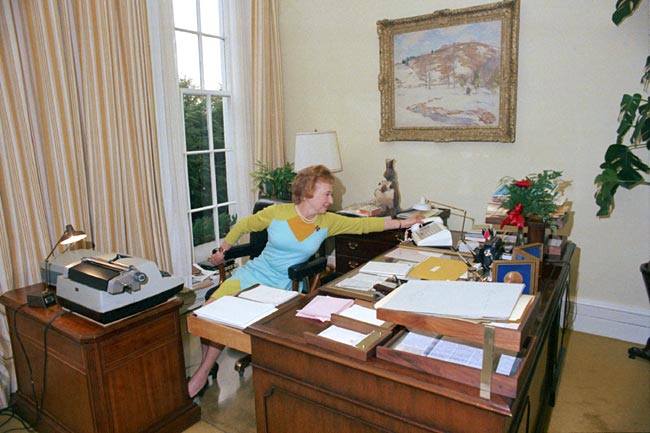
Typewriter of the moment: White House, Rosemary Woods

October 22, 2007

Rosmary Woods shows how she might have erased Nixon tapes

President Richard Nixon’s secretary, Rosemary Woods, demonstrates how she thought she might have accidentally erased 18-1/2 minutes of tape, when she reached to answer her phone and her foot extended to the “erase” footpedal, in 1974.

Ms. Woods’s typewriter is an electric, as best I can make out, an IBM. (Update, May 21, 2008: Ben Batchelor of etypewriters.com dropped by in comments to say it’s an IBM Model D Executive. Thanks, Ben!)

Good resource discovered in getting this image: The Watergate Files, presented by the Gerald R. Ford Presidential Library (at the University of Texas site). Image from the Gerald R. Ford Presidential Library.

Tip of the old scrub brush to Dr. Pamela Bumsted.


Crazies promise to abandon California public schools?

October 21, 2007

No, the news is not that good, really. It’s not really news, either. WorldNet Daily, an on-line publication of borderline sanity, may have left the border.

If only it were a promise, instead of a “call to abandon the schools.”

“We’re calling upon every California parent to pull their child out of California’s public school system,” Randy Thomasson, president of Campaign for Children and Families, told WND.

“The so-called ‘public schools’ are no longer a safe emotional environment for children. Under the new law, schoolchildren as young as kindergarten will be sexually indoctrinated and introduced to homosexuality, bisexuality, and transsexuality, over the protests of parents, teachers and even school districts,” he said.

The law at issue went through the California legislature as SB 777, and now bans in school texts and activities any discriminatory bias against those who have chosen alternative sexual lifestyles, Meredith Turney, legislative liaison for Capitol Resource Institute, said.

There are no similar protections for students with traditional or conservative lifestyles and beliefs, however. Offenders will face the wrath of the state Department of Education, up to and including lawsuits.

“So-called ‘public schools?'”

Below the fold, the full text of the law. You’ll note, Dear Reader, that the law includes protections for “students with traditional or conservative lifestyles and beliefs,” under the prohibition of discrimination on the bases of religion or sexual orientation, “or any other characteristic contained in the definition of hate crimes that is contained in the Penal Code.”

The new law will make it a crime to bully homosexual kids. Is that the real reason WND is worried about the bill, that it makes bullying a crime?

Why would anyone want to defend a right to bully kids? The purpose of the law is clear, from its purpose clause:

Existing law states that it is the policy of the state to afford equal rights and opportunities to all persons in the public or private elementary and secondary schools and postsecondary educational institutions of the state regardless of their sex, ethnic group identification, race, national origin, religion, or mental or physical disability and prohibits a person from being subjected to discrimination on those bases and contains various provisions to implement that policy.

Existing law prohibits a teacher from giving instruction, and a school district from sponsoring any activity, that reflects adversely upon persons because of their race, sex, color, creed, handicap, national origin, or ancestry.

This bill would revise the list of prohibited bases of discrimination and the kinds of prohibited instruction and activities and, instead, would refer to disability, gender, nationality, race or ethnicity, religion, sexual orientation, or any other characteristic contained in the definition of hate crimes that is contained in the Penal Code. The bill would define disability, gender, nationality, race or ethnicity, religion, and sexual orientation for this purpose.

Would you pull your kid out of a public school because she doesn’t have a right to bully anybody?

Critics of the bill object even to correcting English usage on forms asking information about students; forms may now ask “gender” rather than the more gauche “sex.” California’s Catholics for the Common Good found that correction a threat, somehow:

“Who knows what the consequences would be of deleting the definition of ‘sex’ of a child as a biological fact and replace it with ‘gender,’ a subjective term to be determined by the student. The legislature never investigated the cost of accommodating student preferences for lavatory and locker room facilities.” Read the rest of this entry »


American flag display: Wall of shame

October 21, 2007

Somebody had to do it. UShistory.org has a page dedicated to erroneous and disrespectful displays of the U. S. flag — a “what not to do directory.

That site also links to this one.

Please display your flags properly.

______________________________

Luba’s examples at his blog only make the point sharper.  See especially the cartoon at the top of his post.


Vouchers as Oreos: Crumbs for the kids

October 21, 2007

Here’s the infamous “Oreo® cookie” ad by the pro-voucher Richard and Linda Eyre, in the 30-second version:

I have a few questions for the Eyres and their Modified Vampire Voucher program:

1. Private schools are few and far between in Utah — where is a kid supposed to find a school?

2. National statistics tracked by the Department of Education show Utah at the bottom of the per-student spending list. Were Utah spending $7,500/year/student, Utah would rank comfortably near the top. Where did you get your figures for spending in Utah, and why do they differ from the national statistics?

3. Are you saying that, if vouchers cut student loads at public schools, no teachers or classrooms would be cut? I don’t see that guarantee in the law, and I’m wondering why you’re claiming something like that will occur.

4. How many kids need to leave the average public school classroom before there is a significant increase in money left over for the rest of the kids, under your formula? By “significant,” I mean at least 10% increases, or with your statistics, $750/pupil. My quick, in-my-head calculations show that, if only rich kids leave, we need to get 5 rich students , with the lowest vouchers, out of that 30-student class in order to get a significant increase in spending. That’s 17% of the students.

If 17% of the students left Utah’s public schools, how much would your program cost? How many private schools would need to be created to accommodate that percentage?

5. You say Utah spends about $7,000/student, and you suggest that Utah should be spending nearly $10,000/student. In order to get a $3,000/student increase in that classroom, you’d need to get 10 rich students to leave, or 33%. How soon do you think you can get a third of the students to leave Utah’s public schools?

6. You say teachers should lose their jobs if students leave public schools for private schools. Why? Studies show that generally it is the best students who leave public schools for private schools. If their teachers are punished . . . well, explain just what it is you really advocate?

7. When I published the research studies at the U.S. Department of Education, we published studies showing that reduction in classroom size helped student achievement — a measurable amount once classroom size got down to 18 students, and significantly once classroom size got down to 15 students per class. By your figures, we’d need to get half of all students to leave Utah’s public schools to get down to 15 kids per class — without firing any of the bad teachers. How long will it take to get that reduction? How much will it cost?

8. If we can’t get a third of all students to leave the public schools, we’re still stuck with a massive shortfall in funding. What’s your backup plan, since getting a third of all students to leave is a stupid idea with zero chance of success? When you’re done hammering at the foundations of public education, what then?

9. Do the good people at Nabisco approve of your abuse of their cookies?

Eyre’s program may look neat as Oreos, but it leaves only crumbs for the kids. Taking money out for vouchers does almost nothing to contribute to solutions for Utah’s education problems.

Below the fold: The longer version of the ad.

Read the rest of this entry »