Historic images: Quanah Parker, Last Chief of the Comanches

June 19, 2008

Quanah Parker, photo by Lanney

Quanah Parker, a Kwahadi Comanche chief; full-length, standing in front of tent.
Photographed by Lanney. Public Domain photo.
National Archives, “Pictures of Indians in the United States”

Photographs of Native Americans reside among the publicly and internet available materials of the National Archives. Images can be ordered in sets of slides, or as individual prints, though many are available in quality high enough for PowerPoint works and use on classroom materials. Many of the photos are 19th century.

Quanah Parker stands as one of the larger Native Americans in Texas history. This photo puts a face to a reputation in Texas history textbooks. Texas teachers may want to be certain to get a copy of the photo. His life story includes so many episodes that seem to come out of a Native American version of Idylls of the King that a fiction writer could not include them all, were they not real.

  • Quanah’s mother was part of the famous Parker family that helped settle West Texas in the 1830s. Cynthia Ann Parker was captured in 1836 when Comanches attacked Fort Parker, near present-day Groesbeck, Texas, in Limestone County. (See Fort Parker State Park.) Given a new name, Nadua (found one), she assimilated completely with the Nocona band of Comanches, and eventually married the Comanche warrior Noconie (also known as Peta Nocona). Quanah was their first child, born in 1852.
  • Nadua was captured by a Texas party led by Lawrence Sullivan “Sul” Ross in 1860, in the Battle of Pease River. Noconie, Quanah, and most of the Nocona men were off hunting at the time, and the fact of Nadua’s capture was not realized for some time. Nadua asked to return to the Comanches and her husband, but she was not allowed to do so. When her youngest daughter, who had been captured with her, died of an infection, Nadua stopped eating, and died a few weeks later.
  • Sul Ross was a character in his own right. At the time he participated in the raid that recaptured Cynthia Parker, he was a student at Baylor University (“What do I do on summer breaks? I fight Indians.”) At the outbreak of the Civil War, Ross enlisted in the Confederate Army as a private. Over 135 battles and skirmishes he rose to the rank of Brigadier General, the ninth youngest in the Confederate Army. A successful rancher and businessman back in Texas after the war, he won election as governor in 1887, served two very successful terms (he resolved the Jaybird-Woodpecker War in Fort Bend County, and had to call a special session of the legislature to deal with a budget surplus), refused to run for a third term, and was named president of Texas Agricultural and Mechanical College (Texas A&M) within a few days of stepping down as governor. Ross’s leadership of the college is legendary — students put pennies near a statue of Ross in a traditional plea to pass final exams, among many other traditions. After his death, Texas created Sul Ross State University, in Alpine, Texas, in his honor.
  • Quanah Parker’s father, Noconie, died a short time after his mother’s capture. He left the Nocona band, joined the Destanyuka band under Chief Wild Horse, but eventually founded his own band with warriors from other groups, the Quahadi (“antelope eaters”) (also known as Kwahadi). The Quahadi band grew to be one of the largest and most notorious, always with Quanah leading them. The Quahadis refused to sign the 1867 Medicine Lodge Treaties, and so avoided immediate internment to a reservation. However, dwindling food supplies and increasing opposition forced Quanah to retire to a reservation in 1875, in what is now southwestern Oklahoma. This was the last Comanche band to come to the reservation.
  • Quanah was appointed Chief of all the Comanches.
  • Through investments, Quanah became rich — probably the richest Native American of his time.
  • Quanah hunted with President Theodore Roosevelt.
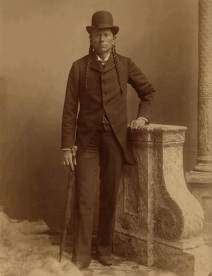
    Quanah Parker in later life, as a successful businessman. Wikipedia image, public domain

    Quanah Parker in later life, as a successful businessman. Wikipedia image, public domain

  • Rejecting monogamy and Christianity, Quanah founded the Native American Church movement, which regards the use of peyote as a sacrament. Quanah had been given peyote by a Ute medicine man while recovering from wounds he’d suffered in battle with U.S. troops. Among his famous teachings: The White Man goes into his church and talks about Jesus. The Indian goes into his Tipi and talks with Jesus.
  • Photo at right: Quanah Parker in his later life, in his business attire. Photo thought to be in public domain.
  • Bill Neeley wrote of Quanah Parker: “Not only did Quanah pass within the span of a single lifetime from a Stone Age warrior to a statesman in the age of the Industrial Revolution, but he never lost a battle to the white man and he also accepted the challenge and responsibility of leading the whole Comanche tribe on the difficult road toward their new existence.”
  • Quanah Parker died on February 23, 1911. He is buried at Fort Sill Cemetery, Oklahoma, next to his mother and sister.

Quanah Parker’s epitaph reads:

Resting Here Until Day Breaks
And Shadows Fall and Darkness Disappears is
Quanah Parker Last Chief of the Comanches
Born 1852
Died Feb. 23, 1911

Other Resources:

Spread Quanah’s story:

Add to FacebookAdd to NewsvineAdd to DiggAdd to Del.icio.usAdd to StumbleuponAdd to RedditAdd to BlinklistAdd to TwitterAdd to TechnoratiAdd to Furl


Teach evolution in Christian schools

June 18, 2008

Here’s a viewpoint you don’t see often: An engineer urges Christian schools to be sure they teach evolution, and he makes a pretty good case.

It’s a twist on the usual position, where religious fanatics argue that science should be watered down in public schools, or that some form of creationism should be taught to cast doubt on the science.

The essay was published at a blog called An Evangelical Dialogue on Evolution. An engineer named Gordon Glover argues that evolution should be taught, first, because it’s good science. Second, he says teaching evolution “enhances” critical thinking — a point I agree with; in my experience, students get more creative when they study and understand the real creative work of real scientists, and students become much more discerning about what is good science and a good argument.

Third, for private Christian schools, Glover argues that teaching evolution opens another opportunity to discuss Biblical inspiration.

The first reason is the most powerful. Sticking to good science also presents an opportunity to stand up for good ethics.

Take a look at Glover’s arguments. Is he right? What do you think? Should scientists argue for including evolution in religious schools where it is avoided now? As always, comments are open.


Mosquitoes eat DDT, and here’s how

June 18, 2008

University of Illinois researchers found the protein that allows mosquitoes to metabolize DDT.

It’s good news in mosquito research, and may someday provide some insight into how to kill mosquitoes that seem to be resistant to DDT.

But, for all those DDT advocates out there, isn’t this rather embarrassing? Here these researchers have discovered the molecular level mechanisms for a process that the DDT apologists claim doesn’t happen. Oops. Rachel Carson proven right, once again.

There they are, caught red- and bumpy-handed.

Press release text from the University of Illinois below the fold.

Read the rest of this entry »


Geography hidden in plain sight

June 18, 2008

Strange Maps features federally-owned lands. Those of us who grew up in the west tramping those federal lands, and those of us who worked policy for those lands rarely think they should be listed as “strange” maps. Beautiful land maps, perhaps. God’s Country. It’s funny others regard it as so strange.

But we get clues. In comments at Strange Maps I noted a corporate meeting where I was chastised and ostracized for making a simple statement of fact about the ownership of lands in the west. Other than we veterans of the Sagebrush Rebellion (on all sides), ranchers, miners, and members of the Sierra Club, Wilderness Society, National Recreation and Parks Association (NRPA) [Barry Tindall? Are you still out there?], National Parks Conservation Association (NPCA), and enrolled tribal members, who pays attention to that stuff?

Too few in government pay enough attention. Fewer people outside government pay attention, especially if they don’t live in states in which the federal lands reside.

Public lands are all around us, yet we don’t see them as anything much different from any other land. Too often we don’t even see them for the resources they are. It’s as if we had a treasure of diamonds, rubies and gold, and we put it on display, and no one could see it.

For example, there was a major decision in federal district court on an issue of federalism last Friday — did you hear of it in your local newspaper, or on your local television or radio news? Nor are most people familiar with the move to amend the 1872 Mining Act, nor could most Americans describe for you what the 1872 Mining Act is or why it’s worth billions of dollars annually to the federal government, state governments, and mining corporations.

Strange Maps showed only the amount of land in federal hands in each state. Below is a map that shows where are the actual federal holdings, from the online National Atlas (nationalatlas.gov) — a map of federal lands and Indian Reservations. (A .gif preview is below; below that is a link to a .pdf file you can download.) The light green is National Forest land; the yellow is Bureau of Land Management land. The red plots are Indian reservations. Click on the map for the enlargement, you can see that Nevada, for example, has just thin threads of private lands (in white), mostly along U.S. Highway 50, and around Las Vegas.

All Federal Lands and Indian Reservations; NationalAtlas.gov, now archived at USGS

All Federal Lands and Indian Reservations; NationalAtlas.gov, now archived at USGS


Flip the pages of most geography texts, however, and you’ll find little clue of the role federal lands play in modern America, let alone the historical roles played.

History?

Sure. Notice that most of the public lands held today are in 13 western states, generally the last states allowed into the union (not exactly; Oklahoma is a 20th century admission — but it has Indian reservations; read on). Outside the 13 original colonies, which became the 13 original states, and Vermont (#14), all the land in the U.S. was held by the federal government at one time. Much of the territory between the 13 original states and the Mississippi was ceded to the U.S. by Britain in the Treaty of Paris, which ended the American Revolution. Americans thought the land useful for farming, chiefly, so the intention was to devise the lands to private holders. To that end the various Northwest Ordinances (e.g., 1785, 1786, 1787 and later) established systems to sell off the lands into private hands.

Disposal of the lands required the creation of a bureau to do the job. The General Land Office was created in 1812, and remained part of the federal government until it was folded into the new Bureau of Land Management in 1946.

That some of the lands might have national value, and should be held in federal title, did not surface as a complete idea until the Progressive Era, with the emphasis on land stewardship, under Teddy Roosevelt, Taft, and their successors. Even then, the general idea was to get most of the lands into private ownership. Roosevelt worked to preserve the most scenic and most unique lands.

Beginning with the Northwest Ordinances, the federal government set aside two sections in every township for the benefit of education. Local governments sold the tracts and put the money to school construction, or put the schools on those sections. Some of the tracts in the far western states are still there, unsold and providing no benefits to the schools. In some cases this is because the tracts are stuck inside federally-held tracts, in National Forests, in National Parks. Texas dedicated some of its state lands to provide funding for the University of Texas. Fortunately, these tracts happened to be on a pool of oil. When oil development took off, Texas’s university systems benefited (the Texas A&M System got a third of the rights along the way).

Poster advertising lands in Nebraska and Iowa

Development of the Transcontinental Railroad was financed by massive grants of land to the railroad companies. Even today the fortunes of the old Burlington Northern Railroad (now BNSF) are swelled by coal on land granted to the original companies building the rails, land the company has held for all these years. The thin line of private land across northern Nevada originally was the route of the Central Pacific Railroad — now it is approximately the route of U.S. Highway 50, “America’s Loneliest Highway.”

President Abraham Lincoln signed the Homestead Act on May 20, 1862. Under the Act, any American could lay claim to public lands for a small fee, and if he could live on the land for five years, title was vested in that citizen. This explanation comes from a lesson plan at the National Archives:

The new law established a three-fold homestead acquisition process: filing an application, improving the land, and filing for deed of title. Any U.S. citizen, or intended citizen, who had never borne arms against the U.S. Government could file an application and lay claim to 160 acres of surveyed Government land. For the next 5 years, the homesteader had to live on the land and improve it by building a 12-by-14 dwelling and growing crops. After 5 years, the homesteader could file for his patent (or deed of title) by submitting proof of residency and the required improvements to a local land office.

When I was a child in southern Idaho, customers at my parents’ furniture store included many people who were still trying to make a go of things on homesteads north of Burley, Idaho, on “the North Side.” Much of the land granted this way could not support a family, and the failure rate of these homesteads in the 1950s and 1960s was probably more than 50 percent (I’m swagging the figure — if you have better statistics, send them along).

Overall, the Homestead Act shaped America’s character as a home for entrepreneurs:

By 1934, over 1.6 million homestead applications were processed and more than 270 million acres—10 percent of all U.S. lands—passed into the hands of individuals. The passage of the Federal Land Policy and Management Act of 1976 repealed the Homestead Act in the 48 contiguous states, but it did grant a ten-year extension on claims in Alaska.

Much of the land that open for homesteading was desert, unsuitable for farming. It was available for grazing cows and sheep, though, and much of it was overgrazed. (Grazing alone wouldn’t meet the homestead requirements.) It was not until the 1970s that people outnumbered sheep in Utah, for example. In the first three decades of the 20th century enormous flocks of sheep grazed much of what is now considered Utah’s western desert territory, flocks of thousands of sheep, or tens of thousands.

These lands, too arid for farming, too hilly for much of anything else, too far away from settlements for other commerce, eventually formed the core of lands held by the Bureau of Land Management (BLM) in the Department of Interior. BLM manages 264 million acres of land, far and away the biggest land management agency in the federal government. Much of the land was severely overgrazed by 1930, and after the harsh lessons of the Dustbowl, Congress tried to rope in grazing and set it up in a rational scheme in the Taylor Grazing Act of 1934, one of the lesser noted chunks of the New Deal era.

The major federal land management agencies today include the Department of Interior’s BLM, National Park Service, Fish and Wildlife Service, Bureau of Reclamation, and to a lesser and more complicated degree, the Bureau of Indian Affairs; the Department of Agriculture’s National Forest Service; and the Department of Defense, especially in the western public lands states (think Nevada gunnery range, Skull Valley and Dugway Proving Grounds, Utah, and Area 51).

Each area of land management policy is controversial to some degree, but even these controversies rarely rise to the level of public acknowledgment. The latest starlet’s sexcapades will grab headlines away from the major effort to overhaul mining law, for example. In the 1980s, Alaska voted on a proposal to secede from the union, but the issue barely got three paragraphs in the Washington Post or New York Times, two of the newspapers that are generally very good in covering such issues. This post barely scratches the surface of these issues.

(Digression: I first encountered Molly Ivins when she reported for the NY Times out of the Denver bureau; as a Scout I had hiked and traveled much of Utah and the west; as a Senate staffer to a western senator, I was intimately familiar with most of the land in Utah especially. Ivins wrote a story on a protection issue on a chunk of land and a formation I’d not been familiar with, and in sparring with her about the article, it became very clear that she had pulled out sources we didn’t know about, and that she knew the stuff about as well as we did. Anyone who bothers to give a damn about western lands can earn my respect with such careful research.)

As a side note, Strange Maps suggested that the District of Columbia was all federal lands, but most of the District has been devised into private property, and commenters noted that. Here is a map of the District showing its federally-maintained lands.

District of Columbia and Federal Lands; NationalAtlas.gov (now at USGS)

District of Columbia and Federal Lands; NationalAtlas.gov (now at USGS)

Other resources:

Other related posts at the Bathtub:


Chess games of the rich and famous: IBM 360, circa 1974

June 17, 2008

IBM 360 playing chess in 1974; five men unidentified; Chilton.org

IBM 360/195 playing chess, November 1974, probably in the world computer chess championships. MASTER Team, from left: Alex Bell, Peter Kent, John Birmingham, John Waldron (a British chess player)

Annual Report, C & A Division, Rutherford Laboratories, United Kingdom, 1974.

No details are offered in the 1974 report; it appears that the machine is playing someone at a remote location, linked by telephone. According to the report, “The only major hardware change made to the IBM System 195 Central Computer during 1974 was the addition in March of a third megabyte of main core. The system has now given consistently high performance for a period of three years and from this experience it is now possible to predict its maximum capability when fully loaded.”

At another section of the Rutherford Lab’s online materials you can view a short history of computer chess playing.


Lawmakers in the dark

June 17, 2008

Just how much will YouTube affect this year’s campaigns?

The Sierra Club offers this spot on the politics of fixing global warming on YouTube. Would they even bother to produce it, if YouTube didn’t exist?


Storefront schools

June 16, 2008

Why not?

In comments to the immediately previous post, Zhoen says segregation by gender is no panacea for education. But, she wonders at OneWord: Why not storefront schools?

For many years, I have thought the never-will-be-done answer was to have storefront schools. One room schoolhouses, two teachers and a local adult volunteer, no more than a dozen students, all online classes – a national, self paced, curricula. Touring experts and scholars for special lectures and demonstrations. Kid has a problem with a particular teacher, move ’em to the next neighborhood over. Walking distances from their homes, field trips common (easier to arrange with small groups), flexible schedules (let the teens sleep in). A circle of homeschools in rural areas instead of warehouses to haul whole populations into.

Why not? The idea strikes me as similar to Japanese juku, private schools for kids in public schools, where kids get remedial attention or advanced instruction, depending on what they need. I copy the Library of Congress’ description of juku after the fold.

What do you think? Is there an example of storefront schools we can cite either way, for or against the idea?

Comment away.

Read the rest of this entry »


Does gender-separated schooling work better?

June 16, 2008

Even public school districts toy with the idea of separating genders in the primary and secondary grades.  Some people argue that there is experimental evidence to support the plan, plus there are the arguments about physical differences between the genders, which suggest different educational strategies for girls than for boys.

The No Child Left Behind Act requires schools to implement programs that are supported by research.  Is there solid research to support separating the genders?

Apart from the hoaxes, such as the much ballyhooed “Crokus” in boys brains, the evidence for separating the genders based on physical differences may be a lot slimmer than advocates claim.

For example, do boys really hear differently from girls?   Are the physical differences so great?  Consider the opening paragraph for a lengthy article on the issue by Elizabeth Weil, in The New York Times Magazine last March:

On an unseasonably cold day last November in Foley, Ala., Colby Royster and Michael Peterson, two students in William Bender’s fourth-grade public-school class, informed me that the class corn snake could eat a rat faster than the class boa constrictor. Bender teaches 26 fourth graders, all boys. Down the hall and around the corner, Michelle Gay teaches 26 fourth-grade girls. The boys like being on their own, they say, because girls don’t appreciate their jokes and think boys are too messy, and are also scared of snakes. The walls of the boys’ classroom are painted blue, the light bulbs emit a cool white light and the thermostat is set to 69 degrees. In the girls’ room, by contrast, the walls are yellow, the light bulbs emit a warm yellow light and the temperature is kept six degrees warmer, as per the instructions of Leonard Sax, a family physician turned author and advocate who this May will quit his medical practice to devote himself full time to promoting single-sex public education.

Mark Liberman, who writes at Language Log, deals with these issues dispassionately, and scientifically.  He started a policy of publishing on the blog questions that he gets from journalists on the issues.  Here’s his first published answer, for example, and as you can see, it’s a bit of an information-loaded doozy:

1. I’ve read a few posts on Language Log, but please tell me more about what you think about Dr. Sax’s arguments about sex-based differences in the brain?

In his books, Leonard Sax is a political activist using science to make a case, not a scientist evaluating a hypothesis.

Science is sometimes on his side, sometimes neutral or equivocal, and sometimes against him. He picks the results that fit his agenda, ignoring those that don’t; and all too often, he misunderstands, exaggerates or misrepresents the results that he presents.

There’s detailed support for these assertions in some Language Log posts from 2006:

David Brooks, cognitive neuroscientist” (6/12/2006)
Are men emotional children?” (6/24/2005)
Of rats and (wo)men” (8/19/2006)
Leonard Sax on hearing” (8/22/2006)
More on rats and men and women” (8/22/2006)
The emerging science of gendered yelling” (9/5/2006)
Girls and boys and classroom noise” (9/9/2006)

This doesn’t mean that his conclusions are false, but it does mean that his appeals to science are not trustworthy.

More nuance than some policy groups might be able to deal with, but enough information to direct a genuinely interested person to some good sources.

You’ll also want to read “Retinal Sex and Sexual Rhetoric,” and “Liberman on Sax on Liberman on Sax on Hearing.”

In our weekly staff meetings with then Assisstant Secretary of Education for Research Chester W. Finn, at the old Office for Educational Research and Information, Finn often opened the meetings by turning to the Director of Research and asking whether, in the past week, we had learned how people learn.  When satisfied that this key breakthrough had not been achieved in the previous week, which would change much of what we did, Finn would say something like, “Now that we know we don’t know what we’re doing, let’s go through the agenda.”

Keeping an appropriate sense of humor about the issue, Finn still provided sharp reminders that the science behind learning, for all of the volumes available, is very tenuous and thin.

When science is so thin, the policy side of the discipline can be waved around by a good presentation coupled with plausible sciency-sounding material.  “Plausible” does not equal “good,” and often it doesn’t even equal “accurate.”

Liberman’s critiques are detailed, and they point out questions that the average school board member or principal is probably ill-equipped to realize, let alone ask from an “expert” or consultant selling a program to the district.

Before we teach critical thinking to the kids, we need a lot more critical thinking from administrators.  Liberman tries to light the path to that critical thinking.

What do you think?  Does gender-separate education work better?  Are there such great differences in the learning abilities and methods of boys and girls that we ought to separate them?

What about other shibboleths we hear?  Classroom size?  Testing?  Delivery of material?  Difficulty of material?   Where is there good research for reforming our schools, for the better?


Not Bobby Jindal: The Parable of the Idiot Candidate

June 16, 2008

Bobby Jindal’s experience at exorcisms and rejection of the Catholic Church’s position on teaching creationism are getting some attention. He is young and makes an appearance of governmental competence (though, New Orleans is still a mess and he’s had several months to start making things happen that aren’t happening). But on science issues, the man is without sense, without reason.

In response to a post at Pharyngula, someone commented:

No, no no…. we WANT McCain to pick Jindal.

Because Jindal claims to have performed an exorcism.

http://www.time-blog.com/swampland/2008/06/jindals_exorcism.html

PleaseohpleaseohpleaseohPLEASE pick Jindal!!!!!!

Let me tell you a story. This looks like a parable, and after a fashion, it is.  It is also history.  You can look it up.  Call it a parable from Santayana’s Ghost.

Once upon a time, back in the Cretaceous (okay, 1976), when Utah was still split among Democrats and Republicans, especially for national offices like senator and representative, there was a great congressman in Utah’s first district (which you might call the “cursed First,” because it has had its share of misfortunes, like Enid Greene, and Douglas Stringfellow; except that at the time, it was the 2nd. No, I’m not about to explain). Rep. Alan Howe was a smart, well-connected Democrat, and a very good first-term Congressman. He’d won election in 1974 when Wayne Owens vacated the seat to run for the U.S. Senate unsuccessfully against Jake Garn.* In 1976, Howe was considered unbeatable.

Howe’s brother was president of the Utah State Senate. Howe was a friend of outgoing Gov. Calvin Rampton. As a former director of the Four Corners Commission, he had a good bead on water, energy, agricultural, industrial and environmental issues in the entire state. He was rising rapidly up the ladder in Democratic leadership. Republicans who might have made a run looked at Howe’s war chest of campaign contributions, his record and sterling reputation, and sat out the race.

At that time the state’s parties held their conventions in June. Under Utah’s system, all candidates for an office would appeal to the delegates of the state convention, and if one candidate got 50% plus 1 of the delegates to vote for her or him, there would be no primary. If no candidate got a majority, the top two would face off in a primary in September, and the winner would go to the general election in November.

Utah’s Republicans had five people file for the office, all of them unknowns, all of them considered appropriate to fill the ballot out for a losing election. The five were so undistinguished, and so undistinguishable, that the race was close between all of them. An insurance salesman named Dan Marriott (no relation to the J. W. Marriotts) scraped enough delegate votes to stand against a proctologist in the primary election. Both candidates were unfamiliar with national politics and national issues. It would be one gaffe after another up to the primary.

But that’s not the story. I was a part-time reporter for KUTV, helping Lucky Severson (later of NBC) and a great documentary unit in coverage of all things political in the state. Since there was no great race on the Democratic side, I got the short straw and a good chance to cover the local Democratic convention. It was uneventful enough I didn’t even get a stand-up out of it.

Alan Howe’s campaign was loaded with people I knew from college. They invited me to a post-convention party which was, unfortunately, a fund-raiser. Consulting with the assignment desk, we figured that since the invitation came as a comp ticket, and not as an invitation to cover the thing, it was a freebie that was unacceptable under the station’s gift policies. I could go on my own, we determined, but I’d have to pay for the ticket myself. I didn’t have the change.

So I didn’t get even a stand-up. And I didn’t get to go to the party with the Congressman.

About 2:00 a.m. the assignment desk called, asking hopefully whether I’d gone to the fundraiser after all. When I said “no,” the guy yelled “Damn!”

“Look,” I said. “We discussed this — it’s against the station’s policies.”

“Yeah, but a good story isn’t. We just got a tip from the County Jail that Howe was picked up for soliciting a prostitute.”

Utah, then, was much more provincial than it is now. Still, there are few places outside of Louisiana where soliciting sex for hire is not a death knell in an election campaign.

Alan Howe had just handed his congressional seat to a Republican to be named later.

Dan Marriott and the proctologist, J. Preston Hughes fought a gaffe-filled campaign all the way to the primary. Hughes avoided using all the great campaign slogans a proctologist could use fairly and accurately, indicating a great lack of a sense of humor (“Send Hughes to Washington — he’s made a career out of cutting up a–holes to make life better!”) Marriott beat Hughes, 56,000 votes to 25,500 votes roughly.

The campaign for the general election was a groaner. Utah Democrats tried to get Howe to resign the election, but he refused, even after he was convicted. Howe refused to debate Marriott, appearing to hope that Marriott wouldn’t get any publicity. A Democrat ran a write-in campaign, further sapping Howe’s hopes.

Television debates were set up, but Howe refused to appear. These turned into painful interviews of Dan Marriott, who had no real good ideas about what he was getting into, it appeared. In one public television “debate,” open to voters to call in questions, when the host, Rod Decker then of the Deseret News went to the phones, not even crickets chirped. Decker ended up asking questions himself, though he hadn’t prepared to do that. In one exchange seared into my memory, Decker asked Marriott what committees he might like to be on in Congress, since it was all but absolutely certain he’d win the election and be able to stay out of the way of speeding buses and trains. Marriott explained that he’d been on a few committees in his local PTA, and they didn’t seem to get anything done, so he hoped he wouldn’t get any committee assignments.

Utah, so dependent on largesse from the Interior Committees and Agriculture Committees, issued a collective groan.

Utah got stuck with a candidate no one wanted, and had to send him to the House of Representatives.

Do not ever — EVER! — hope the other party will nominate an idiot against your candidate. Even the good candidates are idiot enough to blow an election. But sure as the other side nominates an idiot that even other idiots can see unable to do the job, something will happen to push that nominated idiot into the position.

There is a good history of surprise office-holders rising to the occasion. Teddy Roosevelt was nominated for the Vice Presidency largely to get him out of New York politics, where his mere presence threatened to clean up some of the corruption. New Yorkers thought he’d never recover from serving as Vice President. You know the rest of the story, of course, how President William McKinley showed up in Buffalo to shake hands, how Leon Czolgosz got in line and shot McKinley fatally.

Dan Marriott with large rubber gloves

Even Utah got lucky. Dan Marriott had enough sense to learn a bit about Congress. He lucked into a seat on the House Interior Committee, and in a Democratic Congress, with everyone ignoring him, he sneaked through a bill to clean up radioactive mill tailings in Salt Lake County. Managing to avoid major embarrassments, he went on to serve four terms. Utah swatted him down when he stood for election as governor in 1984.

Photo at left: Dan Marriott, on right, with large rubber gloves. Dan Marriott Photograph Collection at the J. Willard Marriott Library, University of Utah.

Events can intervene. Good candidates get tripped up — think Ed Muskie defending his wife’s honor in New Hampshire, but with a few tears, before tears were acceptable. Think all those Republicans who avoided the nastiness of the campaign against Nixon in 1968, since Robert Kennedy would easily outdistance Nixon. Sen. Paul Wellstone was a lock in a close race in Minnesota in 2002, until an airplane crash changed the race — as happened to Mel Carnahan in Missouri in 2000, and to Dick Obenshain in Virginia in 1978. Or think of former Speaker of the House Tom Foley of Washington, who simply lost his seat when an unexpected change of mind of the voters of Washington got him, in 1994, when the Newt Gingrich Contract On America was executed.

Every vote counts, until it’s dismissed or uncounted. Every race is important. Pray that each party puts up the best available people, and that the best of them win.

Remember: Do not ever — EVER! — hope the other party will nominate an idiot against your candidate. Even the good candidates are idiot enough to blow an election. But sure as the other side nominates an idiot that even other idiots can see is unable to do the job, something will happen to push that nominated idiot into the position.

________

* Shortly after his election in 1974 I interviewed Jake Garn with a panel for KUED-TV. I asked Garn what he would bring to the Senate, a good, softball question. He went on at length about his viewpoint as a former mayor, noting that no one else in the Senate had that experience. I named five or six former mayors in the Senate, and I asked him what was the difference. “I won’t become federalized like they did,” he said. I thought of that quote often as he orbited the Earth. Glad he didn’t fall victim to the siren song of federalization.


McLeroy declares war on science in Texas classrooms?

June 15, 2008

Considering recent history and the Texas State Board of Education, how can any reasonable voter or parent read this, except as a declaration of war on science? According to the blogs at the Dallas Morning News:

State Board of Education chairman David Bradley of Beaumont told GOP delegates [at the Texas State Republican Convention] that the board was about to take up the science curriculum for public schools. He forecasted a fight over evolution vs. creationism.
Bradley said there are some on the board (he’s among them) that believe God created Man.
“There are others who think their ancestors were apes. That’s okay. But I’m going to vote the right way,” Bradley said.

Is there anything there that suggests Bradley wants good science in Texas textbooks and Texas classrooms?

Remember the Excellence in Education Commission Report in 1983? The Commission warned that the nation was facing “a rising tide of mediocrity” in schools, in such things as lax science standards.

“Our nation is at risk. The educational foundations of our society are presently being eroded by a rising tide of mediocrity. If an unfriendly foreign power had attempted to impose on America the mediocre educational performance that exists today, we might well have viewed it as an act of war. We have, in effect, been committing an act of unthinking, unilateral educational disarmament. History is not kind to idlers.”

25 years later, Commissar Don McLeroy is leading the tide of mediocrity, doing crippling things to our education system that the likes of Nikita Khruschev and Mao Ze Dong could only dream about.


June 14 – Flag Day

June 14, 2008

Did you fly your flag today?  Even without my reminding you?  Good!

Norman Rockwell painting, Scout saluting the flag

Painting by Norman Rockwell, Scout saluting the flag.

Flag Day celebrates the date of the first resolution passing the Continental Congress designating Stars and Stripes as the flag of the soon-to-be U.S., on June 14, 1777.


Iowa Scout tragedy – a message from the Chief Scout Executive

June 14, 2008

Chief Scout Executive Robert J. Mazzuca issued this message yesterday, regarding the tornado strike at Mid-America Council’s Little Sioux Scout Ranch in western Iowa. For the record, for your information and action:

Robert J. Mazzuca
Chief Scout Executive

June 13, 2008

To our Scouting family:

We were all shocked and saddened by the news coming out of Western Iowa. The tornado that ripped through our Little Sioux Scout Ranch left a terrible wake of destruction in its path. We mourn the lives lost and injuries suffered as a result of the storm. And we extend our deepest sympathies and concern to the families of those who were affected.

BSA President John Gottschalk and I have pledged the full support of the National Council to assist in any way. Particularly during this period of front-line response, most of the effort is being managed by the outstanding Mid-America Council. We are grateful for Lloyd Roitstein and his staff, who have shown remarkable leadership during this very challenging time. The local council has placed a very high priority on tending to the needs of the impacted families. We continue to remain in close contact and are helping to coordinate communication across the local council network. The National Council is prepared to engage further at any time.

Understandably, we are receiving many calls from all across the country from staff, volunteers, Scouts, and families who want to be supportive. Thank you, everyone, for this outpouring of support. We have put into place a process for properly channeling offers of financial assistance for the impacted families, as well as interest in volunteering time to the effort. Right now, we need to give emergency responders and the local council time to attend to the task at hand. Very soon, the effort will turn to rebuilding and reconstructing. Upon the determination of exact needs, we will follow up with you.

Please forward contact information and offers of support to our emergency response e-mail at oomcd@netbsa.org. Anyone interested in making a donation to help rebuild Scouting in the communities affected by the tornadoes and flooding in the Midwest go to www.scoutingfriends.org. Select “BSA Disaster Relief.”

Again, we are deeply saddened by this tragedy. At the same time, however, we are moved by and proud of the way in which our Scouts, leaders, and the local council have responded. There is no question that this terrible situation would have been worse if it were not for the heroic efforts of the young men who were on the ground when the tornado hit. They epitomize what is so very special about being a Scout.

Please join me in keeping all of those affected in our thoughts and prayers. God bless our Scouts.

Yours in Scouting,

Robert Mazzuca signature

Robert J. Mazzuca signature

blank

blank

Robert J. Mazzuca
Chief Scout Executive

Memo in .pdf form

Tip of the old scrub brush to Debie Franz, Wisdom Trail District, Circle 10 Council


Query to historians: Material on German-American Internment in WWII?

June 14, 2008

Historians, help me out: What do you know about the internment of German Americans and Italian Americans during World War II?

The website of the German-American Internee Coalition lists several sources, and it has a lengthy set of lesson plans (too much for use in Texas, I fear). Is this information accurate? Has anyone used it in a classroom, and can you tell us your experience? Is there a mention of this in your world history or U.S. history text?

Please respond in comments.

Gate and guard tower at Fort Lincoln, ND, intern site for German-Americans and othersPhoto: At sunset, the gate and guard tower at Fort Lincoln, North Dakota, where German-Americans and Japanese-Americans were interned during World War II. From the John Christgau Collection of photos; courtesy the site at the German-American Internee Coalition (GAIC).

Friends of Rachel Carson win a quiet victory

June 13, 2008

How quiet?

None of my news readers pulled it up, either last August and September, when U.S. Rep. Jason Altmire, D-Penn., got the bill through Congress and signed into law by President Bush, nor a couple of weeks ago when the action occurred.

The Post Office in Rachel Carson’s home town, Springdale, Pennsylvania, has been named in her honor. The ceremony at the Post Office was held on May 27, 2008.

Rep. Rob Bishop’s, R-Utah, incendiary and inaccurate statement on the bill was what caught my eye originally about the continuing campaign of calumny against the author and scientist.

Rep. Altmire conducted a petition campaign in Pennsylvania, and used the lever of popular, bipartisan support to pry the bill loose from U.S. Sen. Tom Coburn’s hold in the Senate. Coburn is a Republican from Oklahoma, a physician, and an ardent advocate of spraying DDT. He had placed a hold on the bill in committee, stopping all action under the Senate’s rules of profound deference to members.

The swell of popular support made clear by Altmire’s campaign appears to have persuaded Sen. Coburn to allow the bill to move. The bill passed the Senate by unanimous consent on August 3, 2007, and got President Bush’s signature on August 9. These sorts of honorary bills generally are not targeted for political points. That Coburn allowed the bill through suggests a good deal of maturation as a senator on Coburn’s part.

Below the fold, Rep. Altmire’s press releases on the bill’s passing the Senate, and on President Bush’s signing the bill.

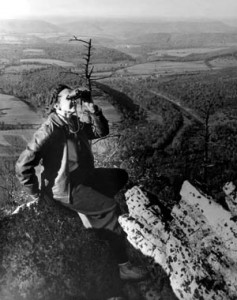
Photo below: Rachel Carson, birding, on a ridge (in Pennsylvania); photo originally found at site of Professor Catherine Lavender, The College of Staten Island of CUNY.

Rachel Carson, birding at Hawk Mountain Sanctuary

Rachel Carson, birding at Hawk Mountain Sanctuary

Read the rest of this entry »


Well written, by hand

June 12, 2008

We had to take a semester of typing in high school. Computers back then were readers of stacks of punch cards, but the idea was that those students bound for college would need to know how to type to do term papers, and the other students would be able to use typing as a job skill. I got up to 90 words per minute for a short period.

One of my majors was mass communication. I wrote a lot of radio news scripts, and I wrote constantly for the Daily Utah Chronicle. Utah’s debate team was quite active, too, and we typed our evidence cards so they’d be easier to share. By my junior year, almost everything handed in was typewritten.

After one lousy year of grad school I took a job as press secretary for a U.S. Senate campaign. It was a shoe-string operation, and I typed all our press releases myself — plus the few prepared speeches. Three years later we had computers to use for press releases and speech texts in the Senate. My office was the first in the Senate to completely automate the process. By the time I moved to the President’s Commission on Americans Outdoors, we had PCs on everybody’s desk (ahead of our time, I know). At the Department of Education a couple of years later, we even had a crude e-mail system.

Moving to American Airlines was a shock. As counsel, I was expected to write everything in long-hand, so the secretary could type up the final copy. Having been wholly keyboard for way over a decade, I couldn’t make the switch. I had to find a surplused, still-barely-working typewriter to give stuff to the secretary. By the time I left four years later, everybody had PCs on their desks (and at least half the secretarial positions were gone, too). That was my last experience with long-hand as the norm, until I got to the Dallas Independent School District.

Our kids didn’t learn cursive long or well. Younger son James doesn’t do much in cursive at all (thank you notes are a problem, of course). Older son Kenny has keyboards on everything, and probably types better than I do. I didn’t worry much about it.

Now comes a comic strip based on a blog with the claim that writing in cursive improves literacy and numeracy.

Is that true? Does writing improve literacy and numeracy?

That would explain a lot about my students’ inabilities in both areas, and it would suggest we need to do a lot more writing, and a lot more note-taking. It would suggest that our drive to technology has damaged our skills in an unexpected way.

What do you think? Does anyone know if there is an actual study on the topic? Comments open.

Read the rest of this entry »