At its second birth science took a very different form. It left cosmic theories to pantheistic enthusiasts like Giordano Bruno, while in sober laborious circles it confined itself to specific discoveries — the earth’s roundness and motion about the sun, the laws of mechanics, the development and application of algebra, the invention of the calculus, and a hundred other steps forward in various disciplines. It was a patient siege laid to the truth, which was approached blindly and without a general, as by an army of ants; it was not stormed imaginatively as by the ancient Ionians, who had reached at once the notion of nature’s dynamic unity, but had neglected to take possession in detail of the intervening tracts, whence resources might be drawn in order to maintain the main position.
Nevertheless, as discoveries accumulated, they fell insensibly into a system, and philosophers like Descartes and Newton arrived at a general physics. This physics, however, was not yet meant to cover the whole existent world, or to be the genetic account of all things in their system. Descartes excluded from his physics the whole mental and moral world, which became, so far as his science went, an inexplicable addendum. Similarly Newton’s mechanical principles, broad as they were, were conceived by him merely as a parenthesis in theology. Not until the nineteenth century were the observations that had been accumulated given their full value or in fact understood; for Spinoza’s system, though naturalistic in spirit, was still dialectical in form, and had no influence on science and for a long time little even on speculation.
Indeed the conception of a natural order, like the Greek cosmos, which shall include all existences–gods no less than men, if gods actually exist–is one not yet current, although it is implied in every scientific explanation and is favoured by two powerful contemporary movements which, coming from different quarters, are leading men’s minds back to the same ancient and obvious naturalism. One of these movements is the philosophy of evolution, to which Darwin gave such an irresistible impetus. The other is theology itself, where it has been emancipated from authority and has set to work to square men’s conscience with history and experience. This theology has generally passed into speculative idealism, which under another name recognises the universal empire of law and conceives man’s life as an incident in a prodigious natural process, by which his mind and his interests are produced and devoured. This “idealism” is in truth a system of immaterial physics, like that of Pythagoras or Heraclitus. While it works with fantastic and shifting categories, which no plain naturalist would care to use, it has nothing to apply those categories to except what the naturalist or historian may already have discovered and expressed in the categories of common prose. German idealism is a translation of physical evolution into mythical language, which presents the facts now in the guise of a dialectical progression, now in that of a romantic drama. In either case the facts are the same, and just those which positive knowledge has come upon. Thus many who are not brought to naturalism by science are brought to it, quite unwillingly and unawares, by their religious speculations.
— George Santayana, Life of Reason; or, The Phases of Human Progress, Vol. 1, Reason in Common Sense; Chapter 1, “Types and Aims of Science.” Dover Publications, New York, 1980; from Charles Scribner & Sons 1905 edition. This section carries a sidebar with the notation, “Its timid reappearance in modern times.”
Guest published his first poem in the Detroit Free Press in 1898. Between then and his death in 1959, he wrote and published more than 11,000 poems, syndicated to hundreds of newspapers.
I hadn’t heard the news (did you even bother to tell us, Dallas Morning News?). If you’re not steeped in Tejaniana — or Texana, if you prefer — you may not have known about Doug Tinker.
He was the sort of guy who was the best of Texas. Just telling the truth about him sounds like you’re telling a whopper – but it’s so satisfying to be able to tell such stories and know they’re the truth, too.
Best of Texas had a better vantage point than I had from here in the Bathtub — so read the story there (artfully dotted with links so you can check it out if you don’t think a human being could live that large). And think: Where would we be without good friends like Best of Texas, to tell the history worth the listening — and more, where would we be without good people like Doug Tinker, to make the history worth the telling?
Sometimes, people tell history so somebody will repeat it. Then they tip their champagne bottle with the straw in it to the clouds and say, “Take that! George Santayana!”
Hummell’s wardrobe choice — a Hawaiian shirt, shorts and flip-flops — could have brought laughs on its own. But he quickly told the group not to do so.
His casual attire was for Doug Tinker’s memorial service. The well-liked attorney requested the gathering be informal and his obituary asked for donations to be made to the girls at Knuckleheads, a popular biker bar on Upper Broadway.
More testimony from the Texas State Board of Education hearing in Austin yesterday, this time from a geologist, another member of Texas Citizens for Science:
My name is Paul Murray. I am a state-licensed geoscientist, I have BS and MS degrees in the geosciences, and I am a research scientist associate at the University of Texas at Austin. I am here today only as a private citizen and concerned scientist. I would like to speak to you about the often-misunderstood process of science.
Science begins with an idea. If you can write a coherent paragraph or two, you can submit it as an abstract to a conference. You then have the chance to present your work to other scientists. There, you will get feedback and questions from those scientists. You can use that feedback to expand your original work and submit it to a peer-reviewed journal. The peer review process is brutal and impersonal; logical fallacies, bad arguments and unsupported conclusions will be threshed out; only the seed of good science will remain. When your work is published, others will analyze it again and again. Either it will grow as others build upon it, or some better idea will grow in its place.
Eventually, those ideas that become part of the accepted body of knowledge are used as the foundation upon which to build a well-rounded education. What this process does not include is an express lane for those who instead want to publish books, blogs and newspaper articles to go directly to our children’s classroom and foolishly ask them to sort out the good ideas from bad for themselves. This is like asking pilots in the second week of ground school to land a plane with an engine fire.
I am concerned by some of the “expert” feedback sought in revising the science standards. Stephen Meyer has an extensive publication record of books, reviews and newspaper articles, but has not once published a legitimate work in any peer-reviewed scientific journal. Given his well-documented anti-scientific rhetoric and lack of direct participation in the process of science, I see no experience that qualifies him to comment on either science or science education.
Doctors Garner and Seelke both have publication records that at least expose them to the process; however, neither has ever published a peer-reviewed work that is even remotely critical of Darwinian evolution, which is ironic because their criticism is their main source of notoriety.
Any legitimate scientific debate to be had over evolution would be welcomed by all scientists. Science is a strong, viable process because scientists reserve the highest honors for those who can tear down our best ideas and replace them with something better. As a famous resident of Crawford, Texas once said, “Bring it on!”
But please bring it on in the proper forum for scientific debate. I ask the State Board to adopt language that recognizes the process of educating future citizens and leaders of Texas is separate and distinct from the process of legitimate scientific debate.
That the creationist experts have not published seemed to be a surprise and a concern to the creationists on the SBOE who (we must assume) worked to have the out-of-staters appointed to the review panel contradicting 40 years of “keep it in Texas” tradition. According to some, Murray was “grilled” on his testimony; when applause broke out in support of Murray, Board Chairman Don McLeroy flew into action. Here’s how Steve Schafersman described it at Evosphere, where he live-blogged the event to its very late end:
Gail Lowe thanked Paul for mentioning that Charles Garner of Baylor did not have any peer-reviewed “anti-Darwinian” publications, and she did not choose him because of such literature. Paul said it was true that Garner had no anti-evolution peer-reviewed publications, but his Creationism was well-know among colleagues and students at Baylor. I think Lowe knew this and picked Garner for precisely this reason. As I reported before, Garner was the only Baylor science faculty member who did not criticize William Dembski when he arrived at Baylor under a special arrangement created by its new president.
Cynthia Dunbar said she didn’t think Galileo would have been peer-reviewed well by his fellow scientists, because he was persecuted by them. Paul corrected her, saying that Galileo was esteemed by his scientific peers and was persecuted by the religious authorities of the day. With this remark, an audience member applauded and was promptly ejected by Chairman Don McLeroy, who said in a very loud voice, “Sir, you may leave!” The fellow said “Thank you” and promptly left. I felt like joining him but I need to suffer a few more hours.
Dunbar next said she only advocates academic freedom, saying that this and having students learn about any problems of explanations faced by scientists is all that she and her colleagues want.
9:20 p.m.
News reports this morning not with that air of ennui that the SBOE is again contesting evolution and other science; some of the news reports could have been recycled from four years ago.
Dave Montgomery in the Fort Worth Star-Telegram:AUSTIN — Texas became the latest stage for the debate about evolution and creationism Wednesday, as more than 80 witnesses trooped before the State Board of Education to weigh in on proposed changes in the public school science curriculum.With few exceptions, the speakers — scientists, teachers, clergy and grassroots activists — took the side of evolution, saying they feared that the proposed changes will open the door to the teaching of creationism or intelligent design.Board Chairman Don McLeroy said the lopsided turnout was part of an orchestrated campaign and flatly dismissed the notion that the board is intent on sabotaging the teaching of evolution in public schools, which would defy the U.S. Supreme Court.”This is all being ginned up by the evolution side,” McLeroy, of College Station, said in an interview during a break. “I’m a creationist, but I’m not going to put creationism in the schools.”
News 8 Austin, with a video link; I was unaware the Free Market Foundation had any dog in this fight, but News 8 finds them arguing against business in this case, arguing that creationism needs to be in the curriculum regardless the damage it does to Texas business — need more evidence that this is a political-religious fight, and not science?
Spread the word; friends don't allow friends to repeat history.
If I didn’t have two other competing meetings, one which is rather life-or-death, I’d love to on my way to Arlington, Texas, and the University of Texas at Arlington, right now.
When the senator from the Land of Lincoln, Barack Obama meets with John McCain to smoke the peace pipe, and seems to be on the verge of inviting his chief rival, Hillary Clinton, into his cabinet, Goodwin’s lecture cannot be more timely.
And, probably, fun.
DR. DORIS KEARNS GOODWIN
Admission is free, but tickets are required. Go to www.utatickets.com for your free tickets.
Dr. Doris Kearns Goodwin (MOVED TO TEXAS HALL)
Pulitzer Prize-winning author and historian
November 19, 2008 · 8:00 pm · Texas Hall
A recap of the presidential election and discussion of her book Team of Rivals: The Political Genius of Abraham Lincoln
Andrew Ellington, the UT Austin biochemistry professor spoke and said that he has formed two biomedical companies that use “directed evolution” (he presumably means gene sequencing techniques) to manufactures and delivers drugs for humans. He started these in Boston, MA, and Durham, NC, not Austin, because he needed to be sure there were plenty of workers properly trained in evolutionary biology that could understand the modern recombinant DNA techniques that are needed to produce and deliver the drugs. He spoke harshly about the “retrograde” Texas SBOE and its interference in accurate and reliable science education.
Most of the members of SBOE were there in 2003 when they tried to trap Ellington into admitting that evolution couldn’t occur because of the “handedness” issue. Ellington’s lab was where the handedness issue was put to bed, and he instead delivered a 15-minute tour-de-force lecture on how handedness is not a problem for evolution at all.
Dr. Andrew Ellington, a professor of biochemistry at the University of Texas, spoke to reporters at a Texas Freedom Network press conference following his testimony to the Texas State Board of Education, November 19, 2008
I guess they didn’t listen then. Will they listen now?
Spread the word; friends don't allow friends to repeat history.
Texas science teacher Joe Lapp (a member of TCS) will give the board some good advice — will they listen?
Lapp will say:
My name is Joe Lapp, but I go by Spider Joe. I teach children about spiders, about the biology and physics of a spider’s world. My mission is to stoke passion for science in children and to empower children to think like scientists. I like to think that I’m launching these children into productive future careers as scientists, and indirectly, through them, contributing to solving some of mankind’s most serious challenges.
I’m watching what is going on here in the State Board of Education. You’re vying over what to teach about science and about evolution in particular. Some of you say, “teach the weaknesses with evolution.” Some of you say, “the ‘weaknesses’ are phony, don’t teach them.” You argue over whether science includes the supernatural or is restricted to just natural phenomena.
I ask you, how many of you grew up to be scientists? How many of you make a living teaching science to children? In a world full of people who dedicate their lives to science or science education, how many of you on the board are one of these specialized experts?
I’m suggesting that you recognize that you yourselves don’t have the answers.
We all come to the table with preferences and biases, but we’re talking about our children’s education and their future lives. When a scientist approaches a question, she may have a preferred answer, one that might win her the Nobel prize. When Pons and Fleischmann performed their cold fusion experiment, they wanted to see more energy output than input. Their bias blinded them to the truth, and rather than winning the Nobel Prize they became laughing stocks. If a scientist wants to know the truth, she must design an experiment that might show her desired outcome wrong; she must delegate her answer to the outcome of an experiment that ignores her biases.
The State Board of Education has a choice. One option is to play politics with our children’s future and vote your bias, regardless of the truth. The other option is to delegate your answer to the outcome of an experiment that ignores your biases, so that the answer better reflects the truth.
Fortunately for you, you have already performed the experiment. You delegated answers to your questions about science and evolution to experts in science and science education. They answered in the form of your September TEKS drafts. I urge you not to suffer the embarrassing fate of Pons and Fleischmann and to accept your experimental results. I suspect that politics introduced biases into the November drafts. Don’t fudge your results.
Please show your respect for children and science by making this a scientific decision and not a political one. Launch children into science by example. Envision children growing up to create new biofuels, cure cancers, eliminate AIDS, end malnutrition, reverse global warming, and save our wondrous natural resources for future generations.
Alaska is still counting ballots in the U.S. Senate race, but for the state offices, most of which were not contended in this cycle, the election is over. Sarah Palin is back at work there — except when she’s on a plane to the lower 48 to do interviews for her out-of-Alaska career.
Many scientists and researchers call Texas home, working at the Johnson Space Center, Texas A&M University, the University of Texas, University of Texas at Dallas, Texas Christian University, Southern Methodist University, Baylor University, Rice University, the University of Houston, Texas Tech, the University of Texas Southwest Medical Center, M. D. Anderson Cancer Center . . . well, you get the idea.
These are people who work in science every day. Many of them dedicate their lives to research in biological sciences, where evolution theory is the foundation and framework that hold all the biological sciences together.
2. Texas science faculty (95 percent) want only evolution taught in science classrooms.
3. Scientists reject teaching the so-called “weaknesses” of evolution, with 94 percent saying that those arguments are not valid scientific objections to evolution.
4. Science faculty believe that emphasizing “weaknesses” of evolution would substantially harm students’ college readiness (79.6 percent) and ability to compete for 21st-century jobs (72 percent).
5. Scientists (91 percent) strongly believe that support for evolution is compatible with religious faith.
The survey results show that politicians who argue that there is a scientific controversy over evolution are not supported by scientists even in a state as conservative as Texas, [TFN President Kathy] Miller said.
Texas scientists report that their students from Texas too often are unprepared for college science curricula in biology because evolution wasn’t taught to them. This increases costs at the college level where remedial work must be done, and it discourages many capable students from pursuing careers in science. The report urges SBOE to listen to Texas scientists:
It is no exaggeration to say that Texas colleges and universities have a world-class science faculty and boast some of the most respected science educators found anywhere. These scientists should be an invaluable resource in crafting curriculum standards that prepare Texas schoolchildren for college and for the jobs of tomorrow. But is anyone listening? The State Board of Education would do well to heed the advice from these professors. The science education of a generation of students hangs in the balance. [page 9]
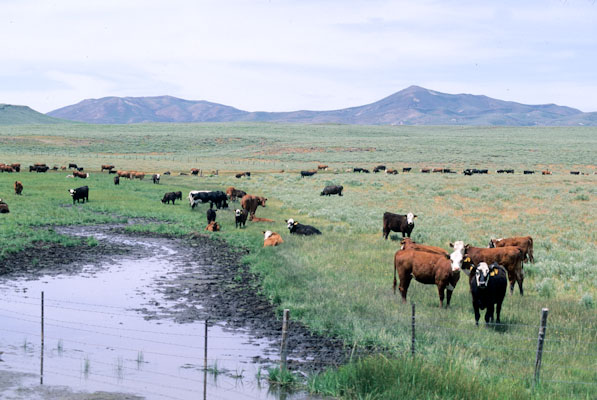
In October, a Portland real estate blogger picked up on the post at Strange Maps. His post related information — but in the comments, one fellow urged we sell off the lands. Oregon has a good amount of land held in trust by federal agencies, but it’s far from the the highest percentage. Oregon has benefited from public lands more than many other states. Who would suggest selling off assets?
The Capitalist Digest — which misappropriates Jefferson’s warning to the clergy (famously engraved around the rotunda of the Jefferson Memorial, but I digress) — displayed a remarkable lack of historic perspective and a unfamiliarity with capitalist property law, declaring that the federal government’s holding lands in trust was one of the things Marx and Engels wished to see (November 10, not a week after the election). Had Marx and Engels actually meant that wise land stewardship was something to be striven for, that public lands should be used to the public good, they would have been in the bosom of capitalism when they did so (I suspect they were not in favor of poor stewardship.) The Capitalist Digest would urge burning Milton Friedman and Jesus Christ if their names had appeared in the Communist Manifesto. This is not a bunch that works on principles and reason. Under U.S. law, federal land management is not communist at all with small exceptions made to support American cattlemen, sheep ranchers and mineral and oil extractors, and I doubt that the Capitalist Digest really intended to indict American oil producers, miners and livestock operations. The Capitalist Digest blames their insanity on Robert Higgs at the Independent Institute, as if The Capitalist Digest can’t make up their own minds.
None of these sites gives any serious thought to the idea. None provides a scintilla of an iota of analysis to indicate it would be a good idea.
As one of the the principal spokesmen for the Sagebrush Rebellion in the early days, I want it known that I’ve thought these issues through, and argued them through, and followed the documentation for 30 years (Holy frijole! I’m old!). Issues with public lands revolve around stewardship. Bad stewardship is not improved by a change in ownership. Ownership change has all too often only led to worse stewardship. Selling off the public lands is a generally stupid idea.
Certain local circumstances change the nature of a tiny handful of such deals — but not often, not in many places, and not enough to make a significant contribution to retiring any debt the federal government owns.
It’s troubling that such a flurry of stupidity strikes now, during a transition of presidents. This is how stupid ideas get traction, like kudzu on a cotton farm, while no one is paying deep attention. Let’s put this idea back into its coffin with a sagebrush stake in its heart.
Update 2014: The original GSA map showing percentages of federal holdings in each state (including Indian Reservations as federal holdings), as published in Strange Maps when it was still active.
Spread the word; friends don't allow friends to repeat history.
Or, until that account is unsuspended by the forces supporting Donald Trump: Follow @FillmoreWhite, the account of the Millard Fillmore White House Library
We've been soaking in the Bathtub for several months, long enough that some of the links we've used have gone to the Great Internet in the Sky.
If you find a dead link, please leave a comment to that post, and tell us what link has expired.
Thanks!
Retired teacher of law, economics, history, AP government, psychology and science. Former speechwriter, press guy and legislative aide in U.S. Senate. Former Department of Education. Former airline real estate, telecom towers, Big 6 (that old!) consultant. Lab and field research in air pollution control.
My blog, Millard Fillmore's Bathtub, is a continuing experiment to test how to use blogs to improve and speed up learning processes for students, perhaps by making some of the courses actually interesting. It is a blog for teachers, to see if we can use blogs. It is for people interested in social studies and social studies education, to see if we can learn to get it right. It's a blog for science fans, to promote good science and good science policy. It's a blog for people interested in good government and how to achieve it.
BS in Mass Communication, University of Utah
Graduate study in Rhetoric and Speech Communication, University of Arizona
JD from the National Law Center, George Washington University


 Posted by Ed Darrell







 Millard Fillmore's Bathtub