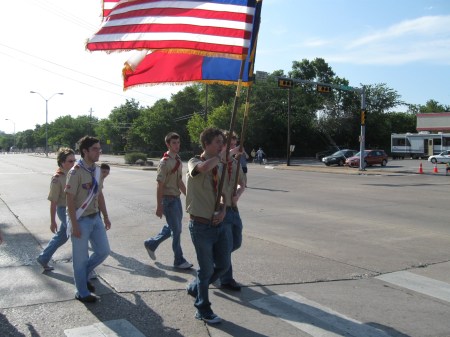
Scouts from Troop 355 and Pack 494 carry the colors in the Duncanville, Texas, 4th of July parade
Scouts from Troop 355 and Pack 494 carry the colors in the Duncanville, Texas, 4th of July parade
 Leave a Comment » |
  4th of July, Boy Scouts of America, Flag ceremony, Flag etiquette, Fly your flag today, History | Tagged: Boy Scouts of America, Duncanville Texas, Flag etiquette, July 4 |
  Permalink
 Posted by Ed Darrell

U.S. flag displayed over Virginia Route 53, the road to Monticello, Jefferson's home in Virginia, 2008 - Photo by Emory
Properly displayed, by the way. The field is in the “northwest” position.
Leave a Comment » | 4th of July, Flag etiquette, Fly your flag today | Tagged: Flag etiquette, Fourth of July, Monticello, Thomas Jefferson, Virginia Route 53 | Permalink
Posted by Ed Darrell

Soldiers raise the U.S. flag at a base in Afghanistan, 2003
It’s the 233rd anniversary of the announcement of the Declaration of Independence. The resolution calling for independence of the 13 colonies passed the Continental Congress on July 2, 1776. The Declaration would be Thomas Jefferson’s crowning achievement, outshining even his presidency and the Louisiana Purchase. John Adams wrote to his wife, Abigail, that July 2 would forever be marked by patriotic displays.
But the Declaration, which gave teeth to the resolution, was adopted on July 4. Adams didn’t miss a beat. Who quibbles about a couple of days when the celebrating is so good?
Adams and Jefferson were two of the five-member committee the Congress had tasked to write a declaration. Adams and Ben Franklin quickly determined to leave it up to Jefferson, who had a grand flair with words, and who had just written a couple of stirring documents for Virginia. Roger Sherman and Robert Livingston, the other two members, went along.
Adams and Jefferson became friends only later, when they both served the nation at war as ambassadors to France, and then for Adams, to England. A widower, Jefferson was taken in by Abigail Adams who worried about him. After the war, Jefferson was in England when Adams was to meet King George III in a grand ceremony in which the king would accept the credentials of all the ambassadors of foreign nations to England. As the king strode down the line, each ambassador or delegation would bow, the king would acknowledge them, the papers would be passed, and the king would move on. Adams and Jefferson bowed. King George moved on, ignoring them completely.
In such a case of such a snub, the snubbed foreigners usually made a quick exit. Adams and Jefferson did not. They stood at attention as if the king had treated them like all the rest, reversing the snub.
Back in America in peacetime, Adams and Jefferson fell out. Jefferson favored a more limited federal government; Adams favored a more powerful one. By the end of Washington’s second term, party politics had been well developed. Adams defeated Jefferson in the election of 1796. As was the law then, Jefferson was vice president; but Adams kept Jefferson out of all government affairs. Perhaps because he didn’t have Jefferson to help, Adams’s presidency did not go well. In the rematch election in 1800, one of the bitterest fights ever, Jefferson’s party defeated Adams. The gleeful Democratic-Republican electors all voted one ballot for Jefferson, the presidential candidate, and one ballot for Aaron Burr, the party’s vice presidential candidate.
Alas, that produced a tie vote in the electoral college. Adams’s party, the Federalists, still held the House of Representatives before the new Congress came in. A tie vote goes to the House for decision. They could not bring themselves to vote for Jefferson, and the deadlock continued for 37 ballots. Finally Jefferson’s arch enemy Alexander Hamilton intervened, explaining that Burr was clearly the greater scoundrel, and the House elected Jefferson. Adams slunk out of town, avoiding the inauguration.
It wasn’t until after 1809 when Benjamin Rush hoodwinked Jefferson into writing to Adams, and Adams to Jefferson, that the two became friendly again. For the next 17 years Jefferson and Adams carried on perhaps the greatest series of correspondence in history between two great minds. Letters went out almost daily. They discussed the weather, their families, old times, farming — but especially the republic they had been most instrumental in creating, and how it might be preserved, and prosper. Eventually the letters became harder to read, both because their eyesight was failing, and because their penmanship deteriorated, too.
The ideas, however, flowed like a river.
Both men took ill early in 1826. This was a landmark year, 50 years since the Declaration of Independence. In Massachusetts, a grand display of fireworks was to cap off a day of feasting and celebration. Adams hoped he might attend. In Virginia, a week before, it became clear Jefferson was too ill to venture even as close as Charlottesville for the celebration. Jefferson slept through most of July 3, but awoke about 9:00 p.m., and asked, “This is the fourth?” It was not. These are the last significant, recorded words of Jefferson. He awoke at about 4:00 a.m. on the Fourth of July, 1826, but could not make a rally. He died at 12:50 in the afternoon.
Adams, too, was too ill to attend the celebrations. In the late afternoon or early evening of the Fourth, he awoke, and heard the celebration in the town. Almost as if he had worked just to live to see that particular day, he checked the date. Realizing he was near the end, happy that he’d seen 50 years after the Declaration, and unaware of the events earlier that day in Virginia, Adams said, “Thomas Jefferson still survives.”
Fly your flag today. Remember John Adams and Thomas Jefferson. Remember their great work in creating the nation that protects our freedoms today. Remember their great friendship. Write a letter to a good friend you’ve not written to lately.
It’s the Fourth of July. Their spirit survives in us, as we celebrate, and as we remember why we celebrate.
9 Comments | 4th of July, Declaration of Independence, Flag etiquette, Fly your flag today, History, Holidays, John Adams, Thomas Jefferson | Tagged: 4th of July, Declaration of Independence, Flag etiquette, History, John Adams, Thomas Jefferson | Permalink
Posted by Ed Darrell

Fireworks in Texas - supposedly in Addison, but I can't figure where
I used to tell the kids their mother was so beloved that the town set off fireworks every year on her birthday. They probably didn’t believe the cause, but the town did, indeed, set off fireworks on her birthday. I don’t always do the best planning, but at least I don’t ever forget Kathryn’s birthday — I cannot forget it.
We saw a lot of great displays on the Fourth of July in Washington, D.C., and a fantastic show one year out on the water in Baltimore’s harbor, right over Fort McHenry where Francis Scott Key was inspired to write his now-famous poem. One year with brother Wes and his wife, Momie, we watched bluebirds all day, and then stayed for the fireworks at the Yorktown Battlefield, where Cornwallis was cut off by George Washington and the Continental Army with a grand assist from the French fleet.
We’ve seen great shows in Dallas, a bunch of shows in Duncanville, Texas, and Ogden, Utah, and we saw a part of a show in Addison, Texas, before the rain and wind shut it down (no, I can’t figure out where that photo came from, either) — and that doesn’t count all those shows before we met. New York City, Hyde Park, from the parking lot of the Veterans Administration Hospital in Salt Lake City, overlooking Liberty Park, Derks Field, and a dozen other displays across the valley; from Wahkara Ridge, high up in Payson Canyon, catching the displays from Payson, Springville, Spanish Fork and Provo, Utah; and right there in Cougar Stadium in Provo. Ohio, Michigan, Idaho, upper New York State, and probably a few other places we’ve forgotten about. Great fireworks displays every one.
Last year we camped at the Coral Pink Sand Dunes State Park in Utah on the Fourth of July — no gunpowder fireworks, just the Milky Way and the most spectacular stars you can imagine, perched on 80-foot sand dunes where voices carried 150 yards with no shouting. The decision not to drive back into Kanab for their show was a good idea.
This year? Heck, we’ve already had some fireworks — Kathryn’s mother made a quick trip to an emergency room Friday, and we’ve had to rejuggle the dinner arrangements just a bit for tomorrow. But the knockwursts and bratwursts from Kuby’s are in the refrigerator; the potato salad’s halfway done. The beans will cook up most of the morning. The flags will wave from their new poles.
The kids are home. Buddy the border setter has his sedatives, so maybe the illegal fireworks around the neighborhood won’t make him a total wreck; and we can choose between a Grucci show at the Cotton Bowl or the local fireworks two miles away — or maybe the fireworks at the U.S. Capitol again, this time on PBS, with a glass of champagne.
The nation may not be setting off all those fireworks just for you, Kathryn, but they should be — and the coincidence can’t be explained except by divine intervention, eh? Happy birthday, sweetie!
6 Comments | Family, History, Holidays, Point of personal privilege | Tagged: Birthday, Family, Fireworks, Fourth of July | Permalink
Posted by Ed Darrell
The only thing that comes to my mind is the old saw about how to survive in a tough neighborhood — act crazier than a hopped-up loon. No one wants to cross the crazy guy.
Of course, neither will the neighborhood generally unite to elect the crazy guy to the city council.
Palin will resign, she says, at the end of the month. Yeah, Larry Craig promised to resign, too.
Grandmother’s ghost said I should check to see whether she’s been to Argentina lately. Now she’s quietly singing “Don’t cry for me, Wasilla.”
At least she didn’t say “You won’t have Sarah Palin to kick around anymore.” Since Richard Nixon, that line’s been better reserved for zombie movies.
Say what?
6 Comments | Campaigns, History, Politics | Tagged: 2012, Alaska, Campaigns, Politics, Sarah Palin, Surprise! | Permalink
Posted by Ed Darrell
George M. Cohan sang that he was a “real-live nephew of my Uncle Sam, born on the Fourth of July.”
Ben Davidian would have liked that birthdate, but truth be told, he wanted to savor the full day — so he was born on the third of July.
In April he was named by Gov. Arnold Schwarzeneggar to a judgeship in Sacramento.
Happy birthday, Ben. (Which is it: 39? 40?) I won’t tell anyone that secretly you’re a great fan of Joan Baez.
Leave a Comment » | Life, Point of personal privilege | Tagged: Birthdays, Judge Ben Davidian, Life, Personal | Permalink
Posted by Ed Darrell
Well I remember summer camp as a Boy Scout, annually at Maple Dell, a few miles up Payson Canyon, Utah. Troop 17 camped the week of July 4th, by tradition. Most other troops avoided that week so families could get together on the holiday — there would be half the usual number of Scouts, and we had a lot more opportunities to hit the rifle range, archery range, rowboats and canoes. Over four years, we noticed that the annual cicada invasion would usually start near the end of that week, as the Utah heat started its march toward August records. It was a good week to camp, to avoid the heat and the astounding noise of those insects.
As an Explorer, and junior camp staff member later, I spent entire summers at Maple Dell. We’d start in early June, when the Payson River still ran icy from the snow runoff, and when our sleeping bags would be coated with frost in the morning. Cicadas in July said it was warming. Cicadas in August screamed it was hot — sometimes near 100° F, a dramatic shift from the frost just eight weeks earlier.
In Maryland, one year we lived through the confluence of the 13-year and 17-year locusts, which are related to cicadas. (Bug Girl? You out there? Help me out on these details.) The adults would literally coat trees. They’d mate and die, and fall to the street, where cars would smush them — driving was more treacherous than driving on ice. What few predators there were — and the predators seemed awfully few in relation to the billion locusts per acre — would eat their fill, and then ignore the rest of the mob. The locusts came earlier than the cicadas, as I recall — but still later in the summer.
A post I wrote two years ago has been getting a lot of hits. In late July 2007 I wrote of the return of the cicada hawks, here in Dallas. Each summer since, about the time the cicada hawks return, people start cruising the web to find out how to get rid of them, mostly (don’t, they’re practically harmless). As I watched the traffic counts, I noticed that I had posted it on July 20 back in 2007. I wrote that the wasps had been around for about ten days, then. Last year I posted a welcome to the wasps on July 8.

Cicada killer wasps on Boisenberry Lane, Dallas, 2008 - copyright Ed Darrell
I saw my first cicada-killer wasp in 2009 about June 10. We didn’t have cicadas, then, that I could find. The cicadas started buzzing on June 21, the first day of summer. Our backyard is quite busy with cicada hawks right now, tracking down the cicadas and digging the holes in which to store the cicada zombies.
I hate to crash the denialists’ parties, but it sure seems to me that this cicada season thing is moving up. The tilt of the Earth is still 23°. The amount of daylight is the same. What factors other than climate warming would cause these insects to come earlier each year? What’s your experience?
More information:
5 Comments | Climate change, Cost of Green, Global warming, Green Politics, History, Natural history, Science | Tagged: Cicada Hawks, Cicada Killer Wasps, Climate change, Cost of Green, Insects, Natural history, Nature, Science, Summer | Permalink
Posted by Ed Darrell
The exhibit left the George H. W. Bush Presidential Library in March 2007 — but the good folks who run the library left an on-line version. It’s a gallery of 100 photographic portraits of important Texans. Click on the photo, you get a short biography of each person.

Red Adair, pioneer in putting out oil field fires - Image from George H. W. Bush Presidential Library
Red Adair holds the first spot on the list, and ZZ Top occupies the last (the list is alphabetical). The list is eclectic, and useful. The list focuses on the 20th century, leaving out the usual Texas luminaries Austin, Houston and de Zavala, and that’s good. This is a great list for junior high Texas history students to use, for learning Texas history, or for selecting the “famous Texan” who will be the subject of their biography project.
A handful of these people are commonly reported on in classrooms. Most are not, however. You’ll learn more about Texas folklore and Texas’s Mexican heritage in music from these short biographies than you can learn in many Texas history courses. Adair to ZZ Top, including John Henry Faulk, John Nance Garner, Walter Cronkite, Bobby Layne, Janis Joplin, Scott Joplin, Michael DeBakey, George Foreman, Lydia Mendoza, Sam “Lightnin'” Hopkins, Hector Garcia, and Bessie Coleman, and 86 others. All the major Texas industries are represented, and all parts of Texas. If a student knew all of these people, the student would have a heck of a bunch of Texas knowledge.

Bessie Coleman, world's first licensed black pilot - image from the George H. W. Bush Presidential Library
Use this exhibit to broaden your knowledge of Texas history, or to invent new teaching points. A savvy teacher could use these to create 100 bell ringers, I suspect — and do a lot more.
It would be great if the library were to publish a poster featuring the 100 portraits. Anybody in College Station listening?
How do you use this exhibit in your classroom?
1 Comment | Biography, History, History images, Libraries, Museums, Texas, Texas history | Tagged: 100 Tall Texans, Bessie Coleman, Biography, George H. W. Bush Presidential Library, History, History images, Red Adair, Texas, Texas history | Permalink
Posted by Ed Darrell
They could get together for one huge party, eh? Well, maybe not Somalia. Found this list on Wikipedia:
Leave a Comment » | Africa, Freedom - Political, History, International law | Tagged: Africa, Burundi, Ghana, Independence, Rwanda, Somalia | Permalink
Posted by Ed Darrell
Al Franken’s in the Senate and Sen. Robert Byrd is out of the hospital. I was thinking maybe it’s time for some intransigent Republicans to review whether they really want to cross the Democrats. And then I came across this photo. Somehow, it’s symbolic.
In any case, it’s a great photo.

Well, technically it's a mule, and not a jackass, but sometimes I worry that Thomas Nast couldn't tell the difference. Mule at a Georgia petting zoo - Photo by Lona
3 Comments | Humor, photography, Politics | Tagged: Humor, photography, Politics | Permalink
Posted by Ed Darrell
I noticed two events that share a day, though five years apart, and I wonder whether it was coincidence.
Pure coincidence, or macabre planning by diplomats? Anyone know?
3 Comments | 1914-1918, Historic documents, History, milestones, War, World War I | Tagged: 1914-1918, Archduke Franz Ferdinand, History, Treaty of Versailles, World War I | Permalink
Posted by Ed Darrell
You are currently browsing the Millard Fillmore's Bathtub blog archives for July, 2009.


Ed Darrell on Texas's Colorado River


Come on in, the water's fine. Come often: Cleanliness is next to godliness.


 Millard Fillmore's Bathtub