Eugene Robinson: “The GOP’s rude awakening on health-care repeal”

January 23, 2011

Eugene Robinson stuck to the facts, and noted that by a careful count, 62 percent of Americans oppose the Republican vote to repeal the new health care law:

What actually happened, though, is that the Republican majority managed to win the votes of just three Democrats – all of them Blue Dogs who have been consistent opponents of the reform package anyway. In terms of actual defectors, meaning Democrats who changed sides on the issue, there were none. This is momentum?

The unimpressive vote came at a moment when “the will of the people” on health care is coming into sharper focus. Most polls that offer a simple binary choice – do you like the “Obamacare” law or not – show that the reforms remain narrowly unpopular. Yet a significant fraction of those who are unhappy complain not that the reform law went too far but that it didn’t go far enough. I think of these people as the “public option” crowd.

Eugene Robinson, op-ed writer, Washington Post
Washington Post header for Eugene Robinson’s columns                                                                      .

The numbers:

A recent Associated Press poll found that 41 percent of those surveyed opposed the reform law and 40 percent supported it. But when asked what Congress should do, 43 percent said the law should be modified so that it does more to change the health-care system. Another 19 percent said it should be left as it is.

More troubling for the GOP, the AP poll found that just 26 percent of respondents wanted Congress to repeal the reform law completely. A recent Washington Post poll found support for outright repeal at 18 percent; a Marist poll pegged it at 30 percent.

In other words, what House Republicans just voted to do may be the will of the Tea Party, but it’s not “the will of the people.”

[My math:  43% +19%=62%.]

The facts:

The CBO, which “scores” the impact of proposed legislation, calculated that the health-reform law will reduce federal deficits by at least $143 billion through 2019. Confronted with the fact that repeal would deepen the nation’s fiscal woes, Republicans simply claimed the CBO estimate to be rubbish. Who cares what the CBO says, anyway?

Er, um, Republicans care, at least when it’s convenient. Delving into the CBO’s analysis, they unearthed a finding that they proclaimed as definitive: The reform law would eliminate 650,000 jobs. Hence “Job-Killing” in the repeal bill’s title.

One problem, though: The CBO analysis contains no such figure. It’s an extrapolation of a rough estimate of an anticipated effect that no reasonable person would describe as “job-killing.” What the budget office actually said is that there are people who would like to withdraw from the workforce – sometimes because of a chronic medical condition – but who feel compelled to continue working so they can keep their health insurance. Once the reforms take effect, these individuals will have new options. That’s where the “lost” jobs supposedly come from.

So, in other words, Republicans voted to keep people slaves to jobs that provide health care benefits.  The party of  Abraham Lincoln has fallen so far not even Abraham Lincoln at his most charitable moment would recognize it any longer.


Roger Bate’s simple lie about DDT

January 22, 2011

In the last two weeks we’ve seen a virtual-world assault by Richard Tren, Roger Bate and Don Roberts, alternately telling fantastic tales about how Rachel Carson from beyond the grave organized a mass murder that rivals Joseph Stalin, or saying that environmentalists conspire to keep life-saving chemicals from getting to Africa and Asia.

This morning’s e-mail brought a release from the often-fact-challenged American Enterprise Institute, under the by-line of Roger Bate — “The UN’s Scientific Fraud Against DDT.”

Fraud?  That’s all on Bate.  Here are things Bate will not tell you:

  • No malaria fighting organization claims it needs more DDT.
  • DDT has never been banned in Africa, nor Asia.
  • If any nation wishes to use DDT to fight malaria, that nation need only write a letter to the World Health Organization informing WHO of that fact.
  • If anyone violates the Persistent Organic Pollutants Treaty (POPs) and uses DDT without telling WHO first, there is no penalty.
  • Malaria death rates are, now, at the lowest level in human history.  While there is a threat of a resurgence of malaria, the threat comes because the malaria parasites themselves develop resistant to the pharmaceuticals used to treat the disease in humans — no connection to DDT.
  • DDT use cannot stop malaria.  Consider:  India is one of two or three nations today who still manufacture DDT, and India uses more DDT than all the rest of the world’s nations put together.  Malaria is still a problem for India.
  • Beating malaria requires more than poisoning the hell out of Africa.

Roger Bate:  Walking science, history, law and policy fraud.  His claims are hoaxes.

Update: Tim Lambert at Deltoid looked at the claims of Bate and Roberts, and found that they appear to have made many errors in simple math and statistics.  Read about it here.


Dallas schools superintendent on Texas budget: “Worse than initially projected”

January 21, 2011

$9.8 billion in cuts to Texas education.

If the Chinese did this to us, we’d declare war. When Gray Davis proposed much smaller cuts in California, Californians recalled him from office.

But it’s Rick Perry and the Republicans.  Can anyone think of a good reason to treat them better?

Recall petition on Rick Perry, anyone?

Here’s the reaction from Dallas Independent School District Superintendent Michael Hinojosa:

A message from Superintendent of Schools Michael Hinojosa

First Budget Numbers Look Grim

The Texas Legislature convened this week and provided the first look at how the state’s budget crunch could impact public education. Unfortunately, things do not look good, and that is putting it mildly.

In fact, the scenario that was presented is even worse than was initially projected. Prior to this week’s legislative session, budget analysts had predicted that public education statewide would undergo cuts of approximately $5 billion during the next biennium. The number just presented to the Texas House of Representatives is closer to $9.8 billion.

Right now, various programs that have been fully or partially funded through state grants such as prekindergarten, summer school, teacher performance incentives, and technology infrastructure are not included in the new budget. In addition, current estimates place cuts to Dallas ISD at a staggering $180-$200 million during the next two years. Because 85 percent of the district’s budget goes to personnel, this means that we will have to look at reducing payroll.

Please note that this memorandum is not written to cause a panic. It is important, however, for you to understand that the state’s budget outlook is anything but rosy and funding for education will likely be reduced. It is too early to speculate where cuts in payroll will need to take place, but everything will likely be on the table.

Next week, the Senate will present its version of the budget, and it will likely be similar. At this point, the House version does not include tapping into the state’s Rainy Day Fund, which is still an option to lawmakers. It may be a couple of months before a clearer picture will emerge of how public education will be impacted by the budget.

Please know that I will make every effort to keep you informed throughout the budget process. I also can assure you that our trustees and I will do everything we can to impress upon lawmakers the important work that you do for the children of the Dallas Independent School District.

Thank you for your continued work on behalf of Dallas ISD students.


Bull baiting bill not appearing ready, Utah legislator proposes for killing horses instead

January 20, 2011

You couldn’t make this stuff up, and if you did, you should see a therapist.

As the Utah 2011 legislative session gets underway, state Rep. Curt Oda wasted no time in introducing a bill that reflects his legislative priority. He is not using his position as a legislator, however, to try to create jobs, improve schools, or protect children, for example. Instead, his bill, H.B. 210,  encourages the torture and killing of animals.

Oda wants to amend the state’s animal cruelty law, Section 76-9-301, to exempt “pests” and “feral” animals from the definition of animal. This means that to the extent they were protected, these animals would no longer be protected by the state’s animal cruelty law. Oda is reported to have told a local newspaper that “feral” animals and “pests” could be shot with a bow and arrow, for example, decapitated or clubbed to death.

Why kill horses with such brutality?  Dog fighting and cock fighting clearly wouldn’t fly?  Bear baiting won’t work — not enough bears?  Surely there are more humane ways to deal with “pest” animals.


Texas Democrats mobilize against Foolish Five Budget Cuts

January 20, 2011

I get e-mail, some of it that offers hope.  This one came from Boyd Richie, chair of the Texas Democratic Party:

Dear fellow Democrat,

Earlier this week, the State House version of the budget proposal was set out in black and white.  The cost of ten years of Republican rule: a $27 billion budget deficit.

Governor Rick Perry wants Texans to believe the massive budget shortfall is simply the result of the recession – but this is not true.  The tax package the Republican-controlled legislature passed in 2006 created a permanent structural deficit that led to the budget crisis facing our state, and now they refuse to take responsibility.

Texas Democrats stand up for the interests of our working families.  We demand a quality education for our children because we know this is the key to their ability to compete for the good jobs of tomorrow.  However, these budget cuts place public education and other issues critical to Texas’ future economic security under attack.  They are short-sighted, hostile to our state’s children and elderly and bound to weaken employment and economic growth:

“The Foolish Five” Proposed Cuts

Jobs:

  • 9,600 state jobs eliminated that could cause the loss of 14,400 more jobs.  Economist Ray Perryman explained that every lost public sector job creates a “multiplier effect”, resulting in an additional 1.5 jobs lost.


  • $1.15 BILLION reduction in Closing the Gap programs, designed to attract students to study in fields that help Texas’ economy. These cuts will negate over one million new jobs and $122 billion in personal income that economist Perryman calculated these programs would create by 2030.

Children:

  • $9.8 BILLION in cuts from our public schools
  • Elimination of Pre-K Early Start and Early Childhood School Ready program funding, meaning that nearly 200,000 kids will be kicked off these important school-readiness programs.

Elderly:

  • $1.57 BILLION cut in nursing home payments

As Democrats, our numbers are down but we are not out – and we will fight these cuts every day on behalf of our working families.


Boyd L. Richie
Boyd L. Richie
Chairman
Texas Democratic Party

P.S. Don’t forget to join the Party Insider email list to receive the latest talking points on issues like the budget and other important priorities. Sign-up is quick and easy on the TDP website: http://www.txdemocrats.org/party-insider-sign-up/


Repeal ObamaCare, drive American families into bankruptcy

January 19, 2011

Getting everybody insured is the first step toward controlling health care costs — and the bill we have makes significant savings even without being so strong as it should be.  Watch and listen to White House adviser Stephanie Cutler’s explanation.

Tip of the old scrub brush to Mary Almanza.


Science ethics: Ten biggest science paper retractions of 2010

January 18, 2011

Science uses a tough system to correct errors and prevent frauds.  Peer-review makes it difficult to get a paper into a journal, period, let alone one with hoaxed-up data or conclusions.  Still, out of the tens of thousands of serious science papers published each year, a few sneak through that shouldn’t, sometimes due to researcher error, sometimes due mix-ups in peer review, sometimes — rarely — due to outright fraud.

In the past 15 months political action to fight global warming took huge hits around December 2009 when a few thousand e-mails were hacked from computers at the Hadley Climate Research Unit in England, one of the leading groups in climate research that indicates a warming Earth.   Critics of Hadley made great hay about how the alleged wrong-doing in the e-mails meant that all climate research was wrong, or at least questionable.

So, I was greatly interested to stumble across this article in The Scientist, which lists what that magazine calls the “Top Retractions of 2010” — papers retracted for errors and ethical reasons.

None of the top retractions had anything to do with climate research.  One of the most under-reported stories of 2010 was that the claims of error and fraud by climate scientists were, themselves, hoaxes.  Looking at the list of top retractions, unless you were really looking for the climate papers, you might never notice.

Most of the retractions were in medicine and health.  Several were in cancer research.  False science in climate studies does not appear to be a major problem, measured by retractions.

Those who accuse climate scientists falsely don’t really have anything to retract in a formal sense.  They did no science work that was published.

When do people wake up and realize that global warming is a real problem, and we shouldn’t be fooled by political smears of the scientists who discover the data?


But the Earth still warms

January 18, 2011

Political activists who oppose working to stop or slow greenhouse gas emissions in order to slow global warming find themselves in awkward positions recently.

Before, during and after the Copenhagen meeting in December 2009 they predicted that warming had stopped, and that we are entering a period of global cooling.  Alas for their claim, the planet refuses to cool.  The decade ending in 2009 was the warmest in human history; 2010 itself turned out to be one of the warmest years in history, worldwide.

NOAA graphic: Indicators of global warming: “Seven of these indicators would be expected to increase in a warming world, and observations show that they are, in fact, increasing. Three would be expected to decrease and they are, in fact, decreasing.”

Somebody stole hundreds of e-mails from one of the climate research clusters in England, and the anti-action activists claimed that the messages would reveal wrong-doing on the part of scientists, perhaps even criminal action.  Instead, five separate investigations discovered no wrong-doing on the parts of scientists, but a lot of hard work gone for too little action because of the anti-science shenanigans of the anti-action crew.  The science showing global warming remains untouched, with no significant body of research showing contrary.

One of the loudest voices against claims of global warming, Christopher Monckton, was unmasked as a blowhard and a fraud.    Scientists organized to refute the hoax claims of the anti-action activists.

So, the anti-action activists are sore.  They don’t take criticism well, and they especially don’t like anyone who points out their errors.

Sadly, they didn’t learn from the their past hoaxes.  So if even a lowly high school teacher should point out an error of history, they resort to making false claims and censorship against the teacher.  They have no data to back their case, nothing but invective to rebut with.

And so it was that a rather new site, hauntingthelibrary, took my comment noting where they could find the data to disabuse their wild claims, stripped it out, and substituted words I did not and would not write.

Fraud again, this time from hauntingthelibraryHoaxFraud even in small things.

The movement against the science of global warming is rotten to its core.  (Seriously — most sites would be happy to note the pingback from this blog; the blogger had to act to block the pingback from showing up.  What are they so afraid of?)

Legend says that Galileo, backing out of the audience with the Pope in which he was put under house arrest after having “recanted” any claim that the Earth orbits the Sun, said quietly, “Still, it moves.”  Even the Pope’s powers through the Inquisition could not stop the Earth orbiting the Sun.  No matter how powerful the denial propaganda machines, no matter how many anti-science bloggers they recruit, the Earth keeps on stubbornly warming up.

Or, as Galileo might have said, “Eppure, lei si scalda!”

_____________

Update: Then there is Anti-Gore Effect Sillies Syndrome — claiming Gore erred, when he didn’t.  It’s demonstrated with the infection fully affecting the judgment of its victims at this odd place, XD Talk Forums.


More:

Earlier at Millard Fillmore’s Bathtub:

Photo by W. W. MacFarlane - Pine bark beetle damage in Teton National Forest

Photo by W. W. MacFarlane – NPR caption: “Many dead trees appear gray and red on the high-mountain slopes of Union Pass Bridger in Teton National Forest in Wyoming”


Republicans and Tea Party usher in school segregation in Wake County, North Carolina

January 17, 2011

No comment here, just the facts:  Republican school board in N.C. backed by tea party abolishes integration policy


Oldest written melody in history

January 17, 2011

There is the oldest known animated cartoon, 5,200 years old.  There is the oldest known musical instrument, between 7,000 and 9,000 years old.

Now, also, here is the oldest known written melody, too – from 1400 BCE.

Are we to assume that for at least 5,000 years, music was all improvised?  Would that make jazz the oldest musical form?

In the YouTube comments, there is what may be oldest known copyright dispute, too.

Michael Levy performs on the lyre in the video, and he’s the authority on ancient music who put the thing together.  His explanation and website offer a lot more that teachers of world history might use to bring these ancient arts to life.  He explained at YouTube:

This unique video, features my arrangement of the 3400 year old “Hurrian Hymn no.6”, which was discovered in Ugarit ,ancient northern Canaan (now modern Syria) in the early 1950s, and was preserved for 3400 years on a clay tablet, written in the Cuneiform text of the ancient Hurrian language – it is THE oldest written song yet known! Respect, to the amazing ancient culture of Syria…السلام عليكم

Although about 29 musical texts were discovered at Ugarit, only this text, (text H6), was in a sufficient state of preservation to allow for modern academic musical reconstruction.

In short, the Cuneiform text clearly indicated specific names for lyre strings, and their respective musical intervals — a sort of “Guitar tablature”, for lyre!

Although discovered in modern day Syria, the Hurrians were not Syrian — they came from modern day Anatolia. The Hurrian Hymn actually dates to the very end of the Hurrian civilisation (c.1400BCE) . The Hurrian civilization dates back to at least 3000 BCE. It is an incredible thought, that just maybe, the musical texts found at Ugarit, preserved precious sacred Hurrian music which may have already been thousands of years old, prior to their inscription for posterity, on the clay tablets found at Ugarit!

My arrangement here, is based on the original transcription of the melody, as interpreted by Prof. Richard Dumbrill. Here is a link to his book, “The Archeomusicology of the Ancient Near East”:
http://bit.ly/d3aovp

A photograph of the actual clay tablet on which the Hurrian Hymn was inscribed, can be seen here:

http://phoenicia.org/music.html

The melody is one of several academic interpretations, from the ambiguous Cuneiform text of the Hurrian language in which it was written. Although many of the meanings of the Hurrian language are now lost in the mists of time, it can be established that the fragmentary Hurrian Hymn which has been found on these precious clay tablets are dedicated to Nikkal; the wife of the moon god.

There are several such interpretations of this melody, but to me, the fabulous interpretation just somehow sounds the most “authentic”. Below is a link to the sheet music, as interpreted by Clint Goss:

http://www.flutekey.com/pdf/HurrianTa…

In my arrangement of the Hurrian Hymn, I have attempted to illustrate an interesting diversity of ancient lyre playing techniques, ranging from the use of “block and strum” improvisation at the end, glissando’s, trills & tremolos, and alternating between harp-like tones in the left hand produced by finger-plucked strings, and guitar-like tones in the right hand, produced by use of the plectrum.

I have arranged the melody in the style of a “Theme and Variations” – I first quote the unadorned melody in the first section, followed by the different lyre techniques described above in the repeat, & also featuring improvisatory passages at the end of the performance.

I am also playing the lyre horizontally – a much more authentic playing position, as depicted in ancient illustrations of Middle Eastern Lyre players:

http://www.hebrewhistory.info/factpap…

This also seems a much more stable playing position to me, and I find it much easier to improvise with string-blocking etc when the lyre is held in this manner.

My arrangement of the melody is much slower than the actual academic interpretation – I wanted the improvisations in the variations on the theme to stand out, and to better illustrate the use of lyre techniques by a more rubato approach to the melody.

All of my 9 albums of mystical, ancient lyre music are now available from iTunes . . .

1)”An Ancient Lyre”: http://bit.ly/dhCozi

2)”King David’s Lyre; Echoes of Ancient Israel”: http://bit.ly/9PCIua

3)”The Ancient Biblical Lyre”: http://bit.ly/9hTDje

4)”Lyre of the Levites”: http://bit.ly/9baWuM

5)”Apollo’s Lyre”: http://bit.ly/dhCozi

6)”Ancient Times — Music of The Ancient World”: http://bit.ly/aRF5PD

7)”The Ancient Greek Modes”: http://bit.ly/cZks0o

8)”The Ancient Greek Lyre”: http://bit.ly/bxO7Ra

9)”Ancient Visions — New Compositions for an Ancient Lyre”: http://bit.ly/dCPmRN

Physical CDs are also available anywhere in the world from CD Baby, for 3 of my best selling albums:

“An Ancient Lyre”: http://www.cdbaby.com/cd/mlevy4

“King David’s Lyre; Echoes of Ancient Israel”: http://www.cdbaby.com/cd/mlevy

“Lyre of the Levites”: http://www.cdbaby.com/cd/mlevy2

For full details about my albums of lyre music, and the fascinating ancient historical background, please visit my official website:

http://www.ancientlyre.com

Tip of the old scrub brush to Pharyngula, who used the video only in passing, oddly enough.


A real missed anniversary: Death of Hiram Walker, defendant in the case of Rose 2d of Aberlone

January 16, 2011

Another missed anniversary on January 12.

Detroit grocer Hiram Walker, founder of St. Mary's Church

Detroit grocer Hiram Walker, defendant in the case of Rose 2d of Aberlone, Sherwood v. Walker; it is one of the most famous contracts cases in American law. No photo of the cow was found.

Hiram Walker — yes, that Hiram Walker — died on January 12, 1899.  He was a Detroit grocer, and distiller, but dabbled in a lot of businesses.  Among those dabbles:  Land and cattle.

Every law student knows about Walkers dealing in one particular cow:  Rose 2d of Aberlone.

In addition to these notable accomplishments, Mr. Walker was also a cattle breeder and was party to a famous contracts case known as “The Pregnant-Cow Case.” (33 N.W. 919 (Mich. 1887).) According to the majority opinion, Walker agreed with Theodore Sherwood, a banker, to sell him a cow of distinguished ancestry known as “Rose 2d of Aberlone”. The price was $80, both parties believing Rose to be sterile. When Walker discovered that she was pregnant and worth between $750 and $1,000, he refused to deliver her. Sherwood sued and prevailed in the trial court, but lost on appeal. This case illustrates the contract law rules of rescission of contract by mutual mistake. Because both parties believed they were contracting for a sterile cow, there was a mutual mistake of fact, and therefore ground for rescission. However, the dissent in the case, written by Justice Sherwood, notes that Sherwood believed that Rose “might be made to breed” and purchased her on that chance.

Mutual mistake.  Rescission.  What law student doesn’t cram that case before the final?

Sherwood v. Walker 33 N.W. 919 (Mich. 1887).  The Pregnant Cow Case. (Short version here.  Is a full-text version available on-line for free?  History of the case from the Michigan Courts History site, here.) Fans of the Coen brothers’ True Grit may want to note it was a case in replevin.

No, the case did not settle the issues of replevin nor rescission.  We’re talking law, not the movies. “Thus and such is the law, except sometimes,” as our

When can a person get out of a contract?  When both parties are mistaken about key properties of the object of the contract, one party can back out.

The Michigan Supreme Court held that a party who has given apparent consent to a contract of sale may refuse to execute it, or may void it after it has been completed if the consent was founded, or the contract made, upon the mistake of a material fact—such as the subject matter of the sale, the price, or some collateral fact materially inducing the agreement—and this can be done when the mistake is mutual. Where the item actually delivered or received is different in substance from the thing bargained for and intended to be sold, there is no contract. However, if it is only a difference in some quality or accident, even though the mistake may have been the actuating motive to the purchaser or seller, or both, the contract remains binding. Where a cow was contracted to be sold upon the understanding of both parties that she was barren and useless for breeding purposes, and it appeared that such was not the case, the vendors had a right to rescind the contract, and refuse to deliver the property. The Cow Case has since received attention as, literally, a textbook example of contract law issues.  (Wallace D. Riley, President, Michigan Supreme Court Society)

Hiram Anderson, the defendant in Sherwood v. Walker, died 112 years ago, January 12.

The contract controversy rages on.

Comedians should be able to find many straight lines in that history.

More:


Why conservative talk makes more money than liberal talk: No thinking (is it true?)

January 15, 2011

Some say the success of conservative radio can be traced to 1987 when the Reagan administration put an end to the Fairness Doctrine, making it easier for broadcasters to be one-sided. Others cite the Telecommunications Act of 1996, which led to mega-chains of stations and the widespread duplication of successful formats – including conservative talk radio – which gradually took over the stronger radio outlets in most markets.

Peter Funt, of Candid Camera

Peter Funt, of Candid Camera

But such arguments really overlook the simpler truths of the matter: conservative broadcasters serve an audience that is often angry and easily stirred, that wants to be reinforced more than challenged, and that doesn’t always feel compelled to slavishly adhere to the facts of a matter.

More importantly, conservative broadcasters across the dial are vastly more entertaining than their liberal counterparts. Limbaugh and Beck are polished performers, with enough shtick in the tank to keep truckers engrossed over the long haul, or to rouse tired shift workers on the drive to and from home. Indeed, the daring diatribe of the right is so compelling that it often seems as if the most dedicated listeners of conservative broadcasters are their progressive competitors.

Peter Funt of Candid Camera, at the Cagle Post (Cagle Cartoons)


Typewriter of the moment: Daniel Patrick Moynihan’s policy machine and crystal ball

January 15, 2011

Daniel Patrick Moynihan at his typewriter - photo from the American Academy of Political and Social Science

Daniel Patrick Moynihan at his typewriter – photo from the American Academy of Political and Social Science

This photo adorns the page announcing and asking for nominations to the annual Daniel Patrick Moynihan Prize, at the site of the American Academy of Political and Social Sciences.

Moynihan was the always-opinionated, rarely un-informed social scientist who caused a firestorm of criticism to rain down on Richard Nixon when Moynihan, working for Nixon, suggested that civil rights might benefit from a period of  “benign neglect” by the President.  Later he caused another firestorm, and along period of reflection, when he worried in a paper about the potential bad effects of social welfare programs that would ease suffering, but fail to achieve all of their loftier goals — the workers compensation program that could not restore a worker to full service, the program to provide food and shelter to the children of out-of-work parents if the parents could not find new jobs, etc.  He worried about the ‘culture of poverty.’

He raised hell as the U.S. Ambassador to the United Nations.

Time Magazine cover of UN Ambassador Daniel Patrick Moynihan

Time Magazine cover of UN Ambassador Daniel Patrick Moynihan

I knew him as the U.S. Senator from the State of New York, where he would shock his staff by showing up early on a Saturday morning to knock out a few letters to the editor, and op-ed pieces on his typewriter, without the bother of an in-session Senate to slow him down.  Later I worked for Checker Finn, who had worked with Moynihan when Moynihan was U.S. Ambassador to India.  Finn adopted many of his scholarly habits from Moynihan.  While working for Finn, nearly 25 years ago at the Department of Education, I got a taste of the world to come when Finn aggressively adopted e-mail messaging for himself and anyone of any executive influence under him, at the old Office of Educational Research and Improvement (OERI).  Aggressive adoption of new technologies can greatly improve organizations and organizational effectiveness.

Almost always with a bow tie.  Usually heavily editing his speeches, or writing his own op-ed pieces while other officials paid ghosts to do it for them.  Thinking thoughts Republicans would come to love, while a Democrat, but years before Republicans would come to love them.  Thinking thoughts Democrats would learn to love, but much later.

Few topics evaded his attention and careful thought.  He talked at length with David Gergen about the problem of Wikileaks, a dozen years before Wikileaks came to public attention (and years before Wikileaks even existed.)  He wrote books about international affairs, and education at home.  He pushed environmental laws to be better. Moynihan worried about the health of American families while James Dobson was still learning what a microphone and a family were.  In 1970, Moynihan warned the U.S. president that global warming is a problem.

Moynihan often appeared as the man who went everywhere, and did everything — after leaving Tulsa.  Moynihan studied everywhere.  He worked under New York Gov. Averell Harriman, and Presidents Kennedy, Johnson, Nixon and Ford, before serving a quarter century in the U.S. Senate (Is there some magic in that seat?  His predecessor was James Buckley; his successor was Hilary Rodham Clinton).   Here’s his brief Congressional biography:

MOYNIHAN, Daniel Patrick, a Senator from New York; born in Tulsa, Tulsa County, Okla., March 16, 1927; attended the public and parochial schools of New York City; attended City College of New York 1943; graduated, Tufts University, Medford, Mass., 1948; received graduate and law degrees from the Fletcher School of Law and Diplomacy 1949, 1961, 1968; studied as a Fulbright fellow, London School of Economics and Political Science 1950-1951; served in the United States Navy 1944-1947; Navy reserve 1947-1966; assistant and secretary to New York Governor W. Averell Harriman 1955-1958; member, New York State Tenure Commission 1959-1960; director, Syracuse University’s New York State Government Research Project 1959-1961; director, Joint Center for Urban Studies, Massachusetts Institute of Technology and Harvard University 1966-1969; author; held cabinet or sub-cabinet positions under Presidents John Kennedy, Lyndon Johnson, Richard Nixon, and Gerald Ford 1961-1976; Ambassador to India 1973-1975; United States Permanent Representative to the United Nations 1975-1976; elected as a Democrat to the United States Senate in 1976; reelected in 1982, 1988, and 1994 and served from January 3, 1977, to January 3, 2001; was not a candidate for reelection in 2000; chairman, Committee on the Environment and Public Works (One Hundred Second and One Hundred Third Congresses); Committee on Finance (One Hundred Third Congress); awarded the Presidential Medal of Freedom on August 9, 2000; professor at Syracuse University’s Maxwell School 2001; senior scholar, Woodrow Wilson International Center for Scholars 2001-2003; died of complications from a ruptured appendix on March 26, 2003; interment at Arlington National Cemetery.

Moynihan was a man ahead of his time.

In this photo, he’s making use of the technology of his time:  A typewriter (I think it’s an old Royal).  How much different would the world be had there been personal computers, and the internet, for Moynihan to toy with?

Moynihan was a writer, and the typewriter the chief tool of his trade.  How important was writing?  He gets his own page at Amazon.com.   Hendrik Hertzberg, in The New Yorker, last year:

Nevertheless, Pat Moynihan was, first, last, and always, a writer. “When I was five years old, I asked my mother, what does Dad do?” his daughter, Maura, recalls in a charming afterword to a splendid new book. “She replied, he’s a writer. And he was: he wrote every day—even at Christmas—articles, books, speeches, and, in great abundance, letters.” You might say he wrote his way to power. Without the writing, no foot-in-the-door job in John F. Kennedy’s Labor Department (and no influence once he was there), no high domestic-policy post in Richard Nixon’s White House, no ambassadorships to India and the United Nations, no twenty-four years in the Senate—and no Moynihan Station.

More, Resources:

Daniel Patrick Moynihan and typewriter, Harvard University

Daniel Patrick Moynihan and typewriter (Smith-Corona, I think) in his office at Harvard University – 1971. George Tames/The New York Times.


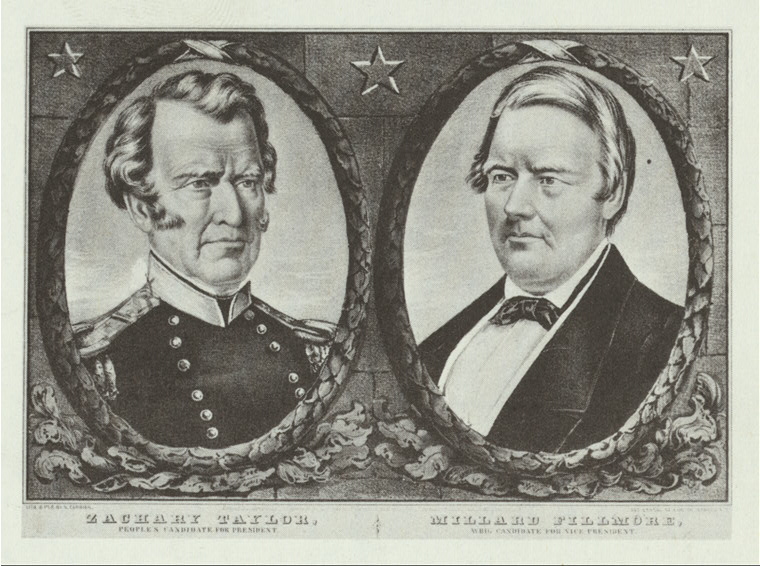
Millard Fillmore in 1848

January 15, 2011

From a flyer or something published for the 1848 presidential campaign, images of the Whig Party ticket, Zachary Taylor for president and Millard Fillmore for vice president:

Campaign flyer for Taylor/Fillmore Whig ticket, 1848 - NY Public Library image

"Zachary Taylor, People's candidate for president; Millard Fillmore, Whig candidate for vice president"

We probably shouldn’t read anything into Taylor’s being identified as the “People’s Candidate” and Fillmore’s being identified as the “Whig Candidate.”  Probably just the copy writer’s way of not sounding redundant.

Found it at the massive digital image collection of the New York Public Library.  Image details from the NYPL:

Image Title:  Millard Fillmore.

Source: Print Collection portrait file. / F / Millard Fillmore. / Portraits.

Location: Stephen A. Schwarzman Building / Print Collection, Miriam and Ira D. Wallach Division of Art, Prints and Photographs

Digital ID: 1234729

Record ID: 583391

Digital Item Published: 12-8-2004; updated 6-25-2010

Image Title

:  Millard Fillmore.


Source

: Print Collection portrait file. / F / Millard Fillmore. / Portraits.


Location

: Stephen A. Schwarzman Building / Print Collection, Miriam and Ira D. Wallach Division of Art, Prints and Photographs


Digital ID

: 1234729


Record ID

: 583391


Digital Item Published

: 12-8-2004; updated 6-25-2010


Sitting Bear, and the Millard Fillmore medal

January 13, 2011

Sitting Bear, Chief of the Arikaras, wearing a medal commemorating Millard Fillmore - Photo by Edward S. Curtis, Library of Congress image

Sitting Bear, Chief of the Arikaras, wearing a medal commemorating Millard Fillmore - Photo by Edward S. Curtis, Library of Congress image

In the 19th century, the U.S. Mint struck medals with the likeness of the sitting president, for use as gifts to foreign dignitaries.  Often these medals would be given to Native Americans as tokens of friendship between the government and the tribe, or as a ceremonial gift on the striking of a treaty.

Description from the Library of Congress:

Photograph shows Sitting Bear, an Arikara chief, in full regalia, with a medallion around his neck. The medallion appears to bear the image of Millard Fillmore and the words: … President of the United States, 1851(?).

Famous photographer of American Indians Edward S. Curtis took this photo.  The photo was copyrighted on November 19, 1908.

  • Reproduction Number: LC-USZ62-136605 (b&w film copy neg.)
  • Rights Advisory: No known restrictions on publication.
  • Call Number: LOT 12321-D [item] [P&P]
  • Other Number: H118592
  • Repository: Library of Congress Prints and Photographs Division Washington, D.C. 20540 USA
  • Notes:
    • H118592 U.S. Copyright Office.
    • Title from item.
    • Curtis no. 2894-08.
    • Forms part of: Edward S. Curtis Collection (Library of Congress).
    • Published in: The North American Indian / Edward S. Curtis. [Seattle, Wash.] : Edward S. Curtis, 1907-30, Suppl. v. 5, pl. 166.

Is the medal the 1851 Indian Peace Medal, perhaps?

Without medals, any plan of operations among the Indians, be it what it may, is essentially enfeebled. This comes of the high value which the Indians set upon these tokens of Friendship. They are, besides this indication of the Government Friendship, badges of power to them, and trophies of renown. They will not consent to part from this ancient right, as they esteem it; and according to the value they set upon medals is the importance to the Government in having them to bestow.

Thomas L. McKenney, head of the Indian Office, to the secretary of the War Department, 1829

And, by the way — isn’t that a grand photo of Sitting Bear?  Even knowing that Curtis might, on occasion, take some liberties in clothing Indians he photographed, it’s a great photo in a great setting of a great man.