Bathtub reading on a cold February day . . .

February 10, 2011

Stuff to make you think:

  • Do you care? At least 16 members of Congress passed up on the government-sponsored health care plans, trying to be true to their campaign promises to repeal similar care for all citizens, a plan they try to ridicule as Obamacare.  Some of them discovered other plans “available from the market” are expensive, don’t cover pre-existing conditions, and generally don’t meet their needs.  Crooks and Liars explains:

Nevertheless, Republicans are discovering the truth: The status quo is unsustainable, unaffordable, and discriminatory. Now what will they do about that? And how will they appease their angry hordes of Tea Party members being stoked daily via email and fear campaigns?

  • Arctic Ice disappears, and so does the evidence Tim Lambert notes that those wacky pranksters at the Heartland Institute managed to find one small part of a chart to make a case that Arctic ice is increasing, even as Russia and China prepare to beat the U.S. to trans-Arctic shipping when the ice disappears.  Whose side is the Heartland Institute on, again?  It’s a new propaganda tactic:  The Small Lie.

There are people who need to soak their crania.  Back to work, here.


Students frozen out of schools, education, maybe hope

February 9, 2011

Does the headline pertain to Dallas ISD’s being closed for cold weather for the fifth day in eight, or does it refer to the situations in Austin, where Gov. Rick Perry insists Texas is better off than the rest of the nation with a $25 billion deficit it can’t close, and all education institutions being given solitary confinement or death penalties?

Gov. Rick Perry, Texas State of the State Address, February 8, 2011

Photo by Ralph Barrera/Austin American-Statesman; Dallas Morning News caption: "Texas Gov. Rick Perry, with Lt. Gov. David Dewhurst after delivering the State of the State address Tuesday, said there are 'no sacred cows' in the strapped Texas budget." Reality caption: Texas Emperor Rick Perry gives thumbs up to the lions who will face education's representative, Hypatia, in the Lege Arena fight-to-the-death; Perry promised not to be present for the final moments of the fight.


Can’t fire the bums to make a quality school: Principals division

February 8, 2011

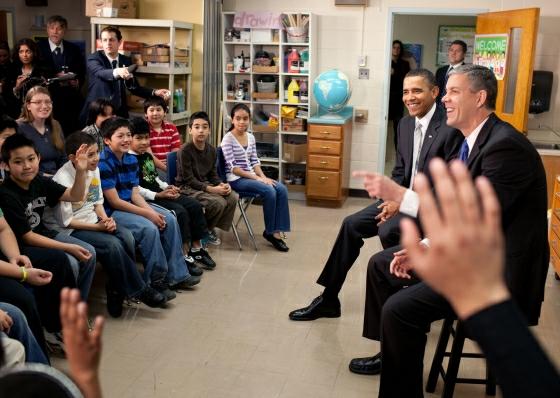
Be sure to see the story in the New York Times today. Obama administration “Race to the Top” money went to states who proposed to replace principals in failing schools. A problem in the strategy threatens the program:  Not enough qualified people exist to replace all the “bad” ones.

Wrong-headed education “reformers” keep talking about “firing the bad ones,” teachers, administrators, or janitors.  Without significantly raising the pay for teachers, without greatly increasing the number of teachers and administrators in the pipeline from teaching colleges or any other source, reformers can’t attract anyone better qualified than the people they wish to replace.
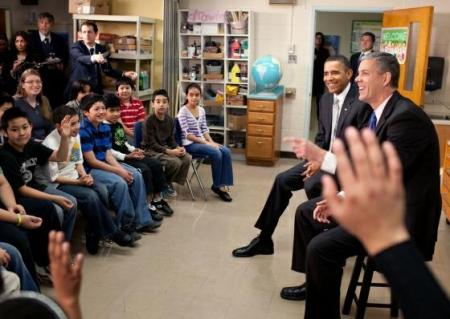
Pres. Obama and Sec. Duncan and the 6th grade at Graham Road Elementary, Falls Church, Virginia

President Barack Obama and Education Secretary Arne Duncan took questions from a 6th grade class at Graham Road Elementary School in Falls Church, Virginia, January 18, 2010 – photo credit unknown

Maybe, just maybe, it’s time these reformers took a step back and did some study, perhaps from the quality gurus, Deming and Juran and Crosby, or from the heights of championship performance, in basketball, football, soccer, sailing (try the America Cup), horse racing or politics:  No one can use firing as a chief tool to turn an organization around, nor to lead any organization to a championship.  Threatening people’s jobs does not motivate them, nor make the jobs attractive to others.

How can we tell the fire-the-teachers-and-principals group is on the wrong track?  See the article:

“To think that the same leader with a bit more money is going to accomplish tremendous change is misguided,” said Tim Cawley, a managing director at the Academy for Urban School Leadership, a nonprofit group that began leading turnaround efforts in Chicago when Mr. Duncan was the superintendent there.

“This idea of a light-touch turnaround is going to sully the whole effort,” Mr. Cawley added.

Tell that to Steve Jobs, who turned Apple around.  Tell it to Jack Welch, the tough-guy boss from GE (who had his own peccadilloes about firing, but who emphasized hiring and pay, at least, as the way to create a succession plan for the vacancies).  Tell it to any CEO who turned around his organization without falling on his own sword.

Any competent quality consultant would have foreseen this problem:  Nobody wants to train for a job with little future, less money to do the job right, little authority to get the job done, and the sole promise that the exit door is always open.

Secretary of Education Arne Duncan should know better, intuitively.  He used to play basketball, professionally.  Surely he knows something about team building and team turnarounds.  What caused his astounding, expensive amnesia?

Part of the issue identified in the article is training:

Because leading schools out of chronic failure is harder than managing a successful school — often requiring more creative problem-solving abilities and stronger leadership, among other skills — the supply of principals capable of doing the work is tiny.

Most of the nation’s 1,200 schools, colleges and departments of education do offer school leadership training. “But only a tiny percentage really prepare leaders for school turnaround,” said Arthur Levine, a former president of Teachers College who wrote a 2005 study of principal training.

That only contributes to the larger problem, that people in the positions are, often, the best ones for the job already; firing them damages turnaround efforts.

In Chicago, federal money is financing an overhaul of Phillips Academy High School. Mr. Cawley’s nonprofit trained Phillips’s new principal, Terrance Little, by having him work alongside mentor principals experienced at school makeovers.

“If we’re talking about turning around 700 schools, I don’t think you can find 700 principals who are capable of taking on the challenge of this work,” Mr. Little said. “If you could, why would we have this many failing schools?”

Education’s problems are many.  Few of the problems are the result of the person at the chalkboard in the classroom.  Firing teachers won’t help.  W. Edwards Deming claimed that 85% of the problems that plague front-line employees, like teachers, are management-caused.  Firing their bosses won’t solve those problems, either, but will just push the problems around.   (What?  “Deck chairs?”  “Titanic?”  What are you talking about?)

Did you hear?  Texas plans to cut state funding to all education by at least 25% for next year, due to Gov. Rick Perry’s $25 billion deficit, which he worked so hard to conceal during last year’s election campaign.

Santayana’s Ghost just dropped by to remind us, suitably the day after Ronald Reagan’s 100th birthday anniversary, of the Report of the Commission on Excellence in Education, the report that saved Reagan’s presidency and got him a second term:

Our nation is at risk. The educational foundations of our society are presently being eroded by a rising tide of mediocrity. If an unfriendly foreign power had attempted to impose on America the mediocre educational performance that exists today, we might well have viewed it as an act of war. We have, in effect, been committing an act of unthinking, unilateral educational disarmament. History is not kind to idlers.

When do we get political leaders who will swim against that tide instead of trying to surf it?


Dan Wasserman cartoon, Boston.com

Dan Wasserman, Boston Globe

See a small collection of  Dan Wasserman’s cartoons on Race to the Top, here.


Big balls in Cowtown . . .

February 7, 2011

”]Farm trucks at the Worthington, Ft Worth Stock Show 2011 - Import 01-22-2011 029Photographer error makes these less than perfect — but I still like them.  Panorama shots in very bad light of four enormous farm pickups, parked in the valet parking area usually reserved for the Jaguars, Mercedes and occasional Bentley, at the Worthington Hotel in Fort Worth.  Stockmen come to Fort Worth every January and February for the Fort Worth Fat Stock Show — these are the Caddillacs and Lincolns and Mercedes of the big-money farm set.


”]Trucks at the Worthington, during the Ft. Worth Stock Show 2011 - Import 01-22-2011 030None of these trucks was as small as a Ford F-250.  These are duellies, crew-cab monsters.


When I saw them I immediately heard Bob Wills and the Texas Playboys singing:

Big balls’ in Cowtown!  We’ll all go down.
Big balls’ in Cowtown!  We’ll dance around.

I wish the sound on this clip were better, featuring several of the original Texas Playboys performing in 1999 (Bob died in 1974):

Listen to Asleep at the Wheel’s true-to-Bob’s-spirit version, featuring Johnny Gimbel, one of the Texas Playboys:

If you can afford to gas one of those rigs, you can afford to dance a bit.


Watt’s Up puts collective hand into the fan – er, um, windmill

February 6, 2011

In the march to brand all non-fossil fuel use as politically incorrect (at least for those who deny global warming should get our policy making attention), the poobahs and commenters at Watts Up have outdone themselves in seeing conspiracies under the ice, mountains where there are molehills, and molehills where there are mountains.

If you wonder whether global warming deniers are biased, Watts’s blog just confessed.

We’re quite frozen in here in Texas, you know.  The unseasonable warm air (high pressure) over the Arctic that warms the sea and melts the ice also pushed the Arctic air south over the U.S.  Where that frigid air met wet air coming from the Gulf of Mexico, weather ensued (yeah, warming may have increased the amount of moisture, too — but that just makes the anti-warmists go blind, so we won’t say it).

Texas got hit with rolling power blackouts last week, when the cold weather increased demand for electricity and crimped the ability of several utilities to bring on power plants build to generate to meet such extra demands.  Some coal-fired plants were off-line, a couple froze up, and natural gas supplies were not in the right place at the right time, so some natural gas plants couldn’t fire up.

But Anthony Watts, seeing spooks behind every clump of Texas Bluestem (Big or Little), promptly got a post up blaming wind power turbines. His post’s headline gives you the whole story as Watts spun it:  “We Spent Billions on Wind Power… and All I Got Was a Rolling Blackout.”

If you’re wondering just what in the world he was thinking, you’d be demonstrating more common sense than the average global warming denier.

Freezing rain had been predicted, but not so much as Texas got.  The follow-up snow also surpassed predictions and expectations — for example, the “skiff to 1″ accumulation” predicted for Dallas turned into 5″ to 7″ through much of the area — stopping any hope that the ice might clear so schools could reopen.  Texas got slammed by the same enormous storm that slammed much of the Midwest and Northeast, with similar results.  For Super Bowl host cities Fort Worth, Arlington and Dallas, that created big problems.  Texas is not equipped to deal with much winter weather, let alone so much in so little time.

In cold weather, power plants fail.  Sometimes power lines fail when the plants stay up.  Sometimes it’s just a question of wheeling power from one part of a local, regional or national grids.  Sometimes the wheeling fails because a switch fails or . . . a failure of capacity can have myriad causes.  In the past, we covered for these problems with additional generating capacity, in excess of what might be needed at any point — mandated by state and local utility commissions to insure power at all times.

Texas deregulated electrical power more than a decade ago, too — which means that market forces govern what gets built and whether there is any emergency generating capacity.

Free enterprise cannot take any blame in the kingdom of those who deny climate and economics.  So when the rolling blackouts plagued Texas, the search for a scapegoat became frenetic.   The question was, who could take the blame that could cast what was perceived to be the most aspersional light on Al Gore, the case for global warming, and anything approaching “green energy?”

Ah, there’s the target!   Wind power.

Watts Up quickly claimed that Texas windmill-generated electricity had failed, if not in fact, then in economic hypothesis.  If the windmills didn’t fail themselves, it must be that the money invested in them could have been better invested in coal-fired power plants, or oil-fired plants, and the blame can be squarely laid at the feet of Michael Mann, or the UN’s IPCC, or Al Gore, or Rachel Carson, or John Muir, or Aeolus — or anyone other than the real trouble, the freakish weather.  Avoiding blame on the weather is important to denialists, because such “perfect storm” combinations come astonishingly close to the predictions of some global warming hypotheses.

So blame must be established, far from the house of warming denialists if possible.  Watts’ blog attacked windpower all through 2010; ignoring any rebuttals, all Watts had to do was point to his earlier published articles.

Days later the facts come out, as revealed in a lengthy investigative story published this morning in the Dallas Morning News with this lead:

The operators of Texas’ electricity grid blamed myriad problems at power plants across Texas for last week’s rolling blackouts.  But interviews and a review of documents by The Dallas Morning News reveal that the breakdown of a cluster of coal-fired power plants in Central Texas was at the heart of the problem.

These facts were known days ago.  In fact the second comment at Watts’ blog corrected the record:

Walt Stone says:

I believe it was two power plants, one coal and one gas fired.

http://fuelfix.com/blog/2011/02/02/whats-behind-the-blackouts-power-plants-not-designed-for-cold-weather/

Could Watts ever concede a possible error?  Not yet, not on his blog, nor anywhere else.  Texas electric grid officials said early they had coal-fired power plants down; they’ve stuck to that story.  Reporting by the state’s major newspapers and other news organizations has borne out that story.

Continuing their leading reporting on energy and environment issues, the Texas Tribune, an on-line publication by a non-profit group, specifically asked about wind power shortages as alleged by Watts:

TT: Were there problems with wind-power plants needing to be shut down for high winds or icing blades, and also did nuclear plants have any problems?

[Trip] Doggett [CEO of the Electricity Reliability Council of Texas (ERCOT)]: I’m not aware of any nuclear plant problems, and I’m not aware of any specific issues with wind turbines having to shut down due to icing. I would highlight that we put out a special word of thanks to the wind community because they did contribute significantly through this time frame. Wind was blowing, and we had often 3,500 megawatts of wind generation during that morning peak, which certainly helped us in this situation.

Is there any room for the wind nay-sayers to squirm on this?

One publication which should be keyed into the facts poked fun at Watts’ hypothesis, although in a subtle, implicit fashion.  Energy Tribune’s story by Philip E. Lewis, comparing Texas to King Canute, noted that Texas has bragged about its energy reliability and separateness from the rest of the state.  What to do in the next energy crisis?

But no worries, I have the perfect solution: Next time power plants are “tripping,” ERCOT (irony alert: Electric Reliability Council of Texas) should issue an order for the wind to blow harder in West Texas. If the wind is reluctant to comply, ERCOT should brook no nonsense and immediately escalate. Surely an order from the governor’s office will do the trick.

Based on little more than antipathy towards wind power, bloggers beginning with Anthony Watts started a hoax rumor that wind power is to blame for Texas’s electricity shortage problems.  Very little  basis could be found for such a claim, and in the days since the events, that little basis is evaporating.  It’s time to put that claim to bed.

Sorta post script:  I am aware of the claims at Meteorological Musings that wind generation is, somehow, to blame — if for no other reason than that it could not play Superman and bring a few thousand megawatts online with no notice to save the rest of the grid.  As best I can cipher it, the claim is that because not every wind generator was on line, wind generators should have been able to take up the slack.  Of course, no other energy source could step in to take up the slack, either, including those who were scheduled to do it.  I don’t put a lot of stock in the claim that we need to be particularly stern with wind generating companies when other generating companies fall down on the job.  For that matter, there is a Reuters article listed at Watts Up that said a wind shortage added to the problems, but it didn’t suggest in any way that a wind shortage caused the problems — and it’s from 2008, not 2011.  I don’t believe problems in 2008 contributed to blackouts in 2011.   I’m also aware that Energy Tribune is hostile to wind generated power.  Testimony contrary to interest . . .

More:

Tip of the old scrub brush to a commenter named Bryan Brown.


Where do I sign the petition? Ronald Reagan Memorial National Debt

February 6, 2011

It would be a fitting tribute, would it not?

In the rush to name things after Ronald Reagan, especially stuff he screwed up (“Ronald Reagan National Airport” after he fired thousands of air traffic controllers and made our airways much less safe), could we not aim for appropriate memorials?

One of Ronald Reagan’s biggest legacies is his multiplying the national debt.  Reagan’s supporters want to name a mountain somewhere after him — how about the mountain of debt, which is everywhere?

Artist's conception, Ronald Reagan on Mt. Rushmore - Fred J. Eckert, Eckert/Ambassador Images

Artist's conception, Ronald Reagan on Mt. Rushmore - Fred J. Eckert, Eckert/Ambassador Images. Gutzon Borglum, the designer and sculptor for Mt. Rushmore, determined the rock on either side of the current four busts is unsuitable for carving -- Jefferson was moved from Washington's right where it was originally planned because the rock crumbled when carved.

Perhaps we could name it in his honor:  The Ronald W. Reagan Memorial National Debt. Just imagine how that would change the tone and direction of discussions on spending and taxes in Washington and the state capitals.

What Republican could possibly vote against the “Ronald W. Reagan Memorial National Debt Ceiling Raising Act?”

Who will start the petition?  Maybe Grover Norquist?

More:

Ronald Reagan Building and International Trade Center

Ronald Reagan Building and International Trade Center - most expensive government building ever built


England? Britain? United Kingdom? Everything explained

February 4, 2011

Is it England, Britain or UK?  The explanation:

Tip of the old scrub brush to Joe Carter at First Things.


Monkeys take over Greg Laden’s blog; counterattack planned?

February 4, 2011

All I know is what I see in this photo and caption I got in an e-mail from Science Blogs:

Efe pygmy and poison arrows, photo from Science Blogs

An Efe pygmy prepares poison arrows for hunting monkeys on Greg Laden's Blog. {No, really, that was the caption.}

As Groucho Marx would have explained, how they got on Greg Laden’s blog, I’ll never know. (Does anyone have a few spare commas they can send over the Science Blogs?)


War on science – what else would you call it?

February 4, 2011

From Michael Tobis at Only In It For the Gold, an essential blog for Texans:

At the other end of Pennsylvania Avenue, Rand Paul proposes half a trillion in cuts to the US government, including:

  • National Oceanic And Atmospheric Administration (NOAA) is cut by $857 million.
  • NIH is cut by $5.8 billion.
  • DOE is completely defunded, with some nuclear-related tasks shifted to DOD.
  • NASA is cut by $4,500,000,000 (25%)
  • NSF is cut by $4,723,000,000. (62%)

Science? What science?

Cutting the federal budget is difficult.  Yes, we have a crisis in spending.  We also have many crises in education and in research, and many crises in our economy that are, each of them, rooted in a need for new research.

Is Rand Paul a complete fool?  Is he in league with Chinese Exceptionalists?  Are his ears made of tin?  Or is he a warrior against American knowledge and the American future?

This is a debate which needs facts, and people who can evaluate facts and arguments, and people with a vision for a future America — a good vision for a future America.

One gets the feeling that Rand Paul would have gone after the funding for Ben Franklin’s experiments — not because it would help the federal deficits, since Franklin funded his own work — but because he just doesn’t like science. ‘Why should we let Dr. Franklin take lightning from the gods?’ Rand might ask.  ‘Dr. Franklin should stay out of theology.’

And so the modern-day, real Rand Paul, blunders on, waging a War on Science.


Is Bill Gates the Superman education needs?

February 3, 2011

At Almost Diamonds, a clear explication of why Bill Gates alone cannot save education:

If you want to improve education in the U.S., fund it properly. Fund the education and salaries of teachers. Fund the building and maintenance of schools. Fund supplies. Fund libraries. Fund good textbooks and other materials. Fund early education. Fund student nutrition and health. Fund community social services that keep parents rooted in one place longer.

In short, fund those things it takes to produce small classes of students undistracted by other problems, taught by experienced teachers who aren’t constantly overworked. Is it a sexy solution? Does it put somebody’s name in lights? No, but it works.

Putting your name on some education initiative somewhere is grand. Nifty, even. The problem is that it really isn’t all that innovative when it comes right down to it. There is plenty of history of experimentation in education. Much of it even produced promising results.

Then it fell by the wayside because the implementation cost money. All the promise in the world can’t produce results if no one is willing to pay the cost. No, if someone really wants to do something new and different in the field of education, they need to implement those solutions that have already been proven.

More good stuff there at Almost Diamonds, keying off an article in The Atlantic by Chrystia Freeland on the “new elite.”

Tip of the old scrub brush to Rational Rant.


Bill Clinton on Bachmann/Tea Party “parallel universe” politics: “We need to put our country back in the future business”

February 3, 2011

At Davos, Switzerland, Bill Clinton answered a question from former White House advisor David Gergen, I gather.  American is exceptional, Clinton said — but those who insist on making “American Exceptionalism” a political mantra seriously risk making America unexceptional, and putting us into decline, he argues.

Texas Gov. Rick Perry’s ears are stinging on the issue of unbalanced state budgets.

President Bill Clinton interviewed at the 2011 World Economic Forum Annual Meeting held in Davos, Switzerland. – World Economic Forum

William Jefferson “Bill” Clinton was the 42nd President of the United States, serving from 1993 to 2001. At 46 he was the third-youngest president. He became president at the end of the Cold War, and was the first baby boomer president. His wife, Hillary Rodham Clinton, is currently the United States Secretary of State. Each received a Juris Doctor (J.D.) from Yale Law School.

The complete Clinton discussion can be viewed here.

Tip of the old scrub brush to Nicole Smith.


Truth or Poe:

February 2, 2011

Truth or Poe?  You decide:

Republicans Vote To Repeal Obama-Backed Bill That Would Destroy Asteroid Headed For Earth

Tip of the old scrub brush to Arthur Howard.


American Icons: Half Dome in Yosemite National Park

February 2, 2011

One of what should be an occasional series of posts on American iconic places, natural features, sights to see, etc.  For studies of U.S. history and U.S. geography, each of these posts covers subjects an educated American should know.  What is the value of these icons?  Individually and collectively, our preservation of them may do nothing at all for the defense of our nation.  But individually and collectively, they help make our nation worth defending.

This is a less-than-10-minute video you can insert into class as a bell ringer, or at the end of a class, or as part of a study of geologic formations, or in any of a number of other ways.  Yosemite Nature Notes provides glorious pictures and good information about Yosemite National Park — this video explains the modern incarnation of Half Dome, an enormous chunk of granite that captures the imagination of every living, breathing soul who ever sees it.

Potential questions for class discussion:

  • Have you put climbing Half Dome on your bucket list yet?  Why not?
  • Is it really wilderness when so many people go there?
  • How should the National Park Service, and the Forest Service and Bureau of Land Management, manage these spectacular, completely unique features, both to preserve their wild nature, and allow people to visit them?
  • What are the federalism issues involved in protecting Half Dome, or any grand feature, like the Great Smokey Mountains, Great Dismal Swamp, Big Bend, Yellowstone Falls, or Lincoln Memorial?
  • Does this feature make you wonder about how glaciers carve mountains and valleys?  (Maybe you should watch this video about glaciers in Yosemite.)
  • What is the history of the preservation of the Yosemite Valley?
  • Planning your trip to Yosemite:  Which large city airports might be convenient to fly to?  (What part of which state is this in?)
  • What other grand sights are there to see on your trip to Yosemite?
  • What does this image make you think?  Can you identify the people in it?

    John Muir and Teddy Roosevelt in Yosemite Valley

    Who are those guys? Why might it matter? (Answer below the fold)

  • How about this image? Who made this, and so what?

    Albert Bierstadt, Sunrise, Yosemite Valley, ca. 1870 - Amon Carter Museum, Fort Worth, Texas

    Photo or painting? Where could you see this work?

Read the rest of this entry »


Septic tank leadership

February 2, 2011

Septic Tank - where the big clumps float

Septic Tank - where the big clumps float to the top - SeptiCare image

Former Sen. Jake Garn, R-Utah, used to tell a story he claimed he first heard from then-Sen. Alan Simpson, R-Wyoming.

“The seniority system in Congress is a lot like a septic tank. You know: All the big clumps rise to the top.”

Not sure why, but that story sprang to mind when I saw this headline:

Michele Bachmann Rises as Sarah Palin Falls

(Original story, and headline, at U.S. News politics blog.)


Civility? Doing lunch the rights way, North Carolina, February 1, 1960

February 1, 2011

Today is the 51st anniversary of the Greensboro sit-in. Be sure to read Howell Raines’ criticism of news media coverage of civil rights issues in last year’s New York Times: “What I am suggesting is that the one thing the South should have learned in the past 50 years is that if we are going to hell in a handbasket, we should at least be together in a basket of common purpose.”

Four young men turned a page of history on February 1, 1960, at a lunch counter in a Woolworth’s store in Greensboro, North Carolina.

Ezell A. Blair, Jr. (now Jibreel Khazan), Franklin E. McCain, Joseph A. McNeil, and David L. Richmond, sat down at the counter to order lunch. Because they were African Americans, they were refused service. Patiently, they stayed in their seats, awaiting justice.

On July 25, nearly six months later, Woolworth’s agreed to desegregate the lunch counter. One more victory for non-violent protest.


Ezell A. Blair, Jr. (now Jibreel Khazan), Franklin E. McCain, Joseph A. McNeil, and David L. Richmond leave the Woolworth store after the first sit-in on February 1, 1960. (Courtesy of Greensboro News and Record)

Ezell A. Blair, Jr. (now Jibreel Khazan), Franklin E. McCain, Joseph A. McNeil, and David L. Richmond leave the Woolworth store after the first sit-in on February 1, 1960. (Courtesy of Greensboro News and Record) (Smithsonian Institution)

News of the “sit-in” demonstration spread. Others joined in the non-violent protests from time to time, 28 students the second day, 300 the third day, and some days up to 1,000. The protests spread geographically, too, to 15 cities in 9 states.

On the second day of the Greensboro sit-in, Joseph A. McNeil and Franklin E. McCain are joined by William Smith and Clarence Henderson at the Woolworth lunch counter in Greensboro, North Carolina. (Courtesy of Greensboro News and Record)

Smithsonian caption: "On the second day of the Greensboro sit-in, Joseph A. McNeil and Franklin E. McCain are joined by William Smith and Clarence Henderson at the Woolworth lunch counter in Greensboro, North Carolina. (Courtesy of Greensboro News and Record)"

Part of the old lunch counter was salvaged, and today is on display at the Smithsonian Institution’s Museum of American History. The museum display was the site of celebratory parties during the week of the inauguration as president of Barack Obama.

Part of the lunchcounter from the Woolworths store in Greensboro, North Carolina, is now displayed at the Smithsonians Museum of American History, in Washington, D.C.

Part of the lunchcounter from the Woolworth's store in Greensboro, North Carolina, is now displayed at the Smithsonian's Museum of American History, in Washington, D.C.

Notes and resources:

Student video, American History Rules, We Were There – First person story related by Georgie N. and Greg H., with pictures:

Associated Press interview with Franklin E. McCain:

This is mostly an encore post.