Common Core of Errors and Nostalgia: Where is the future of education?

May 18, 2011

How do you plan for the future?

Oh, yeah, I know the old story about the ants and the grasshopper.  But it’s really a story about traditional agriculture and the need to look no more than a year ahead, as usually told.  In the classic Aesop version, the moral is about the need to prepare for “days of necessity.”    The story doesn’t say anything about how the ants planned for the advent of DDT, Dieldren or Heptachlor, nor for an invasion of immigrants from Argentina, nor for the paving of the forested field they lived in.

And that’s probably the point.  How do we plan for what we don’t know will happen, for what we cannot even imagine will happen?

In retrospect, much “planning” looks silly.  Bob Townsend, the former head of Avis and American Express, wrote a book years ago that I wish more educators would read today, Up the Organization.  In one of its brief chapters he talks about having been appointed poobah (vice president? managing director?) of “future planning” at one of those corporations, and how proud he was to have the title.  A few days after he got the job his bubble was burst in a most unusual way.  He got home for dinner, and his wife asked him, “What did you plan today?”

(I don’t do the story justice.  Go get a copy and read the story.)

Nancy Flanagan at Teacher in a Strange Land demonstrates the folly that Townsend’s wife brought to light, the folly in thinking we’ve got a good grip on what the future holds, and especially on what skills and education and training will be required to get there:  “Common Core Standards:  A though experiment.”

Soon after the report of the President’s Commission on Excellence in Education came out, and for some years after, there was much worry about just what was the “common core” of knowledge that a modern kid would need, both to be a successful student and prepare for a life of beneficial work, family raising, voting and tax paying.  Tradition and federal law had kept (and still keep) the federal government from writing a national curriculum, leaving that task to the states and local school boards — the 50 states, plus the District of Columbia, plus territories of the Virgin Islands, Guam and Puerto Rico, and the more than 15,000 local school boards.  There is no national curriculum in the U.S., nor is there agreement from state to state or district to district on just what should be taught.  State standards exist, but they were supposed to be the floor above which students could soar, instead of what they have become, the too-low target at which students really aim in their drive to be good bubble-guessers.

Flanagan has a sharp and entertaining fantasy about what would have happened, if:

So now the Common Core Everything movement is worried about whether schools’ technological capacity is up to the task of constant, computer-driven assessment–and Bill Gates and Pearson are developing the aligned on-line curriculum that you always knew was just around the corner. Soon–all the pieces will be in place, and we’ll be on our way to that One Unified System that we’ve been pursuing for decades. At last. Too bad it’s taken so long…

Just imagine what could be in place if Ronald Reagan had leveraged the political will engendered by the “Nation at Risk” report to get Congress to agree to a set of common standards and tests.

Is it a glorious future?  Well, consider the standards for students to learn about business and communications:

The business career rooms are outfitted with zippy Selectric typewriters and dictation machines–Williams sees girls transcribing the tapes. He is especially pleased with the broadcast studio, where students can read the morning announcements over the public address system, meeting the standard for broadcast media. A group of students is taking French IV via distance learning there, watching a TV lecture, then mailing off their homework and quizzes. Elmwood could only afford one language lab, so Mr. Williams has phased out Latin and Spanish, deciding to offer only French in a four-year block. Rationale: the French Club can travel to France–but his rural students were not likely to meet Spanish-speaking people in the future!

Flanagan’s view is entertaining, and enlightening, even in that short glimpse.  Go read the rest of her fantasy.  If you agree — and you will find it hard not to — can you think of ways to prevent the obvious problems?  Can you think of how we could have dealt with those problems, in 1983 and 1989?  Are we avoiding those problems with our curriculum standards today?

Did any state plan to educate kids on the ethics of real estate deals, so they’d be ready to avoid the real estate bubble, or its bursting?  It’s still true that we are “ready to fight the last war.”

I responded:

Generally I argue, against those who claim any beneficial change in schools is “socialism” and should be fought, that we compete against nations who do better than we do, at least as measured by the international comparison tests — and every nation ranked above the U.S. has a national curriculum. So, I argue, there doesn’t appear to be harm in a national curriculum, per se.

But as you demonstrate, there could indeed be harm in a national curriculum set in stone that is wrong — or even the wrong curriculum set in Jello.

When I did quality work and consulting with big corporations, way back in 19XX, I often used the story about the difference between Nissan and GM on robotics. Nissan was seen as the wave of the future with fancy auto plants with lots of big robots doing high quality work in assembling autos. GM, on the other had, was struggling. GM sank $5 billion or so into a robotized plant in Hamtramck, Michigan — and had to close it down. Couldn’t make it work.

What was the difference?

Nissan used to make fenders by having metalworkers pound them out by hand. Nissan took a few of those workmen, and asked them to search for machines that would make their work easier. Those guys found some stamp presses, got expert on them, and Nissan was off to the races on automation. At each step, the people who actually did the work were brought in to make the next improvements. I saw one interview of a guy running several massive robots, and the interviewer asked what sort of education he’d gotten to get to that point. He said he’d started out pounding fenders with a hammer and anvil, years earlier.

GM saw those robots in that plant, and bought a whole plantful of them. When the robots were installed in Michigan, they began the search for people to run the machines, unfortunately having to let go a lot of the people who ran the old stamping machines, because they lacked the “necessary background.”

What is the equivalent front line worker in education today? What is the “necessary background?” Impose that on your story, you could get some good results.

By the way, I was handicapped greatly by my high school education. We didn’t have enough advanced math students to get a calculus class going. So I couldn’t get calculus. But, the district said, they had purchased a brand new machine to get going in “computer math.” It was a card compiler. Students could learn to punch IBM computer cards, and that would give them a leg up in the computer world . . .

35 years later, my kids needed help with their calculus homework. They took some of my old debate cards, on old [computer] punch cards, to school for show and tell. Antiques. ( I didn’t have any programs to send — I couldn’t fit the computer math into the schedule opposite “student council;” my counselor advised me to drop out of student council for computer math, a decision I probably would have regretted in my years in Washington.)

I spoke with one of my high school English teachers last year — she’s the doyen of the computer lab today, an after-retirement job.  Turns out the computer lab really needed someone who could teach kids to write, someone who knows grammar and a bit about reading and judging sources for research papers.

What did you “plan” today?


Case study: How state legislatures and school administrators damage schools, the students they serve, and America

May 17, 2011

The bruises from my broken nose are fading — two black eyes eventually resulted — but the smarting remains.  Especially I’m smarting because we have been unable to move either of the students to places where they can be helped, and get educated.

But I don’t think that colors my view that this example, from JD 2718, demonstrates how much damage unthinking legislatures and administrators can do to a school, to students who attend the school, and our entire education system, quickly, and probably without recourse.  Nor is there much hope for recovery:

Superintendent threatens principal for offering teacher tenure

A good teacher, one we need to have in the classroom, was offered tenure as promised.

President Reagan’s Commission on Excellence in Education wrote about a “rising tide of mediocrity” in education.  They said that our students’ achievement levels were in trouble, and that it was our own fault.  Had a foreign nation done that damage to U.S. education, they wrote, we might consider it an act of war.

And so it is that the war continues on American education, a war conducted by home grown . . . administrators, and state legislators.

We have met the enemy, Pogo said, and he is us.


Sowell wrong about DDT and Rachel Carson

May 16, 2011

Thomas Sowell bolloxed it up at National Review Online:

Who blames Rachel Carson, an environmentalist icon, because her crusading writings against DDT led to the ban of this insecticide in countries around the world — followed by a resurgence of malaria that killed, and continues to kill, millions of people in tropical Third World countries?

To which I responded:

Rachel Carson Homestead painting of Ms. Carson: Rachel Carson, a child of the Allegheny Valley, was a writer and an ecologist. There have been great writers whose descriptions of natural history and stories of the natural world charm and delight readers; and there have been scientists whose work excites the public attention. Rachel Carson rises to a heroic stature because her conscience called for action, not only words. (Painting by Minette Bickel)

Rachel Carson Homestead painting of Ms. Carson: “Rachel Carson, a child of the Allegheny Valley, was a writer and an ecologist. There have been great writers whose descriptions of natural history and stories of the natural world charm and delight readers; and there have been scientists whose work excites the public attention. Rachel Carson rises to a heroic stature because her conscience called for action, not only words.” (Painting by Minette Bickel)

Who blames Rachel Carson?

Only someone ignorant of malaria and DDT, or someone with a real political axe to grind.

Malaria did not “resurge” when DDT was banned on cotton crops in the U.S.  The U.S. ban did not extend to Africa, and DDT has never been banned in Africa nor most of Asia.

Malaria deaths have declined steadily over the past 50 years, generally as DDT use was reduced.  In 1959 and 1960, the peak years of DDT use, 4 million people died from malaria, worldwide.  WHO cut back on DDT use in 1965 when mosquitoes began showing serious resistance and immunity to the stuff, but by 1972, when the U.S. banned agricultural use of DDT (but continued exports), about 2 million people died annually from malaria.

Today, largely without DDT, malaria deaths are down to under 900,000 — a 75% reduction in deaths from peak DDT use.

Instead, since 2000 we’ve been using integrated vector management (IVM) to hold mosquito populations down, and we’ve been using improved medical care to treat humans who have malaria.  IVM and beefed up medical care was what Rachel Carson recommended in her book, Silent Spring, in 1962.

So, there is no cause-effect relationship between Ms. Carson and the U.S. ban on DDT, nor between that ban and malaria deaths.  In fact, there are fewer malaria deaths now than when DDT was used irresponsibly.

Carson was right.  It’s a good thing wise people listened to her.

More information?  See Millard Fillmore’s Bathtub:
https://timpanogos.wordpress.com/ddt-chronicles-at-millard-fillmores-bathtub/

Who knows what comments see the light of day over there?

How many times will conservative commentators of all stripes abuse the DDT/Rachel Carson story before they start getting it right?  How much does that skew their views from the accurate and wise view?


Tommy Lee Jones asks your help in raising hands to support Texas education

May 14, 2011

With Texas ranking 44th out of 50 states in student spending, how can we consider making cuts? Tommy Lee Jones, actor and fellow Texan, calls for all of us to unite and take action to support quality Texas public education – http://www.raiseyourhandtexas.org/index.php/act/issues/advocacy

Do you read about politics on line? Help with this research (it’s free!)

May 14, 2011

Texas Liberal asks help for a friend doing research:

I’ve been requested to ask my readers to consider taking part in a survey of uses and users of online sources of political information being conducted by researcher Tom Johnson.

Research, in dictionary - Oklahoma State U

Image from Oklahoma State University

Mr. Johnson is a senior scholar at the University of Texas School of Journalism.

Mr. Johnson says that most of the people responding have been conservatives. This is fine as far as that goes, but they’d like to balance it out so the survey is more representative of the full electorate.

The survey should take between about 15 – 20 minutes to complete.

You might also wish to consider passing along the link to the survey on Facebook or Twitter.

Thank you.

Don’t hope that your assisting with Dr. Johnson’s research will improve the writing or accuracy of anything you get on line, though.  It’s research, not miracle working.


Thinking of voting Republican?

May 14, 2011

Vote Republican, shoot yourself in the foot

The artist shows the voter aiming much lower than the real damage, even to the opposite end of the body.

Tip of the old scrub brush to Jonathan Conrad, on Facebook.


Shorter Ayn Rand

May 14, 2011

Objectivist Tree, cartoon about Ayn Rand

Apologies in profusion to Shel Silverstein, wherever you are

Tip of the old scrub brush to New APPS:  Art, Politics, Philosophy, Science.  That site attributes the quote to John Rogers, via Andrew Sullivan.  It may be so.


Quote of the moment, on shaping lives: Lord of the Rings or Atlas Shrugged

May 13, 2011

Good donkey quote of the day candidate:

Atlas Shrugged, by Ayn Rand

Atlas Shrugged, by Ayn Rand

There are two novels that can change a bookish fourteen-year old’s life: The Lord of the Rings and Atlas Shrugged. One is a childish fantasy that often engenders a lifelong obsession with its unbelievable heroes, leading to an emotionally stunted, socially crippled adulthood unable to deal with the real world. The other, of course, involves hobbits orcs.

Attributed to John Rogers, whoever that is. (Got a better source?  Let us know in comments.)

Tip of the old scrub brush to Kent commenting at PennLive.com.

Lord of the Rings trilogy

Lord of the Rings trilogy, by J. R. R. Tolkien


Is the Constitution dead?

May 13, 2011

Oh, the eternal crabbiness of the conservative, striving-to-be intellectual mind.

Time cover, Is God Dead?

Time cover, Is God Dead? -- April 8, 1966

At one of those hangouts for conservatives with more education and degrees than brains and sense — for example, friends and sympathizers with Francis “I am not an ID advocate” Beckwith — forgetting the trouble Time got into with the cover story asking “Is God dead?” I nearly twisted my ankle on a rhetorical hole that opened with this:

But more importantly, America has a problem: the Constitution is dead. Now what?

Assuming that statement to be a fact rather than a radical, perhaps hallucinatory claim, comments proceeded to denigrate the New Deal as completely unconstitutional and therefore worthy of complete rollback, in that future when these people take over and replace the Constitution.

Can you imagine what they would say if they stumbled into a leftist, pro-communist site making the same claims?

So, I questioned their judgment that the New Deal was unconstitutional, bad, and unjustified.   No nibbles on the invite to make a case they might be right, so I noted the thread earlier.

Those who think they are He-and-She-Who-Must-Be Obeyed* took great exception to my posts, said I had “one more chance.”

Skroom, you know?

Dear Readers:  Is the Constitution dead?  What evidence do you see?

Was the New Deal complete, unvarnished hoakum, or do you see value in any of the vestiges and legacy of the New Deal?

It could be an interesting discussion, if the Bathtub had any influence and a bunch of readers who would chime in.

Constitution in a casket

Is the U.S. Constitution dead? Libertarians, Conservatives, and other ne'er-get-wells can't tell. So they use it as cover for raucous behavior, What's Wrong With the World, May 5, 2011.

_____________

* Apologies to John Mortimer and Horace Rumpole.


Quote of the moment: Charles Dickens, on Tea Party and Republican Party budget cuts

May 12, 2011

This is mostly an encore post, unfortunately made more urgent recently.

What is the driving motivation of Republican budget cuts in Texas, Wisconsin, and the rest of the nation?

Quote of the moment:

Darkness is cheap, and Scrooge liked it.

— Charles Dickens, A Christmas Carol, Stave 1

I thought of that line of Dickens’s when I read of this celebration of darkness, ignorance and calumny. Although, with the recent renewing of Limbaugh’s contract, it may no longer be true that his particular brand of darkness is cheap.

Still, it remains dark.

Scrooge meets Ignorance and Want, the products of his stinginess (drawing by John Leech, 1809-1870)

Scrooge meets Ignorance and Want, the products of his stinginess (drawing by John Leech, 1809-1870)

I was reminded of this post from three years ago by a discussion at What’s Wrong With the World (commented on earlier at the Bathtub, here), in which the principal protagonists appear to me to be wholly ignorant of the New Deal, the progressive movement and progressive ideals, and much more of U.S. history, law, and events.  In effect, I thought, that discussion was fueled by that ugly, mean little boy, Ignorance.  The angel warned Scrooge, “but most of all beware this boy [Ignorance], for on his brow I see that written which is Doom.”

(More about the drawing below the fold)

Read the rest of this entry »


Now they reveal the monsters that live within their breasts . . .

May 11, 2011

Just let ’em ramble, they’ll spin enough rope to hang themselves.

Do you ever wonder what are the fondest dreams of tea partiers (tea baggers) and the rash, radical right?

Here, they confess, in “Post-Constitutional America”:

The idea of raising a governing majority to actually roll back the New Deal is quixotic fantasy. Even in the most fiscally conservative moment in recent history, the idea of simply removing all the social democratic infrastructure of the New Deal is not even being broached by GOP politicians. Not even Sen. Rand Paul proposes it.

They shouldn’t take Quixote’s name in vain like that.

Seriously, what is left of the New Deal?  For a few examples,

  • There is the Federal Deposit Insurance Corporation, which saved countless banks in the past two decades.
  • There is the Securities and Exchange Commission and the rules on honesty in trading in securities.  Only a fool would wish a repeal to those.
  • Vestiges of the Agricultural Adjustment Administration remain, keeping small farmers from going broke and losing the family’s inheritance and heritage to speculators in the prices of commodities — not that it doesn’t work some evil these days supporting big corporations (but over at What’s Wrong With the World, they prefer the latter, one might think)
  • Tennessee Valley Authority
  • Social Security

Why would anyone want to roll back those programs?

Outright rejection of the “progressive agenda,” the pro-democracy, pro-American, human-rights friendly political movement of the late 19th and 20th century, is one of the uglier manifestations of conservative politics of the past decade, and especially of the past year.  When confronted with the things they actually propose, those who make the proposals usually sputter that they don’t mean to do that, that they have been misunderstood.

The misunderstanding is in thinking that positive improvements in our laws are, somehow, deserving of roll back.  Why shouldn’t we bring back Jim Crow?  Why shouldn’t we bring back child labor, unclean food, unclean water, tainted meat and non-working, damaging pharmaceuticals?  They don’t know?

Have logic and common sense suddenly died?


New in tattoos: The formula of Wall Street doom

May 11, 2011

Here’s one the prof won’t even care about — you can’t cheat with this one, and if you do, you get burned:

Tattoo of the formula that created the 2008 financial crisise, from Marketplace

Tattoo of the formula that created the 2008 financial crisise, from Marketplace.

Marketplace, the radio program, noted it, and described it:

The financial crisis in one handy tattoo: surely you remember the formula that caused the financial crisis. But you haven’t seen it like this, from a creative friend of Marketplace who works for advertising firm Wieden + Kennedy, based in Portland. He enlisted “the ever-brilliant designer James Tung, computational typeface author Donald Knuth, and the steady hand of Cheyenne at Atlas Tattoo, according to his Facebook post[.]

Earlier, Marketplace interviewed Felix Salmon, who wrote about the formula for Wired.

RYSSDAL: This guy, David Li, what was he trying to do?

SALMON: What David Li was trying to do was look at lots of different bonds and try and work out whether they were all moving in the same direction or not. Whether they were correlated or not. Whether they were independent of each other or not. And he created this astonishing piece of mathematics called the Gaussian copula function, which sought to answer that very question.

RYSSDAL: What does that mean — Gaussian copula? I mean, if I can just take a little sidebar here for a second.

SALMON: People get very scared when they hear the word Gaussian. But this is just one way of looking to see whether one set of probabilities is associated with another set of probabilities. The really key part of the Gaussian copula function is the copula bit. It’s what’s known as a multivariant copula. You can take lots of different bonds or stocks or any kind of securities you like, and you can throw them all into one big equation and out the end get a single number which is easily manipulable and trackable as they say in the world of quantitative finance.

If you mention “Gaussian copula functions” at a cocktail party, you might do well to avoid anyone who appears to know what you’re talking about . . .


May 7: Anniversary of the 27th Amendment to the Constitution

May 8, 2011

Oops.  I forgot this anniversary yesterday.

September 25, 1789, Congress had approved and enrolled the proposals, and sent twelve proposed amendments to the Constitution to the states for ratification.  Ten of the twelve amendments were approved, rather quickly, and by 1791 the were attached to the Constitution.  These ten we now call the Bill of Rights.

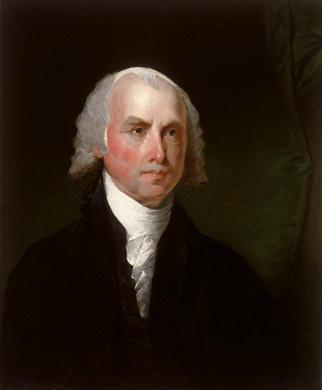
James Madison before he was president

James Madison proposed the first 10 Amendments to the Constitution, and the 27th Amendment; the 203 years it took to ratify the 27th Amendment is the longest legislative process in the history of the U.S., and probably the world.

The two proposals that failed to earn the required approval of three-fourths of the 13 states fell into a special limbo for Constitutional amendments that became clear only in the late 1970s when Congress discussed how long to wait for states to approve the Equal Rights Amendment (this is a much-simplified explanation, I know).  Congress put deadlines on the ratification process in the late 20th century, but the first twelve proposals had no deadlines, nor did any other proposal before the Equal Rights Amendment proposal.  In the 1980s, Congress passed a law that said any amendments floating around, unapproved, would be considered dead after a date certain.  There were six amendments in that category.

Before that date certain passed, more states took a look at one of James Madison’s 1789 proposals.  They liked it, and they ratified it — 34 states total.

That amendment became the 27th Amendment to the Constitution, on May 7, 1992, 203 years after it was proposed:

No law, varying the compensation for the services of the Senators and Representatives, shall take effect, until an election of Representatives shall have intervened.

This is the longest legislative procedure in U.S. history, perhaps the longest ever — it lasted much longer than many nations.  By that ratification in 1992, James Madison became the person who proposed both the first, and last amendments to the Constitution.

Madison’s reaching out from the grave 156 years after his death — he died on June 28, 1836 — is one of the greatest legislative coups in history, too.


Robert Johnson’s centennial, May 8: Memorial to the blues

May 8, 2011

May 8, 2011, is the 100th anniversary of the birth of bluesman Robert Johnson.

Robert Johnson, hat and guitar
Robert Johnson — one of two known photographs of the Delta blues legend

In a fitting tribute to Johnson and an important coming-of-age coming-to-senses moment, First Presbyterian Church in downtown Dallas announced plans to save the old Brunswick Records Building at 508 Park Avenue, a site where Johnson recorded songs in 1937 that changed the blues, changed recording, and left us a legacy of Johnson to study from his short life.

(On at least one day of those 1937 recordings, Johnson could have brushed shoulders with the Light Crust Doughboys, the Texas Swing legends, who were recording in the same building.  The Doughboys set their own pace and gave birth to Bob Wills and the Texas Playboys.  Two of Texas’s greatest music legends, in the same building on the same day, both just stepping on the platform of the train to immortality.)

Saving 508 Park Avenue vexed Dallas for a couple of decades.  First, blues is not the music of Dallas cognescenti, though the world class musicians in town including Dallas Symphony Orchestra’s Jaap van Zweden tend to support the eclectic music scence and honoring musicians of all genres (and Texas is loaded with different music genres).  Second, while Park Avenue may have been a bustling business district adjunct once, Dallas’s city center suffered 50 years of decline after school desegregation.  Parts of downtown and Uptown begin to look prosperous again, but the southern peninsula of the city, away from the now-packed-with-performance venues Arts District, a freeway and ten blocks away from Uptown, with its back up against another freeway, part of Interstate 30 and the famous Dallas Mixmaster.

508 Park Avenue, Dallas, Robert Johnson's early recording site, photo by Justin Terveen for the Dallas Observer in 2011
508 Park Avenue, Dallas, Robert Johnson’s early recording site, photo by Justin Terveen for the Dallas Observer, 2011

Plus, the building is directly across the street from the Stewpot, a kitchen operated by First Presbyterian Church to serve Dallas large and unfortunately thriving homeless population.

Who wants to renovate an abandoned building that has homeless people as scenery for the better part of the day?

Big news this week:  508 Park Avenue was sold to First Presbyterian, who have plans to save the building (and recording studio!), add a performance amphitheatre at one end of the block, and a park at the other.  This is people-friendly development well ahead of its time — there is not a resident population in that part of the city to support such a venue — yet.

Last summer, it was the neighbors, First Presbyterian Church of Dallas, who made an offer to buy 508 Park Avenue and the adjacent building and empty lot. But the deal was contingent on the city allowing the church, which also operates the Stewpot, to tear down an unrelated building next door, at 1900 Young, and replace it with an outdoor amphitheater for church socials and concerts. The Landmark Commission went into last Monday’s meeting with angels on one shoulder and devils on the other: The commission’s task force suggested approval; city staff, denial. The latter would have sent 508 Park Avenue back into purgatory.

But Landmark OK’d the plan, and the church says it will restore 508 Park Avenue to its former glory, inside and out—including the construction of a real recording studio where Johnson once sat and played “Hell Hound on My Trail.”

The church promises: It has musicians lined up to participate, but it can’t yet reveal who. The church promises: 508 Park Avenue will be resurrected.

One hell of a birthday gift for a man who supposedly sold his soul to the Devil.

The second authenticated photo of blues legend Robert Johnson

So, on Robert Johnson’s 100th birthday (assuming he wasn’t really born in 1912 . . . another mystery for another time, perhaps), the news is that the legendary bluesman who burned out like a shooting star helped save one of the few examples of art deco building decoration in Dallas, when a group of Christians who help the homeless, decided to step in an update their downtown Dallas campus.

Every step of the way, it’s an unlikely story.  Truth is, in this case, much, much stranger than fiction.

Ovation Music released to YouTube the video of Eric Clapton playing and singing “Me and the Devil,” at 508 Park Avenue, in the same room where Robert Johnson sang for a record early on.  Johnson recorded the song at that same location on Sunday, June 20, 1937.

508 Park Avenue, Dallas, is already a memorial to Robert Johnson, to the blues, and to the city where these early blues hits were made.  The struggle remains to make the memorial accessible, and not threatened with destruction.

More, resources: 


Heritage Foundation urges that Africa be poisoned

May 7, 2011

Oh, not outwardly anti-Africa, but stupidly so.

The extreme right-wing Heritage Foundation lashed out at health care workers and scientists fighting malaria in Africa and Asia for World Malaria Day, April 25 (HF’s post showed up on May 5).  If these malaria fighters really were smart, HF’s Jane Abel wrote, they’d just poison Africa with DDT instead of protecting children with bednets and working to improve medical care.  According to Abel, DDT is safe for everyone but mosquitoes, and more effective than anything else malaria fighters use — so they are stupid and venal, she asserts, for not using DDT.

Here’s her post:

Environmentalists celebrated World Malaria Day last week (and Earth Day the week prior). Meanwhile, thousands of African children died of malaria.

While these activists may make themselves feel like they’re saving the world, they are ignoring the best possible solution to Africa’s malaria problem: the use of DDT to wipe out the Anopheles mosquito.

Even though the World Health Organization resumed promotion of DDT in September 2006—realizing it had the best track record for saving the lives of 500 million African children—environmentalists are still emphasizing the use of bed nets instead. DDT treatments almost completely eradicated the disease in Europe and North America 50 years ago, but today an African child dies every 45 seconds of malaria.

Providing sub-Saharan Africans with bed nets has had far from acceptable success in delivering the amount of protection needed from mosquitoes. The World Bank touts the fact that 50 percent of children in Zambia are now sleeping under nets as a good thing, but what about the other half who are left defenseless against a killer disease? The Democratic Republic of the Congo had only 38 percent of children under nets in 2010.

One would question why, in the 21st century, people should have to live inside of a net in order to be safe from malaria. The world has a better solution, and it’s not the quarantine of African infants. Dr. John Rwakimari, as head of Uganda’s national malaria program, described DDT, which is nontoxic to humans, as “the answer to our problems.”

World Malaria Day 2011 had the theme of “Achieving Progress and Impact” and aims to have zero malaria deaths by 2015. If the world really wants to make progress and increase the number of lives saved from malaria, it needs to embrace for Africans the best possible technologies available today, and that means DDT.

Here’s my response, which I predict will not show up at HF’s blog in any form*:

DDT is toxic to humans — just not greatly and acutely so.  Ms. Abel should be aware of recent studies that indicate even limited, indoor use of DDT in the end produces a death toll similar to malaria.  But we digress on just one of the errors assumed by Ms. Abel.

If DDT could wipe out malaria-carrying mosquitoes, WHO would not have slowed or stopped its use in 1965, years before anyone thought about banning the stuff.  By 1965 it was clear that overuse of DDT in agriculture had bred mosquitoes that are resistant and even immune to DDTJonathan Weiner noted in his Pulitzer Prize-winning book, The Beak of the Finch, that today every mosquito on Earth carries at least a few copies of the alleles that allow mosquitoes to digest DDT as if it were a nutrient.

DDT cannot be a panacea for malaria.

Please do not forget that malaria is a parasite disease, and that mosquitoes are only the carriers of it.  To truly eradicate malaria, we need to cure the humans — and if we do that, the mosquitoes do not matter.  With no infected humans, mosquitoes have no well of disease to draw from.  Without infected humans, mosquitoes cannot spread malaria.

Only 38 percent of children in Congo sleep under bednets?  I’ll wager that’s twice the percentage of kids that were ever protected from malaria in Congo by DDT.  In actual tests in Africa over the past decade, bednets have proven to reduce malaria by 50 to 85 percent; DDT, on the other hand, reduces malaria only 25 to 50 percent under the best conditions.  If we have to go with one and not the other, bednets would be the better choice.  Nets are much, much cheaper than DDT, too.  DDT applications must be repeated every 6 months, at a cost of about $12 per application per house.  Nets cost about $10, and they last five years.  Nets protect kids for $2 a year, better than DDT; DDT protects kids for $24 a year (that’s 12 times the cost), but not as effectively as nets.

Also, it’s important to remember that DDT has never been banned in Africa.  DDT non-use is much more a result of the ineffectiveness of DDT in many applications — why should we expect Africans to throw away hard-earned money on a pesticide that doesn’t work?

Finally, it’s also good to understand that, largely without DDT, malaria deaths are, today, at the lowest point in human history.  Fewer than 900,000 people a year die from malaria today.  That’s 25% of the death toll in 1960, when DDT use was at its peak.

Ms. Abel assumes that all Africans are too stupid to use DDT, though it might save their children.  He states no reason for this assumption, but we should question it.  If Africans do not use DDT, it may well be because the local populations of mosquitoes are not susceptible; or it could be because other solutions, like bednets, are more effective, and cheaper.

Ms. Abel has not made a case that DDT is the best solution to use against malaria.  DDT cannot improve a nation’s medical care delivery systems, to quickly diagnose and appropriately treat malaria in humans.  DDT cannot make mosquitoes extinct, we know from 66 year of DDT use that mosquitoes always come roaring back.  DDT cannot prevent mosquitoes from spreading malaria as effectively as bednets.

Maybe, just maybe, as evidenced by the dramatic reductions in malaria deaths, we might assume that modern Africans and health care workers know what they’re doing fighting malaria — and they do not need, want, or call for, a lot more DDT than is currently in use.

It’s too bad Heritage Foundation fell victim to so much junk science, and that the otherwise august press release operation pushes the grand DDT hoaxes.  Just once, wouldn’t it be nice if these conservative echo chambers would, instead of recycling the old, wrong press releases of other conservatives, would do a little research on their own, and get the facts right?

_______________

*  It’ll be fun to watch.  I sent my response early, early in the morning while rushing to get a presentation ready, and I made a couple of egregious typos, including identifying Jonathan Weiner as “Stephen Weiner.”  If HF wished to embarrass me, they’d publish that one out of their moderation queue — but I’ll bet that even with my typos, they can’t allow the facts through.  Also, for reasons I can’t figure, some guy named Thurman showed as the author of HF’s piece on May 5.  So I had referred to Mr. Thurman instead of Ms. Abel.  Interesting technical glitch, or story, there.

_______________

Update, May 8:  As we should have expected, Steven Milloy’s Junk Science Side Bar also went on record as favoring the poisoning of Africa rather than the fighting of malaria.  Milloy makes claims that DDT will beat malaria (ostensibly before it kills all life in Africa), but his sources don’t support the claim.  Milloy is always very careful to never mention that, largely without DDT, the death toll from malaria is at the lowest point in human history.  Instead he notes that while malaria fighters promoted World Malaria Day, lots of African kids died of malaria.  That’s true, but misleading.  Because of the malaria-fighting efforts of those Milloy tries to impugn, far fewer African kids die.  Contrary to Milloy’s insane and offensive claims, it’s not alright that “only people” die.  Milloy asserts implicitly that, but for environmentalists, thousands or millions of children would survive that do not know.  That’s not true:  Because of the work that Milloy denigrates, millions fewer die.  It wasn’t environmentalists who overused DDT and rendered it ineffective in the fight against malaria, it was Milloy’s funders.  Follow the money.