Bill Clinton’s nomination of Barack Obama – the text

September 5, 2012

The prepared text, according to Market Watch; Clinton probably made a few changes between that text and delivery; and Clinton ad-libbed a lot of flourishes:

“We’re here to nominate a President, and I’ve got one in mind.

Former President Bill Clinton at 2012 Democratic National Convention - Reuters

Reuters
Former President Bill Clinton addresses delegates during the second session of the Democratic National Convention in Charlotte, North Carolina, September 5, 2012.

I want to nominate a man whose own life has known its fair share of adversity and uncertainty. A man who ran for President to change the course of an already weak economy and then just six weeks before the election, saw it suffer the biggest collapse since the Great Depression. A man who stopped the slide into depression and put us on the long road to recovery, knowing all the while that no matter how many jobs were created and saved, there were still millions more waiting, trying to feed their children and keep their hopes alive.

I want to nominate a man cool on the outside but burning for America on the inside. A man who believes we can build a new American Dream economy driven by innovation and creativity, education and cooperation. A man who had the good sense to marry Michelle Obama.

I want Barack Obama to be the next President of the United States and I proudly nominate him as the standard bearer of the Democratic Party.

In Tampa, we heard a lot of talk about how the President and the Democrats don’t believe in free enterprise and individual initiative, how we want everyone to be dependent on the government, how bad we are for the economy.

The Republican narrative is that all of us who amount to anything are completely self-made. One of our greatest Democratic Chairmen, Bob Strauss, used to say that every politician wants you to believe he was born in a log cabin he built himself, but it ain’t so.

We Democrats think the country works better with a strong middle class, real opportunities for poor people to work their way into it and a relentless focus on the future, with business and government working together to promote growth and broadly shared prosperity. We think “we’re all in this together” is a better philosophy than “you’re on your own.”

Who’s right? Well since 1961, the Republicans have held the White House 28 years, the Democrats 24. In those 52 years, our economy produced 66 million private sector jobs. What’s the jobs score? Republicans 24 million, Democrats 42 million!

It turns out that advancing equal opportunity and economic empowerment is both morally right and good economics, because discrimination, poverty and ignorance restrict growth, while investments in education, infrastructure and scientific and technological research increase it, creating more good jobs and new wealth for all of us.

Though I often disagree with Republicans, I never learned to hate them the way the far right that now controls their party seems to hate President Obama and the Democrats. After all, President Eisenhower sent federal troops to my home state to integrate Little Rock Central High and built the interstate highway system. And as governor, I worked with President Reagan on welfare reform and with President George H.W. Bush on national education goals. I am grateful to President George W. Bush for PEPFAR, which is saving the lives of millions of people in poor countries and to both Presidents Bush for the work we’ve done together after the South Asia tsunami, Hurricane Katrina and the Haitian earthquake.

Through my foundation, in America and around the world, I work with Democrats, Republicans and Independents who are focused on solving problems and seizing opportunities, not fighting each other.

When times are tough, constant conflict may be good politics but in the real world, cooperation works better. After all, nobody’s right all the time, and a broken clock is right twice a day. All of us are destined to live our lives between those two extremes. Unfortunately, the faction that now dominates the Republican Party doesn’t see it that way. They think government is the enemy, and compromise is weakness.

One of the main reasons America should re-elect President Obama is that he is still committed to cooperation. He appointed Republican Secretaries of Defense, the Army and Transportation. He appointed a Vice President who ran against him in 2008, and trusted him to oversee the successful end of the war in Iraq and the implementation of the recovery act. And Joe Biden did a great job with both. He appointed Cabinet members who supported Hillary in the primaries. Heck, he even appointed Hillary! I’m so proud of her and grateful to our entire national security team for all they’ve done to make us safer and stronger and to build a world with more partners and fewer enemies. I’m also grateful to the young men and women who serve our country in the military and to Michelle Obama and Jill Biden for supporting military families when their loved ones are overseas and for helping our veterans, when they come home bearing the wounds of war, or needing help with education, housing, and jobs.

President Obama’s record on national security is a tribute to his strength, and judgment, and to his preference for inclusion and partnership over partisanship.

He also tried to work with Congressional Republicans on Health Care, debt reduction, and jobs, but that didn’t work out so well. Probably because, as the Senate Republican leader, in a remarkable moment of candor, said two years before the election, their number one priority was not to put America back to work, but to put President Obama out of work.

Senator, I hate to break it to you, but we’re going to keep President Obama on the job!

In Tampa, the Republican argument against the President’s re-election was pretty simple: we left him a total mess, he hasn’t cleaned it up fast enough, so fire him and put us back in.

In order to look like an acceptable alternative to President Obama, they couldn’t say much about the ideas they have offered over the last two years. You see they want to go back to the same old policies that got us into trouble in the first place: to cut taxes for high income Americans even more than President Bush did; to get rid of those pesky financial regulations designed to prevent another crash and prohibit future bailouts; to increase defense spending two trillion dollars more than the Pentagon has requested without saying what they’ll spend the money on; to make enormous cuts in the rest of the budget, especially programs that help the middle class and poor kids. As another President once said – there they go again.

I like the argument for President Obama’s re-election a lot better. He inherited a deeply damaged economy, put a floor under the crash, began the long hard road to recovery, and laid the foundation for a modern, more well-balanced economy that will produce millions of good new jobs, vibrant new businesses, and lots of new wealth for the innovators.

Are we where we want to be? No. Is the President satisfied? No. Are we better off than we were when he took office, with an economy in free fall, losing 750,000 jobs a month. The answer is YES.

I understand the challenge we face. I know many Americans are still angry and frustrated with the economy. Though employment is growing, banks are beginning to lend and even housing prices are picking up a bit, too many people don’t feel it.

I experienced the same thing in 1994 and early 1995. Our policies were working and the economy was growing but most people didn’t feel it yet. By 1996, the economy was roaring, halfway through the longest peacetime expansion in American history.

President Obama started with a much weaker economy than I did. No President – not me or any of my predecessors could have repaired all the damage in just four years. But conditions are improving and if you’ll renew the President’s contract you will feel it.

I believe that with all my heart.

President Obama’s approach embodies the values, the ideas, and the direction America must take to build a 21st century version of the American Dream in a nation of shared opportunities, shared prosperity and shared responsibilities.

So back to the story. In 2010, as the President’s recovery program kicked in, the job losses stopped and things began to turn around.

The Recovery Act saved and created millions of jobs and cut taxes for 95% of the American people. In the last 29 months the economy has produced about 4.5 million private sector jobs. But last year, the Republicans blocked the President’s jobs plan costing the economy more than a million new jobs. So here’s another jobs score: President Obama plus 4.5 million, Congressional Republicans zero.

Over that same period, more than more than 500,000 manufacturing jobs have been created under President Obama – the first time manufacturing jobs have increased since the 1990s.

The auto industry restructuring worked. It saved more than a million jobs, not just at GM, Chrysler and their dealerships, but in auto parts manufacturing all over the country. That’s why even auto-makers that weren’t part of the deal supported it. They needed to save the suppliers too. Like I said, we’re all in this together.

Now there are 250,000 more people working in the auto industry than the day the companies were restructured. Governor Romney opposed the plan to save GM and Chrysler. So here’s another jobs score: Obama two hundred and fifty thousand, Romney, zero.

The agreement the administration made with management, labor and environmental groups to double car mileage over the next few years is another good deal: it will cut your gas bill in half, make us more energy independent, cut greenhouse gas emissions, and add another 500,000 good jobs.

President Obama’s “all of the above” energy plan is helping too – the boom in oil and gas production combined with greater energy efficiency has driven oil imports to a near 20 year low and natural gas production to an all time high. Renewable energy production has also doubled.

We do need more new jobs, lots of them, but there are already more than three million jobs open and unfilled in America today, mostly because the applicants don’t have the required skills. We have to prepare more Americans for the new jobs that are being created in a world fueled by new technology. That’s why investments in our people are more important than ever. The President has supported community colleges and employers in working together to train people for open jobs in their communities. And, after a decade in which exploding college costs have increased the drop-out rate so much that we’ve fallen to 16th in the world in the percentage of our young adults with college degrees, his student loan reform lowers the cost of federal student loans and even more important, gives students the right to repay the loans as a fixed percentage of their incomes for up to 20 years. That means no one will have to drop-out of college for fear they can’t repay their debt, and no one will have to turn down a job, as a teacher, a police officer or a small town doctor because it doesn’t pay enough to make the debt payments. This will change the future for young Americans.

I know we’re better off because President Obama made these decisions.

That brings me to health care.

The Republicans call it Obamacare and say it’s a government takeover of health care that they’ll repeal. Are they right? Let’s look at what’s happened so far. Individuals and businesses have secured more than a billion dollars in refunds from their insurance premiums because the new law requires 80% to 85% of your premiums to be spent on health care, not profits or promotion. Other insurance companies have lowered their rates to meet the requirement. More than 3 million young people between 19 and 25 are insured for the first time because their parents can now carry them on family policies. Millions of seniors are receiving preventive care including breast cancer screenings and tests for heart problems. Soon the insurance companies, not the government, will have millions of new customers many of them middle class people with pre-existing conditions. And for the last two years, health care spending has grown under 4%, for the first time in 50 years.

So are we all better off because President Obama fought for it and passed it? You bet we are.

There were two other attacks on the President in Tampa that deserve an answer. Both Governor Romney and Congressman Ryan attacked the President for allegedly robbing Medicare of 716 billion dollars. Here’s what really happened. There were no cuts to benefits. None. What the President did was save money by cutting unwarranted subsidies to providers and insurance companies that weren’t making people any healthier. He used the saving to close the donut hole in the Medicare drug program, and to add eight years to the life of the Medicare Trust Fund. It’s now solvent until 2024. So President Obama and the Democrats didn’t weaken Medicare, they strengthened it.

When Congressman Ryan looked into the TV camera and attacked President Obama’s “biggest coldest power play” in raiding Medicare, I didn’t know whether to laugh or cry. You see, that 716 billion dollars is exactly the same amount of Medicare savings Congressman Ryan had in his own budget.

At least on this one, Governor Romney’s been consistent. He wants to repeal the savings and give the money back to the insurance companies, re-open the donut hole and force seniors to pay more for drugs, and reduce the life of the Medicare Trust Fund by eight years. So now if he’s elected and does what he promised Medicare will go broke by 2016. If that happens, you won’t have to wait until their voucher program to begins in 2023 to see the end Medicare as we know it.

But it gets worse. They also want to block grant Medicaid and cut it by a third over the coming decade. Of course, that will hurt poor kids, but that’s not all. Almost two-thirds of Medicaid is spent on nursing home care for seniors and on people with disabilities, including kids from middle class families, with special needs like, Downs syndrome or Autism. I don’t know how those families are going to deal with it. We can’t let it happen

Now let’s look at the Republican charge that President Obama wants to weaken the work requirements in the welfare reform bill I signed that moved millions of people from welfare to work.

Here’s what happened. When some Republican governors asked to try new ways to put people on welfare back to work, the Obama Administration said they would only do it if they had a credible plan to increase employment by 20%. You hear that? More work. So the claim that President Obama weakened welfare reform’s work requirement is just not true. But they keep running ads on it. As their campaign pollster said “we’re not going to let our campaign be dictated by fact checkers.” Now that is true. I couldn’t have said it better myself – I just hope you remember that every time you see the ad.

Let’s talk about the debt. We have to deal with it or it will deal with us. President Obama has offered a plan with 4 trillion dollars in debt reduction over a decade, with two and a half dollars of spending reductions for every one dollar of revenue increases, and tight controls on future spending. It’s the kind of balanced approach proposed by the bipartisan Simpson-Bowles commission.

I think the President’s plan is better than the Romney plan, because the Romney plan fails the first test of fiscal responsibility: The numbers don’t add up.

It’s supposed to be a debt reduction plan but it begins with five trillion dollars in tax cuts over a ten-year period. That makes the debt hole bigger before they even start to dig out. They say they’ll make it up by eliminating loopholes in the tax code. When you ask “which loopholes and how much?,” they say “See me after the election on that.”

People ask me all the time how we delivered four surplus budgets. What new ideas did we bring? I always give a one-word answer: arithmetic. If they stay with a 5 trillion dollar tax cut in a debt reduction plan – the – arithmetic tells us that one of three things will happen: 1) they’ll have to eliminate so many deductions like the ones for home mortgages and charitable giving that middle class families will see their tax bill go up two thousand dollars year while people making over 3 million dollars a year get will still get a 250,000 dollar tax cut; or 2) they’ll have to cut so much spending that they’ll obliterate the budget for our national parks, for ensuring clean air, clean water, safe food, safe air travel; or they’ll cut way back on Pell Grants, college loans, early childhood education and other programs that help middle class families and poor children, not to mention cutting investments in roads, bridges, science, technology and medical research; or 3) they’ll do what they’ve been doing for thirty plus years now – cut taxes more than they cut spending, explode the debt, and weaken the economy. Remember, Republican economic policies quadrupled the debt before I took office and doubled it after I left. We simply can’t afford to double-down on trickle-down.

President Obama’s plan cuts the debt, honors our values, and brightens the future for our children, our families and our nation.

My fellow Americans, you have to decide what kind of country you want to live in. If you want a you’re on your own, winner take all society you should support the Republican ticket. If you want a country of shared opportunities and shared responsibilities – a “we’re all in it together” society, you should vote for Barack Obama and Joe Biden. If you want every American to vote and you think its wrong to change voting procedures just to reduce the turnout of younger, poorer, minority and disabled voters, you should support Barack Obama. If you think the President was right to open the doors of American opportunity to young immigrants brought here as children who want to go to college or serve in the military, you should vote for Barack Obama. If you want a future of shared prosperity, where the middle class is growing and poverty is declining, where the American Dream is alive and well, and where the United States remains the leading force for peace and prosperity in a highly competitive world, you should vote for Barack Obama.

I love our country – and I know we’re coming back. For more than 200 years, through every crisis, we’ve always come out stronger than we went in. And we will again as long as we do it together. We champion the cause for which our founders pledged their lives, their fortunes, their sacred honor – to form a more perfect union.

If that’s what you believe, if that’s what you want, we have to re-elect President Barack Obama.

God Bless You – God Bless America.”


Labor Day Bathtub reading, part 2

September 5, 2012

More tea!  Good.  Warm up the tub.  Where were we?

Sir Isaac Newton's death mask; Royal Society image

Caption from the Royal Society: A cast of the face of Sir Isaac Newton was made at his death in 1727. The original, now owned by the Royal Society, was probably sculpted by J.M.Rysbrack (1693?-1770). This plaster copy, which is numbered “44”, is a Victorian relic and was donated to the Observatory by the Misses Wallace.
Newton was born at Woolsthorpe in Lincolnshire, England on 25 Dec 1642. He studied at Trinity College, Cambridge from 1661 – 1665/6 when the university closed due to the plague. His most famous work is the The Principia [the Crawford Library holds a first edition (1687) and a third edition (1726)] where he discusses universal gravitation. In 1696 he was appointed Warden then later Master of the Mint and in 1703, he became President of the Royal Society.

Wallace believes the Dems’ “filibuster proof majority in the Senate” lasted 24 months. In reality, he’s off by 20 months, undermining the entire thesis pushed so aggressively by Republicans.

  • Ron Paul sometimes appears, to me, as a guy from another century.  I don’t mean “in the future.”  Looky here!  Here’s a Paul-supporting site, a group that tends to glom on to almost every conspiracy theory coming down the pike, touting Paul’s great success in getting a “full audit” of the books of the Federal Reserve — you know, that bank Alexander Hamilton told us we needed, and that in its post-Depression form modeled the way central banks the world over should behave, creating a post-WWII era of American-modeled economic freedom that led to astonishing leaps in income and quality of life for people and peoples all around the world.  Well, we are told breathlessly, Paul insisted on an audit, got a law passed — and here’s the audit and the results are shocking!  Wait — don’t those “findings” sound familiar?  Oh, the report is more than a year old . . . to just took the Paul people that long to find it .  Sen. Bernie Sanders told us all about it a year ago.
  • Glenn Beck is a bully, and frequently wrong on factual issues.  He’s the chief supporter of history-distorter David Barton.  Beck has moved to Dallas (our air quality has been awfully bad here lately), where he can fly American Airlines all he wants.  But alas for him, American Airlines employs honest people.  I’ll wager Beck’s prevaricating about what happened.  I’ll wager the flight attendant treated him exactly the same as everyone else, but Beck has a congenital chip on his shoulder and sour pickle in his mouth.  He certainly he got accurate feedback, despite the flight attendant’s courtesy.  Maybe it was God opening Beck’s eyes, eh?
  • Wonder what Obama and Romney think about science issues?  So did Scientific Debate, so they asked.  Obama and Romney answered.
  • Bill Nye said creationism is inappropriate for children.  He’s been saying that for years, but when he said it off the cuff, for Big Think, a bunch of people sat up and took notice.  “The Science Guy, standing up for science!  How dare he!”  Who knew?
  • Bedbug stupid:  Over at the Constitution Club (to get what they mean, think of “Baby Seal Club”), they’re yucking it up over a Washington Times manufactured story that says some Charlotte, North Carolina hotels might have bedbugs — ho! ho! ho! — and maybe some Democrats will get bitten.  Con Clubbers aren’t good on science, law or history — they blame the U.S. ban on DDT for the problem, and say it’s a case of over-regulation since a lesser restriction, like banning agricultural use, would have worked.  They were unaware that bedbugs developed immunity to DDT in the 1950s; that that bedbugs were eliminated from the U.S., mostly, without DDT later; that the “ban” on DDT was only on agricultural uses, etc., etc.  It’s almost like watching somebody laugh at Euclid for claiming a triangle in a plane has angles that total 180°.  “Everyone knows water boils at 212°, so a triangle would be too hot to handle!” the ConClubbers would complain.

Enough of the soaking.  But the backlog still exists.


Encore typewriter of the moment: Mencken and the 1948 conventions

September 4, 2012


Mencken at 1948 Democratic Convention

Mencken at 1948 Democratic Convention

Photo from the collection of the School of Journalism and Mass Communication, at the Park Library, University of North Carolina.

H. L. Mencken at one of the 1948 political conventions (Thomas Dewey was the Republican nominee, Harry S. Truman was the Democratic nominee). Obviously the photo is a copy from the National Press Club Library. The Park Library site describes the photo and Mencken:

H. L. Mencken (1880-1956) was a familiar figure at many national political conventions. This photo, taken at the one in 1948, was his last political convention. He is well known for his attacks on American taste and culture, or the lack of same. His magnum opus, The American Language: An Inquiry into the Development of English in the United States, was first published in 1919 and remains a classic. From 1906 to 1941, he worked chiefly as a reporter, editor, and columnist for the Baltimore Sun. (Photo courtesy of the Baltimore Sun Library.)

Assuming Mencken covered both conventions, this photo was taken at the Democratic convention in Philadelphia in mid-July, 1948. We know it was taken in Philadelphia since both parties held their conventions there that year, the Republicans from June 21 to June 26, and the Democrats from July 12 to July 14.

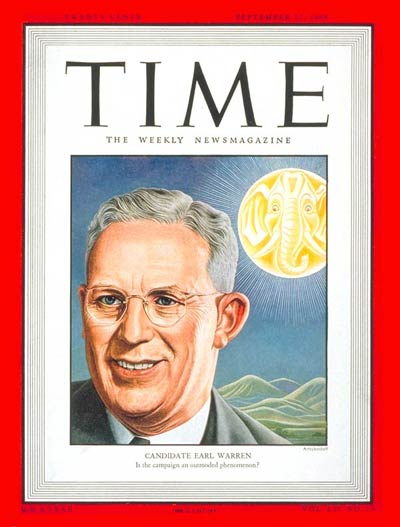
Republicans nominated New York Gov. Thomas J. Dewey and California Gov. Earl Warren for president and vice president.

After a contentious convention that saw Minneapolis Mayor Hubert H. Humphrey propose a civil rights plank that got South Carolina Gov. Strom Thurmond to walk out of the convention and found his own States’ Rights (Dixiecrat) Party (with himself as the nominee for president), and former Vice President Henry Wallace walk out because the party platform was too conservative (Wallace ran on the Socialist Progressive Party ticket), Democrats nominated President Harry S Truman and Kentucky Sen. Alben W. Barkley for president and vice president. Truman narrowly defeated Georgia Sen. Richard B. Russell for the nomination. Had Thurmond not walked out, Truman may well have lost the nomination of his own party.

And the rest of the story?

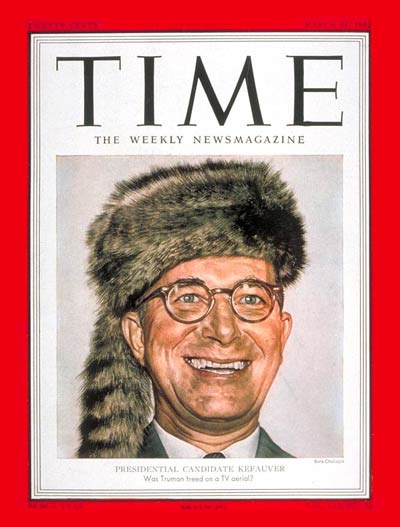
Sen. Estes Kefauver, cover of Time Magazine, 1952

Sen. Estes Kefauver

  • Truman had a contentious second term, and was defeated in the New Hampshire primary in 1952 by Sen. Estes Kefauver; Truman ended his campaign for a second full term shortly after.
  • Earl Warren was appointed Chief Justice of the Supreme Court by Truman’s successor, President Dwight D. Eisenhower, in late 1953. Warren is remembered for engineering the 9-0 decision in Brown vs. Topeka Board of Educationwhich ruled “separate but equal” school systems to violate the Constitution’s equal protection clause, and for his chairing the commission that investigated the assassination of President John F. Kennedy.  
  • Hubert Humphrey moved on to the U.S. Senate, served as Vice President to Lyndon Johnson, and won the Democratic nomination for president in another contentious convention in 1968 in Chicago. Humphrey lost the election to Richard Nixon, and returned to the U.S. Senate two years later.

    California Gov. Earl Warren, cover of Life Magazine, May 10, 1948; copyright Time-Life.

  • Strom Thurmond won election to the U.S. Senate in 1954, switching parties to Republican in 1964, and serving until his death in 2003.
  • Russell, who had served as Georgia’s senator since 1933, continued to serve to his death on January 21, 1971; he was a key member of the Warren Commission that investigated the assassination of President John F. Kennedy. The Russell Senate Office Building is named in his honor, the oldest of the three Senate office buildings.
  • Barkley was the oldest vice president ever inaugurated, aged 71. He remarried in his first year as vice president (his first wife died in 1947). Barkley’s nephew suggested that he should be called “the veep” because “Mr. Vice President” was too long. The title was seized up on by headline writers. Considered too old to run for the presidency in 1952, Barkley won a U.S. Senate seat from Kentucky in the 1954 elections, serving from 1955 to his death in 1956. Barkley Dam on the Cumberland River is named in his honor, as is the lake behind it, Lake Barkley.
  • Henry Wallace finished a distant fourth in the 1948 election, behind Dewey and Thurmond. His political career was essentially over due to his inability or unwillingness to disavow communist support. He achieved success as a chicken breeder. In a daramatic turnabout, he wrote a book, Where I Was Wrong, disavowing communism and critical of Joseph Stalin, and endorsed Republican candidates in 1956 and 1960. He died of Amyotrophic Lateral Sclerosis (ALS, or Lou Gehrig’s Disease) in 1965.
  • Dewey returned to his law practice. In 1952, Dewey helped engineer the nomination of Eisenhower over his old political nemesis Sen. Robert Taft of Ohio, pushed Richard Nixon as the Vice Presidential nominee, and in 1956 first convinced Ike to run again, and then to keep Nixon on the ticket. Dewey politely refused offers of offices, including refusing a nomination to the U.S. Supreme Court, sticking to his law practice which made him very wealthy. He died suddenly of a heart attack in 1971, at age 68.
  • Mencken suffered a stroke later in 1948 that left him unable to speak, or read, or write for a time. He spent much of the rest of his life working to organize his papers, and died in 1956. His epitaph, on his tombstone and on a plaque in the lobby of the Baltimore Sun, reads: “If, after I depart this vale, you ever remember me and have thought to please my ghost, forgive some sinner, and wink your eye at some homely girl.”

This is an encore post.  Some new links have been added — though, as you can see, I don’t yet have a better photo of Mencken at the conventions.  More news sources, below.

More, Other Sources:


Quote of the moment, again: Abraham Lincoln on job creators, ‘labor is the superior of capital’

September 4, 2012

Lincoln enters Coles County, Illinois, by Charles Turzak

Abraham Lincoln as working man, woodcut by Charles Turzak circa 1933 – Abraham Lincoln Presidential Library & Museum; caption on this image at the Lincoln Library site notes that Turzak portrayed Lincoln as the working man Lincoln himself never aspired to be, though he well respected those who did labor.

Labor is prior to and independent of capital. Capital is only the fruit of labor, and could never have existed if labor had not first existed.

Labor is the superior of capital, and deserves much the higher consideration.

President Abraham Lincoln, Annual Message to Congress, December 3, 1861 (the “State of the Union”)

Abraham Lincoln took great inspiration from Americans and their striving to move up in the world.  He admired inventions and inventors, he admired working people and their drive to become their own managers and proprietors of their own businesses.  Lincoln had been there himself.

By the time he stopped at the Wisconsin State Fair in 1859 — a full year before his campaign for the presidency — Lincoln was a relatively wealthy lawyer, a good trial lawyer whose better-paying clients included the largest industrial companies of the day, railroads.  Lincoln grew up on hard-scrabble farms, though, and he had been a shopkeeper and laborer before he studied law and opened his practice.  Lincoln also owned a patent — a device to float cargo boats higher in the Sangamon River that served Sangamon County where he lived, the better to make the entire area a figurative river of free enterprise.

Lincoln was invited to comment on “labor,” at an exhibit showing new machines to mechanize America’s farms.  At the Wisconsin fair Lincoln complimented farmers, inventors, inventions, and all laborers.  Just over 24 months later, excerpts from that speech showed up at the close of his State of the Union declaration, his December 3 remarks delivered to Congress as the Constitution required.  Lincoln probably did not deliver the remarks as as a speech, but they appear in the Congressional Record as a speech, and it is often cited that way.  He spoke something like these words in Wisconsin, and they were his views at the end of the first year of the Civil War, expressing yet again his hope that the union would survive, and continue to prosper, for all working people.

Below is a more complete quoting of Lincoln’s remarks from the Message to Congress.

It continues to develop that the insurrection is largely, if not exclusively, a war upon the first principle of popular government– the rights of the people. Conclusive evidence of this is found in the most grave and maturely considered public documents, as well as in the general tone of the insurgents. In those documents we find the abridgment of the existing right of suffrage and the denial to the people of all right to participate in the selection of public officers except the legislative boldly advocated, with labored arguments to prove that large control of the people in government is the source of all political evil. Monarchy itself is sometimes hinted at as a possible refuge from the power of the people.

In my present position I could scarcely be justified were I to omit raising a warning voice against this approach of returning despotism. It is not needed nor fitting here that a general argument should be made in favor of popular institutions, but there is one point, with its connections, not so hackneyed as most others, to which I ask a brief attention. It is the effort to place capital on an equal footing with, if not above, labor in the structure of government. It is assumed that labor is available only in connection with capital; that nobody labors unless somebody else, owning capital, somehow by the use of it induces him to labor. This assumed, it is next considered whether it is best that capital shall hire laborers, and thus induce them to work by their own consent, or buy them and drive them to it without their consent. Having proceeded so far, it is naturally concluded that all laborers are either hired laborers or what we call slaves. And further, it is assumed that whoever is once a hired laborer is fixed in that condition for life.

Now there is no such relation between capital and labor as assumed, nor is there any such thing as a free man being fixed for life in the condition of a hired laborer. Both these assumptions are false, and all inferences from them are groundless.

Labor is prior to and independent of capital. Capital is only the fruit of labor, and could never have existed if labor had not first existed.

Labor is the superior of capital, and deserves much the higher consideration. Capital has its rights, which are as worthy of protection as any other rights. Nor is it denied that there is, and probably always will be, a relation between labor and capital producing mutual benefits. The error is in assuming that the whole labor of community exists within that relation. A few men own capital, and that few avoid labor themselves, and with their capital hire or buy another few to labor for them. A large majority belong to neither class–neither work for others nor have others working for them. In most of the Southern States a majority of the whole people of all colors are neither slaves nor masters, while in the Northern a large majority are neither hirers nor hired. Men, with their families–wives, sons, and daughters,–work for themselves on their farms, in their houses, and in their shops, taking the whole product to themselves, and asking no favors of capital on the one hand nor of hired laborers or slaves on the other. It is not forgotten that a considerable number of persons mingle their own labor with capital; that is, they labor with their own hands and also buy or hire others to labor for them; but this is only a mixed and not a distinct class. No principle stated is disturbed by the existence of this mixed class.

Again, as has already been said, there is not of necessity any such thing as the free hired laborer being fixed to that condition for life. Many independent men everywhere in these States a few years back in their lives were hired laborers. The prudent, penniless beginner in the world labors for wages awhile, saves a surplus with which to buy tools or land for himself, then labors on his own account another while, and at length hires another new beginner to help him. This is the just and generous and prosperous system which opens the way to all, gives hope to all, and consequent energy and progress and improvement of condition to all. No men living are more worthy to be trusted than those who toil up from poverty; none less inclined to take or touch aught which they have not honestly earned. Let them beware of surrendering a political power which they already possess, and which if surrendered will surely be used to close the door of advancement against such as they and to fix new disabilities and burdens upon them till all of liberty shall be lost.

From the first taking of our national census to the last are seventy years, and we find our population at the end of the period eight times as great as it was at the beginning. The increase of those other things which men deem desirable has been even greater. We thus have at one view what the popular principle, applied to government through the machinery of the States and the Union, has produced in a given time, and also what if firmly maintained it promises for the future. There are already among us those who if the Union be preserved will live to see it contain 200,000,000. The struggle of to-day is not altogether for to-day; it is for a vast future also. With a reliance on Providence all the more firm and earnest, let us proceed in the great task which events have devolved upon us.

[Excerpted here from the online Classic Literature Library, Writings of Abraham Lincoln Vol. 5; the complete Message to Congress of December 3, 1861, begins here; the section quoted above can be found on pages 143 and 144.]

Yes, I should have reposted this yesterday, for Labor Day.  Lincoln’s words are good 365 days a year, 366 days in leap years.  Keeping the thought with us is what counts.  (This was originally posted in February 2012.)

See Also:

Related articles (from Zemanta)


Rude giant: Jail him, or make him a tax payer?

September 4, 2012

What do you do with someone who is obnoxious and rude, and a giant besides?  You can’t duke it out with him . . .

More than just a clever ad for an electricity company, this piece really gets at the heart of the differences between the Republican view of the world, presented by the Romney campaign, and the Democratic view of the world, as exemplified by the Obama administration.

Romney Signs Wind Turbine In Iowa

Yeah, but he didn’t think anyone was watching: Romney Signs Wind Turbine In Iowa (Photo credit: Talk Radio News Service) (Now Mitt thinks he built it, ignoring the union guys and other laborers who did.)

First, the obvious comparison:  Romney promises to kill subsidies for wind power, doubling down on America’s dependence on fossil fuels, especially oil.  To the GOP platform, wind is a rude giant, perhaps worthy of ignoring, but in not case worthy of giving a job to do.  To the Obama administration, every watt of power generated by wind is a watt that doesn’t need to be generated by coal, oil or gas, freeing up those fuels for other work, and decreasing U.S. dependence on oil imported from Canada, Mexico and Saudi Arabia.

Which treatment is more likely to increase the nation’s energy security and move the U.S. towards oil independence?

Second, the story carries metaphorical value, for the rest of the agendas of the two campaigns.  Consider the Rude Giant as an out of work person, someone who is unemployed.  The Romney campaign’s answer is that this fellow needs to become an entrepreneur, change his ways, change his behaviors, develop some other talents other than those God gave him, and maybe he’ll be successful; to encourage him to change himself, the Romney platform calls for pulling the rug out from under the poor guy so he’ll have to do something different or die.  Democratic platform stands for retraining, great education in the first place, good benefits and a safety net that works — to get the former taxpayer back on his feet and, coincidentally, paying taxes again soon.

Guess which plan is cheaper to taxpayers, in operation?

What’s the reality:  This past summer I drove through ten different states and the District of Columbia.  Only in Maryland, Virginia and D.C. did I not see vast new “wind farms” of windmills, or pass on the road the massive truck trailers carrying parts for wind turbine installations.  As it turns out, that was because I didn’t drive to the area of Maryland and Virginia with wind farms.  Only D.C. lacks a windfarm, out of the states I visited (Wisconsin, Illinois, Missouri, Oklahoma, Texas, New Mexico, Kansas, Colorado were the others).  Wind is big business and growing.

Why would any candidate try to choke off windpower growth, in tough economic times?

More:

Update on resources, September 13, 2012:


LBO of GOP complete, impeaching the hand that helped you

September 3, 2012

Steve Sack cartoon in the Minneapolis Star-Tribune

Steve Sack, Minneapolis Star-Tribune

Maureen Dowd, in the New York Times (and other venues), “Cruel Conservatives Throw a Masquerade Ball”:

As I wandered the hall Tuesday night, past cowboy hats and cheeseheads, I ran into Christopher Shays, a delegate and former congressman. I asked the Connecticut moderate if he felt lonely at the conservative masquerade ball.

He laughed and then said wistfully, “Our biggest crime was trying to impeach the one president who was working with us.”

[All links added here.]


Fly your flag today, Labor Day 2012

September 3, 2012

Probably more important in 2012 than ever before: Fly your flag for American labor today.

Free Labor Will Win, poster from 1942, (Library of Congress)

Poster from the Office of War Information, 1942

It’s Labor Day 2011 in the United States, a federal holiday, and one of those days Americans are urged to fly the U.S. flag.

“Free Labor Will Win,” the poster said, encouraging a theme important during World War II, when unions were encouraged to avoid strikes or any action that might interrupt work to build the “arsenal of democracy” believed necessary to win the war.  Labor complied, the war was won, and organized labor was the stronger for it. In 2012, some have difficulty remembering when all Americans knew that our future rides on the backs of organized labor.

The poster was issued by the Office of War Information in 1942, in full color. A black-and-white version at the Library of Congress provides a few details for the time:

Labor Day poster. Labor Day poster distributed to war plants and labor organizations. The original is twenty-eight and one-half inches by forty inches and is printed in full color. It was designed by the Office of War Information (OWI) from a photograph especially arranged by Anton Bruehl, well-known photographer. Copies may be obtained by writing the Distribution Section, Office of War Information [alas, you can’t get a copy from the Office of War Information in 2012]

Even down here in deepest, darkest-right-to-work Texas, patriots fly their flags to honor Labor today. It’s heartening.

Flags fly all around in 1882 at the first Labor Day Parade in New York City’s Union Square; lithograph from USC’s Dornsife History Center, via Wikipedia, artist unidentified

More, Other Resources:


The book on why the Democrats don’t tell their story better

September 2, 2012

Ira Glass gave an interview to the New York Times Book Review (Sunday, August 19, 2012; page 6). (All links have been added here.)

Ira Glass of This American Life

Ira Glass of This American Life

What’s the one book you wish someone else would write?

Could someone please write a book explaining why the Democratic party and its allies are so much less effective at crafting a message and having a vision than their Republican counterparts?  What a bunch of incompetents the Dems seem lie.  Most people don’t even understand the health care policy they passed, much less like it.  Ditto the financial reform.  Or the stimulus.  Some of the basic tasks of politics — like choosing  and crafting a message — they just seem uninterested in it.

I remember reading in The Times that as soon as Obama won, the Republicans were scheming about how they’d turn it around for the next election, and came up with the plan that won them the House, and wondered, did the House Dems even hold a similar meeting?  Kurt EichenwaldMark BowdenJohn Heilemann and Mark Halperin!  I’ll pre-order today.

Deucedly good question.  When I got to Washington in a permanent position, the question among conservatives was why couldn’t they tell a good story?  In 30 years, the tables have turned.  Who will tell the Democrat’s story cogently, as good as it really is?

More:


President Obama: On anniversary of ending of Iraq War, a pledge to heal the wounded

September 1, 2012

President Barack Obama spoke at Fort Bliss, Texas, On August 31, 2012:

Description from the White House:

On the two-year anniversary of the end of our combat mission in Iraq, the President speak to troops at Fort Bliss, and discusses that part of ending wars responsibly demands standing by those who have served. August 31, 2012.

More


Biden vs. Ryan, on a homeless guy

September 1, 2012

Oh, so THAT’s how you get a Tweet to look like a Tweet on a blog!

This isn’t real Biden vs. Ryan, though from my experience with Biden his side is pretty clear; and from what the GOP folk said from Tampa, Ryan’s side it pretty clear, too:

https://twitter.com/EdDarrell/status/241947670443343873

Bathtub reading for a Labor Day

September 1, 2012

A week of school out of  the way, perhaps.  One convention down, one to gird up for.  Last long weekend of a mosquito-plagued summer.  Enough rain to quench the wildfire danger, perhaps, while washing away the town outside the levees.

English: Millard Fillmore helped build this ho...

Millard Fillmore bathed here: Fillmore helped build this house in East Aurora, NY, in 1825, moving in with his wife Abigail in 1826. They lived here until 1830. It is the only surviving residence of Fillmore, aside from the White House. Good image created and copyright held by Yoho2001 Toronto, ON. (Photo credit: Wikipedia)

Whatever the justification, a good stack of stuff for a good, long soak.

Wait.  The tea is cold.  Bother.  Why don’t they make tea dispensers for the bath tub?