Mo Rocca’s profile of Millard Fillmore

April 7, 2014

You may view Mo Rocca’s “profile” of President Millard Fillmore for CBS Sunday Morning, on YouTube:

“CBS Sunday Morning” correspondent Mo Rocca, far left, poses with Kathy Frost, curator of the Millard Fillmore Presidential Site, and Robert Lowell Goller, town historian and director of the Aurora Historical Society, during his recent visit to East Aurora.  Photo by  Robert Lowell Goller

East Aurora Advertiser caption: CBS Visits East Aurora “CBS Sunday Morning” correspondent Mo Rocca, far left, poses with Kathy Frost, curator of the Millard Fillmore Presidential Site, and Robert Lowell Goller, town historian and director of the Aurora Historical Society, during his recent visit to East Aurora. Photo by Robert Lowell Goller

CBS broadcast this piece on February 16, 2014.

 974

More:


DOI honored Rachel Carson in Women’s HIstory Month

April 6, 2014

You can use this year around.  For Women’s History Month, the Department of the Interior did a brief biographical video honoring Rachel Carson.

Interior is home to U.S. Fish and Wildlife Service (USFWS), the agency where Carson spent most of her life in research and writing.  The film is narrated by Dan Ashe, the current Director of USFWS.

Details:

Published on Mar 25, 2014

Saluting biologist, writer, and conservationist Rachel Carson.

Photos courtesy of http://www.rachelcarsoncouncil.org.
Credits:
Photo 1: Marian Carson with her three children, Marian, Rachel (about 3) and Robert (Carson family photograph)
Photo 2: Rachel Carson as a child, reading to her dog Candy (Carson family photograph)
Photo 3: Rachel Carson with Bob Hines in the Florida Keys, gathering information for “The Edge of the Sea.” (Rex Gary Schmidt)
Photo 4: Rachel Carson entrance photo for Johns Hopkins Graduate School, 1928 (Carson family photograph)
Photo 5: Rachel Carson at microscope, 1951 (Brooks Studio)
Photo 6: Rachel Carson in her “summer laboratory” at Woods Hole, MA (Unknown)
Photo 7: Rachel Carson at Woods Home, MA, 1951 (Edwin Gray)
Photo 8: “Silent Spring” cover photo (yale.edu)
Photo 9: Rachel Carson watching migrating hawks at Hawk Mountain, PA, 1945 (Shirley A. Briggs)
Photo 10: Rachel Carson’s government photograph while she was working for the U.S. Fish and Wildlife Service. (USFWS)
Photo 11: Rachel Carson National Wildlife Refuge (DOI)
Photo 12: Rachel Carson on the dock at Woods Hole, MA 1951 (Edwin Gray)

Hang on to the bookmark for next year, or better, use it in an appropriate part of your regular curriculum.  Women’s history, and environmental history, doesn’t happen in just one month.  Teach it when the kids need it.


Annals of DDT: Rachel Carson was right, DDT hurts birds

April 6, 2014

Coming up on World Malaria Day 2014, and U.S. Congressional elections, we’ll start seeing repeated false attacks on Rachel Carson as the right’s most-favored representative of environmentalism, and those attacks will include calls to “end the ban” on DDT to roll back the “increase in malaria caused by the ban. ” Facts are that DDT was never banned in Asia nor Africa (not even under a 2001 anti-pollution treaty); Rachel Carson called for no ban on DDT, but instead urged use of “integrated pest management” (IPM)  to combat disease vectors, and IPM used broadly since 1999 has slashed malaria death totals and infections even more; and malaria deaths and infections started a downward trend in the 1960s that continues today, mostly without DDT.
This is one in an occasional series of posts to correct these hoax claims, with citations to information that readers may check for themselves. Much of this post appeared here earlier, in much longer form.

Rachel Carson was very careful in her 1962 book Silent Spring.  She offered more than 50 pages of citations to science papers and hard research to support what she wrote — a “don’t take my word for it, check it out for yourself” kind of honesty.

Still, today, there is an organized effort with broad success on the internet to smear Rachel Carson and hide the science she wrote about.  Standard from adherents to this insurgent anti-science movement include are claims that Carson’s book was wrong.  The title comes from a prologue of the book in which Carson described a spring in some future year, a spring which was unheralded by the songs and chatterings of birds.  Carson argued that, if humans do not stop to think about secondary effects of chemicals used, especially as pesticides, whole regions might be devoid of birds, dead from DDT poisoning.

Carson cited research from the U.S. Department of Agriculture and the U.S. Fish and Wildlife Service about just how deadly DDT could be to entire ecosystems.  She was particularly alarmed by research done at Midwestern universities, where DDT sprayed to save American elm trees from Dutch elm blight, quickly killed off most birds who came in contact with the stuff.  Dutch elm blight is spread by beetles, the targets of DDT in those sprayings.

In the 1950s, ornithologists, wildlife managers and bird watchers documented the pending demise of entire species of birds, especially raptors at the top of local food chains.  Audubon bird watchers throughout the eastern U.S. noted that migrations consisted of older birds only, with young and maturing birds appearing to have disappeared. Older birds mated, built nests, and laid eggs. Usually the eggs did not hatch, with chicks dying before the end of gestation.  In the few cases where young hatched, they generally died before they could migrate even one year.

Especially for the American bald eagle, this was a great disappointment. Eagles had been plentiful when European colonists migrated to North America, starting after Columbus’s voyages, 1492-1494.  By 1900, however, eagles had been hunted almost to extinction — well, they were extinct in some states.  Colonists, then farmers and ranchers, saw eagles as pests.  They ate fish the colonists wanted to catch for themselves.  Eagles would sometimes take a farmer’s chicken.  Cases of eagles taking larger prey are sparse to non-existent prior to the latter 20th century — but farmers claimed they did.  And so the birds were hunted mercilessly, simply to shoot them.

In 1911 the federal government tried to solve a many-states-wide problem, with a law protecting eagles from hunting.  It did little good.  In 1941 Congress passed a new law, with criminal penalties for people who poached eagles.  The decline of adult numbers slowed dramatically.  But that problem with hatching fledges stopped the recovery, at least so far as young birds who could replace those who died of old age or accidents.

Carson’s critics argue that eagles were never really in decline.  Steven Milloy and Gordon Edwards invented a fantastic tale that the Audubon Society annual Christmas Bird Count actually recorded an increase in eagle numbers, a false claim that Audubon certainly never made, based on a twisted misapplication of bird count methods.  USFWS and others noted the decline of eagles speeding up through the 1950s and 1960s.

Carson’s critics then will say that what plagued eagles was hunting and poaching, and not DDT.  While that was true prior to 1941, that was not the case after World War II when the laws were enforced well.

When studies indicated that DDT would stop birds from successfully breeding, Carson cited them. Her critics claim those studies were in error.

Double-crested cormorant chicks, dead in their nest from DDT-DDE poisoning; nest in the Columbia River estuary, in Oregon. US Fish and Wildlife photo.

Double-crested cormorant chicks, dead in their nest from DDT-DDE poisoning; nest in the Columbia River estuary, in Oregon. U.S. Fish and Wildlife photo. 1999 report.

But they were not.  In fact, not a single study cited by Carson in Silent Spring has ever been refuted by later peer-reviewed research, nor pulled back for any reason.  A decade after Carson’s death, researchers discovered that residual DDT in birds, especially eagles and other raptors, prevented the females from forming competent shells on the eggs they laid.  Even when the DDT doses were not high enough to kill the chicks outright, the shells could not survive the mother’s sitting on them.  The shells broke, and the chicks inside died.

DDT was a scourge to the American bald eagle, the brown pelican, the peregrine falcon, and osprey — and probably many other birds.

Pelican eggs: Healthy pelican egg on left, egg affected by DDT in its laying mother on right.

Pelican eggs: Healthy pelican egg on left, egg affected by DDT in its laying mother on right. Image from VCE Environmental Science.

Discover magazine carried an article about DDT and Carson’s book in November 2007Discover said that, since 1962 when Carson’s book was published, more than 1,000 peer-reviewed publications support Carson’s conclusions, a record remarkable in any branch of science.

In fact, Carson may have underestimated the impact of DDT on birds, says Michael Fry, an avian toxicologist and director of the American Bird Conservancy’s pesticides and birds program. She was not aware that DDT—or rather its metabolite, DDE—causes eggshell thinning because the data were not published until the late 1960s and early 1970s. It was eggshell thinning that devastated fish-eating birds and birds of prey, says Fry, and this effect is well documented in a report (pdf) on DDT published in 2002 by the Department of Health and Human Services’ Agency for Toxic Substances and Disease Registry (ATSDR). The report, which cites over 1,000 references, also describes how DDT and its breakdown products accumulate in the tissues of animals high up on terrestrial and aquatic food chains—a process that induced reproductive and neurological defects in birds and fish.

History also supports the scientists.  President John F. Kennedy tasked the President’s Science Advisory Council to check out Carson’s book, to see whether it was accurate, and whether the government should start down the path of careful study and careful regulation of pesticides as she suggested.  In May 1963 the PSAC reported back that Carson was dead right on every issue, except, maybe for one.  PSAC said Carson wasn’t alarmist enough, that immediate action against pesticides was justified, rather than waiting for later studies or delaying for any other reason. (The full text of the report may be obtained here.)

Rachel Carson was right.  DDT kills birds.  DDT threatened several species with extinction.

Carson’s science citations were verified by a select panel of the nation’s top biologists including entomologists, certified as scientifically accurate.   Since she published, more than 1,000 peer-reviewed studies have been performed that verify her findings on DDT’s harms to birds.

I have never found a contrary study published in any peer-review science journal, based on research.


Christopher Bill’s “Happy” trombone

April 5, 2014

Christopher Bill, classicaltrombone.com

Christopher Bill, classicaltrombone.com

Wimp.com said:

Christopher Bill, a classically trained trombone player currently studying at the SUNY Purchase Conservatory of Music in New York City, plays a trombone loop version of Pharrell Williams’ “Happy”. His sequencer software of choice is Ableton Live 9.

Christopher Bill notes at his YouTube channel:

Christopher Bill

Christopher Bill

Free Sheet Music: http://www.classicaltrombone.com/down…
Soundcloud: http://tinyurl.com/k825me5

Looped using Ableton Live 9.

Go give a listen to some of Mr. Bill’s other productions.


Joseph Keppler’s cartoon on why we need the 17th Amendment

April 4, 2014

[Welcome, University of Houston students reading here for History 1306, American History after 1877. Please leave a comment on whether you find this entry useful, and other questions you may have.]

This is the cartoon:
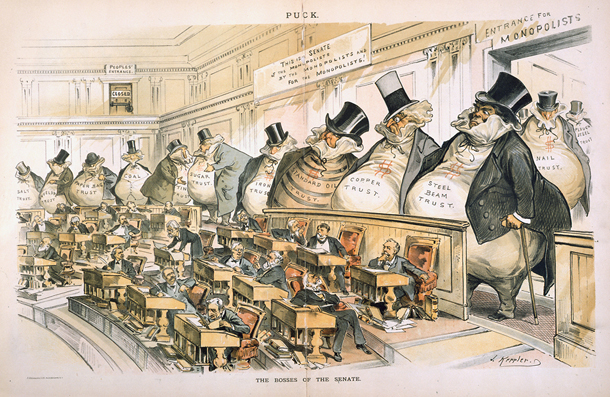
“The Bosses of the Senate,” by J. Ottmann Lith. Co. after Joseph Keppler Puck Lithograph, colored, 1889-01-23 From the collection of the U.S. Senate

One of my old high school classmates, Shaun McCausland, ran for the U.S. Senate in Utah in 2012, on the Constitution Party ticket.  Nice kid, I felt an obligation to pay attention to what he was trying to do, even with his running against my old boss, Orrin Hatch.

I was surprised to find in his campaign materials he e-mailed me, a call for the repeal of the 17th Amendment.

What?  That’s the amendment that gives us direct election of U.S. senators, instead of letting the state legislatures select them.   Why repeal?

Shaun sent along an explanation, from Constitution Party materials, as I recall, claiming that the 17th Amendment was a “power grab” by industry and other oligarchist groups, to take power from the states.  It was a move towards corruption, the material explained.

Seriously?  People think that today?

History takes a different view.

Prior to the 17th Amendment, state legislatures selected the U.S. senators.  Big corporate interests — the monopolists — figured this out in spades, and proceeded to buy state legislatures, thereby getting the right to name their friends to the U.S. Senate, in the perfect picture of a corrupt bargain (the charge originally aimed at the supposed deal between John Quincy Adams and Daniel Webster Henry Clay, in which it was alleged Webster Clay got the House of Representatives to name Adams president, and Webster Clay was in turn appointed Secretary of State, the president-in-waiting post of that day).

Look at the cartoon.  You’ll see the fat “bosses” sitting around the back of the senate chamber labeled, “Copper Trust,” “Steel Trust,” “Oil Trust,” and so on.

Consider Montana, Utah and Arizona.  In each of those states, huge copper mines were among the leading businesses.  The domes of the Arizona and Utah capitol buildings are capped with copper, in honor of the leading role the ore and mineral played in early state history.

Who got elected to the state legislatures in those states?  Copper company-approved and -supported candidates won.

So, who was elected to the U.S. Senate, by the state legislatures?  Copper company-approved senators.

In 1913, when Arizona joined the union, one could make a case that copper controlled at least 6 senators out of 96.

And so it was for other trusts, in other states — or a mixture of trusts in some states. Think of the trusts of the time — the copper trust, the steel trust, the steel beam trust, the nail trust, the coal trust, and many others.

The rich guys ruled.

While this system technically violated no laws in those campaign-contribution-limit-free days, it clearly affected legislation.  The Progressive Movement arose as a grassroots movement, from farmers and laborers, from downtrodden immigrants, from the prairies, mines and mills.  When enough people got involved, they could out vote the trusts in a few things — but it still took more than a quarter century to change the election process for the U.S. Senate, to keep the corruption out.

Politics of the times from 1900 to 1920 were complex, and can be oversimplified easily.  Running that risk, let us note that by the time Woodrow Wilson took over the White House, reformers were maneuvering to fix problems in lots of areas, sometimes with great overreaches like the 18th Amendment and Prohibition, but also with long-needed reforms, and reforms headed in the right direction but not strongly or fast enough, like the creation of the Federal Reserve.

The 17th Amendment was intended to get corruption out of the U.S. Senate, especially the senator selection process.  Instead of leaving the selection in the hands of corporation-captive state legislatures, the 17th Amendment expanded democracy, making the selection of U.S. senators a choice of the people of the state, at the ballot box.

Keppler’s cartoon, originally published in Punch Magazine, tells the story in one panel.  It shows the U.S. Senate — very astute historians may be able to pick out and identify particular senators — with the chief door labeled “Monopolists’ Entrance.”  Coming through the door, and lining the back of the Senate, are the “Bosses of the Senate,” moneybags with legs, or in one case an oil barrel with legs, and with the name of the trust written across the front of their nattily-dressed girths.

The senators turn to their bosses, awaiting instruction.

Inscribed on the wall at the back of the chamber is a twisted rendition of Lincoln’s stirring description of the government intended by the Constitution:  “This is the Senate of the Monopolists by the Monopolists and for the Monopolists!” (Compare Keppler’s cartoon drawings of the U.S. Senate Chamber with photographs and drawings, if you can find them.)

There is a door to the galleries of the Senate, labeled “The Peoples’ Entrance.”  It is barred, bolted and nailed shut, keeping out the American people.

Keppler’s cartoon was published January 23, 1889.  Earlier reform attempts failed, in 1828, 1829 and 1855. Progressives including William Jennings Bryan, George Frisbie Hoar and Elihu Root pushed for reform in the 1890s.  By 1910, some 31 states had passed resolutions asking for reform; some of them initiated direct primary elections, though that didn’t generally affect the selections by the legislatures.  Partly to avoid a states-led convention to amend the Constitution, which could easily run rogue, critics feared, Congress took up the issue.  Congress passed the amendment, submitting it to the states on May 13, 1912.  By April 18, 1913, three-fourths of the states had ratified the proposal, and it was declared the 17th Amendment.  Ironically, by that time Bryan had assumed the office of Secretary of State, and it fell to him to proclaim the amendment adopted on May 31, 2013.

The fat cats lost.

Please remember that.

More:

Another cartoon, by Spencer, for the Omaha (Nebraska) World, poking fun at the time required to get the 17th Amendment; from the U.S. National Archives, collected by Robert C. Byrd, Senate Majority Leader:

Cartoon portraying the time needed to pass the 17th Amendment allowing the direct election of U.S. senators By Spencer, for the Omaha World Herald, 1912 Reproduced from Robert C. Byrd, The Senate, 1789­1989

Cartoon portraying the time needed to pass the 17th Amendment allowing the direct election of U.S. senators By Spencer, for the Omaha World Herald, 1912 Reproduced from Robert C. Byrd, The Senate, 1789­1989

Nota Bene: Oh, to have a good copy editor. Clay, not Webster. How many years, how many thousand readers, before anyone read it as it was, and not as we expected it to be?

Save

Save


Nothing But Nets invites you to join in the fight against malaria, for World Malaria Day

April 3, 2014

I get e-mail from Nothing But Nets, in preparation for World Malaria Day, April 25, 2014:

Compete to Beat Malaria Header with credit

Dear Ed,

As you know, World Malaria Day is April 25, and supporters will be taking action throughout April to help us send 25,000 bed nets to families in Africa.

Are you in?

Our champions are holding basketball tournaments, soccer games, and running in 5K races to get their friends, families, and communities involved in the fight against malaria.Megan Walter Jumpology

Megan Walter, our supporter from Richmond, Virginia, organized a unique event in her hometown. She partnered with her local trampoline park to jump for nets – and they raised $10 for every jumper who participated. The event was a huge success, raising more than $2,000 to send 200 bed nets to families in Africa. What made it even better is that Megan had fun doing it!

There are lots of ways to raise money and send nets while doing what you love. Every $10 you raise helps us purchase and distribute life-saving bed nets with our UN partners.

What sports challenge will you do this April?

Join us in sending nets and saving lives for World Malaria Day! Together, we can defeat malaria.

Sincerely,

Liz Wing
Senior Grassroots Officer, Nothing But Nets

P.S. Whether you run, swim, or play basketball, you can help raise critical funds and save lives. Take a challenge.


Compete to Beat Malaria Footer

Donate Now | Unsubscribe | View in browser

© Copyright 2014 United Nations Foundation
1750 Pennsylvania Avenue NW, Suite 300,
Washington, DC 20006

You noted, of course:  No call for more DDT.  No slamming of science, scientists, medicine, medical workers, or Rachel Carson and environmental organizations.

This comes from people who fight malaria for a (meager) living, on non-profit basis, without political bias.  In short, these people need help, and consequently have no use for the pro-DDT, anti-Rachel Carson, anti-WHO, anti-science hoaxes.

Please give.  Every $10 can save a life.


Yogi Berra and ObamaCare

April 2, 2014

Cartoon from Tom Toles at the Washington Post, April 2, 2014:

“ObamaCare: Nobody goes there. It’s too crowded.” Tom Toles in the Washington Post, April 2, 2014.

Why you need to know a little history to get good jokes:

Yogi Berra is famous for his sayings, some of which sound foolish at first, but which generally pack a lot of wisdom or sharp observation.

Berra grew up in St. Louis, which has many famous restaurants.  On some occasion, someone suggested the group should go eat at Ruggeri’s, and Yogi’s reply became famous:

On why he no longer went to Ruggeri’s, a St. Louis restaurant: “Nobody goes there anymore. It’s too crowded.”


Signs of life: “Support Boy Scouts, buy a brat!”

April 1, 2014

Peel your eyes, you can find signs in real life better than any punchline you could dream up for one of those fake sign sites.

Comes this story from Minnesota Prairie Roots (with more details there):  Harriet Traxler of Carver, Minnesota, drove U.S. Highway 212 between Chaska  and Cologne, Minnesota, coming on a sign at a garden store, selling food for a Boy Scout fundraiser — we guess.

Minnesota, in the summer, you don’t sell just hot dogs.  You sell brätwurst.  Bräts. Or, if you don’t have the letter with the diacritical markings over the top in your sign kit, “brats.”

Oh, you see where this is going, don’t you?

“Here’s the sign Harriet spotted several years ago in front of a garden store along U.S. Highway 212 between Chaska and Cologne, Minnesota.” Caption from Minnesota Prairie Roots. Photo by Harriet Traxler

Ms. Traxler notes the sign was gone the next day.  Sold out?

We hope they hit their fundraising goals, but we might worry about just what it was they were really selling.

Punctuation and diacritical markings!  They can prevent horrible misunderstandings!