Fly your flag today for the 2017 holiday honoring Rev. Martin Luther King, Jr.

January 16, 2017

As on every federal holiday, citizens and residents of the U.S. should fly their U.S. flags today, on the holiday marking the birth of the Rev. Dr. Martin Luther King, Jr.

Rev. King, and the U.S. flag

Rev. King, and the U.S. flag. (No information on place or time of photo; please feel free to lend light and facts.)

Fly the U.S. flag today for the holiday for the birthday of Martin Luther King, Jr.  The holiday is celebrated on the third Monday in January.

King’s actual birthday is January 15. You could have flown your flag then, too — many Americans fly flags all weekend.

Many Americans will celebrate with a day of service. Perhaps you will, too.

In 2017, days before the inauguration of a new president, remembering and honoring the life and struggles of Martin Luther King, Jr., and serving others in real and symbolic ways, is more important than ever.

More:

The Martin Luther King, Jr. Memorial in Washington, D.C. Credit: architecture.about.com, via Saporta Report

The Martin Luther King, Jr. Memorial in Washington, D.C. Credit: architecture.about.com, via Saporta Report

Save


Frosty Sandias

January 10, 2017

Sandia Peak on a frosty evening, from Mark Boslough

Sandia Peak on a frosty evening, from Mark Boslough

Living with a mountain provides myriad moments that cannot quite be captured on film, but must be filed away in memory to produce a smile at some future moment.

But, sometimes a camera can come close.

That last bit of sunlight at the top of the mountain, on a cold day, giving hope, or assurance, before it is snuffed out for a time by the rotation of the Earth.

The mountain will be there tomorrow. The Sun will return. The moment won’t be the same.


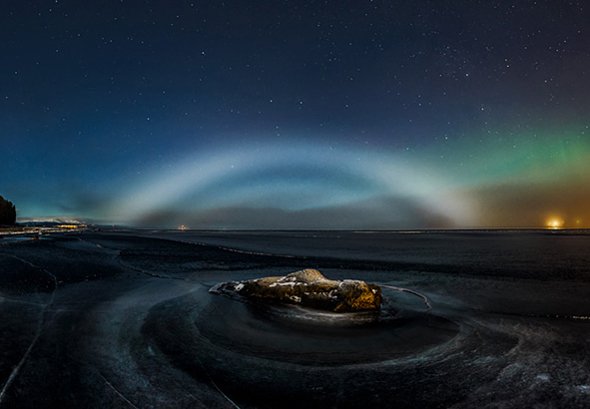
Lunar fogbow? Beautiful, whatever you call it

January 10, 2017

I follow Phil Plait to get smart and stay informed about the stars and the universe.

Sometimes it’s just the sheer beauty one finds that wakes you up.

Phil posted this on Twitter, a lunar fogbow:

From Twitter, Phil Plait: Göran Strand (@astrofotografen) captured a VERY rare sight: a lunar fogbow! http://www.slate.com/blogs/bad_astronomy/2016/12/26/g_ran_strand_photo_of_a_very_rare_lunar_fogbow.html …

From Twitter, Phil Plait: Göran Strand (@astrofotografen) captured a VERY rare sight: a lunar fogbow! http://www.slate.com/blogs/bad_astronomy/2016/12/26/g_ran_strand_photo_of_a_very_rare_lunar_fogbow.html

Plait’s explanations are fun:

Göran Strand is an amazing astrophotographer whose work I’ve highlighted here many times. He has an astonishing skill in making beautiful photographs out of rare and bizarre phenomena.

It’s not just a beautiful photograph. It’s a rather rare phenomenon beautifully captured by Göran Strand, and wonderfully explained by Plait at his blog at Slate:

And here he is once again: That photo above shows that’s quite uncommon sigh: a fogbow! But this being Strand, even that’s not unusual enough. For him, it had to be even more difficult to track down. That’s not just a fogbow, it’s a lunar fogbow!

Fogbows are similar to rainbows, in that they’re caused by water droplets, but in detail they’re very different. In a rainbow, sunlight is bent and reflected inside a raindrop, and sent off at an angle. The drops are big compared to the wavelength of light, so they act a bit like mirrors. Each color of sunlight, though, bends at a slightly different angle, separating them, creating the multihued rainbow.

Plait’s got more good science explanation. Go see.

Strand has photos to sell in various formats. I see in a lot of offices, “inspirational” posters with good photos and occasionally-pithy-but-often-banal sayings and platitudes, hoped by bosses to spur productivity on the cheap. Order up a sizable print from Strand, get the full description of the photo, and mount it in your office instead. You’re likely to discover than genuine natural beauty from awe-inspiring photos spurs creativity and productivity more than the stock photos and stock sayings.

Those photos are starting points for learning, too, teachers. Real photos, worthy of any history, economics, geography, astronomy, chemistry, physics, geological science or environmental science class.

Try ’em and see.

More:


Save

Save


January 9, 2017 – Connecticut flies U.S. flags for statehood

January 9, 2017

Carol Highsmith photo of Connecticut's Hall of Flags

Love this photo: Hall of Flags in the Connecticut State Capitol Building; photo by the great photo-historian Carol Highsmith, from the Library of Congress collection; the statue is Connecticut’s Civil War Governor, William A. Buckingham (1804-1875), honored for his personal contributions to the equipping of Connecticut’s men fighting in the Civil War.

Technically, states didn’t exist at all, yet.

But on January 9, 1788, Connecticut became the fifth of the 13 colonies to ratify the proposed Constitution for the United States of America, and by that action set the date we count as Connecticut’s entery into the union.

Within 12 months, four more colonies ratified the document, totaling nine ratifications required to put the Constitution into effect.  When the government of the new nation started functioning in 1789, Connecticut was counted as the fifth state.

Connecticut capitol building, Hartford

Capitol building for Connecticut in Hartford; this photo is from the rear of the building, so the U.S. flag is flying correctly on its own right. The building was completed in 1878. The dome is covered in gold. Image from Wikimedia Commons

To avoid political scheming by anti-federalist colony governors, especially Patrick Henry in Virginia, in September 1787 James Madison proposed that the draft constitution be ratified not by legislatures in the colonies, but instead by a specially-called convention of the people of the colony.  Connecticut’s convention met first on January 3, 1788. With six days of discussion and debate, the convention passed a resolution of ratification on January 9.

So by tradition, January 9 is Connecticut’s statehood anniversary.  According to U.S. law, the Flag Code and tradition, citizens and residents of a state fly their flags on statehood anniversaries.

Happy birthday Connecticut, 228 years old.

Next date to fly the U.S. flag is January 16, 2016, to honor the birth of the Rev. Dr. Martin Luther King, Jr. January 16 is the official holiday; January 19 is the actual birthday. You may fly your colors on both dates.

More:


Quote of the Trump administration? “What’s the Constitution between friends?”

January 8, 2017

Timothy J. Campbell, Congressman from New York; photo from Mathew Brady negative circa 1870; Library of Congress, Prints and Photographs Division, http://www.loc.gov/pictures/item/2005691716/

Timothy J. Campbell, Congressman from New York; photo from Mathew Brady negative circa 1870; Library of Congress, Prints and Photographs Division, http://www.loc.gov/pictures/item/2005691716/

What’s the Constitution between friends?

–Timothy J. Campbell (1840-1904), Attributed, circa 1885

A little more below the fold? Certainly. Read the rest of this entry »


Happy 217th birthday, Millard Fillmore! Mo Rocca’s profile, from our archives to yours

January 7, 2017

Millard Fillmore as a younger man? Several sites claim this is a painting of Fillmore, but as with much about our mysterious 13th president, it's difficult to confirm, partly because images of Fillmore really are rather rare.

Millard Fillmore as a younger man? Several sites claim this is a painting of Fillmore, but as with much about our mysterious 13th president, it’s difficult to confirm, partly because images of Fillmore really are rather rare.

Our 13th president, Millard Fillmore, was born January 7, 1800. He’s 217 years old today, though he’s been dead most of that time.

After commemorating Fillmore’s birthday each year for the past several years, I’m running out of ideas to write about him that seem novel, at least to me. [No doubt you’ve noted this is roughly the same post as last year.]  Several years I’ve called the University of Buffalo to try to get copies of the remarks officials make at Fillmore’s gravesite, but those remarks rarely come through — so we don’t get enlightenment from them.

Reality? Few people remember anything about Fillmore even after we feature it here. For Fillmore’s 217th, let’s review what little we really know about him, with some encore posts.

Raconteur Mo Rocca profiled Fillmore for CBS’s Sunday Morning, a while back. That may be as good a place as any to review the highlights of Fillmore’s life, and meaning and place in U.S. history.

Most historians give Fillmore bad marks as a president, despite his having opened Japan for trade, and despite his having procured a steady supply of bird poop for U.S. industry.

I get this eerie feeling Fillmore would fit right in today in the GOP presidential scraps, and would be a serious challenge to fellow New Yorker Donald Trump. Do you agree?

You may view Mo Rocca’s “profile” of President Millard Fillmore for CBS Sunday Morning, on YouTube:

“CBS Sunday Morning” correspondent Mo Rocca, far left, poses with Kathy Frost, curator of the Millard Fillmore Presidential Site, and Robert Lowell Goller, town historian and director of the Aurora Historical Society, during his recent visit to East Aurora. Photo by Robert Lowell Goller

East Aurora Advertiser caption: CBS Visits East Aurora “CBS Sunday Morning” correspondent Mo Rocca, far left, poses with Kathy Frost, curator of the Millard Fillmore Presidential Site, and Robert Lowell Goller, town historian and director of the Aurora Historical Society, during his recent visit to East Aurora. Photo by Robert Lowell Goller

CBS broadcast this piece on February 16, 2014.

 974

More:

Yes, this is mostly an encore post. Fighting ignorance requires patience.

Yes, this is mostly an encore post. Fighting ignorance requires patience. Overcoming Mencken’s hoax requires an army, too.

Save


U.S. flag on the McPolin Barn, Park City, Utah (It’s Utah Statehood Day!)

January 4, 2017

Most Utah citizens regard themselves as patriots. It’s a state where almost every home has at least one U.S. flag, and where many neighborhoods will be festooned with them on any U.S. holiday.

January 4 is Utah’s statehood day. I ran across this photo of the picturesque McPolin Barn in Park City, Utah, up in the Wasatch Mountains in ski country.

For Utah Statehood day, I pass it along:

U.S. flag displayed on the McPolin Barn, Park City, Utah. Date unknown, photographer unknown (if you can identify the photographer, please do!)

U.S. flag displayed on the McPolin Barn, Park City, Utah. Date unknown, photographer unknown (if you can identify the photographer, please do!)

Save

Save


Utah flies U.S. flags on January 4 for statehood: 121 years in 2017 – old enough to drink

January 4, 2017

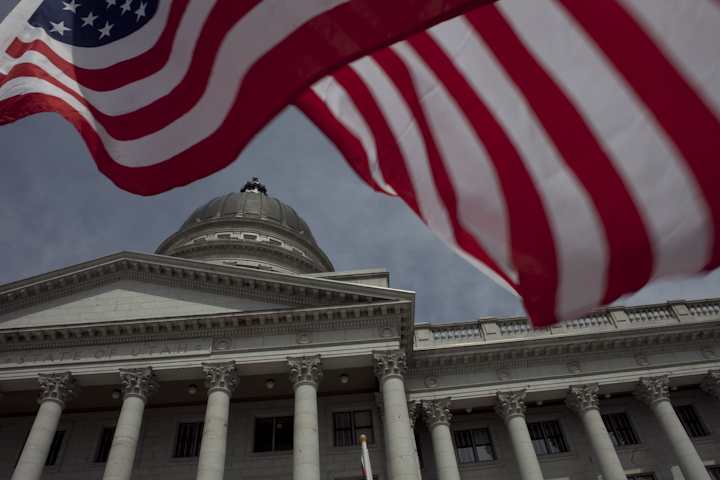
U.S. flag flying in front of the Utah State Capitol. Utah State Capitol image.

U.S. flag flying in front of the Utah State Capitol. Utah State Capitol image.

U.S. flags fly in Utah today in honor of Utah statehood. It’s also the day that new, elected state officers take their oaths and take their offices. Utah is 121 years in the union — as a state, it’s old enough to drink, though you may have difficulty finding a drink there among the teetotaling Mormons.

Utah joined the Union on January 4, 1896.  It had been a 49-year slog to statehood for Deseret, the Mormon settlement in the Desert.  The size had been pared down, so it would not be the biggest state, incorporating parts of what is now Nevada, Arizona, Oregon, Idaho, Colorado and New Mexico.  New capitals had been tried and cast aside (Fillmore, Utah).  Democratic Party rule was broken when LDS church authorities went door-to-door, calling every other family to the Republican Party, and party parity.  The Mormon Church abandoned polygamy, and adopted a state constitution that gave the vote to women.

Finally, Utah became the 45th state.

You may fly your U.S. flag today for Utah statehood, especially if you’re in Utah.

Happy birthday, Utah!  121 years old today.

Big dance in Fillmore to celebrate, Saturday:

Next federal flag-flying date: January 6, in honor of New Mexico’s statehood.

More:

One of my favorite Utah photos: U.S. flag at the south end of Mount Timpanogos; photo from Orem, Utah, by Bob Walker.

One of my favorite Utah photos: U.S. flag at the south end of Mount Timpanogos; photo from Orem, Utah, by Bob Walker.

Yes, this is mostly an encore post. Fighting ignorance requires patience.

Yes, this is mostly an encore post. Fighting ignorance requires patience.

Save

Save


Snow geese coming at you

January 3, 2017

Wildlife photographer Nancy J. Warner caught a breathtaking view with dozens (hundreds?) of snow geese taking off, flying directly at her.

Nancy J. Wagner on Twitter: Seeing 1000s of #snow #geese flying towards me was breathtaking. Looks chaotic, but they take to the air very methodically. #Skagit #birding

Nancy J. Wagner on Twitter: Seeing 1000s of #snow #geese flying towards me was breathtaking. Looks chaotic, but they take to the air very methodically. #Skagit #birding

I’m not familiar with Ms. Wagner’s work, but it seems we should be. Wagner shoots wildlife that would make nice adornments for your home and office walls, truly inspiring.


58 years ago, January 3, 1959: Welcome, Alaska, and the 49-star flag

January 3, 2017

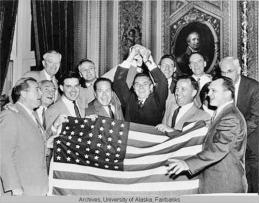
Alaska Territorial Gov. Bob Bartlett in center, with the 49-star flag (Bartlett was one of Alaska's first U.S. senators).

Alaska Territorial Gov. Bob Bartlett in center, with the 49-star flag (Bartlett was one of Alaska’s first U.S. senators).

The great service at the New York Times site, the Learning Network, notes the 1959 Dwight Eisenhower proclamation of Alaska as the 49th state, and the unveiling of the 49-star flag:

On Jan. 3, 1959, President Dwight Eisenhower signed a proclamation admitting Alaska to the Union as the 49th state. The New York Times noted that the signing included the unveiling of the new 49-star American flag.

The land that became Alaska came into U.S. possession in 1867, when William Seward, secretary of state under President Andrew Johnson, negotiated a deal to buy the 586,000-square-mile area from Russia for $7.2 million, less than 2 cents per acre. Seward’s decision was ridiculed in the American press, who saw no potential in the vast, inhospitable and sparsely populated area.

For decades after its purchase, Alaska was derided as “Seward’s folly” or “Seward’s icebox.” This opinion changed in 1896 with the discovery of gold in the neighboring Yukon Territory, which spurred tens of thousands of people to head to Alaska in search of gold. The gold rush also brought about a boom in mining, fishing and trapping.

Though the first statehood bill had been presented to Congress in 1916, there was little desire in either Alaska or Washington for Alaskan statehood until after World War II. During the war, the U.S. established multiple military bases to resist Japan’s attacks on Alaska’s Aleutian Islands and prevent a potential invasion of the mainland. The military activity, along with the completion of a major highway from Montana, led to a large population growth.

In 1946, Alaskans voted in favor of statehood in a referendum and Alaskan delegates began to lobby Congress for statehood. After years of debate, Congress voted in June 1958 to admit Alaska.

Eight months after Alaska’s admission, on Aug. 21, 1957 [should be 1959, no?], Hawaii became the 50th state. The 49-star remained in place until the following July 4, when it was replaced by the now-familiar 50-star flag.

49-star flags were produced only until August 1959, so there are few of them around.  I love this photo of the unveiling of the flag with President Eisenhower:

President Eisenhower and Quartermaster General MG Andrew T. McNamara, with 49-star flag - image from QM foundation

“Quartermaster General MG Andrew T. McNamara and President Eisenhower examine new 49 star flag” – image and caption from the Quartermaster Foundation. Photo by Bob Schutz, Associated Press (Who are the other two people?  The guy on the right looks to me a bit like is Pennsylvania’s Sen. Hugh Scott.)

It had been about 47 years since the previous state admission (Arizona); people became aware that no law set what the flag should look like.  President Eisenhower issued a directive.

How did the nation survive for 170 years without firm, decisive and conclusive orders on what the U.S. flag should look like?  Isn’t it a great story that we went so long without law setting the requirements?

Alaska's state flag design came from 13-year old Benny Benson.

Alaska’s state flag design came from 13-year old Benny Benson. Benny Benson holding the Alaska flag at the Jesse Lee Home, Seward, Alaska. ASL-P01-1921, Alaska State Library-Historical Collections.


Alaska’s state flag came from the imagination of a 13-year-old Aleut, Benny Benson, winning a contest to design the state’s flag.  Alaska’s flag stands out in any display of U.S. state flags.

Alaska's flag as it was approved by the state legislature, and still flies today. Image from the Ninilchik Natives Association, Inc (NNAI).

Alaska’s flag as it was approved by the state legislature, and still flies today. Image from the Ninilchik Natives Association, Inc (NNAI).


Yes, this is mostly an encore post. Fighting ignorance requires patience.

Yes, this is mostly an encore post. Fighting ignorance requires patience.

Save

Save

Save

Save

Save


Will you fly your U.S. flags in January 2017?

January 3, 2017

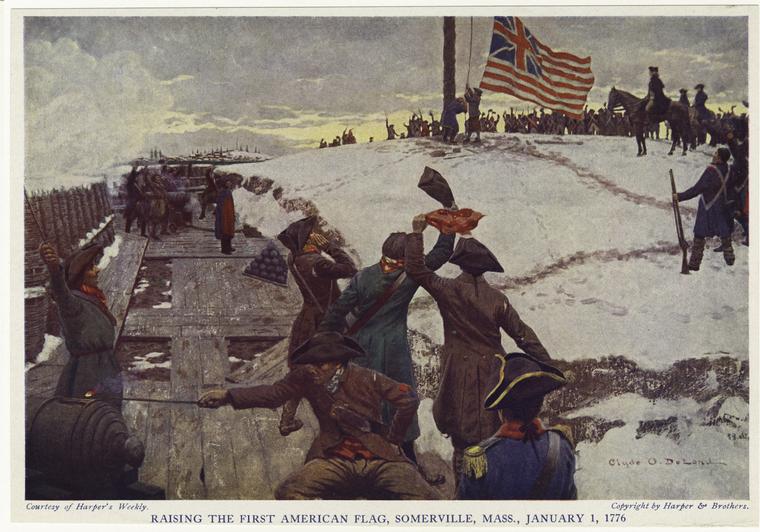
“Raising the first American flag, Somerville, Mass., January 1, 1776.” Harper’s Weekly painting by Clyde Osmer DeLand, 1897. From the digital collections of the New York Public Library

January is loaded with flag flying dates, when we add in statehood days, dates those states are invited to fly their U.S. flags.

In January 2017, the U.S. Flag Code urges citizens to fly flags on these dates, listed chronologically:

  • New Year’s Day, January 1, a federal holiday
  • January 2, Georgia Statehood Day
  • January 3, Alaska Statehood Day
  • January 4, Utah Statehood Day
  • January 6, New Mexico Statehood Day
  • January 9, Connecticut Statehood Day
  • Martin Luther King’s Birthday, a federal holiday on the third Monday of January; that date is January 16, in 2017; King’s actual birthday is January 15, and you may fly your flag then, too
  • Inauguration Day, January 20, the year after election years, as 2017 is
  • January 26, Michigan Statehood Day
  • January 29, Kansas Statehood Day

You may fly your flag any other day you wish, too; flags should not be flown after sundown unless they are specially lighted, or at one of the few places designated by Congress or Presidential Proclamation for 24-hour flag flying.  According to Wikipedia’s listing, those sites include:

  • Fort McHenry, Baltimore, Maryland (Presidential Proclamation No. 2795, July 2, 1948).
  • Flag House Square, Albemarle and Pratt Streets, Baltimore, Maryland (Public Law 83-319, approved March 26, 1954).
  • Marine Corps War Memorial (Iwo Jima Memorial), Arlington, Virginia (Presidential Proclamation No. 3418, June 12, 1961).
  • Lexington Battle Green, Lexington, Massachusetts (Public Law 89-335, approved November 8, 1965).
  • White House, Washington, D.C. (Presidential Proclamation No. 4000, September 4, 1970).
  • Washington Monument, Washington, D.C. (Presidential Proclamation No. 4064, July 6, 1971, effective July 4, 1971).
  • Any port of entry to the United States which is continuously open (Presidential Proclamation No. 413 1, May 5, 1972).
  • Grounds of the National Memorial Arch in Valley Forge State Park, Valley Forge, Pennsylvania (Public Law 94-53, approved July 4, 1975).
Flag House in 1936, 844 East Pratt & Albemarle Streets (Baltimore, Independent City, Maryland) (cropped). Image courtesy of the federal HABS—Historic American Buildings Survey of Maryland.

Flag House in 1936, where Mary Pickersgill sewed the garrison-sized, 15-star flag that flew over Fort McHenry at the Battle of Baltimore in 1814; one of the sites where the U.S. flag may be flown 24 hours. The house is at 844 East Pratt & Albemarle Streets (Baltimore, Independent City, Maryland). Cropped image courtesy of the federal HABS—Historic American Buildings Survey of Maryland.

Yes, this is mostly an encore post. Fighting ignorance requires patience.

Yes, this is mostly an encore post. Fighting ignorance requires patience.

Save