Making those nice photographs of the Milky Way and stars isn’t so easy as it looks.
I made my most successful efforts on our recent swing through Colorado, New Mexico and West Texas. Here’s a shot I got that almost shows the Milky Way, probably has Polaris in it, and because it was a timed exposure, also captured star movement and an airplane flying overhead. Photo was taken from the Army Corps of Engineers campground at Abiquiu Reservoir, a few miles from Georgia O’Keefe’s home.
Abiquiu Stars – Time photograph of stars against a pinon pine, pointing north; Milky Way almost visible in the East.
Spread the word; friends don't allow friends to repeat history.
I come back from vacation, and no one tells me Warren Bennis passed on?
Why wasn’t that front page news, in every city with a corporation, a government, or a school?
Warren Bennis, in a publicity photo from the University of Southern California, the last of several academic institutions where he taught, or lead the entire school.
We know why. Bennis, who some claim invented the study of leadership in the modern world, is too little read in corporations — and almost never read in government, and probably never read in education leadership.
Try this experiment, you teachers: As you go back to school this month for the “in service” sessions that challenge your ability to stay awake, ask your principals and administrators what their favorite Warren Bennis book, or idea, is. If you find one who knows who Warren Bennis was, will you send us that person’s name for a Wall of Honor here?
Bennis wrote too abstractly for many. He was not one who would have ever thought about writing The One Minute Manager, not because there aren’t some good ideas in that book, but because he wrote to the higher levels of organizational thinking. (Our good friend Perry W. Buffington used to point out in his lectures that you’d run from the waiting room if you heard your neurosurgeon was reading the One Minute Brain Surgeon. Bennis would have put it more gracefully, and taken three pages to do it — but a serious reader would understand.)
With all the trouble we have in organizations these days, you’d think Bennis’s work would be on everybody’s bookshelf, and assigned to all incoming interns.
Hey, you MBAs: What class did you read Bennis in? Did you read Bennis at all?
Warren Bennis, who died Thursday in Los Angeles at age 89, was once called the “dean of leadership gurus,” a description that unfortunately stuck.
I say “unfortunately” because, for Bennis, there was never any kind of shtick. There was no silver bullet or four-box matrix or slide deck offering an oversimplified how-to guide to leadership. This giant among leadership experts — I take no exception to the “dean” part — was a thinker and an adviser, but not a guru. He wrote and talked about leadership as if the answers were still being shaped, even in his experienced mind.
He was a thoughtful, genuine, and always engaged man whom I came to know in these past eight years as a reporter covering management and leadership.
“I am as leery as anyone of the idea of leaping to conclusions, or making more of evidence than is demonstrably true,” Bennis wrote in his influential 1989 classic, On Becoming a Leader. “To an extent, leadership is like beauty: It’s hard to define, but you know it when you see it.”
For Bennis, leadership was a personal journey, something individual and introspective that must be learned through life’s experiences. He was a staunch believer that leaders are made not born, formed out of “crucible” moments and struggles that prepare them to lead. As he wrote in On Becoming a Leader — essential reading for anyone — leadership is about self-discovery and self-expression. “Before people can learn to lead, they must learn something about this strange new world.”
It may take me a few days to organize thoughts: Does it matter that he’s gone, if those who most need his work would never read it anyway?
Any guy who can look at a convention of high-paid CEOs and tell them that followers make them what they are, deserves much more than just a second thought.
What do others say?
.@geriwithetc@garthcello Another variation from my friend Warren Bennis, re successful transformers: "dreamers with deadlines."
I once took a survey among teachers, and not one said they thought their principal would fight to defend them; it was a small survey, but it discouraged me from pursuing the question more.
— Bulletin of the Atomic Scientists (@BulletinAtomic) August 9, 2014
From The Bulletin of Atomic Scientists:
At the end of the day, it can be worthwhile on the Hiroshima and Nagasaki anniversaries to think about the personal and the emotional—while keeping such clinical data in mind and ready to hand when it is necessary to debate proponents of ideas such as “battlefield nuclear weapons,” “limited nuclear war,” and the use of select nuclear strikes as a form of “de-escalation.”
Therefore, perhaps the most compelling of the stories in the Bulletin archive is a first-person recollection, Hiroshima Memories, by Hideko Tamura Friedman, who was just a young girl back on August 6, 1945. After moving to the United States and becoming a therapist in private practice and a part-time social worker in the Radiation Oncology Department at the University of Chicago Hospitals, Hideko excerpted this 1995 article from a longer, unpublished manuscript she was working on.
Hideko describes how she was reading a book when “a huge band of white light fell from the sky down to the trees.” She jumped up and hid behind a large pillar as an explosion shook the earth and pieces of the roof fell about her.
Hideko survived; some members of her family did not. “My father,” she wrote in in a heart-rending statement of fact, “brought Mama’s ashes home in his army handkerchief.”
Much has changed since I wrote most of the post, below, in 2009. The number of years, perhaps (and I’ve changed them in the text). Not enough else.
The Obama Administration made some progress in getting Iran to the table to talk non-proliferation of nuclear weapons. START was renewed. But not much more.
We’re left with the hope that this was the last time atomic weapons are used.
Stars and Stripes posted this short video of the ceremonies held in 2011 in Peace Park in Nagasaki
A memorial service was held at the Nagasaki Peace Park on Aug. 9, 2011, the 66th anniversary of the atomic bomb being dropped on the city at the tail end of World War II. The ceremony was attended by dignitaries from 44 countries – including an envoy from the United States – to honor the more than 155,000 people who were claimed by the bomb, including the 80,000 killed instantly.
The service came three days after one similar in Hiroshima, and marked the first time in history that an envoy from the United States attended both services.
In the wake of the March 11 disaster, Japanese officials called for the abolition of nuclear weapons and also for renewable sources of energy to replace nuclear power.
Nuclear anniversaries have been ignored again this year, it seems to me.
Ceremony in Nagasaki marked the remembrance of the victims of the second atomic weapon used in war, which was detonated over Nagasaki on August 9, 1945. Agence France Press reported (in 2009):
Nagasaki’s mayor, marking the 64th anniversary [66th in 2011] of his city’s atomic bombing by the United States, called on Sunday on the leaders of nuclear-armed powers to visit the site and build a nuclear-free world.
Hiroshima and Nagasaki, map by CNN
Tomihisa Tanoue urged world leaders from both declared nuclear powers and others such as Iran, Israel and North Korea to visit the city in southwestern Japan.
“I am sure anyone who visits here would feel the sorrow of the victims and be shaken by it,” the mayor said in an address at an annual ceremony commemorating the 1945 bombing.
A minute of silence was observed at 11:02 am (0202 GMT), when the US bomb exploded above the city, killing roughly 74,000 people. The bombing followed one a week before in Hiroshima and hastened Japan’s surrender in World War II.
Tanoue said an April speech by US President Barack Obama in Prague, where Obama pledged to build a world with no nuclear weapons, “impressed” the residents of Nagasaki.
“The Japanese government must support the Prague speech. As a nation that has come under nuclear attack, Japan must lead the international community” in abolishing the weapons, he said.
Similar appeals were made Thursday when Hiroshima marked the anniversary of its bombing, which killed 140,000 people.
At the Nagasaki ceremony, Prime Minister Taro Aso reiterated the Japanese government’s anti-nuclear stance, three weeks ahead of national elections that he is tipped to lose.
Aso raised eyebrows at the Hiroshima ceremony, when he pledged to work toward abolishing nuclear weapons but later told reporters that he thought it was “unimaginable” to attain a nuclear-free world.
Similar ceremonies, and similar pleas for nuclear non-proliferation marked the August 6 anniversary of the atomic bomb drop on Hiroshima. The Chinese news agency Xinhua reported:
Some 50,000 people gathered Thursday at the peace park in Hiroshima to mourn the 64th anniversary of the atomic bombing of the city by U.S. forces during the World War II.
Hiroshima Mayor Tadatoshi Akiba delivered a peace declaration, calling for the abolition of nuclear weapons by 2020.
“The hibakusha still suffer a hell that continues,” said Akiba.
“The Japanese government should support hibakusha, including those who were victims of black rain and those who live overseas,” he said.
“Japanese Prime Minister Taro Aso delivers a speech in front of the Memorial Cenotaph during the Hiroshima Peace Memorial Ceremony in Hiroshima, western Japan on Aug. 6, 2009. Hiroshima on Thursday mourned the 64th anniversary of the atomic bombing of the city by U.S. forces during the World War II. (Xinhua/Ren Zhenglai)”
It was reported Wednesday that the Japanese government aims to come to an agreement with all atomic bomb survivors who have sued the government for financial support to help them pay medical bills for illnesses related to the bombings of Hiroshima and Nagasaki.
Akiba also said “The year 2020 is important as we want to enter a world without nuclear weapons with as many hibakusha as possible. We call on the world to join forces with us to eliminate all nuclear weapons by 2020.”
Referring to the movements such as the environmentalists, Akibasaid, “Global democracy that respects the will of the world and respects the power of the people has begun to grow.”
“We have the power. We have the responsibility. We are the Obamajority. And we can abolish nuclear weapons. Yes we can,” said the mayor.
On Wednesday, Akiba urged the people around the world to join the city’s efforts to abolish nuclear weapons in response to U.S. President Barack Obama’ s appeal for a world free of nuclear weapons.
During the 50-minute memorial ceremony, a moment of silence was observed at 8:15 a.m., the time the atomic bomb detonated over Hiroshima 64 years ago, killing nearly 100,000 people in a blink.
This in a week when two burgeoning new nuclear powers, Iran and North Korea, continue to claim they will flout non-proliferation agreements for their own self defense. [Still true in 2014, alas.]
The question obtains on nuclear issues as well as genocides: When does “never again” start?
It’s up to you and me. What have you done to make “never again” with atomic weapons, start now?
Other related posts at Millard Fillmore’s Bathtub:
Milton Glaser is famous for uniting New Yorkers under the simple, iconic “I Heart New York” logo. (He also designed the label for Brooklyn Brewery and, as I learned on a recent tour, had the good sense to emphasize the beer’s borough of origin back before it was cool.) Now, at age 85, he’s out to rebrand the climate movement. The pitch: a hazy black circle with just a small band of green (read: Earth), which people can purchase and wear as a button. In a poster hung on the exterior of the New York School of Visual Arts‘ East 23rd Street building, the logo is accompanied by the slogan “It’s not warming, it’s dying.”
The obvious problem, right off the bat, is that Earth is warming: It’s done so rapidly over the 20th century, and is expected to continue at an even faster rate over the next 100 years. The world’s governments agreed that we should try to limit warming to below 2 degrees Celsius (3.6 degrees Fahrenheit) above pre-industrial levels to try to avoid the worst consequences of that warming, yet we’re on track to blow right past that limit. While Glaser obviously agrees that this is a problem, the slogan obscures that point. And as someone attuned to the world of climate deniers, I can’t help thinking that getting the hashtag #itsnotwarming to go viral might not have the intended effect.
But those are technicalities. Glaser told WNYC’s Brain Lehrer that his problem with the word “warming” is that it “sounds reassuring and comforting.” So if your complaint is that the slogan sounds overly pessimistic, well, that’s kind of the point. “Either Earth is dying or it’s beginning to grow again,” Glaser explained. “My preference would be that it was beginning to grow again, but for the moment I have no evidence of that.”
As a Utah Downwinder, I fight depressing ideas every August 6, and August 9.
The first atomic bomb used in war was dropped by my nation on August 6, 1945. The second, on August 9. Hiroshima, then Nagasaki, were the targets.
I know the arguments, both ways. I feel certain my Uncle Leo B. Stewart’s life was saved by the bombs — and the lives of probably two or three million more Americans, and five or ten million Japanese. And still I am troubled.
I’m troubled that there seems to be so little attention paid to the anniversary in the U.S. Year by year, it gets tougher to get news out of remembrance ceremonies in Japan. Here are some Twitter notes on the day. I may be back with more, later.
August 6 1945, 68 years ago today. The Enola Gay drops the bomb Little Boy, devastating Hiroshima. pic.twitter.com/5hG8uuCKmP
— Tule Lake National Monument (@tulelakenps) August 6, 2013
U.S. professor connects global nuclear victims, raises awareness: HIROSHIMA–An American professor living… http://t.co/dVQgKms9N9#HIN
This comes from a pseudo-Truman, but it’s an accurate reflection of the angst Truman went through; once he made the decision, he did not have doubts that it was the right one.
>>> You break your heart & your head trying to figure out a way to save one life. #Hiroshima
— Harry S Truman, CEO of Twltter 🐀 (@PresHarryTruman) August 6, 2013
Fortunately, in 68 years since, no other nuclear device has ever been used in war. May we have a planet that never sees their use in war, again.
Just try to find someone who can tell you who first said it, and what the circumstances were. It’s a sign that history instruction is not what it should be on some matters.
August 5 marks the 150th anniversary of the Battle of Mobile Bay in 1864, when the Union Navy under the command of Admiral David Farragut took Mobile from Confederate forces.
U.S. Heritage Protection Services — a division of the National Park Service — gives a straight up, unemotional description of the fight, which was a key victory for the Union, shutting down much of the Confederacy’s ability to trade with foreign nations and supply its army:
Photograph from circa 1855-1865 of then-Rear Admiral David Glasgow Farragut, the commander of the Union forces at the Battle of Mobile Bay, and the man to who is attributed the famous line, “Damn the Torpedoes!”
Forces Engaged: Farragut’s Fleet (14 wooden ships and 4 monitors) and U.S. army forces near Mobile [US]; Buchanan’s Flotilla (3 gunboats and an ironclad), Fort Morgan Garrison, Fort Gaines Garrison, and Fort Powell Garrison [CS]
Estimated Casualties: 1,822 (US 322; CS 1,500)
Description: A combined Union force initiated operations to close Mobile Bay to blockade running. Some Union forces landed on Dauphin Island and laid siege to Fort Gaines. On August 5, Farragut’s Union fleet of eighteen ships entered Mobile Bay and received a devastating fire from Forts Gaines and Morgan and other points. After passing the forts, Farragut forced the Confederate naval forces, under Adm. Franklin Buchanan, to surrender, which effectively closed Mobile Bay. By August 23, Fort Morgan, the last big holdout, fell, shutting down the port. The city, however, remained uncaptured.
Results(s): Union victory
World War I recruiting poster showing Admiral David Farragut lashed to the mast of his ship, and offering the quote for which Farragut is famous. Image from the collection of the Library of Congress, via Wikipedia
Nota bene:
Was Farragut lashed to the rigging?Wikipedia’s listing:An anecdote of the battle that has some dramatic interest has it that Farragut was lashed to the mast during the passage of Fort Morgan. The image it brings to mind is of absolute resolve: if his ship were to be sunk in the battle, he would go down with her. The truth is more prosaic; while he was indeed lashed to the rigging of the mainmast, it was a precautionary move rather than an act of defiance. It came about after the battle had opened and smoke from the guns had clouded the air. In order to get a better view of the action, Farragut climbed into Hartford‘s rigging, and soon was high enough that a fall would certainly incapacitate him and could have killed him. Seeing this, Captain Drayton sent a seaman aloft with a piece of line to secure the admiral. He demurred, saying, “Never mind, I am all right,” but the sailor obeyed his captain’s orders, tying one end of the line to a forward shroud, then around the admiral and to the after shroud.[50]Later, when CSS Tennessee made her unsupported attack on the Federal fleet, Farragut climbed into the mizzen rigging. Still concerned for his safety, Captain Drayton had Flag-Lieutenant J. Crittenden Watson tie him to the rigging again.[51] Thus, the admiral had been tied to the rigging twice in the course of the battle.
Did Farragut actually say, “Damn the torpedoes, full speed ahead? Mobile Bay had been mined by the Confederates, to hold off exactly the sort of Union attack Farragut mounted. Mines, in that time, were known as “torpedoes,” not the underwater-missiles made famous by World War II movies. Farragut had an iron-clad ship, Tecumseh, under his command leading the attack; legend holds that other ships slowed to allow Tecumseh to cross them and move ahead. Farragut asked why the attack was slowing, and upon hearing that they feared torpedoes (mines), he later was reputed to have said “Damn the torpedoes,” and urged moving at all speed. Did he say, “full speed ahead?” Accounts differ on that, even in legend. In one version he shouted to the ship Brooklyn, “Go ahead!” That’s unlikely in the din of sailing, coupled with the din of battle. Another account has him shouting (vainly) to the Hartford, “Four bells, Captain Drayton.” Yet another version, that almost makes sense, has him shouting to the Metacomet, which was lashed to the Hartford’s side, “Go ahead, Jouett, full speed.” The entire quote must be listed as attributed, and the only part most versions agree on is “Damn the torpedoes.” A World War I recruiting poster probably inscribed the quote into history (see the poster in this post). Alas, Tecumseh hit a torpedo early in the battle, and sank, killing most of its crew.
Political importance: Coupled with Gen. William Tecumseh Sherman‘s March Across Georgia, and the Fall of Atlanta, the Battle of Mobile Bay gave credence to the idea that the fortunes of the Civil War had turned in the Union’s favor. This victory probably contributed greatly to the re-election of President Abraham Lincoln against opponents who urged simply ending the war without victory.
Mobile Bay was an important port? Mobile Bay stands as a monument to poor soil conservation practices, today. Maps of the battle show a much larger bay than exists today; since 1864, silting from the river has filled in the bay, making it much less useful, and much less important to shipping.
1861 map of Mobile Bay: “H.H. Lloyd & Co’s Campaign Military Charts Showing The Principal Strategic Places Of Interest. Engraved Expressly To Meet A Public Want During The Present War. Compiled From Official Data By Egbert L. Viele, Military and Civil Engineer; and Charles Haskins. Published Under The Auspices Of The American Geographical And Statistical Society. Entered … 1861 by H.H. Lloyd & Co. H.H. Lloyd & Co’s Military Charts. Sixteen Maps On One Sheet.”
LandSat image of Mobile Bay, from NASA, 2003 (via Wikipedia). The Northern Bay is almost completely silted in by the Mobile River and others.
Whether Admiral David G. Farragut actually said, “Damn the torpedoes!” the phrase remains an often-used quotation to urge action in the face of uncertainty, hopefully, to victory. Farragut’s forces won the Battle of Mobile Bay on August 5, 1864, a key maritime battle of the Civil War. Whatever he said, it must have been inspiring.
A photograph of Marcus Garvey from the collection of the Library of Congress. The photo was taken on August 5, 1924.
Why? I don’t know.
Marcus Garvey, August 5, 1924. Photographer, and location, unknown. Library of Congress collection.
The photo was part of a Library of Congress exhibit honoring the NAACP in 2009, on its 100th anniversary. The description from the exhibit covers Garvey’s life.
Born in Jamaica, Marcus Garvey (1887–1940) moved to New York in 1917 to organize the American branch of the Universal Negro Improvement Association (UNIA), the largest black mass movement. His defiant black nationalism, which stressed self-help and entrepreneurship, coupled with his flair for pageantry galvanized thousands of working class urban blacks. Garvey also founded the Negro Factories Corporation and the Black Star Steamship Line. Financial mismanagement of these organizations led to his indictment on mail fraud charges in 1922. He was convicted and sentenced to Atlanta’s federal penitentiary in 1925. After his release in 1927, he was deported to Jamaica.
Spread the word; friends don't allow friends to repeat history.
On August 4, 1964, President Johnson awoke to the news that two U.S. Navy ships cruising in the Tonkin Gulf had been fired upon by North Vietnamese Navy gunboats; then the FBI called and announced that the bodies of three civil rights workers had been found, young men registering African Americans to vote in Mississippi. Both of these events rumble through history like a Rocky Mountain avalanche to today; either was a make-or-break event for any presidency.
And also on that day, the U.S.S. Maddox reported it had been attacked by gunboats of the North Vietnamese Navy, in the Gulf of Tonkin. The Gulf of Tonkin incident led to the Gulf of Tonkin Resolution, which gave Johnson the authority to expand and escalate the war in Vietnam, which he did.
Cover for the CD of the Dallas Symphony’s Grammy-nominated performance of Steven Stucky’s “August 4, 1964,” Jaap van Zweden conducting.
The Dallas Symphony commissioned the work, from composer Steven Stucky and librettist Gene Scheer, in commemoration of President Johnson’s 100th birth anniversary — he would have been 100 on August 27, 2008. The works were premiered in Dallas in 2008.
The music is outstanding, especially for a modern piece. The Dallas Symphony was at its flashiest and most sober best, under the baton of new conductor Jaap van Zweden. It was a spectacular performance. According to the New York Times:
Mr. van Zweden, hailed in his debut as music director a week before, scored another triumph here. And the orchestra’s assured and gritty performance was rivaled by that of the large Dallas Symphony Chorus, both corporately and individually, in shifting solo snippets charting the course of the fateful day.
The strong cast, mildly amplified, was robustly led by the Johnson of Robert Orth, last heard as another president in John Adams’s “Nixon in China” in Denver in June. Laquita Mitchell and Kelley O’Conner, wearing period hats, were touching as Mrs. Chaney and Mrs. Goodman. Understandably, the taxing role of a high-strung McNamara took a small toll on the tenor of Vale Rideout in his late aria.
The entire thing deserves more commentary, perhaps soon. There is stellar history in the choral piece. And there is this: Consider that Lyndon Johnson, the best legislator and second most-effective executive we ever had as president, got hit with these two crises the same day. On the one hand the nation got the Voting Rights Act, the Fair Housing Act, executive orders and government support to end segregation and the evils it created. On the other hand, we got stuck with the disaster of the Vietnam War.
How would the nation fared had a lesser person been in the White House on that day?
(August 4 is a busy, busy day in history; much to think about.)
Especially for international audiences, often distributed by U.S. Embassies in foreign nations, the U.S. State Department offers a wealth of information about the United States, our businesses and heritage, and our history and national heroes.
For several years State has made available a 20 page booklet on Rachel Carson, one of the great drivers of the modern conservation movement after 1960. It was created in 2007, to celebrate the 100th anniversary of Carson’s birth.
Cover of the 20-page pamphlet, Rachel Carson: Pen Against Poison
It keeps moving. Today I’m unable to find it at the site of the U.S. State Department, except through our Embassy to South Korea. I fear the document may go away, and I frequently refer people to it.
I’m making it available here, as insurance against its going away from State Department sites.
If you haven’t read it, take a look. If you’re a teacher of literature, or biology or science, or history, consider this as a resource for your students.
Three extended essays make up the substance of the book. Phyllis McIntosh wrote, “A Quiet Woman Whose Book Spoke Loudly.” Michael Jay Friedman discussed the effects of Carson’s work and writings, “A Book That Changed a Nation.” And distinguished entomologist May Berenbaum contributed an essay on the actual controversies about the hard choices involved in dealing with pesticide safety, “A Persistent Controversy, A Still Valid Warning.” There is a photo essay covering 50 years, and a series of links and other sources, good for students.
History students will recognize that this was nearly two months after D-Day, the Invasion of Normandy that set off the events leading to liberation of Europe from Nazi rule and the collapse of Hitler’s grand visions of conquest. How could Nazi minions not know their time was limited, and oppression ultimately futile?
Germany surrendered in May 1945. In nine months, the Frank family would not need to hide. Anne died in March 1945, less than eight weeks before the surrender of Germany.
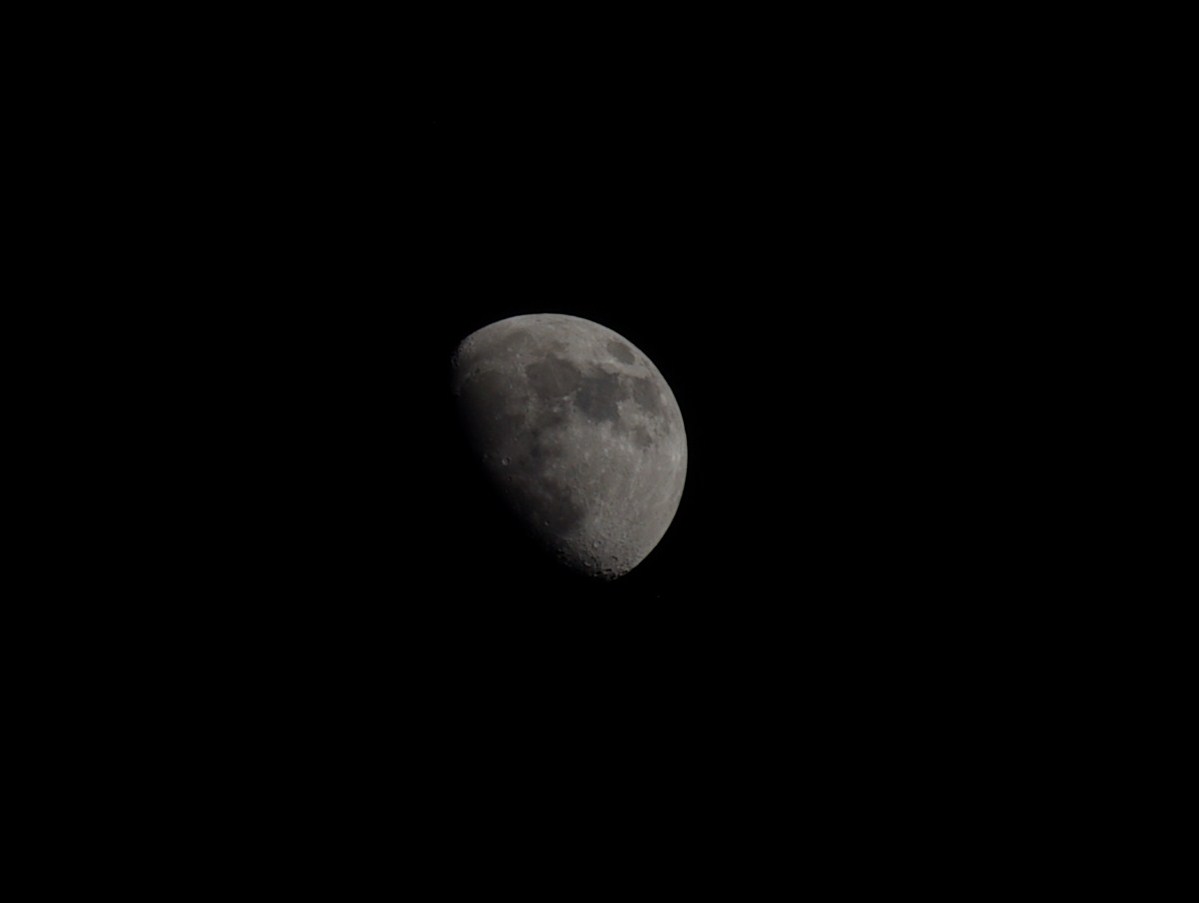
Dallas Moon, June 7, 2014; sure it’s copyrighted, but please use it with abandon.
I got a pretty good shot at the Moon back in June, considering it’s just a 200 mm telephoto, and I was shooting handheld, without the tripod. You can’t tell from the picture, but the sky was blue. One of the issues of getting a good Moon shot concerns exposure — and this time, I got the Moon right. Sky is black, but there you go. We were walking the dog.
I’ve made a lot of photographic experiments over the summer, none of which I’ve posted. I’m also fighting computer issues with both the laptop and desktop, and downloads have been uncertain. The shot above, for example, shows up in some indices, but not in others. Can’t post it if I can’t tell WordPress what to upload, you know? Who really understands computer logic?
I’ve made two trips to Colorado to visit James and Michelle. None of the photos are up yet — and there are, actually, thousands. None of the thought rambles are up, either. I got ambushed by a fellow with “the easiest political quiz in the world” while drinking beer and listening to the Bodeans in Louisville, Colorado; there’s a photo somewhere of my pointing out the errors of the guy’s quiz, and his confessions that he’s a libertarian in GOP clothing; and then there were our visits to those temples to the failures of libertarianism, including the Florissant Fossil Beds National Monument, and the Black Canyon of the Gunnison National Park and Mesa Verde N.P. Colorado libertarians live among the disasters and ruins of libertarian thought, but think and claim they are held back by the ropes their rescuers throw to them.
I hope I’ve got the streams of posts flowing again, Dear Reader. Your past patience is greatly appreciated.
Spread the word; friends don't allow friends to repeat history.
Or, until that account is unsuspended by the forces supporting Donald Trump: Follow @FillmoreWhite, the account of the Millard Fillmore White House Library
We've been soaking in the Bathtub for several months, long enough that some of the links we've used have gone to the Great Internet in the Sky.
If you find a dead link, please leave a comment to that post, and tell us what link has expired.
Thanks!
Retired teacher of law, economics, history, AP government, psychology and science. Former speechwriter, press guy and legislative aide in U.S. Senate. Former Department of Education. Former airline real estate, telecom towers, Big 6 (that old!) consultant. Lab and field research in air pollution control.
My blog, Millard Fillmore's Bathtub, is a continuing experiment to test how to use blogs to improve and speed up learning processes for students, perhaps by making some of the courses actually interesting. It is a blog for teachers, to see if we can use blogs. It is for people interested in social studies and social studies education, to see if we can learn to get it right. It's a blog for science fans, to promote good science and good science policy. It's a blog for people interested in good government and how to achieve it.
BS in Mass Communication, University of Utah
Graduate study in Rhetoric and Speech Communication, University of Arizona
JD from the National Law Center, George Washington University


 Posted by Ed Darrell






 Millard Fillmore's Bathtub