Uganda to start DDT use; funding delayed program start

January 19, 2008

New Vision, a website in Kampala, Uganda, via AllAfrica.com, notes that Uganda will start using DDT in residential spraying against mosquitoes, in February 2008.

Use of DDT would have started earlier, the article says, but for lack of money.

So, participants in the defense of wise environmental policy and Rachel Carson, against the scurrilous charges of junk science purveyors, should take note:

  1. There is no ban on use of DDT against mosquitoes, in a serious, controlled program of integrated pest management.
  2. No environmentalist is to blame for the lack of DDT use in Uganda (and probably elsewhere). As with anti-malaria programs worldwide, lack of funding or lack of organization generally is the reason for any lack of action against malaria.

Read the rest of this entry »


Park your camel, the music’s begun

January 12, 2008

As long as we’re in Mali anyway, why not arrive a couple of days early for this other music festival? Michael Kessler writes about the Festival du Chameau in the Sydney Morning Herald, “The sound of the desert blues”:

A week ago, when the doctor was jabbing me with yellow fever, polio and hepatitis shots and supplying malaria tablets, I’d tried imagining what a camel festival would look like. The Festival du Chameau [in its third year in 2008] is the brainchild of Tinariwen, the international darlings of world music – a group of Touareg nomadic musicians, purveyors of the desert blues, whose political past combined with their hypnotic electric guitars make them local heroes in this, the Adrar des Iforas region of Mali.

Toronto Globe and Mail reporter Stephanie Nolen accompanied a group of Inuit musicians to Mali, documented in a blog for the newspaper, Trail to Timbuktu; from her reports, we know the festival is underway, music is on the dunes:

There’s no down-in-front with a camel, really.

The 8th Festival in the Desert began a couple of hours ago, with several thousand people sitting and standing in the cool, white sand at the edge of the oasis at Essekane. The sun set just as the event kicked off, silhouetting robed men, veiled women and camels on all the surrounding ridges. On the small, raised stage there were speeches by notables including the local governor and Mali’s Minister of Culture.

Then the music began, with the opening provided by Tamnana, a traditional ensemble of men and women from Essekane who drum, chant, clap and ululate. They’re a big hit with the locals, and it turns out that demonstrations of musical appreciation hereabouts take the form of camel tricks. When the spirit moves them, nomads on camelback suddenly charge down from the dunes to the front of the stage, where they coax their camels down to “walk” on their front knees a much-admired feat. Or they dismount and launch sudden sword fights with phantom opponents, before swinging back up and charging the camel back and forth in front of the stage a few times. It’s the Tuareg version of the mosh pit, and it’s magical to watch, but it does tend to blot out the action on the stage.

Inuit performers in the sand at Essakane Festival, Mali, 2008 - photo by Stephanie Nolen, Toronto Globe and Mail

Inuit performers from Canada, in the sands at the Essakane Festival, Mali, 2008; photo by Stephanie Nolen, Toronto Globe and Mail.

News still travels slowly out of Mali’s desert, though. Most of the news about the Mali Festival in the Desert comes in the form of festival veterans spreading the music, in other, far-flung venuues.

Influences of the Essakane Festival of the Desert reach Salina, Kansas, where the Salina Journal talks about the music of Toubab Crewe, a group of North Caronlians who have performed at the big Mali festival in the past.

Oregon feels it, too: MacArthur Foundation grant recipient Corey Harris, a veteran bluesman whose work was featured in the PBS series on the blues, especially his work in Mali with the late Ali Farka Toure, performs at the Rogue Valley Blues Festival in Ashland, Oregon, on January 18 (that’s the Southern Oregon Mail Tribune, not Mali Tribune).

Mali, and Africa, have much more than just these few festivals. Why should we concern ourselves with the Essakane festival at all? Africa. PopMatters carries a column by journalist Mark Reynolds, reviewing events and arts in Africa in 2007, with a look to 2008. It’s a survey of events and publications, but it’s a good backgrounder for a high school student in Africa concerns, an article that should suggest connections to be made in geography, history, government and economics courses.

Thanks to Ann at Peoples Geography for the correction — Sydney Morning Herald.


Festival au Desert Essakane! January 10-12, 2008

January 10, 2008

BBC’s internet services carried this slide and sound account of the 2007 Essakane festival in far off Mali; this is one music festival I would really like to attend. Snippets of songs crop up on NPR or PRI (especially The World), and on PBS, and in record stores with really savvy staff — or where Putumayo discs are on sale. Everything I have heard from these festivals is very, very good.

Robert Plant helped make it famous with his 2003 performance. But its fame is relative; it’s famous only among a select group of people — those who have heard the music.

[Alas, Vodpod died, and the video that I had captured via that service seems to appear nowhere else on the web.  If you should find the piece by Paula Dear which the BBC broadcast in 2007, please note it in comments.]

Vodpod videos no longer available. from news.bbc.co.uk posted with vodpod

.

The festival is set for January 10-12 in 2008. Who is playing? Where are news stories? Where are the CDs? Here’s the official website.

Geography teachers, think of the possibilities this festival offers for fun in the classroom! Adam Fisher wrote about it for the New York Times a couple of years ago:

My real aim is Essakane, an obscure desert oasis a half-day’s drive beyond Timbuktu, and the site of what’s billed as the “most remote music festival in the world.” It’s a three-day Afro-pop powwow held by the Tuareg, the traditionally nomadic “blue people” of the Sahara.

It’s a tribe often feared for the banditry of its rebels and respected for the fact that it has never really been conquered. Historically its great power came from its role in the trans-Saharan trade in gold, slaves and salt. Even now, Tuareg caravans make the 15-day journey south from the northern salt mines to Timbuktu on the Niger River. They rest their camels during the day and use the stars to navigate at night. The skin tint of the nomads comes from the indigo dye they use for their turbans and robes, which leaves a permanent stain.

What more exciting stuff do you have in your classroom on the Tuareg? Does it resonate better with your teenagers than this story would?

Read the rest of this entry »


Stanton Sharp history teaching symposium at SMU, February 9

January 8, 2008

Tired of odd speakers trying to tell you about how boys learn differently from girls because of the size of the Crockus in their brain?

How about serious material to beef up your teaching: Vietnam, the Russian Revolution, Mexicans in U.S. history, Native Americans in the 20th century, use of the internet in history classes — three sessions, each with three classes to choose from.

Poster for session on Russian Revolution, Stanton Sharp Symposium at SMU, 2008

The history department at Southern Methodist University in Dallas offers solid education in serious history issues for teachers in colleges and secondary schools. The Stanton Sharp Teaching Symposium on Saturday, February 9 offers great material in nine different areas. Several of these topics seem to be pulled from the Texas Education Agency’s list of subjects that students need to do better on, for the Texas Assessment of Knowledge and Skills (TAKS).

Invitation below the fold. The $15 fee includes lunch; you may earn up to 7 hours of Continuing Education Units (CEU) credits.

(I plan to be there, and if you’re really interested in the Crockus and its scholars, I happen to have a photo of the elusive Crosley Shelvador on my cell phone — he appeared to have used one of those spray-on tanning solutions, but is otherwise real, as the photos show.)

Read the rest of this entry »


Uganda health ministry slows use of DDT against malaria

December 26, 2007

All Africa.com reports local councils in Uganda approve the use of DDT in a carefully managed integrated pest managment program where DDT is used for some indoor locations — but the Uganda health ministry slows the program.

Want to bet the Chronically-Obsessed With Rachel Carson (COWRC) will blame “environmentalists?” Three . . . two . . . one . . .


Benefits offset by infant deaths? DDT no panacea

December 10, 2007

Cover of August 2008 Emerging Infectious Diseases from the CDC, featuring: Jan Steen (c. 1625–1679). Beware of Luxury (c. 1665). Oil on canvas 105 cm x 145 cm. Kunsthistorisches Museum, Vienna, Austria

Cover of August 2008 Emerging Infectious Diseases from the CDC, featuring: Jan Steen (c. 1625–1679). Beware of Luxury (c. 1665). Oil on canvas 105 cm x 145 cm. Kunsthistorisches Museum, Vienna, Austria

Weighing risks against benefits for DDT spraying is very difficult. Anti-environmentalists and junk science purveyors claim millions of deaths from DDT’s not being sprayed.

They never tell us about the kids DDT could kill.

When we combine data from North America on preterm delivery or duration of lactation and DDE with African data on DDT spraying and the effect of preterm birth or lactation duration on infant deaths, we estimate an increase in infant deaths that is of the same order of magnitude as that from eliminating infant malaria. Therefore, the side effects of DDT spraying might reduce or abolish its benefit from the control of malaria in infants, even if such spraying prevents all infant deaths from malaria.

*   *   *   *   *

The prohibition of DDT use for malaria control was probably not the sole cause of increasing malaria burden in sub-Saharan Africa (40), and thus DDT will probably not be the sole cure for the malaria epidemic there. Insecticide-treated bed nets, widely used in African households to prevent mosquito bites, are effective (41,42). Synthetic pyrethroid insecticides, cheaper than DDT, are available (43,44). Where DDT is used, all infant deaths, plus birth weights and the duration of lactation, should be counted. Some thought could also be given to a formal trial, since the risk and benefit calculations apply to individual dwellings, and an effective alternative, namely bed nets, is available. (Chen A, Rogan WJ. Nonmalarial infant deaths and DDT use for malaria control. Emerg Infect Dis [serial online] 2003 Aug. Available from: URL: http://www.ncbi.nlm.nih.gov/pmc/articles/PMC3020610/)

Go read it — the issue of spraying or not is complex, and this study talks only about infant deaths (there may be greater life saving among older children and adults that would make the infant deaths a trade off policy makers would consider, for example). It’s a study from the Centers for Disease Control, part of a continuing series of technical publications from CDC titled Emerging Infectious Diseases. This series tracks much of the work done to fight malaria world wide.

This is valuable information. It shows the issue is much more complex that just “spray or don’t spray.” It’s also information that JunkScience.com hopes you will not pursue. It’s real information, and it refutes the junk science claims from that site.

(In June 2004 the denialists at Africa Fighting Malaria had a letter published complaining about this paper’s findings, but offering no data in rebuttal.)

Wikimedia Commons image of Jan Steen's painting,

A more clear image from Wikimedia Commons of Jan Steen’s painting, “Beware of Luxury.” Click on cover of journal at top of post for a discussion of this painting and how it relates to infectious diseases.


Praying to DDT for a miracle that DDT cannot work

November 11, 2007

Evolution denier Ray Bohlin is in Liberia telling the Liberians their salvation lies with DDT, at least in fighting malaria. Wholly apart from the theological problems of elevating a chlorinated hydrocarbon killer to the level of idolic deity, DDT can’t solve the many problems that conspire to keep Liberia in the grip of DDT as a killer of children and pregnant women.

What an odd conflict of faith and science. Bohlin is a Christian. His strong faith in DDT is a double puzzle.

[And, what is it with all this denial? Creationist/IDist/evolution deniers tend heavily to be HIV deniers as well, and global warming deniers — now DDT deniers? Have they all had close encounters of the third kind, too? Is it a virus? Is it a cult?]

Fighting malaria in Africa requires a concentrated, integrated plan that provides appropriate medical care to cure any human who contracts malaria, thus breaking a key link in the malaria cycle. Malaria kills children under 5 and pregnant women in larger percentages than other people. Bohlin correctly notes that malaria kills, and that the disease disrupts the nation’s economy. But his recommendation that Liberians increase DDT use, in the absence of an integrated pest management plan, is a prescription for dashed hopes at best, and disaster at worst.

Bohlin seems to urge junk science. DDT offers significant dangers, which Bohlin seems blithely to ignore.

Why won’t DDT help much in the fight against malaria?

Wholly apart from the inherent problems of DDT — mosquitoes develop immunity, or already are immune; DDT kills beneficial insect and arachnid predators of malaria vectors, so the mosquitoes come back in geometrically increased numbers; DDT kills the food fish of people who live on fish; DDT kills reptile, mammal and bird predators of mosquitoes, so the mosquito population roars back with increased killing efficiency — DDT cannot solve the other problems that play a greater role in frustrating the fight against malaria. DDT doesn’t treat the disease once humans catch it; DDT is just one, small tool to prevent infection, and perhaps not the most effective. Read the rest of this entry »


When do we reach the “never” in “Never again?”

November 4, 2007

You won’t find this in your world history text.

Events in Congo trouble at so many levels. Reports in The New York Times and other places document unspeakable violence: 27,000 sexual assaults in South Kivu Province in 2006, just a fraction of the total number across the nation of 66 million people. The assaults are brutal. Women assaulted are often left so badly injured internally, they may never heal.

  • Map of Congo, showing area of high violence in east, from New York Times Map of Congo, highlighting province of Bukavu where violence against women is epidemic, from New York Times

Genocide you say? Many assaults appear to be spillover from the Hutu-Tutsi conflict in next-door Rwanda. But assaults by husbands on wives also are epidemic. Result of civil war? Then how to explain the “Rasta” gang, dreadlocked fugitives who live in the forest, wear tracksuits and Los Angeles Lakers jerseys, and who commit unspeakable crimes against women and children? What nation are they from, and against whom do they fight, if anyone — and for what?

The facts cry out for action:

  • Nightly rapes of women and girls. The violence appears to be a problem across the nation.
  • Huge chunks of Congo have no effective government to even contend against the violence.
  • Killers with experience in genocide in their native Rwanda moved into Congo; they live by kidnapping women for ransom. The women are assaulted while held captive. Sometimes husbands do not take back their wives.
  • The oldest rape victim recorded by one Congo physician is 75; the youngest, 3.

Surely intervention by an international group would help, no? However

  • Congo hosts the largest single peacekeeping mission of the United Nations right now, with 17,000 troops. Congo is a big nation, bordered by nine other nations. How many troops would it take to secure the entire nation, or the entire border? No one knows.
  • 2006 saw an election that was supposed to remake history, end the violence and start Congo on the road to recovery; but was the $500 million it cost enough to change Congo’s history of a string of bad governments?
  • International attention focuses on other crises: Iraq, Afghanistan, Sudan and Darfur, Iran, Korea, Chechnya, Turkey and the Kurds, Palestine and Israel. Congo, constantly roiling since the 1960s, is way down the list of world concerns, no matter how bad the violence.

Americans looking for a quick resolution to the situation in Iraq might do well to study Congo. At Congo’s independence in the 1960s, there was hope of prosperity and greater peace. Foreign intervention, including meddling from the U.S., regional civil wars, bad government and long international neglect, ate up the hope. Achieving what a nation could be is difficult, when so many forces align to prevent it from being anything other than a violent backwater. Pandora’s box resists attempts to shut it. Quick resolution is unlikely.

So the violence in Congo continues. In this world, when is the “never” in “never again?”

How many other such cases fall outside our textbooks, and off the state tests?

Resources:


How to fight malaria – Kenya’s example

August 17, 2007

Kenya has cut malaria by nearly half. Without further comment from me, here’s the news story from Gulf Times, Doha, Qatar, and below that, from a few other sources:

Kenya nearly halves child deaths from malaria

Published: Friday, 17 August, 2007, 01:27 AM Doha Time

NAIROBI: Kenya announced yesterday that it almost halved malaria deaths among small children by using insecticidal nets (INTs), spurring the World Health Organisation (WHO) to advocate free nets for all as it tackles Africa’s deadliest disease.

Health Minister Charity Ngilu said distribution of 13.4mn INTs over the past five years among children and pregnant women had helped curtail infections, a key success against a disease threatening 40% of the world’s population.

“Childhood deaths have been reduced by 44% in high-risk districts, in-patient malaria cases and deaths are falling (and) there are reduced cases at the community level,” she said in a statement.

“For every 1,000 treated nets used, seven children who might have died of malaria are saved.”

Malaria kills 34,000 children under the age of five each year in Kenya, and threatens the lives of more than 25mn of its population of 34mn people, the ministry said.

Children sleeping under INTs in malaria risk areas are 44% less likely to die than those who are not, according to a survey carried out in four districts representing the country’s epidemiological pattern.

The government has distributed 12mn doses of artemisinin-based therapy (ACT), the latest surefire anti-malaria drug cocktail to replace the mono-therapies that had developed resistance.

In addition, some 824,600 houses in 16 epidemic-prone districts underwent indoor spraying this year.
The government and donors spent 4.7bn shillings ($70.2mn) for the campaign, yet the funds were not enough.

Ngilu said the government would freely provide 2mn treated nets annually to ward off mosquitoes at night when they are active, calling on donors to boost the blanket distribution.

“The impact we have seen and the lessons we have learnt through massively distributing INTs, rather than selectively marketing and selling them, will not only benefit Kenya’s children but all Africa’s children,” she said.

In a statement, the WHO said it had abandoned its earlier guideline of targeting only vulnerable groups – under fives and pregnant women – in favour of “making their protection immediate while achieving full coverage”.

“Recent studies have shown that by expanding the use of these nets to all people in targeted areas, increased coverage and enhanced protection can be achieved while protecting all community members.”

WHO chief Margaret Chan said that Kenya’s success “serves as a model that should be replicated throughout ‘malarious’ countries in Africa.”

“This data from Kenya ends the debate about how to deliver the long-lasting nets. No longer should the safety or well-being of your family be based upon whether you are rich or poor,” said WHO’s Global Malaria Programme director Arata Kochi.

Chan and Kochi were deriding the “social marketing” model widely backed by donors of distributing INTs by selling them at subsidised rates, even to vulnerable groups, and raising awareness of their importance.

Although supporting anti-malaria campaigns, public health watchers have chided British and US foreign development agencies for pushing for social marketing in the world’s poorest continent.

The WHO launched a global programme in 1955 to eradicate the disease that has frustrated attempts to create a vaccine owing to its constant mutations.

Using dichloro-diphenyl-trichloroethane (DDT), a powerful insecticide, and the drug chroloquine, the organisation managed to eradicated the disease in the West by the 1960s.

But the programme never got off the ground in the humid and low-lying tropics in sub-Saharan Africa where the disease persisted.

By 1969, the programme collapsed as financing withered in the face of rising poverty, political upheavals and surging opposition to DDT for misuse, not by anti-malaria campaigners, but farmers.

But Kochi said the Stockholm Convention on Persistent Organic Pollutants allowed the use of DDT in endemic countries for “public health only” and Uganda and Malawi were the only African nations keen on the chemical.

Malaria affects more than 1bn people worldwide and kills 1mn – mainly under age five – every year, the vast majority in sub-Saharan Africa. – AFP (Agence France Press) Read the rest of this entry »


Accuracy: A good bias (DDT again)

August 4, 2007

Jay Ambrose retired from editing newspapers, and now writes commentary for the Scripps News chain of papers. Because of his experience in editing, I was suprised to see his commentary from last week which takes broad, inaccurate swipes at environmental groups (here from the Evansville, Indiana, Courier & Press).

Ambrose is victim of the “DDT and Rachel Carson bad” hoax.

His column addresses bias in reporting, bias against Christians, which he claims he sees in reporting on issues of stem cell research, and bias “in favor” of environmentalists, which has resulted in a foolish reduction in the use of DDT. I don’t comment here on the stem cell controversy, though Ambrose’s cartoonish presentation of how federally-funded research works invites someone to correct its errors.

Relevant excerpts of Ambrose’s column appear below the fold, with my reply (which I have posted to the Scripps News editorial section, and in an earlier version, to the on-line version of the Evansville paper).

Read the rest of this entry »


Setting the record straight on Rachel Carson, malaria and DDT

June 19, 2007

The contemptible campaign of hoax and calumny against the work and memory of Rachel Carson continues. You should read more at the sites I cite near the end of this post.

The key false claim of the Carson critics is that, but for the ban on DDT, millions of lives would have been saved over the past 30 years. Chief problem with the claim is that national bans on DDT all preserve DDT use for essential mosquito eradication, especially if there are no other tools to fight the disease. But other problems with the claim include the fact that DDT had stopped being highly effective by the late 1960s; eradication was a pipe dream, and mosquitoes developed resistance to DDT.

That doesn’t stop the critics. So, Dear Reader, when you read criticisms of Rachel Carson and hear the pseudo-science whine that Carson alone has condemned millions to death by malaria, I want you to keep in mind this question: If DDT were such an effective tool against malaria, why didn’t the World Health Organization fight to keep it? Why didn’t the manufacturers fight to keep it? Why would more than 150 nations, tens of thousands of scientists, tens of thousands of health workers, and conservative “I-told-you-so” skeptics who hate environmentalists, all simultaneously fall asleep?

The answer is, Dear Reader, they didn’t all fall asleep. DDT stopped being effective, and malaria fighters realized there were other problems — the parasites that the mosquitoes spread also became resistant to anti-malaria drugs, a bigger problem than DDT resistance. People and organizations who fight malaria did ask that use of DDT be preserved for spraying to fight malaria; but they didn’t defend it against bans on other use because those bans help the malaria fighters.

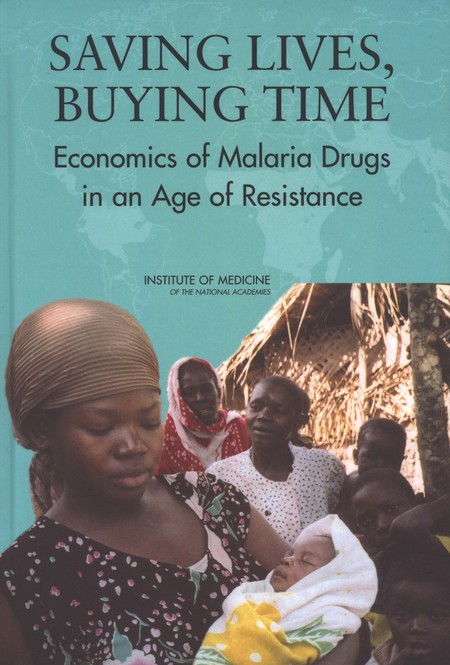
Cover of  Saving Lives, Buying Time: Economics of Malaria Drugs in an Age of Resistance (2004), from the National Academies Press

Cover of Saving Lives, Buying Time: Economics of Malaria Drugs in an Age of Resistance (2004), from the National Academies Press

Below the fold, I offer two quotes from Saving Lives, Buying Time: Economics of Malaria Drugs in an Age of Resistance (2004) Board on Global Health (BGH) (available from the National Academy of Sciences). You can see that DDT is not the golden-egg-laying goose, and that consequently Rachel Carson is not the mindless ogre she is made out to be in recent invectives.

Check out these sites:

Read the rest of this entry »


Ranan Lurie cartoon competition: Sabat, African tsunami

December 22, 2006

Most readers here are from the United States. I wager you didn’t see this cartoon when it was first published:

"Tsunami," by Alberto Sabat, La Nacion in Argentina. Winner of the Lurie-UN Cartoon award, 2007.

“Tsunami,” by Alberto Sabat, La Nacion in Argentina

This cartoon won the 2006 Ranan Lurie Award for editorial cartooning, an international competition supported by the United Nations Correspondents Association (other 2006 winners here). The title of the cartoon is “African Tsunami.”

The cartoonist is Alberto Sabat, the cartoon was published in La Nacion in Argentina. The award is named after the outstanding cartoonist Ranan Lurie, who himself was once nominated for a Nobel Peace Prize for his cartoons that promoted peace and understanding.

Political cartoons make classrooms interesting, and often provoke students to think hard and talk a lot about things they should be thinking and talking about. These links provide more sources of classroom material — please remember to note copyright information.

Tip of the old scrub brush to Reclaiming Space.

Update, December 2007: 2007 Lurie Awards announced; my post here, all the 2007 winners at the Lurie Awards site here.

Update, December 2008:  2008 awards post.

Update December 2009:  2009 awards listed here.

Share this post:

Add to FacebookAdd to NewsvineAdd to DiggAdd to Del.icio.usAdd to StumbleuponAdd to RedditAdd to BlinklistAdd to TwitterAdd to TechnoratiAdd to Furl