Very large bird

June 30, 2010

DFW Airport - Kenny Darrell leaves for Greece

Kathryn, Kenny, Kenny's grandfather Ken Knowles, under the giant wishbone at DFW Airport

Actually, he’s been in Crete now for two weeks, and he’s deep into training for how to teach.  I’m just slow on getting the posts up.

Kenny left for Greece, despite the lack of visitor facilities on either side of the TSA checkpoints, we all went along for the ride and the farewell, Kathryn, Kathryn’s father Ken Knowles, and I.  Airport art and history displays always fascinate me — there are some great pieces hidden away in U.S. airports.  Sometimes the airlines even spring to pay for the stuff (I wonder how much this thing cost).

A great place for a photo of a family  wishing someone bon voyage. A wishbone, how appropriate.  Was this just a coincidence, or is it a little, pricey arty joke?  “Silver bird.”  Oh.  Right.

It’s metal.  I think it’s the wishbone of a Boeing 767.

Kenny leaves for Greece - detail - IMGP2085

Kenny Darrell and his grandfather, Ken Knowles; DFW Airport, under the giant wishbone -- Kathryn snapping a shot at the right.

Bon voyage, Kenny!

Terry Allen sculpture, Wish, 2005 (DFW Airport)

Terry Allen sculpture, Wish, 2005 (DFW Airport)

More:


Educating for a creative society

June 29, 2010

Just as a reminder about what we’re doing in education, I hope every teacher and administrator will take three minutes and view this video (that allows you some time to boggle).

Surely you know who Tom Peters is.  (If not, please confess in comments, and I’ll endeavor to guide you to the information you need.)

Technically, Texas’s early elementary art standards are not so bad as Peters describes them.  But, check this document, from the Texas Education Code (§117.1. Implementation of Texas Essential Knowledge and Skills for Fine Arts, Elementary).  Do a search of the Texas standards and count how many times students are expected to stay “within guidelines.”


Typewriter of the moment: Jerry Lewis’s pantomime typewriter (with Leroy Anderson)

May 22, 2010

Ms. Fox’s class had a great time with this video — easy to see why, no?

From “Who’s Minding the Store,” a 1963 Paramount release.

I would have sworn I had a post on Leroy Anderson, but it’s not there to link to; you can check him out on PBS, though.  Another good topic to explore, an oversight to amend.

Jerry Lewis’s pantomime typewriter, always with the Leroy Anderson tune behind it, was one of his most famous comedic routines.  It was very popular in Europe, in both Germany and France.  It’s easy to translate.

Tip of the old scrub brush to Ms. Fox.


Wildflower Monday: Calfornia poppies

May 17, 2010

California poppies, near Bitter Creek - photo by Amanda Holland

California poppies, near Bitter Creek - photo by Amanda Holland

Kathryn got stuck in traffic on Spur 408 Friday evening.  She happily reported that a few bluebonnets remain, covered by now-taller grasses.  We’re in the seventh week of our Texas wildflower panorama.

But Amanda Holland’s shot of California poppies in the wild hills near Bitter Creek caught my eye.  Amanda’s out saving birds — the best photos of the wild almost always come while you’re on the way to do great stuff, I think.  That’s a good reason to find a job that gets you out of doors, and into the wild.

Notice that, even in the wild, in near-wilderness, there are still signs of human actions.  See the contrails?


Thinking of Banksy

May 12, 2010

There’s the relatively new movie.  There’s the news from Toronto.  There’s the real stuff:

"Indoor" art from Banksy - the Flower Chucker 2

"Indoor" art from Banksy - the Flower Chucker 2 (give the guy credit -- can his kind of art be copyrighted, or just never stolen?)


Colleague’s Fulbright-Hays trip to Senegal

April 26, 2010

One of my colleagues — an art teacher; you know, the adventurous type — heads off to Senegal this summer on a Fulbright-Hays program.

I’m sorta jealous, of course.  I need time to push our history course to championship level, though — I didn’t apply for anything this summer.

You can track Mr. Adkins’ trip and progress at a blog he’s set up, appropriately called Mr. Adkins’ Great Adventure in Senegal.

If you’re teaching world history, or art, or government, or environmental science, or geography, this might be a great blog to track.

Senegal is a very interesting place.  Note on the map how it completely surrounds its neighbor nation of The Gambia.

FAA map of Senegal

Senegal, map courtesy of the U.S. Federal Aviation Administration (FAA)

France held the nation as a colony once upon a time, from 1850 to independence of the Mali Federation in 1960 — one of the national languages is French, but regional languages are numerous, Wolof, Soninke, Seereer-Siin, Fula, Maninka, and Diola.  The Mali Federation was short-lived, and Senegal broke off in August of 1960.

If you listen to NPR, you’ve probably heard their reporter signing off in that distinct way she does, “Tthis is Ofeibea Quist-Arcton, for NPR, in Dah-KAHHH!”  (Not to be confused with Dacca, Pakistan).

According to the CIA Factbook (online version):

The French colonies of Senegal and the French Sudan were merged in 1959 and granted their independence as the Mali Federation in 1960. The union broke up after only a few months. Senegal joined with The Gambia to form the nominal confederation of Senegambia in 1982, but the envisaged integration of the two countries was never carried out, and the union was dissolved in 1989. The Movement of Democratic Forces in the Casamance (MFDC) has led a low-level separatist insurgency in southern Senegal since the 1980s, and several peace deals have failed to resolve the conflict. Nevertheless, Senegal remains one of the most stable democracies in Africa. Senegal was ruled by a Socialist Party for 40 years until current President Abdoulaye WADE was elected in 2000. He was reelected in February 2007, but has amended Senegal’s constitution over a dozen times to increase executive power and weaken the opposition, part of the President’s increasingly autocratic governing style. Senegal has a long history of participating in international peacekeeping and regional mediation.

The country is tropical, hot and humid.  Geographically, it is low, rolling plains.

Dakar is about as far west as one can go on the African continent.   (See the map inset — Senegal is in dark green).

Senegal has iron ores, and phosphorus (ancient bird droppings?).  It’s not a rich nation, but it’s better off than many developing countries.

Adkins is in for a great adventure, no?

Africa, showing Senegal - CIA Factbook

Africa, showing Senegal - CIA Factbook


Friday Fox, and Go vote! Defenders of Wildlife photo contest

April 2, 2010

Friday Fox will not be a regular feature — but, Wow! isn’t that a great photo?

Unless you’re the mouse.

Ron Charest photo of a red fox in the Bombay Hook National Wildlife Refuge (Delaware) - Defenders of Wildlife

Ron Charest photo of a red fox in the Bombay Hook National Wildlife Refuge (Delaware) - Defenders of Wildlife

Defenders of Wildlife called for entries for the 2010 wildlife and wilderness photography contest.  They got more than 10,000 entries, and they’ve got the top 10.  They want you to vote for the best one.  The photo above is just one of the spectacular nominees.

I predict one of the photos featuring animals will win, but the wild lands photos are great, too.

You may vote for three.  Voting ends Sunday, April 4, 2010.

Go see.  Go vote


Finch meets guitar

March 17, 2010

Totally safe for work (in that way), but you may want to turn down your sound, unless you work with a lot of Hendrix fans.

Hey, I’ve used weird things for picks, too.

Tip of the old scrub brush to Happy Jihad’s House of Pancakes.


Computer-aided study of the Venus de Milo

February 27, 2010

Oh, sure, it’s on the web more as advertising for Konica/Minolta.  But it’s still cool.

Close-up of arm of Venus de Milo - Wikimedia image

So-called “Venus de Milo” (Aphrodite from Melos), detail of the upper block: join surface of the right upper arm, with mortise; attachment holes, which probably bore a metal armlet; strut hole above the navel, now covered with plaster. Parian marble, ca. 130-100 BC? Found in Melos in 1820. Wikimedia image

Konica/Minolta scanned the Venus de Milo in great detail, and they have put up a Flash multimedia piece exploring the creation of the piece, techniques of sculptors of the time, and, most interesting to most of us, just what the piece was supposed to look like with her arms.

If your school district is nipple intolerant, don’t send your kids there.  If you have AP World History, your kids might benefit from seeing Konica/Minolta’s comments and study — you can check it all out in less than ten minutes.


Buddy Guy’s Legends will move: Will Mount Bluesmore move, too?

February 11, 2010

Chicago blues legend Buddy Guy is moving his club, Buddy Guy’s Legends.  Guy’s club announced the move last September.

Buddy Guy's Legends, Today's Chicago Blues image

Buddy Guy's Legends, image from Today's Chicago Blues

We visited the club four years ago during the giant Midwest Clinic, where Duncanville’s Wind Ensemble debuted a tribute to Rosa Parks just a few days after her death (Samuel R. Hazo’s “Today Is the Gift”) and *spent a memorable evening going slightly deaf to the Kinsey Report.

Following federal law on how blues club should be, the walls tell stories of blues past, blues well-remembered, good blues players who visited, and stories of blues in general.  A neophyte can get a good education just looking at the walls in a good club.  One wall wore a painting of what could have been Mount Rushmore, which piqued my history radar — but in place of Washington, Jefferson, Teddy Roosevelt and Lincoln, it had Chicago blues legends:  Muddy Waters, Sonny Boy Williamson, Little Walter, and Howlin’ Wolf.

Who knows the history of the image?  Did Buddy Guy hire it done?  Did someone do it as a serious tribute?  Was it an image done for a show in the distant past, just pasted onto the wall?

When I heard the club was moving, I feared for the thing, especially since I was not digital at the time and didn’t get a photo of it.  To my shock, I couldn’t find any images on the internet.

Then a couple of days ago I ran across a version of the the image, at Today’s Chicago Blues.  It’s appropriately called “Mount Bluesmore.”

But the same question remains:  Will it be saved with the new venue?

Mount Bluesmore, at Buddy Guy's Legends, Chicago - image from Today's Chicago Blues

Mount Bluesmore, at Buddy Guy's Legends, Chicago - image from Today's Chicago Blues

Tip of the old scrub brush to Today’s Chicago Blues — go buy the book.

The Kinsey Report:

*  This isn’t blues, below, but it’s worth a listen; I believe it may even be Duncanville’s premiere of Hazo’s tribute to Rosa Parks — alas, without video of the band, and lacking a little on the bass end but otherwise showing off the Wind Ensemble’s performance flair:


Stained glass Scouting: Grand Canyon Council offices, Phoenix

February 11, 2010

Did I remember to tell you Scouting celebrates 100 years in the U.S. this year?

Stained glass Scout fleur de lis, Grand Canyon Council, B.S.A., offices, Phoenix (Decor to Adore photo)

Stained glass Scout fleur de lis, Grand Canyon Council, B.S.A., offices, Phoenix (Decor to Adore photo)

More photos of Grand Canyon Council, B.S.A., offices, at Decor to Adore.


Stained glass Boy Scouting: Torrington, Connecticut

February 8, 2010

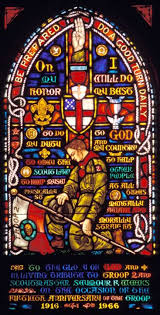
In honor of Scouting’s 100 years in the U.S., I call your attention to the stained glass window in Trinity Episcopal Church in Torrington, Connecticut, The Boy Scout Window:

The Boy Scout Window, Trinity Church, Torrington, Connecticut

Described at the church’s website:

This is one of Trinity’s most well-known windows.

It was dedicated on Boy Scout Sunday, 13 February 1966, a service of Morning Prayer that began with the hymn “We Thank You, Lord of Heaven.” The window was given “to the Glory of God and in living tribute to Troop 2 and Seymour F. Weeks on the 50th anniversary of the Troop, 1916-1966.”

Mr. Weeks had been scoutmaster of Troop 2 since 1934 and would continue to lead the troop until his death in 1967.

Troop 2 produced Torrington’s first Eagle Scout, Paul Pfistner, whose family donated another window at Trinity Church.

Behind the kneeling scout with the flag is the seal of the Episcopal Church and above that a hand raised in the scout hand sign. Flanking the Episcopal seal are the emblems of the First Class Scout and the Eagle Scout badge. The words of the Boy Scout oath form the background. The border is composed of ropes showing some of the knots Scouts must learn. In between the ropes are two of the Scout’s mottoes: Do a Good Turn Daily, and Be Prepared.

Obviously, this window does not follow the architect’s pictorial plan for a window here showing the Holy Family with Jesus as a child.

Although several of Trinity’s windows were made by Len Howard of Kent, CT, one of Mr. Howard’s former associates is nearly positive this window was not made by Mr. Howard. However, a current parishioner’s great uncle, who was on the vestry in 1966, recalls that the church was dealing with an artist in Kent, CT, and there were no other stained glass artists in Kent except for Len Howard. Until further proof one way or another, this window will be attributed to Len Howard of Kent.

To the best of my searching, Troop 2 appears to have vanished from Torrington.

Add to FacebookAdd to NewsvineAdd to DiggAdd to Del.icio.usAdd to StumbleuponAdd to RedditAdd to BlinklistAdd to TwitterAdd to TechnoratiAdd to Furl


Baltimore ponders where to put bust of Frank Zappa, symbol of freedom

December 29, 2009

Ending the Cold War brought no end of benefits to the U.S., including Baltimore’s little civic problem:  Where should Baltimore put a bust of Frank Zappa, donated by Lithuanians to his birth city in honor of his standing for freedom?

Frank Zappa bust, donated by Lithuanians, to City of Baltimore - Baltimore Sun photo

Striking bust of Frank Zappa donated to the City of Baltimore by Lithuanians, in honor of Zappa's representing freedom to Lithuanians during the Cold War

More than a year ago, Baltimore accepted a bust of Baltimore native Frank Zappa. Valued at $50,000, the bust was a gift from a Lithuanian Zappa fan club.

Since then, officials have been debating where to put it.

Why Zappa?  Why Baltimore?

His family lived in the 4600 block of Park Heights Ave., then moved to Edgewood in Harford County. Zappa’s father, a chemist and mathematician, had a job nearby at Aberdeen Proving Ground. They moved to California when Frank was 10.

Until they met last night, some members of the Baltimore Public Art Commission, which voted unanimously to accept the gift of the bronze sculpture – valued at about $50,000 – were also unaware of Zappa’s connection to Charm City.

However, the donors of the bust, who come from much farther afield – in fact, from a nation Zappa never visited – are well aware of his background.

“We’re honored to have a chance to present this Frank Zappa monument to the city of Baltimore,” said Saulius Paukstys, 43, the president of one of the biggest and arguably most dedicated Frank Zappa fan clubs in, of all places, the Republic of Lithuania. “As an artist, and much more than that, he has meant a great deal to the Lithuanian people.”

If Zappa has been something of an unknown prophet in his own land, people like Paukstys, a photographer, have long held him in high regard as a symbol of free expression in the post-Cold War former Soviet bloc.

“Before 1990, you have to remember, [Lithuanians] could not criticize society,” Paukstys said through an interpreter. “Frank Zappa was a voice of freedom.”

After 1990, when Western music became available in their home country, Paukstys and friends like Saulius Pilinkus, an art historian, often gathered to listen to Zappa’s music. The fan club they started eventually numbered more than 300. Most were well-educated aesthetes who appreciated the fact that Zappa was more than a rock-and-roll star: He was a symphonic composer, a fact that appealed to a people whose love of classical music is part of their history.

Zappa’s followers number in the millions in the U.S.  People who don’t see eye-to-eye on much of anything else agree on Zappa’s genius.  Even old sobersides California Judge Ben Davidian is a Zappa fan.  (He was especially fond of Zappa’s deeply philosophical question about a Salt Lake City fan’s letter:  “Suzy Creamcheese, what’s gotten into you?”)

Zappa’s bust will be one more very good reason to visit Baltimore, in addition to crab cakes, Babe Ruth’s house, the C&O Museum and Sabatino’s.


Who invented Santa Claus? Who really wrote the “Night Before Christmas?”

December 7, 2009

An encore post from 2007

Thomas Nast invented Santa Claus? Clement C. Moore didn’t write the famous poem that starts out, “‘Twas the night before Christmas, and all through the house . . . ?”

The murky waters of history from Millard Fillmore’s Bathtub soak even our most cherished ideas and traditions.

But isn’t that part of the fun of history?

Santa Claus delivers to Union soldiers, "Santa Claus in Camp" - Thomas Nast, Harper's Weekly, Jan 3, 1863
Thomas Nast’s first published drawing featuring Santa Claus; for Harper’s Weekly, “A Journal of Civilization,” January 3, 1863 Nast portrayed the elf distributing packages to Union troops: “Santa Claus in camp.” Nast (1840-1904) was 23 when he drew this image.

Yes, Virginia (and California, too)! Thomas Nast created the image of Santa Claus most of us in the U.S. know today. Perhaps even more significant than his campaign against the graft of Boss Tweed, Nast’s popularization of a fat, jolly elf who delivers good things to people for Christmas makes one of the great stories in commercial illustration. Nast’s cartoons, mostly for the popular news publication Harper’s Weekly, created many of the conventions of modern political cartooning and modeled the way in which an illustrator could campaign for good, with his campaign against the graft of Tammany Hall and Tweed. But Nast’s popular vision of Santa Claus can be said to be the foundation for the modern mercantile flurry around Christmas.

Nast is probably ensconced in a cartoonists’ hall of fame. Perhaps he should be in a business or sales hall of fame, too.  [See also Bill Casselman’s page, “The Man Who Designed Santa Claus.]

Nast’s drawings probably drew some inspiration from the poem, “Account of a Visit from St. Nicholas,” traditionally attributed to Clement C. Moore, a New York City lawyer, published in 1822. The poem is among the earliest to describe the elf dressed in fur, and magically coming down a chimney to leave toys for children; the poem invented the reindeer-pulled sleigh.

Modern analysis suggests the poem was not the work of Moore, and many critics and historians now attribute it to Major Henry Livingston, Jr. (1748-1828) following sleuthing by Vassar College Prof. Don Foster in 2000. Fortunately for us, we do not need to be partisans in such a query to enjoy the poem (a complete copy of which is below the fold).

The Library of Congress still gives Moore the credit. When disputes arise over who wrote about the night before Christmas, is it any wonder more controversial topics produce bigger and louder disputes among historians?

Moore was not known for being a poet. The popular story is that he wrote it on the spur of the moment:

Moore is thought to have composed the tale, now popularly known as “The Night Before Christmas,” on December 24, 1822, while traveling home from Greenwich Village, where he had bought a turkey for his family’s Christmas dinner.

Inspired by the plump, bearded Dutchman who took him by sleigh on his errand through the snow-covered streets of New York City, Moore penned A Visit from St. Nicholas for the amusement of his six children, with whom he shared the poem that evening. His vision of St. Nicholas draws upon Dutch-American and Norwegian traditions of a magical, gift-giving figure who appears at Christmas time, as well as the German legend of a visitor who enters homes through chimneys.

Again from the Library of Congress, we get information that suggests that Moore was a minor celebrity from a well-known family with historical ties that would make a good “connections” exercise in a high school history class, perhaps (”the link from Aaron Burr’s treason to Santa Claus?”): (read more, below the fold)

Clement Moore was born in 1779 into a prominent New York family. His father, Benjamin Moore, president of Columbia University, in his role as Episcopal Bishop of New York participated in the inauguration of George Washington as the nation’s first president. The elder Moore also administered last rites to Alexander Hamilton after he was mortally wounded in a tragic duel with Aaron Burr.

A graduate of Columbia, Clement Moore was a scholar of Hebrew and a professor of Oriental and Greek literature at the General Theological Seminary in Manhattan. [See comment from Pam Bumsted below for more on Moore.] He is said to have been embarrassed by the light-hearted verse, which was made public without his knowledge in December 1823. Moore did not publish it under his name until 1844.

Tonight, American children will be tucked in under their blankets and quilts and read this beloved poem as a last “sugarplum” before slipping into dreamland. Before they drift off, treat them to a message from Santa, recorded by the Thomas Edison Company in 1922.

Santa Claus Hides in Your Phonograph
By Arthur A. Penn, Performed by Harry E. Humphrey.
Edison, 1922.
Coupling date: 6/20/1922. Cutout date: 10/31/1929.
Inventing Entertainment: The Motion Pictures and Sound Recordings of the Edison Companies

Listen to this recording (RealAudio Format)

Listen to this recording (wav Format, 8,471 Kb)

But Henry Livingston was no less noble or historic. He hailed from the Livingtons of the Hudson Valley (one of whose farms is now occupied by Camp Rising Sun of the Louis August Jonas Foundation, a place where I spent four amazing summers teaching swimming and lifesaving). Livingston’s biography at the University of Toronto site offers another path for a connections exercise (”What connects the Declaration of Independence, the American invasion of Canada, the famous poem about a visit from St. Nick, and George W. Bush?”):

Henry Livingston Jr. was born in Poughkeepsie, New York, on Oct. 13, 1748. The Livingston family was one of the important colonial and revolutionary families of New York. The Poughkeepsie branch, descended from Gilbert, the youngest son of Robert Livingston, 1st Lord of Livingston Manor, was not as well off as the more well-known branches, descended from sons Robert and Philip. Two other descendants of Gilbert Livingston, President George Walker Herbert Bush and his son, President-Elect George W. Bush, though, have done their share to bring attention to this line. Henry’s brother, Rev. John Henry Livingston, entered Yale at the age of 12, and was able to unite the Dutch and American branches of the Dutch Reformed Church. At the time of his death, Rev. Livingston was president of Rutgers University. Henry’s father and brother Gilbert were involved in New York politics, and Henry’s granduncle was New York’s first Lt. Governor. But the law was the natural home for many of Henry’s family. His brother-in-law, Judge Jonas Platt, was an unsuccessful candidate for governor, as was his daughter Elizabeth’s husband, U.S. Supreme Court Justice Smith Thompson. Henry’s grandson, Sidney Breese, was Chief Justice of the Illinois Supreme Court.

Known for his encyclopedic knowledge and his love of literature, Henry Livingston was a farmer, surveyor and Justice of the Peace, a judicial position dealing with financially limited criminal and civil cases. One of the first New Yorkers to enlist in the Revolutionary Army in 1775, Major Henry Livingston accompanied his cousin’s husband, General Montgomery, in his campaign up the Hudson River to invade Canada, leaving behind his new wife, Sarah Welles, and their week-old baby, on his Poughkeepsie property, Locust Grove. Baby Catherine was the subject of the first poem currently known by Major Livingston. Following this campaign, Livingston was involved in the War as a Commissioner of Sequestration, appropriating lands owned by British loyalists and selling them for the revolutionary cause. It was in the period following Sarah’s early death in 1783, that Major Livingston published most of his poems and prose, anonymously or under the pseudonym of R. Ten years after the death of Sarah, Henry married Jane Patterson, the daughter of a Dutchess County politician and sister of his next-door neighbor. Between both wives, Henry fathered twelve children. He published his good-natured, often occasional verse from 1787 in many journals, including Political Barometer, Poughkeepsie Journal, and New-York Magazine. His most famous poem, “Account of a Visit from St. Nicholas,” was until 2000 thought to have been the work of Clement Clarke Moore (1779-1863), who published it with his collected poems in 1844. Livingston died Feb. 29, 1828.

More on Henry Livingston and his authorship of the Christmas poem here.

Thomas Nast, Merry Old Santa Claus, Harper's Weekly, Jan 1, 1881

Our views of Santa Claus owe a great deal also to the Coca-Cola advertising campaign. Coca-Cola first noted Santa’s use of the drink in a 1922 campaign to suggest Coke was a year-round drink (100 years after the publication of Livingston’s poem). The company’s on-line archives gives details:

In 1930, artist Fred Mizen painted a department store Santa in a crowd drinking a bottle of Coke. The ad featured the world’s largest soda fountain, which was located in the department store of Famous Barr Co. in St. Louis, Mo. Mizen’s painting was used in print ads that Christmas season, appearing in The Saturday Evening Post in December 1930.

1936 Coca-Cola Santa cardboard store display

  • 1936 Coca-Cola Santa cardboard store display

Archie Lee, the D’Arcy Advertising Agency executive working with The Coca-Cola Company, wanted the next campaign to show a wholesome Santa as both realistic and symbolic. In 1931, The Coca-Cola Company commissioned Michigan-born illustrator Haddon Sundblom to develop advertising images using Santa Claus — showing Santa himself, not a man dressed as Santa, as Mizen’s work had portrayed him.
1942 original oil painting - 'They Remembered Me'

  • 1942 original oil painting – ‘They Remembered Me’

For inspiration, Sundblom turned to Clement Clark Moore’s 1822 poem “A Visit From St. Nicholas” (commonly called “‘Twas the Night Before Christmas”). Moore’s description of St. Nick led to an image of Santa that was warm, friendly, pleasantly plump and human. For the next 33 years, Sundblom painted portraits of Santa that helped to create the modern image of Santa — an interpretation that today lives on in the minds of people of all ages, all over the world.

Santa Claus is a controversial figure. Debates still rage among parents about the wisdom of allowing the elf into the family’s home, and under what conditions. Theologians worry that the celebration of Christmas is diluted by the imagery. Other faiths worry that the secular, cultural impact of Santa Claus damages their own faiths (few other faiths have such a popular figure, and even atheists generally give gifts and participate in Christmas rituals such as putting up a decorated tree).

For over 100 years, Santa Claus has been a popular part of commercial, cultural and religious life in America. Has any other icon endured so long, or so well?

________________________
Below:
From the University of Toronto Library’s Representative Poetry Online

Major Henry Livingston, Jr. (1748-1828)

Account of a Visit from St. Nicholas

1 ‘Twas the night before Christmas, when all thro’ the house,
2 Not a creature was stirring, not even a mouse;
3 The stockings were hung by the chimney with care,
4 In hopes that St. Nicholas soon would be there;
5 The children were nestled all snug in their beds,
6 While visions of sugar plums danc’d in their heads,
7 And Mama in her ‘kerchief, and I in my cap,
8 Had just settled our brains for a long winter’s nap –
9 When out on the lawn there arose such a clatter,
10 I sprang from the bed to see what was the matter.
11 Away to the window I flew like a flash,
12 Tore open the shutters, and threw up the sash.
13 The moon on the breast of the new fallen snow,
14 Gave the lustre of mid-day to objects below;
15 When, what to my wondering eyes should appear,
16 But a miniature sleigh, and eight tiny rein-deer,
17 With a little old driver, so lively and quick,
18 I knew in a moment it must be St. Nick.
19 More rapid than eagles his coursers they came,
20 And he whistled, and shouted, and call’d them by name:
21 “Now! Dasher, now! Dancer, now! Prancer, and Vixen,
22 “On! Comet, on! Cupid, on! Dunder and Blixem;
23 “To the top of the porch! to the top of the wall!
24 “Now dash away! dash away! dash away all!”
25 As dry leaves before the wild hurricane fly,
26 When they meet with an obstacle, mount to the sky;
27 So up to the house-top the coursers they flew,
28 With the sleigh full of Toys — and St. Nicholas too:
29 And then in a twinkling, I heard on the roof
30 The prancing and pawing of each little hoof.
31 As I drew in my head, and was turning around,
32 Down the chimney St. Nicholas came with a bound:
33 He was dress’d all in fur, from his head to his foot,
34 And his clothes were all tarnish’d with ashes and soot;
35 A bundle of toys was flung on his back,
36 And he look’d like a peddler just opening his pack:
37 His eyes — how they twinkled! his dimples how merry,
38 His cheeks were like roses, his nose like a cherry;
39 His droll little mouth was drawn up like a bow.
40 And the beard of his chin was as white as the snow;
41 The stump of a pipe he held tight in his teeth,
42 And the smoke it encircled his head like a wreath.
43 He had a broad face, and a little round belly
44 That shook when he laugh’d, like a bowl full of jelly:
45 He was chubby and plump, a right jolly old elf,
46 And I laugh’d when I saw him in spite of myself;
47 A wink of his eye and a twist of his head
48 Soon gave me to know I had nothing to dread.
49 He spoke not a word, but went straight to his work,
50 And fill’d all the stockings; then turn’d with a jerk,
51 And laying his finger aside of his nose
52 And giving a nod, up the chimney he rose.
53 He sprung to his sleigh, to his team gave a whistle,
54 And away they all flew, like the down of a thistle:
55 But I heard him exclaim, ere he drove out of sight –
56 Happy Christmas to all, and to all a good night.

Online text copyright © 2005, Ian Lancashire for the Department of English, University of Toronto. Published by the Web Development Group, Information Technology Services, University of Toronto Libraries. Be sure to visit this site for more information on this poem, on Maj. Livingston, and on poetry in general.


Gilbert and Sullivan meet George Lucas: A Grievous “Modern Major General”

November 15, 2009

A friend wrote about enjoying a production of “Pirates of Penzance” at Oregon State.  I looked for YouTube versions . . .

Oh, my!

(Better:  Rent one of the movies, either of D’Oyly Carte, or the Linda Ronstadt/Rex Smith/Kevin Kline version.)