Video from my council, Circle 10, in and around Dallas, Texas:
Interestingly, I’ve not seen the video before I found it on YouTube. Have I just missed chances, or has it not been promoted as well as it should have been?
Video from my council, Circle 10, in and around Dallas, Texas:
Interestingly, I’ve not seen the video before I found it on YouTube. Have I just missed chances, or has it not been promoted as well as it should have been?
 2 Comments |
  Boy Scouts of America, Dropouts, Ethics, Leadership | Tagged: Boy Scouts of America, Circle 10 Council BSA, Denzel Long, film, Scout recruiting, Texas, video |
  Permalink
 Posted by Ed Darrell
Interesting recruiting film for the Daniel Webster Council, BSA (New Hampshire).
More councils should spend a little more effort filming the reasons to join, I think — and put the films on YouTube.
Do you know of other good Scout recruiting videos — Boy Scouts, Girl Scouts or Campfire?
1 Comment | Adventure, Boy Scouts of America, Girl Scouts, Leadership, Video and film | Tagged: Boy Scouts of America, Daniel Webster Council BSA, film, Join Scouting, video | Permalink
Posted by Ed Darrell
First I’ve heard of this film: “759: Boy Scouts of Harlem,” a film by Jake Boritt and Justin Szlasa.
Have you seen it?
2010 is the 100th anniversary of Scouting in the U.S. This film is not officially a part of that celebration — but expect to see more like it. This film was produced independently, with approval from one Scout council, but entirely independent from Scouting otherwise.
Would this make a good recruiting device for your troop? Why or why not?
Perhaps one of the Scouts in your troop, working on the cinematography merit badge, might be inspired to make a film like this about your troop.
Resources:
3 Comments | Boy Scouts of America, Ethics, Leadership, Learning, Life, Outdoor Recreation, Urbanization, Video and film | Tagged: Boy Scouts of America, Ethics, film, Leadership, Troop 759 in Harlem, video | Permalink
Posted by Ed Darrell
Press release from the malaria-fighting group Nothing But Nets:
Nothing But Nets Teams Up With Boy Scouts of America to Fight Malaria
Boy Scouts of America Celebrate 100 Years of Service by Extending Reach Outside Nation’s Borders; Millions of Scouts Across the U.S., including Distinguished Eagle Scout Bill Gates Sr., Spread the Word on Malaria Prevention.
Detroit, MI (Vocus/PRWEB ) August 28, 2009 — The United Nations Foundation’s Nothing But Nets, a grassroots campaign to prevent malaria by sending long-lasting insecticide-treated nets to families in Africa, announced today that the Boy Scouts of America has joined the malaria-prevention campaign as part of its 100th Anniversary Celebration. Throughout the year, Scouts from around the country will work within their communities to raise awareness about malaria, a leading killer in Africa.
BSA Chief Scout Executive Bob Mazzuca and Nothing But Nets Director Adrianna Logalbo launched the life-saving partnership today during a malaria workshop at Detroit Edison Public School Academy. Bill Gates Sr., Distinguished Eagle Scout and co-chair of the Bill & Melinda Gates Foundation, The Honorable Dave Bing, Mayor of Detroit and Deron Washington of the NBA’s Detroit Pistons, joined Mazzuca and Logalbo at the workshop to teach more than 65 local Scouts about malaria and how to help prevent the deadly disease.
“Every single day, in almost every community across the nation, Scouts are doing their part to make this world a better place by becoming good citizens. But our concern for others doesn’t stop at our borders. We are global citizens,” Mazzuca said. “Even during a challenging economic recession, it’s hard to imagine that nearly 3,000 people die every day from a preventable disease like malaria. We’re pleased to work with the UN Foundation’s Nothing But Nets campaign to help make a positive difference for the children in Africa.”
The Boy Scouts of America joined the Nothing But Nets campaign as part of its newly launched A Year of Celebration, A Century of Making a Difference program, one of eight major engagement programs the organization is undertaking as part of its 100th Anniversary Celebration. A Year of Celebration is a recognition program that rewards Scouts, leaders, and BSA alumni for devotion to five of Scouting’s core values: leadership, character, community service, achievement, and the outdoors. For the Year of Celebration service award, Scouts can choose to participate in the Nothing But Nets service project.
“We are pleased to partner with the Boy Scouts of America and see hundreds of youth leaders work together to raise malaria awareness and spread the message of how simple it is to prevent the disease,” Logalbo said. “This initiative is powered by passionate people, and we are grateful to have the Boy Scouts help us build support to prevent malaria in Africa.”
Through this partnership with Nothing But Nets, Scouts will help build awareness about malaria and prevention by conducting service projects such as removing standing water in parks–a breeding ground for mosquitoes–and creating educational tools and activities that illustrate the impact of malaria on the global community.
The Bill & Melinda Gates Foundation has been a partner of the UN Foundation and its Nothing But Nets campaign since 2006 and is dedicated to eliminating malaria deaths. “It is wonderful to watch the Scouts reach out to help other young children in Africa,” Bill Gates Sr. said. “I am proud of the Boy Scouts’ dedication to service and welcome another great partner in the fight against malaria.”
Long-lasting, insecticide-treated bed nets are an easy and cost-effective method to help prevent malaria. Bed nets prevent malaria transmission by creating a protective barrier against mosquitoes at night, when the vast majority of transmissions occur. For more information about Nothing But Nets, visit www.NothingButNets.net.
About Nothing But Nets:
Nothing But Nets is a global, grassroots campaign to save lives by preventing malaria, a leading killer of children in Africa. Inspired by sports columnist Rick Reilly, more than 100,000 people have joined the campaign that was created by the United Nations Foundation in 2006. Founding campaign partners include the National Basketball Association’s NBA Cares, the people of The United Methodist Church, and Sports Illustrated. It costs just $10 to provide a long-lasting, insecticide-treated bed net to prevent this deadly disease. Visit www.NothingButNets.net to send a net and save a life.About the Boy Scouts of America:
Serving nearly 4.1 million youth between the ages of 7 and 20, with more than 300 councils throughout the United States and its territories, the BSA is the nation’s foremost youth program of character development and values-based leadership training. The Scouting movement is composed of 1.2 million volunteers, whose dedication of time and resources has enabled the BSA to remain the nation’s leading youth-service organization. For more information on the BSA, please visit www.scouting.org.More information about 100 Years of Scouting can be found at www.scouting.org/100years.
Press Contacts:
For media inquiries regarding the United Nations Foundation’s Nothing But Nets, contact:
Amy DiElsi
Communications Director, Children’s Health
(o) 202-419-3230 (c) 202-492-3078For media inquiries regarding the Boy Scouts of America, contact
Nicole Selinger
(o) 314-982-0573 (c) 314-805-2165
Leave a Comment » | Africa, Boy Scouts of America, Disease, Green Politics, Health care, Malaria, medicine, United Nations | Tagged: Africa, Boy Scouts of America, Disease, Malaria, medicine, Nothing But Nets, United Nations | Permalink
Posted by Ed Darrell
So far I’ve been able to learn that Joe Bruni is a firefighter. Beyond that, I don’t know much other than his YouTube series on flag etiquette is very good — not perfect, but very, very good.
In this episode he talks about carrying a flag. I wish he’d discussed it in terms of a flag ceremony, but he gets the basics right.
Younger Scouts, Cub Scouts, Brownies and Bluebirds will have difficulty holding a large flag and pole vertical — get a flag harness to help them out (usually less than $25.00 at Scout supply shops).
He’s got a bunch of these. I’ll pass them along as I get a chance to view them.
(Joe Bruni — who are you?)
4 Comments | Boy Scouts of America, Flag ceremony, Flag etiquette, Patriotism | Tagged: Boy Scouts of America, Flag ceremony, Flag Code, Flag etiquette, Patriotism, U.S. Flag | Permalink
Posted by Ed Darrell
Training adult Scout leaders always produces a few puzzled looks, and occasional passionate, fearful rebukes, when I note that a campfire gives a boy or a girl an opportunity to play with fire.
No, I don’t mean, exactly, that we should let kids play with fire. There are rules — what’s burning must be in the fire pit, is the chief rule.
There is some primal need to watch a fire, to study it, to experiment with it, and finally just to watch it go. If you camped as a kid, you probably know what I mean.

Camp fires are universal. This one was outside Bangalore.
Every kid needs to do that. It’s a part of growing up. It’s a necessary memory for healthy and sane adults.
Start a fire, and a kid will get a stick and poke the burning logs and, especially, the red-, yellow- and white-hot coals after the fire burns a while. They’ll start the stick on fire, put it out, and light it again. They’ll pull the stick out of the fire and watch the flame consume the stick. Kids will experiment with different things on the fire, to see whether, how fast, and how they burn.
Just keep it in the fire pit.
A Scoutmaster can tell which kids have been camping. A Scoutmaster knows which kids have been able to sit around a campfire and play with fire in that way. Kids who know fire are more mature, generally, more relaxed about the excitement of the stuff, and much more careful with it. Scouts who have dabbled in the campfire respect fire for what it is and for what it can do, good and bad.
What you’ll remember 20 years later, or 30 years, or (God bless me!) 40 years, and I hope 50 and 60 years, is the watching of the fire as the flames die down to a red and pulsing bed of coals.
You’ll remember some of the stories — Freddy Jonas’s often-told story of racing down the Champs Elysee in horse-drawn carriages, bribing the driver of the other carriage to go slower to win the race; the story of Rulon Skinner, the best non-swimming canoe instructor on Earth, and the big canoe race in which his opponent finally tipped Skinner’s canoe, and then yelled “snake!” to appeal to Skinner’s other great fear; the night the bear invaded the camp at Ben de la Tour, a bear later found to have antlers and four hooves. You’ll remember the s’mores, and you’ll forget how messy they are. You’ll remember the time you waited for the cobbler to cook after someone forgot to start the charcoal, or the the time the story got so good you forgot to take the cobbler off the fire, and how the Dutch oven had to be thrown away because it never would come clean.
You may remember that little fox at Camp Carter, sneaking just beyond the light of the fire and carefully circling every chair, looking for something good to eat, to steal. Or that stupid porcupine that, now that you think of it must have been rabid, heading straight for the fire there in the only stand of Ponderosa pine in Utah County, up Payson Canyon. And that will trigger the story of the night the fire wouldn’t start in the Catskills, and what seemed like hundreds of giant porcupines convened in bacchanalian festivities while campers dared not sleep in their tents.
Someone will mention retiring U.S. flags, and you’ll remember the retirement ceremony for the flag from the widow of the veteran, how she insisted that you promise the flag would be burned completely and honorably, and warned “he’ll be watching!” You’ll remember the mass flag retirement after the lifting of the burn ban at Wisdom, and how you suddenly realized lots of flags put out lots of toxic fumes — but somebody ad libbed a part to the ceremony to add time to let the fumes clear, and no Scout noticed (you hope!).
We haven’t even gotten to the singing.
I was put in mind of the power of the campfire with a remembrance from Real Live Preacher writing at High Calling:
I remember how worried we were the first time we tried to set one of those brush piles on fire. We nervously stood before a ten-foot high, fifteen-foot wide mound with a can of lighter fluid and a couple of matches. I squirted a modest amount around the bottom of the pile and stood back while Michael threw the match. That’s when we discovered that it’s surprisingly difficult to set things on fire. Now I marvel at stories of people casually throwing cigarettes out of their cars and setting whole forests ablaze. Michael and I had a hard time starting fires even when we used diesel fuel and a blowtorch.
It takes about five hours to burn a giant pile of brush and cedar, so Michael and I would start a fire, then sit on the tailgate of the brown pickup truck and talk while we kept an eye on it. Apart from the searing heat and looking like chimney sweeps, it was fun. I’m always looking for guilt-free reasons to sit around and talk with friends. I don’t suppose I’ll ever have as good an excuse as I did back then.
A guilt-free reason to sit around and talk with friends? A campfire is an automatic reason — guilt only obtains if there’s a ban on burning where you’re making the fire.
Carl Buell painted another one that took my breath away the first time I saw it. Go see it. (I’m asking permission on this one; it may take a little while. Posted below with permission.)
That’s not a photograph, you can tell because it so well preserves what you remember — better than any photograph ever could — it preserves what you remember from that campout up in the San Franciscos the night the sky was so blue so late and you could see the whole moon from the earthglow — or was it in New Mexico? Probably not Colorado because there aren’t any mountains — oh, but if he’s looking east, it could have been south of Pueblo . . . no, maybe near Albion in the Sawtooths . . . Buell works in the east; it’s probably up in Maine . . . but he lived and painted in Marin County.
Didn’t he perfectly capture that night?

Campfire, by Carl Buell. Copyright Carl Buell, all rights reserved; used with permission
8 Comments | Art, Boy Scouts of America, Camping, History, Life, Mythology, Natural history | Permalink
Posted by Ed Darrell
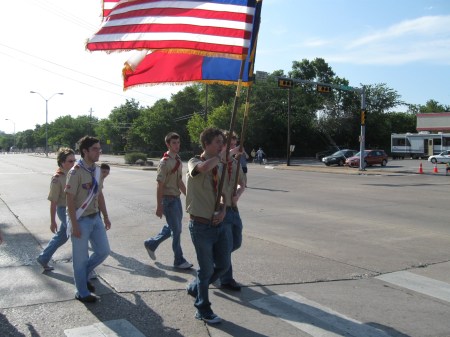
Scouts from Troop 355 and Pack 494 carry the colors in the Duncanville, Texas, 4th of July parade
Leave a Comment » | 4th of July, Boy Scouts of America, Flag ceremony, Flag etiquette, Fly your flag today, History | Tagged: Boy Scouts of America, Duncanville Texas, Flag etiquette, July 4 | Permalink
Posted by Ed Darrell
You couldn’t sell a fictional story where people are this nutty.
Go see. The abominable Steve Milloy — a guy so wacky he cannot be parodied (take that, Poe!) — calls water conservation “Nazi.” He complains about a provision in the Waxman-Markey Clean Energy Act that encourages innovation in water conservation devices.
Milloy flouts Godwin’s Law right off the bat. You can’t make this stuff up.
And — may God save us from these people — Milloy has followers. Check out the graphic here, with Obama portrayed as a marching Brownshirt. It’s almost too stupid to be racist, but it’s certainly incendiary. He even admits he thinks saving water is a good idea, and he’d like to have one of the devices complained about. (This guy knows he’s in error — he censors posts that question any part of his rant.) See the ugly meme expand, here.

Girl Scout/EPA water conservation badge -EPA image
Water conservation equals flag-waving in America, and has done so for a at least a hundred years. Those of us who grew up in the Intermountain West may be a little more attuned to the drive — Hoover Dam, Glen Canyon Dam, Flaming Gorge Dam, the Central Arizona Project, the Central Utah Project, the Colorado River aqueduct that carries water to Los Angeles, it’s impossible to live in the West and not be conscious of water’s value, its precious qualities.
Today, the many benefits of controlling water in this way are evident in the extensive development that has taken place throughout the West over the past 100 years. Huge cities have been created and millions of people live, work, and recreate in this desert region. But, as the West continues to grow, we must face the problem of continually increasing demands on a finite supply of water. This includes human population needs and the needs of the environment.
But one doesn’t need to be from the cold northern desert of southern Idaho to figure out that saving water is a good idea.
Most homeowners would like to save money. Americans spend between $600 and $1600 for washing machines that cut water usage by up to 75% (we just replaced our two-decades-old Maytag with a water conserving front-loader). Go to the appliance stores and listen to the conversations. People who could better afford the $200 models discuss how they will cut costs elsewhere to get the water saving versions — because their water bills are so high.
Much of of the rest of America works to conserve water out of necessity. Texas cities have mandatory water conservation laws, like Temple, Richwood, Austin and Dallas. Texas rural areas fight to save water, too. California cities demonstrate that water conservation works, saving investments in ever-grander and more environmentally-damaging water importation schemes, and allowing for population growth where water shortages would otherwise prohibit new homes. Water conservation is a big deal across the nation: In Raleigh, North Carolina; in Seminole County, Florida; in Nebraska; in the State of Maryland. An April drive across Wisconsin a few years ago convinced me it is the most waterlogged state in the nation, Louisiana notwithstanding — but even in Wisconsin, wise people work to conserve water for agriculture, one of the state’s leading industries and employers.
What’s the next step up from Godwin’s Law? These guys like Milloy and his camp followers can only get crazier, benignly, if they head to the meadow and graze with the cattle. Crazier non-benignly? Let’s not go there.
But let us address the odious comparison to Nazis directly. In World War II, when freedom was on the line, there was a drive to conserve resources in America. Americans grew their own vegetables in Victory Gardens.

Poster encouraging patriotic conservation, for the war effort in World War II
Americans collected scrap metal, iron, copper and aluminum, to be made into war machines to save the world. Americans conserved rubber and gasoline by restricting automobile use. There was the famous poster, “When you ride alone, you ride with Hitler.” Conservation was understood to be a patriotic response to the challenges the nation faced.
Bill Maher updated the poster with his 2005 book, When You Ride Alone You Ride With Bin Laden. Maher urged civic actions like those that helped the U.S. during World War II, including conservation of gasoline and other resources. Maher understands that wise use of resources is something a people should strive for, especially when in competition with other nations, either in a hot war or in trade or influence. Conservation remains a patriotic behavior, and opposing conservation remains a call to support the enemies of America, in war, in trade, in policies.

Update of the World War II poster, for our times. Image from Barnes and Noble
It’s not just a coincidence that Boy Scouts and Girl Scouts (in conjunction with the U.S. EPA for the past several years) learn water conservation as integral parts of their programs, chartered by Congress, to promote civic leadership in America’s youth. Those groups charged with teaching actual patriotism understand conservation to be a high duty, a high calling, something that all patriots do.
So, let’s face it. If you crap on a 6-gallon flushing toilet, you crap with Bin Laden. When you shower with a non-flow restricting shower head, you shower with Bin Laden.
Yes, it sounds creepy. It is.
You hope Milloy and the other Neobrownshirts* have parents or other family to pull them back from the brink, but then you see Congress.
* Yeah, the Nazis were the Brownshirts, in Germany. In Italy the fascists wore black shirts. Brown is generally the opposite of green, in political and business parlance — for example, development of a previously undeveloped piece of property is “greenfield development,” while redevelopment of a previously-developed parcel is “brownfield development.” Since Milloy is opposed to anything “green,” I think it only fair that his shirt color match his politics. It’s his choice, after all.

"Well, what about you, Climate Change 'Skeptics?'"
9 Comments | Boy Scouts of America, Conservation, Cost of Green, Environmental protection, Girl Scouts, Government, Natural history, Natural resources, Patriotism, Public health, Voodoo history, Voodoo science | Tagged: Boy Scouts of America, Conservation, Environmental protection, Girl Scouts, Government, Natural history, Natural resources, Patriotism, Politics, Propaganda, Public health, Voodoo history, Voodoo science | Permalink
Posted by Ed Darrell
This kid is from Heber, Utah — odds are he’s a Mormon, and he’s a Cub Scout. Wolf elective #23 includes “Tell what to do if you get lost.” But it’s an elective for a 7-year old, and in panic, a 9-year old may not remember. We hope that this training will be part of the Outdoorsman requirement for a second-year Webeloes Scout, at age 10 or 11, but this kid wasn’t there yet.

Utah, showing Daggett County - from Pioneer, Utah's online library
So, this story from the Salt Lake Tribune is a morality tale. One of the morals is that we need to drill our kids on what to do if they get lost, in the city, or in the wild:
Search crews found lost hiker, 9, after he left behind clues
Updated: 06/22/2009 10:51:25 AM MDTDaggett County search crews found a missing 9-year-old hiker Sunday night thanks to a footprint, a granola bar wrapper, pieces of his raincoat and a backpack that he left behind as he wandered through the Ashley National Forest.Grayson Wynne’s first words to his father, Kynan: “Happy Father’s Day.”Grayson, from Heber City, was hiking Saturday evening toward Daggett Lake to camp for a couple of days with his family when he was separated from the group.
Search and rescue teams, family members and volunteers — totaling more than 100 people — looked for Wynne on Saturday night and Sunday morning. Some rode horses or mules, others walked.
Grayson said he thought about his parents, prayed and cried while he was lost. He told searchers he spent the night under a log and didn’t get much sleep. He could hear searchers yelling his name but could not tell from which direction they were coming.
Searchers found a granola bar wrapper about 300 yards off of the main trail, and family members recognized the snack matched those Grayson had in his backpack. Rescuers also found a small footprint by a creek bed early Sunday, about 400 yards from the granola wrapper, the sheriff’s office said in a news release.
They later found Grayson’s black backpack, which he later told crews he left behind the night before because it was getting too heavy.
Based on Grayson’s belongings, Daggett County searchers said it appeared the boy was
following the creek, so they focused the rescue effort in specific areas along the water.A helicopter flew a bloodhound and her handler to the spot where the backpack was found. Before they could begin searching for Grayson, he heard the helicopter and headed for a meadow where he hoped the pilot would see him.
Grayson waved his last piece of yellow rain slicker to get the helicopter crew’s attention. He had been tearing the jacket apart and leaving behind chunks to trace his footsteps.
As he waved his slicker, two searchers rode up on horseback and found him in the meadow.
Grayson was taken to the command center, where he was checked by medical teams and reunited with his family. The boy’s feet were wet and cold, but he was in “good health and spirits,” the Sheriff’s Office said.
“This search was successful due to the many searchers and volunteers, and to Grayson for being such a strong little boy with a lot of common sense,” the Sheriff’s Office said in a news release.
I’m not entirely sure where the family was — in addition to the Ashley National Forest, there is the Flaming Gorge National Recreation Area in tiny Daggett County, in Utah’s northeast corner, for families to hike and camp in.
Daggett County was the last of the 29 counties in Utah to be organized, cut out of the much larger Uintah County. I know the story well. My maternal grandfather was one of the organizers of the county and the loser of the first election for sheriff (a great story of the power of women voting, for another time). My mother was born in a the chicken coop her family lived in, in Manila, as her father was building what was to be the biggest house in the county (and the first with rooms set aside for indoor plumbing).
2 Comments | Boy Scouts of America, Geography - Physical, History, Maps, Utah | Tagged: Boy Scouts of America, Emergencies, geography, Utah | Permalink
Posted by Ed Darrell
St. Paul Pioneer Press ran an article today on Anthony Thomas of Lakeville, Minnesota, the Scout designated the 2 millionth Eagle Scout.

Caption from the St. Paul, Minnesota, Pioneer Press: Anthony Thomas, 16, of Lakeville, will encourage other Scouts to work towards the Eagle rank. (Pioneer Press: JOHN DOMAN)
In a sort of luck-of-the-draw deal, Thomas has been named Scouting’s national youth ambassador for Scouting’s 100th anniversary in 2010. He’s scheduled to meet with President Barack Obama, to ride in the Rose Bowl Parade in Pasadena, and for dozens of other less well-known affairs.
On Wednesday, he helped Northern Star Council celebrate the opening of a new Scout Camp, at Fort Snelling, Minnesota.
It was a special day, according to coverage at Northern Star Council’s website:
History was made as Thomas was introduced as the BSA’s two millionth Eagle by Minnesota State leaders. Making the presentation were Associate Justice Christopher Dietzen, Representative Kate Knuth and Representative Cy Thao. Each shared their reflections on the importance of Scouting in their lives and then read a Proclamation from Governor Pawlenty declaring June 17 as “2 Millionth Eagle Scout Day” in Minnesota.
Scouting began awarding Eagle badges in 1912 — Thomas Eldred was the first Eagle. The 1 millionth Eagle was awarded in 1982, 70 years later. It’s been 27 years for the second million. About 100 million boys are or were Boy Scouts since 1910.
You’d think this news would be a bigger deal. Why isn’t this news going farther, faster?
Send this to your local newspapers and television stations — ask them to make a note of Thomas’s achievement, to encourage local kids.
More news stories:
Other resources:
5 Comments | Boy Scouts of America, Citizenship, Eagle Scout, Good Deeds, History | Tagged: Boy Scouts of America, Eagle Scout, Good Deeds, History, Minnesota, Northern Star Council BSA, Two Million Eagles | Permalink
Posted by Ed Darrell
Without editing, here’s the press release from Boy Scouts of America:
Minnesota Teen Named 2 Millionth Eagle Scout
Anthony Thomas to Represent 97 Years of Scouting Tradition and Honor, Serve as Youth Representative at BSA 100th Anniversary Events
Eagle Scout Anthony Thomas, Lakeville, Minn.
MINNEAPOLIS – June 17, 2009 – To describe one Minnesota teenager as “one in a million” is an understatement – by half. The Boy Scouts of America (BSA) today announced that Anthony Thomas, 16, of Lakeville, Minn., has been named the 2 millionth Eagle Scout since the first Eagle badge was awarded in 1912.
Eagle Scout is the highest attainable rank in Boy Scouting and requires years of dedication and hard work. Scouts must demonstrate proficiency in leadership, service, and outdoor skills at multiple levels before achieving the Eagle rank. Fewer than 5 percent of Boy Scouts earn the Eagle badge.
Anthony, who will be a junior at Academy of Holy Angels in Richfield, Minn., has been involved in Scouting since age 7. A member of the Northern Star Council’s Troop 471 at Prince of Peace Lutheran Church in Burnsville, Minn., he credits Scouting for his love of the outdoors and commitment to service. Adopted from Korea, Anthony volunteers as a counselor to Korean adoptees at Camp Choson. He also is active in his church and recently lettered in Service at his school. Anthony will spend part of his summer in New Orleans to help with ongoing cleanup work from Hurricane Katrina.
“Anthony represents everything that the Eagle badge stands for: character, integrity, leadership, and service to others,” said Bob Mazzuca, Chief Scout Executive, Boy Scouts of America. “It is fitting that we honor the 2 millionth Eagle as we prepare to celebrate 100 years of service to the nation.”
As the 2 millionth Eagle Scout, Anthony will serve as a youth ambassador for Scouting by participating in upcoming BSA’s 100th Anniversary events such as the Tournament of Roses Parade in Pasadena, Calif.; the BSA’s annual Report to the Nation in Washington, D.C.; and the National Scout Jamboree in 2010.
“I’m honored and humbled to be selected as the 2 millionth Eagle Scout,” Anthony said. “The Eagle rank represents excellence and leadership at every stage of life, and I will do my best to honor those Eagles who have come before me and to encourage other Scouts to pursue the Eagle Award.”
In addition to the 21 merit badges required to earn Eagle rank, each Scout must complete an extensive service project that he plans, organizes, leads, and manages before his 18th birthday. For his project, Anthony designed and constructed devices to help train service dogs for Helping Paws of Minnesota, which provides dogs for disabled persons to further their independence. A key component of his project was to raise awareness for the organization and its mission. He accomplished this by arranging a service dog demonstration for his troop and coordinating a kick-off drive to encourage his fellow Scouts to earn their Disabilities Awareness merit badge.
Anthony’s parents, Jim and Cheryl Thomas, are active Scouting volunteers. Anthony also has a younger sister, Allison. In addition to Scouting, Anthony enjoys snowboarding, track, soccer, and playing the guitar.
“The fellowship of Eagles celebrates the milestone of the 2 millionth Eagle Scout,” said Glenn Adams, president of the National Eagle Scout Association. “Each Eagle represents a life of service to others and to the communities where Eagles live and work. We congratulate Anthony Thomas and look forward to working with him to help encourage other Scouts to pursue their Eagle.”
About the Boy Scouts of America
Serving nearly 4.1 million young people between the ages of 7 and 20 with more than 300 local councils throughout the United States and its territories, the Boy Scouts of America is the nation’s foremost youth program of character development and values-based leadership training. For more information on the Boy Scouts of America, please visit www.scouting.org.###
Facts about Eagle Scouts
- The first Eagle badge was awarded in 1912.
- Fewer than 5 percent of all Boy Scouts earn the Eagle rank.
- The 1 millionth Eagle Scout milestone was reached in 1982.
- In 2008, a record-high 52,025 Scouts earned the Eagle badge.
In 2008, Eagle Scout service projects provided $16 million in service to communities across the nation (based on national volunteer hour value of $19.51).
Leave a Comment » | A Good Story, Boy Scouts of America, Eagle Scout, History, Patriotism | Tagged: Anthony Thomas, Boy Scouts of America, BSA Centennial, Eagle Scouts, History, Two Million Eagles | Permalink
Posted by Ed Darrell
Once upon a time it was a patriotic action to recycle things.

Boy Scouts distributed posters urging recycling during World War II - National Scouting Museum via National Archives
Once upon a time the nation’s future hinged on the ability of Americans to conserve resources and energy sources, especially gasoline. So Americans, from the president to the lowliest boy, united to urge Americans to recycle rubber, metal, rags and paper. It was the patriotic thing to do.

Make it do or do without - poster encouraging recycling and conservation for World War II
Did the recycling make significant contributions to the resources necessary to win the war? A few argue that the value of the campaigns was uniting people toward a common goal. But there were some clear connections between recycling of some products and the resources delivered to soldiers at the front that aided their fighting.
In the Pacific, Japan cut off U.S. access to rubber in Indochina. Rubber from South America and Africa could be intercepted in shipping by German u-boats. Metal refining from ores required more energy than refining from scrap. Although the U.S. entered the war as the world’s leading petroleum exporting nation, gasoline and Diesel fuel supplies were precious for airplanes, tanks and other machines directly supporting the troops.
Recycling was patriotic in every possible meaning of the word.
Is it really a news flash? Recycling is still the patriotic thing to do.

Waster paper made the boxes in which blood plasma was shipped to battlefield hospitals and medics
What the hell? They’re pro-garbage? Who in the world pays for this campaign Milloy runs, Vladimir Putin? Vlad the Impaler?
Digg: http://digg.com/d1toaH
10 Comments | Boy Scouts of America, Conservation, Cost of Green, Environmental protection, History, Natural resources, Politics, Rampant stupidity | Tagged: Boy Scouts of America, Conservation, Cost of Green, Green Hell, Natural resources, Patriotism, Recycling | Permalink
Posted by Ed Darrell
Scouting is one of the most vulnerable victims of wedge politics and attempts to polarize voters. Even among veteran Scouts and Scouters, lines tend to get drawn over what the program should be doing.
Today the New York Times headlines a story, “Scouts Train to Fight Terrorists, and more.”
It’s Explorers, a group which has been distanced from Boy Scouts by moving it to BSA’s Learning for Life programs. These are not traditional Boy Scouts. I suspect that distinction, small as it is, will get blurred quickly.
It will be interesting to watch discussions about Scouts pictured with semi-automatic weapons and bullet-proof vests.
Exploring used to be more closely related to Scouting. Exploring was for kids 14 years and older. I belonged to an Explorer Post in Utah that specialized in kayaking (I was more active at the council level at the time), and I had the grand opportunity to work with a large Explorer Post affiliated with AMR Corp. (American Airlines), where some of our Scouts got significant time in aircraft simulators (in the good old days, when such machines had downtime). It was a great program.
That was then. Today, 14-21-year-old Scouts can join Venture Crews, which can be co-ed. The old Exploring program you remember survives today mostly in Venturing.
10 Comments | Boy Scouts of America, Illegal Immigrants, Immigration, Politics, Terrorism | Tagged: Border Patrol, Boy Scouts of America, Explorer Scouts, Homeland Security, Immigration, Law Enforcement, Politics, Terrorism | Permalink
Posted by Ed Darrell
Cody Evans confessed that Bugling was the toughest merit badge he had to earn, but unlike others in the recent past, he didn’t put it off to be the last one. Congratulations to another member of the 121 Merit Badge Club.
From the Frederick, Maryland, Gazette:
Frederick resident and Eagle Scout Cody Evans has spent the last seven years learning skills most people won’t acquire in their lifetimes.
The 17-year-old Gov. Thomas Johnson High School junior recently was awarded the last of the 121 obtainable merit badges in Boy Scouts of America in March, an accomplishment that the organization deems almost unattainable.
Evans, who belongs to the Troop 1998 based out of the Elks Lodge in Frederick, said that though he had been involved in scouting for seven years, it was only in the last two that he realized that he was close to doing what very few scouts do in their Boy Scout careers. Realizing how close he was to getting the last badge, he became more motivated.
“I never thought I had much time to earn them all until I got just over halfway there,” Evans said. “I thought, ‘I have a chance, why not just go for it.’ So, I started working hard to earn them all.”
Evans has spent the last seven years learning to do everything from practicing veterinary medicine to driving a motorboat, even bugling, a skill he never anticipated having under his belt.
“That was the hardest because I didn’t know how to play at all before,” Evans said.
On March 14, Evans earned his last badge in energy. To complete the badge requirements, he had to build two projects that represented different forms of energy, which he demonstrated by building a slingshot and a sailboat.
Evans had little words when asked how it felt to have such a big accomplishment.
“I was overwhelmed,” he said. “Just happy that I was able to reach my goal.”
But, he said that the badge requirements have made him a more well-rounded person and student, provided him valuable leadership skills, and he hopes it will reflect well on his resume when he applies for college. Evans is a National Honor Society member and vice president of the Student Government Association at TJ High.
Despite achieving the highest of Boy Scout honors, Evans said he still has more goals in the organization. He said that he will apply to become an assistant scout master for his troop and help other scouts achieve their goals in the program.
When asked what advice he would give to other scouts in Frederick, Evans said: “Set short goals, and start trying to knock a little off at a time when you can.”
Other notes
1 Comment | 121 Merit Badge Club, Boy Scouts of America, Eagle Scout | Permalink
Posted by Ed Darrell
Not even if you’re an Eagle Scout.
Scott Mason of Halifax, Massachusetts, survived three nights on snowy Mt. Washington in New Hampshire. He nursed his sprained ankle, and kept warm with fires he started using hand sanitizer.
(Boston Globe) Mason later told his mother that he had tweaked his leg during the hike and that it was bothering him. As a precaution, he was taken to the Androscoggin Valley Regional Hospital, where he was evaluated and released.
Back in Halifax, his troop issued a statement, “Boy Scouts of America Troop 39 Halifax, Massachusetts, is extremely pleased with the positive outcome of this incident. Scott is a bright young man and our most experienced hiker. We have no doubt that he put all of his training and skills to use in order to come through this ordeal.”
Mason received an award two years ago for collecting more than 3,200 pounds of food for the Greater Boston Food Bank and the Pine Street Inn. For his Eagle Scout project, he collected the food by leaving boxes at Halifax area businesses. He has been a Boy Scout since he was 11.
Not only is Scouting an adventure, it prepares you to get out of even your own mistakes.
Tip of the old scrub brush to Randy Possehl on the Scouts-L list.
4 Comments | Boy Scouts of America, Eagle Scout, Reason | Tagged: Eagle Scout, Hiking Safety, Life, Mt. Washington | Permalink
Posted by Ed Darrell
You are currently browsing the archives for the Boy Scouts of America category.


Ed Darrell on Texas's Colorado River


Come on in, the water's fine. Come often: Cleanliness is next to godliness.


 Millard Fillmore's Bathtub
