December 19, 2011
An encore post, from 2008.
Thomas Nast helped bring down the crooks at Tammany Hall with cartoons. Boss Tweed, the chief antagonist of Nast, crook and leader of the Tammany Gang, understood that Nast’s drawings could do him in better than just hard hitting reporting — the pictures were clear to people who couldn’t read.
But a cartoon has to get to an audience to have an effect.
Here’s a cartoon below, a comment on the security wall being built in Israel, that got very little circulation in the west at Christmas time. Can you imagine the impact had this drawing run in newspapers in Europe, the U.S., and Canada?
It’s a mashup of a famous oil painting* related to the Christian Nativity, from a London-based artist who goes by the name Banksy. (Warning: Banksy pulls no punches; views shown are quite strong, often very funny, always provocative, generally safe for work unless you work for an authoritarian like Dick Cheney who wants no counter opinions.)
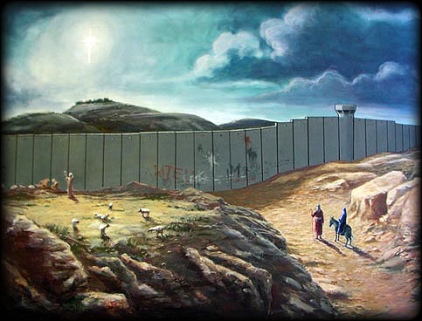
Banksy's modern nativity -- does he ever bother to copyright his stuff, or would he rather you broadcast it?
* At least I thought so in 2008. I can’t find the painting now. Anybody recognize a work underneath Banksy’s re-imagining? Let us know in comments, eh?
Tip of the old scrub brush to Peoples Geography.
More, in 2011:
Spread the word; friends don't allow friends to repeat history.
 Leave a Comment » |
  Art, Cartoons, Dissent, Israel, Palestine, Political cartoons, Politics | Tagged: Art, Banksy, Cartoons, Dissent, Israel's Wall, Mary and Joseph, Media, Palestine, Political cartoons, Politics |
  Permalink
 Posted by Ed Darrell
December 10, 2011

Alfredo Sabat on starvation in Africa, Lurie Award winner 2006
Remember this cartoon, from Sabat, in Brazil? It was a commentary on the “tsunami” striking African children, who were not getting aid like victims of the Indian Ocean tsunami were getting.
Steve Benson, the genius cartoonist at the Arizona Republic, updated the idea.

Steve Benson in the Arizona Republic, on the increase in poverty and hunger in America, 2011
More:
Save
Spread the word; friends don't allow friends to repeat history.
Leave a Comment » | Cartoons, hunger, Political cartoons, Poverty | Tagged: Arizona Republic, Cartoons, hunger, Political cartoons, Poverty, Steve Benson | Permalink
Posted by Ed Darrell
November 24, 2011
November 1869, in the first year of the Grant administration — and Nast put aside his own prejudices enough to invite the Irish guy to dinner, along with many others.
(Click for a larger image — it’s well worth it.)

Thomas Nast's "Uncle Sam's Thanksgiving," appearing in Harper's Weekly, November 20, 1869 - Ohio State University's cartoon collection
As described at the Ohio State site:
“Uncle Sam’s Thanksgiving Dinner” marks the highpoint of Nast’s Reconstruction-era idealism. By November 1869 the Fourteenth Amendment, which secures equal rights and citizenship to all Americans, was ratified. Congress had sent the Fifteenth Amendment, which forbade racial discrimination in voting rights, to the states and its ratification appeared certain. Although the Republican Party had absorbed a strong nativist element in the 1850s, its commitment to equality seemed to overshadow lingering nativism, a policy of protecting the interests of indigenous residents against immigrants. Two national symbols, Uncle Sam and Columbia, host all the peoples of the world who have been attracted to the United States by its promise of self-government and democracy. Germans, African Americans, Chinese, Native Americans, Germans, French, Spaniards: “Come one, come all,” Nast cheers at the lower left corner.
One of my Chinese students identified the Oriental woman as Japanese, saying it was “obvious.” The figure at the farthest right is a slightly cleaned-up version of the near-ape portrayal Nast typically gave Irishmen.
If Nast could put aside his biases to celebrate the potential of unbiased immigration to the U.S. and the society that emerges, maybe we can, too.
Hope your day is good; hope you have good company and good cheer, turkey or not. Happy Thanksgiving.
Spread the word; friends don't allow friends to repeat history.
1 Comment | Cartoons, History, Holidays, Immigration, Political cartoons, Reconstruction, Thanksgiving, Thomas Nast, Uncle Sam | Tagged: 1869, History, Immigration, Political cartoons, Thanksgiving, Thomas Nast, Uncle Sam | Permalink
Posted by Ed Darrell
November 21, 2011
Caption from the National Archives, where this cartoon resides:

Clifford Berryman cartoon from 1912, "Congress will come to order!" National Archives
“Congress Will Come To Order!”
by Clifford K. Berryman
Washington Evening Star, December 2, 1912
From the US Senate Collection, Center for Legislative Archives
The ultimate prize of a congressional election is control over the two houses of Congress: the U.S. House of Representatives and the U.S. Senate. This cartoon shows Congress following the pivotal 1912 elections when the Democrats swept into power and captured majorities both houses.
Some might hope that this history repeats.
Spread the word; friends don't allow friends to repeat history.
2 Comments | Cartoons, Elections, History, History images, Political cartoons | Tagged: 1912, Clifford Berryman, Congress, Elections, History images, Naitonal Archives, Political cartoons, Washington Star | Permalink
Posted by Ed Darrell
November 8, 2011
Rob Rogers at the Pittsburgh Post Gazette firms up the reasons he should get a Pulitzer for cartooning; want books, computers, and the ability to travel through time and space? Santa has a deal for you:

Rob Rogers cartoon, Library Card - Pittsburgh Post-Gazette
Big tip of the old scrub brush to Jean Detjen in Appleton, Wisconsin.
Spread the word; friends don't allow friends to repeat history.
1 Comment | Cartoons, Libraries | Tagged: Cartoons, Libraries, Pittsburgh Post-Gazette, Rob Rogers, Santa Claus | Permalink
Posted by Ed Darrell
November 2, 2011
. . . which accompany this now eerie picture.

Toppling Dictators in Arab world
Actually, I hear tell of a cartoon that looks more like the earlier photo, with a fellow walking away after having crossed out the images of Ali and Mubarak . . . anyone got a link?
Spread the word; friends don't allow friends to repeat history.
Leave a Comment » | Cartoons, History, Political cartoons | Tagged: Arab Spring, Cartoons, History, Political cartoons | Permalink
Posted by Ed Darrell
October 30, 2011

Kevin Siers, Charlotte Observer, October 29, 2011
Kevin Siers is another obvious candidate for a Pulitzer Prize in cartooning, one of these coming years.
Spread the word; friends don't allow friends to repeat history.
79 Comments | 2012 Campaigns, Campaigns, Cartoons, Political cartoons, Politics, Taxes | Tagged: Campaigns, Charlotte Observer, Fat Cats, Flat Tax, Kevin Siers, Political cartoons, Politics, Taxes | Permalink
Posted by Ed Darrell
October 28, 2011
Events of the past two weeks, in the community of scientists and cargo scientists who fail to recognize global warming, sadly, were portrayed in this cartoon by Tom Toles. Whiplash realization moment: Toles’s cartoon is from 2004. (Yes, this is an encore post.)

A Tom Toles cartoon from 2004
Insert a definition of “filibuster” here.
Then pray for action.
Then call your congressman, and him/her to act, now.
_____________
Note on Tom Toles from the Department of Earth Sciences, G-107 Environmental Geology, Indiana University-Purdue University at Indianapolis (IUPUI): “A political cartoon from the Washington Post on climate change. Tom Toles, a political cartoonist, often pens cartoons on environmental issues. His cartoons are often reprinted in other newspapers (Washington Post/Universal Press Syndicate).”
Spread the word; friends don't allow friends to repeat history.
98 Comments | Cartoons, Climate change, climate_change, Cost of Green, denialism, Global warming, Political cartoons, Politics, Science | Tagged: Berkeley Earth Surface Temperature Study, BEST, Cartoons, Climate change, denialism, Global warming, Political cartoons, Politics, Science, Tom Toles, UC Berkeley | Permalink
Posted by Ed Darrell
September 24, 2011
As usual, XKCD makes sense of unbelievable news:

Click to see original at XKCD
Spread the word; friends don't allow friends to repeat history.
Leave a Comment » | Cartoons, Physics | Tagged: Cartoons, Neutrinos, Physics, Speed of Light, XKCD | Permalink
Posted by Ed Darrell
September 14, 2011
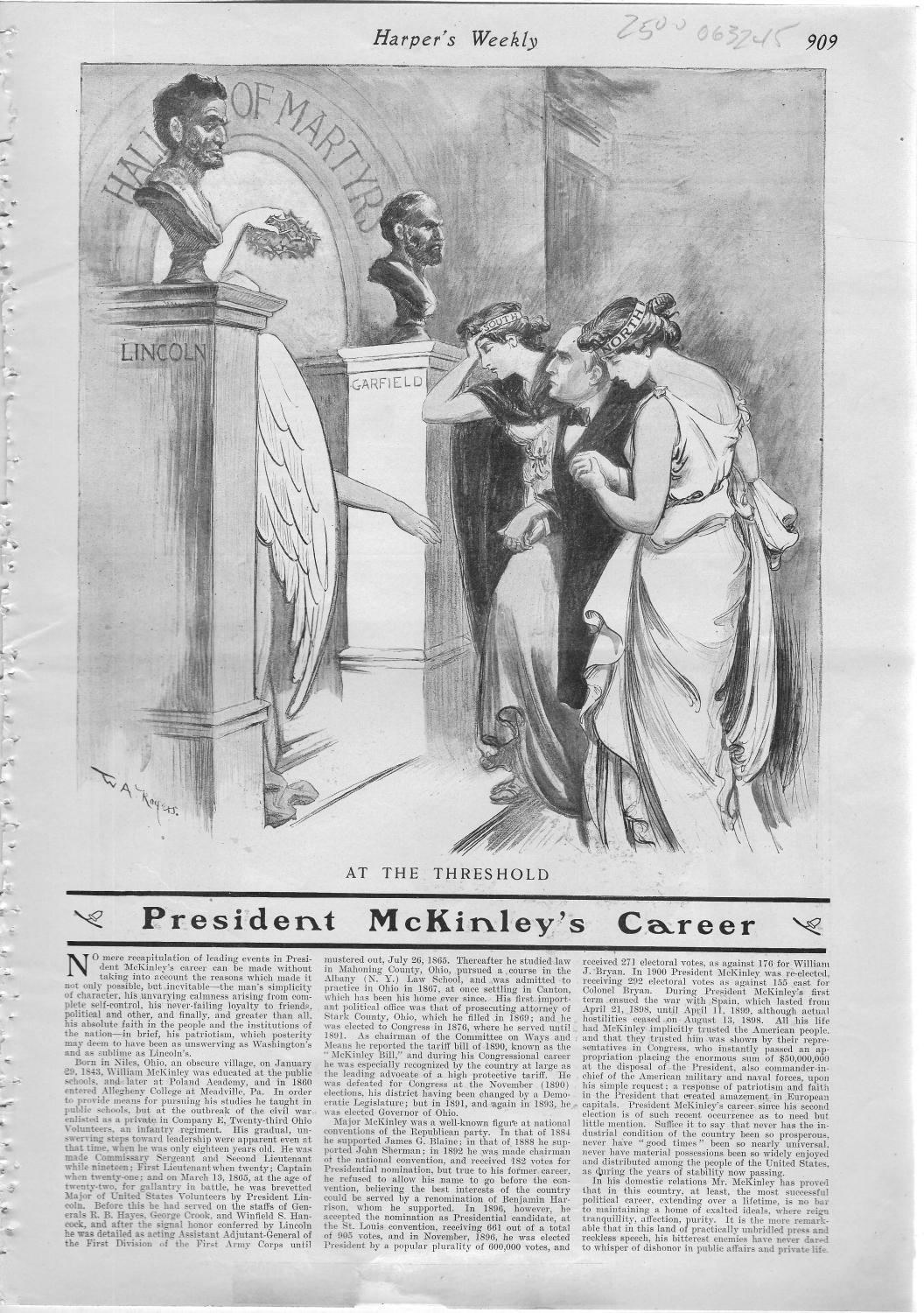
Image from Harper’s Magazine, September 14, 1901 -= McKinley “At the Threshold” of Martyrs’ Hall
Teachers should be mining the “On This Day” feature at the New York Times, which usually features an historic cartoon or illustration from an antique Harper’s Weekly. It is a favorite feature, to me.
Yesterday, it featured the illustration from Harper’s upon the death of President William McKinley, on September 14, 1901.
At the Threshold
Artist: William Allen Rogers
 his post-dated cartoon was published as President William McKinley lay dying from an assassin’s bullet. He had been shot on September 6, 1901, by anarchist Leon Czolgosz (pronounced chol-gosh) at the Pan-American Exposition in Buffalo, New York. The president died on September 14. Here, McKinley is led to the Hall of Martyrs by grief-stricken personifications of the North and South. Between pillars topped by busts of the two previously slain presidents, Abraham Lincoln and James Garfield, the angel of death prepares to place a laurel wreath of honor upon McKinley’s head. (Images related to Garfield’s assassination also showed a reconciled North and South.)
There is much more at the Times site.
Robert Lincoln, the son of Abraham Lincoln, was present when McKinley was shot. Accounts I have read but not confirmed say that Robert Lincoln had been invited to attend Ford’s Theatre with his father and mother, the night his father was shot. As a member of President James Garfield’s cabinet, Robert Lincoln had been awaiting Garfield’s arrival at Union Station in Washington, D.C., when Garfield was shot.
And as a visitor in Buffalo, Robert Lincoln had as a matter of respect lined up to shake President William McKinley’s hand.
Astounding if true. Four U.S. presidents have been assassinated. Robert Lincoln was close to the first, the assassination of his father, and present for the next two. Where can we confirm that story?
McKinley’s death catapulted the do-gooder, Theodore Roosevelt, into the presidency, probably to the great chagrin of corrupt Republican politicians who had hoped that by getting him nominated to the vice presidency they could get him out of New York politics.
The rest is history.
(This is an encore post.)
Image is available for purchase at AbeBooks.
Spread the word; friends don't allow friends to repeat history.
9 Comments | Assassination, Cartoons, History, Presidents, Theodore Roosevelt | Tagged: Assassinations, Cartoons, Harper's Magazine, History, September 14, Theodore Roosevelt, William McKinley | Permalink
Posted by Ed Darrell
September 4, 2011
Greg Williams produces more cartoons than newspapers can print (or do print) — he’s got a blog called WikiWorld as an outlet for some of them. At WikiWorld, he does a one-panel cartoon to accompany some article he found at Wikipedia. It’s much cooler than it sounds.
Do our history students appreciate the significance of Kilroy? Williams offers a quick cartoon to explain.

Would this make a good poster for a classroom? Greg Williams cartoon, Wikipedia information
In my studies of rhetoric at the University of Arizona, one class turned to a long discussion on Kilroy. Without the internet, we had to make do with memory, logic, argument, and a quick trip to the library to see what we could find quickly.
My thesis, which I still hold, is that the presence of Kilroy marks the existence of sanity in otherwise crazy world, and that the rise of Kilroy, or Kilroyism, in war, demonstrates the spirit necessary to win. Kilroy didn’t win the war singlehandedly, of course — but it was that spirit of Kilroy that turned the tide to victory for the Americans and allies so many times, in so many places.
Why isn’t Kilroy in the Texas Essential Knowledge and Skills (TEKS) list?
More, resources:

Kilroy, in granite, at the World War II Memorial, Washington, D.C. - Wikimedia image, photo by Luis Rubio
Spread the word; friends don't allow friends to repeat history.
1 Comment | Cartoons, History, Kilroy Was Here, World War II | Tagged: Cartoons, Greg Williams, Kilroy, Kilroy Was Here, Wikipedia, World War II | Permalink
Posted by Ed Darrell
July 28, 2011
Pat Bagley, the future Pulitzer Prize-winning cartoonist for the Salt Lake Tribune, can be so brilliant sometimes you can’t see him.
For example, what’s he talking about here? Mass murder in Norway? Debt ceiling? The Texas State Board of Education’s assault on evolution? The Texas Lege’s attack on education? Congress’s attacks on the poor and aged?

The Last Crusade - Pat Bagley for the Salt Lake Tribune
Pass the lithium: The cartoon applies to any of those issues, and all of them.
Spread the word; friends don't allow friends to repeat history.
Leave a Comment » | Cartoons, Newspapers, Political cartoons, Violence | Tagged: Cartoons, Dark Ages, Fear and Ignorance, Norway, Pat Bagley, Political cartoons, Salt Lake Tribune, Violence | Permalink
Posted by Ed Darrell
July 27, 2011
On July 27, 1940, Bugs Bunny burst onto screens across the nation in his first Warner Bros. cartoon, “A Wild Hare.”

Lobby card for "A Wild Hare," Warner Bros, via Wikimedia
Who was it said this?
Bugs Bunny is who we hope to be, but Daffy Duck is who we secretly fear we are.
Happy birthday, Bugs!
More:
Spread the word; friends don't allow friends to repeat history.
1 Comment | Cartoons, History, Video and film | Tagged: Bugs Bunny, Cartoons, Film and Video, History | Permalink
Posted by Ed Darrell
July 24, 2011
Oh, while we’re looking at the genius of Jen Sorensen, let’s see what she’s got to cartoon about light bulbs:

Jen Sorensen's Slowpoke Comics, "Bulb Wars" - for a larger image at Jen's website, click the image
This strip appears Wednesdays at Daily Kos, and I understand some newspapers around the country have picked it up. Does it appear in a paper in your city?
Spread the word; friends don't allow friends to repeat history.
5 Comments | Cartoons, Conservation, Energy, Humor, Political cartoons, Politics | Tagged: CFLs, Energy Conservation, Green Politics, Humor, Jen Sorensen, Light Bulbs, Political cartoons, Politics, Slowpoke Comics | Permalink
Posted by Ed Darrell
July 24, 2011
At least one other person in the universe rather agrees with me that it’s odd as hell that anyone would take the debt ceiling issue to use as a bargaining chip.
Jen Sorenson tells the truth, the whole truth and little else, at Slowpoke Comics:

Jen Sorensen's Slowpoke Comics - Debt Ceiling (click image to read it full size at Jen's website)
What are the odds we can get the Dallas Morning News to carry this strip?
Spread the word; friends don't allow friends to repeat history.
1 Comment | Cartoons, Humor, Political cartoons, Politics, Public Debt, Rampant stupidity | Tagged: Cartoons, Debt Ceiling, Humor, Jen Sorensen, Political cartoons, Politics, Public Debt, Rampant stupidity, Slowpoke Comics, Uncivil Discourse, Unreasonable Demands | Permalink
Posted by Ed Darrell





 Millard Fillmore's Bathtub
