Bugs Bunny on the Constitution

August 30, 2010

Was this from 1989, the Constitution’s Bicentennial?  I dimly remember these PSAs.

This one isn’t brilliant — n.b., the Constitution can be amended — but it is Bugs Bunny and Daffy Duck.

I just stumbled into it on YouTube.  Is there a good collection somewhere?  Are the others better?


Cagle Cartoons gets trite, and wrong

August 19, 2010

I’m a great lover of political cartoons and political cartooning, of all stripes.  Great truths sneak out of the pens that produce stunned laughter in a reader (viewer), I think, especially when they stun me into a new realization.

Political cartooning stumbles along through hard times.  Where once upon a time a major U.S. city, like St. Louis, would have three or more daily newspapers, each of which would employ more than one cartoonist, the newspapers themselves disappear (more slowly this year, but no new ones have been birthed, either), and those few surviving newspapers try to get along with one or fewer political cartoonists, and they even reduce the number of syndicated cartoons.

Where U.S. history teachers revel in the glorious images and humor of Thomas Nast (even though he was a Republican sympathizer), Thomas Keppler, Berryman, Ding Darling, Herblock, Bill Mauldin, and other bright cartoonists of the 19th and 20th centuries, Daryl Cagle has gallantly tried to preserve the profession and the art, with a group that spreads cartoons of a lot of cartoonists employed by papers or free-lancing.

I subscribe to the electronic newsletter of Cagle Cartoons.  I’ve found their processes for getting approval not to work well for me (or work at all — I have yet to get any response on any cartoon I’ve asked them about).  But I hope cartoonists like the brilliant Sherffius, or Calvin Grondahl from my almost-native Utah, get enough additional exposure to make them comfortable and keep the cartooning.

Lately I’ve been despairing.  Cagle added columns by cartoonists and others.  Most of that material tends toward hard conservatism, I find, and lack of reportorial and intellectual rigor.

Like this piece of guano from a reporter named Phil Brennan. Oh, we should have expected it to be  lightweight, his being a regular contributor to the disinformation source NewsMax.

But still.

Brennan argues that birthers should give up on their challenges to Obama’s eligibility, because of the chaos that would be caused were Obama to be replaced by John McCain so far into an administration.  (Yeah — just hold on.  I know.)  All the laws Obama signed would be nullified, Brennan wrote, all his appointments nullifed, and the slate wiped clean for McCain and Palin to occupy the White House. Obama’s defended his birth in a U.S. territory successfully so far, so birthers should give up trying for change.

Just for a moment, imagine that the Court does its job and it turns out that Obama can’t come up with a legitimate birth certificate showing that he was indeed born on U.S. soil in what was then the territory of Hawaii, and the Court declares that he is therefore ineligible to serve as the nation’s chief executive.

Should that be the case nothing that he has done, no appointments that he has made nor executive orders he issued would be valid. And under the provisions of the Constitution, John McCain would be declared the legitimate President of the United States and Sarah Palin the Vice President starting with Inauguration Day, 2009.

It might cause a civil war, Brennan says.

Mr. Brennan:  I know the U.S. Constitution.  I’ve read the U.S. Constitution.  The U.S. Constitution is a friend of mine.  What you describe is not in the Constitution, and doesn’t bear any resemblance to reality.

Here’s the comment I posted to Brennan’s piece at Cagle Cartoons:

A couple of fact checking issues here:

1. Hawaii was a state in 1961, not a territory. Hawaii became a state in August 1959.

2. Under the Constitution and federal laws on succession, if the person at the top of the ticket becomes ineligible to serve, the person next in line in succession becomes president. Were Obama declared ineligible, we’d have President Joe Biden.

3. There is no provision to nullify laws and directives of a federal officer later found ineligible for the office. Under pretty well-established law, all of those actions stand unless repealed later. Congressional actions, especially, would not be rolled back. All appointments stand.

4. Obama has already provided unassailable proof of his birth. Under the full faith and credit clause of the Constitution, all states and the federal government must honor official actions of the states. Hawaii issued, under seal, a document verifying that Barack Obama was born in Honolulu in 1961. “Under seal” is the highest authority we can give a document under statutory and common law — it’s got more than 800 years of precedent behind it. The only possible way to get at a document under seal is to provide clear and convincing evidence of fraud on the state. There is no showing of any fraud that stands up in court, under Hawaii or federal rules of evidence.

In short, almost everything stated as fact for the premises of that piece, is fiction.

Bad enough that joints like the Discovery Institute, NewsMax, the Washington Times and others have fired all their fact checkers — but shouldn’t a high school-educated person know better?  Is there no editing at Cagle Cartoons at all?


More Billy Blob: Bumble BeEing and the Butterfly Effect

August 16, 2010

Also from Billy Blob (as the Space Probe cartoon posted here on August 15), “Bumble BeEing, Part 1:  The Butterfly Effect.”

How to categorize such a cartoon:  Philosophy?  Science of Chaos (from which we get the hypothetical “butterfly effect”)?

Education?  Religion?


We Are Science Probes

August 14, 2010

Still from

Still from “We Are Science Probes.” Full clip of movie below.

In animation, a parable about the dangers of being intentionally ignorant of science. In the not-distant-enough future, a probe from another planet arrives on Earth after the demise of human civilization. Unfortunately, the probes land in Kansas, the land of creationism and woo. The plot thickens.

[My apologies — the version I found did not come with a “pause” button.  It will play automatically when you open this post.  Fortunately, it’s almost perfectly safe-for-work.  If you don’t like the music, turn it off.  There is no spoken dialogue in the cartoon.  If you wish to pause the playing of the cartoon, right click to get to the Adobe Flash Player controls.  To pause the playing click the checkmark next to “play.”]

[Update August 18 — Okay, I give up — 100% of comments I’ve been getting ran against the video without the “start” or “pause” buttons.  You’ll have to go see it at another site — here, for example.]

[Years later, it’s on Youtube!]

Found it at a site called NewGrounds, which includes several other animation pieces.  The piece was created by a group that goes by the handle Billy Blob.

Sure would love this group to turn their creative faculties to hard history — say, the Progressive Movement and Gilded Age.  (Probably less chance of commercialization there, and perhaps less chance of awe-striking art, too.)

Tip of the old scrub brush to P. Z. Myers at Pharyngula.


Tea Party medical care

July 21, 2010

Last spring, as the local Tea Party gatherings were shouting hosannahs to the Constitution, they also advocated not answering the decennial census.  I pointed out that the census is required by the Constitution, and got disinvited.

Unbridled and unquestioning support of what the “founders” did, instead of the laws they wrote, can lead one astray, as this cartoon shows:

Tea Party medical care, based on love for the "founders ways" - atheist cartoons.com

Tea Party philosophy: 'If the founders did it, it's good.'

Tip of the old scrub brush to Job’s Anger.


What’s changed since August 2008?

July 13, 2010

Ben Hoffman drew this on August 2008:

Ben Hoffman cartoon, August 2008 - BenHoffman.WordPress.com

Ben Hoffman on the issues of August 2008 - what's changed? BenHoffman.WordPress.com

Replace half the “abortions” with “socialism,” it’s still accurate.

We could change that for the better in November, were we alert to the issues.

Change:

Add to FacebookAdd to NewsvineAdd to DiggAdd to Del.icio.usAdd to StumbleuponAdd to RedditAdd to BlinklistAdd to TwitterAdd to TechnoratiAdd to Furl


Chess games of the rich and famous: House Speaker Joe Cannon vs. Congress

July 7, 2010

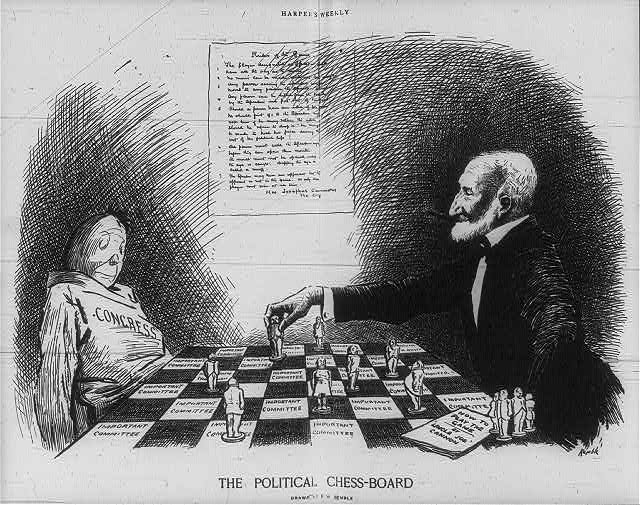
Cartoon - Cannon, Joe, The Poltiical Chessboard, Harpers 2-05-1910 - 3b23316r

The Poltiical Chessboard, Harper's Magazine, February 5, 1910, by E. W. Kemble - Library of Congress image

Description from the Library of Congress:

Joseph Cannon playing chess with straw man labelled “Congress,” using toy men on chessboard with squares labelled “important committee” and “freak committee.”

Legendary House Speaker Joe Cannon — after whom the Cannon House Office Building is named — is remembered for the almost absolute power he held over the House of Representatives.  Here’s the generic description at Wikipedia:

House Speaker Joseph G. Cannon - Wikimedia image, photo from October 1915

House Speaker Joseph G. Cannon - Wikimedia image, photo from October 1915

Cannon wielded the office of Speaker with unprecedented power. At the time of Cannon’s election the Speaker of the House concurrently held the chair of the Rules Committee, which determined under what rules and restrictions bills could be debated, amended, and voted on, and in some cases whether they would be allowed on the floor at all. As such, Cannon effectively controlled every aspect of the House’s agenda: Bills reached the floor of the house only if Cannon approved of it, and then in whatever form he determined—with he himself deciding whether and to what extent the measures could be debated and amended.

Cannon also reserved to himself the right to appoint not only the chairs of the various House committees, but also all of committees’ members, and (despite the seniority system that had begun to develop) used that power to appoint his allies and proteges to leadership positions while punishing those who opposed his legislation. Crucially, Cannon exercised these powers to maintain discipline within the ranks of his own party: the Republicans were divided into the conservative “Old Guard,” led by Cannon, and the progressives, led by President Theodore Roosevelt. His committee assignment privileges ensured that the party’s Progressive element was essentially powerless in the House, and his control over the legislative process obstructed progressive legislation.

Progressives wished to break Cannon’s ability to control so completely the flow of legislation.  By early 1910, progressives in the Republican Party especially chafed under Cannon’s rule.  Anxious for revolt, they struck on March 17, just a few weeks after this cartoon appeared.

On March 17, 1910, after two failed attempts to curb Cannon’s absolute power in the House, Nebraska Representative George Norris [of Nebraska] led a coalition of 42 progressive Republicans and the entire delegation of 149 Democrats in a revolt. With many of Cannon’s most powerful allies absent from the Chamber, but enough Members on hand for a quorum, Norris introduced a resolution that would remove the Speaker from the Rules Committee and strip him of his power to assign committees.

While his lieutenants and the House sergeant-at-arms left the chamber to collect absent members in attempt to rally enough votes for Cannon, the Speaker’s allies initiated a filibuster in the form of a point of order debate. When Cannon supporters proved difficult to find (many of the staunchest were Irish and spent the day at various St. Patrick’s Day celebrations), the filibuster continued for 26 hours, with Cannon’s present friends making repeated motions for recess and adjournment. When Cannon finally ruled the resolution out of order at noon on March 19, Norris appealed the resolution to the full House, which voted to overrule Cannon, and then to adopt the Norris resolution.

Cannon managed to save some face by promptly requesting a vote to remove him as Speaker, which he won handily since the Republican majority would not risk a Democratic speaker replacing him. However, his iron rule of the House was broken, and Cannon lost the Speakership when the Democrats won a majority later that same year.

Instead of the Speaker’s wishes, committee assignments and chairs were selected by a seniority system.

Cannon lost his seat representing Illinois in the progressive tide of 1912, but regained it in 1914, and served another four terms in the House, to 1922.

I have found no information on whether Cannon actually played chess.

Norris’s star was on the rise at the same time.  Though he supported Theodore Roosevelt in the election of 1912, when Roosevelt bolted the Republican Party and ran as a Progressive or “Bullmoose Party” nominee for president, Norris stayed with the Republican Party and won election to the U.S. Senate in 1912.

Norris became an isolationist, and was one of six senators to vote against the declaration of war in 1917 that pushed the U.S. into World War I.  Norris also opposed the Versailles Treaty, and played an important role in keeping the treaty from U.S. ratification.  He supported Franklin Roosevelt’s New Deal Reforms a decade-and-a-half later, and one of the early dams of the Tennessee Valley Authority is named for him.  Norris’s role in the New Deal, and in pushing progressive reforms well into the 20th century, is not fully appreciated, for example:

In 1932, along with Rep. Fiorello H. La Guardia, Norris secured passage of the Norris-La Guardia Act, which outlawed the practice of requiring prospective employees not to join a labor union as a condition of employment (the so-called yellow-dog contract) and greatly limited the use of court injunctions against strikes.

A staunch supporter of President Roosevelt’s New Deal programs, Norris sponsored the Tennessee Valley Authority Act of 1933. In appreciation, the TVA Norris Dam and a new planned city in Tennessee were named after him.[3][4] Norris was also the prime Senate mover behind the Rural Electrification Act that brought electrical service to under-served and unserved rural areas across the United States.

Switching to the Democratic Party in 1936 when the Republicans fell into the minority, Norris generally supported New Deal efforts but did not fear to oppose ideas he found unworthy, regardless their source or party connection.  His opposition to President Franklin Roosevelt’s “court packing” plan helped smother the idea.  Norris finally lost election in 1942.  Norris is one of eight U.S. senators profiled in John F. Kennedy’s book, Profiles in Courage.


Quote of the moment: Books as lighthouses in the dark sea of time

July 3, 2010

Jeffrey Robbins, a human character in the animated cartoon series,

Jeffrey Robbins, a human character in the animated cartoon series, “The Gargoyles”

The written word is all that stands between memory and oblivion. Without books as our anchors, we are cast adrift, neither teaching nor learning. They are windows on the past, mirrors on the present, and prisms reflecting all possible futures. Books are lighthouses, erected in the dark sea of time.

Jeffrey Robbins, a character in the cartoon series, “The Gargoyles”

Now available on Youtube.  To get the quote above, to go to 21:30 in this video:

Tip of the old scrub brush to James Kessler.


Boy Scouts Centennial: Dan Beard and Ed Dodd

June 21, 2010

Dan Beard, a founder of Boy Scouts of America, and cartoonist Ed Dodd, photo dated (incorrectly) February 14, 1950 – Georgia State University Library Photography Collection, Atlanta Area Photographs from the Lane Brothers and Tracy O’Neal Collections

Dan Beard, a founder of Boy Scouts of America, and cartoonist Ed Dodd, photo dated (incorrectly) February 14, 1950 – Georgia State University Library Photography Collection, Atlanta Area Photographs from the Lane Brothers and Tracy O’Neal Collections

Daniel Carter Beard was best known as an illustrator of children’s adventure books.  He founded a group for boys, the Sons of Daniel Boone, in 1905.  That group was merged into the Boy Scouts of America at BSA’s founding in 1910.

Ed Dodd (November 7, 1902 – May 27, 1991) was an illustrator and cartoonist, probably best known for his comic strip “Mark Trail,” which is still carried in many newspapers today.

According to his listing at Wikipedia:

Ed Dodd went to work for Dan Beard, founder of the Boy Scouts of America, at the age of 16. Dodd worked at Beard’s camp in Pennsylvania for thirteen summers, where he honed his writing and illustration skills under Beard’s guidance. Dodd became a scoutmaster and the first paid Youth and Physical Education Director for the city of Gainesville, Georgia.

Another story of Scouting providing a career for a kid, another story of Scouting providing a career for an illustrator (see also Norman Rockwell, and the Csataris).

Dodd was a Georgian.  This photograph, dated February 14, 1950, shows a meeting of the two illustrators, with Dodd appearing older than the 16 he was when he first met Beard.  The photo is in the collections of the Georgia State University Library, in the Atlanta Area Photographs from the Lane Brothers and Tracy O’Neal Collections.  We might assume it was taken in Georgia, perhaps at Dodd’s “Lost Forest” home and workshop.

We know that can’t be the right date, however, since Dan Beard died in 1941.

Who can shed more light on this bit of history?

Updates:  See comments below — among other things, we know that the February 14, 1950 date was the date that a duplicate negative was made.  Please note in comments if you have further details.

More:

Mark Trail strip on NOAA's 200th-2D-MarkTrail650

Click on image: Marke Trail on NOAA’s 200th anniversary; King Features Syndicate

Ed Dodd and others in his studio at Lost Forest, Georgia, drawing the comic strip Mark Trail - Wikimedia

Dodd and others working on “Mark Trail”: The Mark Trail studio was on the second floor of Ed Dodd’s Frank Lloyd Wright-designed home in the Lost Forest at the Atlanta suburb of Sandy Springs, Georgia. At work are (l. to r.) Ed Dodd, Jack Elrod, Tom Hill and Rhett Carmichael. The 130-acre Lost Forest was the model for the fictional Lost Forest National Forest in the strip. Dodd’s house was located on Marsh Creek, a tributary of the Chattahoochee River. Wikimedia photo and caption

  • Sadly, Dodd’s Lost Forest was completely burned in 1996.  I can find no information on any of the studio surviving the fire (anyone know differently?).   Dodd was honored in 1991 with the naming of the Mark Trail Wilderness Area, in the Chattahoochee National Forest.
  • According to the official information at King Features Syndicate, Jack Elrod first assisted Dodd, then in 1978 took over the creative writing and drawing of the strip when Dodd retired and Tom Hill, who had done the Sunday strips, died.  Elrod was a Boy Scout when he first met Dodd, in Dodd’s role as Scoutmaster.  The Scouting links are strong in this strip.

Tip of the old scrub brush to Chamblee54, for showing the way to the Georgia State University photographs.

[Editor’s note: Georgia State Library keeps changing the link url on the photograph; if you find a higher resolution version, please, please let us know where it is!]


SBOE shames Texas, part I: Wilkinson on cutting the Enlightenment out

April 18, 2010

Signe Wilkinson, Philadelphia Daily News, March 17, 2010 - Texas education board cuts Enlightenment from curriculum

Signe Wilkinson, Philadelphia Daily News, March 17, 2010 - Texas education board cuts Enlightenment from curriculum

Signe Wilkinson cartoons for the Philadelphia Daily News.   She won a Pulitzer for political cartoons in 1992, the first woman to win that award (about time!).


Health care legislation as Waterloo – Oliphant (and Benson)

April 17, 2010

Pat Oliphant on health care legislation as Obama's Waterloo, March 23, 2010

Pat Oliphant on health care legislation as Obama's Waterloo, March 23, 2010 - Washington Post

How’s that “make health care Obama’s Waterloo” working out for you, Sen. Demint?

Didn’t expect Obama to be Wellington at Waterloo, eh?

See Steve Benson’s take, below the fold.

Read the rest of this entry »


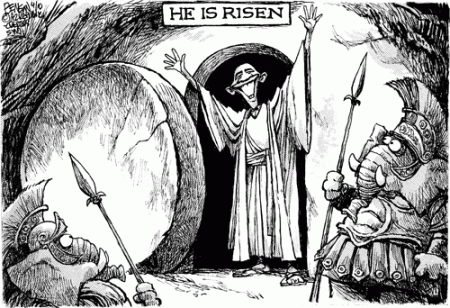
Benson courts controversy: Obama’s political resurrection

April 17, 2010

When he interned for our office, he was such a clean-cut, return-missionary sort of guy.  Steve Benson’s cartoons continually push the envelope for what is acceptable in an editorial cartoon, not exactly what I had come to expect from his early work with conservatives.  A welcome surprise.

This one was probably quite controversial in Phoenix, don’t you think?

Steve Benson in the Arizona Republic, on the Affordable Care Act and President Obama, April 2, 2010

Steve Benson in the Arizona Republic, on the Affordable Care Act and President Obama, April 2, 2010


SBOE shames Texas, part G: Toles in the Washington Post

April 11, 2010

Pulitzer Prize-winner Tom Toles in the Washington Post, March 19, 2010

Pulitzer Prize-winner Tom Toles in the Washington Post, March 19, 2010

It’s pretty embarrassing when the State Board of Education’s actions leave Texas open to jokes about whether Texans remember the Alamo.  Remembering the Alamo is as much a Texas monument or icon as anything else — maybe moreso.

Tom Toles demonstrates why Texas should be embarrassed by the Texas State Board of Education’s work on social studies standards.


Education board shames Texas, part F: Clay Bennett, Chattanooga Times-Free Press

April 11, 2010

Clay Bennett in the Chattanooga Times Free Press:

Clay Bennett, Chattanooga Times-Free Press, March 16, 2010

Clay Bennett, Chattanooga Times-Free Press, March 16, 2010

Bennett remains one of my favorite cartoonists today.  His work is incisive, intelligent, and persuasive to the side of reason and light almost all of the time.  Why hasn’t he won a Pulitzer yet?

Bennett is generally a powerful supporter of U.S. education; see the two other recent cartoons, below the fold.

Read the rest of this entry »


SBOE shames Texas, part D: Mario Piperni and unintended consequences

April 10, 2010

Mario Piperni on Texas State Board of Education

Cartoon by Mario Piperni on the Texas State Board of Education, on any number of subjects

Have never seen this guy’s work before.  Does he publish in a newspaper that is lucky to have him?