Peter Sinclair update: Mars still doesn’t deny Earth’s warming

September 21, 2009

Cleverly avoiding real discussion of greenhouse gases and their effects on Venus, climate change denialists often claim warming to be a solar system-wide event, caused by the Sun — evidenced, they say, by warming on all the other planets in the solar system.

Peter Sinclair’s “Climate Denial Crock of the Week” dealt with the issue several months ago, but he’s redone the piece, with improvements in sound especially.

Spread the word:

Add to FacebookAdd to NewsvineAdd to DiggAdd to Del.icio.usAdd to StumbleuponAdd to RedditAdd to BlinklistAdd to TwitterAdd to TechnoratiAdd to Furl


More evidence of climate change: Arctic methane hydrates evaporating

August 21, 2009

It’s a pretty picture, but it should strike a bit of fear once you know what it is.

New Scientist explains:

Sonar image of methane plumes rising from methane hydrates on the Arctic Ocean floor; image from National Oceanography Centre, Southampton (Britain)

Sonar image of methane plumes rising from methane hydrates on the Arctic Ocean floor; image from National Oceanography Centre, Southampton (Britain)

It’s been predicted for years, and now it’s happening. Deep in the Arctic Ocean, water warmed by climate change is forcing the release of methane from beneath the sea floor.

Over 250 plumes of gas have been discovered bubbling up from the sea floor to the west of the Svalbard archipelago, which lies north of Norway. The bubbles are mostly methane, which is a greenhouse gas much more powerful than carbon dioxide.

The methane is probably coming from reserves of methane hydrate beneath the sea bed. These hydrates, also known as clathrates, are water ice with methane molecules embedded in them.

The methane plumes were discovered by an expedition aboard the research ship James Clark Ross, led by Graham Westbrook of the University of Birmingham and Tim Minshull of the National Oceanography Centre, Southampton, both in the UK.

Fortunately, the methane is not making it out of the water — yet.  The gases are absorbed before they get to the surface — but that increases ocean acidity.  If, and when, the methane hits the atmosphere, it will contribute to greenhouse warming of the planet.  This could create a runaway heat effect:  Warmer waters cause hydrates to release methane to the atmosphere, which causes the atmosphere to warm more, faster.

Scientists have not dismissed all other possibilities, but methane hydrate melting is the most likely cause:

Cohen cautions that the Arctic methane may not be from hydrate, but could be coming from the methane’s primary source, which might be deep within the Earth.

If that was the case, the warming of the West Spitsbergen current may not be to blame.

He says that the large amounts of methane being released make this unlikely, however: “If the methane is all primary, it would be an unprecedented amount.” So the idea that the hydrates are at least partly to blame is more plausible. “It’s not definitively proven, but it’s certainly reasonable,” he says.


Alaska’s salmon go missing. Why?

August 21, 2009

It’s one of those environmental mysteries that would be fun and intrigueing, were it not so worrisome.

Alaska’s King Salmon disappeared from traditional river runs this year.  Again.

From Reuters:  A sockeye salmon scurries through shallow water in the Adams River while preparing to spawn near Chase, British Columbia northeast of Vancouver October 11, 2006.  REUTERS/Andy Clark

From Reuters: "A sockeye salmon scurries through shallow water in the Adams River while preparing to spawn near Chase, British Columbia northeast of Vancouver October 11, 2006. REUTERS/Andy Clark"

Reasons could be one of many, or several:  Changing ocean currents, pollock fishing accidental catches of salmon, plankton blooms, conditions on the rivers, competition from “ranched” salmon.

Consumers may see only the rise in price and a change in labeling in the supermarket.

Effects on employment and food supply in Alaska are huge, and crippling.

Canada fisheries are affected, too.

Climate change probably plays a role, in any scenario anyone poses:

“It’s quite the shocking drop,” said Stan Proboszcz, fisheries biologist at the Watershed Watch Salmon Society. “No one’s exactly sure what happened to these fish.”

Salmon are born in fresh water before migrating to oceans to feed. They return as adults to the same rivers to spawn.

Several theories have been put forward to try to explain the sockeye’s disappearance:

* Climate change may have reduced food supply for salmon in the ocean.

* The commercial fish farms that the young Fraser River salmon pass en route to the ocean may have infected them with sea lice, a marine parasite.

* The rising temperature of the river may have weakened the fish.

The Canadian government doesn’t know what’s killing the fish, but believes the sockeye are dying off in the ocean, not in fresh water, based on healthy out-migrations, said Jeff Grout, regional resource manager of salmon for the Department of Fisheries and Oceans.

In this case, even a small change in climate can have huge effects on ecosystems and specific populations of animals.  It’s one of those climate change issues that climate change skeptics and denialists prefer not to talk about at all.  If, as they allege, concern over climate change is entirely political, driven by bad information and false claims from over-active environmentalists, these problems should not exist at all.

But the problems do exist.  A fishery that had been stable for 50 years previously, the entire time it was tracked so carefully, suddenly becomes fishless.  Watch those rivers and fisheries.

Tip of the old scrub brush to Pamela Bumsted.

Help save the salmon; tell others:

Add to FacebookAdd to NewsvineAdd to DiggAdd to Del.icio.usAdd to StumbleuponAdd to RedditAdd to BlinklistAdd to TwitterAdd to TechnoratiAdd to Furl


How about another cup of coffee? (Global Warming Conspiracy)

August 18, 2009

Encore post from September 17, 2007 — maybe more appropriate today than ever before.

Found this on my coffee cup today:

The Way I See It #289

So-called “global warming” is just

a secret ploy by wacko tree-

huggers to make America energy

independent, clean our air and

water, improve the fuel efficiency

of our vehicles, kick-start

21st-century industries, and make

our cities safer and more livable.

Don’t let them get away with it!

Chip Giller
Founder of Grist.org, where
environmentally-minded people
gather online.

Starbucks Coffee Cup, The Way I See It #289 (global warming)

Look! Someone found the same cup I found!

Add to FacebookAdd to NewsvineAdd to DiggAdd to Del.icio.usAdd to StumbleuponAdd to RedditAdd to BlinklistAdd to TwitterAdd to TechnoratiAdd to Furl

Save


Climate skeptic shell game: ‘Please don’t read how CO2 amplifies warming’

August 8, 2009

In heated political discussions, I’ve discovered that when people stretch the facts, sometimes they do it to protect their interests; but if they exaggerate and stretch things when the facts are on their side, it’s pathological and you can’t trust them on anything.

As the old joke goes, ‘I once knew a guy who cheated at golf so bad that when he got a hole-in-one, he wrote down “zero” on the score card.’

Scientists at Oregon State University released a study that shows the tilt and wobble of the Earth can trigger ice ages and the ends of ice ages. As you can imagine, climate change skeptics and denialist will jump on this study to say we don’t need to worry about carbon dioxide — ‘warming can’t be blamed on carbon dioxide.’

In fact, Anthony Watts has already done that.

Read the entire press release, and don’t skip over the parts that are important to policy on air pollution and climate change.  The paper indeed says that planetary wobble causes ice ages, and warming between ice ages.  That’s part of the climate change debate, probably a sizable win for climate skeptics.

But they can’t leave well enough alone; the study explicitly warns of the warming effects of human-released CO2.  Watts left out this paragraph:

“Solar radiation was the trigger that started the ice melting, that’s now pretty certain,” said Peter Clark, a professor of geosciences at OSU. “There were also changes in atmospheric carbon dioxide levels and ocean circulation, but those happened later and amplified a process that had already begun.”

Watts left this out, too, and this qualifies the Oregon State study as “alarmist” under usual skeptic rubrics:

Sometime around now, scientists say, the Earth should be changing from a long interglacial period that has lasted the past 10,000 years and shifting back towards conditions that will ultimately lead to another ice age – unless some other forces stop or slow it. But these are processes that literally move with glacial slowness, and due to greenhouse gas emissions the Earth has already warmed as much in about the past 200 years as it ordinarily might in several thousand years, Clark said.

“One of the biggest concerns right now is how the Greenland and Antarctic ice sheets will respond to global warming and contribute to sea level rise,” Clark said. “This study will help us better understand that process, and improve the validity of our models.”

Peter Clark of Oregon State and his associates published an important study in Science on Friday.  The study points to variations in the usual 23-degree tilt of the Earth’s access as triggers for glaciation and retreat of glaciers, over time.  The study poses important questions, such as:  Has human contribution to greenhouse gases prevented cooling in the past two centuries?  The study offers potential insights into research into climate change and human contributions to climate change.

The study in no way exonerates carbon dioxide from implication as a major, human-contributed component to the mix of factors driving climate change in the 21st century.  The study is really pretty cool; it should be fodder for geography and environmental science classes this fall, and it should be one factor in the discussion over warming and what we need to do about it.

Watch:  Some will try to make it the latest political shuttlecock instead.

Here’s the full press release:

8-6-09

Media Release

Long debate ended over cause, demise of ice ages – may also help predict future

CORVALLIS, Ore. – A team of researchers says it has largely put to rest a long debate on the underlying mechanism that has caused periodic ice ages on Earth for the past 2.5 million years – they are ultimately linked to slight shifts in solar radiation caused by predictable changes in Earth’s rotation and axis.

In a publication to be released Friday in the journal Science, researchers from Oregon State University and other institutions conclude that the known wobbles in Earth’s rotation caused global ice levels to reach their peak about 26,000 years ago, stabilize for 7,000 years and then begin melting 19,000 years ago, eventually bringing to an end the last ice age.

The melting was first caused by more solar radiation, not changes in carbon dioxide levels or ocean temperatures, as some scientists have suggested in recent years.

“Solar radiation was the trigger that started the ice melting, that’s now pretty certain,” said Peter Clark, a professor of geosciences at OSU. “There were also changes in atmospheric carbon dioxide levels and ocean circulation, but those happened later and amplified a process that had already begun.”

The findings are important, the scientists said, because they will give researchers a more precise understanding of how ice sheets melt in response to radiative forcing mechanisms. And even though the changes that occurred 19,000 years ago were due to increased solar radiation, that amount of heating can be translated into what is expected from current increases in greenhouse gas levels, and help scientists more accurately project how Earth’s existing ice sheets will react in the future.

“We now know with much more certainty how ancient ice sheets responded to solar radiation, and that will be very useful in better understanding what the future holds,” Clark said. “It’s good to get this pinned down.”

The researchers used an analysis of 6,000 dates and locations of ice sheets to define, with a high level of accuracy, when they started to melt. In doing this, they confirmed a theory that was first developed more than 50 years ago that pointed to small but definable changes in Earth’s rotation as the trigger for ice ages.

“We can calculate changes in the Earth’s axis and rotation that go back 50 million years,” Clark said. “These are caused primarily by the gravitational influences of the larger planets, such as Jupiter and Saturn, which pull and tug on the Earth in slightly different ways over periods of thousands of years.”

That, in turn, can change the Earth’s axis – the way it tilts towards the sun – about two degrees over long periods of time, which changes the way sunlight strikes the planet. And those small shifts in solar radiation were all it took to cause multiple ice ages during about the past 2.5 million years on Earth, which reach their extremes every 100,000 years or so.

Sometime around now, scientists say, the Earth should be changing from a long interglacial period that has lasted the past 10,000 years and shifting back towards conditions that will ultimately lead to another ice age – unless some other forces stop or slow it. But these are processes that literally move with glacial slowness, and due to greenhouse gas emissions the Earth has already warmed as much in about the past 200 years as it ordinarily might in several thousand years, Clark said.

“One of the biggest concerns right now is how the Greenland and Antarctic ice sheets will respond to global warming and contribute to sea level rise,” Clark said. “This study will help us better understand that process, and improve the validity of our models.”

The research was done in collaboration with scientists from the Geological Survey of Canada, University of Wisconsin, Stockholm University, Harvard University, the U.S. Geological Survey and University of Ulster. It was supported by the National Science Foundation and other agencies.

About the OSU College of Science: As one of the largest academic units at OSU, the College of Science has 14 departments and programs, 13 pre-professional programs, and provides the basic science courses essential to the education of every OSU student. Its faculty are international leaders in scientific research.

Watts did note the abstract of the paper, at Science (to get the full text, you must be a subscriber or pay a high fee for the one article):

Science 7 August 2009:
Vol. 325. no. 5941, pp. 710 – 714
DOI: 10.1126/science.1172873

Research Articles

The Last Glacial Maximum

Peter U. Clark,1,* Arthur S. Dyke,2 Jeremy D. Shakun,1 Anders E. Carlson,3 Jorie Clark,1 Barbara Wohlfarth,4 Jerry X. Mitrovica,5 Steven W. Hostetler,6 A. Marshall McCabe7

We used 5704 14C, 10Be, and 3He ages that span the interval from 10,000 to 50,000 years ago (10 to 50 ka) to constrain the timing of the Last Glacial Maximum (LGM) in terms of global ice-sheet and mountain-glacier extent. Growth of the ice sheets to their maximum positions occurred between 33.0 and 26.5 ka in response to climate forcing from decreases in northern summer insolation, tropical Pacific sea surface temperatures, and atmospheric CO2. Nearly all ice sheets were at their LGM positions from 26.5 ka to 19 to 20 ka, corresponding to minima in these forcings. The onset of Northern Hemisphere deglaciation 19 to 20 ka was induced by an increase in northern summer insolation, providing the source for an abrupt rise in sea level. The onset of deglaciation of the West Antarctic Ice Sheet occurred between 14 and 15 ka, consistent with evidence that this was the primary source for an abrupt rise in sea level ~14.5 ka.
1 Department of Geosciences, Oregon State University, Corvallis, OR 97331, USA.
2 Geological Survey of Canada, 601 Booth Street, Ottawa, Ontario K1A 0E8, Canada.
3 Department of Geology and Geophysics, University of Wisconsin, Madison, WI 53706, USA.
4 Department of Geology and Geochemistry, Stockholm University, SE-10691, Stockholm, Sweden.
5 Department of Earth and Planetary Sciences, Harvard University, Cambridge, MA 02138, USA.
6 U.S. Geological Survey, Department of Geosciences, Oregon State University, Corvallis, OR 97331, USA.
7 School of Environmental Science, University of Ulster, Coleraine, County Londonderry, BT52 1SA, UK.

Supporting online material, including a solid discussion of methods and several charts that are not contained in the full publication, is available, free, in .pdf form.  Warning to creationists:  This is heavy on science using radioactive isotopes for dating.  For that matter, it’s loaded with a lot of other science that climate change skeptics generally dismiss as “computer simulation” instead of hard data.  How will they treat this study?  Skeptically?  Don’t bet on it.

Resources:

Share this story and the science:

Add to FacebookAdd to NewsvineAdd to DiggAdd to Del.icio.usAdd to StumbleuponAdd to RedditAdd to BlinklistAdd to TwitterAdd to TechnoratiAdd to Furl


Astroturf as tool for (political) climate change – caught red handed

August 8, 2009

Bob Park’s weekly newsletter gives the story sharply and succinctly (August 6 edition):

WHAT’S NEW   Robert L. Park   Friday, 6 Aug 09   Washington, DC

CLIMATE: LETTERS TO CONGRESS ARE EXPOSED AS “ASTROTURF”.
They look like a grass-roots campaign, but they’re fakes.  The letters  purported to be from registered nonprofit groups.  Rep. Edward Markey (D-MA), a sponsor of the climate bill, has begun an inquiry into whether the fake letters amount to fraud.  The American Coalition for Clean Coal Electricity disavowed the scurrilous tactic and said it was considering legal action against the Hawthorne Group, a firm it paid to make the climate bill disappear.  Hawthorne, however, is only a contractor.  It hired Bonner and Associates to make the hit.  The founder of the firm, Jack Bonner, laid the blame squarely on a wayward employee who has since been fired. Thus was the purity of the legislative process restored. But why had this employee taken it upon himself to do such a thing?  A lowly temp, he was paid according to the number of fraudulent letters he sent to congressional offices.  And nobody supervised his work?

Dr. Park offered facts only, no links.

Let me help you out.  But a word of warning:  This campaign against Al Gore and serious science is really, really sleazy.

Who can you trust?  It’s clear that we can’t trust claims from climate change sceptics and denialists, especially when they claim “thousands” of scientists and “thousands” of citizens oppose laws to mitigate the damage from climate change.

Please help spread accurate science reporting; tell friends about this post:

Add to FacebookAdd to NewsvineAdd to DiggAdd to Del.icio.usAdd to StumbleuponAdd to RedditAdd to BlinklistAdd to TwitterAdd to TechnoratiAdd to Furl


Press release on polar bears the climate change skeptics hope you won’t read

August 2, 2009

Why did the self-proclaimed skeptics work so hard to discredit this meeting before it even occurred?  Why have they ignored this press release?

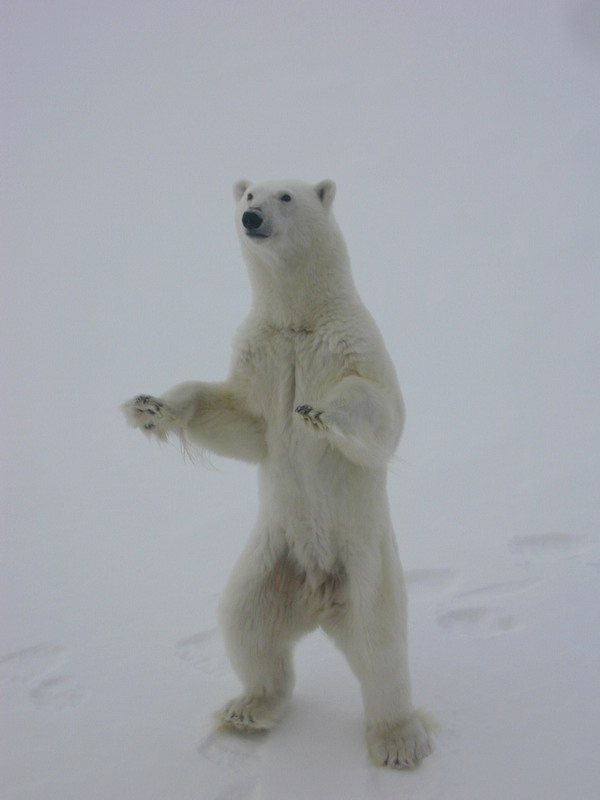
Take it easy! Calm down, stick to the facts! Polar bear photo by Kathy Crane, NOAA Arctic Research Office

“Take it easy! Calm down, stick to the facts!” Polar bear photo by Kathy Crane, NOAA Arctic Research Office

There is no dramatic finding in the release.  After you read it, you’ll probably wonder, too, why climate change skeptics don’t want you to read this press release:

15th meeting of PBSG in Copenhagen, Denmark 2009

PRESS RELEASE

The 15th meeting of the IUCN Polar Bear Specialist Group (PBSG), hosted by the Greenland Institute of Natural Resources, was held at the Greenland Representation in Copenhagen Denmark , June 29-July 3, 2009.  The Polar Bear Specialist Group is composed of researchers and managers representing each of the five circumpolar nations that signed the International Agreement for the Conservation of Polar Bears of 1973.  Since the late 1960s, the members of PBSG have met every 3 to 5 years under the umbrella of the Species Survival Commission of the IUCN (the International Union for the Conservation of Nature and Natural Resources) to review and exchange information, and make recommendations for research and management of polar bears throughout the Arctic.

The PBSG renewed the conclusion from previous meetings that the greatest challenge to conservation of polar bears is ecological change in the Arctic resulting from climatic warming.  Declines in the extent of the sea ice have accelerated since the last meeting of the group in 2005, with unprecedented sea ice retreats in 2007 and 2008. The PBSG confirmed its earlier conclusion that unabated global warming will ultimately threaten polar bears everywhere.

The PBSG also recognized that threats to polar bears will occur at different rates and times across their range although warming induced habitat degradation and loss are already negatively affecting polar bears in some parts of their range. Subpopulations of polar bears face different combinations of human threats.  The PBSG recommends that jurisdictions take into account the variation in threats facing polar bears.

The PBSG noted polar bears suffer health effects from persistent pollutants.  At the same time, climate change appears to be altering the pathways by which such pollutants enter ecosystems. The PBSG encourages international efforts to evaluate interactions between climate change and pollutants.

The PBSG endorses efforts to develop non-invasive means of population assessment, and continues to encourage jurisdictions to incorporate capture and radio tracking programs into their national monitoring efforts. The members also recognized that aboriginal people are both uniquely positioned to observe wildlife and changes in the environment, and their knowledge is essential for effective management.

The PBSG recognizes that where habitats are stable, polar bears are a renewable resource, and reaffirmed its support of the right of aboriginal groups to harvest polar bears within sustainable limits.  The PBSG noted that the population of polar bears in Baffin Bay, shared between Greenland and Canada, may simultaneously be suffering from significant habitat change and substantial over harvest, while at the same time interpretations by scientists and local hunters disagree regarding population status.  Similarly, the Chukchi Sea polar bear population which is shared by Russia and the United States is likely declining due to illegal harvest in Russia and one of the highest rates of sea ice loss in the Arctic. Consistent with its past efforts to coordinate research and management among jurisdictions, the PBSG recommended that the polar bear populations in Baffin Bay and the Chukchi Sea be reassessed and that harvests be brought into balance with the current sustainable yield.

A variety of management changes have occurred since the PBSG last met in 2005.  The PBSG members were particularly pleased that quotas for the harvest of polar bears in Greenland were implemented in January 2006, and that quota reductions have been implemented in some parts of Greenland.  Also since the last meeting, the government of Nunavut reduced the harvest quota in Western Hudson Bay because of the documented population decline.

The PBSG reevaluated the status of the 19 recognized subpopulations of polar bears distributed over vast and relatively inaccessible areas of the Arctic. Despite the fact that much new information has been made available since the last meeting, knowledge of some populations is still poor.  Reviewing the latest information available the PBSG concluded that 1 of 19 subpopulations is currently increasing, 3 are stable and 8 are declining.  For the remaining 7 subpopulations available data were insufficient to provide an assessment of current trend.  The total number of polar bears is still thought to be between 20,000 and 25,000.  However, the mixed quality of information on the different subpopulations means there is much room for error in establishing that range.  That potential for error, given the ongoing and projected changes in habitats and other potential stressors is cause for concern.  Nonetheless, the PBSG is optimistic that humans can mitigate the effects of global warming and other threats to polar bears, and ensure that they remain a part of the Arctic ecosystem in perpetuity.

Dr. Erik Born from the Greenland Institute of Natural Resources was elected as the new chairman of the group after Dr. Andrew Derocher from the University of Alberta, who has been serving as chair since 2005.

Well, there is that proclamation of optimism in the penultimate paragraph, that humans can mitigate threats to bears, including global warming.  Is that why they don’t want you to read it?

How are the polar bears?  They are in trouble.  The Polar Bear Specialist Group says we should help them out, that we can do things to save the bears.  Why would the “skeptics” not want us to know that?

Other resources:

Save


Can’t fool the birds: Migratory birds in North America react to climatic warming

February 12, 2009

Generally it would be an insult to call someone a bird brain.  We may need to revise that thinking.  In contrast to climate change denialists, 177 species of migratory birds in North America have adjusted their migrations because of a warming climate.  The birds know something the denialists don’t.

The news comes from the National Audubon Society, after analysis of 40 years of bird count data.

Migrations has the story, along with the map that is appearing in U.S. newspapers this week.  Cornell University’s ornithology blog, Round Robin, provides history to the study and a couple more links to science reports.

How will denialists spin this?  It’s difficult for them to claim that the birds have been hornswoggled by inaccurate newspaper accounts, since these are not the birds whose cages are lined with newspapers.

Eastern Meadowlark, photo by FWS/John and Karen Hollingsworth

Eastern Meadowlark, photo by FWS/John and Karen Hollingsworth

We don’t have a canary in a mine warning us, this time.  It’s the meadowlark on the prairie. Will we listen, in time?

Eastern and Western Meadowlark: These popular robin-sized grassland birds form winter flocks and always feed on the ground. Neither species has been wintering farther north over the past 40 years, probably because the quality of northern grasslands is not sufficient to support these birds through the winter. The Eastern Meadowlark is one of Audubon’s Common Birds in Decline; its population has plummeted 72% in population over the last 40 years.

Also see this earlier post, “Plants refuse to listen to climate change skeptics.”


Clay Bennett cartoons

December 13, 2007

I love Thomas Nast cartoons, partly for their dated look. They look like they are 100 years old from the style of the art.

For much the same reason, I love Herblock cartoons. They look like the middle of the 20th century. And Pat Oliphant cartoons look like post-Kennedy modern ideas.

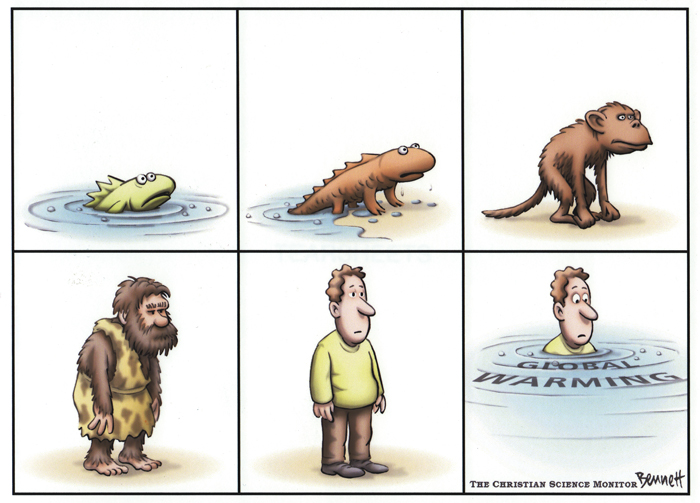
Clay Bennett, winner of the 2007 Curie UN Cartoon Award

Clay Bennett, winner of the 2007 Curie UN Cartoon Award

Clay Bennett cartoons look like 21st century clean to me. There’s a smoothness, a silkiness of color that lends an immediacy to them. They really look good, and they look like they’d project well in a classroom (though I’ve not tried any of Bennett’s, actually).

All four of these cartoonists had or has something to say, too. I’ve enjoyed Bennett’s work in the Christian Science Monitor for some time. His work is clean, but it has a cutting edge that can’t be missed.

So, I was happy to see that he had won a commendation from the Ranan Lurie Cartoon Competition at the UN Correspondents’ Association dinner. Other people see good stuff in his drawings — I’m not alone.

Here’s his UN Lurie award-winning cartoon:

Evolution of Man, to drowning by global warming

Cartoon winner of the 2007 Curie UN Cartoon Award

More of Bennett’s cartoons can be seen here, at the Clay Bennett Archives.

Bennett’s last cartoon in the Monitor was November 17.  The good news:  He’s moving to the Chattanooga Times-Free Press.  We can hope that means one more opening is available for a cartoonist.

One more, below the fold. Read the rest of this entry »