Odd site to defend Peter Gleick’s exposing of Heartlandgate, citing the law that will let him skate

March 18, 2012

Much angst among Heartlandgate perpetrators over the increasingly obvious fact that Peter Gleick not only shouldn’t be prosecuted, but can’t be prosecuted under federal law, for duping Heartland employees into revealing their true intentions, to lie about global warming so people won’t “believe” it and support solutions.

Peter Gleick - World Economic Forum Annual Mee...

Peter Gleick, lifetime of informing the public accurately at a researcher's greatly diminished salary; Heartland Institute is spending thousands of dollars to convince people he changed suddenly. Who to believe? Here's Gleick at the World Economic Forum Annual Meeting Davos 2009 (Photo credit: World Economic Forum)

But this odd site cut through the clutter and posted the words of the relevant law, establishing Peter Gleick’s lack of criminality:

18 U.S.C. 1343:
Whoever, having devised or intending to devise any scheme or artifice to defraud, or for obtaining money or property by means of false or fraudulent pretenses, representations, or promises, transmits or causes to be transmitted by means of wire, radio, or television communication in interstate or foreign commerce, any writings, signs, signals, pictures, or sounds for the purpose of executing such scheme or artifice, shall be fined under this title or imprisoned not more than 20 years, or both….

Did you catch that, Dear Reader?  Gleick would be guilty of federal wire fraud had he asked the perpetrators of Heartlandgate to send him money or property.

But all Gleick asked for was a copy of their agenda for a meeting, and the supporting data.  No money, no property.  Nothing of value.  Nor did he intend to use, nor could he use, any of that information to get money or property.

You noted, of course, the site is one promulgated by the Heartland Institute itself.

(Did they really mean it that way?  Probably not.)

(By the way — you may want to read the actual law from an authoritative source like the Cornell University Law Library’s Legal Information Institute (LII), and not a version filtered by people who deny global warming, nor its severity, nor its causes, or who don’t work to hoodwink gullible politicians.)

Peter Gleick:  Deep Throat of the climate denial scandals.

How can you tell whether you should be concerned, Dear Reader?

For example, if you’re a teacher, should you be concerned that in Heartlandgate, the Heartland Institute reveals itself to be working to “dissuade” science teachers from teaching science?  Or, if you’re just a concerned citizen, should you be concerned that you’ve heard precious little about the analysis of the documents released, from major news outlets?

If you are in any degree confused about who to believe in this issue, or worse, if you are convinced that there is a pattern of skirting of the laws by scientists (contrary to the evidence), you should be concerned that you’re not getting the full story.

More, Resources, Further reading:


Annals of Global Warming: NASA film, Piecing Together the Temperature Puzzle

March 5, 2012

NASA describes the film, “Piecing Together the Temperature Puzzle”:

The past decade has been the hottest ever recorded since global temperature records began 150 years ago. This video discusses the impacts of the sun’s energy, Earth’s reflectance and greenhouse gasses on global warming.
Credit: NASA
Vital Signs of the Planet: Global Climate Change and Global Warming. Current news and data streams about global warming and climate change from NASA.

Vodpod videos no longer available.

Piecing Together the Temperature Puzzle, posted with vodpod

More NASA climate films, here, at Climate Reel.


Debunking claims of climate hoaxes, or evidence of the End of Civilization as We Know It

March 1, 2012

Found this on the Grist site today:

Grist infographic:  Idea of climate change hoax makes no sense

Grist infographic: Idea of climate change hoax makes no sense

The problem?  Far too many people not only don’t weigh ideas to see if they make sense, but instead they actively seek out ideas, no matter how crazy, just because they like the concept.

In short, the fact that such a chart is necessary at all suggests that it may not be useful.  Anyone who had the common sense to figure out that the globe is warming, and the scientists who say so are mostly honest as the day is long (and warm), won’t accept the judgment of Grist, either.

I mean, Peter Gleick exposed the immoral and perhaps illegal acts of the so-called Heartland Institute, virtually walking through the front door of the group’s offices and asking, “Will you show me all your dirty work?”  John Mashey’s painstaking work confirms Gleick’s blowing the whistle on Heartland, and Heartland’s fellow travelers.

What has Heartlandgate brought?  Heartland is spending thousands of dollars on a public relations campaign to impugn Gleick, and widely-read sites like the anti-science Watts Up get suckered in (well, Heartland was paying for Anthony Watts’ pet project . . . what should we expect?).  Even Andrew Revkin at his New York Times Blog can’t find his way to label actions as they should be labeled.

Will it make a difference to state the facts, the common sense version of reality?  My actual hope is that I am in error, and that such a graphic, if pasted around the internet, will make a difference.

Is my hope wholly misplaced?

Update:  At the Washington Post blogs, Stephen Stromberg wrote that Gleick erred by failing to follow the rule that climate scientists must be more than twice as morally straight as the “skeptics.”  I’m not convinced Gleick erred; he’s done yeoman service to exposing the truth.  I’m struggling to find any illegal act he committed.  Heartland claims there may be some fraud, but not all the elements of any crime of fraud are present.  If, as Heartland argues, the documents are fakes, there was no value lost.  If, as most of us suspect, the documents are not fakes, I still see no harm to Heartland in their having their feet held the fire on being honest with the IRS and the public.  Heartland claims an absolute right to fib to the public, and somehow Mr. Gleick interfered?  Where’s the harm to the public good?  Certainly not in exposing Heartland’s dark secrets.  No harm, no crime, in this case.


Annals of Global Warming: 2011 comes in as 9th warmest year ever recorded

January 19, 2012

If global warming is not reality, if the anti-warmists are to be found correct, we’re going to need some great cooling to start happening, very, very quickly!

From NASA today:

NASA Finds 2011 Ninth Warmest Year on Record

RELEASE : 12-020, January 19, 2012

WASHINGTON — The global average surface temperature in 2011 was the ninth warmest since 1880, according to NASA scientists. The finding continues a trend in which nine of the 10 warmest years in the modern meteorological record have occurred since the year 2000.

NASA’s Goddard Institute for Space Studies (GISS) in New York, which monitors global surface temperatures on an ongoing basis, released an updated analysis that shows temperatures around the globe in 2011 compared to the average global temperature from the mid-20th century. The comparison shows how Earth continues to experience warmer temperatures than several decades ago. The average temperature around the globe in 2011 was 0.92 degrees F (0.51 C) warmer than the mid-20th century baseline.

“We know the planet is absorbing more energy than it is emitting,” said GISS director James E. Hansen. “So we are continuing to see a trend toward higher temperatures. Even with the cooling effects of a strong La Nina influence and low solar activity for the past several years, 2011 was one of the 10 warmest years on record.”

The difference between 2011 and the warmest year in the GISS record (2010) is 0.22 degrees F (0.12 C). This underscores the emphasis scientists put on the long-term trend of global temperature rise. Because of the large natural variability of climate, scientists do not expect temperatures to rise consistently year after year. However, they do expect a continuing temperature rise over decades.

The first 11 years of the 21st century experienced notably higher temperatures compared to the middle and late 20th century, Hansen said. The only year from the 20th century in the top 10 warmest years on record is 1998.

Higher temperatures today are largely sustained by increased atmospheric concentrations of greenhouse gases, especially carbon dioxide. These gases absorb infrared radiation emitted by Earth and release that energy into the atmosphere rather than allowing it to escape to space. As their atmospheric concentration has increased, the amount of energy “trapped” by these gases has led to higher temperatures.

The carbon dioxide level in the atmosphere was about 285 parts per million in 1880, when the GISS global temperature record begins. By 1960, the average concentration had risen to about 315 parts per million. Today it exceeds 390 parts per million and continues to rise at an accelerating pace.

The temperature analysis produced at GISS is compiled from weather data from more than 1,000 meteorological stations around the world, satellite observations of sea surface temperature and Antarctic research station measurements. A publicly available computer program is used to calculate the difference between surface temperature in a given month and the average temperature for the same place during 1951 to 1980. This three-decade period functions as a baseline for the analysis.

The resulting temperature record is very close to analyses by the Met Office Hadley Centre in the United Kingdom and the National Oceanic and Atmospheric Administration’s National Climatic Data Center in Asheville, N.C.

Hansen said he expects record-breaking global average temperature in the next two to three years because solar activity is on the upswing and the next El Nino will increase tropical Pacific temperatures. The warmest years on record were 2005 and 2010, in a virtual tie.

“It’s always dangerous to make predictions about El Nino, but it’s safe to say we’ll see one in the next three years,” Hansen said. “It won’t take a very strong El Nino to push temperatures above 2010.”

For more information on the GISS temperature analysis, visit:

http://data.giss.nasa.gov/gistemp

– end –


text-only version of this release

Tip of the old scrub brush to Rashid’s Blog.


EU charges airlines for carbon emissions on flights to Europe; airlines, other nations rankled

January 10, 2012

Been to court once, looks like it’s going again.  The Economist reported this week:

AS OF January 1st, American, Chinese and all the world’s airlines are being billed for the carbon emissions of their flights into and out of the European Union. About time, too: airlines contribute 2-3% of global emissions, yet they were hitherto free to pollute. The European initiative, which brings airlines into the EU’s existing cap-and-trade regime, the Emissions Trading Scheme (ETS), is a modest corrective. The hope is that it will speed the creation of a long-promised, more ambitious successor, governing all the world’s airspace.

Foreign airlines, needless to say, are unhappy. So are their governments. Because flights into the EU have been included in their entirety, not just the portion within European airspace, they detect an infringement of their sovereignty. Last month, in response to a suit from an American industry body, Airlines for America (A4A), the European Court of Justice dismissed that concern. A4A, which claims, improbably, that the scheme will cost its members more than $3 billion by 2020, may file a fresh suit in the High Court in London.

Especially hopping mad are warming denialists, who fear that charges for carbon emissions will cause emitters to reduce emissions, which might have an effect on global warming, thereby making the denialists out to be wrong.

Better not to be proven wrong than to have a cleaner planet, they reckon.


Why we worry about global warming: It ain’t the climate, it’s the people

January 9, 2012

Alun Salt gave great advice about not bothering to engage idiots, pigs, denialists or trolls (here, among other places).  He said I should avoid lengthy answers to blogs that have little audience.

This is probably one of those occasions.

But in a running attempt to stimulate serious thought at a denialist blog, I got a question that has been rather common, and a question which indicates the deep serious misunderstanding denialists and even some well-meaning, overly-skeptical sensible people have:

Why worry about  climate change, since the climate is changing all the time?  Especially, why are people like Al Gore urging that we stop climate change, when CO2 has no great direct effect on human health?  Shouldn’t environmentalists be cheering climate change on, since it’s a “natural process?”

The answer is lost on the other blog, as Mr. Salt predicted it would be.  But since I’ve gotten some version of the question repeatedly in the last month, I may as well repeat the answer here, for the record.

The short answer to why we worry about climate change is that, as with almost all environmental protection, we are worried first about the quality of life of humans, and ultimately about the ability of human life to survive at all.

Here’s the question put to me there:

Ed I’m a little confused. I thought we were talking about the effect of co2 on the climate not the effect of co2 on human health. Co2 is not a toxic gas and would have no effect on human health. The fact that humans weren’t around when co2 was 10-20 times higher has absolutely nothing to do with its effect on climate.
Ed there was no runaway greenhouse effect or climate catastrophe. The planet was fine during the phanerazoic. There is actually a lack of co2 in the atmopshere comapred to that time.

Here’s my answer, with a few more links than their format would allow:

No, you’re not a little confused.  You’re a lot confused, greatly misinformed, and not thinking hard.

We worry about CO2’s effects on climate only because we worry about the future of humanity.  Many of us who have children and wish them the same blessings of having children and grandchildren, have thought through the truth of the matter that we don’t possess and rule the Earth for ourselves, but instead act only as stewards for future generations.

No Earth, no humans; but at the same time, no habitable Earth, no humans.  In the long run, Earth doesn’t care.  It’ll do fine — without humans.

We can’t damage the planet.  We can only damage its habitability for humans.

I don’t know what sort of dystopian Randian future you and other Do Nothings hope for, but it’s a future contrary to human life, American values, and all known religions.

We’re talking about the future of humans.  I tell “skeptics,” “If you don’t care, butt out.  You’ll be dead in the short run anyway, but that’s no reason to stand in the way of action not to ensure a livable planet for our grandchildren.”

You also fail to understand chemistry, pollution, and how the world works.  CO2 is indeed a toxic gas.  For about a century now we’ve had indoor air standards that require air circulation to keep CO2 down below concentrations of about 500 ppm, because at that level it starts to have dramatic effects on humans working.  It clouds their thinking and causes drowsiness.  CO2 is a conundrum, in that it is also necessary to trigger mammalian breathing.  If CO2 drops too low, we don’t take in enough oxygen and may pass out.  Too much oxygen in place of CO2 is a problem in that regard.  A substance can be both essential and a  pollutant, at the same time. (This has vexed food safety experts for years, especially after the 1958 Delaney Clause; substances we know to be essential nutrients can be carcinogenic, in the same concentrations, or in the same concentrations with a slight twist in chemical formula — how do we regulate that stuff?)

CO2 is toxic in much greater proportions — it was a CO2 cloud that killed thousands in Cameroon 30 years ago or so, if you know history.

Clearly you did not know that we’ve regulated indoor CO2 for decades.  Clearly you haven’t looked at the medical journals‘ discussion on CO2 — and I’ll wager you’d forgotten the Cameroon incident, if you ever knew about it.

CO2 is a toxic gas (the dose is the poison); CO2 has dramatic effects on human health — too little and we die, too much and we die.

The fact that humans were not around when CO2 was much higher is exactly the point.  That was presented here, as it is in most venues, as support for a claim that we don’t need to worry about CO2 pollution.  Well, that’s right — if we don’t care about a habitable Earth.  But when CO2 was higher, life for humans was impossible.

I think it’s reckless to run an experiment on what would happen with higher CO2 levels, using the entire planet as a testing place, and testing the hypotheses on just how much CO2 will kill us all off, and how.

How about a control group, at least?

In the past, massive CO2 created massive greenhouse effects that would devastate us today — not as a toxic gas, but as a result of the warming that greenhouse gases do.

Let us understand the physical conundrum of CO2 here:  Without the greenhouse effect from the human-historic levels of CO2, this would be an ice planet.  Our lives today depend on the greenhouse effects of CO2.

Consequently, anyone who claims there is no greenhouse effect fails to understand physics, chemistry, biology and history.  (Heck, throw in geology, too.)  Life would be impossible but for the greenhouse effect.  Life is impossible without water, too, but you can’t live totally surrounded by water.

Can it be true that there can never be too much of a good effect, with regard to greenhouse gases?  Ancient Greek ideas of “all things in moderation” applies here.  We need a Goldilocks amount of CO2 in our atmosphere — not to much, not too little; not too hot, not too cold.

To the extent that higher CO2 levels didn’t produce a total runaway greenhouse effect, as some hypothesize exists on Venus, we know that was due to other feedbacks.  Early on, for example, CO2 began to be reduced by photosynthesizing life.  Animal life today would be impossible but for that occurrence.  Few if any modern chordates could breathe the very-low oxygen atmosphere of the early Earth, and live.  Those feedbacks and limiting situations do not exist today.

So now we face a double or triple whammy.  The reduction in CO2 in the air was accomplished through a couple billion years of carbon sequestration through plants.  In fact, a lot of carbon was sequestered in carbon-rich fossils, stuff we now call coal and oil.  Oxygen replenishment was accomplished with massive forests, and healthy oceans, with a great deal of photosynthesis.  This created a rough CO2 equilibrium (with fluctuations, sure) that existed we know for at least the last 50,000 years, we’re pretty sure for the last 100,000 years (we know that from carbon-dating calibration exercises).

Today we have removed fully 30% of the forests that used to replenish oxygen and lock up a lot of CO2 (some estimates say 50% of the forests are gone); modern plant communities cannot pluck CO2 out fast enough.  Plus, we’re releasing a lot of that old, sequestered carbon in coal and oil — at rates unprecedented in human history.

Will more CO2 warm the planet?  We know from the fact that the planet is warm enough for life, that more CO2 will warm the planet more.  Anyone who says differently does not know physics and chemistry, nor history.

Is there anything that can stop that effect?  Sure — healthy, massive forests, and healthy oceans.  Reducing carbon emissions could help a lot, too.  But we’re committed for about a century.  CO2 in the atmosphere doesn’t fall to the ground like particulate pollution.  it drifts until it is incorporated into something else, either through photosynthesis or other chemical reactions.  It takes a mole of CO2 a couple of centuries to come out of the air.  We’re stuck with elevated and elevating CO2 regardless our actions, for a century or two, even if we are wildly successful in reining in emissions and creating sequestration paths.

What happens when CO2 levels get higher than 350 ppm?  History, physics and chemistry tells us glaciers will melt, rainfall patterns will alter dramatically, sea levels will rise, carbon will be absorbed by the seas in increasing amounts (causing acidification — simple chemistry).

It’s a very exciting experiment.  The entire human race is at stake. How much CO2 will it take to produce the effects that kill us all?  It’s likely that changing rainfall patterns and rising sea levels will produce wars over resources, long before CO2 itself starts being physically toxic.  That’s what the Pentagon’s big thinkers say.  That’s what the Chinese big thinkers say, which is why they are working to reduce emissions even without an enforceable treaty.

As experiments go, I think it’s immoral to use humans in experimentation without getting their consent, and without passing the entire experiment through the Institutional Review Board to make sure the experiment is useful, necessary, and done ethically.

Do you have those consent statements?  All seven billion of them?  Have you got approval from the research overseers of the institution?

If you don’t have permission to proceed with this progeny-killing experiment, why do you propose to proceed?  Many people believe that, if the courts on Earth don’t get us, a higher court will.

How will you plead wherever the call to justice is delivered?


Annals of global warming: NASA press release, 2010 tied as warmest year on record

December 31, 2011

Certain things need to be on the record, in the annals.  Last January I failed to post this press release from NASA, issued January 11, 2011:

NASA Research Finds 2010 Tied for Warmest Year on Record

01.12.11
WASHINGTON — Global surface temperatures in 2010 tied 2005 as the warmest on record, according to an analysis released Wednesday by researchers at NASA’s Goddard Institute for Space Studies (GISS) in New York.

The two years differed by less than 0.018 degrees Fahrenheit. The difference is smaller than the uncertainty in comparing the temperatures of recent years, putting them into a statistical tie. In the new analysis, the next warmest years are 1998, 2002, 2003, 2006, 2007 and 2009, which are statistically tied for third warmest year. The GISS records begin in 1880.

The analysis found 2010 approximately 1.13 F warmer than the average global surface temperature from 1951 to 1980. To measure climate change, scientists look at long-term trends. The temperature trend, including data from 2010, shows the climate has warmed by approximately 0.36 F per decade since the late 1970s.

“If the warming trend continues, as is expected, if greenhouse gases continue to increase, the 2010 record will not stand for long,” said James Hansen, the director of GISS.

The analysis produced at GISS is compiled from weather data from more than 1000 meteorological stations around the world, satellite observations of sea surface temperature and Antarctic research station measurements. A computer program uses the data to calculate temperature anomalies — the difference between surface temperature in a given month and the average temperature for the same period during 1951 to 1980. This three-decade period acts as a baseline for the analysis.

The resulting temperature record closely matches others independently produced by the Met Office Hadley Centre in the United Kingdom and the National Oceanic and Atmospheric Administration’s National Climatic Data Center.

The record temperature in 2010 is particularly noteworthy, because the last half of the year was marked by a transition to strong La Niña conditions, which bring cool sea surface temperatures to the eastern tropical Pacific Ocean.

“Global temperature is rising as fast in the past decade as in the prior two decades, despite year-to-year fluctuations associated with the El Niño-La Niña cycle of tropical ocean temperature,” Hansen and colleagues reported in the Dec. 14, 2010, issue of Reviews of Geophysics.

A chilly spell also struck this winter across northern Europe. The event may have been influenced by the decline of Arctic sea ice and could be linked to warming temperatures at more northern latitudes.

Arctic sea ice acts like a blanket, insulating the atmosphere from the ocean’s heat. Take away that blanket, and the heat can escape into the atmosphere, increasing local surface temperatures. Regions in northeast Canada were more than 18 degrees warmer than normal in December.

The loss of sea ice may also be driving Arctic air into the middle latitudes. Winter weather patterns are notoriously chaotic, and the GISS analysis finds seven of the last 10 European winters warmer than the average from 1951 to 1980. The unusual cold in the past two winters has caused scientists to begin to speculate about a potential connection to sea ice changes.

“One possibility is that the heat source due to open water in Hudson Bay affected Arctic wind patterns, with a seesaw pattern that has Arctic air downstream pouring into Europe,” Hansen said.

For more information about GISS’s surface temperature record, visit:
http://data.giss.nasa.gov/gistemp/

A Warming World
http://climate.nasa.gov/warmingworld/

Global Temperatures Animation
http://svs.gsfc.nasa.gov/vis/a000000/a003600/a003674/index.html


Annals of Global Warming: Planetary energy budget, for beginners, and climate engineering — from GAO

December 28, 2011

From the General Accountability Office, an arm of Congress, a report to the House Committee on Science, Space and Technology.

Aug 25, 2011
01:16

Global Average Energy Budget of the Earth’s Atmosphere

In eight steps, this animation depicts the path of sunlight that enters the planet’s atmosphere, illustrating how that radiation is reflected, absorbed, and emitted as heat energy.

In less than 90 seconds, an animated, graphic description of how and why global warming occurs.  You didn’t get it in 90 seconds?  Watch it again.  This video was made to accompany a GAO report on climate engineering. (Emphasis added, in red.)

Climate Engineering: Technical Status, Future Directions, and Potential Responses

GAO-11-71, Aug 25, 2011

[135-page report, in .pdf, here]

Summary:  Reports of rising global temperatures have raised questions about responses to climate change, including efforts to (1) reduce carbon dioxide (CO2) emissions, (2) adapt to climate change, and (3) design and develop climate engineering technologies for deliberate, large-scale intervention in Earth’s climate. Reporting earlier that the nation lacks a coordinated climate-change strategy that includes climate engineering, GAO now assesses climate engineering technologies, focusing on their technical status, future directions for research on them, and potential responses. To perform this technology assessment, GAO reviewed the peer-reviewed scientific literature and government reports, consulted experts with a wide variety of backgrounds and viewpoints, and surveyed 1,006 adults across the United States. Experts convened with the assistance of the National Academy of Sciences advised GAO, and several reviewed a draft of this report. GAO incorporated their technical and other comments in the final report as appropriate.

Climate engineering technologies do not now offer a viable response to global climate change. Experts advocating research to develop and evaluate the technologies believe that research on these technologies is urgently needed or would provide an insurance policy against worst case climate scenarios–but caution that the misuse of research could bring new risks. Government reports and the literature suggest that research progress will require not only technology studies but also efforts to improve climate models and data. The technologies being proposed have been categorized as carbon dioxide removal (CDR) and solar radiation management (SRM). CDR would reduce the atmospheric concentration of CO2, allowing more heat to escape and thus cooling the Earth. For example, proposed CDR technologies include enhancing the uptake of CO2 in oceans and forests and capturing CO2 from air chemically for storage underground. SRM technologies would place reflective material in space or in Earth’s atmosphere to scatter or reflect sunlight (for example, by injecting sulfate aerosols into the stratosphere to scatter incoming solar radiation or brightening clouds) or would increase the planet’s reflectivity (for example, by painting roofs and pavements in light colors). GAO found these technologies currently immature, many with potentially negative consequences. Some studies say, for example, that stratospheric aerosols might greatly reduce summer precipitation in places such as India and northern China. Many experts advocated research because of its potential benefits but also recognized its risks. For example, a country might unilaterally deploy a technology with a transboundary effect. Research advocates emphasized the need for risk management, envisioning a federal research effort that would (1) focus internationally on transparency and cooperation, given transboundary effects; (2) enable the public and national leaders to consider issues before they become crises; and (3) anticipate opportunities and risks. A small number of those we consulted opposed research; they anticipated major technology risks or limited future climate change. Based on GAO’s survey, a majority of U.S. adults are not familiar with climate engineering. When given information on the technologies, they tend to be open to research but concerned about safety.

Transcript of the video, describing each slide, below the fold.

Read the rest of this entry »


Human extinction? Nature doesn’t care

December 22, 2011

Some of the cartoonists get it.  Mother Earth will survive human extinction; it’s humans who will suffer if we don’t work to save ourselves.

Tim Eagan in Deep Cover, December 15, 2011:

Tim Eagan's Deep Cover, on Durban Climate Conference, December 15, 2011

Tim Eagan’s Deep Cover, on Durban Climate Conference, December 15, 2011; go to Eagan’s site for a larger view of the original

That’s right:  Contrary to conservative and warming denialist blather, it is environmentalists who are the humanitarians in this unfortunate-to-have, unnecessary discussion.

Eagan is another recovering lawyer, ten points to his favor.  Is there any publication that regularly features his work?  I don’t know.  There should be many.

Update:  If you’re visiting the Bathtub for the first time, be sure not to miss the link at the top, to go to this cartoon.

Tip of the frozen-but-thawing scrub brush to Devona Wyant.


Schneider on global warming, Parts 1, 3 and 4

December 12, 2011

Earlier I posted a video of Stanford’s late Dr. Stephen Schneider in a meeting with Australian climate “skeptics.”  It was one of a four-part series, Part 2, to be precise.

Here are the other parts.  They are excerpted from an Australian television program, “Insight,” taped in June 2010.

Part 1:

Links promised in the video above can be found below the fold.
764

Part 2 is here, in a previous post.

Part 3:

742

Part 4:

479

Read the rest of this entry »


Stephen Schneider explains global warming so even a “skeptic” can get it

December 12, 2011

Impressive.  Schneider explains, to Australian “skeptics,” how CO2 accumulates in the atmosphere, why that’s bad, what the urban heat island effect is and why it does not negate temperature measures that show global warming.  He savages the argument about CO2’s “logarithmic” absorption characteristics negating scientists’ findings.

Sadly, Dr. Schneider died a few weeks after this was taped in 2010.

This is, I see, part 2 of a 4 part series.  Hmmm.  WhHere are the other parts?.


Annals of Global Warming: It didn’t start with the hockey stick . . .

December 12, 2011

Peter Sinclair comes through with a good explanation of the history of concern about global warming — how the warming trend was discovered.

It wasn’t scientists trying to get government grants.  It was the U.S. Air Force, trying to beat the commies and keep America safe for democracy and, ironically, safe for dissent from such applications of science.


9,996

Real history couldn’t be published as fiction, which is one way we can tell real history from the stuff that gets made up.  In the story told in this video, note carefully the serendipity of figuring out the CO2 issues:  Who could invent a story about warfare leading to the discovery of global warming?  As with the coincidence of John Adams and Thomas Jefferson both dying on the 50th anniversary of the Declaration of Independence, no editor of fiction would accept it as believable.

More:

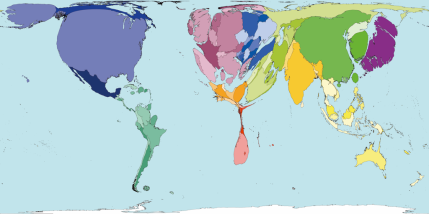
Why we worry, why policy makers are involved:  Carbon Emissions, 2000 – from WorldMapper, with a serendipitous tip of the old scrub brush to Petra Tschakert at Penn State.

Carbon emissions 2000, from worldmapper.org - creative commons license

Carbon Emissions 2000, from worldmapper.org - creative commons license

Carbon Emissions 2000 © Copyright 2006 SASI Group (University of Sheffield) and Mark Newman (University of Michigan). “We welcome use of our maps under the Creative Commons conditions by educational, charitable and other non-profit organisations.”

Stupid-Boy-Cries- “Wolf” Department: Thieves release more e-mails stolen from climate scientists

November 23, 2011

In his clear style, Tim Lambert at Deltoid lays out the basic facts:

Some more of the emails stolen from the Climate Research Centre in 2009 have been released. This time they are accompanied by a readme with out-of-context quotes that asserts the purpose of the release is information transparency, but that’s an obvious lie, since they’ve sat on them for two years and released them just before Durban conference. The timing suggests that the people behind the theft and release have a financial interest in preventing mitigation of greenhouse gas emissions. It is most unlikely that there is anything incriminating in these emails — if there was, it would have been released two years ago.

Gavin Schmidt is providing context for the emails, Brendan DeMelle has an extensive roundup and Stephan Lewandowsky writes about the real scandal.

I remind readers that the last round revealed wrong-doing only by accomplices and friends of the thieves, and revealed no wrong-doing on the part of climate scientists.

Especially, the last round revealed no data to show warming is not happening, nor any data to show anything but righteous and noble concern to mitigate or stop the human contribution to the pollution that causes unnatural global warming.  This round of releases will do the same, I predict.

Joe Romm illustrated his post on the issue (which you will want to read) with this cartoon from Drew Sheneman of the Newark Star-Ledger:

Drew Sheneman, Newark Star-Ledger, on politics around findings of global warming

Drew Sheneman, Newark Star-Ledger, on politics around findings of global warming; polar bears won't read the stolen e-mails, refuse to be convinced findings of warming comprise a hoax

(Does anyone have the date on that cartoon?  Is it, like this one from Tom Toles, so old it indicates denialists do nothing new under the sun?)

In the two years since the last release of stolen e-mails, a few hundred studies on global warming have been published confirming the fact that warming occurs, and confirming the links to human activity as a cause of unnatural warming.  Even Anthony Watts’s work was published, but when analyzed, it also showed global warming and not miscalculations of data or misreadings of data  (Watts denies the results from his data).

So, in two years, climate change denialists have been unable to find any significant chunk of data to support any of their claims, while the planet continues to warm at an increasingly alarming rate. 

How many times do we allow the miscreant to call “wolf” falsely?  Why would we believe him on any other issue?

More, Resources: 


What were scientists saying about global warming in 1971?

November 3, 2011

What did scientists know and say about climate change and global warming in the 1970s?  I keep running into claims by modern climate change denialists that scientists in the 1970s firmly predicted a pending ice age.  This is usually posited to establish that scientists are fools, and that concerns about warming now are probably displaced because the same scientists were in error 40  years ago.

I worked in air pollution studies way back then.  That’s not how I remember it at all.  I remember great, good-natured debates between Ph.Ds in the Department of Biology at the University of Utah, and other scientists from other institutions passing through and working in the field with us.  Greenhouse effect was very well understood even back then, and the discussions were on the nature of just how much human pollution would affect climate, and in which way.

Savvy scientists then well understood that there were two competing trends in air pollution:  Greenhouse gases and particulates and aerosols.  Greenhouse gases would warm the climate, but they were offset by particulates and aerosols that reflect solar radiation back into space before warming can occur.  At least, back then, the particulates and aerosols counteracted the greenhouse gases.

Manhattan skyline enveloped in heavy smog, May 1973: Chester Higgins/NARA. via Mother Jones

EPA collection, Manhattan skyline enveloped in heavy smog, May 1973: Chester Higgins/NARA. via Mother Jones

Looking for something else, I took off my shelf a book we used as a text in air pollution courses at the University of Utah in the 1970s, Whatever Happened to Fresh Air? by Michael Treshow.  Treshow taught at Utah.  He was deeply involved in several research projects on air pollution.  He was also a great conversationalist and competitive tennis player.  His book was a good text, but he intended it to be read by lay people, especially policy makers, also.  It’s easy to fathom, intentionally so.

Here, below, is what Treshow wrote in the early pages about carbon dioxide as an air pollutant, in sketching the global problems of air pollution.  Notice that, while he makes note of the predictions of what would happen with uncontrolled particulate and aerosol pollution, he gives the science straight up, telling what pollution can do, depending on local circumstances and global circumstances.  Treshow notes the research that the denialists cite now, but he explains enough of the science so that any reasonable person should be able to see that, if one form of pollution is controlled and another is not, the effects might be different.

Michael Treshow:

Over the past several million years, the earth’s animal and plant life have reached a workable equilibrium in sharing this atmosphere and keeping the oxygen and carbon dioxide concentrations in balance.  But man, by burning fossil fuels (particularly coal) at an accelerated rate and by removing vegetation at the prodigious rate of 11 acres per second in the U.S., may be upsetting this equilibrium.  Many scientists believe this carbon dioxide build-up is one of the major threats to man’s environment.

Carbon dioxide (CO2) is occasionally regarded as an air pollutant for this reason, even though it is a natural and essential component of the atmosphere.  Certainly the present concentrations are not dangerous; but what would happen if the amount of carbon dioxide in the atmosphere should increase appreciably?  What hazards would be imposed?

An increase in carbon dioxide would benefit the green plants since they need it for photosynthesis.  But what effect would it have on man and animals?  Or on the physical environment?  The main hazard lies in the effect that carbon dioxide has in absorbing the infrared radiation which normally radiates from the earth back to the atmosphere.  If the carbon dioxide content of the lower atmosphere were to increase, it would prevent the infrared heat absorbed by the earth from the sun from reradiating into the atmosphere.  Heat energy would accumulate and cause a general increase in the earth’s temperature.  Such an increase in temperature, often called the “greenhouse effect,” could cause the ice caps to melt, raising the level of the oceans and flooding most of the world’s major cities.

It is awesome to realize that sea level is actually rising.  It is now 300 feet above what it was 18,000 years ago, and is reportedly rising nearly nine inches higher each century.  Beaches are being wasted away and tides lap ever closer to the steps of coastal homes.  But is the displacement of our beaches more closely related to increasing carbon dioxide concentrations or to the normal warming process between ice ages?

Not everyone agrees that carbon dioxide is to blame.  Concentrations vary greatly around the world.  Near urban areas, where fossil fuels are burned, concentrations are high; over forested areas, where plants are rapidly removing the gas, they are low.  Concentrations also vary with the height above the ground, the latitude, whether over the ocean or land and even with the time of day and season of the year.  All of these variables make it difficult to agree on a reasonable average carbon dioxide concentration.

Despite some disagreement, it is generally conceded that carbon dioxide has been added to the atmosphere at an alarming rate during the past century.  Actual measurements show that between 1857 and 1956, carbon dioxide concentrations increased from an average of 0.0293 to 0.0319 percent; 360 X [10 to the 9th] tons of carbon dioxide have been added to the atmosphere by man during this period.  Upwards of a trillion tons will be added by the year 2000.  Such  a tremendous release of carbon dioxide would increase the atmospheric concentrations appreciably unless some mechanism is available to absorb the surplus and to maintain equilibrium.

Extensive measurements suggest that carbon dioxide concentrations near the earth’s surface have increased about 10 percent since 1900.  During this same time, fossil fuel consumption increased about 15 percent.  This is a remarkably, close, meaningful relationship.  The 5 percent difference is readily accounted for, since this much would be absorbed by the ocean or by rocks and living organisms, particularly plants, which absorb much of the surplus carbon dioxide.  In fact, green plants probably have the capacity to absorb and utilize far more carbon dioxide than man is likely to release.

Calculations presented by Gordon MacDonald of the University of California at Santa Barbara show that a 10 percent increase in the total carbon dioxide content theoretically should cause an increase of 0.4° F in the average temperature of the earth.  Although the carbon dioxide content is being increased about 0.06 percent each year by the combustion of fossil fuels, no temperature increase has been demonstrated.  Rather, the average temperature appears to be decreasing.  During the past 25 years, when the addition of carbon dioxide has been most rapid, the average temperature has dropped half a degree.

This temperature drop has been thought to result from the increase in the amount of submicron sized particulates which remain suspended in the atmosphere. These aerosols obstruct the entrance of the sun’s heat and light rays, thereby disrupting the earth’s energy balance.  The effect is one of less heat and lower temperatures.  Dr. William E. Cobb of the National Oceanic and Atmospheric Agency predicts the possibility of another ice age.

Whatever Happened to Fresh Air, Michael Treshow, University of Utah Press, 1971, pp. 3-6.

What changed since then?  The Clean Air Act provided the legal drive to clean particulates and aerosols out of the air.  Alas, we did not then have good controls for greenhouse gases.  The success of the Clean Air Act, and similar laws worldwide, rather left the pollution field open for greenhouse gases.  Without pollution to offset the effects of GHG, warming became the stronger trend.

I think Treshow was quite prescient back then.  His work is still accurate, when we adjust for the events of history that came after he wrote the book.

Time Magazine cover for January 27, 1967, photo by Larry Lee. The photo shows a typical Los Angeles day at 3:30 p.m., with photochemical smog restricting visibility dramatically. Particulate pollution, and sulfates, added to the visibility problems, and made air pollution a greater health hazard. An accompanying story was titled,

Time Magazine cover for January 27, 1967, photo by Larry Lee. The photo shows a typical Los Angeles day at 3:30 p.m., with photochemical smog restricting visibility dramatically. Particulate pollution and sulfates added to the visibility problems, and made air pollution a greater health hazard. An accompanying story was titled, “Ecology: The Menace in the Skies.”

It’s popular among those opposed to the science of climate change to claim scientists don’t know what they’re talking about, because ‘back in the 1970s they predicted a new ice age, and they were wrong.’

Dr. Treshow’s book presents the state of the science of air pollution in the early 1970s. He didn’t “predict” an ice age. He noted that particulate pollution was a major problem, and that particulates and other pollution created a cooling effect that could offset and perhaps overpower the warming effects of CO2, as he discusses in the passage above. In lay terms, in a few brief passages, Treshow notes the conflicting results of different types of pollution.

CO2’s warming effects were well known, and acknowledged. If particulates and other aerosols won the battle to pollute the skies, the Earth would cool. If GHGs won the battle, the Earth would warm.

Claiming scientists “predicted” an ice age tells only half the story, and thereby becomes a grossly misleading, whole lie.

More:


Annals of Global Warming: Arctic ice at second lowest level ever measured

October 12, 2011

Two years ago warming denialists claimed the Earth is actually cooling, and they predicted dramatic cooling by late 2010.

Instead, warming continues, overcoming the temporary mediation caused by increased particulate and sulfate emissions from coal burned in uncontrolled fashion in China, as evidence by things like the continued shrinking of Arctic ice below 20th century averages.  See this press release from NASA:

RELEASE : 11-337 – October 4, 2011

 Arctic Sea Ice Continues Decline, Hits Second-Lowest Level

WASHINGTON — Last month the extent of sea ice covering the Arctic Ocean declined to the second-lowest extent on record. Satellite data from NASA and the NASA-supported National Snow and Ice Data Center (NSIDC) at the University of Colorado in Boulder showed that the summertime sea ice cover narrowly avoided a new record low.

The Arctic ice cap grows each winter as the sun sets for several months and shrinks each summer as the sun rises higher in the northern sky. Each year the Arctic sea ice reaches its annual minimum extent in September. It hit a record low in 2007.

The near-record ice-melt followed higher-than-average summer temperatures, but without the unusual weather conditions that contributed to the extreme melt of 2007. “Atmospheric and oceanic conditions were not as conducive to ice loss this year, but the melt still neared 2007 levels,” said NSIDC scientist Walt Meier. “This probably reflects loss of multiyear ice in the Beaufort and Chukchi seas as well as other factors that are making the ice more vulnerable.”

Joey Comiso, senior scientist at NASA’s Goddard Space Flight Center in Greenbelt, Md., said the continued low minimum sea ice levels fits into the large-scale decline pattern that scientists have watched unfold over the past three decades.

“The sea ice is not only declining, the pace of the decline is becoming more drastic,” Comiso said. “The older, thicker ice is declining faster than the rest, making for a more vulnerable perennial ice cover.”

While the sea ice extent did not dip below the 2007 record, the sea ice area as measured by the microwave radiometer on NASA’s Aqua satellite did drop slightly lower than 2007 levels for about 10 days in early September, Comiso said. Sea ice “area” differs from extent in that it equals the actual surface area covered by ice, while extent includes any area where ice covers at least 15 percent of the ocean.

Arctic sea ice extent on Sept. 9, the lowest point this year, was 4.33 million square kilometers (1.67 million square miles). Averaged over the month of September, ice extent was 4.61 million square kilometers (1.78 million square miles). This places 2011 as the second lowest ice extent both for the daily minimum extent and the monthly average. Ice extent was 2.43 million square kilometers (938,000 square miles) below the 1979 to 2000 average.

This summer’s low ice extent continued the downward trend seen over the last 30 years, which scientists attribute largely to warming temperatures caused by climate change. Data show that Arctic sea ice has been declining both in extent and thickness. Since 1979, September Arctic sea ice extent has declined by 12 percent per decade.

“The oldest and thickest ice in the Arctic continues to decline, especially in the Beaufort Sea and the Canada Basin,” NSIDC scientist Julienne Stroeve said. “This appears to be an important driver for the low sea ice conditions over the past few summers.”

Climate models have suggested that the Arctic could lose almost all of its summer ice cover by 2100, but in recent years, ice extent has declined faster than the models predicted.

NASA monitors and studies changing sea ice conditions in both the Arctic and Antarctic with a variety of spaceborne and airborne research capabilities. This month NASA resumes Operation IceBridge, a multi-year series of flights over sea ice and ice sheets at both poles. This fall’s campaign will be based out of Punta Arenas, Chile, and make flights over Antarctica.  NASA also continues work toward launching ICESat-2 in 2016, which will continue its predecessor’s crucial laser altimetry observations of ice cover from space.

To see a NASA data visualization of the 2011 Arctic sea ice minimum as measured by the Advanced Microwave Scanning Radiometer – Earth Observing System (AMSR-E) on Aqua, visit:

http://www.nasa.gov/topics/earth/features/2011-ice-min.html  [I have changed the link to one that works for me.]

Here is that visualization, presented by Cryosphere Program Manager, Tom Wagner:

On Sept. 9th, 2011, Arctic sea ice most likely hit its minimum extent for the year. On Sept. 20th, NASA’s Cryosphere Program Manager, Tom Wagner, shared his perspectives on the ice with television audiences across the country.

On the top of the world, a pulsing, shifting body of ice has profound effects on the weather and climate of the rest of the planet. Every winter as temperatures dip, sea ice freezes out of cold Arctic Ocean waters, and every summer the extent of that ice shrinks as warm ocean temperatures eat it away. Ice cover throughout the year can affect polar ecosystems, world-wide ocean currents, and even the heat budget of the Earth.

During the last 30 years we’ve been monitoring the ice with satellites, there has been a consistent downward trend, with less and less ice making it through the summer. The thickness of that ice has also diminished. In 2011 Arctic sea ice extent was its second smallest on record, opening up the fabled Northwest Passages and setting the stage for more years like this in the future. In this video, NASA’s Cryosphere Program Manager, Tom Wagner, shares his perspectives on the 2011 sea ice minimum.

More data and animation versions here, at Goddard Multimedia.