Quote of the Moment: Churchill’s Iron Curtain speech (encore)

March 5, 2013

March 5, 2013, is the 67th anniversary of Winston Churchill’s speech in Fulton, Missouri. He called the speech “Sinews of Peace,” but it is better known as the speech in which Churchill first used the phrase Iron Curtain to describe events in Eastern Europe after World War II.

Winston Churchill delivering the "Iron Curtain" speech, Westminster College, Fulton, Missouri, March 5, 1946 - Photo by George Skadding

Winston Churchill delivering the “Iron Curtain” speech, Westminster College, Fulton, Missouri, March 5, 1946 – Photo by George Skadding

“From Stettin in the Baltic to Trieste in the Adriatic, an iron curtain has descended across the Continent. Behind that line lie all the capitals of the ancient states of Central and Eastern Europe. Warsaw, Berlin, Prague, Vienna, Budapest, Belgrade, Bucharest and Sofia, all these famous cities and the populations around them lie in what I must call the Soviet sphere, and all are subject in one form or another, not only to Soviet influence but to a very high and, in many cases, increasing measure of control from Moscow.”

Sir Winston S. Churchill, in a speech at Westminster College, Fulton, Missouri, on March 5, 1946, titled “The Sinews of Peace.”

Some historians mark the beginning of the Cold War from this speech, in which a respected world leader first spelled out the enormous stakes at issue, and also pointed out that Russian, communist totalitarian governments were replacing more democratic governments in nations only recently freed from the spectre of Nazi rule, in World War II.

Last June son James and I stopped off in Fulton, on the way back from James’s graduation from Lawrence University in Appleton, Wisconsin.  We were treated royally by the people at the Churchill Centre, and got a chance to spend time in what is really a first rate museum.  More people should make Fulton a destination, or pause in their summer travels, for the sake of the kids.

This is an encore post; with a bit of time free, I may post more photographs of our trip.

Oh, why not: Below the fold is the speech in its entirety, from the transcript at the Churchill Centre. Read the rest of this entry »


Van Cliburn’s farewell

March 3, 2013

Van Cliburn performing at the Moscow Conservatory, 1958.

Van Cliburn performing at the Moscow Conservatory, 1958. Photo from the Van Cliburn Foundation; photographer unidentified.  Note the roses on the stage.

As I write this, the telecast of the funeral just started.

Interesting times.

Older brother Dwight played piano, at least through high school.  We had a Gulbranson upright in the living room in our home on Conant Avenue in Burley, Idaho.  I suspect his high school activities and social life cut out the actual lessons, but he still played.  Especially when he was bothered by some issue — if he broke up with a girlfriend, we might be awakened sometime after midnight with Dwight’s playing.

How could anyone sleep through it?  He’d open with Tchaikovsky’s Piano Concerto No. 1.  It’s stirring especially when it bounces you out of bed at 1:00 a.m.

I don’t know for sure that Dwight was emulating Harvey Lavan Cliburn, Jr., but it was, after all, just a year or so after Cliburn jolted the music world, and the world of the Cold War with his stunning win at the First Tchaikovsky Competition in Moscow, USSR — playing that Tchaikovsky piece with verve and power that brought tears to the cheeks of every Russian, except perhaps the teen girls who flocked to the competition to see the lanky Texan and treat him like a prehistoric Mick Jagger.

English: I took photo with Canon Camera.

Van Cliburn Way in Fort Worth’s Cultural District – Wikipedia image

Hidden throughout classical music we find pieces that stir our souls the way Tchaikovsky can in that concerto.  Generally these pieces stay hidden.  It takes a star like Van Cliburn at an event like the Tchaikovsky competition to make those pieces part of world culture — such big parts of world culture that kids in small potato-farming towns in southern Idaho learned the music before they learned Chubby Checker and Fats Domino.

Here in Dallas we’ve been hearing a lot of that opening snippet of the concerto, on radio and television, since Cliburn died last Wednesday.  Kathryn’s choir, the Arlington Master Chorale, got invited to provide a third of the choral force for the funeral — better than a front row seat, a choir seat, to actually take a role in the service.

You can read the history swirling around Cliburn in one of the good obituaries or remembrances  (see notes below).  His funeral today in Fort Worth, Texas, at Broadway Baptist Church, cannot be more than simply a cap to a life lived exceedingly well.  And fittingly, as he brought people of diverse and often opposing viewpoints together to agree on fine points of culture, to discover they could agree on broader points of politics, economics and morality, his funeral offers some interesting viewpoints.

  • Music makes up most of the funeral service.  Broadway Baptist’s Chancel Choir and Rildia Bee O’Bryan Cliburn Organ were joined by the Fort Worth Symphony Orchestra, and 200 more voices from the Arlington Master Chorale and Schola Cantorum.  300 voices make this combined choir slightly smaller than the Mormon Tabernacle Choir in Salt Lake City.
  • He’s known as a pianist, but Cliburn’s love was vocal music, particularly opera.  No piano was used at the service.
  • Cliburn loved Russia from a very young age, when his mother got a photographic atlas of the world, and he took a shine to the onion-domed churches of Moscow.  The choirs got three songs to sing, in Russian.  They got the music and lyrics after noon on Saturday for a 3:00 p.m. Sunday performance.  Astonishing what good musicians can do in a language they don’t speak, in just a short period.
  • One of the Russian songs is known in English as “Moscow Nights.”  Cliburn played and sang it for Mikhail Gorbachev, at the White House, in 1980 1987.
  • Broadway Baptist was Cliburn’s home church.  True Baptist, he usually sat in the last row.
  • The daughter of Mstislav Rostropovich, Olga spoke (Olga? Elena?), bringing a note of condolence from Russian President Vladimir Putin.  Fort Worth Republican U.S. Rep. Kay Granger read the note of condolence from U.S. President Barack Obama.  Former President George Bush remembered Cliburn’s performance of the National Anthem at the first game at the Ballpark in Arlington, where the Texas Rangers play.  Gov. Perry noted Cliburn’s polishing of the reputation of Texas.  Imelda Marcos, widow of Philippines’s president (or dictator) Ferdinand Marcos, sent an enormous floral arrangement of red roses outlined in yellow roses.  Democrat or dictator, socialist to fascist, highest culture to dusty-booted cowboy, people loved Cliburn.
  • Baptists loved Cliburn for his music, for his fellowship, and for the fame and good reputation he brought to the Baptists, Fort Worth and Texas.  No one ever challenged his sexual orientation from the church, so far as is recorded.  Broadway Baptist left the Baptist General Convention in 2010 over the congregation’s stand for gay members.
  • Within the past two weeks Gov. Rick Perry expressed his hope the Boy Scouts will keep a ban against homosexuals in leadership positions.  Today he didn’t hesitate to sing praises of Van Cliburn.

More:


Encore quote of the moment: John F. Kennedy, “We choose to go to the Moon”

September 12, 2012

John F. Kennedy at Rice University, Houston, Texas, Sept 12, 1962 - photo from NASA

John F. Kennedy at Rice University, Houston, Texas, Sept 12, 1962 – photo from NASA

There is no strife, no prejudice, no national conflict in outer space as yet. Its hazards are hostile to us all. Its conquest deserves the best of all mankind, and its opportunity for peaceful cooperation many never come again. But why, some say, the moon? Why choose this as our goal? And they may well ask why climb the highest mountain? Why, 35 years ago, fly the Atlantic? Why does Rice play Texas?

We choose to go to the moon. We choose to go to the moon in this decade and do the other things, not because they are easy, but because they are hard, because that goal will serve to organize and measure the best of our energies and skills, because that challenge is one that we are willing to accept, one we are unwilling to postpone, and one which we intend to win, and the others, too.

President John F. Kennedy, September 12, 1962, at Rice University, Houston, Texas

This is an encore post, on the 50th anniversary of the speech.

Why this speech in Houston?  There’s more here than just a speech in a football stadium.  Kennedy was working to save the space initiative, and to make America more secure.

In this quest, Kennedy lays out the reasons we need strong science research programs funded by our federal government, and strong science educational achievement in all of our schools.

From the White House History Association:

Race to the Moon

President John F. Kennedy (1961-1963) awoke on April 12, 1961, to the news that the Soviet Union had won the race to put a man into space. Kennedy immediately met with Vice President Lyndon Johnson in the White House to discuss the embarrassment of the Soviets beating America again. “Can we put a man on the moon before them?” Kennedy asked. A few weeks later, Kennedy challenged the nation to “commit itself to achieving the goal, before this decade is out, of landing a man on the moon and returning him safely to earth.”

Kennedy challenged Congress and the imaginations of all Americans a few weeks later, when on May 25, in a special Joint Session of Congress, he proposed a Moon exploration program.  In a speech outlining defense and foreign policy needs to make the U.S. secure and safe against threats from Soviet communism, or any other nation or faction, Kennedy spoke openly about the space race that had been waged since October 4, 1957, when the Soviet Union became the first nation on Earth to orbit an artificial satellite, Sputnik.

Kennedy told Congress in that part of the speech:

Finally, if we are to win the battle that is now going on around the world between freedom and tyranny, the dramatic achievements in space which occurred in recent weeks should have made clear to us all, as did the Sputnik in 1957, the impact of this adventure on the minds of men everywhere, who are attempting to make a determination of which road they should take. Since early in my term, our efforts in space have been under review. With the advice of the Vice President, who is Chairman of the National Space Council, we have examined where we are strong and where we are not, where we may succeed and where we may not. Now it is time to take longer strides–time for a great new American enterprise–time for this nation to take a clearly leading role in space achievement, which in many ways may hold the key to our future on earth.

I believe we possess all the resources and talents necessary. But the facts of the matter are that we have never made the national decisions or marshalled the national resources required for such leadership. We have never specified long-range goals on an urgent time schedule, or managed our resources and our time so as to insure their fulfillment.

Recognizing the head start obtained by the Soviets with their large rocket engines, which gives them many months of leadtime, and recognizing the likelihood that they will exploit this lead for some time to come in still more impressive successes, we nevertheless are required to make new efforts on our own. For while we cannot guarantee that we shall one day be first, we can guarantee that any failure to make this effort will make us last. We take an additional risk by making it in full view of the world, but as shown by the feat of astronaut Shepard, this very risk enhances our stature when we are successful. But this is not merely a race. Space is open to us now; and our eagerness to share its meaning is not governed by the efforts of others. We go into space because whatever mankind must undertake, free men must fully share.

I therefore ask the Congress, above and beyond the increases I have earlier requested for space activities, to provide the funds which are needed to meet the following national goals:

First, I believe that this nation should commit itself to achieving the goal, before this decade is out, of landing a man on the moon and returning him safely to the earth. No single space project in this period will be more impressive to mankind, or more important for the long-range exploration of space; and none will be so difficult or expensive to accomplish. We propose to accelerate the development of the appropriate lunar space craft. We propose to develop alternate liquid and solid fuel boosters, much larger than any now being developed, until certain which is superior. We propose additional funds for other engine development and for unmanned explorations–explorations which are particularly important for one purpose which this nation will never overlook: the survival of the man who first makes this daring flight. But in a very real sense, it will not be one man going to the moon–if we make this judgment affirmatively, it will be an entire nation. For all of us must work to put him there.

(Here’s a link to an audio excerpt of that speech, from the Kennedy Library.)

The race was on.  The Soviet Union’s massive rocket engines gave them a decided advantage.  Kennedy’s challenge captured the imagination of Americans and America.  Necessary money flowed from Congress, but not in a completely free flow.  Some opposed the nation’s efforts in space exploration because they thought spending on space exploration detracted from the nation’s defense efforts.  Kennedy continued to stress the connection between space exploration and defense.  He was backed by successes — Navy Commander Alan Shepard, Jr., had successfully launched into space and returned safely; and on February 20, 1962, pilot Marine Capt. John Glenn orbited the Earth three times, catching the U.S. up almost to where the Soviet Union was in manned space exploration.

Kennedy understood that constant attention, constant selling of the space program would be necessary.  So in September 1962 he found himself in Houston, the newly-designated home of the manned space program, and he took the opportunity to cast the American goals in the space race as peaceful, good for all mankind, and definitely worth the massive costs.

Notice in how he casts putting a human on the Moon in league with other great achievements of civilization.  Kennedy was truly shooting for the stars.

Notice also how he relates space exploration to practical applications then in existence, such as communication, navigation of ships at sea, and weather forecasting.  This was years before geosynchronus satellites were used for everyday telephone conversations, years before quantum theory was harnessed for Global Positioning Systems (GPS) and digital personal, handheld telephones, and before the newly-invented printed circuits were miniaturized to make computer calculating a possibility in space — the Moon landing was done with slide rules and hand calculations.

Just over 14 months later Kennedy would die in Texas, in Dallas, on November 22, 1963.  On July 20, 1969, Neil Armstrong and Buzz Aldrin landed the Eagle Lunar Module on the Moon, at the Sea of Tranquility.  A few hours later, on July 21, they stepped out on the Moon.  From Kennedy’s speech to Congress, the task had taken 8 years, one month and 26 days.

More resources:

Tip of the old scrub brush for inspiration to “Anything You Ever Wanted to Know” at KERA-FM 90.1 in Dallas, on July 24, 2009.

Buzz Aldrin on the Moon, with Neil Armstrong, the U.S. flag, and the Eagle Lunar Module reflected in his helmet visor, July 21, 1969 - NASA photo via Wikimedia

Buzz Aldrin on the Moon, with Neil Armstrong, the U.S. flag, and the Eagle Lunar Module reflected in his helmet visor, July 21, 1969 – NASA photo via Wikimedia

Please share.

Add to FacebookAdd to NewsvineAdd to DiggAdd to Del.icio.usAdd to StumbleuponAdd to RedditAdd to BlinklistAdd to TwitterAdd to TechnoratiAdd to Furl


50 years ago today, Kennedy explained the Moon project to the nation

September 12, 2012

Statement this morning from NASA Administrator Charles Bolden:

50th Anniversary of President Kennedy’s Speech at Rice University

Posted on Sep 12, 2012 09:47:27 AM | Administrator Charles Bolden

English: Major General Charles F. Bolden, Jr

NASA Administrator, Major General Charles F. Bolden, Jr (Wikipedia image, probably from official photo; photo added here)

Today marks the 50th anniversary of President Kennedy’s “Address at Rice University on the Nation’s Space Effort,” when the young president shifted our efforts in space from low to high gear. In proclaiming, “We choose to go to the moon,” Kennedy propelled our space program to the forefront of American culture and consciousness, galvanizing an historic effort on which we continue to build today.

Accomplishing Kennedy’s goals, both tangible and intangible, we have taken on his vision to create new challenges and now reach toward new capabilities and destinations. Neil Armstrong first left humanity’s footprint on the moon, and more importantly helped raise the “banner of freedom and peace,” fulfilling Kennedy’s vow to “not see [space] governed by a hostile flag of conquest.”

And we now stand on Armstrong’s shoulders to create a sustainable vision for the future exploration of space. Much like those aboard the Apollo 7, 8, 9, and 10 missions cleared the path for Apollo 11 and Armstrong to land on the moon, our Curiosity rover on Mars is clearing the path for humans – Americans – to land on Mars. Our space program has developed new technologies that made human expansion into the solar system a reality. It created a global enterprise, now spinning off into the private sector, which continues to advance our nation and our world.

We realize now as we did then that we are not just on a mission to discover the universe; we are on a mission to discover ourselves. As astronaut Bill Anders, one of the first three humans to see the far side of the moon, put it, “We came all this way to explore the moon, and the most important thing is that we discovered the Earth.” We cannot forget that the purpose of space exploration is to make life on Earth better, even as we “increase our knowledge and unfold our ignorance,” as Kennedy said, and as we continuously raise the bar of human achievement.

As Kennedy hoped for greater achievements in science and education, in culture, and for peace, he could not have foreseen the degree to which we have unfolded our ignorance. He envisioned “new techniques of learning and mapping and observation, by new tools and computers for industry, medicine, the home as well as the school.”

There are literally thousands of examples of exploration technology being adapted for life on Earth, and a few areas where we have surpassed Kennedy’s greatest dreams: artificial hearts; retrofit systems that convert gas-powered vehicles into gas-electric hybrids, used in such trucks as mail delivery trucks for the U.S. Postal Service; health and fitness monitoring technology capable of measuring and recording vital signs of soldiers, first responders, professional athletes, and consumers seeking to get in shape; and parachutes capable of rescuing entire planes.

Our fleet of Earth observation satellites track hurricanes and wildfires and are able to analyze landslide motion and keep watch on agricultural fields. They provide continuity of data over the long term to help us see how our planet continues to change as a unified system. Our research on the International Space Station has helped us understand processes such as bone and muscle loss especially applicable to our senior citizens.

All this innovation has saved countless lives and billions of dollars, all the while creating thousands of jobs.

And we continue to reach higher. We have opened a new door to commercial space, for instance, helping facilitate a new space transportation industry to low Earth orbit.

Today, to “organize and measure the best of our energies and skills,” as Kennedy charged us, we’re doing things like landing that small SUV-size rover on Mars, now transmitting high definition images and information, which will lead to a better understanding of the Martian environment and the different ways Mars and Earth evolved. By 2018 we will launch our new James Webb Space Telescope, which will serve as our eye in the sky, peering deeper into the universe than ever before.

We’re building our Space Launch System, the most powerful rocket in history, and Orion, the new multi-purpose vehicle crew capsule, which will lead to the first-ever crewed missions beyond the low Earth orbit and the Moon into deep space. President Obama charged us with increasingly difficult challenges, beginning with sending astronauts to an asteroid by 2025 and Mars by the mid-2030s. The journey there will be full of discoveries and new technological breakthroughs.

So while President Kennedy christened our sails on the new sea of space exploration, our work is far from done. Thanks to President Obama, this generation’s young president, we are witnessing a christening of a rejuvenated space program, where we will traverse previously untouched terrain, learning from our past and building on it to forge a bright future.

To watch President Kennedy’s historic speech, visit:

http://www.nasa.gov/multimedia/videogallery/index.html?media_id=151776051

Also, see the next post at Millard Fillmore’s Bathtub.


Chess games of the rich and famous: Truman vs. Stalin, over Berlin

September 8, 2012

Not a chess game that really happened, but a virtual chess game with the highest stakes ever:

Truman and Stalin play chess, by Leslie Illington - Berlin Airlift - George Mason U image

Caption from George Mason collection: In this game Stalin‘s main opponent would be Harry Truman, the board Germany, and the opening gambit would occur in Berlin. Image by Leslie Illington. Source: National Library I of Wales.

Stalin’s pieces include “Eastern Bloc,” and “Berlin Blockade.”  Trumans pieces include a knight,  “Air Lift,” and a piece looking a lot like Gen. Dwight Eisenhower,   “Atlantic Alliance.”

I found this image at a site covering the Berlin Airlift, set up by John Lemza, a Ph.D. candidate in history at George Mason University.  I gather it was his response for a final assignment in a class — but it’s a great site to cover Berlin in the Cold War, and especially the Berlin Airlift:  “Berlin Airlift:  Relief for a city held hostage.”

More:


August 13, 1961: Berlin Wall

August 13, 2012

51 years ago today.

Soviet-bloc communism disabused us of a lot of ideas, including pointing out that when the amplification was turned up a lot, even Robert Frost could be wrong in the voice of his farmer and neighbor character, because high, concrete and concertina wire fences don’t make good neighbors.

A rock wall in Vermont, like the one Robert Frost wrote about -Wikimedia image

A rock wall in Vermont, like the one Robert Frost wrote about -Wikimedia image

Of course, even in demonstrating Frost in error, the communists made the opening clause of “Mending Fences” more poignant: “Something there is that doesn’t love a wall . . .”

Residents of Berlin awoke on August 13, 1961, to discover that the Soviet-dominated East Germany had begun constructing a wall across Berlin, to keep East Berlin residents from escaping the clutches of communism and walking to freedom in West Berlin.

This year I saw a mock up of part of the Berlin Wall next to an exhibit honoring Winston Churchill at the Trout Museum of Art in Appleton, Wisconsin.  A few days later I saw actual portions of the wall, mounted for permanent display at the National Churchill Museum on the Churchill Center in Fulton, Missouri.  A few days later, I saw more sections of the wall, with one of the 300+ guard towers, at the Newseum, in Washington, D.C.  On Each occasion I was reminded of my own  trip to the Wall in 1987, finding next to the boarded-up Reichstag eight wreaths, honoring the eight people who were known to have died trying to cross the wall in the previous six months.

Something there is that doesn’t love a wall.  That something is freedom.

Please see other Bathtub posts on the topic:

And remember the poet’s telling, “Something there is that doesn’t love a wall.”

A wall Robert Frost would not love - Berlin Wall at Potsdamer Platz, November 1975, from West Berlin - Wikimedia photo

A wall Robert Frost would not love – Berlin Wall at Potsdamer Platz, November 1975, from West Berlin – Wikimedia photo


Cold War propaganda: “Make Mine Freedom,” 1948

October 10, 2011

Designed to promote democracy versus communism, and free enterprise (capitalism) over communism’s totalitarian governments then in vogue in the Eastern Bloc, this film was targeted to young college students who did not have the opportunity to fight for freedom in World War II.  “Make Mine Freedom” was produced by Harding College in 1948, preserved by the Prelinger Archives.

Is it a bit heavy handed? Is this an accurate portrait of economic or political freedom?  Are the characters in this animated short movie quite stereotyped?

In Blogylvania, the movie has been seized on as a sort of parable for our times.  Those bloggers who say it is a parable see a lot more in the movie than I do.  Almost any Lewis Hine photograph of child labor should be a good rebuttal.  Some say it seemed far-fetched in 1948 (then why did anyone bother to make it?).  It’s much, much more far-fetched now.

It’s a good departure point for discussions about propaganda in the Cold War.

Harding College resides in Searcy, Arkansas, and is affiliated with the Church of Christ.  It is now Harding University.


Pete Seeger: STILL standing taller than his critics

September 6, 2011

(This is almost completely an encore post — one that should get more circulation.  From four years ago, in 2007.  I have not updated years or ages — sharpen your math skills, and do it as you go.)

Some people can’t let go of the past, and like the greedy chimpanzee who grasps the rice in the jar, and then is trapped when he cannot pull out his fist nor will he give up his prize to save his freedom, they trap themselves out of a good life.

  • Cover to Pete Seeger album

    Cover of 1996 album of songs, "Pete." Seeger, born May 3, 1919, is 88 years old now.

Like this fellow, whose father’s dislike of an old political position of Pete Seeger kept them both from a good concert. He appears to agree with his father, though, thinking that somehow Seeger is responsible for the evils of Stalinism, and complaining that Seeger was tardy in making note of the fact that Stalin was evil. And Instapundit’s Glenn Reynolds agrees, profanely, and inaccurately, as I’ll explain below the fold. But heed this warning: I’m explaining at length.

Get a life, people! Pete Seeger did.

Read the rest of this entry »


August 13, 1961: The Berlin Wall’s 50th anniversary

August 13, 2011

August keeps handing us these dates:  How should the 50th anniversary of the construction of the Berlin Wall be remembered?

AP reports in the Seattle Post-Intelligencer that the current mayor of Berlin said we must use the Wall to remember that we must stand up for democracy.  Ceremonies in Berlin marked the anniversary and the creation of a new museum there.  I wrote before:

August 13 . . . [marks the 50th] “anniversary” of the erection of the Berlin Wall, the totem of the Cold War that came down in 1989, pushing the end of the Cold War. Residents of Berlin awoke on this day in 1961 to find the communist government of East Germany erecting what would become a 96-mile wall around the “western quarters” of the city — not so much to lay siege to the westerners (that had been tried in 1948, frustrated by the Berlin Airlift) as to keep easterners from “defecting” to the West. The Brandenburg Gate was closed on August 14, and all crossing points were closed on August 26.

From 1961 through 1991 1989, teachers could use the Berlin wall as a simple and clear symbol for the differences between the communist Eastern Bloc, the Soviet Union and her satellite states, and the free West, which included most of the land mass of Germany, England, France, Italy, the United States and other free-market nations — the North Atlantic Treaty Organization (NATO) countries. I suspect most high school kids today know very little about the Wall, why it was there, and what its destruction meant, politically.

This era of history is generally neglected in high school. Many courses fail to go past World War II; in many courses the Cold War is in the curriculum sequenced after the ACT, SAT and state graduation examinations, so students and teachers have tuned out.

But the Wall certain had a sense of drama to it that should make for good lessons. When I visited the wall, in early 1988, late at night, there were eight fresh wreaths honoring eight people who had died trying to cross the Wall in the previous few weeks (in some places it was really a series of walls with space in between to make it easier for the East German guards to shoot people trying to escape) — it’s an image I never forget. Within a year after that, East Germans could travel through Hungary to visit the West, and many “forgot” to return. Within 18 months the wall itself was breached.

The Wall was a great backdrop for speeches, too — President John F. Kennedy visited Berlin in June 1963, and expressed his solidarity with the walled-in people of both West and East Berlin, with the memorable phrase, “Ich bin ein Berliner, which produced astounding cheers from the tens of thousands who came to hear him. There are a few German-to-English translators who argue that some of the reaction was due to the fact that “Berliner” is also an idiomatic phrase in Berlin for a bakery confection like a jelly doughnut — so Kennedy’s words were a double entendre that could mean either “I am a citizen of Berlin,” or “I am a jelly doughnut.”  [Be sure to see the comments . . .  from Vince Treacy (9/28/2010).]  Ronald Reagan went to the same place Kennedy spoke to the Berlin Wall, too, to the Brandenburg Gate, in his famous June 1987 speech which included a plea to the Soviet Union’s Premier Mikhail Gorbachev: “Mr. Gorbachev, tear down this wall!”

What do we do appropriately with such memory?

What does the Berlin Wall, and its demise, mean to us today?  What should it mean?


Kennedy said, in the struggle for freedom, we are all citizens of Berlin (Quote of the moment)

June 26, 2011

49 years ago, on June 26, 1962, in Berlin:

President Kennedy addresses Berlin citizens, 6-26-1962 (photographer unidentified)

President John F. Kennedy addressing a crowd in Berlin, Germany, June 26, 1962 - image from NARA and/or Kennedy Library

From the Smithsonian Magazine site:

June 26, 1963: “Ich bin ein Berliner”

In West Berlin, President John F. Kennedy delivers the famous speech in which he declares, “Ich bin ein Berliner.” Meaning literally “I am a citizen of Berlin,” the statement shows U.S. solidarity with democratic West Berlin, surrounded by communist territory.

View a video of President Kennedy’s speech at American Rhetoric, Top 100 Speeches.

Audio of the famous line, from the National Archives:

Photos and complete audio, at The Sounds of History.com:

Text and transcript, and other materials, from the Kennedy Library and Museum:

Kennedy’s entire speech was good. It was well drafted and well delivered, taking advantage of the dramatic setting and the dramatic moment. John Kennedy well understood how to give a speech, too.

Below is most of the speech, nearly five minutes’ worth, from a YouTube file — another indication that schools need to open up their filters to allow at least some of the best YouTube material through:

Transcript, from the JFK Library:

I am proud to come to this city as the guest of your distinguished Mayor, who has symbolized throughout the world the fighting spirit of West Berlin. And I am proud to visit the Federal Republic with your distinguished Chancellor who for so many years has committed Germany to democracy and freedom and progress, and to come here in the company of my fellow American, General Clay, who has been in this city during its great moments of crisis and will come again if ever needed.

Two thousand years ago the proudest boast was “civis Romanus sum.” Today, in the world of freedom, the proudest boast is “Ich bin ein Berliner.”

I appreciate my interpreter translating my German!

There are many people in the world who really don’t understand, or say they don’t, what is the great issue between the free world and the Communist world. Let them come to Berlin. There are some who say that communism is the wave of the future. Let them come to Berlin. And there are some who say in Europe and elsewhere we can work with the Communists. Let them come to Berlin. And there are even a few who say that it is true that communism is an evil system, but it permits us to make economic progress. Lass’ sie nach Berlin kommen. Let them come to Berlin.

Freedom has many difficulties and democracy is not perfect, but we have never had to put a wall up to keep our people in, to prevent them from leaving us. I want to say, on behalf of my countrymen, who live many miles away on the other side of the Atlantic, who are far distant from you, that they take the greatest pride that they have been able to share with you, even from a distance, the story of the last 18 years. I know of no town, no city, that has been besieged for 18 years that still lives with the vitality and the force, and the hope and the determination of the city of West Berlin. While the wall is the most obvious and vivid demonstration of the failures of the Communist system, for all the world to see, we take no satisfaction in it, for it is, as your Mayor has said, an offense not only against history but an offense against humanity, separating families, dividing husbands and wives and brothers and sisters, and dividing a people who wish to be joined together.

What is true of this city is true of Germany–real, lasting peace in Europe can never be assured as long as one German out of four is denied the elementary right of free men, and that is to make a free choice. In 18 years of peace and good faith, this generation of Germans has earned the right to be free, including the right to unite their families and their nation in lasting peace, with good will to all people. You live in a defended island of freedom, but your life is part of the main. So let me ask you as I close, to lift your eyes beyond the dangers of today, to the hopes of tomorrow, beyond the freedom merely of this city of Berlin, or your country of Germany, to the advance of freedom everywhere, beyond the wall to the day of peace with justice, beyond yourselves and ourselves to all mankind.

Freedom is indivisible, and when one man is enslaved, all are not free. When all are free, then we can look forward to that day when this city will be joined as one and this country and this great Continent of Europe in a peaceful and hopeful globe. When that day finally comes, as it will, the people of West Berlin can take sober satisfaction in the fact that they were in the front lines for almost two decades.

All free men, wherever they may live, are citizens of Berlin, and, therefore, as a free man, I take pride in the words “Ich bin ein Berliner.”

You may also want to note these posts:


Scouts Shooting for the Moon: The story of twelve Moon walkers, and Scouting

April 30, 2011

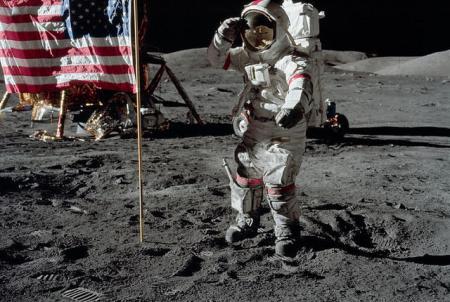
1cernan_jump_salutes_flag_-_gpn-2000-001273_0

Astronaut and 2nd Class Boy Scout Eugene Cernan saluted the U.S. flag on the Moon, on the last Apollo mission, Apollo 17. Photography by Astronaut and Tenderfoot Scout Harrison Schmitt. NASA image.

A short piece I presented this morning to the Tom Harbin Scout Museum Symposium on Scout History, a great morning organized by Bob Reitz, the curator of the Tom Harbin Scout Museum at Camp Wisdom, in Dallas, Texas. Of course the material is copyrighted, but by all means you have permission to use the material at Courts of Honor or in recounting the better history of Boy Scouting.

Scouts Shooting for the Moon:  The story of twelve Moon walkers, and Scouting

This is a recreation with modern numbers of a presentation first used a decade ago. Searching for material for a speech to honor Eagles at our District Dinner, several people suggested in a short period of time, ‘Why not talk about the astronauts who landed on the Moon. I hear they were all Eagle Scouts.’  Was that accurate?  It would have been a good story if so. Research revealed something quite different. The true story can carry just as much inspiration, however. Scouting is shown to be a program that can lead to a lifetime of adventure and accomplishment. Also, Eagles may take some inspiration in knowing they have accomplished something most of the men who walked on the Moon did not.

Speakers constantly need good material for Eagle Scout Courts of Honor and other events honoring Scouts and Scouters. For one event honoring a group of new Eagle Scouts, several people urged that I research the facts behind the story they had heard, that most, or all of the men who walked on the Moon were Eagle Scouts. New Eagles would find comfort in knowing they had soared into the midst of such company, they reasoned.

So it came to pass that, before the advent of Wikipedia and Google, I spent hours on the telephone until a press person at NASA pointed out to me a collection of information on astronauts that NASA had thoughtfully put on-line. At some high cost I printed out the few pages that dealt with the Scouting experience of astronauts, and worked to correlate it with information about which of them had gone to the moon, and which had not.

Anyone can find that book online with ease, today. The NASA Astronaut Fact Book provides information on almost every detail about NASA’s crew of astronauts, past and present. It includes one-and-a-half pages on the Scouting background of people working as astronauts and payload specialists for NASA, and others NASA has launched into manned missions. Cross-indexing that information with lists of Apollo Mission astronauts, I created four short tables showing the Apollo astronauts who went to the Moon, their missions, and the Scout rank they achieved, if any.

Lunar Astronauts and Scouting Experience

Twelve Moon Walkers

Name Mission Dates on the Moon Scout Rank
1 Neil Armstrong Apollo 11 July 21, 1969 Eagle Scout
2 Buzz Aldrin Apollo 11 July 21, 1969 Tenderfoot Scout
3 Pete Conrad Apollo 12 November 19-20, 1969 Cub Scout
4 Alan Bean Apollo 12 November 19-20, 1969 1st Class
5 Alan Shepard Apollo 14 February 5-6, 1971 1st Class
6 Edgar Mitchell Apollo 14 February 5-6, 1971 Life Scout
7 David Scott Apollo 15 July 31-August 2, 1971 Life Scout
8 James Irwin Apollo 15 July 31-August 2, 1971 None
9 John Young Apollo 16 April 21-23, 1972 2nd Class
10 Charles Duke Apollo 16 April 21-23, 1972 Eagle Scout
11 Eugene Cernan Apollo 17 December 11-14, 1972 2nd Class
12 Harrison Schmitt Apollo 17 December 11-14, 1972 Tenderfoot Scout

Apollo 13

Name Mission Dates on the Moon Scout Rank
1 Jim Lovell Apollo 13 Lunar Swingby Eagle Scout
2 Jack Swigert Apollo 13 Lunar Swingby 2nd Class
3 Fred Haise Apollo 13 Lunar Swingby Star

Lunar Missions That Did Not Land

Name Mission Dates on the Moon Scout Rank
1 Frank Borman Apollo 8 Orbited only None
2 Jim Lovell Apollo 8 (&13) Orbited only Eagle Scout
3 William Anders Apollo 8 Orbited only Life Scout
4 Tom Stafford Apollo 10 Orbited only Star Scout
5 John Young Apollo 10 (& 16) Orbited only 2nd Class
6 Eugene Cernan Apollo 10 (& 17) Orbited only 2nd Class

Others Who Did Not Land

Name Mission Dates on the Moon Scout Rank
1 Michael Collins Apollo 11 Capsule pilot None
2 Dick Gordon Apollo 12 Capsule pilot Star Scout
3 Stewart Roosa Apollo 14 Capsule pilot None
4 Al Worden Apollo 15 Capsule pilot 1st Class
5 Ken Mattingly Apollo 16 Capsule pilot Life Scout
6 Ronald Evans Apollo 17 Capsule pilot Life Scout

In all, 24 men flew to the Moon. Twelve set foot on the lunar surface. Of the twelve, eleven were Scouts, two were Eagles. Of the 24, 20 were Scouts, three were Eagles.

At the time I originally researched, about 70% of all astronauts were alumni of Scouting, men and women. Officially, BSA lists 181 NASA astronauts as being alumni, 57.4%

NASA lists the colleges and universities astronauts attended. NASA lists military service, hometowns, and states of birth. But with the possible exception of a generic category of “public schools,” no category of astronauts is larger than the category of Scouting experience. If we were advising a young person on how to get to become an astronaut, we would be remiss if we did not advise him or her to join Scouting.

What can we conclude?

Three things became apparent to me in tracking these figures down. One, I learned once again that the true stories most often carry great value, more value than the stories people make up, or assume.

Two, I learned that Scouting by itself carries great value, without a Scout’s having earned Eagle. We know that not all the Moon walkers earned the Eagle rank. But we also notice that no flight ever went to the Moon without at least two Scouts aboard. Three of the 24 lunar voyagers are Eagles, 12.5%. Two of the dozen who actually set foot on the Moon are Eagles, 16.7%. Eleven of the twelve Moon walkers were Scouts, 91.7%. 21 of 24 lunar voyagers were Scouts, 87.5%.

So, while it was not necessary to be an Eagle, it certainly seemed to help. But simply having Scouting experience seemed to be the biggest help. There may be some magic in a boy’s having taken that oath that carries through his entire life, and spurs him to do daring and great things. That is important. A trend begins to emerge. Scouting by itself, without earning the highest rank, provides great value. When a boy signs up, he signs on for the adventure of a lifetime, and often that leads to a lifetime of adventure. That venturesome spirit carries on well past his Scouting years.

The story of Jim Lovell might carry some great weight with Scouts. Lovell is the only person to have gone to the Moon twice, but never set foot on it. He was the commander of Apollo 13, whose near-disaster was chronicled in the movie of the same name. Among other lessons that might be pulled out of the story:  When your Moon-bound spaceship explodes and loses power on the way to the Moon, it is often good to have an Eagle Scout handy to help get through the experience and return safely.

Is there inspiration here?

When I first presented these figures at a Scout meeting, a parent asked me whether these numbers would discourage boys from working for any rank advancement, since just being a Scout seems to carry such weight. This should not discourage Eagles, nor discourage any Scout from working to get the Eagle rank. We should look at it this way:  Every Scout who earns an Eagle has done what ten of the twelve who walked on the Moon did not do, perhaps could not do. Nine more Moon walkers started on that path to Eagle, but did not finish, or could not finish.

Not every Eagle can go to the Moon, but every Eagle has already won an award that most of those who did go to the Moon wish they had.

Especially in the circles of corporate and government leadership, character, what it is and how to get it, concerns people. What sort of character does it take to go to the Moon? Every Scout has a glimpse of what is required, and every Eagle can say, “I know what it takes to get such character.”

Bibliography

Human Spaceflight, “The Apollo Program,” NASA, July 2, 2009; accessed April 28, 2011; http://spaceflight.nasa.gov/history/apollo/

Astronaut Fact Book, NASA,  NP-2005-01-001JSC, January 2005; accessed April 27, 2011; spaceflight.nasa.gov/spacenews/factsheets/pdfs/astro.pdf

BSA, “Facts About Scouting,” 2009; accessed April 28, 2011; http://www.scouting.org/about/factsheets/scoutingfacts.aspx

“Astronauts With Scouting Experience,” Eagle Scout Information, U.S. Scouting Service Project, April 6, 2011; accessed April 29, 2011; http://www.usscouts.org/eagle/eagleastronauts.asp

About the author:

Ed Darrell teaches U.S. History at Moises E. Molina High School in Dallas. He has taught economics, government, world history and street law in high schools; he also taught at the University of Utah, University of Arizona, and DeVry University. He is a former speech writer for politicians. His degree in Mass Communication came from the University of Utah, and his law degree from George Washington University. This was presented to the Jack Harbin Museum Symposium of Scout History, April 30, 2011.

World Scout badge carried to the Moon by Astronaut Neil Armstrong.

World Scout badge carried to the Moon by Astronaut Neil Armstrong.


Save


Ironic anniversary: Marshall Plan, April 3, 1948

April 4, 2011

Texas Republicans rammed through their radical budget cut program on April 3, 2011 — ironically on the anniversary of another legislative decision made in the depths of deficit spending.

President Truman signing legislation to create the Marshall Plan, 1948 - Library of Congress, Averill Harriman collection

Caption from Library of Congress: "Surrounded by members of Congress and his cabinet, on April 3, 1948, President Harry S Truman (1884-1972) signed the Foreign Assistance Act, the legislation establishing the Marshall Plan. His official statement said, "Few presidents have had the opportunity to sign legislation of such importance. . . . This measure is America's answer to the challenge facing the free world today." The Marshall Plan was a bipartisan effort--proposed by a Democratic president and enacted into law by a Republican Congress in a hotly contested presidential election year. The plan's supporters shown in the photograph are (l-r) Senator Arthur Vandenberg (R--Mich.), Treasury Secretary John Snyder, Representative Charles Eaton (R--N.J.), Senator Tom Connally (D--Tex.), Secretary of the Interior Julius A. Krug, Representative Joseph Martin (R--Mass.), Representative Sol Bloom (D--N.Y.),and Attorney General Tom Clark." Copyprint from The Marshall Plan at the Mid-Mark. Averell Harriman Papers, Manuscript Division

April 3 is the traditional anniversary of the Marshall Plan.  From the U.S. Census Bureau:

SUNDAY, APRIL 3: MARSHALL PLAN

Profile America — Sunday, April 3rd.  One of the major programs that helped to shape history after World War II was signed into law on this date in 1948.  The European Recovery Program — far better known as the Marshall Plan, was suggested a year earlier by Secretary of State George Marshall. It had become clear that the economies of the nations battered by the war were not recovering on their own, and millions of people were not only jobless, but were also going hungry.  The Marshall Plan lasted for four years, distributing some 130 billion in today’s dollars, and helped many nations on the road to recovery.  Recently, the U.S. has given nearly $34 billion a year in economic aid and some $15.5 billion in military aid to countries around the world.  Profile America is in its 14th year as a public service of the U.S. Census Bureau.

Sources:  Chase’s Calendar of Events 2011, p. 204

Statistical Abstract of the United States 2011, t. 1298

Profile America is produced by the Public Information Office of the U.S. Census Bureau. These daily features are available as produced segments, ready to air, on a monthly CD or on the Internet at http://www.census.gov (look for “Multimedia Gallery” by the “Newsroom” button).

SOURCE U.S. Census Bureau

Read more: http://www.sacbee.com/2011/04/02/3523990/us-census-bureau-daily-feature.html#ixzz1IY7ec6mu

On that date in 1948, the U.S. faced the greatest deficits the nation had ever seen, leftover from World War II. Faced with the choice of deeper deficits or no Marshall Plan, Members of Congress chose to borrow the money to rebuild nations hammered by the war,  including our enemies, Germany, Italy and Japan.

What would have happened had the U.S. said “we can’t afford a Marshall Plan?”  Santayana’s Ghost shakes his head.  The U.S. would not have had the aid of growing, free-market economics in France, Germany, Italy, England and Japan, during the Cold War.  Advantages would have been conceded to the Soviet Union and communism, worldwide.

Notice the photograph includes Republicans and Democrats.

What are Texas and U.S. legislators thinking these days?

Resources:


Sputnik – part of the series, “Cold War”

February 17, 2011

BBC’s 24-part series on the Cold War included an entire segment on Sputnik.  Kenneth Branagh narrated this episode.

Sarah Palin, you can start your education here.  On YouTube, it’s broken up into five parts, each less than 10 minutes long.

Cold War, Sputnik, Part 1

Sputnik, Part 2

Sputnik, Part 3

Sputnik, Part 4

Sputnik, Part 5


Baltimore ponders where to put bust of Frank Zappa, symbol of freedom

December 29, 2009

Ending the Cold War brought no end of benefits to the U.S., including Baltimore’s little civic problem:  Where should Baltimore put a bust of Frank Zappa, donated by Lithuanians to his birth city in honor of his standing for freedom?

Frank Zappa bust, donated by Lithuanians, to City of Baltimore - Baltimore Sun photo

Striking bust of Frank Zappa donated to the City of Baltimore by Lithuanians, in honor of Zappa's representing freedom to Lithuanians during the Cold War

More than a year ago, Baltimore accepted a bust of Baltimore native Frank Zappa. Valued at $50,000, the bust was a gift from a Lithuanian Zappa fan club.

Since then, officials have been debating where to put it.

Why Zappa?  Why Baltimore?

His family lived in the 4600 block of Park Heights Ave., then moved to Edgewood in Harford County. Zappa’s father, a chemist and mathematician, had a job nearby at Aberdeen Proving Ground. They moved to California when Frank was 10.

Until they met last night, some members of the Baltimore Public Art Commission, which voted unanimously to accept the gift of the bronze sculpture – valued at about $50,000 – were also unaware of Zappa’s connection to Charm City.

However, the donors of the bust, who come from much farther afield – in fact, from a nation Zappa never visited – are well aware of his background.

“We’re honored to have a chance to present this Frank Zappa monument to the city of Baltimore,” said Saulius Paukstys, 43, the president of one of the biggest and arguably most dedicated Frank Zappa fan clubs in, of all places, the Republic of Lithuania. “As an artist, and much more than that, he has meant a great deal to the Lithuanian people.”

If Zappa has been something of an unknown prophet in his own land, people like Paukstys, a photographer, have long held him in high regard as a symbol of free expression in the post-Cold War former Soviet bloc.

“Before 1990, you have to remember, [Lithuanians] could not criticize society,” Paukstys said through an interpreter. “Frank Zappa was a voice of freedom.”

After 1990, when Western music became available in their home country, Paukstys and friends like Saulius Pilinkus, an art historian, often gathered to listen to Zappa’s music. The fan club they started eventually numbered more than 300. Most were well-educated aesthetes who appreciated the fact that Zappa was more than a rock-and-roll star: He was a symphonic composer, a fact that appealed to a people whose love of classical music is part of their history.

Zappa’s followers number in the millions in the U.S.  People who don’t see eye-to-eye on much of anything else agree on Zappa’s genius.  Even old sobersides California Judge Ben Davidian is a Zappa fan.  (He was especially fond of Zappa’s deeply philosophical question about a Salt Lake City fan’s letter:  “Suzy Creamcheese, what’s gotten into you?”)

Zappa’s bust will be one more very good reason to visit Baltimore, in addition to crab cakes, Babe Ruth’s house, the C&O Museum and Sabatino’s.


20 years ago, the Berlin Wall fell – reverse domino effect

November 9, 2009

High school sophomores in Texas study world history, and juniors study U.S. history. At 16 and 17 years old, they have difficulty figuring out the fuss over the Berlin Wall. It’s just pictures in their textbook.

The Wall was already three or four years gone when they were born. They don’t remember living with the Soviet Union at all — it’s been Russia to them for their entire lives.

I have some hopes that the celebrations set for this week will aid their understanding, on the 20th anniversary of the breaching and destruction of the wall.

Dominoes set for celebration of the Berlin Wall's destruction.  AP photo by Herbert Knosowski, via Canadian Broadcast System

Caption from CBC: "Dominoes are placed where the Berlin Wall once stood in front of the Brandenburg Gate in the German capital. (Herbert Knosowski/Associated Press)"

An enormous line of giant dominoes is set up along the line where the old wall stood — to be toppled on November 9, the anniversary of the official breaching of the wall.

It’s the “domino theory” in reverse.

About 1,000 plastic foam dominoes will fall to the ground Monday along the route where the Berlin Wall once stood to mark the 20th anniversary of the crumbling of the Cold War barrier.

The 2.3-metre-high blocks, painted by schoolchildren, stretch for 1.5 kilometres in a path near the Brandenburg Gate and the German parliament.

Former Polish leader Lech Walesa, whose pro-democracy movement Solidarity played a key role in ending communism in Eastern Europe, will tip the first domino at 8 p.m. local time.

I made one visit to the wall, late on a night in 1988.  American Airlines explored the possibility of taking over the service authorized from Munich to Berlin.  Soviet and East German rules required passenger flights to stay at a very uncomfortable 10,000 feet.  Pan Am had the route, but Pan Am was in trouble.  We spent a day with Berlin airport authorities and real estate agents trying to figure out how to set up a reservations office and other ground facilities.  European airports tended to force foreign carriers to share gate facilities, which was a problem, and we devoted a lot of time to gathering data for computer lines.

But then, after a smashing dinner of sausage and German-style potatoes in a great, small Berlin pub, we talked our taxi driver into giving us a tour of the wall.  He drove a spot near the Brandenburg gate, and there on a chain link fence keeping westerners from the wall were eight fresh wreaths.  Eight people had died trying to cross from East Berlin to West Berlin in the previous six months.  One wreath for each death.

Just over a year later, the Berlin Wall itself would be gone.

West Berlin acted much like a normal, western European city.  But the wall was there as a constant reminder of the oppression on the other side, a dull fog to constantly dim even the sunniest day.

Old posts on the Berlin Wall here at the bathtub are suddenly popular — usually they get a lot of hits after March when U.S. schools get to the post-World War II era, the Cold War and the Berlin airlift.  I imagine the current popularity has something to do with the anniversary.

I hope somebody has some great video of the dominoes toppling.

Dominoes acerbicly note the irony:  While the U.S. feared nations would fall under communism in a “domino effect,” especially in Southeast Asia (Indochina), communism broke up in a domino effect, as one communist-dominated country after another found freedom near the end of the Cold War.  Why has no one done a serious essay on the domino effect of freedom?

More news and resources:

Famous sign warning visitors leaving West Berlin

A sign of old times, now unneeded

Viral dominoes: Help spread the news:

Add to FacebookAdd to NewsvineAdd to DiggAdd to Del.icio.usAdd to StumbleuponAdd to RedditAdd to BlinklistAdd to TwitterAdd to TechnoratiAdd to Furl