February 4, 2009
In administrative hearings at the federal level, it’s a crime to knowingly present false testimony to an agency which might rely on that information to make a decision.
In Texas? The law is not so clear — but Discovery Institute’s John West celebrates false information used by the State Board of Education in considering science standards. (This is one reason, I suspect, why creationists are not more active at the federal level — their tactics are not only unethical, but also illegal.)
Sadly, shockingly but not surprisingly, the false information was presented by SBOE Chairman Don McLeroy in theform of nuggets from the creationist quote mines.
Keep watching that space — with the help of Jeremy Mohn’s blog, which has most of the story in a post from his co-blogger Cheryl Shepherd-Adams.
Tip of the old scrub brush to Tony Whitson and Texas Citizens for Science.
Spread the word; friends don't allow friends to repeat history.
 2 Comments |
  Creativity, Religion, Science, State school boards, Texas, Texas Citizens for Science, Texas Freedom Network | Tagged: Don McLeroy, Education, Evolution, Science, Texas |
  Permalink
 Posted by Ed Darrell
September 13, 2007

“At twilight Friday (Aug. 31) a complete rainbow arched over Taos Valley. Composite photo by Melody Romancito”
From the Taos News Online.
There is just something about Taos that brings out the beauty of things, and the artistic nature of people in order to capture the beauty.
Spread the word; friends don't allow friends to repeat history.
Leave a Comment » | Art, Creativity, Geography - Physical, Natural history, Technology | Permalink
Posted by Ed Darrell
September 5, 2007
The vitality of thought is in adventure. Ideas won’t keep. Something must be done about them. When the idea is new, its custodians have fervor, live for it, and, if need be, die for it.
— Alfred North Whitehead (1861-1947); chapter 12 of Dialogues; written April 28, 1938
Spread the word; friends don't allow friends to repeat history.
1 Comment | Creativity, Famous quotes, Quotes | Permalink
Posted by Ed Darrell
August 15, 2007
August 15 is Leon Theremin’s birthday (b. 1896).
 Without Leon Theremin, musical scores to horror movies would be nearly impossible, at least for everyone except Henry Mancini and John Williams.
His life would make a great movie. He invented the Theremin in the midst of World War I in Russia; after the war he toured Europe, and then the U.S. He played Carnegie Hall, he collaborated with Albert Einstein, and he married a young African-American ballerina, Lavinia Williams. In 1938 he was kidnapped by the Soviet KGB and forced to return to Russia, in the Union of Soviet Socialist Republics (USSR).
Sent to a work camp, he worked alongside Andrei Tupelov and a host of other famous Soviet scientists. Theremin was “rehabilitated” in 1956. He returned to invention, and invented bugging devices, including the famous microphone that was placed in the Great Seal of the United States in the U.S. Embassy in Moscow. The bug had no moving or active parts, and no power supply, but could transmit when hit with a microwave transmission. The bug spied on U.S. diplomats from 1945 until its accidental discovery in 1952.
Later Theremin turned to inventions of devices to open doors, and to burglar alarms. He trained his niece, Lydia Kavina, on the Theremin — she is considered a virtuoso at the instrument today. In 1991 he returned to the U.S., reunited with some of the artists he’d worked with 50 years earlier for several concerts. He died in Russia in 1993, at the age of 97.
And if you’ve ever heard the Beach Boys’ recording of “Good Vibrations,” you know what a Theremin sounds like.
Spread the word; friends don't allow friends to repeat history.
Leave a Comment » | Biography, Cold War, Communism, Creativity, History, Music, Technology | Permalink
Posted by Ed Darrell
August 10, 2007

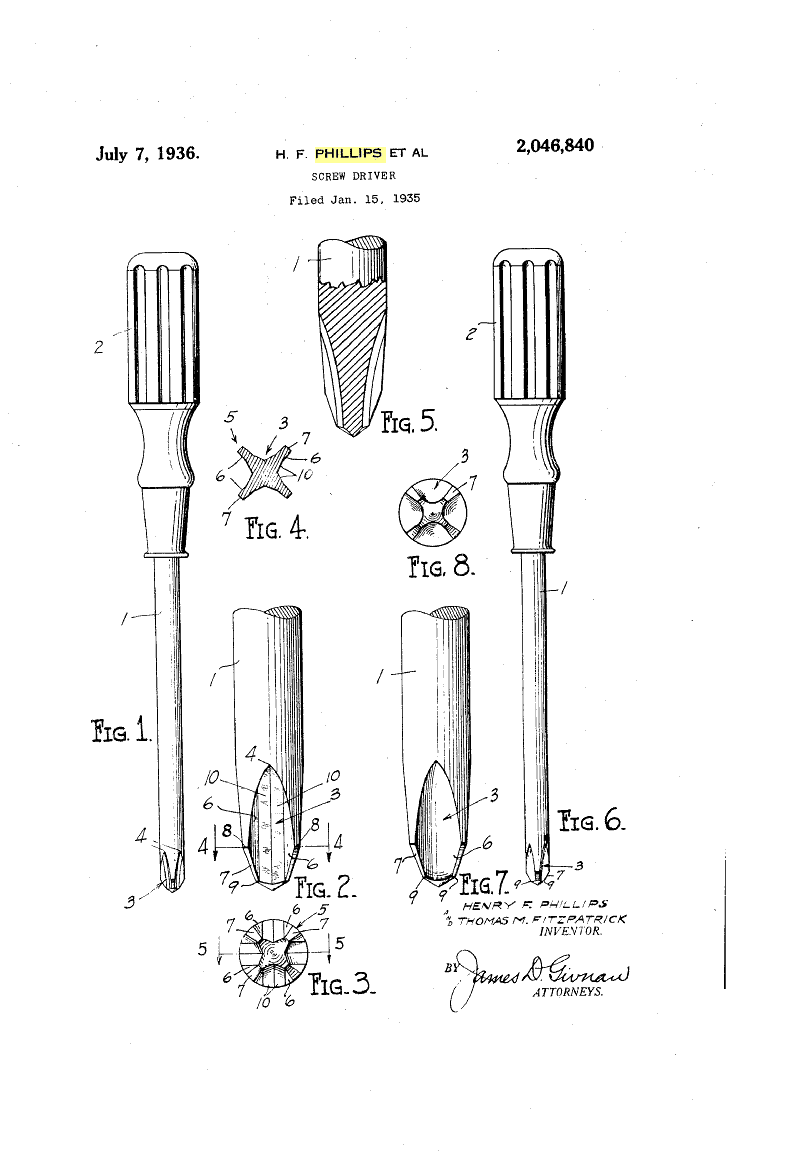
Patent drawings for the Phillips screw and screwdriver, 1936
Only Crook in Town was alerted to the work of Henry F. Phillips by an alert and helpful librarian (well — aren’t they all?). She worries –January 15 is Martin Luther King, Jr., Day, and July 7 is the middle of the summer — what day would be appropriate to celebrate the invention and patenting of the Phillips Screwdriver? (If image above does not display, click the thumbnail picture at the end of the post.)
Ah, history teachers, you noticed that the drawing comes from Google’s files of patent applications. And now you wonder: What other wonderful illustrations can we legally rip off to use in class? Wonderful question — what do you find?
The Phillips screwdriver came along in time for World War II and the mass assembly of aircraft, and aircraft instrument panels. The Phillips screw head helped aircraft assemblers keep from scratching the black metal of the rest of the panel while securing instruments into the forms.
Read the rest of this entry »
Spread the word; friends don't allow friends to repeat history.
12 Comments | Business, Business Ethics, Creativity, DBQ sources, Heroes, History, Invention, Law, Patents, Technology, World War II | Tagged: Business, Creativity, DBQ sources, Henry F. Phillips, Heroes, History, Inventions, Law, Phillips Screwdriver, Technology, World War II | Permalink
Posted by Ed Darrell
August 8, 2007
Remember the earlier post on this?

Robert Krulwich at ABC thought it was neat, too — see this video, and you can see the artist who created the maps. Does this mean there will be more?
Spread the word; friends don't allow friends to repeat history.
1 Comment | Brain learning, Creativity, Geography - Economic, Geography - Physical, Maps, Presentations, Technology, Transportation | Permalink
Posted by Ed Darrell
June 24, 2007

William Faulkner at his typewriter, August 12, 1954, at his home in Oxford, Mississippi. Associated Press photo, via Eons website.
The photo was probably posed; the two books to the left of the typewriter are Faulkner books. Faulkner may have written in a pressed shirt and tie.
Faulkner won the Nobel Prize for Literature in 1950, and delivered a memorable speech about “the human condition” and the importance of art, especially poetry and prose, at his acceptance. His 1954 book, A Fable, won both the National Book Award and the Pulitzer Prize for Fiction, in 1955.
The typewriter is a Royal KHM.
Faulkner was born September 25, 1897 — 2007 marks the 110th anniversary of his birth.
“The past is never dead. It’s not even past.”
—Gavin Stevens
Act I, Scene III, Requiem for a Nun
Spread the word; friends don't allow friends to repeat history.
5 Comments | Books, Creativity, History, History images, Literature, Technology, Typewriters | Tagged: Books, History images, Literature, Technology, Typewriters, William Faulkner | Permalink
Posted by Ed Darrell
June 22, 2007
I’m staking my claim here: I’ve invented a new word. You can see the usage here, at Reclaiming Space.
“BelloBellicoscenti.”
OED? I’m ready for my closeup.
Spread the word; friends don't allow friends to repeat history.
3 Comments | Accuracy, Creativity, Weblogs | Permalink
Posted by Ed Darrell
May 30, 2007
Commenter Bernarda sent a link to a Washington Post story by Robert Kaiser about Finland, a nation who redesigned its education system with rather dramatic, beneficial results. Among other things, the Finns treat teachers as valuable members of society, with high pay, great support, and heavy training.
Finland is a leading example of the northern European view that a successful, competitive society should provide basic social services to all its citizens at affordable prices or at no cost at all. This isn’t controversial in Finland; it is taken for granted. For a patriotic American like me, the Finns present a difficult challenge: If we Americans are so rich and so smart, why can’t we treat our citizens as well as the Finns do?
Why not? Why can’t we treat our citizens as well as the Finns? Their system boosts their economy and leads to great social progress — which part of that do we not want?
Spread the word; friends don't allow friends to repeat history.
5 Comments | Classroom size, Creativity, Economics, Education quality, Education reform, Education spending, Education success, Free market economics, Freedom - Economic, Freedom - Political, Politics, Public education, School vouchers, Socialism, Teacher Pay, Teaching | Permalink
Posted by Ed Darrell
April 20, 2007
Lucky will be the teacher who gets the kids from The Living Classroom. I wager they’ll be eagar to learn, and that they’ll set the pace in good behaviors and academic achievement in future classes — unless someone throttles it out of them later.
For now it’s a bunch carrying a lot of hope to some lucky teachers next year. Check out this post, “All the Beauty We Can Find in Just One Day,” and this one, “My School.”
Spread the word; friends don't allow friends to repeat history.
1 Comment | Classroom size, Creativity, Education, Education blogs, Leadership, Lesson plans, Pedagogy, Weblogs | Permalink
Posted by Ed Darrell
March 3, 2007
How many of us have worked with former athletic coaches who just don’t quite master the need for practice of academic topics, time to master academic skills, the need for constant rehearsal of the skills, and good care and feeding of the brain, the same way they understand the care and feeding of kinesthetic skills?
Chris Wondra.com posted a 7-point summary of Eric Jensen’s plan for keeping kids’ brains in top learning order. It’s worth a look. Treat it like a checklist: How many of these get done in your classroom? How much of this brain conditioning do you have control over?
Now, remember that part of the No Child Left Behind Act that says what we do should be backed by research?
Spread the word; friends don't allow friends to repeat history.
Leave a Comment » | Brain development, Brain learning, Classroom technology, Creativity, Education blogs, Education reform, No Child Left Behind Act, Teaching | Permalink
Posted by Ed Darrell
March 1, 2007
Once upon a time I was a graduate student in a rhetoric program. At the same time I was the graduate assistant for the intercollegiate debate program at the University of Arizona, which at the time had an outstanding, nationally-competitive team and a lot of up-and-comers on the squad. From there I moved almost immediately to a political campaign, a sure-loser that we won, and from there to Congressional staffing, writing speeches, editorials, press releases and a few legislative dabbles. Then law school, etc., etc.
Some of the fights I’ve been involved in include air pollution and the laws controlling it, land use in statewide plans, tobacco health warnings, compensation for victims of fallout from atomic bomb tests, food safety, food recall standards, education testing standards, measurement of management effectiveness, noise control around airports, social studies textbooks and biology textbooks, and a few others. Most political issues are marked by people who really don’t understand the information available to them, and many issues are pushed by people who have no ability or desire to understand the issues in any depth.
And so, having survived a few rounds in the crucibles of serious debate with real stakes, I am often amused and frustrated by state education standards that demand teachers teach “critical thinking,” often as not grounded in something that looks like hooey to me.
In one of my internet rambles I came across a site with modest ambitions of continuing discussion of critical thinking. Rationale Thoughts comes out of Australia. The view is a little different, but not too much so (hey, it’s in English, which is a bonus for me).
If you’re looking for sources to seriously understand what critical thinking is, this is one place you would be well-advised to check. You might find especially useful this list for “further reading” in the topic.
Spread the word; friends don't allow friends to repeat history.
1 Comment | Accuracy, Brain development, Brain learning, Creativity, Education, Hoaxes, Pedagogy, Research, Weblogs | Permalink
Posted by Ed Darrell
February 27, 2007
A fascinating, tragic hoax has unraveled in the classical music world. Dozens of performances by relatively unknown — but great — pianists were pirated, credited to a great pianist dying of cancer, and made internet hits.
The hoax that lives by the internet, dies by the internet, Jesus might have said. A music critic loaded one of the released discs into his iPod list on his computer, and it identified it as being performed by someone else.
Joyce Hatto had retired due to ovarian cancer in the 1970s, but started releasing recordings made at home in 1989. This was not unusual — her husband was a recording engineer. The quietly-released, small-label recordings got good reviews and a faithful audience. As time went on, the recordings became more ambitious, and the quality of the piano playing of the dying woman audibly increased.
Questions arose earlier this year. Read the rest of this entry »
Spread the word; friends don't allow friends to repeat history.
Leave a Comment » | Accuracy, Business Ethics, Creativity, Hoaxes, Music, Music education, Plagiarism | Permalink
Posted by Ed Darrell
February 24, 2007
Here it is in haiku:
Counterarguments:
Let them sleep, like dogs? Oh, no:
Refute them at once.
Here is the title of the thesis the poem represents:
“How to handle opposing arguments in persuasive messages: A meta-analytic review of the effects of one-sided and two-sided messages”
Haiku is probably easier for campaign managers to remember — good advice in 17 syllables.
Jim Gibbon.com has a contest going — he challenged people to boil their recent academic publications down to the 17-syllable poetry form called haiku, for social science research, humanities publications, physical sciences, and a category called tech/computers/internet.
I tell speech students and clients that any good argument or thesis can be boiled down to a 30-second statement. Haiku may be a little too brief for my purposes, but it’s more artful, too. Some of the poems are pretty good, none are really bad.
Grad students with too little art in their lives, perhaps. Go vote and encourage them to communicate better, with poetry, even.
Here’s a piece of social science research I’d like to read:
dixie chicks blacklist
krugman blames clear channel (jerks)
nope, it was rednecks
(“Elites, Masses, and Media Blacklists: The Dixie Chicks Controversy”)
Tip of the old scrub brush to Bug Girl.
Spread the word; friends don't allow friends to repeat history.
7 Comments | Creativity, Education, Graduate study, Lesson plans, Pedagogy, Research | Permalink
Posted by Ed Darrell
February 11, 2007
Divest yourself of that tired and false notion that you’re bad at math. That’s hooey, though it probably sets your self-expectations low enough that it damages your math performance. Don’t make it a self-fulfilling prophecy.
New Carnival on the block: Carnival of Mathematics at Alon Levy’s Abstract Nonsense. It’s got some good stuff there for math teachers, and I suspect people with other interests will find something of interest, too. For me, for example, there is the link to the post that Fisks arguments of some of the more unsuspecting intelligent design fogmeisters. More pure historians may like the history of algebra post. There’s a lot more history and controversy in a post about why students should study math at all:
Biographical history, as taught in our public schools, is still largely a history of boneheads: ridiculous kings and queens, paranoid political leaders, compulsive voyagers, ignorant generals—the flotsam and jetsam of historical currents. The men who radically altered history, the great scientists and mathematicians, are seldom mentioned, if at all.
—Martin Gardner
quoted by G. Simmons, Calculus Gems
(Take THAT you creators of state history standards!)
Hmmm. I’m teaching algebra and geometry this week (“go figure!”). I may use some of that stuff.
Tip of the old scrub brush to JD2718.
Spread the word; friends don't allow friends to repeat history.
2 Comments | Accuracy, Brain learning, Creationism, Creativity, Education, Education blogs, History, Intelligent Design, Lesson plans, Public education, Science, TEKS, Weblogs | Permalink
Posted by Ed Darrell






 Millard Fillmore's Bathtub