How to weigh evidence of climate change, or not.
Dr. Ben McNeil calls out Australian climate change deniers. Are their bodies red?
How to weigh evidence of climate change, or not.
Dr. Ben McNeil calls out Australian climate change deniers. Are their bodies red?
 Leave a Comment » |
  Clean Air Act, Climate change, denialism, Global warming, Science |
  Permalink
 Posted by Ed Darrell
One might hope it is a sign of desperation, and not just one more ratcheting up on the dishonesty scale.
Anthony Watts has a post that looks at Boston Harbor, a post borrowed from a sleepy blog called Climate Sanity, by Tom Moriarty. Watts, a leader among denialists, notes the warnings about sea level rising, and then offers maps of Boston as evidence everyone is safe.
The maps show the shoreline expanding around the peninsula where the main part of Boston sits.
Consequently, the authors claim, rising sea levels won’t do damage anyone should worry about.

Changes in Boston Harbor, animation from the denialist blog Climate Sanity
It’s an odd sort of claim. Anyone with any knowledge of the growth of harbor cities will look at the maps and notice the extension of lands from fill. Watts and Moriarty do not specifically claim that ocean levels have no effect, though some reading the headlines alone may get that idea. They argue that humans will respond to negate the bad effects of climate change.
That’s not what the maps show at all. The maps show that, in the absence of wetlands protection, people will use fill to expand commercial opportunities at a busy harbor. That is true whether the fill requires the destruction of local landmarks, or whether the fill arrives accidentally from other major natural events.
The climate change denialists’ claims make an argument based in deception. Harbor areas are always better fortified against sea and weather changes than other areas. Boston Harbor is a comparatively small area, when contrasted with the Atlantic coastline of North America.
Do they know they’re just pulling our leg? Or is this one more sign of the desperation denialists get over the realization the facts are against them?
At root the argument fails, and fails offensively: Watts and company argue that climate change and rising sea levels are not a problem, if we have enough concrete and fill to expand land close to the water and harden seawalls. We also would need a lot of commercial development to make it cost effective to fill in the threatened lands. That sort of development will involve only a very small area of any nation’s coastline.
Of course, that sort of hardening of sites is exactly what the wetlands protection under Section 404 of the Clean Water Act aimed to slow or stop, and it is part of the cause of trouble in the Mississippi Delta and other places unhardened, where the effects of hardening ports are pushed.
Watts also fails to account for the more serious immediate issues: It’s not permanent inundation that we need to worry about with ports, but rather, the effects of stronger storms with higher sea levels. The U.S. Environmental Protection Agency has been on that issue for years. Boston Harbor is an example of a place that we need to protect from effects of climate change, at great expense, in order to preserve the filling done in the past and the development on that filled-in land that once was sea.
For examples, consult the white paper from EPA in July 2008, “Planning for Climate Change Impacts at U.S. Ports. From the very first lines, you can begin to see why the denialists’s claims don’t wash:
Over the coming decades, climate change is likely to cause sea levels to rise, lake levels to drop, more frequent and severe storms, and increases in extreme high temperatures. These effects can have mild to severe impacts on port infrastructure and operations, depending on their geographical setting and design. Ports are critical to the trade and transportation networks of the United States. Specifically, ports handle 78% of all U.S. foreign trade by weight and 44% by value.1 The United States’ ports also represent billions of dollars in capital improvements and new investments. While the risk that climate change poses to ports is unclear, what is clear is that ports need to better understand climate change, how it may impact them, and what they can do to ensure reliable services for their customers.
Stakes are too high for analysis so shallow as simple map overlays. In reality many factors mean that ports and harbors are threatened from many different problems arising from climate change. The EPA white paper lists specifics.
Changes in water level:
The most immediate concern related to rising sea levels is the need to raise the level of infrastructure to prevent flooding. Ports will need to consider anticipated sea levels when building new infrastructure. In cases where current infrastructure may not be high enough for its useful lifespan, ports will need to increase infrastructure heights.
Higher sea levels may threaten ports’ environmental mitigation projects. Also, many ports have contaminated or potentially contaminated industrial land on their premises.17 Higher water levels may require new containment methods to prevent leeching of contaminants.
Many climate models predict that climate change will cause water levels to drop in the Great Lakes and the Mississippi River Basin, which would make shipping there more difficult. When lake levels decreased from 1997-2001, ships in the Great Lakes were forced to carry less cargo. Future decreases in water level would again require cargo restrictions or perhaps the redesign of vessels. Either one would increase the cost of shipping on interior waterways. Decreased depths could be mitigated by increased dredging, but at a financial and environmental cost.
Storm events and precipitation:
Globally, extreme precipitation events are expected to become more frequent, and severe storms are expected to become more intense. Stronger wave action and higher storm surges, especially when coupled with higher sea levels, are the primary threat to ports. These impacts can damage bridges, wharfs, and piers, terminal buildings, ships, and cargo. Harbor infrastructure may need to be raised or reinforced to withstand these impacts.
In addition to contributing to storm surge, wind can also have its own damaging impacts. High winds particularly threaten unreinforced terminal structures. For example, Hurricane Katrina tore roofs and doors off warehouses at the Port of New Orleans. One possible response to these threats is to change design standards for terminals, cranes, lighting systems, and other infrastructure to incorporate the risk of stronger storms.
Higher temperatures:
Higher incidences of extreme high temperatures could also affect some auxiliary port infrastructure. For example, paved surfaces may deteriorate more quickly in hotter conditions. Cranes and warehouses made of metal may require design changes to withstand higher temperatures. Higher temperatures may also require more energy for cooling of goods stored at ports.
Higher temperatures could impact the human and natural environments associated with ports as well. Many employees at ports work primarily outdoors. Operational changes may be required to protect workers from extreme heat. Warmer temperatures may also increase the risk of transferring invasive species from region to region on cargo vessels.
For ports in northern states, including Alaska, higher temperatures could provide some benefits. Operating conditions may improve as ice accumulation on port infrastructure decreases. Shipping seasons would lengthen as more ports and waterways become ice free for more of the year. These effects could increase volume and reduce costs for northern shipping.
Indirect impacts, including insurance:
Ports are also likely to face changes in insurance coverage and possible higher insurance premiums because of climate change. The insurance industry is one of the leading commercial sectors expressing concern about and exploring adaptive responses to climate change. Several large companies that provide business insurance services are incorporating risk from climate change into insurance offerings. Strategies include shifting a greater share of risk onto customers and providing technical support and pricing incentives for customers to reduce their exposure to climate-related risks.
Denialist arguments frequently come with unintended irony. Part of Boston Harbor was filled in by a the New England hurricane of 1938. Castle Island, one of the areas the animation highlights as being filled out, ostensibly by humans, is connected to the mainland now as a testament, a warning of the potential for nature to change the place quickly, contrary to the plans of humans. One day in 1938 a hurricane converted the place from an island to a peninsula. Is this really the best the denialists have to persuade us that we shouldn’t be concerned about the power of nature now?
Climate warming is real. The effects of warming are real and quite problematic already. Filling in wetlands around busy harbors, even just to raise elevation, is not a viable solution to the problems, regardless their cause.
Resources:
25 Comments | Climate change, denialism, Environmental protection, Global warming, History, Natural history, Natural resources | Tagged: Boston Harbor, Climate change, denialism, Global warming, Harbors, History, Hulhumale, Wetlands Protection | Permalink
Posted by Ed Darrell
Blue Ollie carried a YouTube video that got me to look at Peter Sinclair’s marvelous series of amateur videos, “Climate Denial Crock of the Week.” Sinclair posts under the handle GreenMan at YouTube.
Here’s the Climate Denial Crock of the Week video on ocean levels, and the denial that they are rising — in line with my post a few hours ago about peoples in the South Pacific and in Alaska losing their homes to climate change:
Pat Frank’s work keeps reminding us that, in science, it’s often difficult to establish a clear, indisputable proximate cause. Something is going on in Newtok, Alaska, and in the Carteret Islands, Papua New Guinea. Those things should not be ignored, and cannot be ignored safely for long.
(Teachers: Note most of these videos are around 5 minutes in length — more than suitable for classroom use, perhaps even as a bell ringer. Notice also that, if you don’t know how to make these videos, as I don’t, you’re behind the curve.)
25 Comments | Climate change, denialism, Geography - Economic, Geography - Physical, Global warming, History, Science, Technology in the classroom, Video and film | Permalink
Posted by Ed Darrell
Rush Limbaugh, Pete DuPont, Michael Savage, the Discovery Institute and other great exponents of reality denial (generally, but not always, without drugs) will continue to rail at James Hansen’s science chops, but the universe goes on in the Real World™. Global warming, climate change, takes a severe toll on inhabitants of this planet.
It’s a tribute to the propaganda value of Anthony Watts that this milestone earned so little note: Residents of Carteret Island, Papua New Guinea, began their move to higher ground last week. The rising ocean is reclaiming their land; seasonal high tides make agriculture impossible.
Who noticed?
You can read about the refugees in The Solomon Times. You can read about it in the Papua New Guinea Post -Courier. You can’t read it about it much of anywhere else. The revolution is not televised, it’s not even in print.
Meanwhile, in Alaska, without serious action by the world to enact some sort of program out of the Kyoto meetings to combat climate change by nations united, indigenous peoples are meeting to figure out what they can do without government help. The place of their meeting carries a message:
The summit is taking place about 500 miles from the Alaskan village of Newtok, where intensifying river flow and melting permafrost are forcing 320 residents to resettle on a higher site some 9 miles away in a new consequence of climate change, known as climigration.
Newtok is the first official Arctic casualty of climate change. A U.S. Army Corps of Engineers study indicates 26 other Alaskan villages are in immediate danger, with an additional 60 considered under threat in the next decade, Cochran said.
Here’s how the warming denialists’ diary entries should run:
“Climate change chased the Carteret Islanders out of their homes, but I wasn’t concerned because I am not a Carteret Islander, and probably couldn’t find the place on a map.”
Further reading:
9 Comments | Climate change, denialism, Environmental protection, Geography - Physical, Geography - Political, Global warming, History, Journalism, Politics, pollution, Science | Permalink
Posted by Ed Darrell
I noted the errors in a post at Reformed Musings. Then I noodled around Mr. Mattes’s site, and I dropped this note into his “about” thread, frustrated that I couldn’t just politely note the errors at his posts, where he’s disabled comments.
I said:
I wish you’d take comments on your posts. For example, you’ve got a couple of errors dealing with DDT in your post on climate change. It looks as though you’re hoping to sneak them past readers, rather than get the science right. I hope that’s not so. By: Ed Darrell on December 31, 2008 at 7:41 pm
Mattes held that comment in moderation (afraid to let his other readers see it?), but responded in sort by diving deeper into wankery, with a post defending the more crackpot ideas of Michael Crichton, and straying much farther from the science in his claims about DDT and environmenta protection. Heck, he even trotted out errors about Paul Ehrlich’s writing, apparently not content to be wrong about only DDT and global warming.
So, noting Mattes’s aggravation of his errors, I wrote again on his blog, a bit more sternly:
Shame on you. If you really think DDT is safe and that there was no science behind its “ban,” open comments, let us discuss.
But to compound your errors, and then to fail to approve comments from those who offer you correct information — well, reformation only goes so far, I guess. By: Ed Darrell on January 2, 2009 at 11:56 am
Rather than open comments to discuss, and rather than respond to the post at the Bathtub, he sent me e-mail:
Shame on me? Excuse me, but I’m a bit amazed at your arrogance. You’ll offer correct information? Why, because others have a different opinion than you they have to be wrong? What are your technical qualifications and applicable experience, besides having a blog and a keyboard? Have you been to Africa? I have. Is racial eugenics your thing? Is that why third-world inhabitants are expendable to you?
Whatever you think you know, DDT is being successfully employed in Africa and elsewhere to save lives every day. No bad effects evident. None. Their public health officials are literally begging for more. But then, their only agenda is survival. Selective and misleading reporting doesn’t interest them, only results.
Did Mattes miss many of the Tinfoil Hat Brigade’s concerns?
For the record, I don’t share Mattes’s fascination with eugenics as applied to race (and I’ll wager Mattes has no record fighting it); that tends to be a concern of the anti-science, historical revisionists (wrong about history, too). I said nothing disparaging about third world peoples, and there are a dozen or more posts here to confirm my concerns about health in the third world, in contrast to only the junk science, “Let’s poison the hell out of Africa” attitude from Mattes.
In his second paragraph, he contradicts one of the main points of his first post. He says DDT is being used successfully in Africa — while his first post complained that environmentalists had successfully stopped it from being used.
That’s rather the mark of the true DDT sycophant, someone who suffers seriously from internet DDT poisoning: The only reason they mention DDT is to find a cudgel to use against brave and smart women like Rachel Carson, or otherwise to criticize people who call for an end to pollution, or the preservation of water, air, trees or animals. Unanchored by any fact or any need or desire to be accurate, they attack environmenalists, damn the inconsistency of the attacks.
Oy.
He’s followed up today with a new post that assaults science at every turn, claiming to follow science journals, but instead citing the chemical industry supporters like Richard Tren, opposing the Centers for Disease Control and World Health Organization. While complaining about “eco-socialism,” he approvingly cites the experts of Lyndon Larouche, the late Dr. Gordon Edwards, in all of his errors and all of the political wankery of Larouche.
Mattes has gone back to the false claims that Edmund Sweeney exhonerated DDT, and that “evil” William Ruckelshaus banned DDT anyway — completely murdering Sweeney’s analysis and the law behind it, and completely avoiding the law, the court cases, and the history behind Ruckleshaus’s actions.
In his frantic, apoplectic dance to avoid discussing whether he might be in error, Mattes has dived so deeply into the depths of tinfoil hat sourcery (no, it’s spelled as I intended it) that in the end, he’s not jus twrong, he’s not even wrong.
If someone criticized any translation of the Bible as carelessly and wildly as Mattes criticizes science, he’d be out recruiting neighbors with pitchforks and torches to march.
Mattes claims he’s done with the issue. We can only hope. To continue in his current trend, he’d need to deny gravity (both Newton and Einstein), atomic theory, and Linneaus. But I also suppose it means he’ll never check here to see the facts. Just when we thought we were making progress . . .
The real story about DDT, a few of the posts at Millard Fillmore’s Bathtub:
The real story, elsewhere:
At Bug Girl’s Blog:
At Deltoid:
Also:
11 Comments | Accuracy, Africa, Cargo Cults, DDT, denialism, Environmental protection, Malaria, Public health, Rachel Carson, Rampant stupidity, Religion, Science, Voodoo history, Voodoo science | Tagged: DDT, Malaria, Rachel Carson, Rampang Stupidity, Religion, Science, Voodoo science | Permalink
Posted by Ed Darrell

ArborDay.org map showing changes in hardiness zones between 1990 and 2006, a map climate change denialists wish did not exist.
We need a new category of urban myth or urban legend. Jan Brunvand’s inventions and development of the study of folk stories that people claim to be true long enough that they become legends, needs to be updated to include internet stupidity that just won’t die. Especially, we need a good, two-word label for politically-motivated propaganda that should go away, but won’t.
Perhaps I digress.
One might be filled with hope at the prospect of the administration of President Obama. Science issues that have been ignored for too long may once again rise to due consideration. Friends in health care worry that it will take four or eight terms of diligent work to undo the damage done to medical science by neglect of spending and budgeting during the last eight years.
I take a little hope in this: Maybe we can get an update of the planting zones maps relied on by farmers, horticulturists, and backyard gardeners.
New maps were delayed through the Bush administration. The last serious update, officially, was 1990. Perhaps much has changed in climate in the last generation, and perhaps that is why the new maps were delayed, though they had been painstakingly prepared by the American Horticulture Society.
Why?
Plants cannot be fooled by newspaper reports. Plants are not partisan in political issues. Plants both respond to and clearly demonstrate climate change. To those who wished to suppress or deny climate change, suppressing the hardiness zone maps may have seemed like a good way to win a political debate.
Robust discussion based on the facts, a casualty of the past eight years, ready to be resurrected.
Resources:
3 Comments | Botany, Climate change, denialism, Geography - Economic, Geography - Physical, Geography - Political, Global warming, History, Junk science, Maps, Science, trees, War on Science | Tagged: Agriculture, Botany, Climate change, geography, Global warming, Hardiness Zones, Horticulture, Junk science, Maps, Politics, Science | Permalink
Posted by Ed Darrell
In a conference today [December 5, 2008] the Supreme Court will reconsider together whether to take on a suit challenging the eligibility of Barack Obama to be president of the United States under a sometimes-arcane section of Article II of the Constitution.
Is Barack Obama a “natural born” citizen of the U.S.?
In the building where “Equal Justice Under Law” is engraved high over the front door, poker-player Leo Donofrio’s challenge will be examined to see whether at least four of the nine justices of the Court think he has enough of a case to actually merit a hearing. Justice David Souter rejected Donofrio’s case earlier, so this is a hail-Mary play on the part of Obama’s opponents.
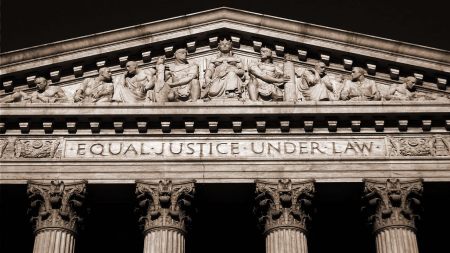
Equal Justice Under Law, the West Pediment of the U.S. Supreme court. AAPF image
The Court takes seriously the principle engraved over the door, however. This is the same Court that ruled earlier this year an accused terrorist and all-around bad guy held at Guantanamo Bay has the right to a writ of habeas corpus over the objections of the Most Power Man in the World, U.S. President George W. Bush. The humble, gritty, or even unsavory history of litigants does not limit their rights under the law.

Leo Donofrio in his usual office. Leo Donofrio image
So the question is, what sort of case does Donofrio have against Obama’s eligibility?
Would Justice Clarence Thomas have agreed to bring this case to the conference if it doesn’t have a chance to succeed?
I’ve not lunched with Thomas in more than two decades, so I can’t speak with any inside knowledge. Historically, the Court, and indeed all the federal courts, have agreed to examine cases like this often simply to provide an authoritative close to the issue. In this case, the outright hysteria of the anti-Obama partisans suggests the issue should be put to bed if possible.
Under usual Court procedures, we won’t learn the results of the conference until Monday. I would not be surprised if the results are announced today, just to promote the settling of the issue.
Does Donofrio have a case?
I don’t see a case. It’s clear that Obama is a U.S. citizen now. Donofrio’s argument is rather strained, and sexist. He claims that Obama’s father having been a British subject in 1961 (Kenya was not yet independent), Obama had dual citizenship at birth — and, further, Donofrio alleges, this dual citizenship trumps both Obama’s birth on U.S. soil (which should be dispositive) AND Obama’s mother’s U.S. citizenship, conferring a special status that doesn’t meet the intentions of the framers of the Constitution.
Donofrio’s claim is odd in that it would grant a lesser-status to children of legal immigrants than is allowed by law to children of illegal immigrants, or temporary visitors. It also is bizarre, to me, in the way it dismisses Obama’s mother’s existence as a factor in Obama’s citizenship status — and while equal rights for women were not wholly obtained in 1961, no one has successfully argued that the citizenship of the father trumps that of the mother in citizenship cases.
Donofrio is arguing that Obama’s dual citizenship at birth disqualifies him from holding the presidency, technically, in a very narrow reading — though Obama would have absolutely every other right of a natural born citizen.
A couple of observations:
First, this is not an easy issue to litigate. Standing is the easiest way for a federal court to avoid a decision — what harm can a citizen claim from letting Obama be president? It’s difficult to find an injury even were Donofrio’s claims valid. No blood, no foul. No injury, no standing to sue. It is upon this basis that most of the cases against Obama’s eligibility have been tossed out, as Donofrio’s has been tossed, twice already.
Second, it is unclear what entity enforces the eligibility clause of the Constitution, or indeed, whether any entity can. For most of the summer Obama’s critics were pressuring the Federal Election Commission (FEC) to do something, even though the FEC lacks a quorum of members to do anything. More to the point, there is nothing in any law that confers on the FEC the function of checking the citizenship status of any candidate. Sometime in October they finally figured out that state secretaries of state might have a role, since they set up the ballots in each state.
I admit I thought that, until I reflected on the issue of the electoral college. In U.S. presidential elections, voters do not vote directly for president and vice president. Instead, we vote to elect people who will be the electors who decide — electors of the electoral college. The history of this institution can be found elsewhere. For the sake of these suits, however, it means that the secretaries of state have no role at all in the eligibility of the candidates. They rule on the eligibility of the electors, which is an entirely different kettle of fish. Some states even list the electors on the ballot.
But in any case, it means Donofrio is suing the wrong entity, even if we can’t tell him what the correct entity is.
Third and most important, Donofrio is asking for U.S. citizenship law to be overturned in a most inconvenient time and place. Dual citizenship is a bar to very little in American life. There is an assumption that people who hold that status are fully American citizens, absent a showing of contrary facts. There are no contrary facts in evidence from Donofrio, nor from anyone else, despite promises of the revelation of conspiracies.
In short, Donofrio is arguing that there is, somewhere, somehow, some information that Barack Obama is not the shining patriot his life story reveals. Donofrio doesn’t know what that information is, or where it might be found, but he thinks maybe the State of Hawaii is complicit in a conspiracy to hide this information, which is hidden on the hand-written records of Obama’s birth in 1961. You might think Donofrio has watched “National Treasure” a few too many times, and whether it’s that movie or some other source, you’d be right — paranoid suspicions of conspiracy are not the stuff good court cases are made of.
The dozen or more cases against Obama’s eligibility all suffer from this astounding, dramatic lack of evidence. Is there an affidavit from someone who alleges that Obama’s citizenship should be called into question? If so, they’ve not been presented to any court. (Obama tormentor Corsi claims to have interviewed Obama’s Kenyan grandmother, and he alleges she said through an interpreter that Obama was born in Kenya; oddly, he didn’t bother to get an affidavit from the woman, nor from anyone else — and others who listen to the tape think she thought Corsi was asking about the birth of her son, not grandson. This is not solid evidence.)
I argued earlier there is a long chain of evidence creating rebuttable presumptions that Obama’s a natural born U.S. citizen. To contradict this chain of evidence, contestants should provide extraordinary, clear evidence of contradiction. What is offered by Donofrio is neither extraordinary, nor clear, nor necessarily contradictory to the presumptions.
This is not an issue solely for the hysterical. Lawyers and scholars have looked at the issue through the years, and intensely this year, and arrived at the conclusion that Obama is perfectly eligible for the presidency.
Will sanity ever prevail?
Resources you may want to consult:
Vodpod videos no longer available.
164 Comments | Barack Obama, Birth Certificate, Citizenship, denialism, Elections, History, Jurisprudence, Justice, Law, Natural Born, Politics, President Obama, Presidential Eligibility, Presidents, U.S. Constitution, U.S. Supreme Court | Tagged: Barack Obama, Birth Certificate, Birthers, Citizenship, Constitution, denialism, Elecctions, Eligibility, History, Natural Born, Politics, Presidential Eligibility, Supreme Court | Permalink
Posted by Ed Darrell
This is how bad it is: Even accurate statements about Gov. Sarah Palin are called unfair by McCain campaign operatives and hard-shell, stiff-necked partisans.
Conservatives are complaining about media coverage of Gov. Sarah Palin. For example, they say, she is accused of cutting funding for Alaska’s Special Olympics in half. Not fair they say, and they offer the actual figures: The budget for Special Olympics for 2007 from the Alaska legislature was $650,000. Palin used her line-item veto, and cut the funding to $275,000.
Hello? Half of $650,000 would be $325,000. Palin cut the Special Olympics budget by 58%. Last time I looked at the math tables, 58% was more than half of 100%.
So, why would it not be fair to say that Palin cut the funding by half? She cut it by more than half.
Oh, no, the conservatives say: ‘You have to let us jigger the numbers first — the final total, after Palin cut it, was still more than the previous year’s allocation from the state.’
Excuse me? Why should anyone be interested in “debunking” a “rumor” which is, as the sources indicate and the conservatives’ own research demonstrates, neither rumor nor error, but hard fact?
If you needed a demonstration that conservatives cannot count, or that they will not count accurately when only honor is at stake, these sorts of stories will do.
Below the fold, for the sake of accuracy, you’ll find a longish excerpt from Charlie Martin’s analysis.
Leave a Comment » | Accuracy, Debunking, denialism, Elections, Ethics, History Revisionism, Hoaxes, McCain 2008, Newspapers, Obama 2008, Politics, Uncomposted Organic Fertilizer, Voodoo history | Tagged: Campaign 2008, denialism, Hoaxes, Politics, Sarah Palin, Special Olympics, Spin, Voodoo history | Permalink
Posted by Ed Darrell
Every once in a while we get a glimpse of what the future would be like if the creationists ruled education and could teach some of the fantastic things they believe to be true as fact.
For example, creationists have for years complained that the basic chemistry of life somehow violates what chemists and physicists know as the “laws” of thermodynamics. Patient explanations of what we know about how photosynthesis works, and how animals use energy, and what the laws of thermodynamics actually are, all fall on deafened ears.
Comes Jennifer Marohasy, an Australian blogger at The Politics and Environment Blog, with this fantastic explanation about how the well-established notion of radiative equilibrium, simply doesn’t work.
“For the Earth to neither warm or cool, the incoming radiation must balance the outgoing.”
Not really.
No, really. Go read the post. And see these critiques, at Tugboat Potemkin, where problems with the rules of the principle of Conservation of Energy are noted, and Deltoid, where LOLCats makes a debut in explaining physics to the warming denialists.
Then go back and read the comments at Marohasy’s blog.
It’s not just the confusion of terms, like treating watts as units of heat. There’s an astonishing lack of regard for cause and effect in history, too:
Conservation of energy: it’s not just a phrase. The theory of radiative equilibrium arose early in the 19th century, before the laws of thermodynamics were understood.
Probably didn’t mention it here before, but Marohasy is also one of those bloggers who suffers from DDT poisoning. Among other things, she and Aynsley Kellow (whose book she recommends) use an astounding confabulation of history to claim DDT wasn’t harming birds at all, completely ignoring more than 1,000 research studies to the contrary (and not one in support of their claim).
Suggestion for research: Is the denialism virus that affects creationists, DDT advocates, and climate denialists, the same one, or are there slight variations? A virus seems the most charitable explanation, unless one wishes to blame prions.
Creationist physics, denialism in meteorology, physics, chemistry, and history. It makes a trifecta winner look like he’s not trying.
See also:
How many lightbulbs does it take to change the laws of thermodynamics?
One apparently.
1 Comment | Accuracy, Climate change, Creationism, denialism, Education, Global warming, History, Physics, Science, Voodoo history, Voodoo science | Tagged: chemistry, Climate change, Creationism, DDT, denialism, History, Physics, Thermodynamics, Voodoo history, Voodoo science | Permalink
Posted by Ed Darrell
We’re talking past each other now over at Right Reason[*], on a thread that started out lamenting Baylor’s initial decision to deny Dr. Francis Beckwith tenure last year, but quickly changed once news got out that Beckwith’s appeal of the decision was successful.
I noted that Beckwith’s getting tenure denies ID advocates of an argument that Beckwith is being persecuted for his ID views (wholly apart from the fact that there is zero indication his views on this issue had anything to do with his tenure discussions). Of course, I was wrong there — ID advocates have since continued to claim persecution where none exists. Never let the facts get in the way of a creationism rant, is the first rule of creationism.

Steve Sack cartoon in the Minneapolis Star-Tribune
Discussion has since turned to the legality of teaching intelligent design in a public school science class. This is well settled law — it’s not legal, not so long as there remains no undisproven science to back ID or any other form of creationism.
10 Comments | Accuracy, Charles Darwin, Creationism, denialism, Evolution, Intelligent Design, Junk science, Law, Voodoo history, Voodoo science | Tagged: Accuracy, Charles Darwin, Creationism, denialism, Evolution, Intelligent Design, Junk science, Law, Voodoo history, Voodoo science | Permalink
Posted by Ed Darrell
You are currently browsing the archives for the denialism category.


Ed Darrell on Texas's Colorado River


Come on in, the water's fine. Come often: Cleanliness is next to godliness.


 Millard Fillmore's Bathtub