Years ago when I staffed a U.S. senator’s office, one of my tasks was to look through all the weekly newspapers in the state. Back then subscriptions were cheap, and most senators would take out a subscription to these weeklies more to flatter the editors and publishers than to read. We put them to use, first checking to see whether the clipping services were getting all the clips (mostly), and then on a hunch, to see what issues were raging in the state, well below the radar of the big city daily newspapers and broadcast outlets.
You can learn a lot.
Many of those old weekly newspapers are gone, now, victims to local populations that turn over in every recession, and to electronic news gathering services — and to general alienation: People are not so sure they want to know what their neighbors are up to, these days. Heck, many people aren’t sure they want to know their neighbors.
My own electronic news gatherers occasionally pull out something to think about from a minor news outlet. For example, below is an opinion piece out of the Carrboro Citizenfrom Dan Coleman, a member of the town council in Carrboro, North Carolina. I gather from the paper it is rather close to Chapel Hill, the home of the University of North Carolina (I haven’t checked a map).
But look at what this guy says. He questions the wisdom of Adam Smith. Adam Smith! It appears Coleman wasn’t led astray by all those Adam Smith neckties that were so popular in the Reagan administration. He questions the true need for profits from corporations, and he wonders if there isn’t a higher duty for a corporation.
How many others like Dan Coleman are there, out there in America, relatively sane on all other accounts, and thinking?
Did you know that Carrboro’s Town Code incorporates a principle devised by Shell Oil? That’s right, the same Shell Oil that has been accused of human rights violations in Nigeria, including summary execution, crimes against humanity, torture, inhumane treatment and collaborating in the execution of Nigerian activist Ken Saro-Wiwa. The same Shell Oil that has despoiled the Niger delta and was responsible for the largest freshwater oil spill ever.
With a record like this, it is little wonder that Shell came up with one of the corporate world’s more effective public relations concepts of recent years: the Triple Bottom Line (TBL), also known as People, Planet, Profit. It’s as if Shell was saying, sure you can criticize our environmental and humanitarian record but don’t forget, we have to make a profit.
Efforts to value people have dogged profiteering for over a century. The late 19th and early-to-mid-20th centuries were marked by many thousands of strikes by workers, more than 1,400 in the year 1886 alone. Many of these were met by violent strikebreakers backed up at times by military force. This is a struggle that continues in 2011 in Wisconsin and other states.
William Blake
Through the efforts of these men and women, much of value was created: the weekend, workplace-safety standards, health care for workers, vacation and sick leave, etc. And each of these was wrested from the one bottom line that corporate America really cares about.
Despite William Blake offering the image of “dark satanic mills” as far back as 1804, the environmental impacts of industrial capitalism began to be understood with Rachel Carson’s 1962 publication of The Silent Spring. Within a decade, there was Earth Day, the Environmental Protection Agency, the Clean Water Act and much more, each a challenge to the profit-focused priorities of capital.
Given the pre-eminent importance of profit-maximization, it is not surprising that corporations touting the Triple Bottom Line often oppose measures to combat global warming, oppose workers’ rights and oppose regulatory mechanisms to protect the health of people and planet.
History has taught us that Adam Smith was wrong when he offered the justification for prioritizing profit that “by pursuing his own interest [the businessman] frequently promotes that of the society more effectually than when he really intends to promote it.” If Smith were correct, companies like Shell would not have such a devastating impact on society and nature. In part, this impact results from profit being measured in a short timeframe, a year or even a quarter of a year, while sustainability requires a vision spanning, as the Iroquois put it, as much as seven generations.
But Smith was right that profit ought to serve human well-being. Therefore, it must be understood within an ethical system that places people and planet first. This holds true for the vague term “stakeholder value” that some, including Carrboro, use instead of profit. Who are the stakeholders if not people and planet?
The TBL offers nothing to help us navigate the inevitable contradictions between profit on the one hand and people/planet on the other. But, really, why should we have any social or political bottom lines at all?
It was social ecologist Murray Bookchin who bemoaned the cultural turn to the “grubby language” of the market economy, which has “replaced our most hallowed moral and spiritual expressions. We now ‘invest’ in our children, marriages, and relationships. … We live in a world of ‘trade-offs’ and we ask for the ‘bottom line’ of any emotional ‘transaction.’”
There are a variety of frameworks that speak to a more fundamental commitment to the well-being of all life. In an 1854 speech, Chief Seattle offered the notion of a web of life: “Humankind has not woven the web of life. We are but one thread within it. Whatever we do to the web, we do to ourselves.”
Aldo Leopold, in Arizona, Arizona State Parks image
A century after Chief Seattle, Aldo Leopold articulated his land ethic in Sand County Almanac, “A thing is right when it tends to preserve the integrity, stability and beauty of the biotic community. It is wrong when it tends otherwise.” The biotic community, of course, includes humans.
We need the ability to truly place people and planet first and to reject the false, self-serving homilies offered by those who spread pavement and poverty in pursuit of the almighty dollar. Rather than seek simplistic nostrums, we may have to take the time to look hard at each decision, and bring a clear ethical sensibility, like that of Seattle or Leopold, to bear.
Dan Coleman is a member of the Carrboro Board of Aldermen.
Coleman may want to check the provenance of the Chief Seattle quote — but the thought is solid.
What do you think?
Spread the word; friends don't allow friends to repeat history.
In what must be one of the most bizarre but informative exchanges we’ve ever heard from a Tea Partier, Kentucky Sen. Rand Paul reveals what bugs so many Tea Partiers. His toilets don’t work, and haven’t for 20 years.
That’s not supposed to be a straight line for a gag.
You can’t get the information from just listening to him, however — you have to have some additional facts so you can read between the lines.
From this exchange at the Senate Committee on Energy and Natural Resources, we learn:
Rand Paul trivializes abortion and women’s rights. He appears to think babies are similar to incandescent light bulbs; he’s pretty clueless about either pregnancies or light bulbs. Could there be a more offensive way to introduce this topic, than to claim his right to buy an incandescent light bulb and waste energy is equal, somehow, to a woman’s right to choose whether to carry a baby?
Rand Paul doesn’t know how to shop. Rand Paul isn’t much of a plumber. He apparently bought a defective toilet some years ago, one that either doesn’t work or just can’t deal with the amount of effluent he personally produces, and he blames government for his bowel issues and his plumbing issues. Well-working, low-water-use toilets have been available for decades in Europe and Asia, and are now available in the U.S., but he can’t be bothered to shop for them. If he could maintain his old, water-wasting toilet, he’d have no kick, of course. But he can’t be bothered to shop for a plumber who knows plumbing, and he can’t figure out how to do it himself.
Rand Paul is incompetent at economics and constitutional law, at the same time. Rand Paul thinks government should regulate things for his satisfaction, keeping products available that are no longer economical to produce — and if government fails to force businesses to do his bidding, it’s government’s fault; but the fact that Paul lives in the 19th century in his mind and no one else wants what he wants, never occurs to him.
Rand Paul wants government to subsidize his bad choices.
Oy.
Let’s go to the video:
Can somebody get Rand Paul a competent plumber? Can somebody show him how to use Google or Bing or Yahoo! to shop for good toilets and good plumbers? The nation needs Paul to return to sanity, decency, and sanitation.
Am I wrong to think Paul is making an attack on wise conservation in general? Why?
Paul’s smug, self-satisfied invincibility of incompetence and learned helplessness is appalling. (Take that, Protein Wisdom; it’s just you, Jeff G. — everybody else sees Ms. Morgan as composed against Paul’s overweening smugness.)
Can somebody explain this to me: This moment of extreme embarrassment to Sen. Paul is posted by his office at his YouTube site. What were they thinking?
Somebody give a medal to Energy’s Deputy Assistant Secretary Kathleen Morgan for not teeing off on the guy. Letting him twist in the wind is good enough.
By the way, the bill Paul complains about? The manufacturers agreed to the standards voluntarily, and have already agreed to comply — the bill adds no regulations they say they cannot meet; Hogan’s statement noted:
S.398 codifies agreements that were negotiated, signed, and promoted by a cross-section of stakeholders representing consumer advocacy groups, manufacturers, manufacturer trade associations, and energy efficiency advocacy organizations, all of whom support this bill. The negotiated consensus agreements would establish energy conservation standards for 14 products, several of which are in the midst of DOE’s ongoing standards and test procedure rulemakings.
“The law that they are taking to the airwaves to condemn was signed by that notorious tree-hugger George W. Bush (and voted for by 54 congressional Republicans). Because its energy-efficiency standards can’t be met by tungsten-based incandescent lightbulbs, 100-watt bulbs will be obsolete come Jan. 1, with the rest phased out by 2014.
Incandescent bulbs waste about 90 percent of the energy that goes into them, much of it in generating more heat than light (a lot like this debate).
By contrast, alternative lightbulbs are far more energy-efficient. Compact Fluorescent Lamps (CFLs) use about a quarter of the energy of traditional lightbulbs and last 10 times longer. Halogen and LED lightbulbs also save significant amounts of energy.
Spread the word; friends don't allow friends to repeat history.
Teaching is a lonely profession, oddly enough. All too often teachers get stuck on an island away from other adults, away from socializing with colleagues even just a few feet away in the next room. Different from most other professions, teachers in most schools are required to function without basic support for much of what they do, or with minimal support.
Consequently, teachers organizing to support teachers is difficult and too rare.
Unions become vital organizations to fight against unhealthy social isolation, to fight for teachers, to fight for education.
On March 22 union teachers in New York will wear red as an expression of solidarity with and support for teachers under attack in Wisconsin, Tennessee, Texas, Ohio, Indiana, and dozens of other places that we don’t know much about because, after all, brutal legislative attacks on teachers and teaching are so commonplace these days — “dog bites man” stories.
I was asked to join a group of bloggers who will blog on the importance of teaching, the importance of education, and why we support teacher unions on March 22.
If you teach and blog, will you join us? If you had a teacher who made a difference in your life, and blog, will you join us?
As we all know, teachers and our unions, along with those of other public sector employees, face unprecedented attacks in the national media and from local and state governments. It is easy for politicians and the media to demonize the “unions” and their public faces; it is far more difficult to demonize the millions of excellent teachers who are proud union members. Those of us who are excellent teachers and who stand in solidarity with our unions are probably no stranger to the question “Well, why are you involved with the union if you’re a good teacher?” It’s time for us to stand up and answer that question loudly and clearly.
On Tuesday, March 22, teachers in NYC will wear red in solidarity with our brothers and sisters who are under attack in Wisconsin, Ohio, Indiana, Tennessee and elsewhere. We also stand with teachers in places like Idaho, California, and Texas who are facing massive layoffs. We would like to take this stand on the web as well. We encourage you to publish a piece on March 22 entitled “Why Teachers Like Me Support Unions.” In this piece, please explain your own reasons for being a proud union member and/or supporter. Including personal stories can make this a very powerful piece. It would be great to also explain how being a union member supports and enables you to be the kind of teacher that you are. We want these posts to focus not only on our rights, but also on what it takes to be a great teacher for students, and how unions support that.
After you have published your post, please share it through the form that will go live on March 22 at http://www.edusolidarity.us. Posts should also be shared on Twitter using the tag #edusolidarity.
I could see a bell-ringer in there somewhere. Who do you think ought to see this thing? What classes in public schools should see it, for what purpose?
I hope the year-long series lives up to the video. I hope there are a lot more videos to go along with it. As a piece of persuasive rhetoric, it does make a decent case for subscribing to National Geographic for a year. How’s that for rhetorical criticism?
Spread the word; friends don't allow friends to repeat history.
Looking at my print copy I was struck that most of the “states” listed — really communities of people — have lost economic ground in the past decade. Average per capita incomes dropped for most groups.
Since 1980, income inequality has fractured the nation. Click each icon to see each of the dozen states, which counties belong to them and how median income has changed over the last 30 years.
The old income inequality monster rearing its ugly, ugly head again. America is losing ground. No wonder the Republicans are discouraged — but why don’t they understand that its their policies that create the trouble?
The U.S. economy appears to be coming apart at the seams. Unemployment remains at nearly ten percent, the highest level in almost 30 years; foreclosures have forced millions of Americans out of their homes; and real incomes have fallen faster and further than at any time since the Great Depression. Many of those laid off fear that the jobs they have lost — the secure, often unionized, industrial jobs that provided wealth, security and opportunity — will never return. They are probably right.
Cover of Winner-Take-All Politics, by Jacob Hacker and Paul Pierson
And yet a curious thing has happened in the midst of all this misery. The wealthiest Americans, among them presumably the very titans of global finance whose misadventures brought about the financial meltdown, got richer. And not just a little bit richer; a lot richer. In 2009, the average income of the top five percent of earners went up, while on average everyone else’s income went down. This was not an anomaly but rather a continuation of a 40-year trend of ballooning incomes at the very top and stagnant incomes in the middle and at the bottom. The share of total income going to the top one percent has increased from roughly eight percent in the 1960s to more than 20 percent today.
This what the political scientists Jacob Hacker and Paul Pierson call the “winner-take-all economy.” It is not a picture of a healthy society. Such a level of economic inequality, not seen in the United States since the eve of the Great Depression, bespeaks a political economy in which the financial rewards are increasingly concentrated among a tiny elite and whose risks are borne by an increasingly exposed and unprotected middle class. Income inequality in the United States is higher than in any other advanced democracy and by conventional measures comparable to that in countries such as Ghana, Nicaragua, and Turkmenistan.
In recent decades, the bulk of income growth in America has gone to the top 10% of families, but that was not always the case. Throughout most of the 20th Century, the bottom 90% claimed a much larger share of income growth than they have in recent years. The Chart, from EPI’s new interactive State of Working AmericaWeb site, compares the distribution of income growth over two periods. Between 1948 and 1979, a period of strong overall economic growth and productivity in the United States, the richest 10% of families accounted for 33% of average income growth, while the bottom 90% accounted for 67%. The overall distribution of income was stable for these three decades. In an extreme contrast, during the most recent economic expansion between 2000 and 2007, the period that led up to the Great Recession, the richest 10% accounted for a full 100% of average income growth.
In other words, while average annual incomes over the seven-year period between 2000 and 2007 grew by $1,460, that growth was extremely lopsided. Average incomes for the bottom 90% of households actually declined. The interactive feature When income grows, who gains?, on the new State of Working America Web site, lets users look at income growth and distribution patterns for any time frame between 1917 and 2008.
This new feature lets users choose any two years between 1917 and 2008 to see how much the top 10%, versus the bottom 90%, contributed to growth in average incomes. Because income growth can change a lot during periods of recession, researchers tracking trends in inequality often chart movements between the peaks of different business cycles in order to avoid comparing a high point in one business cycle to a low point in another. The interactive feature on income distribution also shows how an increasing amount of income growth has been flowing not just to the top 10%, but to the richest 1% of families.
Tip of the old scrub brush to reader Nic Kelsier, and to Luiz Carlos Abreu, who appends this note:
I wish the bottom 90% would let go of the myth that we can all be in the 10% richest. In fact, being rich does not mean having a happy not even non-stressful life, not if polls on the subject tell anything.
Never mind Christianity, Judaism, Islam — the real religion of most Americans seems to be Capitalism; there are even some fundamentalist capitalists. Its main beliefs seem to be:
The world has unlimited resources so long as we have faith in Money to whom nothing is impossible.
Only Money is God, those who have Money are His Prophets.
The Holy Sainthood and Divine Right of the Rich.
Money is happiness, and to be one with Money is the Supreme Happiness.
We can do all things through Money that enriches us.
An amount of Money is a measure of Holiness or Godliness, therefore separating Money is a sin and accumulating Money is a holy act.
Artist's conception, Ronald Reagan on Mt. Rushmore - Fred J. Eckert, Eckert/Ambassador Images. Gutzon Borglum, the designer and sculptor for Mt. Rushmore, determined the rock on either side of the current four busts is unsuitable for carving -- Jefferson was moved from Washington's right where it was originally planned because the rock crumbled when carved.
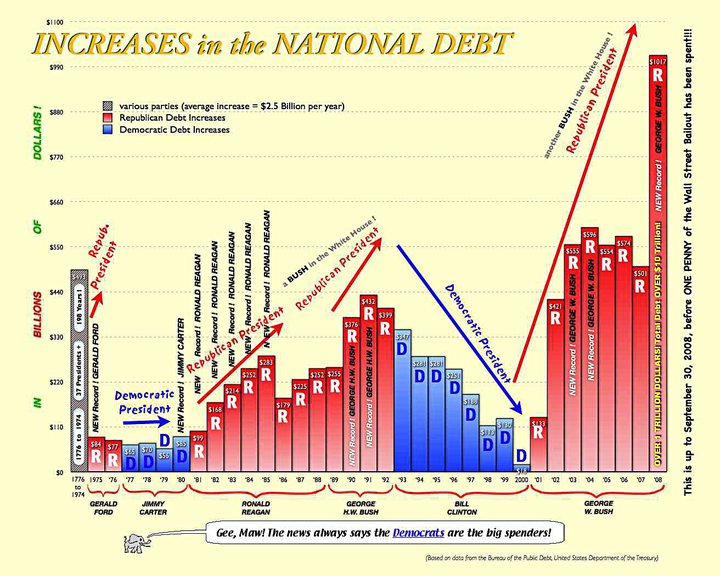
Perhaps we could name it in his honor: The Ronald W. Reagan Memorial National Debt. Just imagine how that would change the tone and direction of discussions on spending and taxes in Washington and the state capitals.
What Republican could possibly vote against the “Ronald W. Reagan Memorial National Debt Ceiling Raising Act?”
At Davos, Switzerland, Bill Clinton answered a question from former White House advisor David Gergen, I gather. American is exceptional, Clinton said — but those who insist on making “American Exceptionalism” a political mantra seriously risk making America unexceptional, and putting us into decline, he argues.
Texas Gov. Rick Perry’s ears are stinging on the issue of unbalanced state budgets.
William Jefferson “Bill” Clinton was the 42nd President of the United States, serving from 1993 to 2001. At 46 he was the third-youngest president. He became president at the end of the Cold War, and was the first baby boomer president. His wife, Hillary Rodham Clinton, is currently the United States Secretary of State. Each received a Juris Doctor (J.D.) from Yale Law School.
100,000 people gather in Times Square, New York City, tonight, and millions more around the world, in festivities for the new year made possible by the work of Thomas Alva Edison.
Here it is, the invention that stole sleep from our grasp, made clubbing possible, and launched 50,000 cartoons about ideas:
The light bulb Thomas Edison demonstrated on December 31, 1879, at Menlo Park, New Jersey - Wikimedia image (GFDL)
The light bulb. It’s an incandescent bulb.
It wasn’t the first bulb. Edison a few months earlier devised a bulb that worked with a platinum filament. Platinum was too expensive for mass production, though — and Edison wanted mass production. So, with the cadre of great assistants at his Menlo Park laboratories, he struggled to find a good, inexpensive filament that would provide adequate life for the bulb. By late December 1879 they had settled on carbon filament.
Edison invited investors and the public to see the bulb demonstrated, on December 31, 1879.
Thomas Edison in 1878, the year before he demonstrated a workable electric light bulb. CREDIT: Thomas Edison, head-and-shoulders portrait, facing left, 1880. Prints and Photographs Division, Library of Congress. Reproduction number LC-USZ62-98067
Edison’s successful bulb indicated changes in science, technology, invention, intellectual property and finance well beyond its use of electricity. For example:
Edison’s Menlo Park, New Jersey, offices and laboratory were financed with earlier successful inventions. It was a hive of inventive activity aimed to make practical inventions from advances in science. Edison was all about selling inventions and rights to manufacture devices. He always had an eye on the profit potential. His improvements on the telegraph would found his laboratory he thought, and he expected to sell the device to Western Union for $5,000 to $7,000. Instead of offering it to them at a price, however, he asked Western Union to bid on it. They bid $10,000, which Edison gratefully accepted, along with the lesson that he might do better letting the marketplace establish the price for his inventions. Other inventive labs followed Edison’s example, such as the famous Bell Labs, but few equalled his success, or had as much fun doing it. (Economics teachers: Need an example of the marketplace in action?)
Edison didn’t invent the light bulb — but his improvements on it made it commercial. “In addressing the question ‘Who invented the incandescent lamp?’ historians Robert Friedel and Paul Israel list 22 inventors of incandescent lamps prior to Joseph Wilson Swan and Thomas Edison. They conclude that Edison’s version was able to outstrip the others because of a combination of three factors: an effective incandescent material, a higher vacuum than others were able to achieve (by use of the Sprengel pump) and a high resistance lamp that made power distribution from a centralized source economically viable.”
Look around yourself this evening, and you can find a score of ways that Edison’s invention and its descendants affect your life. One of the more musing effects is in cartooning, however. Today a glowing lightbulb is universally accepted as a nonverbal symbol for ideas and inventions. (See Mark Parisi’s series of lightbulb cartoons, “Off the Mark.”)
Even with modern, electricity-saving bulbs, the cartoon shorthand hangs on, as in this Mitra Farmand cartoon.
Brilliant cartoon from Mitra Farmand, Fuffernutter
Or see this wonderful animation, a video advertisement for United Airlines, by Joanna Quinn for Fallon — almost every frame has the symbolic lightbulb in it.
Thomas Edison's electric lamp patent drawing and claim for the incandescent light bulb CREDIT: “New Jersey--The Wizard of Electricity--Thomas A. Edison's System of Electric Illumination,” 1880. Prints and Photographs Division, Library of Congress. Reproduction Number LC-USZ62-97960.
I had to turn the graphic on its side to fit it in here big enough that you can read it. Where does your state, or nation, rank in percentage of students achieving an advanced level of math proficiency? For U.S. citizens, this is not a pretty chart.
Or is this one more case of using environmentalists as scapegoats by the hard right, and other know-nothings and know-not-enoughs?
Jackson’s piece makes mild defense of a great idea in government, I think. To me, the critics appear hysterical in comparison.
In tracking this down, I discovered that Matt Ridley had been given some really bum information about Rachel Carson, DDT and malaria, which appears in his new book, The Rational Optimist. To his credit, Ridley made a quick correction of the grossest distortions. He defends the premises, still, however, which I find troubling. There may be subject for a later comment.
Disinformation is insidious. Claims against the accuracy and reputation of Rachel Carson follow the stories of Millard Fillmore’s bathtub, but with darker, malignant intent.
Seriously: What does Lisa Jackson overstate here?
The EPA Turns 40
‘Job-killing’ environmental standards help employ more than 1.5 million people.
Forty years ago today, the U.S. Environmental Protection Agency opened its doors, beginning a history of improvements to our health and environment. We reach this milestone exactly one month after the midterm elections strengthened the influence of groups and individuals who threaten to roll back the EPA’s efforts.
Last month’s elections were not a vote for dirtier air or more pollution in our water. No one was sent to Congress with a mandate to increase health threats to our children or return us to the era before the EPA’s existence when, for example, nearly every meal in America contained elements of pesticides linked to nerve damage, cancer and sometimes death. In Los Angeles, smog-thick air was a daily fact of life, while in New York 21,000 tons of toxic waste awaited discovery beneath the small community of Love Canal. Six months before the EPA’s creation, flames erupted from pollution coating the surface of Cleveland’s Cuyahoga River, nearly reaching high enough to destroy two rail bridges.
These are issues that are above politics. The last 40 years have seen hard-won advances supported by both sides of the aisle, and today the EPA plays an essential role in our everyday lives. When you turn on the shower or make a cup of coffee, the water you use is protected from industrial pollution and untreated sewage. In fact, drinking water in Cleveland was recently shown to be cleaner than a premium brand of bottled water. You can drive your car or catch a bus without breathing dangerous lead pollution. At lunch, would you prefer your food with more, or less, protection from pesticides?
The most common arguments against these protections are economic, especially as we continue to recover from the worst downturn since the Great Depression. Fortunately, the last 40 years show no evidence that environmental protection hinders economic growth. Neither the recent crisis nor any other period of economic turmoil was caused by environmental protection. In fact, a clean environment strengthens our economy.
Special interests have spent millions of dollars making the case that we must choose the economy or the environment, attacking everything from removing lead in gasoline to cleaning up acid rain. They have consistently exaggerated the cost and scope of EPA actions, and in 40 years their predictions have not come true.
We have seen GDP grow by 207% since 1970, and America remains the proud home of storied companies that continue to create opportunities. Instead of cutting productivity, we’ve cut pollution while the number of American cars, buildings and power plants has increased. Alleged “job-killing” regulations have, according to the Commerce Department, sparked a homegrown environmental protection industry that employs more than 1.5 million Americans.
Even in these challenging times, the EPA has been part of the solution, using Recovery Act investments in water infrastructure, clean-diesel innovation and other projects to create jobs and prepare communities for more growth in the years ahead.
The EPA’s efforts thrive on American ingenuity and entrepreneurship. Holding polluters accountable sparks innovations like the Engelhard Corporation’s catalytic converter, which pioneered the reduction of toxic emissions from internal combustion engines, and DuPont’s replacements for chlorofluorocarbons (CFCs), which protected the ozone layer while turning a profit for the company. One executive told me that the EPA’s recent standards for greenhouse gas emissions from cars will help create hundreds of jobs in a state where his company operates—a state whose U.S. senators have both opposed the EPA’s authority to regulate greenhouse gases.
These attacks are aimed at the EPA, but their impacts are felt by all Americans. Pollutants like mercury, smog and soot are neurotoxins and killers that cause developmental problems and asthma in kids, and heart attacks in adults. We will not strengthen our economy by exposing our communities and our workers to more pollution.
In these politically charged times, we urge Congress and the American people to focus on results from common-sense policies, not inaccurate doomsday speculations. That is how we can confront our nation’s economic and environmental challenges and lay a foundation for the next 40 years and beyond.
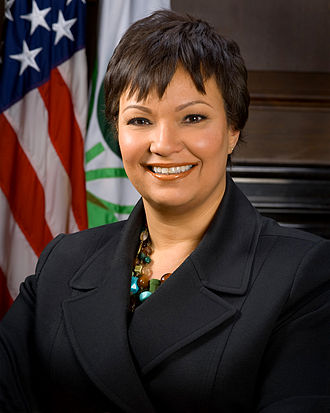
Ms. Jackson is administrator of the Environmental Protection Agency.
* [Oops. Same birthday as Donna. Happy birthday, Donna! Happy EPA’s 40th (yours, too? can’t be much more, can it?)]
Spread the word; friends don't allow friends to repeat history.
I’m back and back is beautiful, to tweak a phrase. Where have I been? Taking care of business with the helping hand of a special-special life-long friend.
For now, I’ll simply say: Life is an adventure, a gift and a grand adventure, and more than just a mite irksome at times.
These many weeks, in what little spare time I’ve had, I’ve also been writing lyrics. Everyone needs a hobby. Mine is writing lyrics.
Thus, the following song regarding our times:
WEDDING RING IN THE PAWNSHOP WINDOW By Daniel Valentine (c) 2010
The wedding ring
In the pawnshop window.
The price tag on a string,
Tied to the wedding ring,
Says it all, says ev’rything.
Life seldom ever goes as planned.
The wedding ring
In the pawnshop window.
To think the joy it must
Have brought once. Now it’s just
Sitting there collecting dust,
Pawned for a fast few bucks in hand.
That said, a future groom and bride,
Their savings on the meager side,
Stop to sneak a peak, beguiled and starry-eyed.
And what they see are tons and tons
Of rare old coins, guitars and guns,
One music box, two cuckoo clocks,
Plus a fly or three dead on the sill.
Then they see the ring and all is still.
The wedding ring
In the pawnshop window.
It glimmers and it gleams.
It’s ev’rything that dreams
Are made of, or so it seems,
And all for less than half a grand.
And so, like tens of times before,
The tiny bell above the door
Jingles as the lovers step inside the store.
And, oh, the sparkle in her eyes
When first she tries it on for size.
It fits just right and in the light,
When she holds her left hand out to show,
Like her heart, the diamond’s all aglow.
The wedding ring
In the pawnshop window.
The register ka-chings.
An angel gets its wings.
And a tweetie birdie sings.
All while a credit card is scanned.
The wedding ring
In the panwshop window.
A mom with bills to pay
In need without delay
Pawned the ring to save the day,
Such are the times in our fair land.
Spread the word; friends don't allow friends to repeat history.
Or, until that account is unsuspended by the forces supporting Donald Trump: Follow @FillmoreWhite, the account of the Millard Fillmore White House Library
We've been soaking in the Bathtub for several months, long enough that some of the links we've used have gone to the Great Internet in the Sky.
If you find a dead link, please leave a comment to that post, and tell us what link has expired.
Thanks!
Retired teacher of law, economics, history, AP government, psychology and science. Former speechwriter, press guy and legislative aide in U.S. Senate. Former Department of Education. Former airline real estate, telecom towers, Big 6 (that old!) consultant. Lab and field research in air pollution control.
My blog, Millard Fillmore's Bathtub, is a continuing experiment to test how to use blogs to improve and speed up learning processes for students, perhaps by making some of the courses actually interesting. It is a blog for teachers, to see if we can use blogs. It is for people interested in social studies and social studies education, to see if we can learn to get it right. It's a blog for science fans, to promote good science and good science policy. It's a blog for people interested in good government and how to achieve it.
BS in Mass Communication, University of Utah
Graduate study in Rhetoric and Speech Communication, University of Arizona
JD from the National Law Center, George Washington University


 Posted by Ed Darrell









 Millard Fillmore's Bathtub