Post-Labor Day: Unions and pay inequality

September 13, 2007

Stumbling and Mumbling has some pithy thoughts on whether unions aid or abet pay inequality.


Vox Day: Trapped in a quote mine cave-in

August 31, 2007

Vox Day, who claims to know more than most mortals can even think about, has fallen into a quote mine. (Quote mine defined.) Worse, the mine appears to have caved in.

Vox Day wishes to make the claim that Darwin is responsible for the evils of the Soviet Union. Apart from the prima facie absurdity of the claim, Vox has a dozen highly tenuous links he wishes to torture into supporting his claim, despite their refusal to do so.

This just in: Since I started out on this particular Fisking, Vox has popped up with this gem:

Unsurprisingly, evolutionists are reacting strongly to my column today. They swear up and down that there is no connection whatsoever between evolution and Communism, despite the fact that every single major Communist not only subscribed to Darwinist evolution but considered Darwin to be second only to Hegel as a pre-Marxist socialist figure.

There is no evidence Stalin or Lenin ever subscribed to evolution theory, and at any rate, Stalin expressly rejected Darwin and evolution, eviscerating the Soviets’ lead in genetics in 1920 by banning the teaching of evolution, banning research in evolution or research that had Darwinian overtones, stripping Darwin-theory subscribing biologists of their jobs, exiling a few to Siberia and death in several cases, and executing a few just for good measure. In place of evolution, Stalin backed Trofim Lysenko who advocated, apart from his creationist-like hatred of Darwin, an odd, almost-Lamarckian idea that stress in utero would change characteristics.

So, for example, Lysenko ordered that seed wheat be frozen, and then planted in winter. The freezing, the Stalin-Lysenko idea held, would make the wheat able to grow in cold weather. The crop failures were so spectacular that at least 4 million people died of starvation in the Soviet Union. By 1954 the crop failures were so massive the Soviet Union had to purchase wheat from the U.S., with loans from the U.S. These loans crippled any hope of the Soviet economy ever breaking out of its doldrums, and started the long slide to the collapse of the Soviet Union. You’d think Vox Day, who professes to be a libertarian and a Christian, would approve of the collapse of the Soviet Union by any cause — but he does not approve of the collapse if it came by a lack of evolution theory.

Vox Day never lets the facts get in the way of a rant. (As evidence that Marx was so deeply influenced by evolution theory, Vox notes that a fellow who knew Darwin, Edward Aveling attended Marx’s funeral. If that doesn’t convince, you, Vox says, Aveling later wrote an article saying it’s true, Marxism was based on evolution theory. So take THAT all you people who think Marxism emphasizes collectivism and the state: Darwin’s individual competition for survival is the REAL root of socialism. No, I’m not making this up — go read it for yourself. Then get some facts — read this account, which includes the guest list of Marx’s funeral. There were only nine people at Marx’s funeral, and Vox got the guest list wrong: Aveling wasn’t there. One more Vox claim refuted.)

Back to the regularly scheduled Vox Day quote mine cave-in, below the fold.

Read the rest of this entry »


How to fight malaria – Kenya’s example

August 17, 2007

Kenya has cut malaria by nearly half. Without further comment from me, here’s the news story from Gulf Times, Doha, Qatar, and below that, from a few other sources:

Kenya nearly halves child deaths from malaria

Published: Friday, 17 August, 2007, 01:27 AM Doha Time

NAIROBI: Kenya announced yesterday that it almost halved malaria deaths among small children by using insecticidal nets (INTs), spurring the World Health Organisation (WHO) to advocate free nets for all as it tackles Africa’s deadliest disease.

Health Minister Charity Ngilu said distribution of 13.4mn INTs over the past five years among children and pregnant women had helped curtail infections, a key success against a disease threatening 40% of the world’s population.

“Childhood deaths have been reduced by 44% in high-risk districts, in-patient malaria cases and deaths are falling (and) there are reduced cases at the community level,” she said in a statement.

“For every 1,000 treated nets used, seven children who might have died of malaria are saved.”

Malaria kills 34,000 children under the age of five each year in Kenya, and threatens the lives of more than 25mn of its population of 34mn people, the ministry said.

Children sleeping under INTs in malaria risk areas are 44% less likely to die than those who are not, according to a survey carried out in four districts representing the country’s epidemiological pattern.

The government has distributed 12mn doses of artemisinin-based therapy (ACT), the latest surefire anti-malaria drug cocktail to replace the mono-therapies that had developed resistance.

In addition, some 824,600 houses in 16 epidemic-prone districts underwent indoor spraying this year.
The government and donors spent 4.7bn shillings ($70.2mn) for the campaign, yet the funds were not enough.

Ngilu said the government would freely provide 2mn treated nets annually to ward off mosquitoes at night when they are active, calling on donors to boost the blanket distribution.

“The impact we have seen and the lessons we have learnt through massively distributing INTs, rather than selectively marketing and selling them, will not only benefit Kenya’s children but all Africa’s children,” she said.

In a statement, the WHO said it had abandoned its earlier guideline of targeting only vulnerable groups – under fives and pregnant women – in favour of “making their protection immediate while achieving full coverage”.

“Recent studies have shown that by expanding the use of these nets to all people in targeted areas, increased coverage and enhanced protection can be achieved while protecting all community members.”

WHO chief Margaret Chan said that Kenya’s success “serves as a model that should be replicated throughout ‘malarious’ countries in Africa.”

“This data from Kenya ends the debate about how to deliver the long-lasting nets. No longer should the safety or well-being of your family be based upon whether you are rich or poor,” said WHO’s Global Malaria Programme director Arata Kochi.

Chan and Kochi were deriding the “social marketing” model widely backed by donors of distributing INTs by selling them at subsidised rates, even to vulnerable groups, and raising awareness of their importance.

Although supporting anti-malaria campaigns, public health watchers have chided British and US foreign development agencies for pushing for social marketing in the world’s poorest continent.

The WHO launched a global programme in 1955 to eradicate the disease that has frustrated attempts to create a vaccine owing to its constant mutations.

Using dichloro-diphenyl-trichloroethane (DDT), a powerful insecticide, and the drug chroloquine, the organisation managed to eradicated the disease in the West by the 1960s.

But the programme never got off the ground in the humid and low-lying tropics in sub-Saharan Africa where the disease persisted.

By 1969, the programme collapsed as financing withered in the face of rising poverty, political upheavals and surging opposition to DDT for misuse, not by anti-malaria campaigners, but farmers.

But Kochi said the Stockholm Convention on Persistent Organic Pollutants allowed the use of DDT in endemic countries for “public health only” and Uganda and Malawi were the only African nations keen on the chemical.

Malaria affects more than 1bn people worldwide and kills 1mn – mainly under age five – every year, the vast majority in sub-Saharan Africa. – AFP (Agence France Press) Read the rest of this entry »


Nightmare at 1600 Pennsylvania Ave: Socialized medicine! (it works well)

August 16, 2007

Rep. Ron Paul, who wants to be president, made a speech recently on the floor of the House of Representatives where he suggested that Americans are mad at their government because the government tries to do stuff for them that they’d rather do themselves. Having recently spent two nights in the medical brig, I immediately thought that Paul is completely out of his mind — who in their right mind would want to do their own health care?

(Old joke: You know what they told the guy who wanted to do his own appendectomy? His doctor said, “Whatever! Suture self!”)

It seems to me people are upset because they can’t get health care at reasonable cost, and the government is doing absolutely nothing to fix most of those problems.

Then I read somewhere that Karl Rove urged his clients to bring up the bogey word “socialized” to describe programs their opponents advocate, since everybody hates anything that is socialized? Oh, yeah? You mean like people hate socialized roads, socialized water delivery systems, socialized sewer systems, and socialized airports?

So I was ready when Jim Wallis’s e-mail hit my in box this morning. His story about his experience with “socialized medicine” in London — a horror story that George Bush will use in his next State of the Union?

It’s a nightmare for sure — for the critics of “socialized medicine.” Read it for yourself, below the fold.

Here’s the usual, Republican view of “socialized medicine” (click on thumbnail for a larger view:

Government Optical

Pretty funny, eh? It’s totally groundless. Think about the government’s program of eye care for soldiers. Pilots and sharpshooters need great eye care. They get the best. They also get stylish glasses. And, though budgeted, you can get some style on Medicare and Medicaid, too — lots of styles, not just one. Our government operated eye care is socialized almost not at all in the classic, socialism definition of its being a planned output and planned outcomes system. Neither output nor outcomes are planned.

Socialized medicine really works. It’s a nightmare for the crowd that thinks bad health care or no health care is cheap, and the socialized medicine can’t work. Read Jim Wallis’s story, below the fold:

Read the rest of this entry »


Jefferson, economics and history

August 15, 2007

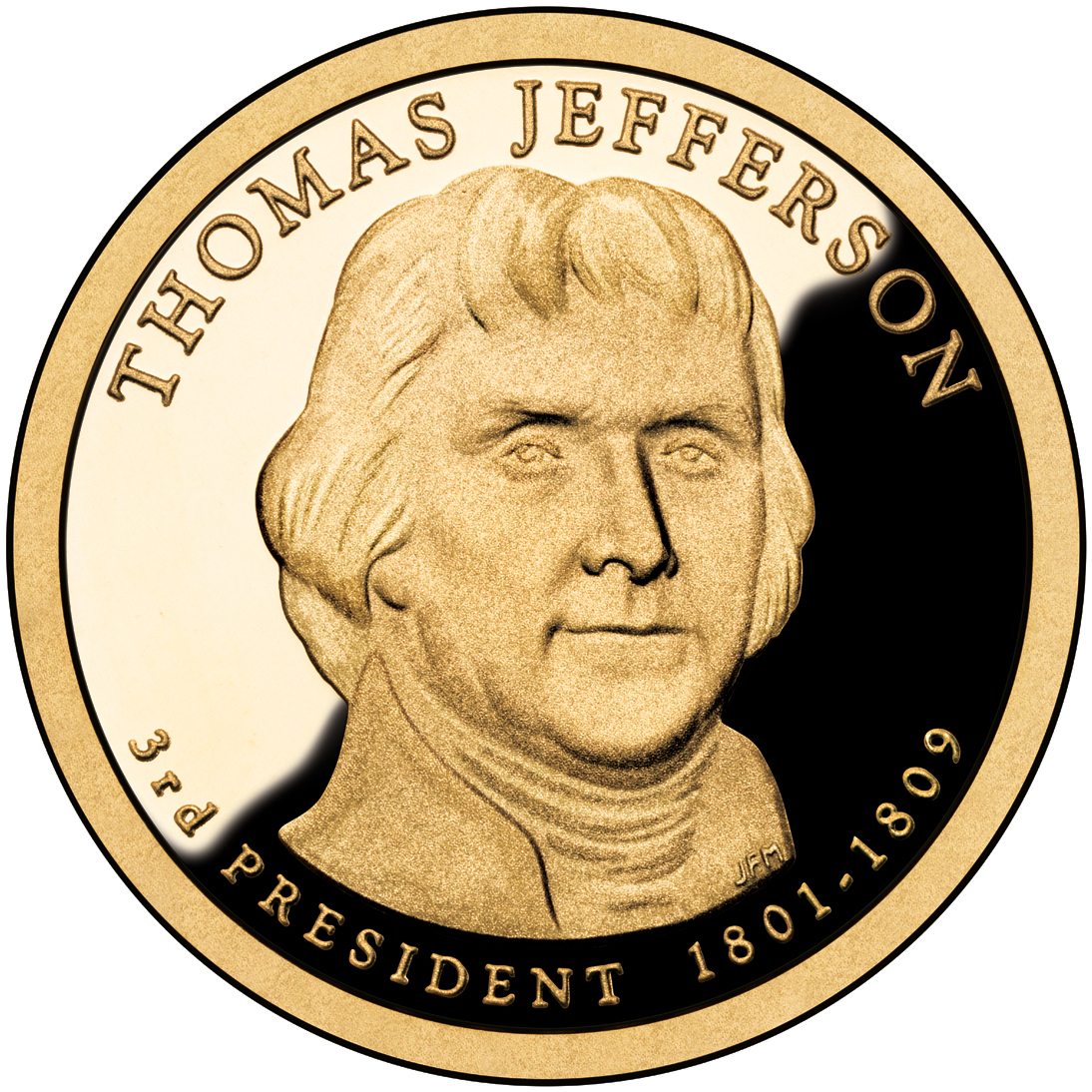
Jefferson dollars will be unveiled today in a ceremony at the Jefferson Memorial in Washington, D.C. They officially go into circulation tomorrow, August 16, 2007.

Jefferson dollar; U.S. Mint image via Associated Press

Jefferson dollars are the third in a series commemorating U.S. presidents. The series started with Washington and will proceed, three new coins a year, through all the presidents. (Quick: What’s the cheapest amount you can invest to get dollars representing all 43 administrations? Don’t forget Grover Cleveland’s anomaly . . .)

The Associated Press story notes three things of interest:

History: Fewer than a third of Americans know Jefferson was the third president. They did better with Washington as the first president. I had a few scary moments last year covering a Texas history course when kids kept answering either “George Washington” or “Abraham Lincoln” to the questions, “Who was the the Father of Texas?” (Stephen F. Austin) and “Who was the first president of the Republic of Texas?” (Sam Houston).

Economics: The vending machine industry loses about $1 billion each year when dollar bills jam in the machine’s vending mechanism. The U.S. Mint and vending machine operators hope the dollar coins catch on and help reduce those losses.

Dollar coins are unpopular: This is another in a series of efforts to “wean” people from paper dollars to coins — remember the Sacagawea dollar? The Eisenhower dollar? The Susan B. Anthony dollar? Just last week I got an Eisenhower dollar in change from our local Starbucks — they had mistakenly put it in the coin drawer for quarters. You can get dollar coins in change at the U.S. Post Office, but not at many other places. Our local post office occasionally sneaks a Euro into the dollar change mechanism. Bonus!

The Washington Post story carried more details of the poll, conducted by the Gallup organization for the U.S. Mint: Read the rest of this entry »


Berlin Wall’s 46th

August 13, 2007

Today is the 46th anniversary of the beginning of the Berlin Wall. The post I wrote last year on this topic continues to be popular, day in and day out, but especially when high school curricula get to the Cold War, the Berlin Airlift, the 1960s, and the collapse of the Soviet empire, best exemplified by the destruction of the Berlin Wall itself and the reunification of Germany.

Go read my post of last year, “Berlin Wall’s 45th.”

The photograph I used to illustrate that post has become one of the more popular photos of the Berlin Wall on the internet. It is from a small, too-little used collection posted by Corey Hatch at the University of Utah.

Here is another photo from his collection. It comes without caption; from the barbed wire and the uniform and helmet, I would say This is cropped version of a photo of an East German soldier,  Conrad Schumann , assigned to shoot people trying to breach the wall to escape to West Germany, who instead decided to leap to freedom himself, probably at Checkpoint Charlie, one of three gates between East and West Berlin. I regret I have no further credit information on the photo on August 15, 1961.  The photo is by West German photographer Peter Leibing, then working for Contiepress, in Hamburg.

East German soldier leaping barbed wire of the Berlin Wall, to freedom.

German authorities announced the Wall was open for travel between the two entities of divided Germany on November 9, 1989. Jubilant Germans on both sides of the wall tore down sections, poked holes in the concrete barriers, and generally vandalized the wall over the next few weeks. Negotiations then led the way for the Reunification of Germany on October 3, 1990.

Read the rest of this entry »


Can China sink the U.S. economy quickly?

August 9, 2007

Don’t panic. But pay attention.

Here’s something students in economics courses should be discussing, from London’s Telegraph.com:

The Chinese government has begun a concerted campaign of economic threats against the United States, hinting that it may liquidate its vast holding of US treasuries if Washington imposes trade sanctions to force a yuan revaluation.

On so many levels, that discussion offers opportunities for students of economics to understand how markets, finance, and borrowing work. This news report alone could be the foundation for a couple of weeks of lesson plans on international finance, the Federal Reserve system, government spending, and general operation of markets.

Two officials at leading Communist Party bodies have given interviews in recent days warning – for the first time – that Beijing may use its $1.33 trillion (£658bn) of foreign reserves as a political weapon to counter pressure from the US Congress.

Shifts in Chinese policy are often announced through key think tanks and academies.

Described as China’s “nuclear option” in the state media, such action could trigger a dollar crash at a time when the US currency is already breaking down through historic support levels.

It would also cause a spike in US bond yields, hammering the US housing market and perhaps tipping the economy into recession. It is estimated that China holds over $900bn in a mix of US bonds.

Xia Bin, finance chief at the Development Research Centre (which has cabinet rank), kicked off what now appears to be government policy with a comment last week that Beijing’s foreign reserves should be used as a “bargaining chip” in talks with the US.

Could China afford to try such a move? Would it sink their economy, too? How could the U.S. try to mitigate such a move? Does this mean the U.S. needs to seriously control trade with China, or would that kind of interference in free markets do more damage by itself?

The Dow dropped 387 points in trading on the New York Stock Exchange today. News analysts ascribe it to concerns over sub-prime mortgage lender troubles, which caused a panic in French markets today. The credit-crunch “ripples around the world,” according to a PBS reporter.

One blogger at Telegraph.com says not to worry; Ambrose Evans-Pritchard says the dollar will not collapse:

Disregard all hysteria. The ailing Greenback will not collapse this year, not in ten years, not in twenty years, not in half a century. There is no credible currency against which it can collapse. (Unless you count gold). None of the world’s rival power blocs have the economic and demographic depth to challenge American dominance.

That view is shared by a lot of the more pragmatic and successful investment advisors.

What do your local newspapers say? How can you use this to weave together a coherent narrative for your economics curriculum, starting in a week or two?

Sources to beef up your classroom presentations:


A religious bias against good education?

August 8, 2007

One might be too stunned to shake one’s head; this is a description for a high school calculus course:

CALCULUS
Students will examine the nature of God as they progress in their understanding of mathematics. Students will understand the absolute consistency of mathematical principles and know that God was the inventor of that consistency. Mathematical study will result in a greater appreciation of God and His works in creation. The students will understand the basic ideas of both differential and integral calculus and its importance and historical applications. The students will recognize that God created our minds to be able to see that the universe can be calculated by mental methods.

No, I’m not kidding. It’s from Castle Hills First Baptist School in San Antonio, Texas.

The scientist who sent me the link called it “God’s math.” Architect Mies van der Rohe once said, “God is in the details.” But he didn’t mean that math should be taught as anything other than mathematics. He didn’t mean that any religion should be inserted into math classes — and frankly, that’s a little worrying to me. I speak regularly with theologians who read the same text and come up with radically different descriptions of what it means, sometimes diametrically opposite descriptions.

The social studies curricula are more troubling. What is described is at best second-rate course work. One hopes that the teachers teach the material instead of these descriptions:

SOCIAL STUDIES/HISTORY

WORLD HISTORY I
NINTH GRADE
The students will examine the nature of God as revealed through the study of social studies. Students will develop convictions about God’s word as it relates to world history and will define their responses to it. Through the study of world history, students will develop an understanding of the economic, social, political and cultural developments of our world, as they compare countries and civilizations, Students will learn and acquire an appreciation for God’s relations throughout the timeline of world events. The integration of literature into studies of ancient civilizations will enhance and inspire their learning process. Students will develop attitudes, values, and skills as they discover their place in the world. Students will analyze, synthesize and evaluate social studies skills, including social relationships such as family and church.

WORLD HISTORY II
TENTH GRADE
The students will examine the nature of God as revealed through the study of social studies. Students will develop convictions about God’s word as it relates to world history and will define their responses to it. Through the study of world history, students will develop an understanding of the economic, social, political and cultural developments of our world, as they compare countries and civilizations since the Reformation. Students will learn and acquire an appreciation for God’s relations throughout the timeline of world events. The integration of literature into the studies of modern civilizations will enhance and inspire their learning process. Students will develop attitudes, values, and skills as they discover their place in the world. Students will analyze, synthesize and evaluate social studies skills, including social relationships such as family and church.


AMERICAN HISTORY
ELEVENTH GRADE
Students will evaluate the past and learn from its lessons (I Corinthians 10:11), and become effectual Christians who understand “the times” (I Chronicles 12:32). Students will study the history of our country beginning with the Civil War with a biblically integrated filter as they examine the political, social, and economic perspectives. An emphasis will be placed on the major wars, the industrial revolution, and the settlement of the frontier, requiring students to critically analyze the cause and effect relationships of events in history.

GOVERNMENT/CIVICS
TWELFTH GRADE
Students will evaluate the past and learn from its lessons (I Corinthians 10:11), and become effectual Christians who understand “the times” (I Chronicles 12:32). Students will study the foundational documents of our founding Fathers built upon as they formulated the ideals upon which our country was established. Such documents include: The Magna Carta, The English Bill of Rights of 1689, and the Mayflower Compact. Students are equipped with an understanding of the basic principles contained in these documents, and are able to identify their dependence upon biblical and Reformation principles, leading them to an understanding why the American system is meant for a religious people.

ECONOMICS/FREE ENTERPRISE
TWELFTH GRADE

Students will evaluate the past and learn from its lessons (I Corinthians 10:11), and become effectual Christians who understand “the times” (I Chronicles 12:32). Students will gain an understanding of the workings of economic systems, being able to identify the strengths and weaknesses inherent in capitalism (Deuteronomy 8, 15, 28, Leviticus 25), and the reasons for its superiority to the models of communism and socialism (Ezekiel 46:18).

The last description there, for economics, might lead one to understand this school ignores most of the lessons of Jesus, and especially the stories of the disciples in the immediate aftermath of the crucifixion as described in Acts 2. Not only are the courses described inadequate (we hope the teachers teach the state standards instead, at least), where scripture is specifically mentioned, they appear to be tortured to fit the agenda.

Then comes the choker:

SCIENCE

BIOLOGY

Students will study the physical life of God’s creation. They will continue to develop skills in the use of the scientific method. The students will learn methods and techniques of scientific study, general attributes of the cell and its processes, characteristics of the wide spectrum of living organisms, the classification, similarities and differences of the five kingdoms, evolutionary models and the creation model, the mechanics of inheritance, disease and disorders, and the workings of the human body. Students will gain experience in manipulating the conditions of a laboratory investigation and in evaluating the applications of biological principles in everyday life.

There is no “creation model” that is scientific, nor is there one that conflicts with evolution and is also Biblical. What, in God’s name, are they teaching?

CHFB School was established over 25 years ago, and claims to have more than 300 students enrolled, K-12. Surely there is a track record to look at.

Anybody know what the actual curricula look like at this school? Are there any measures to suggest the school teaches real subjects instead of what is described?

What was the Texas legislature thinking when they authorized Bible classes? Isn’t this bad enough as it is?

____________________

Update: See parent and student comments and ratings of the school, here.

____________________

Update, August 11:  Blogs4Brownback endorses the curriculum — if you do not fully realize the significance of that particular endorsement, study this post, and this one.  Parody?  I asked Brownback’s campaign about the site — they have not disowned it.  As Dave Barry often wrote, I could not make this stuff up.


Freakonomics moved

August 8, 2007

Stephen J. Dubner talks about the move of the blog to the New York Times site.  The old Freakonomics site still works, is revised, and links to the new blog home.


Quote of the moment: Andrew Carnegie, on competition

August 1, 2007

Carnegie Steel Works, Youngstown, Ohio, 1910

While the law [of competition] may be sometimes hard for the individual, it is best for the race, because it insures the survival of the fittest in every department. We accept and welcome, therefore, as conditions to which we must accommodate ourselves, great inequality of environment, the concentration of business, industrial and commercial, in the hands of a few, and the law of competition between these, as being not only beneficial, but essential for the future progress of the race.

Andrew Carnegie (1835-1919), “Wealth,” in the North American Review, June 1889.


Leo Rosten on Adam Smith

July 29, 2007

Leo Rosten writes clearly, concisely, and often with great humor. Consequently, his essays make good fodder for classroom use.

British bank note featuring Adam Smith

Rosten is probably most famous for the introduction he once gave to the comedian W. C. Fields, a spur-of-the-moment bon mots that so exactly described Fields comedian persona that it is often listed as a line Fields himself wrote: “Any man who hates dogs and children can’t be all bad.”

That story also tells us that Rosten looks at Adam Smith coolly, through no rose-colored glass.

The Adam Smith Institute carries Rosten’s essay on Smith in its entirety. Go read it:

It is a clumsy, sprawling, elephantine book. The facts are suffocating, the digressions interminable, the pace as maddening as the title is uninviting: An Inquiry into the Nature and Causes of the Wealth of Nations. But it is one of the towering achievements of the human mind: a masterwork of observation and analysis, of ingenious correlations, inspired theorizings, and the most persistent and powerful cerebration. Delightful ironies break through its stodgy surface:

“The late resolution of the Quakers [to free] their Negro slaves may satisfy us that their number cannot be very great …”

“The chief enjoyment of riches consists in the parade of riches.”

“To found a great empire for the sole purpose of raising customers [is] unfit for a nation of shopkeepers, but extremely fit for a nation whose government is influenced by shopkeepers.”

So comprehensive is its range, so perceptive its probings, that it can dance, within one conceptual scheme, from the diamond mines of Golconda to the price of Chinese silver in Peru; from the fisheries of Holland to the plight of Irish prostitutes in London. It links a thousand apparently unrelated oddities into unexpected chains of consequence. And the brilliance of its intelligence “lights up the mosaic of detail,” says Schumpeter, “heating the facts until they glow.” Sometimes.

Adam Smith published The Wealth of Nations in 1776 – not as a textbook, but as a polemical cannon aimed at governments that were subsidizing and protecting their merchants, their farmers, their manufacturers, against “unfair” competition, at home or from imports. Smith set out to demolish the mercantilist theory from which those politics flowed. He challenged the powerful interests who were profiting from unfree markets, collusive prices, tariffs and subsidies, and obsolete ways of producing things.

[More at the site of the Adam Smith Institute, including the continuation of this essay.]

Leo Rosten, publicity shot

Leo Rosten


Immigrants win Pennsylvania case: Hazleton’s anti-immigrant law struck down

July 26, 2007

News from the Pennsylvania ACLU (watch the right wing blogs explode, especially in Texas when they figure out the Farmers Branch ordinance is based on Hazleton’s ordinance, and that the judge in Pennsylvania used language similar to the TRO language used by the judge in Texas looking at the Farmers Branch ordinance) (text of press release and background from Pennsylvania ACLU):

Judge’s Decision Upholds Fair Treatment for All

“The genius of our Constitution is that it provides rights even to those who evoke the least sympathy from the general public. In that way, all in this nation can be confident of equal justice under its laws.” – Judge Munley’s Lozano v. Hazleton decision, pp. 188-189

In the first trial decision of its kind, a federal court has declared unconstitutional a local ordinance that sought to punish landlords and employers for doing business with undocumented immigrants. The landmark decision in the closely-watched challenge to Hazleton’s anti-immigrant ordinance held that the ordinance cannot be enforced.

ACLU Hazleton logo

“We are grateful the court recognized that municipal laws like those in Hazleton are unconstitutional. The trial record showed that these ordinances are based on propaganda and deception,” said Vic Walczak, Legal Director of the ACLU of Pennsylvania and a lead attorney in the case. “Hazleton-type laws are designed to make life miserable for millions of immigrants. They promote distrust of all foreigners, including those here legally, and fuel xenophobia and discrimination, especially against Latinos.”

Read the rest of this entry »


Collateral damage from magic bullets

July 22, 2007

In an earlier post I noted Norman Borlaug’s receiving the Congressional Gold Medal. In comments, Bernarda noted those who disagree with the claim that Borlaug’s Green Revolution was much of a benefit, or perhaps more accurately, those who note the problems that result from such advances — and there are many. Bernarda pointed to a BBC lecture from Vendana Shiva, detailing the problems that Punjab experienced as a result of governmental and society structures unable to deal with the changes required by high-yield crops: “Poverty and Globalisation.” It’s worth a read or a listen.
Similarly, in another BBC lecture in that series, Gro Harlem Bruntland details problems from “progress” that includes cutting the forests, in “Health and Population.” Relevant to other discussions here, she notes a rise in malaria due to deforestation, raising an issue that the junk science purveyors opposed to Rachel Carson’s honoring would like to ignore. Here is a small excerpt of her talk — note that deforestation is not a problem that more DDT can solve:

Gro Harlem Bruntland:  Recently, in Mozambique, I saw children with their eyes glazed with fever from a malaria that could have been prevented if their parents could afford bed nets. Deforestation had changed malaria from a nuisance to a curse in a matter of twenty years. 

Gro Harlem Brundtland, former Director General of the World Health Organization (WHO). Wikiquote image.

Gro Harlem Brundtland, former Director General of the World Health Organization (WHO). Wikiquote image.

More people are suffering from this killing and debilitating disease now than ever before, and deforestation, climate change and breakdowns in health services have caused the disease to spread to new areas and areas that have been malaria-free for decades, like in Europe.

In the Philippines, I have watched how beggars sit exhausted on the pavements convulsed with coughing. Tuberculosis, which we long believed had been brought under control by effective treatment, is on the rise again. Increasingly, we see forms of tuberculosis which are resistant to all but a very expensive cocktail of drugs.

I think that HIV/AIDS may be the most serious threat to face sub-Saharan Africa and other developing regions. space. Already, the AIDS epidemic is the leading cause of death in several African countries. AIDS has reversed the increases in life expectancy we have seen over the past thirty years. The social and economic devastation in countries that could lose a fifth of their productive populations is heart-rending.

I believe we are facing this alarming situation largely because of an outdated approach to development. Our theories have to catch up with what our ears and eyes are telling us – and fast.

There was a period in development thinking – not so long ago – when spending on public services, such as health and education, would have to wait. Good health was a luxury, only to be achieved when countries had developed a particular level of physical infrastructure and established a certain economic strength. The implicit assumption was that health was to do with consumption. Experience and research over the past few years have shown that such thinking was at best simplistic, and at worst plainly wrong.

I maintain that if people’s health improves, they make a real contribution to their nation’s prosperity. In my judgement, good health is not only an important concern for individuals, it plays a central role in achieving sustainable economic growth and an effective use of resources.

As in Europe at the end of the 19th and beginning of the 20th century, we have seen that developing countries which invest relatively more, and well, on health are likely to achieve higher economic growth.

In other words, malaria prevention grows on trees, or malaria grows with the cutting of trees.


Not reading for comprehension: Glenn Reynolds, National Geographic and DDT

July 17, 2007

It’s best to avoid the tabloids most of the time, but particularly its good not to rely on tabloids for good information for making policy.

Glenn Reynolds at Instapundit, often an internet tabloid, demonstrates these dangers, especially with regard to the hoax campaign against Rachel Carson and the World Health Organization.

In a post today, Instapundit said:

A REPORT ON MALARIA, from National Geographic.

And note this bit:

Soon after the program collapsed, mosquito control lost access to its crucial tool, DDT. The problem was overuse—not by malaria fighters but by farmers, especially cotton growers, trying to protect their crops. The spray was so cheap that many times the necessary doses were sometimes applied. The insecticide accumulated in the soil and tainted watercourses. Though nontoxic to humans, DDT harmed peregrine falcons, sea lions, and salmon. In 1962 Rachel Carson published Silent Spring, documenting this abuse and painting so damning a picture that the chemical was eventually outlawed by most of the world for agricultural use. Exceptions were made for malaria control, but DDT became nearly impossible to procure. “The ban on DDT,” says Gwadz of the National Institutes of Health, “may have killed 20 million children.”

Read the whole thing. [Emphasis from Instapundit.]

“Malaria: Stopping a Global Killer,” cover of National Geographic Magazine, July 2007. Test to see if your reading comprehension is better than Instapundit’s Glenn Reynolds!

Please do read the whole thing — what is emphasized is not what the brief snippet at Instapundit says at all. The National Geographic article, “Bedlam in the Blood,” gives details of the fight against malaria, including details about how difficult it is to beat. Among other things, the article talks about the medical difficulties and the political difficulties. The article emphasizes that there is not a panacea solution, including especially DDT.

But, that paragraph Reynolds quotes already carries that message. Did you miss it? Reynolds appears to have missed it big time. Here’s the paragraph again, with my emphasis for what you should understand about the difficulties

Soon after the program collapsed, mosquito control lost access to its crucial tool, DDT. The problem was overuse—not by malaria fighters but by farmers, especially cotton growers, trying to protect their crops. The spray was so cheap that many times the necessary doses were sometimes applied. The insecticide accumulated in the soil and tainted watercourses. Though nontoxic to humans, DDT harmed peregrine falcons, sea lions, and salmon, [especially predators of mosquitoes]. In 1962 Rachel Carson published Silent Spring, documenting this abuse and painting so damning a picture that the chemical was eventually outlawed by most of the world for agricultural use [years later]. Exceptions were made for malaria control, but DDT became nearly impossible to procure. “The ban on DDT,” says Gwadz of the National Institutes of Health, “may have killed 20 million children.”

In the critical area of Subsaharan Africa, governments were unable to put together programs to spray for mosquitoes and deliver pharmaceuticals to victims. Although DDT was largely ineffective against the mosquitoes that carried some forms of the disease in that area, the human institutions simply did not exist to make an eradication program work.

Instapundit puts the blame on Rachel Carson, as if the later restrictions on DDT were what she urged, and as if Carson could personally have saved the Belgian Congo, Rwanda, Rhodesia/Zimbabwe and other nations from revolutions that crippled governmental efficacy throughout Africa.

Read the entire article. Malaria eradication in the U.S. was made easier by the fact that the mosquitoes that carry the disease here tend to eschew humans for meals — they bite cattle instead (who have their own forms of malaria). The U.S. had money to put screens on windows, a medical establishment to treat malaria, and the less aggressive form of the malaria parasites.

Subsaharan Africa had none of those advantages. Reynolds suggests, and the Competitive Enterprise Institute says, all of that was Rachel Carson’s fault.

The power of a bad, wrong idea should not be underestimated. Malaria cannot be conquered today without a combination of better medical care, education, strong governmental agencies to carry out government malaria-fighting programs, and consistent work to prevent evolution of malaria parasites into tougher diseases, or malaria-carrying mosquitoes into pesticide-resistant weapons of disease dissemination.

If Reynolds were to actually read Silent Spring, he’d begin to understand the enormity of the problems, and he could become a tool to stop the spread of malaria, instead of a voice unwittingly calling for surrender.

DDT is not a panacea against malaria now. Insects are resistant, the parasites are resistant to medical treatment (and DDT never played a key role in that process), money is scarce for creating and distributing effective blocks to malaria infections, and political institutions to fight the disease are wobbly. None of that is Rachel Carson’s fault. Much of that information was carried in the warnings from Rachel Carson.

But, if you read the article, you understand that DDT never could have been effective against some of the worst forms of malaria. DDT was never a panacea against malaria.

You won’t learn that from tabloid journalism, which offers solutions to difficult problems which are, as Ronald Reagan described them, simple and easy, but also ineffective and wrong. Instapundit misleads with such reports.

Read the rest of this entry »


Quote of the moment: Immigration and economic growth

July 15, 2007

Immigrants’ Contribution to Economic Growth
“The pace of recent U.S. economic growth would have been impossible without immigration. Since 1990, immigrants have contributed to job growth in three main ways: They fill an increasing share of jobs overall, they take jobs in labor-scarce regions, and they fill the types of jobs native workers often shun. The foreign-born make up only 11.3 percent of the U.S. population and 14 percent of the labor force. But amazingly, the flow of foreign-born is so large that immigrants currently account for a larger share of labor force growth than natives (Chart 1).”

Foreign-born share of U.S. Labor Force and Labor Force Growth; Orrenius, Dallas FRB

Foreign-born share of U.S. Labor Force and Labor Force Growth; Orrenius, Dallas FRB

Foreign-born share of U.S. labor force and labor force growth

Pia M. Orrenius, senior economist in the Research Department of the Federal Reserve Bank of Dallas, Southwest Economy, Issue 6, November/December 2003, Federal Reserve Bank of Dallas