Education reforms working? Poverty, poor test results correlate in national study. What could it mean?

February 27, 2011

More from Greg Laden’s blog that deserves your attention, and a much wider audience.

The Science component of “The Nation’s Report Card” was released today and clearly indicates that we have moved one step closer as a nation in two of our most important goals: Building a large and complacent poorly educated low-pay labor class, and increasing the size of our science-illiterate populace in order to allow the advance of medieval morality and Iron Age Christian values.

The plan to sabotage the middle class, kill teachers unions and keep most Americans stupid, is working.

That was the plan, right?

Pay no attention to that teapot tempest in Wisconsin.  Pay no attention to the man behind the curtain.  You are getting sleepy, very, very sleepy . . .

Get the facts:

Teachers, compare your class results:


Can’t fire the bums to make a quality school: Principals division

February 8, 2011

Be sure to see the story in the New York Times today. Obama administration “Race to the Top” money went to states who proposed to replace principals in failing schools. A problem in the strategy threatens the program:  Not enough qualified people exist to replace all the “bad” ones.

Wrong-headed education “reformers” keep talking about “firing the bad ones,” teachers, administrators, or janitors.  Without significantly raising the pay for teachers, without greatly increasing the number of teachers and administrators in the pipeline from teaching colleges or any other source, reformers can’t attract anyone better qualified than the people they wish to replace.
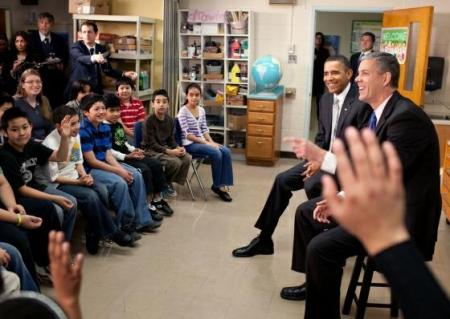
Pres. Obama and Sec. Duncan and the 6th grade at Graham Road Elementary, Falls Church, Virginia

President Barack Obama and Education Secretary Arne Duncan took questions from a 6th grade class at Graham Road Elementary School in Falls Church, Virginia, January 18, 2010 – photo credit unknown

Maybe, just maybe, it’s time these reformers took a step back and did some study, perhaps from the quality gurus, Deming and Juran and Crosby, or from the heights of championship performance, in basketball, football, soccer, sailing (try the America Cup), horse racing or politics:  No one can use firing as a chief tool to turn an organization around, nor to lead any organization to a championship.  Threatening people’s jobs does not motivate them, nor make the jobs attractive to others.

How can we tell the fire-the-teachers-and-principals group is on the wrong track?  See the article:

“To think that the same leader with a bit more money is going to accomplish tremendous change is misguided,” said Tim Cawley, a managing director at the Academy for Urban School Leadership, a nonprofit group that began leading turnaround efforts in Chicago when Mr. Duncan was the superintendent there.

“This idea of a light-touch turnaround is going to sully the whole effort,” Mr. Cawley added.

Tell that to Steve Jobs, who turned Apple around.  Tell it to Jack Welch, the tough-guy boss from GE (who had his own peccadilloes about firing, but who emphasized hiring and pay, at least, as the way to create a succession plan for the vacancies).  Tell it to any CEO who turned around his organization without falling on his own sword.

Any competent quality consultant would have foreseen this problem:  Nobody wants to train for a job with little future, less money to do the job right, little authority to get the job done, and the sole promise that the exit door is always open.

Secretary of Education Arne Duncan should know better, intuitively.  He used to play basketball, professionally.  Surely he knows something about team building and team turnarounds.  What caused his astounding, expensive amnesia?

Part of the issue identified in the article is training:

Because leading schools out of chronic failure is harder than managing a successful school — often requiring more creative problem-solving abilities and stronger leadership, among other skills — the supply of principals capable of doing the work is tiny.

Most of the nation’s 1,200 schools, colleges and departments of education do offer school leadership training. “But only a tiny percentage really prepare leaders for school turnaround,” said Arthur Levine, a former president of Teachers College who wrote a 2005 study of principal training.

That only contributes to the larger problem, that people in the positions are, often, the best ones for the job already; firing them damages turnaround efforts.

In Chicago, federal money is financing an overhaul of Phillips Academy High School. Mr. Cawley’s nonprofit trained Phillips’s new principal, Terrance Little, by having him work alongside mentor principals experienced at school makeovers.

“If we’re talking about turning around 700 schools, I don’t think you can find 700 principals who are capable of taking on the challenge of this work,” Mr. Little said. “If you could, why would we have this many failing schools?”

Education’s problems are many.  Few of the problems are the result of the person at the chalkboard in the classroom.  Firing teachers won’t help.  W. Edwards Deming claimed that 85% of the problems that plague front-line employees, like teachers, are management-caused.  Firing their bosses won’t solve those problems, either, but will just push the problems around.   (What?  “Deck chairs?”  “Titanic?”  What are you talking about?)

Did you hear?  Texas plans to cut state funding to all education by at least 25% for next year, due to Gov. Rick Perry’s $25 billion deficit, which he worked so hard to conceal during last year’s election campaign.

Santayana’s Ghost just dropped by to remind us, suitably the day after Ronald Reagan’s 100th birthday anniversary, of the Report of the Commission on Excellence in Education, the report that saved Reagan’s presidency and got him a second term:

Our nation is at risk. The educational foundations of our society are presently being eroded by a rising tide of mediocrity. If an unfriendly foreign power had attempted to impose on America the mediocre educational performance that exists today, we might well have viewed it as an act of war. We have, in effect, been committing an act of unthinking, unilateral educational disarmament. History is not kind to idlers.

When do we get political leaders who will swim against that tide instead of trying to surf it?


Dan Wasserman cartoon, Boston.com

Dan Wasserman, Boston Globe

See a small collection of  Dan Wasserman’s cartoons on Race to the Top, here.


Is Bill Gates the Superman education needs?

February 3, 2011

At Almost Diamonds, a clear explication of why Bill Gates alone cannot save education:

If you want to improve education in the U.S., fund it properly. Fund the education and salaries of teachers. Fund the building and maintenance of schools. Fund supplies. Fund libraries. Fund good textbooks and other materials. Fund early education. Fund student nutrition and health. Fund community social services that keep parents rooted in one place longer.

In short, fund those things it takes to produce small classes of students undistracted by other problems, taught by experienced teachers who aren’t constantly overworked. Is it a sexy solution? Does it put somebody’s name in lights? No, but it works.

Putting your name on some education initiative somewhere is grand. Nifty, even. The problem is that it really isn’t all that innovative when it comes right down to it. There is plenty of history of experimentation in education. Much of it even produced promising results.

Then it fell by the wayside because the implementation cost money. All the promise in the world can’t produce results if no one is willing to pay the cost. No, if someone really wants to do something new and different in the field of education, they need to implement those solutions that have already been proven.

More good stuff there at Almost Diamonds, keying off an article in The Atlantic by Chrystia Freeland on the “new elite.”

Tip of the old scrub brush to Rational Rant.


“WTF?” Palin completely misunderstands what “Sputnik Moment” means

January 28, 2011

Vodpod videos no longer available.

“WTF?” Palin completely misunderstands what “S…, posted with vodpod

Some bloggers have sworn off comments on Sarah Palin. Good on them.

This fruit is too low-hanging.

Palin doesn’t appear to have a clue about what the phrase “Sputnik moment” refers to — and mistakes it with the much later financial difficulties of the Soviet Union.  You’d think, since she was so close to the U.S.S.R. in Alaska, she’d know something about Sputnik.

And what’s with the “WTF” on television?  Has she no composure, no decency?

Here, Sarah; a primer:

Sputnik was the first artificial satellite launched from Earth, in October 1957.  (Palin wasn’t born for another seven years . . . arguments about teaching history, anyone?)

Please note that the launch of the satellite scared the bejeebers out of Americans.  Most people thought — without knowing anything about how heavy a nuclear device might be, nor how hard it might be to target one — that if the Russians could orbit a satellite the size of a beach ball, they could certainly launch missiles with nuclear warheads to rain down on America.  Maybe, some thought, Russians had already orbited such nukes, which could just fall from space without warning.

That was the spooky, red scary part.  Then there was the kick-American-science-in-the-pants part.  A lot of policy makers asked how the Russians could surpass the U.S. in the race for space (wholly apart from the imported German rocket scientists used by both the U.S. and the U.S.S.R.).  Looking around, they found science and technology education in America sadly lacking.  Congress passed a law that called science education necessary for our defense, and appropriated money to help boost science education — the National Defense Education Act.

The Cold War stimulated the first example of comprehensive Federal education legislation, when in 1958 Congress passed the National Defense Education Act (NDEA) in response to the Soviet launch of Sputnik. To help ensure that highly trained individuals would be available to help America compete with the Soviet Union in scientific and technical fields, the NDEA included support for loans to college students, the improvement of science, mathematics, and foreign language instruction in elementary and secondary schools, graduate fellowships, foreign language and area studies, and vocational-technical training.

(See the Wikipedia entry on NDEA, too.)

The National Science Foundation (NSF) history points to the genuine advances in science the Soviets had made, and the need for the U.S. to quickly catch up:

Sputnik once again elevated the word “competition” in the language of government officials and the American public. Sputnik threatened the American national interest even more than the Soviet Union’s breaking of America’s atomic monopoly in 1949; indeed it rocked the very defense of the United States because Russia’s ability to place a satellite into orbit meant that it could build rockets powerful enough to propel hydrogen bomb warheads atop intercontinental ballistic missiles.  Perhaps more importantly, however, Sputnik forced a national self-appraisal that questioned American education, scientific, technical and industrial strength, and even the moral fiber of the nation. What had gone wrong, questioned the pundits as well as the man in the street. They saw the nation’s tradition of being “Number One” facing its toughest competition, particularly in the areas of science and technology and in science education.

With its ties to the nation’s research universities, the Foundation of course became a key player in the unfolding events during this trying time. An indication is shown by the large increase in Foundation monies for programs already in place and for new programs. In fiscal year 1958, the year before Sputnik, the Foundation’s appropriation had leveled at $40 million. In fiscal 1959, it more than tripled at $134 million, and by 1968 the Foundation budget stood at nearly $500 million. Highlights of this phase of the agency’s history cannot be told in a vacuum, however, but must be placed within the broad context of American political happenings.

The Congress reacted to Sputnik with important pieces of legislation and an internal reorganization of its own committees. Taken together, the action announced that America would meet the Soviet competition.  The National Aeronautics and Space Act, more than any other post-Sputnik law, had great impact on increasing federal funding of scientific research and development. Signed by the president in July 1958, the law created the National Aeronautics and Space Administration (NASA) and gave it responsibility for the technological advancement of the space program. NASA became a major contracting agency and boosted tremendously the extra mural research support of the federal government. NASA not only symbolized America’s response to the Soviet challenge, but also dramatized the federal role in support of science and technology.

Among other things, the National Science Foundation looked at science textbooks used in elementary and secondary schools, and found them badly outdated.  NSF and other organizations spurred the development of new, up-to-date books, and tougher academic curricula in all sciences.

So, when President Obama refers to a “Sputnik moment,” he isn’t referring to a foolish expenditure of money for space junk that bankrupts the nation.  He’s referring to that time in 1957 when America woke up to the fact that education is important to defense, and to preparing for the future, and did a lot about improving education.  Between the G.I. Bill’s education benefits and the NDEA, the U.S. became the world’s leader in science and technology for the latter half of the 20th century.

But we’ve coasted on that 1958 law for too long.  Now we are being lapped by others — India, China, France, Japan, and others — and it’s time to spur progress in education again, to spur progress and great leaps in science.

One gets the impression Palin does not think much of science, nor education, nor especially science education.  She could use some lessons in history, too.  Sputnik didn’t bankrupt the Soviet Union.  Ignoring Sputnik might have bankrupted the U.S.

Santayana’s Ghost is shaking his head in sad disbelief.  And he has a question for Sarah Palin:  Santayana’s Ghost wants to know from Ms. Palin, can the U.S. compete with the Russians?

Tip of the old scrub brush to P. Z. Myers and Pharyngula, and another shake to DailyKos.

More, resources:


New paradigm for education

October 31, 2010

Not sure where this guy, Sir Ken Robinson,  is going — nor especially how it would relate to education in the U.S. (this group is from Britian — hear the accent?).

The animation is great — I’d love to have someone who could do this for quick history lessons to correspond with what we’re supposed to be doing on the curriculum calendar.

Plus, of course, he’s right.  We need less standardization, and more personalization.  Firing teachers frustrates both ends of that equation. He’s right — the schools are headed in the wrong direction.

I’ll wager Arne Duncan has never seen this.  Any of our old friends at Education know?  I’ll wager this speech and film drop into the abyss, regardless the credentials of Sir Ken Robinson and the good intentions of RSA.

RSA is the acronym for the clumsily-named Royal Society for the encouragement of Arts, Manufactures and Commerce.  “RSA” is a deft recovery from such a nomenclaturical handicap.

This RSA Animate thing has some potential — a lot like some of the animation schemes used by network news.

Resources:


Broad Prize, for best urban schools, to Gwinnett County, Georgia

October 20, 2010

It’s a million-dollar gold star for the administrators and board of the school system in Gwinnett County, Georgia: They won the 2010 Broad Prize for Urban Education.

The trophy for the Broad Prize for Urban Education

The trophy for the Broad Prize for Urban Education

(It’s pronounced with a long “o” as in “road.”)

NPR reported:

Gwinnett County beat out Charlotte-Mecklenburg Schools in North Carolina, Montgomery County Public Schools in Maryland, and Socorro Independent School District and Ysleta Independent School District in El Paso, Texas, for the award.

The prize, created in 2002 by the Eli and Edythe Broad Foundation in Los Angeles, is the nation’s largest education award given to school districts. It is designed to reward schools for increasing graduation rates, improving low-income students’ performance, and reducing differences in achievement rates between minority and white students. Winners are chosen from the country’s 100 largest school systems serving a large percentage of low-income and minority students.

This is big news to a select few in Dallas.  Dallas Superintendent Michael Hinojosa urged Dallas teachers on to win the Broad Prize by 2010.  Dallas ISD did not count among the finalists this year, nor in any previous year.

News in many places is about the districts who gained the finalist list, but did not win.  Interesting prize.

Next year.  Next year.

More:


2010 Texas Democratic Platform: Effective Teachers for Every Student

June 28, 2010

This post is sixth in a series on the education planks of the 2010 Texas Democratic Party Platform.

This is an unofficial version published in advance of the final version from the Texas Democrats, but I expect very few changes.

EFFECTIVE TEACHERS FOR EVERY STUDENT

The most important factor in student success is having qualified teachers in our classrooms. Texas has a serious teacher shortage. Teacher pay and benefits are not competitive with private sector pay for occupations requiring comparable knowledge and skills. To recruit and retain our best to teach, Texas Democrats advocate the following:

  • raise teacher and support staff pay to levels exceeding the national average;
  • extend quality state funded health insurance to all education employees;
  • respect and safeguard the rights and benefits of education employees;
  • guarantee that every class has a teacher certified to teach that subject;
  • recruit and train teachers who reflect the state’s diversity;
  • provide a mentor (a master teacher) for every novice teacher;
  • base teacher pay and evaluations on multiple measures that give a full, rounded picture of student and teacher accomplishment, and oppose Republican plans to use narrow test results instead;
  • provide retired teachers a cost-of-living increase to restore their pensions’ purchasing power, which has eroded more than 20 percent under Rick Perry and the Republicans since the last increase in 2001;
  • repeal the federal government pension offset and windfall elimination provisions that unfairly reduce Social Security benefits for educational retirees and other public employees; and
  • provide tuition credits and financial assistance for college students who become certified public school teachers and teach for a specified period of time in public schools.

2010 Texas Democratic Platform: Excellent Schools for Every Student

June 28, 2010

This post is fourth in a series on the education planks of the 2010 Texas Democratic Party Platform.

This is an unofficial version published in advance of the final version from the Texas Democrats, but I expect very few changes.

EXCELLENT SCHOOLS FOR EVERY STUDENT

To make public education our highest priority, we believe the state should:

  • provide universal access to pre-kindergarten and kindergarten;
  • provide universally accessible after school programs for grades 1-12;
  • provide free, accurate and updated instructional materials aligned to educationally appropriate, non-ideological state curriculum standards and tests;
  • provide free computer and internet access, as well as digital instructional materials;
  • provide early intervention programs to ensure every child performs at grade level in English Language Arts, Social Studies, Math, and Science;
  • ensure that students with disabilities receive an appropriate education in the least restrictive environment, including access to the full range of services and supports called for in their individual education plans;
  • provide appropriate career and technical education programs;
  • reject efforts to destroy bilingual education;
  • promote multi-language instruction, beginning in elementary school, to make all students fluent in English and at least one other language;
  • replace high-stakes tests, used to punish students and schools, with multiple measures that restore the original intent of the state assessment system–improving instruction to help students think critically, be creative and succeed;
  • end inappropriate testing of students with disabilities whose individual education plans call for alternative assessments of their educational progress;
  • enforce and extend class size limits to allow every student to receive necessary individualized attention;
  • support Title IX protections for gender equity in public education institutions;
  • ensure that every school has a fully funded library that meets state requirements;
  • provide environmental education programs for children and adults; and
  • oppose private school vouchers.

2010 Texas Democratic Platform: Public Education Funding

June 28, 2010

This post is third in a series on the education planks of the 2010 Texas Democratic Party Platform.

This is an unofficial version published in advance of the final version from the Texas Democrats, but I expect very few changes.

PUBLIC EDUCATION FUNDING

Texas Democrats believe:

  • the state should establish a 100% equitable school finance system with sufficient state revenue to allow every district to offer an exemplary program;
  • the state should equitably reduce reliance on “Robin Hood” recapture;
  • state funding formulas should fully reflect all student and district cost differences and the impact of inflation and state mandates;
  • Texas should maintain or extend the 22-1 class size limits and expand access to prekindergarten and kindergarten programs; and
  • the federal government should fully fund all federal education mandates and the Elementary and [Secondary] Education Act.

Republicans have shortchanged education funding every session they have controlled the Texas Legislature. After cutting billions from public education in 2003, the 2006 Republican school funding plan froze per pupil funding, leaving local districts faced with increasing costs for fuel, utilities, insurance and personnel with little new state money. To make matters worse, that same plan placed stringent limits on local ability to make up for the state’s failures.

In 2009, Republicans hypocritically supplanted state support for our schools with the very federal “stimulus” aid they publicly condemned after state revenues plunged because of the Republican-caused recession and the structural state budget deficit they created. They reduced state funding for our schools by over $3 billion. Because our student population continues to grow, the combined reduction in state revenue per student was nearly 13%.

Most Texans support our public schools, yet now Republicans want to cut even more from education and also want to siphon off limited public education funds for inequitable, unaccountable voucher and privatization schemes. Texas Democrats believe these attempts to destroy our public schools must be stopped.


Education Department crowdsourcing for innovation

June 25, 2010

But, will it get my classroom thermostat under control?  Will it fix the copy machine?

Story at Federal News Rado’s Dorobek Insider:

The Department of Education is trying to foster innovation in a new and unique way.

They’ve created an innovation portal and are crowdsourcing ideas to try and improve education across the country.

Jim Shelton is Assistant Deputy Secretary for Innovation and Improvement at the Department of Education.

He says the idea for the portal came about after they held a competition with funds from the American Recovery and Reinvestment Act (ARRA).

The Education Department held a contest, funded by ARRA, to highlight good work being done by educators across the country.

They soon realized that there would be an even greater benefit if people weren’t simply competing with each other, but sharing ideas.

“In the run up to the competition and afterward [we realized] that there would be great benefit to all of the education community being able to hear about and see these ideas, for people to share information, find opportunities for partnership, [and] . . . for teachers and entrepreneurs to be seen by people who have funding and might be interested in supporting their work.”

Thus, the Open Innovation Portal was created.

More, there.

Well I remember when Information Services at OERI had most the department’s automation innovation, and it was in an unlocked room with a 386 computer running a toll-free telephone bulletin board.  Have we come a long way?

The true innovation was how Ned Chalker beat OPM at put a lock on the door to keep the computers from walking away.


Liveblogging the Texas State Board of Education

May 21, 2010

Or, should that be “Texas State Soviet of Education?”

Steve Schafersman (of Texas Citizens for Science fame)  is live blogging for the Texas Observer, here.

Texas Freedom Network blogs it here.

Did I forget to mention that earlier?

More:


NAACP letter campaign against gutting Texas social studies standards

May 6, 2010

I get e-mail from the NAACP; the rest of the nation is paying attention to the follies run by the conservative bureaucrats at the SBOE:

Ed,

Don't Erase Our History I wouldn’t want to be a Texas State Board member this week.

Last week, we asked you to write to your representative, telling him or her that rewriting Texas history textbooks is ignorant and unpatriotic.

Over 1,500 people have already written in, filling the inboxes of our school leaders.

This week, we’d like to offer you one more chance to get involved. The NAACP is planning rallies, hearings and press conferences in Texas to stop the state board from rewriting history. But we can’t do it without you.

An issue as controversial as rewriting history elicits strong emotions, and we want to give you the chance to speak out. Do you have something you would like to say at the hearing?

http://action.naacp.org/TextbookHearing

The NAACP works to ensure equal rights and to eliminate discrimination against all racial and ethnic groups. The proposed changes to our textbooks threaten our mission. This is not about Republicans or Democrats — it’s about our shared history as Texans. That’s why we want to use the words of our Texas supporters to turn the tide.

The Texas textbook vote is just two weeks away, so we need to push ourselves harder now than ever before.

The future of our children’s education is in the hands of just a few State Board members. Your voice could be the one to tip the scale.

Take a moment to tell us what you think about the Texas State Board rewriting history. The best submissions will be read at the hearing on May 19th.

http://action.naacp.org/TextbookHearing

Thank you for helping to protect our history.

Gary Bledsoe
President, Texas NAACP


Ravitch calls the issue: Will public education survive?

May 1, 2010

Diane Ravitch in Dallas, April 28, 2010 - IMGP3872  Copyright 2010 Ed Darrell

Diane Ravitch in Dallas, April 28, 2010 – Copyright 2010 Ed Darrell (you may use freely, with attribution)

Bill McKenzie, editorial board member and writer for the Dallas Morning News, wrote briefly about the rekindled controversy over standards a year ago — but did he listen to Diane Ravitch on Wednesday night?

He should have.

I first met Ravitch a couple of decades ago when I worked for Checker Finn at the Office of Educational Research and Improvement.   Ted Bell’s idea of a commission to look at education quality, and it’s 1983 report, saved the Reagan administration and assured Reagan’s reelection in 1984.  She was one of the most prodigious and serious thinkers behind education reform efforts, then a close friend of Finn (who was Assistant Secretary of  Education for Research) — a position that Ravitch herself held in the administration of George H. W. Bush.

Ravitch now criticizes the end result of all that turmoil and hard work, the No Child Left Behind Act, and the way it has distorted education to keep us in the crisis we were warned of in 1983.  Then, the “rising tide of mediocrity” came in part because we didn’t have a good way to compare student achievement, state to state.  Today, the mediocrity is driven by the tests that resulted from legislative efforts to solve the problem.

Conditions in education in America have changed.  We still have a crisis after 27 years of education reform (how long do we have a crisis before it becomes the norm), but for the first time, Ravitch said, “There is a real question about whether public education will survive.”  The past consensus on the value of public education and need for public schools, as I would put it, now is challenged by people who want to kill it.

“The new issue today:  Will we have a public education system bound by law to accept all children.”

Ironic, no?  The No Child Left Behind Act has instead created a system where many children could be forced to the rear.

I took an evening in the middle of a week of TAKS testing — the Texas Assessment of Knowledge and Skills.  With ninth through twelfth grades, we had four days of testing which essentially requires the shutdown of the education for the week (we had Monday to review for the test).  It was a week to reflect on just how far we have strayed from the good intentions of public education advocates who pushed the Excellence in Education Commission’s report in 1983.

Ravitch spoke for over an hour.  I’ll have more to report as I get caught up, after a month of meetings, test prep, testing, and little sleep.

Background, more:


Diane Ravitch in Dallas: NCLB isn’t working

April 28, 2010

Dr. Diane Ravitch, one of the principal education theorists behind the No Child Left Behind Act, will speak twice in Dallas over the next two days — telling how NCLB is not working

Both public events, tonight at 7:00 p.m., and Thursday at the Dallas Institute of Culture and Humanities, are sponsored by the Dallas Institute.

Note that registration is required for tonight’s session:

To All Staff RE: The Dallas Institute of Culture and Humanities presents: Education Forum: What Makes a Good Education?

Two Public Events: Wednesday, April 28, at 7 p.m., and Thursday, April 29, at 7 p.m.

Wednesday, April 28, 2010, 7 p.m. Evening Forum and Book Signing at the Booker T. Washington High School for the Performing and Visual Arts Montgomery Arts Theater, 2501 Flora Street, Dallas, 75201

Keynote Speaker: Dr. Diane Ravitch, Education Historian

In this age of productivity models and minimum standards, the topic of a good education often
gets lost, but it evokes the century-long quarrel between the practical and the academic
curricula in our public discourse. Today, if we want to build a school system that will serve our
youth not only in their schooling but throughout life, we need to place what makes a good education
at the center of our discussion.

Beginning this conversation during our inaugural Education Forum are two noted authorities in the teaching profession: Dr. Diane Ravitch and Dr. Louise Cowan

Dr. Diane Ravitch, one of the nations leading education historians and author of the
#1 bestselling book on education, The Death and Life of the Great American School System: How Testing and Choice Are Undermining Education.

In it, Dr. Ravitch explains why she is recanting many of the views she held as U.S. Assistant Secretary of Education. Based on the data, she claimed in a recent interview on The Diane Rehm show, the remedies are not working and will not give us the educated citizens that we all want. Dr. Ravitch will explore what makes a good education and how to fulfill our commitment to a democratic future.

Dr. Louise Cowan, a Founding Fellow of the Dallas Institute and former dean at the University of Dallas, created the Institutes nationally recognized Teachers Academy programs from her vision of what makes a good education. For 27 years, these programs have challenged area school teachers to assume their full authority and responsibility as teaching professionals.

SEATING FOR THE EVENING FORUM IS LIMITED – ADMISSION BY RESERVATION ONLY

Teachers Admission – $15 / General Admission – $25

Deadline to register is noon, Wednesday, April 28.

For more information or to register, call 214-871-2440, or go to http://www.dallasinstitute.org/programs_events_eduforum.html

Thursday, April 29, 2010, 7 p.m. Evening Book Discussion at the Dallas Institute of Culture and Humanities, 2719 Routh Street, Dallas, Texas 75201

The Death and Life of the Great American School System: How Testing and Choice are Undermining Education.

Discussion of Dr. Ravitchs new book will be led by Institute Fellows and Teachers Academy alumni.

General Admission – $10

For more information or to register, call 214-871-2440, or go to http://www.dallasinstitute.org/programs_events_eduforum.html

The Dallas Institute of Humanities and Culture
2719 Routh Street
Dallas, Texas 75201
www.dallasinstitute.org


Education board shames Texas, part F: Clay Bennett, Chattanooga Times-Free Press

April 11, 2010

Clay Bennett in the Chattanooga Times Free Press:

Clay Bennett, Chattanooga Times-Free Press, March 16, 2010

Clay Bennett, Chattanooga Times-Free Press, March 16, 2010

Bennett remains one of my favorite cartoonists today.  His work is incisive, intelligent, and persuasive to the side of reason and light almost all of the time.  Why hasn’t he won a Pulitzer yet?

Bennett is generally a powerful supporter of U.S. education; see the two other recent cartoons, below the fold.

Read the rest of this entry »