Naked-eye star gazer Jack Horkheimer, dead at 72

August 22, 2010

Jack Horkheimer, the guy who worked for more than 30 years to acquaint people with the fine old tradition of naked-eye astronomy, died in Miami Friday.  He was 72.

Jack Horkheimer, America's Star Gazer - Photo by Bill Wisser

Jack Horkheimer, America's Star Gazer, at home in a television production studio - Photo by Bill Wisser, first published in Astronomy, January 2006

A short note appears in Sunday’s Miami Herald:

`Star Gazer’ host Jack Horkheimer dies

By ELINOR J. BRECHER, ebrecher@MiamiHerald.com

Jack Horkheimer, Public Television’s “Star Gazer,” died Friday afternoon of a respiratory ailment, according to a spokesman for the Miami Museum of Science and Space Transit Planetarium.

Born June 11, 1938, he was 72.

In an e-mail to staff, museum officials said they were “very saddened to have just learned that our resident Star Gazer, Jack Horkheimer, passed away today after being ill for quite some time.

“Jack was executive director of [the] Planetarium for over 35 years and was an internationally recognized pioneer in popularizing naked-eye astronomy. He was also a recognized media celebrity, often being the foremost commentator on all astronomy related happenings nationwide.

Horkheimer was best known as the creator, writer and host of public television’s “Star Gazer,” the 30-year weekly TV series on naked eye astronomy. Seen on PBS stations nationwide, “Star Gazer” reached millions of people, helping create a love of the stars for several generations of enthusiasts.”

Arrangements are pending.

Read more: http://www.miamiherald.com/2010/08/20/1785361/star-gazer-host-jack-horkheimer.html#ixzz0xJv6dDOq

Many of my best opportunities to watch stars come when I’ve far away from optics to improve the sighting.  Horkheimer’s practical advice on how to eyeball the sky delighted me from the start.

Horkheimer was a media guy, not an astronomer or scientist in any strict sense.  He was a great popularizer of astronomy.  Star Gazer may be the single most effective educational program on astronomy in history, by viewers and by total effect.

Checking his website, I note that he’s got, in the can and ready to broadcast, episodes of Star Gazer for weeks to come.

Here’s Star Gazer for the coming week:

More:


NASA awards Global Climate Change Education grants

August 18, 2010

NASA announced a series of awards totaling $7.7 million to 17 agencies who will work to improve education on climate change. One of NASA’s goals and duties is to educate about NASA research.

These grants have been in the mill for a while, and should be welcomed by the winners of the awards. Wait for people convinced climate change isn’t happening or shouldn’t be prevented, to howl up a storm. 

Here’s the press release:

NASA Announces 2010 Global Climate Change Education Awards

WASHINGTON — NASA has awarded $7.7 million in cooperative agreements to 17 organizations across the United States to enhance learning through the use of NASA’s Earth science resources. The selected organizations include colleges and universities, nonprofit groups, and a community college. The winning proposals in the Global Climate Change Education Awards illustrated innovative approaches to using NASA content in elementary, secondary and undergraduate teaching, and lifelong learning. The proposals emphasized engaging students in NASA Earth observation data and Earth system models, and providing climate-related research experiences for teachers and undergraduate students. Each cooperative agreement is expected to leverage NASA’s unique contributions in climate and Earth system science. The grants support NASA’s goal of engaging students in the critical disciplines of science, technology, engineering and mathematics, and inspiring the next generation of researchers and explorers. The 17 proposals will fund organizations in Washington, D.C., and 13 states: California, Colorado, Florida, Idaho, Massachusetts, Minnesota, Nebraska, New Hampshire, New York, North Carolina, Ohio, Oregon and Pennsylvania. Winning proposals were selected through a merit-based, peer-reviewed competition. The performance period is up to three years and awards range in value from $300,000 to $700,000. For a list of selected organizations and projects descriptions, click on “Selected Proposals” and look for “Global Climate Change Education” at: http://nspires.nasaprs.com For information about NASA’s education programs, visit: http://www.nasa.gov/education

– end –

Winning proposals came from organizations across the nation (home state listed in parentheses; last name of principal investigator after the dash). Selected proposals in Funding Category D/M: Using NASA Earth system data, interactive models and simulations to Strengthen Teaching and Learning about Global Climate

  • American Meteorological Society – Brey
  • Columbia University – Chandler
  • Cayuga Community College (New York) – Coughlin
  • University of Toledo (Ohio) – Czajkowski
  • University of California at Riverside – Droser
  • University of North Carolina – Gray
  • Florida Atlantic University – Lambert
  • University of New Hampshire – Martin
  • Colorado State University – Moore
  • University of Idaho – Mulkey
  • University of Minnesota – Roehrig
  • University of Massachusetts – Rooney-Varga
  • SRI International (California) – Zalles

Selected proposals in Funding Category R: Global Climate Change Science Research Experiences for Pre- or In-Service Teachers

  • Institute for Earth Science Research and Education (Pennsylvania) – Brooks
  • Harvard University – Ellison
  • University of Nebraska – Gosselin
  • Oregon State University – O’Connell

Details of the winning proposals can be found here.


We Are Science Probes

August 14, 2010

Still from

Still from “We Are Science Probes.” Full clip of movie below.

In animation, a parable about the dangers of being intentionally ignorant of science. In the not-distant-enough future, a probe from another planet arrives on Earth after the demise of human civilization. Unfortunately, the probes land in Kansas, the land of creationism and woo. The plot thickens.

[My apologies — the version I found did not come with a “pause” button.  It will play automatically when you open this post.  Fortunately, it’s almost perfectly safe-for-work.  If you don’t like the music, turn it off.  There is no spoken dialogue in the cartoon.  If you wish to pause the playing of the cartoon, right click to get to the Adobe Flash Player controls.  To pause the playing click the checkmark next to “play.”]

[Update August 18 — Okay, I give up — 100% of comments I’ve been getting ran against the video without the “start” or “pause” buttons.  You’ll have to go see it at another site — here, for example.]

[Years later, it’s on Youtube!]

Found it at a site called NewGrounds, which includes several other animation pieces.  The piece was created by a group that goes by the handle Billy Blob.

Sure would love this group to turn their creative faculties to hard history — say, the Progressive Movement and Gilded Age.  (Probably less chance of commercialization there, and perhaps less chance of awe-striking art, too.)

Tip of the old scrub brush to P. Z. Myers at Pharyngula.


Photog (and Eagle Scout) Luke Sharrett leaving NY Times . . .

August 13, 2010

Go see the photos.  Seriously.  “The Capital was his classroom”, by David Dunlap.

Doubtless, there are other accomplished photojournalists in Washington who have won an Eagle Scout medal with bronze palm. Luke Sharrett of The Times may be the only one who earned his just six years ago.

And he is almost certainly the only photographer who’ll be leaving the D.C. press corps on Friday to start his junior year in college.

“Why are you doing that?” President Obama asked him as Air Force One was taking off the other day.

Dunlap does not say whether Sharrett earned the Photography Merit Badge.  Anyone know?


History in photos – great art, good student project?

August 12, 2010

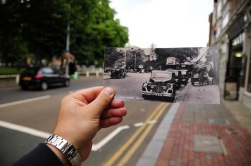
Earlier I found an idea I’ve not been able to incorporate into my classes, but which I still like:  Take historic photos of your town, go to the same place today and see what it looks like.

Comparing historic images with places today

Students could do this: Comparing historic images with places today

A Russian photographer takes the exercise further, and creates sometimes-stunning art.

Sergey Larenkov has photos from Europe in World War II.  He blends parts of those images with photos of the same places today, in cities across Europe. He has images from Berlin, Leningrad, and other cities (crawl over his LiveJournal site — there’s good stuff).

Sergey Larenkov, World War II historic photo overlay on modern shot - Leningrad?

Sergey Larenkov, World War II historic photo overlay on modern shot - is this Leningrad? Whose soldiers, what year?

Sergey Larenkov work, the Siege of Leningrad, and Leningrad today (reverting to the name St. Petersburg)

Sergey Larenkov work, the Siege of Leningrad, and Leningrad today (reverting to the name St. Petersburg)

Ghostly, no?

The photos show the destruction of war, and how far Europe has come since then.  It’s an astounding view of history.  If a picture is worth a thousand words, these photo mashups are worth ten thousand words or more.

Tip of the old scrub brush to Alices’ blog at My Modern Met.

Add to FacebookAdd to NewsvineAdd to DiggAdd to Del.icio.usAdd to StumbleuponAdd to RedditAdd to BlinklistAdd to TwitterAdd to TechnoratiAdd to Furl


Petition to Congress: Tell Texas Board of Education to fly right correctly

August 11, 2010

E-mail from the Texas Freedom Network:
Alert Header

Tell Your Congress Member to Support Education over Politics

The Texas Freedom Network and the Texas Faith Network this week joined nearly two dozen national organizations in support of a resolution in the U.S. House of Representatives calling on the State Board of Education to stop playing politics with the education of Texas schoolchildren. We have signed on to a letter to U.S. Rep. Eddie Bernice Johnson, D-Dallas, supporting House Resolution 1593. Congresswoman Johnson introduced the resolution in the U.S. House on July 30. The resolution, which has four other co-sponsors from Texas, calls out the state board for disregarding nearly a year’s worth of work by teachers and scholars who wrote initial drafts of new social studies curriculum standards. It also notes that more than 1,200 history scholars have warned that the heavily revised standards, which the board adopted in May, “would undermine the study of the social sciences in public schools by misrepresenting and even distorting the historical record and the functioning of United States society.”

The House resolution is available here. The letter from TFN and other organizations supporting that resolution is available here.

Take Action

Ask your U.S. House representative today to support House Resolution 1593 by Rep. Eddie Bernice Johnson. You can find out who your U.S. House member is here. When you call, tell him or her:

  • Teachers and scholars should write curriculum standards and textbook requirements, not politicians.
  • Texas schools should give our schoolchildren an education based on sound scholarship that prepares them to succeed in college and their future careers. Decisions about curriculum and textbooks shouldn’t be based on the personal and political agendas of state board members.
  • Because of the size of Texas, publishers often write their textbooks to meet curriculum standards in this state and then sell them to schools across the country. Texas should be a model for good curriculum and textbooks, not a national laughingstock.

You can do three other things to stop radical members of the State Board of Education from promoting their political and personal agendas in our kids’ classrooms:

Join the Just Educate campaign, which is working to reform the State Board of Education.

Stay informed by signing up for TFN News Clips and reading our blog, TFN Insider.

Support the Texas Freedom Network by making a special gift today.

Take Action Now

Reform the State Board of Education

In the race to the future, politicians are holding our children back. Find out what you can do about it!

Tell politicians to stop promoting ideological agendas in our public schools. JUST educate the children of Texas!

Sign the petition »

Sounds good to me. Unlikely, and rare for the national Congress to urge state action — but appropriate in this case.


Wow (in metaphor)

August 7, 2010

You should be using this tool, don’t you think?

(WordPress doesn’t support embedding this player — you’ll have to go see for yourself — it’s worth the click.)

One more way to make outstanding presentations; one more way to get students involved in rationally-active, brain-intensive, graphic organizers.

One tool I picked up in a session with Learning.com earlier this week.

(See also “Thoughts on using Prezi as a teaching tool.”)

Add to FacebookAdd to NewsvineAdd to DiggAdd to Del.icio.usAdd to StumbleuponAdd to RedditAdd to BlinklistAdd to TwitterAdd to TechnoratiAdd to Furl


Some teachers had great summer experiences

August 6, 2010

One of our more adventurous teachers spent the summer on a Fulbright-Hays program in Senegal, in West Africa.

Lunch in Senegal, William Adkins photo

No, that's not William Adkins. That's his lunch one day in Senegal.

William Adkins’ African adventure blog is here.  Mine it for stuff you can use in economics, art, world history, world geography, or anything else.  He’ll probably give you free reign to use the photos for classroom presentations.

What did you do on your summer vacation?

Add to FacebookAdd to NewsvineAdd to DiggAdd to Del.icio.usAdd to StumbleuponAdd to RedditAdd to BlinklistAdd to TwitterAdd to TechnoratiAdd to Furl


Classrooms and technology: Pencil integration, pencil natives

August 1, 2010

Are you reading Tom Johnson’s Adventures in Pencil Integration?

Do you care about technology in your classroom, here in 1897?

You might even laugh.  It’s well written, well worth the read.  See his recent piece, “They’re Still Pencil Natives,” for example.  His piece on the district’s blocking of phonographs is good, too.  It’ll give you a new appreciation for “bandwidth.”


Travel is an education of itself

July 27, 2010

It’s a tough place to go to school, but somebody has to do it.

Kenny Darrell in Chania, on the island of Crete

Kenny Darrell in Chania, on the island of Crete, becoming a teacher - photo by Stacy Grace


White men gave civil rights to women, blacks and Hispanics?

July 16, 2010

It’s maybe an apocryphal story. Republicans in Texas hope so.

It was at a very large, mostly African-American church in Dallas. The social action committee, or whatever it’s name is, was meeting. The only white guy in the room was there to try to get them interested in the elections for the members of the Texas State Board of Education. Normally these races are sleepers, down ballot, and off the radars of almost all interest groups. The social action committee was just as tough an audience as any other group with limited resources and limited time to try to get good political action.

Besides, a good chunk of Dallas is represented by Mavis Knight, an African American who is a pillar of common sense on the Texas education board, and Ms. Knight’s seat isn’t being contested in 2010. Why should Dallas voters be interested in any of these races?

“Before we start talking,” the lone white guy said, “I’d like to show you some of what has been going on in the Texas State Board of Education over the last year, in their work to change social studies standards.”

And he showed the video below. The entire committee grew quiet, silent; and then they started to shout at the television image. “What’s that?” “Is he crazy?” “He said white men gave us civil rights?”  “HE SAID WHAT?”

A 58-second video clip that could greatly animate electoral politics in Texas. The comments came fast and loud.

“That was part of the debate?  What, are they crazy down there?  Don’t they know history?  Don’t they know the truth?  They aren’t going to tell our children that Martin Luther King didn’t work to get civil rights, are they?  They aren’t going to say Martin Luther King died, but some white man gave rights to African Americans — are they?”

It’s a video clip that every Republican candidate in Texas hopes will be hidden away.  The Democratic tide that has swept Dallas County in two consecutive elections threatens to stop the Republican stranglehold on statewide offices in November, if those who voted in such great numbers in 2008 turn out again.

There are other stakes, too — the Republican stranglehold allowed the state education board to gut science standards, to eliminate Hispanic literature from language arts standards, and to try to change history, to blot out Thurgood Marshall and as much of the civil rights movement as they could hide.  So Texas children get a second-rate, incorrect set of standards in social studies, in English, and in science.

Republicans have declared war on good education, war on the children who benefit most from good education.

So, according to Don McLeroy, who lost the primary election to keep his seat, this little piece of history, below, is inaccurate. Tough for McLeroy — the Schoolhouse Rock video sits in too many Texas school libraries. Sometimes, the facts sneak through, defying the best efforts of the Texas State Soviet of Education to snuff out the truth.

But don’t you wonder what every woman, African American, and Hispanic in Texas will think about the importance of the 2010 elections, when they see what Gov. Rick Perry’s appointee to chair the SBOE, thinks about how civil rights were achieved in the U.S.?

Over at Republican headquarters, they hope that story is apocryphal.

Video of the Texas State Board of Education from the Texas Freedom Network.

Here, you can make sure other voters see this video that Don McLeroy hopes you will not see:

Add to FacebookAdd to NewsvineAdd to DiggAdd to Del.icio.usAdd to StumbleuponAdd to RedditAdd to BlinklistAdd to TwitterAdd to TechnoratiAdd to Furl


Stealth creationists aim to mess up biology students

July 15, 2010

So, God is a platypus?

Appearing to be aware they are losing the battle of the classroom to real science, creationists have taken a sneakier way to undermine science education.  P. Z. Myers explains:

A lot of people have been writing to me about this free webgame, CellCraft. In it, you control a cell and build up all these complex organelles in order to gather resources and fight off viruses; it’s cute, it does throw in a lot of useful jargon, but the few minutes I spent trying it were also a bit odd — there was something off about it all.

Where do you get these organelles? A species of intelligent platypus just poofs them into existence for you when you need them. What is the goal? The cells have a lot of room in their genomes, so the platypuses are going to put platypus DNA in there, so they can launch them off to planet E4R1H to colonize it with more platypuses. Uh-oh. These are Intelligent Design creationist superstitions: that organelles didn’t evolve, but were created for a purpose; that ancient cells were ‘front-loaded’ with the information to produced more complex species; and that there must be a purpose to all that excess DNA other than that it is junk.

Suspicions confirmed. Look in the credits.

Also thanks to Dr. Jed Macosko at Wake Forest University and Dr. David Dewitt at Liberty University for providing lots of support and biological guidance.

Those two are notorious creationists and advocates for intelligent design creationism. Yep. It’s a creationist game. It was intelligently designed, and it’s not bad as a game, but as a tool for teaching anyone about biology, it sucks. It is not an educational game, it is a miseducational game. I hope no one is planning on using it in their classroom. (Dang. Too late. I see in their forums that some teachers are enthusiastic about it — they shouldn’t be).

No such thing as a free lunch.  If it sounds too good to be true, it probably is.  Free software for use in educating kids about biology, sounds too good to be true.

_____________

In comments, Lars Doucet disavows creationist intent.  So the creationist/intelligent design factors were added just to make the game more playable, and not as an attempt to introduce or endorse creationism or intelligent design.

Lots of discussion, much of it rude (some of it delightfully so), at Myers’ joint.

Maybe, if the makers didn’t intend to make a creationist stealth game, they could jigger the thing to make it more accurate?


What scares Texas Republicans? How will Texas Democrats push into the future?

July 14, 2010

Scholars & Rogues summarized the Texas Republican Party platform.  It’s all about “deviant sex,” S&R finds.

Compare it to the Texas Democratic Platform (education planks only, here — rest of the platform here).

Bill White, Linda Chavez-Thompson, Barbara Ann Radnofsky and others are clearly superior candidates running on a real, pro-Texas, pro-business, pro-family platform. Help Texas, help America, help yourself:  Support them and give them your votes in November.

Texas Democratic Party platform word cloud

Texas Democratic Party platform word cloud


Quote of the moment: David Brooks, books vs. internet

July 12, 2010

Wisdom comes in keen insights:

These different cultures foster different types of learning. The great essayist Joseph Epstein once distinguished between being well informed, being hip and being cultivated. The Internet helps you become well informed — knowledgeable about current events, the latest controversies and important trends. The Internet also helps you become hip — to learn about what’s going on, as Epstein writes, “in those lively waters outside the boring mainstream.”

But the literary world is still better at helping you become cultivated, mastering significant things of lasting import. To learn these sorts of things, you have to defer to greater minds than your own. You have to take the time to immerse yourself in a great writer’s world. You have to respect the authority of the teacher.

Right now, the literary world is better at encouraging this kind of identity. The Internet culture may produce better conversationalists, but the literary culture still produces better students.

It’s better at distinguishing the important from the unimportant, and making the important more prestigious.

David Brooks, “The Medium is the Medium,” New York Times, July 9, 2010, page A23


I get e-mail: July Econlib newsletter

July 5, 2010

A bit on the right, but generally pointing to useful current stuff for economics teachers, the EconLib Newsletter for July 2010 is out — download it to your e-book for beach or desert reading:

Dear Readers,

Around the world in the last three decades, governments have made dramatic moves toward more economic freedom. While retaining most of the welfare state, governments have cut marginal tax rates from the Olympian heights they had reached in the 1960s and 1970s, deregulated whole industries, and privatized major swaths of the economy. Scott Sumner details the “neoliberal” movement and shows that countries that moved closest to economic freedom also made major gains in per capita income. Read it here:

The Unacknowledged Success of Neoliberalism
http://www.econlib.org/library/Columns/y2010/Sumnerneoliberalism.html

This month, Anthony de Jasay extends his series, asking

Is Society a Great Big Insurance Company?
http://www.econlib.org/library/Columns/y2010/Jasayinsurance.html

On EconTalk this week, Russ Roberts and Arnold Kling talk about the Unseen World of Banking, Mortgages, and Government:

http://www.econtalk.org/archives/2010/07/kling_on_the_un.html

Other recent podcasts include Caplan on Richter and Hayek, Sumner on growth and economic policy, and Blakley on fashion and intellectual property. Check them out at http://www.econtalk.org.

On EconLog, David Henderson discusses the EPA, Bryan Caplan reviews whether students like school, and Arnold Kling talks about green jobs. Read all the latest on EconLog at:

http://econlog.econlib.org

This month in the Concise Encyclopedia of Economics we feature “Fiscal Sustainability,” by Laurence J. Kotlikoff , and the biography of Milton Friedman, whose birthday is later this month. See

http://www.econlib.org/library/CEE.html

We welcome all our new registrants and wish all a fine summer.

Lauren Landsburg, Editor
Russ Roberts, Associate Editor
David R. Henderson, Features Editor
Library of Economics and Liberty
http://www.econlib.org