Aaron Swartz has the summary. Start with the introduction here, and see the full text with links here.
He goes easy on the hoaxers, those who cast stones at Ms. Carson, but you still get the idea if you read the article.
Aaron Swartz has the summary. Start with the introduction here, and see the full text with links here.
He goes easy on the hoaxers, those who cast stones at Ms. Carson, but you still get the idea if you read the article.
 3 Comments |
  Accuracy, Africa, DDT, Environmental protection, Health care, Hoaxes, Junk science, Malaria, Politics, Rachel Carson, Science | Tagged: Africa, DDT, Environmental protection, Health care, Hoaxes, Junk science, Malaria, Politics, Rachel Carson, Science |
  Permalink
 Posted by Ed Darrell
From This Isn’t Happiness: A photograph captioned only “Spraying DDT / Santa Monica, 1940s”:

Spraying DDT in Santa Monica, California, c. 1940s (UCLA; LA Times?)
See also, “5,700 Vintage Los Angeles Photos Now Online,” at MetBlogs.
1 Comment | DDT, Environmental protection, History, History images, Science | Tagged: DDT, Environmental protection, History, Science | Permalink
Posted by Ed Darrell
In continuing efforts to slam environmentalists and Rachel Carson, Instapundit and RWDB complain (whine?) about the European Union’s efforts to block the importation of cotton from Uganda on fears of DDT contamination.
Meanwhile, back in Kampala, the news is that the EU has done the opposite, and is encouraging the use of DDT officially, not blocking its use at all. If DDT is used to fight malaria and not in uncontrolled agricultural use simply to keep products blemish-free, in carefully-controlled sprayings, EU has no complaints.
Is there any western news agency with a stringer in Kampala who could chase this story down? Beck and Reynolds still offer no evidence to back their odd claims, but the story could sure benefit from a solid chunk of reporting from BBC, or Reuters, or Agence France Presse, or someone who could talk with the EU and Uganda officials.
Other resources:
Full text of report, below the fold.
2 Comments | Africa, Business, Business Ethics, DDT, Environmental protection, Health care, Hoaxes, Malaria, Rachel Carson, Science | Tagged: Africa, Business, DDT, Environmental protection, health, Hoaxes, Malaria, Rachel Carson, Science | Permalink
Posted by Ed Darrell
The Cicada Killers have returned!
Here’s a photo of our real, live version.

Cicada killers at Boisenberry Lane, Dallas
12 Comments | Environmental protection, Natural history, Science | Tagged: Cicada Killers, Environmental protection, Natural history, Science | Permalink
Posted by Ed Darrell
Instapundit loves to roil waters, but he’s low on content, and everytime I see it, low on accuracy, too.
This is the entirety of Glenn Beck’sReynolds’s post linking to the rabidly anti-Rachel Carson, RWDB with a rant about DDT that lacks several key points of accuracy:
THE HIGH COST OF fighting malaria.
Six words and he’s wrong already. That’s quite a skill to be dead wrong in six words.
Our friend, Mr. Beck, at RWDB, has a news report from Uganda, and rather than note it and check for accuracy, he uses it as a tee for numerous shots and mulligans against science, scientists, environmentalists, health care workers, the EU, and anyone else who inhabited his latest delerium.
The story out of Africa is that a buyer of organic cotton refused to buy Ugandan cotton due to DDT contamination. True to the line of recent events, it’s not environmentalists who do anything , though the news story finds a way to blame them in the last paragraph. Instead, it’s a businessman.
But here are problems with the story:
Are we to believe that marauding anti-insect people roam Uganda, forcing farmers to steal DDT from health authorities and spray it on their cotton instead, against the farmer’s better interests?
Neither Glenn BeckReynolds at Instapundit nor the other Beck at RWDB bothered to check the facts, nor even to see whether the first face story passes the smell test. Where would DDT contamination come from? Why would a buyer refuse cotton if there’s no DDT contaminant? Why wouldn’t there be tests? Where are the test results? If EU is so down on DDT on cotton, where is the document that says so?
The company in the news story, ineptly named as it is, Bo-Weevil, does exist, it appears, either there or in the Netherlands. That surely is not the only cotton buyer for the EU. The first BoWeevil isn’t an EU company, since it’s headquartered in Tennessee. From their website:
Welcome to Bo-Weevil Eco Sportswear Mfg. LLC., nestled in the hills of Tazewell, Tennessee.
Producers of the most earth friendly clothing on the planet.
Bo-Weevil Eco started manufacturing and supplying clothing with one main vision: “Provide our customers with the highest quality clothing that integrates current fashions with timeless style, to create lifestyle clothing that brings awareness to care what you wear.”
We are a company that practices to restore, maintain and enhance ecological harmony. Doing so by being at the forefront of U.S.A. factories producing a line of women’s, men’s, kids and k-9 apparel made by pre-consumer recycled fibres. We are working to create change in the textile industry; to offer one step on the path to more sensible and sustainable use of resources in the production of basic commodities.
So, how does the EU get into this story at all? The second company, I can find listed only through a post at Pesticide Action Network, a source that is not always reliable on such issues.
Smell test: Does this sound accurate to you? When was the last time you saw anyone at Wal-Mart demand organic cotton?
The use of DDT has now affected cotton prices in the region. Patrick Oryang from Lango Cooperative told All Africa, “We are buying cotton at sh500 per kilogram instead of sh750. The country will lose about US$20 million because EUREP-GAP, an EU exporters body, has suspended buying products from the region because the consumers in Europe and America want purely organic products.”
What’s the real story?
Neither Beck nor Reynolds seems to care. They get a dig at environmentalists, so what if Ugandans get malaria?
Update, sorta: News from Uganda, in New Vision, seems to indicate that the EU has okayed the wise use of DDT in Uganda, contrary to claims of an EU ban (July 10 story). You can’t help but wish there were some good, clear reporting of this issue, from BBC or Reuters, or someone in Kampala besides these few, shallow news dailies.
12 Comments | Africa, Business, Business Ethics, DDT, Environmental protection, Science | Tagged: Africa, Business, DDT, Environmental protection, EU, Rachel Carson, Science, Uganda | Permalink
Posted by Ed Darrell
Dr. David Suzuki is a Canadian scientist who writes popular science chiefly for Canadians. We in the U.S. might do well to pay more attention to him.
Below, his e-mail newsletter/column, with observations about the 50 years of science progress since his graduation from college. FYI.
Dear Friend:
Here’s your weekly Science Matters column by David Suzuki with Faisal Moola.
What a difference 50 years makes
Last month, I attended the 50th anniversary of my college graduation. A week later, I celebrated my grandson’s graduation from high school. I don’t think I was much different from the kids in my grandson’s class when I went away to college in 1954 (give or take a few rings and tattoos). Like them, I was filled with trepidation but also excitement about testing my physical and intellectual abilities beyond high school. But my how the world has changed in 50 years!
I began my last year of college in 1957. On October 4 that year, the Soviet Union electrified the world by successfully launching a satellite, Sputnik 1, into space. Little did we dream that out of the ensuing space race between the U.S.S.R. and the U.S.A. would come 24-hour television news channels, cellphones, and GPS navigation. In 1958, the only trans-Atlantic phone lines were cables laid on the ocean floor, so phone calls to England had to be booked hours or sometimes days in advance. I flew from Toronto to a roommate’s wedding in San Francisco on a propeller plane that made several stops during the 22-hour trip.
In 1958, scientists were still debating about whether genetic material was DNA or protein, we didn’t know how many chromosomes humans have or that the Y chromosome determines sex, and the Green Revolution was yet to come. Polio was still a problem in North America, smallpox killed hundreds of thousands annually, and oral contraceptives, photocopiers, personal computers, colour TV, and DVDs didn’t exist. In 1958, parts of the Amazon, Congo, and New Guinea had not been explored. We were yet to learn of species extinction, depletion of fish in the oceans, the effects of CFCs on the ozone layer, acid rain, global warming, PCBs, and dioxins.
In half a century our lives have been transformed by scientific, medical, and technological advances, as well as a host of environmental problems. No one deliberately set out to undermine the planet’s life-support systems or tear communities apart, but those have been the consequences of our enormous economic and technological “success” over the past five decades. Beset by vast problems of wealth discrepancy, environmental issues, poverty, terror, genocide, and prejudice, we are trying to weave our way into an uncertain future.
I began speaking out on television in 1962 because I was shocked by the lack of understanding of science at a time when science as applied by industry, medicine, and the military was having such a profound impact on our lives. I felt we needed more scientific understanding if we were to make informed decisions about the forces shaping our lives. Today, thanks to computers and the Internet, and television, radio, and print media, we have access to more information than humanity has ever had. To my surprise, this access has not equipped us to make better decisions about such matters as climate change, peak oil, marine depletion, species extinction, and global pollution. That’s largely because we now have access to so much information that we can find support for any prejudice or opinion.
Don’t want to believe in evolution? No problem – you can find support for intelligent design and creationism in magazines, on websites, and in all kinds of books written by people with PhDs. Want to believe aliens came to Earth and abducted people? It’s easy to find theories about how governments have covered up information on extraterrestrial aliens. Think human-induced climate change is junk science? Well, if you choose to read only certain national newspapers and magazines and listen only to certain popular commentators on television or radio, you’ll never have to change your mind. And so it goes. The challenge today is that there is a huge volume of information out there, much of it biased or deliberately distorted. As I think about my grandson, his hopes and dreams and the immense issues my generation has bequeathed him, I realize what he and all young people need most are the tools of skepticism, critical thinking, the ability to assess the credibility of sources, and the humility to realize we all possess beliefs and values that must constantly be reexamined. With those tools, his generation will certainly leave a better world to its children and grandchildren 50 years from now.
Take David Suzuki’s Nature Challenge and learn more at www.davidsuzuki.org.

5 Comments | Education, Environmental protection, History, Science | Tagged: David Suzuki, Education, Environmental protection, History, Science | Permalink
Posted by Ed Darrell
Africa Science News Service reports that USAID signed a contract that allows U.S. money to be used to purchase DDT for Indoor Residual Spraying (IRS) against malaria-carrying mosquitoes.
If so, this is one of the final barriers to use of U.S. funds for DDT use. Oddly, the news report offers no details on when or where the contract was made.
DDT use in Uganda was halted pending a suit by Uganda agricultural businesses to stop the spraying. The contract discussed would allow purchase of other insecticides to be used in place of DDT for IRS.
It’s important to note that no environmental organizations have expressed opposition to the limited use of DDT in IRS applications. It may be significant to note that the programs involving indoor spraying fall into the category of integrated pest management, which is what Rachel Carson urged in her 1962 book, Silent Spring.
2 Comments | Africa, DDT, Environmental protection, Malaria, Politics, Rachel Carson, Science | Tagged: Africa, DDT, Environmental protection, Malaria, Politics, Rachel Carson, Science, USAID | Permalink
Posted by Ed Darrell
Oklahoma Sen. Tom Coburn released his hold, Rep. Jason Altmire’s bill moved, and three weeks ago the post office in Springdale, Pennyslvania, was named in Rachel Carson’s honor. On the internet, yahoos still try to blame her deaths from malaria, claiming that her message of stewardship was misplaced, and led to a “ban” on DDT that allows malaria to run wild.
Off the internet, serious scholars still work. SUNY Press published a compilation of lectures at Oregon State Univesrity commemorating the 40th anniversary of Carson’s most famous book, Silent Spring. The new book, Rachel Carson: Legacy and Challenge is edited by Lisa Sideris and Kathleen Dean Moore.
The press release from the University of Indiana is below the fold.
Leave a Comment » | Books, DDT, Environmental protection, Ethics, History, Rachel Carson, Religion, Science | Tagged: Books, DDT, Environmental protection, Ethics, Rachel Carson, Religion, Science | Permalink
Posted by Ed Darrell
Strange Maps features federally-owned lands. Those of us who grew up in the west tramping those federal lands, and those of us who worked policy for those lands rarely think they should be listed as “strange” maps. Beautiful land maps, perhaps. God’s Country. It’s funny others regard it as so strange.
But we get clues. In comments at Strange Maps I noted a corporate meeting where I was chastised and ostracized for making a simple statement of fact about the ownership of lands in the west. Other than we veterans of the Sagebrush Rebellion (on all sides), ranchers, miners, and members of the Sierra Club, Wilderness Society, National Recreation and Parks Association (NRPA) [Barry Tindall? Are you still out there?], National Parks Conservation Association (NPCA), and enrolled tribal members, who pays attention to that stuff?
Too few in government pay enough attention. Fewer people outside government pay attention, especially if they don’t live in states in which the federal lands reside.
Public lands are all around us, yet we don’t see them as anything much different from any other land. Too often we don’t even see them for the resources they are. It’s as if we had a treasure of diamonds, rubies and gold, and we put it on display, and no one could see it.
For example, there was a major decision in federal district court on an issue of federalism last Friday — did you hear of it in your local newspaper, or on your local television or radio news? Nor are most people familiar with the move to amend the 1872 Mining Act, nor could most Americans describe for you what the 1872 Mining Act is or why it’s worth billions of dollars annually to the federal government, state governments, and mining corporations.
Strange Maps showed only the amount of land in federal hands in each state. Below is a map that shows where are the actual federal holdings, from the online National Atlas (nationalatlas.gov) — a map of federal lands and Indian Reservations. (A .gif preview is below; below that is a link to a .pdf file you can download.) The light green is National Forest land; the yellow is Bureau of Land Management land. The red plots are Indian reservations. Click on the map for the enlargement, you can see that Nevada, for example, has just thin threads of private lands (in white), mostly along U.S. Highway 50, and around Las Vegas.

All Federal Lands and Indian Reservations; NationalAtlas.gov, now archived at USGS
Flip the pages of most geography texts, however, and you’ll find little clue of the role federal lands play in modern America, let alone the historical roles played.
History?
Sure. Notice that most of the public lands held today are in 13 western states, generally the last states allowed into the union (not exactly; Oklahoma is a 20th century admission — but it has Indian reservations; read on). Outside the 13 original colonies, which became the 13 original states, and Vermont (#14), all the land in the U.S. was held by the federal government at one time. Much of the territory between the 13 original states and the Mississippi was ceded to the U.S. by Britain in the Treaty of Paris, which ended the American Revolution. Americans thought the land useful for farming, chiefly, so the intention was to devise the lands to private holders. To that end the various Northwest Ordinances (e.g., 1785, 1786, 1787 and later) established systems to sell off the lands into private hands.
Disposal of the lands required the creation of a bureau to do the job. The General Land Office was created in 1812, and remained part of the federal government until it was folded into the new Bureau of Land Management in 1946.
That some of the lands might have national value, and should be held in federal title, did not surface as a complete idea until the Progressive Era, with the emphasis on land stewardship, under Teddy Roosevelt, Taft, and their successors. Even then, the general idea was to get most of the lands into private ownership. Roosevelt worked to preserve the most scenic and most unique lands.
Beginning with the Northwest Ordinances, the federal government set aside two sections in every township for the benefit of education. Local governments sold the tracts and put the money to school construction, or put the schools on those sections. Some of the tracts in the far western states are still there, unsold and providing no benefits to the schools. In some cases this is because the tracts are stuck inside federally-held tracts, in National Forests, in National Parks. Texas dedicated some of its state lands to provide funding for the University of Texas. Fortunately, these tracts happened to be on a pool of oil. When oil development took off, Texas’s university systems benefited (the Texas A&M System got a third of the rights along the way).

Development of the Transcontinental Railroad was financed by massive grants of land to the railroad companies. Even today the fortunes of the old Burlington Northern Railroad (now BNSF) are swelled by coal on land granted to the original companies building the rails, land the company has held for all these years. The thin line of private land across northern Nevada originally was the route of the Central Pacific Railroad — now it is approximately the route of U.S. Highway 50, “America’s Loneliest Highway.”
President Abraham Lincoln signed the Homestead Act on May 20, 1862. Under the Act, any American could lay claim to public lands for a small fee, and if he could live on the land for five years, title was vested in that citizen. This explanation comes from a lesson plan at the National Archives:
The new law established a three-fold homestead acquisition process: filing an application, improving the land, and filing for deed of title. Any U.S. citizen, or intended citizen, who had never borne arms against the U.S. Government could file an application and lay claim to 160 acres of surveyed Government land. For the next 5 years, the homesteader had to live on the land and improve it by building a 12-by-14 dwelling and growing crops. After 5 years, the homesteader could file for his patent (or deed of title) by submitting proof of residency and the required improvements to a local land office.
When I was a child in southern Idaho, customers at my parents’ furniture store included many people who were still trying to make a go of things on homesteads north of Burley, Idaho, on “the North Side.” Much of the land granted this way could not support a family, and the failure rate of these homesteads in the 1950s and 1960s was probably more than 50 percent (I’m swagging the figure — if you have better statistics, send them along).
Overall, the Homestead Act shaped America’s character as a home for entrepreneurs:
By 1934, over 1.6 million homestead applications were processed and more than 270 million acres—10 percent of all U.S. lands—passed into the hands of individuals. The passage of the Federal Land Policy and Management Act of 1976 repealed the Homestead Act in the 48 contiguous states, but it did grant a ten-year extension on claims in Alaska.
Much of the land that open for homesteading was desert, unsuitable for farming. It was available for grazing cows and sheep, though, and much of it was overgrazed. (Grazing alone wouldn’t meet the homestead requirements.) It was not until the 1970s that people outnumbered sheep in Utah, for example. In the first three decades of the 20th century enormous flocks of sheep grazed much of what is now considered Utah’s western desert territory, flocks of thousands of sheep, or tens of thousands.
These lands, too arid for farming, too hilly for much of anything else, too far away from settlements for other commerce, eventually formed the core of lands held by the Bureau of Land Management (BLM) in the Department of Interior. BLM manages 264 million acres of land, far and away the biggest land management agency in the federal government. Much of the land was severely overgrazed by 1930, and after the harsh lessons of the Dustbowl, Congress tried to rope in grazing and set it up in a rational scheme in the Taylor Grazing Act of 1934, one of the lesser noted chunks of the New Deal era.
The major federal land management agencies today include the Department of Interior’s BLM, National Park Service, Fish and Wildlife Service, Bureau of Reclamation, and to a lesser and more complicated degree, the Bureau of Indian Affairs; the Department of Agriculture’s National Forest Service; and the Department of Defense, especially in the western public lands states (think Nevada gunnery range, Skull Valley and Dugway Proving Grounds, Utah, and Area 51).
Each area of land management policy is controversial to some degree, but even these controversies rarely rise to the level of public acknowledgment. The latest starlet’s sexcapades will grab headlines away from the major effort to overhaul mining law, for example. In the 1980s, Alaska voted on a proposal to secede from the union, but the issue barely got three paragraphs in the Washington Post or New York Times, two of the newspapers that are generally very good in covering such issues. This post barely scratches the surface of these issues.
(Digression: I first encountered Molly Ivins when she reported for the NY Times out of the Denver bureau; as a Scout I had hiked and traveled much of Utah and the west; as a Senate staffer to a western senator, I was intimately familiar with most of the land in Utah especially. Ivins wrote a story on a protection issue on a chunk of land and a formation I’d not been familiar with, and in sparring with her about the article, it became very clear that she had pulled out sources we didn’t know about, and that she knew the stuff about as well as we did. Anyone who bothers to give a damn about western lands can earn my respect with such careful research.)
As a side note, Strange Maps suggested that the District of Columbia was all federal lands, but most of the District has been devised into private property, and commenters noted that. Here is a map of the District showing its federally-maintained lands.

District of Columbia and Federal Lands; NationalAtlas.gov (now at USGS)
Other resources:
Other related posts at the Bathtub:
6 Comments | Environmental protection, Federalism, Geography - Economic, Geography - Physical, Geography - Political, History, Maps, Native Americans, Natural history, Natural resources, Politics, Science, Theodore Roosevelt | Tagged: Environmental protection, geography, History, Maps, National Parks, Public Lands, Sagebrush Rebellion | Permalink
Posted by Ed Darrell
Just how much will YouTube affect this year’s campaigns?
The Sierra Club offers this spot on the politics of fixing global warming on YouTube. Would they even bother to produce it, if YouTube didn’t exist?
Leave a Comment » | Climate change, Elections, Environmental protection, Global warming, History, Politics, Science | Tagged: CFLs, Climate change, Elections, Environmental protection, Politics, Science, Sierra Club | Permalink
Posted by Ed Darrell
How quiet?
None of my news readers pulled it up, either last August and September, when U.S. Rep. Jason Altmire, D-Penn., got the bill through Congress and signed into law by President Bush, nor a couple of weeks ago when the action occurred.
Rep. Rob Bishop’s, R-Utah, incendiary and inaccurate statement on the bill was what caught my eye originally about the continuing campaign of calumny against the author and scientist.
Rep. Altmire conducted a petition campaign in Pennsylvania, and used the lever of popular, bipartisan support to pry the bill loose from U.S. Sen. Tom Coburn’s hold in the Senate. Coburn is a Republican from Oklahoma, a physician, and an ardent advocate of spraying DDT. He had placed a hold on the bill in committee, stopping all action under the Senate’s rules of profound deference to members.
The swell of popular support made clear by Altmire’s campaign appears to have persuaded Sen. Coburn to allow the bill to move. The bill passed the Senate by unanimous consent on August 3, 2007, and got President Bush’s signature on August 9. These sorts of honorary bills generally are not targeted for political points. That Coburn allowed the bill through suggests a good deal of maturation as a senator on Coburn’s part.
Below the fold, Rep. Altmire’s press releases on the bill’s passing the Senate, and on President Bush’s signing the bill.
Photo below: Rachel Carson, birding, on a ridge (in Pennsylvania); photo originally found at site of Professor Catherine Lavender, The College of Staten Island of CUNY.
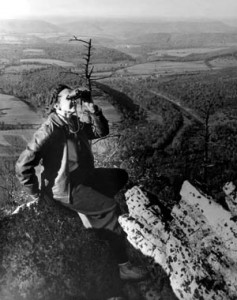
Rachel Carson, birding at Hawk Mountain Sanctuary
8 Comments | Accuracy, DDT, Environmental protection, History, Law, Natural history, Natural resources, Politics, Rachel Carson, Science | Tagged: DDT, Environmental protection, History, Law, Rachel Carson, Science | Permalink
Posted by Ed Darrell
Here is the press release, from Alma College in Alma, Michigan:
Continued Use of DDT Is a Global Health Concern
Scholars who attended the Eugene Kenaga International DDT Conference on Health and the Environment at Alma College are drafting a consensus statement urging global policymakers to reconsider the future use of the synthetic pesticide DDT.
The scholars acknowledge that the use of DDT has prevented millions of infections and deaths from insect-borne diseases, especially malaria. Yet, substantial exposure to DDT poses serious health risks for human populations and the environment, says Edward Lorenz, director of the Public Affairs Institute at Alma College.
“The consensus of the scholars was a recognition of the serious impediments to further restricting DDT use, given that several million people die each year from malaria, most of whom are under the age of five,” says Lorenz. “However, these scholars have documented in numerous human health studies what can be called a ‘deepening understanding of the effects of DDT use on humans.’ The collective wisdom of the experts at the Kenaga Conference was that world policymakers need to use extreme caution when considering easing restrictions on DDT use.”
The March 14 conference attracted international experts in the areas of public health and the environment, including South African scholars Riana Bornman, Henk Bouwman and Christiaan de Jager; Aimin Chen of Creighton University; Barbara Cohn and Brenda Eskenazi of the University of California at Berkeley; Henry Anderson of the Wisconsin Division of Public Health; Suzanne Snedeker of Cornell University; Diane Henshel of Indiana University; Darwin Stapleton of the Rockefeller Archives; Lorenz and John Leipzig of Alma College; and Felicia Leipzig of the Pine River Superfund Citizen Task Force.
The anticipated DDT conference “consensus statement” is expected to list the following summary statements and recommendations, says Lorenz:
- Repeated use of DDT results in serious health risks for humans.
- Many sites of chemical-manufacturing facilities continue to be a source of DDT contamination to area residents. While clean-up efforts continue, some DDT proponents, such as John Tierney (New York Times, June 5, 2007), have claimed that, “the billions spent cleaning up Superfund sites would be better spent on more serious dangers.”
“The experts at the DDT Conference unanimously disagree with Tierney’s assessment,” says Lorenz. “Because of the known DDT impacts on human health, the experts not only support continued Superfund clean up, but also endorse assessment of health impacts on residents of communities with DDT sites, such as St. Louis, Mich.”
- Children and pregnant women in malaria endemic areas where DDT is used are most at risk.
- Studies have shown that DDT impedes breast milk production, the best source of infant nutrition in many parts of the world.
“Because of the negative impacts on breastfeeding, resulting in more low birth weight babies, communities potentially exposed to DDT to control malaria must be told that the short-term benefits of DDT may spawn longer-term problems,” says Felicia Leipzig.
- New methods of malaria control should be encouraged and tested.
“Those who are lobbying for DDT use should focus on support for research into alternative chemicals and public health strategies that ultimately will allow for the full phase-out of DDT,” says John Leipzig, director of Alma’s Center for Responsible Leadership.
- The socio-economic development of malaria-affected communities is the best solution to malaria eradication.
- Conference experts call for “full support for the Stockholm Convention that will phase out the use of the 12 most dangerous persistent organic pollutants, including DDT,” says Lorenz.
“The Stockholm Convention mandates that each country using DDT have an implementation and management plan on controlling the use of DDT,” he says. “Ultimately it envisions eventual reliance on sustainable methods of disease vector control.”
The scholars argue that sufficient evidence exists that DDT exposure is occurring and posing significant health risks.
“Because of both DDT related Superfund sites and continued use of DDT, exposure to the pesticide is occurring around the world with significant health risks to current and future generations,” says Lorenz.
“The conference experts are challenging policy makers to provide support to further determine health risks associated with DDT exposure in both the developing world and in U.S. communities near contaminated Superfund sites,” he says. “The experts were especially critical of special interests groups and their lobbyists who negate the clear evidence of human health dangers of DDT exposure.”
-mjs-
Other coverage of the Alma DDT Conference at the Bathtub:
2 Comments | DDT, Environmental protection, Politics, Science | Tagged: DDT, Environmental protection, Politics, Science | Permalink
Posted by Ed Darrell
Don’t breathe the air, don’t eat the eggs. Life next door to a DDT plant in India.
In case you were wondering where nations that want to use DDT might find some, now that it’s not being made in the U.S.
1 Comment | DDT, Environmental justice, Environmental protection, Health care, History, Politics, Public health, Science | Tagged: DDT, Environmental protection, health, India, Politics, Science | Permalink
Posted by Ed Darrell
Some nations do not wish to use DDT to poison mosquitoes because they have other poison problems, and they’d almost rather have malaria than more poison.
For example, see this description of clean water problems in India. From A Wide Angle View of India. Be sure to follow the links to stories in the New York Times and on BBC’s website.
Leave a Comment » | DDT, Environmental protection, Health care, History, Politics, Public health, Science | Tagged: Clean Water, DDT, Environmental protection, India, Pesticides, Politics, Science | Permalink
Posted by Ed Darrell
DDT advocates continue to smear Rachel Carson and “environmental groups” with a campaign of made up calumny. To the frustration of scientists, health officials and the gods of fairness, these people continue to get credence from people who should know better, like the contributors at the Volokh Conspiracy (Quiggin and Lambert are the good guys, if you’re not following closely).
Reality is a different story. Business interests appear to have started a false rumor that someone stole a massive quantity of DDT from Uganda’s mosquito control program in an attempt to make the mosquito control guys look incompetent and dangerous. From The Monitor in Kampala, via allAfrica.com:
21 May 2008
Posted to the web 21 May 2008Safina Nambafu
KampalaThe Ministry of Health has denied reports that some people were last week arrested in possession of stolen DDT drugs in Oyam District.
The head of the Malaria Control Programme, Dr Rwakimari, said it was the detractors of the campaign that are inciting the public to spread falsified information.
He was addressing the press at the ministry headquarters on Monday.
Dr Rwakimari said some local leaders are trying to fail the DDT campaign yet over 94% of the district had successfully been sprayed as of last Monday. Last week, civil society organisations led by the National Association of Professional Environmentalists [Nape] held a half day sensitization meeting with stakeholders in Kampala where they collectively condemned the government for carrying out the exercise.
They claimed that many of the crew members had reported strange illnesses, which they fear could have been caused by exposure to DDT. Dr Rwakimari said the government would not just look on as individuals de-campaign the exercise, adding that DDT was being sprayed in eight district in an effort to fight malaria.
Erute North MP Charles Angiro Gutomoi told Daily Monitor that he was bitter that government had had sprayed DDT, saying the exercise threatens the food market.
“National Association of Professional Environmentalists” — in Uganda. Don’t you love it? The group’s website, lacking much information, looks like the site of an astroturf organization to me. The organization exists, though, but DDT doesn’t appear to be a major concern of the group (it earns no mention in their April 2008 report).
There is real opposition to the use of DDT in Uganda, and there is a lawsuit to stop use of DDT. The suit was filed on behalf of nine different agricultural businesses. Farmers claim the spraying is not following the strict guidelines of the World Health Organization (WHO), and they fear their crops will be contaminated and unsaleable.
Effective malaria fighting uses only small quantities of DDT, in a few places, on a few occasions. The fight also requires use of screens and nets to protect people at night, when the mosquitoes are active in feeding. The New York Times featured a story on the successful Nothing But Nets program today — not a government-run program, not a program favored by the Rachel Carson critics, but a useful and necessary program.
Leave a Comment » | Africa, DDT, Environmental protection, Health care, Malaria, Politics, Science | Tagged: Africa, DDT, Environmental protection, health, Malaria, Politics, Rachel Carson, Science | Permalink
Posted by Ed Darrell
You are currently browsing the archives for the Environmental protection category.


Ed Darrell on Texas's Colorado River


Come on in, the water's fine. Come often: Cleanliness is next to godliness.


 Millard Fillmore's Bathtub