August 21, 2007
Elron Steele submitted one of his — I’ll wager several readers here have photos that should be included in the encyclopedic site of photos of North American Wildlife. The project is collecting mammal photos right now (birds, reptiles and invertebrates yet to come?)

I note the project has only one not-very-clear photo of a tassel-eared squirrel, and I know there are at least two species of these things ranging through Arizona, New Mexico and Colorado, and I know there are no fewer than four Boy Scout Camps in those areas — so does some Scout or Scouter have a good shot of one of the tassel-eared guys to include?
So, if you have a good photo, send it along to North American Wildlife, or drop it in an e-mail to the curator of the site.
In my recent excursion into New Mexico, we were south of Raton when I spotted a fine specimen of a pronghorn antelope alongside the road. Within a few minutes we had spotted way over a dozen, and returning along the route a week later we must have seen at least 50 of them, in groups as large as a dozen. While I got no decent photos zipping along at 60 mph, surely someone from one of the mountain states has a very good picture that could be contributed.
And teachers: This is a great source of images for student projects and presentations for biology, environmental science, history and geography.
Spread the word; friends don't allow friends to repeat history.
 3 Comments |
  Boy Scouts of America, Environmental protection, Images, Natural history, Student projects, Teaching |
  Permalink
 Posted by Ed Darrell
August 17, 2007
The Wall Street Journal‘s editorial page continues to exhibit signs of hysteria that can only be described as DDT poisoning. DDT has poisoned their view of what to do about malaria. (The article is now available by paid subscription.)
Malaria is a nasty disease that kills more than a million people every year. It is particularly brutal in attacking infants and pregnant women.
Malaria continues to rage because western nations with the resources to fight the disease spent their money on other things in the past 40 years, because the nations most affected lack the governmental adequacy or financial resources and willpower to mount effective campaigns against the disease, but mostly because malaria is a tough disease to fight.
Malaria is spread by several different species of mosquito, some of which have habits or constitutions which make mosquito eradication programs much less effective. Human malaria is really four different parasites, some of which have acquired resistance to the drugs used to fight it. The HIV/AIDS epidemics in tropical nations have not helped matters: What used to be minor cases of malaria now kill thousands who have compromised immune systems because of HIV/AIDS.
Hospitals in far too many nations are overwhelmed with malaria patients, and unable to provide care for many who could be saved. Most of those who die every year could live, with better distribution of health care, and with better prevention.
A few people have been afflicted with what can only be described as a different problem: DDT poisoning. Their views of malaria and what we need to do to fight the disease are poisoned by their anti-science political views. For at least five years there has been a nasty, persistent campaign to impugn “environmentalists” and Rachel Carson, claiming that DDT is the answer to all the world’s malaria woes. Though DDT has been available to fight malaria since 1946, these people complain that bans on spraying crops have discouraged the use of DDT against malaria, fatally.
Below the fold I’ll fisk the short piece from yesterday’s WSJ. It’s difficult to keep ahead of hoaxers, though — today they’ve got another call for DDT use, this time to fight West Nile Virus. Ironically, West Nile is most deadly against several species of bird, some of which are acutely subject to death by DDT.
Read the rest of this entry »
Spread the word; friends don't allow friends to repeat history.
5 Comments | DDT, Environmental protection, Junk science, Rachel Carson, Reason, Voodoo science | Tagged: DDT, endocrine disruptors, Junk science, Malaria, Voodoo science, West Nile | Permalink
Posted by Ed Darrell
August 12, 2007
Critics of Rachel Carson and sponsors of the anti-science, anti-environmentalist campaign to bring back DDT as a major killer, frequently misinform in very selective ways. For example, they like to mention DDT’s role in causing human cancers, because, they claim Rachel Carson was dead wrong about that link. Therefore, they say, DDT is a nice chemical and bans should be lifted.
In reality, carcinogenicity played a very small role in banning DDT. DDT was banned because it kills indiscriminately, killing beneficial insects along with the bad, killing untargeted species, like songbirds, along with the insect targets; and DDT was banned because once released into the wild, it is very long-lived, and its ultimate destructive effects cannot be known or controlled — though some harms, such as the devestation of America’s birds of prey, are extremely well documented.
Similarly, the anti-science crowd doesn’t like to talk about the third big area where DDT produces harms: Hormone disruption. In fact, Steven Milloy’s “100 things you should know about DDT” at the site that peddles junk science, JunkScience.com, does not even contain the word “hormone.”
They play down the fact that DDT and its by-products disrupt reproductive processes, and sometimes disrupt and deform reproductive organs, of nearly every animal it touches. They don’t want you to know about the hormonal effects of DDT and its breakdown products.
So, they never mention books like the National Academy of Sciences’ compilation of the harms of such chemicals, Hormonally Active Agents in the Environment.
Milloy will misquote the NAS when NAS mentions slightly the benefits of DDT; Milloy will not quote NAS when they cite the dangers of DDT. So this book on hormonally active agents, which mentions DDT specifically in 16 chapters for a total of 309 times, will never be mentioned in a discussion of DDT’s dangers — unless you bring it up.
Go see what the book says in the Executive Summary. If you debate the anti-Rachel Carson crowd, use this book frequently — they will have no answers.
And, Sen. Tom Coburn, are you listening? Since when do your constituents want you to defend a chemical which will ruin their farm animals, and especially the ducks they want to hunt? It’s time to quit trying to tarnish the memory of Rachel Carson, Sen. Coburn, and let that post office in Pennsylvania be named after her.
Spread the word; friends don't allow friends to repeat history.
2 Comments | DDT, Environmental protection, Politics, Rachel Carson, Science, Voodoo science, War on Science | Tagged: Accuracy, DDT, Endocrine Disruption, Environmental protection, Junk science, Politics, Propaganda, Rachel Carson, Rampant stupidity, Science, Voodoo science | Permalink
Posted by Ed Darrell
August 12, 2007
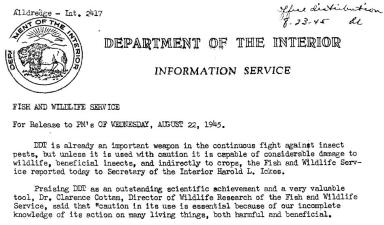
Archives of the U.S. Fish and Wildlife Service (FWS) reveal a long history of trouble with DDT, almost from the first uses of the chemical as an insecticide during World War II. You’ll find extensive links to historic press releases from FWS below the fold.
Critics of the various restrictions on DDT use often claim that DDT is a God-sent chemical that nearly eradicated malaria from the world (absolutely untrue) and which was banned only because of hysteria caused by Rachel Carson’s 1962 book, Silent Spring (untrue at both ends, hysteria and the power of Carson’s book). This is history revisionism at its worst, it is bogus history.
A careful study of the history of the use of DDT shows that scientists were concerned about its dangers from the first uses as a pesticide. The U.S. Fish and Wildlife Service reported dangers in a press release on August 22, 1945, just a week after the surrender of Japan ended World War II (VJ Day was August 15 in Tokyo, August 14 in Washington). In that release FWS noted the beneficial uses of DDT to fight insect and lice infestations that threatened troops and civilians with typhus and other diseases, but cautioned that such use should not become common, that more study was needed: Read the rest of this entry »
Spread the word; friends don't allow friends to repeat history.
5 Comments | Bogus history, DBQ sources, DDT, Environmental protection, Historic documents, History, History Revisionism, Hoaxes, War on Science | Permalink
Posted by Ed Darrell
August 9, 2007
Another in a continuing series, showing the errors in JunkScience.com’s list of “100 things you should know about DDT.” (No, these are not in order.)
Steven Milloy and the ghost of entomologist J. Gordon Edwards listed this as point six in their list of “100 things you should know about DDT “[did Edwards really have anything to do with the list before he died?]:
6. “To only a few chemicals does man owe as great a debt as to DDT… In little more than two decades, DDT has prevented 500 million human deaths, due to malaria, that otherwise would have been inevitable.”
[National Academy of Sciences, Committee on Research in the Life Sciences of the Committee on Science and Public Policy. 1970. The Life Sciences; Recent Progress and Application to Human Affairs; The World of Biological Research; Requirements for the Future.]
In contrast to their citation for the Sweeney hearing record, which leads one away from the actual hearing record, for this citation, the publication actually exists, though it is no longer available in print. It’s available on-line, in an easily searchable format. [I urge you to check these sources out for yourself; I won’t jive you, but you should see for yourself how the critics of Rachel Carson and WHO distort the data — I think you’ll be concerned, if not outraged.] The quote, though troubled by the tell-tale ellipses of the science liar, is accurately stated so far as it goes.
The problems? It’s only part of the story as told in that publication. The National Academy of Science calls for DDT to be replaced in that book; NAS is NOT calling for a rollback of any ban, nor is NAS defending DDT against the claims of harm. The book documents and agrees with the harms Rachel Carson wrote about eight years earlier.

Cover of the electronic version of Life Sciences, the 1970 book looking to future needs in biology and agriculture.
Milloy (and Edwards, he claims), are trying to make a case that the National Academy of Sciences, one of the more reputable and authoritative groups of distinguished scientists in the world, thinks that DDT is just dandy, in contrast to the views of Rachel Carson and environmentalists (who are always cast as stupid and venal in Milloy’s accounts) who asked that DDT use be reduced to save eagles, robins and other songbirds, fish, and other wildlife, and to keep DDT useful against malaria.
First, there is no way that a ban on DDT could have been responsible for 500 million deaths due to malaria. Calculate it yourself, the mathematics are simply impossible: At about 1 million deaths per year, if we assume DDT could have prevented all of the deaths (which is not so), and had we assumed usage started in 1939 instead of 1946 (a spot of 7 years and 7 million deaths), we would have 69 million deaths prevented by 2008. As best I can determine, the 500 million death figure is a misreading from an early WHO report that noted about 500 million people are annually exposed to malaria, I’m guessing a bit at that conclusion — that’s the nicest way to attribute it to simple error and not malicious lie. It was 500 million exposures to malaria, not 500 million deaths. It’s unfortunate that this erroneous figure found its way into a publication of the NAS — I suppose it’s the proof that anyone can err.
Read the rest of this entry »
Spread the word; friends don't allow friends to repeat history.
16 Comments | Accuracy, Bogus history, Conservation, DDT, Environmental protection, History, Hoaxes, Junk science, Public health, Rachel Carson, Research, Voodoo history, Voodoo science, War on Science | Tagged: Bogus history, DDT, Environmental protection, History, Hoaxes, J. Gordon Edwards, Junk science, Malaria, National Academy of Science, Rachel Carson, Science, Steven Milloy | Permalink
Posted by Ed Darrell
July 23, 2007
The Straight Dope has a motto: “Fighting ignorance since 1973. (It’s taking longer than we thought.)”
Alas, the motto could work as well for people who understand science, who understand chemistry and biology, and who urge sanity in discussions about DDT, malaria prevention and control, and Rachel Carson.

DDT sprayed on a crowded beach -- photo from an unidentified 1950s publication. Caption in the photo: "This machine is spreading a kind of fog of DDT spray to see if it will kill the mosquitoes and other insects on the beach. Outdoors, the spray soon spreads and does not harm people."
The meme that “Rachel Carson caused millions of deaths” and prompted the disappearance of DDT is factually in error, but popular, and still spreading. It doesn’t help that there are well-funded groups that work hard to spread the disinformation.
As Ben Franklin noted, in a fair fight, truth wins. The difficulty is that the fight for truth about DDT and Rachel Carson has never been fair, and the anti-sense forces have a 25-year head start on wise people like Bug Girl, Deltoid, Rep. Jason Altmire of Pennsylvania, and even dunderheads like me.
How widespread is the damage? Well, how many editorial pieces were there slamming Rachel Carson, falsely, on the event of the 100th anniversary of her birth? Has Sen. Tom Coburn, R-Okla., lifted his holds on naming a post office for her?
The damage continues to spread.
For example, these blogs have fallen victim to the malaria/DDT/Rachel Carson hoax:
a. London Fog, ostensibly about government in London, Ontario, goes off half-cocked on DDT
b. Irrational Optimism, about a Georgian transplanted to Utah, picks up the misunderstandings of DDT
c. The Squamata Report, a general diatribe, accepts at face value all the falsehoods about DDT, especially those that cast scientists and environmentally-concerned politicians in a light where they can be ridiculed
d. PoliPundit.com — not the most bizarre view there, so of course it also accepts the false myths as good data
e. Boots and Sabers, sort of a frat party for young military guys, makes the gung-ho gonzo claim that it would have been worth it to sacrifice bald eagles because DDT could have saved African kids
d. Even Forbes Magazine’s blogs put out the faulty version of the story
e. Red State includes an artless and caustic piece here (repeated during what appears to be a brain power failure at PowerLine)
f. The famous column at the Wall Street Journal, marking a premature end of fact checking at that newspaper’s opinion columns
g. “Rachel Carson’s Genocide,” hysteria at a Ron Paul site misnamed Rational Review
h. Even Nobel Prize winning economists and distinguished federal judges get sucked into the vortex of specious information if they are not scrupulously careful — as Becker and Posner did here, and again here. (See final installment,too.)
And even while fighting ignorance and generally rebutting the wild claims about Rachel Carson, even Cecil Adams at Straight Dope gets suckered in by some of the myths. (In “moderate amounts,” DDT concentrates up to 10 million times in the wild, poisoning birds of prey and predator fishes, especially; DDT is deadly to mosquito-eating birds and bats, and pest-eating lizards; EPA’s hearings on DDT were overwhelmingly in favor of banning the substance — a court suit cited EPA for not moving fast enough to ban such a dangerous substance, and evidence in such trials is not made up; the cause of egg-shell thinning in birds is pretty solidly established to be DDT and its breakdown substances, only the exact process is not well understood; the international treaty against POPs has a specific out-clause for DDT to be used to prevent malaria; and so on).
So, there’s a lot of work to be done, and little time. Stay tuned.
Update: The Capital Times in Madison, Wisconsin, had a wonderful feature on the 1970 hearings in that state to ban DDT,[alternate URL here] and the subsequent success with the spectacular return of the bald eagle to local waterways. In comments, early in the process, the junk science about DDT and malaria appear. It’s everywhere.
P.S. — Here’s a reading for a lecture at Purdue University that neatly summarizes Carson’s life and work, accurately. (In fact, the entire lecture series, by Jules Janick, should prove interesting to people interested in horticulture.)
Spread the word; friends don't allow friends to repeat history.
4 Comments | DDT, Environmental protection, History, Rachel Carson, Rampant stupidity, Reason, Research, Science, Voodoo history, Voodoo science, War on Science | Tagged: DDT, eagles, endangered species, Malaria, Rachel Carson, Science, Voodoo science | Permalink
Posted by Ed Darrell
July 22, 2007
Gro Harlem Bruntland: Recently, in Mozambique, I saw children with their eyes glazed with fever from a malaria that could have been prevented if their parents could afford bed nets. Deforestation had changed malaria from a nuisance to a curse in a matter of twenty years.

Gro Harlem Brundtland, former Director General of the World Health Organization (WHO). Wikiquote image.
More people are suffering from this killing and debilitating disease now than ever before, and deforestation, climate change and breakdowns in health services have caused the disease to spread to new areas and areas that have been malaria-free for decades, like in Europe.
In the Philippines, I have watched how beggars sit exhausted on the pavements convulsed with coughing. Tuberculosis, which we long believed had been brought under control by effective treatment, is on the rise again. Increasingly, we see forms of tuberculosis which are resistant to all but a very expensive cocktail of drugs.
I think that HIV/AIDS may be the most serious threat to face sub-Saharan Africa and other developing regions. space. Already, the AIDS epidemic is the leading cause of death in several African countries. AIDS has reversed the increases in life expectancy we have seen over the past thirty years. The social and economic devastation in countries that could lose a fifth of their productive populations is heart-rending.
I believe we are facing this alarming situation largely because of an outdated approach to development. Our theories have to catch up with what our ears and eyes are telling us – and fast.
There was a period in development thinking – not so long ago – when spending on public services, such as health and education, would have to wait. Good health was a luxury, only to be achieved when countries had developed a particular level of physical infrastructure and established a certain economic strength. The implicit assumption was that health was to do with consumption. Experience and research over the past few years have shown that such thinking was at best simplistic, and at worst plainly wrong.
I maintain that if people’s health improves, they make a real contribution to their nation’s prosperity. In my judgement, good health is not only an important concern for individuals, it plays a central role in achieving sustainable economic growth and an effective use of resources.
As in Europe at the end of the 19th and beginning of the 20th century, we have seen that developing countries which invest relatively more, and well, on health are likely to achieve higher economic growth.
In other words, malaria prevention grows on trees, or malaria grows with the cutting of trees.
Spread the word; friends don't allow friends to repeat history.
1 Comment | Citizenship, Conservation, Current History, DDT, Disasters, Economics, Environmental protection, Ethics, Geography - Economic, Geography - Physical, Geography - Political, Globalization, History, Junk science, Public health, Rachel Carson, Research, Science, Travel, War on Science | Permalink
Posted by Ed Darrell
July 21, 2007
To counter the notion that “evangelical Christian” is synonymous with “conservative enough to make Attila the Hun blush,” the editor of Sojourners magazine speaks out in favor of helping the poor, protecting the environment, and generally not being so crabby about life. If you’re in the North Texas area next Tuesday, you can hear the message first hand.

Jim Wallis will speak in Dallas, at Wilshire Baptist Church, on July 24, at 7:00 p.m., part of the Faith and Freedom Speaker Series of the Texas Freedom Network. Wallis speaks forcefully for faithful people who do not share the crabby views of the religious right. This is a great opportunity for Dallas to hear a voice of goodwill from faith — some call it a prophetic voice. The TFN website says:
Rev. Wallis has boldly proclaimed that the monologue of the religious right in this country is over. In his evening lecture, he will explain how to renew the values of love, justice and community in Texas.
The Dallas organizing committee meets on July 12, 7:00 p.m., at Wilshire Baptist Church, 4316 Abrams Road, (see map in the sidebar). Please come!
Admission is free, but TFN asks people to click in advance to reserve seats, or call 512-322-0545 (TFN’s offices in Austin).
Pre-speech discussions among the organizers have suggested follow-up events to discuss Rev. Wallis’s ideas, and to fan the flames of freedom of faith in North Texas. In short, this will be a good networking event, too.
Who is Rev. Wallis?
Rev. Jim Wallis is a bestselling author, public theologian, preacher, speaker, activist, and international commentator on ethics and public life. His latest book, God’s Politics: Why the Right Gets It Wrong and the Left Doesn’t Get It, was on The New York Times bestseller list for four months. He is president and executive director of Sojourners/Call to Renewal, where he is editor-in-chief of Sojourners magazine — whose print and electronic publication reaches more than 250,000 people — and also convenes a national network of churches, faith-based organizations, and individuals working to overcome poverty in America.
Check out the Sojourners website.
More details are available at the TFN website. You may reserve a seat at the Sojourners website, also.
Mark your calendars: July 24, Jim Wallis speaks (that’s NEXT TUESDAY). To get to Wilshire Baptist Church, from Central Expressway take Mockingbird Lane east to Abrams Road, turn left onto Abrams, and the church is about one block farther, on the right. It’s big, it has a lot of space and a good deal of parking.

Spread the word; friends don't allow friends to repeat history.
Leave a Comment » | Civil Rights, Environmental protection, First Amendment, Politics, Religion, Religious Freedom, Texas Freedom Network | Permalink
Posted by Ed Darrell
July 20, 2007

Extensive rains delayed them a bit, but our annual cicada cycle started up with vigor sometime in the last ten days. For the past three years, we get the announcement at our house, not from the cicadas singing from the trees, but from the cicada-killer wasps that buzz our back patio area, scouting the yard for good places to bury their prey.
It started with one female burying cicadas under the patio; perhaps another joined her by the end of the first season. But last year, we had about a dozen buzzing about the yard. We have plenty of cicadas, so it should be good pickings for the wasps — so long as no one sprays insecticide on them.
These wasps are larger than most wasps, as long as 2.5 inches, and big enough to muscle a cicada around. The cicadas are twice as big, volume wise, but I suspect they weigh less. In any case, the wasps show outstanding strength and coordination in zooming around carrying their paralyzed victims to their holes — yesterday I saw a wasp rocket into a hole in the garden without the usual stop to drop the cicada and tug it in. The hole was a perfect fit. Jet air delivery.
The wasps leave us alone as we watch. We’ve never been stung, and I don’t know that these guys sting humans (unless attacked, and I assume they’d fight back).
Their ability to move dirt is amazing. We usually get a pile of soil about a foot around and three to six inches high at each hole.
So far as I know, down here in Dallas we don’t get any massive infestations of the the 13- or 17-year cicadas. I cannot imagine how such a feast might affect these industrious little guys, other than they might fly themselves to death. We lived through a double hatching of the 13- and 17-year cicadas in Maryland. Corpses of the cicadas made some streets slick enough they were dangerous to drive. Man, what I wouldn’t have given for a few thousand cicada killers then!
Cicada killers, or cicada hawks, sting and paralyze cicadas, then inter the still-living cicada with one egg laid in it for male larvae, or one egg with two cicadas, for female larvae. The wasp egg hatches and the larva consumes the fresh cicada; some of the wasps survive the winter, and I don’t know if the cicada is kept fresh the entire time, or if a few of the wasps hatch and go dormant.
My photos didn’t turn out as well as those from Purdue and Michigan State — the buggers are fast and restless. The photos could easily have come from our yard, with the massive blossoming of the yellow composites right now (“DYCs” in local horticultural parlance).
Watch your yard — you probably have these tiny “True Life Adventures” going on in your own backyard. You can encourage them with careful plantings, and especially by not spraying poisons (did I mention that between the predatory insects and the now-large geckoes that have taken up residence here, we don’t have cockroaches and other nasty house pests?).
The photo below shows a wasp carrying a cicada.

Update on resources (7-30-2008):


Spread the word; friends don't allow friends to repeat history.
47 Comments | Environmental protection, Natural history, Point of personal privilege, Science, Texas | Tagged: Bugs, Cicada Hawks, Cicada Killer Wasps, Cicada Killers, Cicadas, Entomology, Environmental protection, Natural history, Point of personal privilege, Science, Summer, Texas | Permalink
Posted by Ed Darrell
July 8, 2007
I’m trying to figure out how to use this amazing spectrum of maps in class.
But, one set can do something good for schools: You can buy a piece of a national forest, and thereby contribute to a fund to help schools. It’s a bit of a crackpot idea, really — selling off the national forests to provide a minuscule amount of money for schools. But there may be some gems of land out there that could be used for . . . decreasing global warming by creating a preserve for trees.
Davey Crockett National Forest, parcels for sale: This map shows land in Texas for sale.
Your local National Forest may be represented, too. Get there before the developers? Not likely — but you can dream, can’t you?
Please be warned, though, I find the site a real memory hog. If you’re running several programs, and you’re memory deficient as I appear to be for this set of maps, be careful.
Seriously, the site offers a variety of maps of public lands under the jurisdiction of the Bureau of Land Management and National Forest Service. Mineral leasing, oil and gas, coal, and other resources are mapped. This affects the western public lands states mostly, but it could be a great source for a geography project on energy or mineral or timber resources for the nation.
What do you think?
Spread the word; friends don't allow friends to repeat history.
Leave a Comment » | Environmental protection, Geography - Economic, Geography - Physical, Geography - Political, Maps, Public education, Technology, Technology in the classroom, Travel | Permalink
Posted by Ed Darrell
June 29, 2007
This is the second in a series of Fisks of “100 things you should know about DDT,” a grotesquely misleading list of factoids about DDT put up a site called JunkScience.com. While one would assume that such a site would be opposed, this particular site promotes junk science. I’m not taking the points in order.The “100 things” list is attributed to Steven Milloy, a guy who used to argue that tobacco use isn’t harmful, and who has engaged in other hoaxes such as the bizarre and false claim that Compact Fluorescent Lightbulbs (CFLs) can pose serious toxic hazards in your home (and therefore, you should continue to waste energy with less efficient bulbs); and to J. Gordon Edwards, a San Jose State University entomologist who, despite being a great entomologist, was a bit of a nut on some political things; Edwards assisted Lyndon Larouche’s group in their campaign against Rachel Carson before his death in 2004. (Did Edwards actually have a role in the development of this list?)
100 things you should know about DDT
Claim #8. Some mosquitoes became “resistant” to DDT. “There is persuasive evidence that antimalarial operations did not produce mosquito resistance to DDT. That crime, and in a very real sense it was a crime, can be laid to the intemperate and inappropriate use of DDT by farmers, especially cotton growers. They used the insecticide at levels that would accelerate, if not actually induce, the selection of a resistant population of mosquitoes.”
[Desowitz, RS. 1992. Malaria Capers, W.W. Norton & Company]

Cover of The Malaria Capers, by Robert S. Desowitz
This was what Rachel Carson warned about. Indiscriminate use of DDT, such as broadcast application on crops to kill all insect, arthropod or other pests, would lead to mosquitoes and other dangerous insects developing resistance to the chemical. Of course, resistance developed as a result of overspraying of crops has exactly the same result, in the fight against malaria, as overuse in the fight against malaria. Cover of The Malaria Capers, by Robert S. Desowitz
Worse, such overuse also killed predators of mosquitoes, especially birds. In an integrated pest management program, or in a well-balanced ecosystem, birds and other insect predators would eliminate a large number of mosquitoes, holding the population in check and preventing the spread of malaria. Unfortunately, when the predators are killed off, the mosquitoes have a population explosion, spreading their range, and spreading the diseases they carry.
Assuming Milloy quoted the book accurately, and assuming the book actually exists, this point says nothing in particular in favor of DDT; but it reaffirms the case Rachel Carson made in her 1962 book, Silent Spring. Contrary to suggestions from the campaign against Rachel Carson, she urged that we limit use of DDT to tasks like preventing malaria, around humans, to preserve the effectiveness of DDT and prevent overspraying.
And then, there is this: Milloy doesn’t bother to quote the first part of the paragraph he quotes, on page 214 of Malaria Capers. Here is what the paragraph actually says:
There were a number of reasons for the failure, not least that the anophaline vector mosquitoes were becoming resistant to the action of DDT both physiologically — they developed the enzymes to detoxify the insecticide — and behaviorally — instead of feeding and wall-resting, they changed in character to feed and then quickly bugger off to the great outdoors. [from this point, Milloy quotes correctly]
In other words, the DDT-based campaign against malaria failed because DDT failed; mosquitoes became resistant to it. DDT’s declining ability to kill mosquitoes is one of the major reasons DDT use plunged after 1963, and continues to decline to no use at all.
To combat the dastardly campaign of calumny against Rachel Carson and science, you should also read: Deltoid, here, here and here, and the rest of his posts on the topic; Bug Girl, here, at least, and here, and the rest of her posts; denialism, here; and Rabett Run, here.
Save
Save
Spread the word; friends don't allow friends to repeat history.
4 Comments | Accuracy, Bogus history, Citizenship, DDT, Economics, Environmental protection, Ethics, History, Hoaxes, Junk science, Malaria, Natural history, Public health, Rachel Carson, Science, War on Science | Tagged: Bogus history, DDT, Environmental protection, Malaria, Public health, Rachel Carson, War on Science | Permalink
Posted by Ed Darrell
June 25, 2007
Bug Girl sleuthed around a bit, and found information from official sources that really demonstrates the critics of Rachel Carson are using Gillette Foamy to make us think “mad dog!”

Chart from US Fish and Wildlife Service (USFWS) illustrates biomagnification, by which a minuscule dose of DDT to small plankton gets magnified a few million times by the time the top predators in the food chain get it.
So the evidence continues to pile up that Rachel Carson was simply a fine writer, a good scientist, and correct about DDT’s dangers.
Check out the Fish and Wildlife Service’s site, here; notice especially their structure of the site, to dispel the falsehoods.
FWS quotes Carson on DDT use:
In Audubon magazine she wrote, “We do not ask that all chemicals be abandoned. We ask moderation. We ask the use of other methods less harmful to our environment” (4). Countering claims that she was advocating a back-to-nature philosophy, she said, “We must have insect control. I do not favor turning nature over to insects. I favor the sparing, selective and intelligent use of chemicals. It is the indiscriminate, blanket spraying that I oppose” (5).
Evidence mounts that claims against Rachel Carson are sheer calumny. While the political motivations of this smear campaign are not clear, we don’t need to know for certain who is telling lies about a great American hero, or why. As Americans, as concerned citizens, as teachers and parents — as patriots — we only need to know that the claims against Rachel Carson are false.
And now it is our duty to call on Oklahoma’s Sen. Tom Coburn to stop the campaign against Carson. Coburn is the point man in the smear campaign right now: He has put a committee hold on the well-intentioned, justified bill to name a post office in her hometown after Rachel Carson. It is time for Tom Coburn to stand up and do the right thing for a great American. Sen. Coburn needs to lift his committee hold and allow committee action on this minor honor.
Other sources of note:
Bruce Watson, “Sounding the Alarm,” Smithsonian Magazine, September 2002. (Watson, Bruce. Sounding the alarm. Smithsonian, v. 33, Sept. 2002: 115-117. AS30.S6)
“The Berry and the Poison,” about methyl bromide and its ban, Smithsonian Magazine, December 1997.
- Image showing how DDT concentrations rise 10 million times from their introduction to the water to concentrate in raptors like the national symbol, the bald eagle, osprey, peregrine falcon and brown pelicans, from the U.S. Fish and Wildlife Service. Due to the effects of DDT, the bald eagle, peregrine falcon and brown pelican were all listed on the Endangered Species List. [Update, June 13, 2008 – USFWS has taken this page down. I’m leaving the links until they put it back, or until I find what they changed the page to.] [Update June 21, 2015 – Chart may also be found here: https://myorganicchemistry.wikispaces.com/DDT%5D
Spread the word; friends don't allow friends to repeat history.
3 Comments | Accuracy, Conservation, DDT, Environmental protection, Ethics, History, Hoaxes, Junk science, Natural history, Politics, Public health, Rachel Carson, Research, Science, Voodoo history, Voodoo science, War on Science | Tagged: DDT, Environmental protection, Ethics, History, Hoaxes, Junk science, Natural history, Rachel Carson, Science, War on Science | Permalink
Posted by Ed Darrell
June 21, 2007
Much of recent history does not show up in internet searches. Some of the holes are being filled, as copyrights expire and older sources get digitized — but that means that a lot of what happened in the late 1970s, in the 1980s and 1990s escapes notice of history searches.
Whatever happened to the Sagebrush Rebellion?
My view is biased — I got stuck on the front lines, knowing a bit about the environment and working for Sen. Orrin Hatch from 1978 through 1985. While working with people who think it’s good policy to aim a D-9 Caterpillar through a wilderness area has its drawbacks, there were a lot of great people and great places working that issue.
Orrin Hatch’s website doesn’t even mention the stuff any more, though it features a nice photo of Delicate Arch, which some of his supporters threatened to bulldoze or dynamite to make a point. Paul Laxalt is dead long gone from office, and (in 2011) nearing 90. Jake Garn is out of the Senate, and never really was all that interested in it. I had extensive files on the ins and outs, but I unwisely loaned them to the guy who took over the issue for Hatch after Jim Black left the staff, and they disappeared.
The issues have never died. It’s in the news again — see this article in the Los Angeles Times in April. But the old history? Where can it be found?
If you have sources, especially internet sources, please send them my way.

Poor copy of a photo from U.S. News and World Report, Dec. 1, 1980
Spread the word; friends don't allow friends to repeat history.
9 Comments | Bureau of Land Management (BLM), Capturing history, Conservation, Environmental protection, Government, History, Law, Public Lands, Sagebrush Rebellion | Tagged: BLM, Capturing history, Government, Law, Sagebrush Rebellion, Sen. Jake Garn, Sen. Orrin Hatch, Sen. Paul Laxalt, Wilderness | Permalink
Posted by Ed Darrell
June 19, 2007
Anti-environmental long-knives leave the impression that Rachel Carson knew little about science, and had a crabby disposition toward business and life in general.
Go read this: “Rachel Carson: I knew her when.”
She was a poet and a scientist. You won’t learn anything about the controversy, really, other than the fact that Rachel Carson was a genuine woman, a very nice person. But it’s worth the read.
While you’re at Mort Reichek’s site, noodle around and see what else he’s got. He is a retired journalist with a lot to say. Pay attention. [New Jersey history and economics teachers: Do you realize what a resource you could have in this guy? Washington correspondent for Business Week? Hello!!???]
Update: Sadly, Mort passed on in 2011. His blog remains up as a tribute to a great journalist and early blogger.
Spread the word; friends don't allow friends to repeat history.
Leave a Comment » | DDT, Environmental protection, Heroes, Natural history, Public health, Rachel Carson, Research, Science, War on Science | Tagged: DDT, History, Rachel Carson, US Fish and Wildlife Service | Permalink
Posted by Ed Darrell
June 19, 2007
Vicki Thaxton all by herself has saved more water usage in the Dallas area than can be contained in one of our Army Corps of Engineers water projects — say, Joe Pool Lake (yes, it really is named “Joe Pool Lake” — named after Congressman Joe Pool).

How did she do it? How did she save so much water?
Vicki advises Texans on planting their gardens, and for the 20 years or so we’ve known her, she’s been spreading the word, and sometimes spreading the mulch and fertilizer, about xeriscaping with native plants. “Xeriscaping” means landscaping that relies on natural water, rain and dew, instead of irrigation from a hose.
Vicki has been at the same place for all that time, but the establishment’s name has changed — the nursery in Cedar Hill where you find her and get advice is Petal Pushers, on Old Straus Road. (No promotional consideration, by the way.)
Plus, Vicki’s a nice lady. It’s good to see her getting a wider audience for her flower indoctrinations, even if just for a few minutes, on our local NBC affiliate, KXAS-TV, Channel 5. For at least a short while you can view this piece with KXAS’s weatherman, David Finfrock.
Spread the word; friends don't allow friends to repeat history.
Leave a Comment » | Conservation, Education, Environmental protection, Natural history, Texas, Texas history, Video and film | Permalink
Posted by Ed Darrell





 Millard Fillmore's Bathtub