Point numero three-oh: The phrase “ill-informed blog” is redundant.
o Panhandle Truth Squad contributor R. Spacedark
Quote of the moment: Wisdom from a Texas blogger
May 19, 2007
 Leave a Comment » |
  Famous quotes, Quotes, Texas, Weblogs |
  Permalink
 Posted by Ed Darrell
Quote of the moment: Martin Luther, on wine, women and song
May 15, 2007
Martin Luther, by Lucas Cranch
Wer nicht liebt Wein, Weib, und Gesang, Der bleibt ein Narr sein Lebenlang.
Who loves not wine, women and song, remains a fool his whole life long.
Attributed in Matthias Claudius, Der Wandsbecker Bothe (1775). Read the rest of this entry »
Leave a Comment » | Famous quotes, Quotes | Permalink
Posted by Ed Darrell
Quote of the moment: Lincoln on Labor
May 12, 2007
Labor is prior to, and independent of,capital. Capital is only the fruit of labor, and could not have existed if labor had not first existed. Labor is the superior of capital, and deserves much the higher consideration.
Lincoln in the Annual Message to Congress, December 3, 1861
The photograph shows Lincoln as president-elect; it is one of a series taken on February 23, 1861; from The History Place.
Leave a Comment » | Abraham Lincoln, Economics, Famous quotes, Free market economics, Good Quotes, History, Labor and unions, Presidents, Quotes | Permalink
Posted by Ed Darrell
Quote of the moment: James Madison
May 2, 2007
A popular Government, without popular information, or the means of acquiring it, is but a Prologue to a Farce or a Tragedy; or perhaps both. Knowledge will forever govern ignorance.
— James Madison in a letter to W. T. Barry, August 4, 1822
1 Comment | Accuracy, Education, Famous quotes, First Amendment, James Madison, Journalism, Quotes | Permalink
Posted by Ed Darrell
Long, long quote of the moment: Charles Darwin, opposing eugenics
April 25, 2007What did Darwin say about natural selection and humans? Creationists frequently claim Darwin as an advocate of eugenics. Here, below is the section from Descent of Man that they usually quote; and below the fold is the entire quote in its greater context, in which Darwin is shown as an anti-eugenics advocate, at least for humans. 
Darwin died 125 years ago, on April 19, 1882.
I borrowed the text from one of the on-line full-text versions of the book. This excerpt is from Chapter 5, “On the Development of the Intellectual and Moral Faculties During Primeval and Civilised Times,” one of the chapters most frequently cited and most often misquoted out of Darwin’s works. Note Darwin’s rather extensive citing to other works of research to support his arguments:
In regard to the moral qualities, some elimination of the worst dispositions is always in progress even in the most civilised nations. Malefactors are executed, or imprisoned for long periods, so that they cannot freely transmit their bad qualities. Melancholic and insane persons are confined, or commit suicide. Violent and quarrelsome men often come to a bloody end. The restless who will not follow any steady occupation–and this relic of barbarism is a great check to civilisation (17. ‘Hereditary Genius,’ 1870, p. 347.)–emigrate to newly-settled countries; where they prove useful pioneers. Intemperance is so highly destructive, that the expectation of life of the intemperate, at the age of thirty for instance, is only 13.8 years; whilst for the rural labourers of England at the same age it is 40.59 years. (18. E. Ray Lankester, ‘Comparative Longevity,’ 1870, p. 115. The table of the intemperate is from Neison’s ‘Vital Statistics.’ In regard to profligacy, see Dr. Farr, ‘Influence of Marriage on Mortality,’ ‘Nat. Assoc. for the Promotion of Social Science,’ 1858.) Profligate women bear few children, and profligate men rarely marry; both suffer from disease. In the breeding of domestic animals, the elimination of those individuals, though few in number, which are in any marked manner inferior, is by no means an unimportant element towards success. This especially holds good with injurious characters which tend to reappear through reversion, such as blackness in sheep; and with mankind some of the worst dispositions, which occasionally without any assignable cause make their appearance in families, may perhaps be reversions to a savage state, from which we are not removed by very many generations. This view seems indeed recognised in the common expression that such men are the black sheep of the family. Read the rest of this entry »
1 Comment | Charles Darwin, Darwin, Evolution, Famous quotes, Good Quotes | Tagged: Charles Darwin, Eugenics, Evolution, Famous quotes, Morality | Permalink
Posted by Ed Darrell
Celebrating April 19: Paul Revere, “shot heard ’round the world”
April 20, 2007April 19. Does the date have significance? 
Among other things, it is the date of the firing of the “shot heard ’round the world,” the first shots in the American Revolution. On April 19, 1775, American Minutemen stood to protect arsenals they had created at Lexington and Concord, Massachusetts, against seizure by the British Army then occupying Boston.
April is National Poetry Month. What have we done to celebrate poetry?
What have we done to properly acknowledge the key events of April 18 and 19, 1775? Happily, poetry helps us out in history studies, or can do.
In contrast to my childhood, when we as students had poems to memorize weekly throughout our curriculum, modern students too often come to my classes seemingly unaware that rhyming and rhythm are used for anything other than celebrating materialist, establishment values obtained sub rosa. Poetry, to them, is mostly rhythm; but certainly not for polite company, and never for learning.
Poems slipped from our national curriculum, dropped away from our national consciousness.
And that is one small part of the reason that Aprils in the past two decades turned instead to memorials to violence, and fear that violence will break out again. We have allowed darker ideas to dominate April, and especially the days around April 19.
You and I have failed to properly commemorate the good, I fear. We have a duty to pass along these cultural icons, as touchstones to understanding America.
So, reclaim the high ground. Reclaim the high cultural ground.
Read a poem today. Plan to be sure to have the commemorative reading of “Paul Revere’s Ride” in your classes next April 18 or 19, and “The Concord Hymn” on April 19.
We must work to be sure our heritage of freedom is remembered, lest we condemn our students, our children and grandchildren to having to relearn these lessons of history, as Santayana warned.
Texts of the poems are below the fold, though you may be much better off to use the links and see those sites, the Paul Revere House, and the Minuteman National Historical Park.
18 Comments | 1776, Accuracy, America's founding, Education, Famous Battles, Famous quotes, Heroes, History, Santayana's ghost, Teaching, TEKS | Permalink
Posted by Ed Darrell
Quote of the Moment, October 29, 1941: Churchill, ‘never give in’
April 11, 2007
Churchill speaking at the Albert Hall in London, 1944, at an American Thanksgiving Celebration. Churchill Centre image
Never give in, never give in, never, never, never, never — in nothing, great or small, large or petty — never give in except to convictions of honour and good sense!
Winston S. Churchill, address to the boys of Harrow School, October 29, 1941.
6 Comments | Famous quotes, Good Quotes, Leadership, Quotes, Winston Churchill | Tagged: Famous quotes, Great Speeches, History, Leadership, Quotes, Winston Churchill, World War II | Permalink
Posted by Ed Darrell
Quote of the Moment: John Fitzgerald Kennedy and negotiating
April 9, 2007 Let us never negotiate out of fear, but let us never fear to negotiate.
John Fitzgerald Kennedy, in his Inaugural Address, January 20, 1961
Leave a Comment » | Cold War, Democracy, Famous quotes, Good Quotes, Leadership, Presidents, Quotes | Permalink
Posted by Ed Darrell
Quote to think by: Timothy J. Campbell and the Constitution
March 29, 2007What’s the Constitution between friends?
–Timothy J. Campbell (1840-1904), Attributed, circa 1885
A little more below the fold? Certainly. Read the rest of this entry »
2 Comments | Bad Quotes, Famous quotes, Good Quotes, Patriotism, Politics, Presidents, Quotes, U.S. Constitution | Permalink
Posted by Ed Darrell
Quote of the Moment: Nikita Khruschev, whose side is history on?
March 15, 2007About the capitalist states, it doesn’t depend on you whether or not we exist. If you don’t like us, don’t accept our invitations, and don’t invite us to come and see you. Whether you like it or not, history is on our side. We will bury you.*
Nikita Sergeyevich Khruschev (1894-1971); reported statement at a reception for Wladyslaw Gomulka at the Polish Embassy, Moscow, November 18, 1956
Soviet Premier Nikita Khruschev enjoying a hot dog in Des Moines, Iowa, during his 1959 tour of the U.S. (Photo from American Meat Institute, National Hot Dog & Sausage Council, http://www.hot-dog.org)

* The exact phrasing of the last line is debatable. As Bartlett’s Familiar Quotations, 16th Edition has it, “Neither the original nor the translation of the last two sentences appeared in either Pravda or the New York Times, which carried the rest of the text. Another possible translation of the last sentence is: We shall be present at your funeral, i.e., we shall outlive you; but the above is the familiar version.”
3 Comments | Cold War, Famous quotes, Free market economics, Freedom - Economic, Freedom - Political, Good Quotes, History, Politics, Quotes, Socialism | Permalink
Posted by Ed Darrell
Quote of the Moment: Teddy Roosevelt on beating depression
March 14, 2007After the same-day deaths in 1884 of his beloved wife Alice, in childbirth, and his mother, who lived with the family, Teddy Roosevelt went into a depression. To beat the depression, he moved to South Dakota and became a cowboy, a very good cowboy.
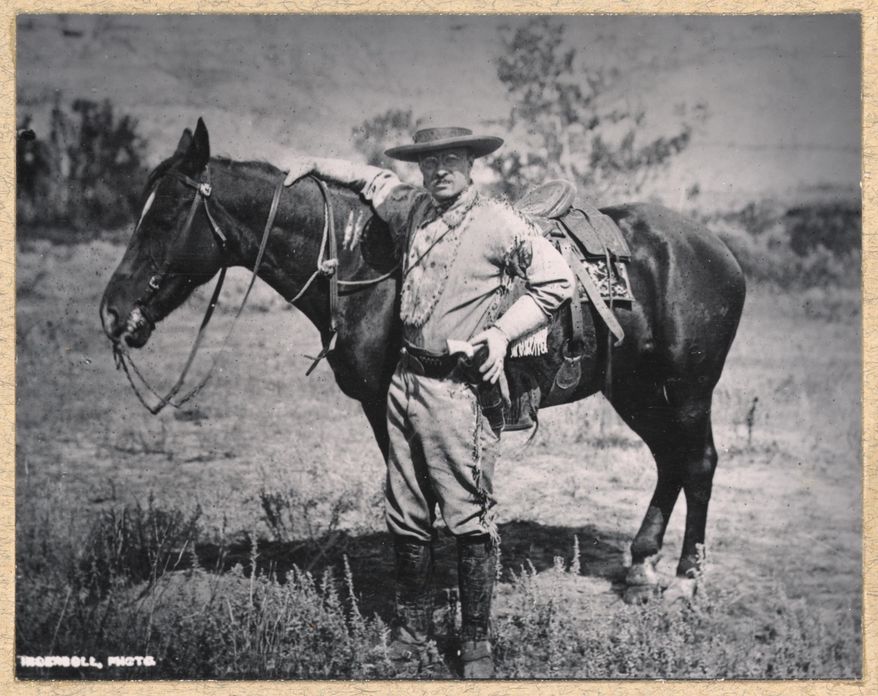
Black care rarely sits behind a rider whose pace is fast enough.
— Attributed to Teddy Roosevelt by David McCullough, on the frontispiece for McCullough’s biography of Roosevelt, Mornings on Horseback (Simon & Schuster, 1981).
6 Comments | Famous quotes, History, Quotes, Theodore Roosevelt | Tagged: Famous quotes, History, Quotes, Theodore Roosevelt | Permalink
Posted by Ed Darrell
Millard Fillmore: Still dead, still misquoted, 133 years later
March 8, 2007
A wax likeness of Millard Fillmore’s head, appearing to be for sale for $950.00.
March 8, 2007, is the 133rd anniversary of Millard Fillmore’s death.
Manus reprints the text from the New York Times story a few days later:
Buffalo, N.Y., March 8 — 12 o’clock, midnight. — Ex-President Millard Fillmore died at his residence in this city at 11:10 to-night. He was conscious up to the time. At 8 o’clock, in reply to a question by his physician, he said the nourishment was palatable; these were his last words. His death was painless.
First, I wonder how the devil the writer could possibly know whether Fillmore’s death was painless?
And second, accuracy obsessed as I am, I wonder whether this is the source of the often-attributed to Fillmore quote, “The nourishment is palatable.” Several sources that one might hope would be more careful attribute the quote to Fillmore as accurate — none with any citation that I can find. Thinkexist and Brainyquote charge ahead full speed. Wikipedia lists it. Snopes.com says the quote is “alleged,” in a discussion thread.
I’ll wager no one can offer a citation for the quote. I’ll wager Fillmore didn’t say it.
Millard Fillmore: We’d protect his legacy, if only anyone could figure out what it is.
1 Comment | Accuracy, Bad Quotes, Capturing history, Famous quotes, History, Millard Fillmore, Newspapers, Presidents, Quotes | Permalink
Posted by Ed Darrell
Quote of the Day: FDR’s Four Freedoms
January 24, 2007Franklin Delano Roosevelt delivered the State of the Union speech for 1941 on January 6. Eleven months and one day later, Japan attacked the U.S. Pacific Fleet at Pearl Harbor, Territory of Hawaii. I have been fascinated by Roosevelt’s clear statement of the freedoms he thought worth fighting for, especially considering that most Americans at that moment did not consider it desirable or probable that the U.S. would get involved in the war that raged across the Pacific and Atlantic.

Here is an excerpt of the speech, the final few paragraphs:
I have called for personal sacrifice, and I am assured of the willingness of almost all Americans to respond to that call. A part of the sacrifice means the payment of more money in taxes. In my budget message I will recommend that a greater portion of this great defense program be paid for from taxation than we are paying for today. No person should try, or be allowed to get rich out of the program, and the principle of tax payments in accordance with ability to pay should be constantly before our eyes to guide our legislation.
If the Congress maintains these principles the voters, putting patriotism ahead of pocketbooks, will give you their applause. Read the rest of this entry »
11 Comments | 1941-1945, Accuracy, Famous quotes, Franklin Roosevelt, Free speech, Freedom - Economic, Freedom - Political, Good Quotes, History, Lesson plans, Presidents, Quotes, Religious Freedom, World War II | Permalink
Posted by Ed Darrell
Turning Point Presentations: Nixon’s “Checkers” speech
October 7, 2006During one of my phase-shift transitions between universities and public schools yesterday, I caught a snippet of a commentary that I thought was on Richard Nixon’s 1952 speech that kept him on the ticket with Dwight Eisenhower. Public reaction was reported to be overwhelmingly warm, the Eisenhower-Nixon ticket won the 1952 election, won again in 1956, and Nixon eventually took the presidency for his own in 1968.
Shouldn’t that speech be considered one of the greater presentations of the 20th century, at least? It probably should, especially when we consider what history might have looked like had Nixon left the ticket — no Nixon nomination in 1960 against John Kennedy, no later Nixon presidency, Nixon continuing in the Senate . . . gee, which path is more gloomy?
The Checkers speech does not wear well, I think. Reading it today, I see the origins of smear campaign tactics and diversionary tactics that mar so much of today’s election campaigns and policy discussions.
This all comes up because the transcripts of the famous 1977 interview series newsman/comedian David Frost did with Nixon is the basis for a new play in London, “Frost/Nixon” by Peter Morgan, with Frank Langella playing Nixon and Michael Sheen as Frost — a play that is already being made into a movie for Universal Pictures by Academy Award winning director Ron Howard, but after a Broadway run in 2007.
Nixon’s mea culpa answer to Frost on the entirety of the Watergate scandal — “I made so many mistakes” — in the NPR piece voiced by Langella, sounded exactly like Nixon. I mistakenly thought it a recording of the Checkers speech, hearing just a snippet. The Frost/Nixon interviews would probably never have been necessary, had the Checkers speech not been a success. Surely there is a direct line from the Checkers speech to Nixon’s attempt to revive his reputation in the Frost interviews.
Watergate on Broadway, with a movie in the works, should offer good opportunities especially for high school history teachers to bring Watergate to a new generation. Too many people today fail to understand the depth of the damage done to Constitutional institutions in that crisis, and how lucky our nation was to have survived it. There are many lessons there for us in our current Constitutional crisis.
A lesson awaits, also, in the career of David Frost, who crossed from news to comedy and back. Many kids today use comedians as their chief source of political news. We should not be surprised — but let us hope that today’s comedians have as much a sense of public duty as David Frost did in 1977, even while using his public service interview to revive his own career.
Sometimes free markets work spectacularly, don’t they?
4 Comments | Ethics, Famous quotes, History, Lesson plans, Movies, Presentations, Presidents, Quotes, Turning Points, Watergate scandal | Tagged: Ethics, Famous quotes, History, Lesson plans, Movies, Presentations, Presidents, Quotes, Richard M. Nixon, Watergate scandal | Permalink
Posted by Ed Darrell
Berlin Wall’s 45th
August 13, 2006August 13, 2006, is the 45th “anniversary” of the erection of the Berlin Wall, the totem of the Cold War that came down in 1989, pushing the end of the Cold War. Residents of Berlin awoke on this day in 1961 to find the communist government of East Germany erecting what would become a 96-mile wall around the “western quarters” of the city — not so much to lay siege to the westerners (that had been tried in 1948, frustrated by the Berlin Airlift) as to keep easterners from “defecting” to the West. The Brandenburg Gate was closed on August 14, and all crossing points were closed on August 26.
From 1961 through 1991 1989, teachers could use the Berlin wall as a simple and clear symbol for the differences between the communist Eastern Bloc, the Soviet Union and her satellite states, and the free West, which included most of the land mass of Germany, England, France, Italy, the United States and other free-market nations — the North Atlantic Treaty Organization (NATO) countries. I suspect most high school kids today know very little about the Wall, why it was there, and what its destruction meant, politically.
This era of history is generally neglected in high school. Many courses fail to go past World War II; in many courses the Cold War is in the curriculum sequenced after the ACT, SAT and state graduation examinations, so students and teachers have tuned out.
But the Wall certain had a sense of drama to it that should make for good lessons. When I visited the wall, in early 1988, late at night, there were eight fresh wreaths honoring eight people who had died trying to cross the Wall in the previous few weeks (in some places it was really a series of walls with space in between to make it easier for the East German guards to shoot people trying to escape) — it’s an image I never forget. Within a year after that, East Germans could travel through Hungary to visit the West, and many “forgot” to return. Within 18 months the wall itself was breached.
The Wall was a great backdrop for speeches, too — President John F. Kennedy visited Berlin in June 1963, and expressed his solidarity with the walled-in people of both West and East Berlin, with the memorable phrase, “Ich bin ein Berliner,“ which produced astounding cheers from the tens of thousands who came to hear him. There are a few German-to-English translators who argue that some of the reaction was due to the fact that “Berliner” is also an idiomatic phrase in Berlin for a bakery confection like a jelly doughnut — so Kennedy’s words were a double entendre that could mean either “I am a citizen of Berlin,” or “I am a jelly doughnut.” [Be sure to see the comments below, from Vince Treacy (9/28/2010).] Ronald Reagan went to the same place Kennedy spoke to the Berlin Wall, too, to the Brandenburg Gate, in his famous June 1987 speech which included a plea to the Soviet Union’s Premier Mikhail Gorbachev: “Mr. Gorbachev, tear down this wall!”
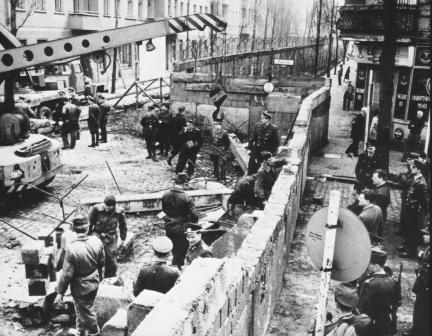
Construction of the Berlin Wall in August 1961 –photo from University of Utah, by Corey Hatch.
Update March 9, 2007: Berlin Airlift information and lesson plans are available from the Truman Library, here, here and here.
Update November 9, 2009: Notes on the 20th anniversary of the fall of the Wall
Please share this post:


27 Comments | Cold War, Democracy, Economics, Famous quotes, Free market economics, Freedom - Political, Geography - Political, History | Tagged: Berlin Wall, Cold War, Democracy, Economics, Famous quotes, Free market economics, freedom, geography, History | Permalink
Posted by Ed Darrell




 Millard Fillmore's Bathtub