Utah flies U.S. flags on January 4 for statehood: 121 years in 2017 – old enough to drink

January 4, 2017

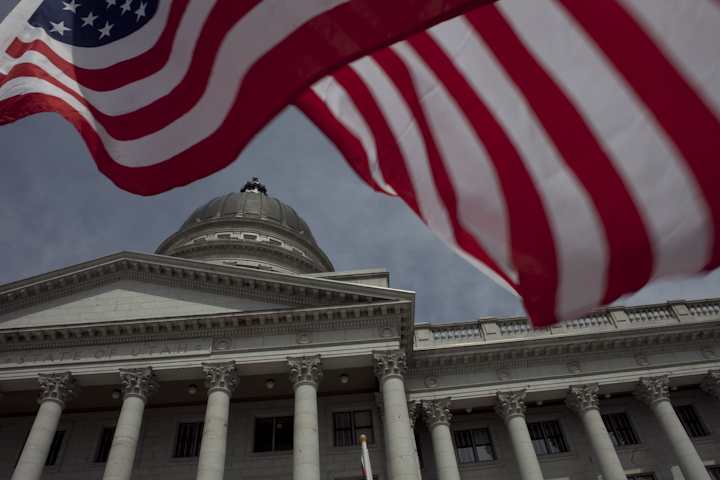
U.S. flag flying in front of the Utah State Capitol. Utah State Capitol image.

U.S. flag flying in front of the Utah State Capitol. Utah State Capitol image.

U.S. flags fly in Utah today in honor of Utah statehood. It’s also the day that new, elected state officers take their oaths and take their offices. Utah is 121 years in the union — as a state, it’s old enough to drink, though you may have difficulty finding a drink there among the teetotaling Mormons.

Utah joined the Union on January 4, 1896.  It had been a 49-year slog to statehood for Deseret, the Mormon settlement in the Desert.  The size had been pared down, so it would not be the biggest state, incorporating parts of what is now Nevada, Arizona, Oregon, Idaho, Colorado and New Mexico.  New capitals had been tried and cast aside (Fillmore, Utah).  Democratic Party rule was broken when LDS church authorities went door-to-door, calling every other family to the Republican Party, and party parity.  The Mormon Church abandoned polygamy, and adopted a state constitution that gave the vote to women.

Finally, Utah became the 45th state.

You may fly your U.S. flag today for Utah statehood, especially if you’re in Utah.

Happy birthday, Utah!  121 years old today.

Big dance in Fillmore to celebrate, Saturday:

Next federal flag-flying date: January 6, in honor of New Mexico’s statehood.

More:

One of my favorite Utah photos: U.S. flag at the south end of Mount Timpanogos; photo from Orem, Utah, by Bob Walker.

One of my favorite Utah photos: U.S. flag at the south end of Mount Timpanogos; photo from Orem, Utah, by Bob Walker.

Yes, this is mostly an encore post. Fighting ignorance requires patience.

Yes, this is mostly an encore post. Fighting ignorance requires patience.

Save

Save


58 years ago, January 3, 1959: Welcome, Alaska, and the 49-star flag

January 3, 2017

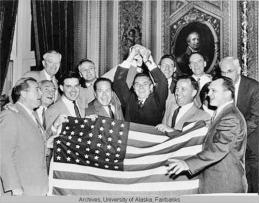
Alaska Territorial Gov. Bob Bartlett in center, with the 49-star flag (Bartlett was one of Alaska's first U.S. senators).

Alaska Territorial Gov. Bob Bartlett in center, with the 49-star flag (Bartlett was one of Alaska’s first U.S. senators).

The great service at the New York Times site, the Learning Network, notes the 1959 Dwight Eisenhower proclamation of Alaska as the 49th state, and the unveiling of the 49-star flag:

On Jan. 3, 1959, President Dwight Eisenhower signed a proclamation admitting Alaska to the Union as the 49th state. The New York Times noted that the signing included the unveiling of the new 49-star American flag.

The land that became Alaska came into U.S. possession in 1867, when William Seward, secretary of state under President Andrew Johnson, negotiated a deal to buy the 586,000-square-mile area from Russia for $7.2 million, less than 2 cents per acre. Seward’s decision was ridiculed in the American press, who saw no potential in the vast, inhospitable and sparsely populated area.

For decades after its purchase, Alaska was derided as “Seward’s folly” or “Seward’s icebox.” This opinion changed in 1896 with the discovery of gold in the neighboring Yukon Territory, which spurred tens of thousands of people to head to Alaska in search of gold. The gold rush also brought about a boom in mining, fishing and trapping.

Though the first statehood bill had been presented to Congress in 1916, there was little desire in either Alaska or Washington for Alaskan statehood until after World War II. During the war, the U.S. established multiple military bases to resist Japan’s attacks on Alaska’s Aleutian Islands and prevent a potential invasion of the mainland. The military activity, along with the completion of a major highway from Montana, led to a large population growth.

In 1946, Alaskans voted in favor of statehood in a referendum and Alaskan delegates began to lobby Congress for statehood. After years of debate, Congress voted in June 1958 to admit Alaska.

Eight months after Alaska’s admission, on Aug. 21, 1957 [should be 1959, no?], Hawaii became the 50th state. The 49-star remained in place until the following July 4, when it was replaced by the now-familiar 50-star flag.

49-star flags were produced only until August 1959, so there are few of them around.  I love this photo of the unveiling of the flag with President Eisenhower:

President Eisenhower and Quartermaster General MG Andrew T. McNamara, with 49-star flag - image from QM foundation

“Quartermaster General MG Andrew T. McNamara and President Eisenhower examine new 49 star flag” – image and caption from the Quartermaster Foundation. Photo by Bob Schutz, Associated Press (Who are the other two people?  The guy on the right looks to me a bit like is Pennsylvania’s Sen. Hugh Scott.)

It had been about 47 years since the previous state admission (Arizona); people became aware that no law set what the flag should look like.  President Eisenhower issued a directive.

How did the nation survive for 170 years without firm, decisive and conclusive orders on what the U.S. flag should look like?  Isn’t it a great story that we went so long without law setting the requirements?

Alaska's state flag design came from 13-year old Benny Benson.

Alaska’s state flag design came from 13-year old Benny Benson. Benny Benson holding the Alaska flag at the Jesse Lee Home, Seward, Alaska. ASL-P01-1921, Alaska State Library-Historical Collections.


Alaska’s state flag came from the imagination of a 13-year-old Aleut, Benny Benson, winning a contest to design the state’s flag.  Alaska’s flag stands out in any display of U.S. state flags.

Alaska's flag as it was approved by the state legislature, and still flies today. Image from the Ninilchik Natives Association, Inc (NNAI).

Alaska’s flag as it was approved by the state legislature, and still flies today. Image from the Ninilchik Natives Association, Inc (NNAI).


Yes, this is mostly an encore post. Fighting ignorance requires patience.

Yes, this is mostly an encore post. Fighting ignorance requires patience.

Save

Save

Save

Save

Save


Will you fly your U.S. flags in January 2017?

January 3, 2017

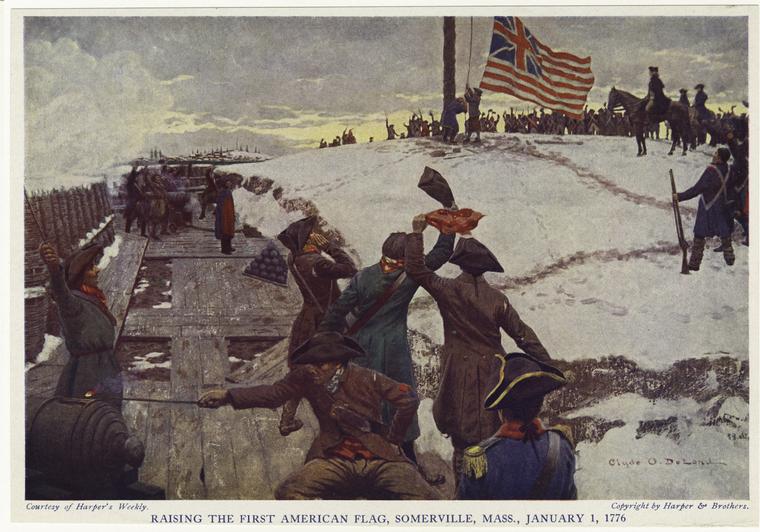
“Raising the first American flag, Somerville, Mass., January 1, 1776.” Harper’s Weekly painting by Clyde Osmer DeLand, 1897. From the digital collections of the New York Public Library

January is loaded with flag flying dates, when we add in statehood days, dates those states are invited to fly their U.S. flags.

In January 2017, the U.S. Flag Code urges citizens to fly flags on these dates, listed chronologically:

  • New Year’s Day, January 1, a federal holiday
  • January 2, Georgia Statehood Day
  • January 3, Alaska Statehood Day
  • January 4, Utah Statehood Day
  • January 6, New Mexico Statehood Day
  • January 9, Connecticut Statehood Day
  • Martin Luther King’s Birthday, a federal holiday on the third Monday of January; that date is January 16, in 2017; King’s actual birthday is January 15, and you may fly your flag then, too
  • Inauguration Day, January 20, the year after election years, as 2017 is
  • January 26, Michigan Statehood Day
  • January 29, Kansas Statehood Day

You may fly your flag any other day you wish, too; flags should not be flown after sundown unless they are specially lighted, or at one of the few places designated by Congress or Presidential Proclamation for 24-hour flag flying.  According to Wikipedia’s listing, those sites include:

  • Fort McHenry, Baltimore, Maryland (Presidential Proclamation No. 2795, July 2, 1948).
  • Flag House Square, Albemarle and Pratt Streets, Baltimore, Maryland (Public Law 83-319, approved March 26, 1954).
  • Marine Corps War Memorial (Iwo Jima Memorial), Arlington, Virginia (Presidential Proclamation No. 3418, June 12, 1961).
  • Lexington Battle Green, Lexington, Massachusetts (Public Law 89-335, approved November 8, 1965).
  • White House, Washington, D.C. (Presidential Proclamation No. 4000, September 4, 1970).
  • Washington Monument, Washington, D.C. (Presidential Proclamation No. 4064, July 6, 1971, effective July 4, 1971).
  • Any port of entry to the United States which is continuously open (Presidential Proclamation No. 413 1, May 5, 1972).
  • Grounds of the National Memorial Arch in Valley Forge State Park, Valley Forge, Pennsylvania (Public Law 94-53, approved July 4, 1975).
Flag House in 1936, 844 East Pratt & Albemarle Streets (Baltimore, Independent City, Maryland) (cropped). Image courtesy of the federal HABS—Historic American Buildings Survey of Maryland.

Flag House in 1936, where Mary Pickersgill sewed the garrison-sized, 15-star flag that flew over Fort McHenry at the Battle of Baltimore in 1814; one of the sites where the U.S. flag may be flown 24 hours. The house is at 844 East Pratt & Albemarle Streets (Baltimore, Independent City, Maryland). Cropped image courtesy of the federal HABS—Historic American Buildings Survey of Maryland.

Yes, this is mostly an encore post. Fighting ignorance requires patience.

Yes, this is mostly an encore post. Fighting ignorance requires patience.

Save


Texans fly U.S. flags today in honor of Texas statehood

December 29, 2016

First class postage stamp showing U.S. and Texas flags together, issued for the Texas Statehood Centennial, in 1945. Yes, first class postage was three cents. Wikipedia image.

First class postage stamp showing U.S. and Texas flags together, issued for the Texas Statehood Centennial, in 1945. Yes, first class postage was three cents. Wikipedia image.

Congress approved Texas’s petition to join the union on December 29, 1845. Texas joined the United States of America 171 years ago today.

KWTX Channel 10 News described the process in 1845:

On December 29, 1845—171 years ago today—the U.S. Congress voted to annex Texas, eight years after statehood was first proposed. In June 1845 the Texas Congress voted in favor of annexation and on July 4, 1845, a convention of elected delegates followed suit. A popular vote in October ratified the document, which the U.S. Congress accepted on December 29, 1845, making Texas the 28th state. Texas President Anson Jones handed over control of the new state government to Gov. James Pinckney Henderson on February 19, 1846.

Engraving of Texas President Anson Jones lowering the flag of the Republic of Texas, to be replaced with the flag of the United States, on December 29, 1845, after Congress accepted the annexation of Texas into the Union. Texas State Library image.

Engraving of Texas President Anson Jones lowering the flag of the Republic of Texas, to be replaced with the flag of the United States, on December 29, 1845, after Congress accepted the annexation of Texas into the Union. Texas State Library image.

More:


Iowa entered the union on December 28, 1846; fly your flags, Hawkeyes!

December 28, 2016

Iowans may fly their flags today in celebration of the anniversary of Iowa statehood.  Iowa’s admission to the Union came on December 28, 1846; Iowa was the 29th state admitted.

“Millions of acres. Iowa and Nebraska. Land for sale on 10 years credit by the Burlington & Missouri River R. R. Co. at 6 per ct interest and low prices.” Poster advertising land in Iowa, circa 1872, from the Burlington & Missouri River Railroad Co. – Library of Congress Printed Ephemera Collection; Portfolio 134, Folder 13; via Wikipedia

The Flag Code, 4 USC §6 (d), notes that the U.S. flag may be flown on “the birthdays of States (date of admission),” in addition to the other score of dates specifically written into law.

Stars and Stripes were impossible to miss at University of Iowa's Kinnick Stadium in November 2014. Photos by Tim Schoon.

Sometimes we excuse parts of the Flag Code if the display otherwise stirs great patriotism. Stars and Stripes were impossible to miss at University of Iowa’s Kinnick Stadium in November 2014. Photos by Tim Schoon.

More:

Yes, this is mostly an encore post. Fighting ignorance requires patience.

Yes, this is mostly an encore post. Fighting ignorance requires patience.

Save

Save


Merry Christmas, 2016! Fly your flag today

December 25, 2016

“A Gift to a Nation” by painter of western scenes Tom Browning; Santa Claus puts together a flag for a family to fly on Christmas.

Christmas Day, December 25, is one of the holidays designated in the U.S. Flag Code for U.S. residents to fly the flag.

No, you don’t take the flag down for mere inclement weather; fly it through rain and snow. Remember to dry your flag before putting it away.

More:

  • Next dates to fly the flag: December 28, for Iowa statehood; December 29, for Texas statehood; New Years Day
  • Look around for other Christmas and Santa Claus posts
Ron Cogswell captured a flag displayed at Reagan National Airport in Washington, D.C., in December 2015; Creative Commons license

Ron Cogswell captured a flag displayed at Reagan National Airport in Washington, D.C., in December 2015; Creative Commons license

Save

Save

Save


December 14, Alabama flies the flag for statehood

December 14, 2016

U.S. and Alabama flags share a pole at the Alabama Capitol Building in Montgomery. USFlagStore.com image.

U.S. and Alabama flags share a pole at the Alabama Capitol Building in Montgomery. USFlagStore.com image.

Alabama joined the union on December 14, 1819, the 22nd state.

Under provisions of the U.S. Flag Code, residents of a state are encouraged to fly the U.S. flag on their respective statehood day.

Does Alabama commemorate its own statehood?

More: 


U.S. and Alabama flags flying together. Liberty Flagpoles image.

U.S. and Alabama flags flying together. Liberty Flagpoles image.

Save

Save


December 7, 2016: Fly your flags for Pearl Harbor Remembrance, and for Delaware statehood — and at half staff

December 7, 2016

Flag flies at half-staff over the USS Utah, in Pearl Harbor (2004 photo – Pearl Harbor, Hawaii (May 31, 2004) – Sailors assigned to ships based at Pearl Harbor bring the flag to half-mast over the USS Utah Memorial on Ford Island in honor of Memorial Day May 31, 2004. U.S. Navy photo)

Flag flies at half-staff over the USS Utah, in Pearl Harbor (2004 photo – Pearl Harbor, Hawaii (May 31, 2004) – Sailors assigned to ships based at Pearl Harbor bring the flag to half-mast over the USS Utah Memorial on Ford Island in honor of Memorial Day May 31, 2004. U.S. Navy photo)

December 7 is a two-fer flag-flying day.

By public law, December 7 is Pearl Harbor Remembrance Day, and Americans fly the U.S. flag in memory of those who lost their lives at Pearl Harbor on December 7, 1941. U.S. flags should be flown at half-staff.

Under the U.S. Flag Code, residents of the relevant state should fly their U.S. flag on the date the state joined the union.

In 1787 Delaware quickly and promptly elected delegates to the former colony’s convention to ratify the Constitution proposed at the Philadelphia convention just over three months earlier. The ratification of the Constitution won opposition from strong factions in almost every state. Pols anticipated tough fights in New York, Virginia, and other states with large populations. They also expected other states would wait to see what the bigger states did.

Delaware didn’t wait.  On December 7 Delaware became the first of the former British colonies to ratify the Constitution. Perhaps by doing so, it guaranteed other states would act more favorably on ratification.

Because Delaware was first, it is traditionally granted first position in certain ceremonies, such as the parades honoring newly-inaugurated presidents. Delaware’s nickname is “The First State.”

In Delaware and the rest of the nation, fly your flags on December 7, 2016.

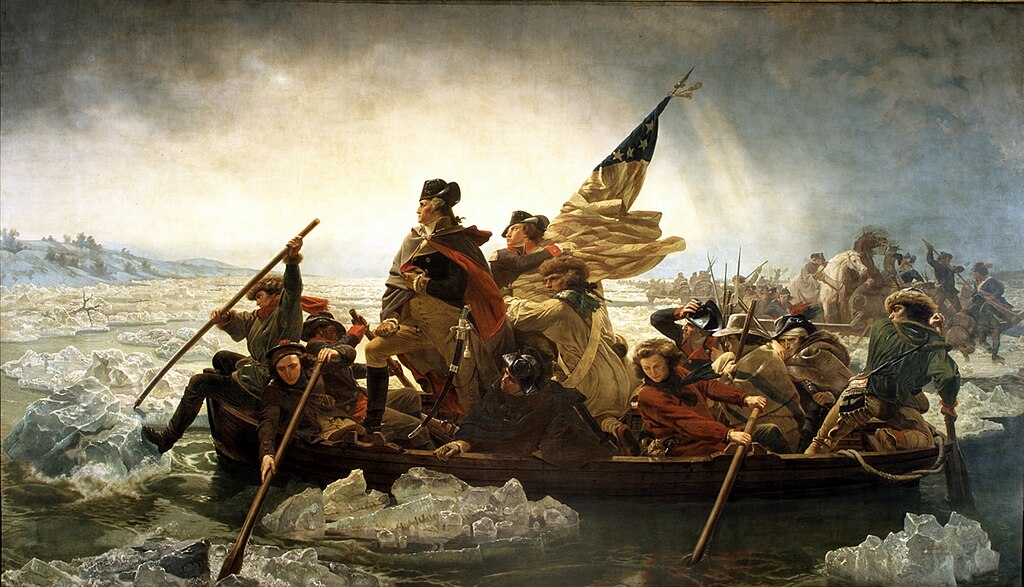
The most famous portrayal of a U.S. flag flying in Delaware is in the painting by Emanuel Leutze (American, 1816–1868).

The most famous portrayal of a U.S. flag flying in Delaware is in the painting by Emanuel Leutze (American, 1816–1868). “Washington Crossing the Delaware,” 1851. The Metropolitan Museum of Art, New York, Gift of John Stewart Kennedy, 1897 (97.34) Among other problems with this portrayal: The flag depicted had not been designated on the date of the crossing, Christmas 1776.

Yes, this is mostly an encore post. Fighting ignorance requires patience.

Yes, this is mostly an encore post. Fighting ignorance requires patience.

Save

Save


December 2016 flag-flying days

December 7, 2016

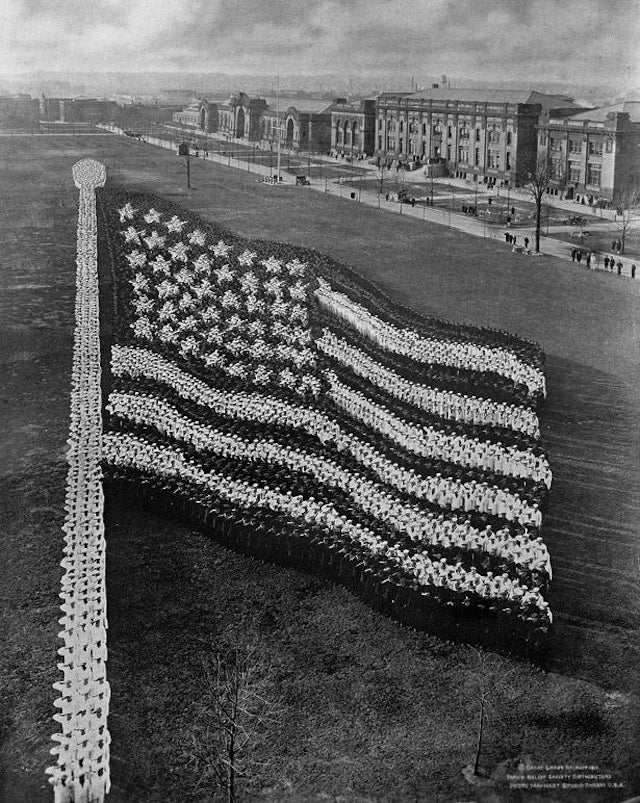
A

A “living flag” composed of 10,000 sailors, or “Blue Jackets at Salute,” by the Mayhart Studios, December 1917; image probably at the Great Lakes training facility of the Navy. Gawker media image

November offers several flag flying days, especially in years when there is an election.

But December may be the month with the most flag-flying dates, when we include statehood days.

December 7 is Pearl Harbor Remembrance Day.  It’s not in the Flag Code, but public law (P.L. 103-308) urges that the president should issue a proclamation asking Americans to fly flags.

December 25 is Christmas Day, a federal holiday, and one of the score of dates designated in the Flag Code. If you watch your neighborhood closely, you’ll note even some of the most ardent flag wavers miss posting the colors on this day, as they do on Thanksgiving and New Years.

Other dates?

Nine states attained statehood in December, so people in those states should fly their flags (and you may join them).  Included in this group is Delaware, traditionally the “First State,” as it was the first colony to ratify the U.S. Constitution:

  • Illinois, December 3 (1818, 21st state)
  • Delaware, December 7 (1787, 1st state)
  • Mississippi, December 10 (1817, 20th state)
  • Indiana, December 11 (1816, 19th state)
  • Pennsylvania, December 12 (1787, 2nd state)
  • Alabama, December 14 (1819, 22nd state)
  • New Jersey, December 18 (1787, 3rd state)
  • Iowa, December 28 (1846, 29th state)
  • Texas, December 29 (1845, 28th state)

December 15 is Bill of Rights Day, marking the day in 1791 when the Bill of Rights was declared ratified; but though this event generally gets a presidential proclamation, there is no law or executive action that requires flags to fly on that date, for that occasion.

Eleven flag-flying dates in December.  Does any other month have as many flag flying opportunities?

Have I missed any December flag-flying dates?  11 events on 10 days (Delaware’s statehood falls on the anniversary of the Pearl Harbor attack).

Here’s a list of the days to fly the flag, under national law, in chronological order:

  1. Illinois, December 3 (1818, 21st state)
  2. Pearl Harbor Remembrance Day, December 7
  3. Delaware, December 7 (1787, 1st state) (shared with Pearl Harbor Remembrance Day)
  4. Mississippi, December 10 (1817, 20th state)
  5. Indiana, December 11 (1816, 19th state)
  6. Pennsylvania, December 12 (1787, 2nd state)
  7. Alabama, December 14 (1819, 22nd state)
  8. New Jersey, December 18 (1787, 3rd state)
  9. Christmas Day, December 25
  10. Iowa, December 28 (1846, 29th state)
  11. Texas, December 29 (1845, 28th state)

Fly your flag with respect to the flag, for the republic it represents, and for all those who sacrificed that it may wave on your residence.

Appropriate to a snowy December.

Appropriate to a snowy December. “The Barn on Grayson-New Hope Road. This barn with its old truck and ever-present American flag, is often the subject of photographs and paintings by the locals.” Photo and copyright by Melinda Anderson

Yes, this is mostly an encore post. Fighting ignorance requires patience.

Yes, this is mostly an encore post. Fighting ignorance requires patience, and it’s taking much longer than I thought.

Encore

Save

Save


Fly your flag on Thanksgiving 2016

November 23, 2016

You’re planning for the big day, the big turkey (or vegan equivalent), you’re wondering how to time everything . . .

Just a reminder to patriots and sunshine patriots that Thanksgiving is one of those days designated in the U.S. Flag Code as a day for citizens to fly Old Glory. Plan to put your flag out early, you won’t have to worry about it all day.

There was a time when people actually sent Thanksgiving cards; few keep up that tradition. Image from Pacific Paratrooper.

There was a time when people actually sent Thanksgiving cards; few keep up that tradition. Image from Pacific Paratrooper.

It’s a great time to recall that the purposes of Thanksgiving usually start with expressing gratitude to and with all of our neighbors, as a means of binding us together as a community, a people, and a nation. And sometimes, an entire world, as cartoonist Joseph Keppler imagined.

Joseph Keppler's

From the Library of Congress collection: Joseph Keppler’s “A Thanksgiving Toast,” Puck magazine, November 30, 1898. “Caption: Puck Gentlemen, your health! I am glad to see from your bea[…]ing faces that you share the high aspirations of our friend, the Czar, for Universal Peace. Here’s to you all! Illus. from Puck, v. 44, no. 1134, (1898 November 30), centerfold.”

(More explanation from the Library of Congress: Print shows Puck standing on a chair at the head of a large dinner table, offering a Thanksgiving toast to those seated around the table, including “England, France, Germany, [Japan?], Russia, Austria, Italy, Turkey, Uncle Sam, Puerto Rico, Hawaii, Brazil, [and] Mexico”. Most of the European countries, as well as Mexico and Brazil, are glaring at their neighbors, with the exception of Russia where Nicholas II attempts to look pious. Turkey appears to be trying to stifle laughter. Uncle Sam seems to be the only one enjoying the toast. Puerto Rico, holding an American flag, and Hawaii are expressionless.)


More:

Save


Oklahoma statehood, November 16, 1907; Oklahomans fly your flags today

November 16, 2016

U.S. Flag Code urges citizens of states to fly the U.S. flag on the anniversary of statehood.

President Theodore Roosevelt signed the Oklahoma statehood proclamation on November 16, 1907. Oklahoma became the 46th state, with New Mexico and Arizona to come later to fill out the contiguous 48 states.

Mike Wimmer's 2003 painting of President Theodore Roosevelt's signing of the proclamation that made Oklahoma a member of the union. Oklahoma Arts Council image.

Mike Wimmer’s 2003 painting of President Theodore Roosevelt’s signing of the proclamation that made Oklahoma a member of the union. Oklahoma Arts Council image.

Oklahoma’s pre-history is long, complex and fascinating; the road to statehood is similarly complex and winding, lined with broken promises to Native Americans, tragedy and other drama. Does the state require Oklahoma history be taught in public schools?

Fly your flags today, Sooners!

More: 

Front page of the Daily Oklahoman on November 16, 1907, anticipating President Roosevelt's proclamation to come that morning. Daily Oklahoman image.

Front page of the Daily Oklahoman on November 16, 1907, anticipating President Roosevelt’s proclamation to come that morning. Daily Oklahoman image.


From Jeff R. Bridgman Antiques: 46 star American national flag, made in the period between 1907 and 1912, in small and desirable scale. The 46th state, Oklahoma, joined the Union on November 16th, 1907, during Teddy Roosevelt’s presidency. Roosevelt had many friends in the Oklahoma Territory from his Rough Rider days, and pushed it through to statehood. The 46 star flag became official on July 4th, 1908 and remained so until July 3rd, 1912. Many 46 star flags were made earlier, however, in great anticipation of the future addition of the state, which had previously been appointed to Native Americans.

From Jeff R. Bridgman Antiques: 46 star American national flag, made in the period between 1907 and 1912, in small and desirable scale. The 46th state, Oklahoma, joined the Union on November 16th, 1907, during Teddy Roosevelt’s presidency. Roosevelt had many friends in the Oklahoma Territory from his Rough Rider days, and pushed it through to statehood. The 46 star flag became official on July 4th, 1908 and remained so until July 3rd, 1912. Many 46 star flags were made earlier, however, in great anticipation of the future addition of the state, which had previously been appointed to Native Americans.

Save

Save

Save

Save


Celebrating Veterans Day 2016

November 11, 2016

A teacher asked on Twitter yesterday for sources of information to set up a curriculum for Veterans Day, and I sent a few suggestions (and got thanked!).

Teachers watching through the day probably saw several sources pop up on the internet that they wished they’d had last week, to plan for this week.

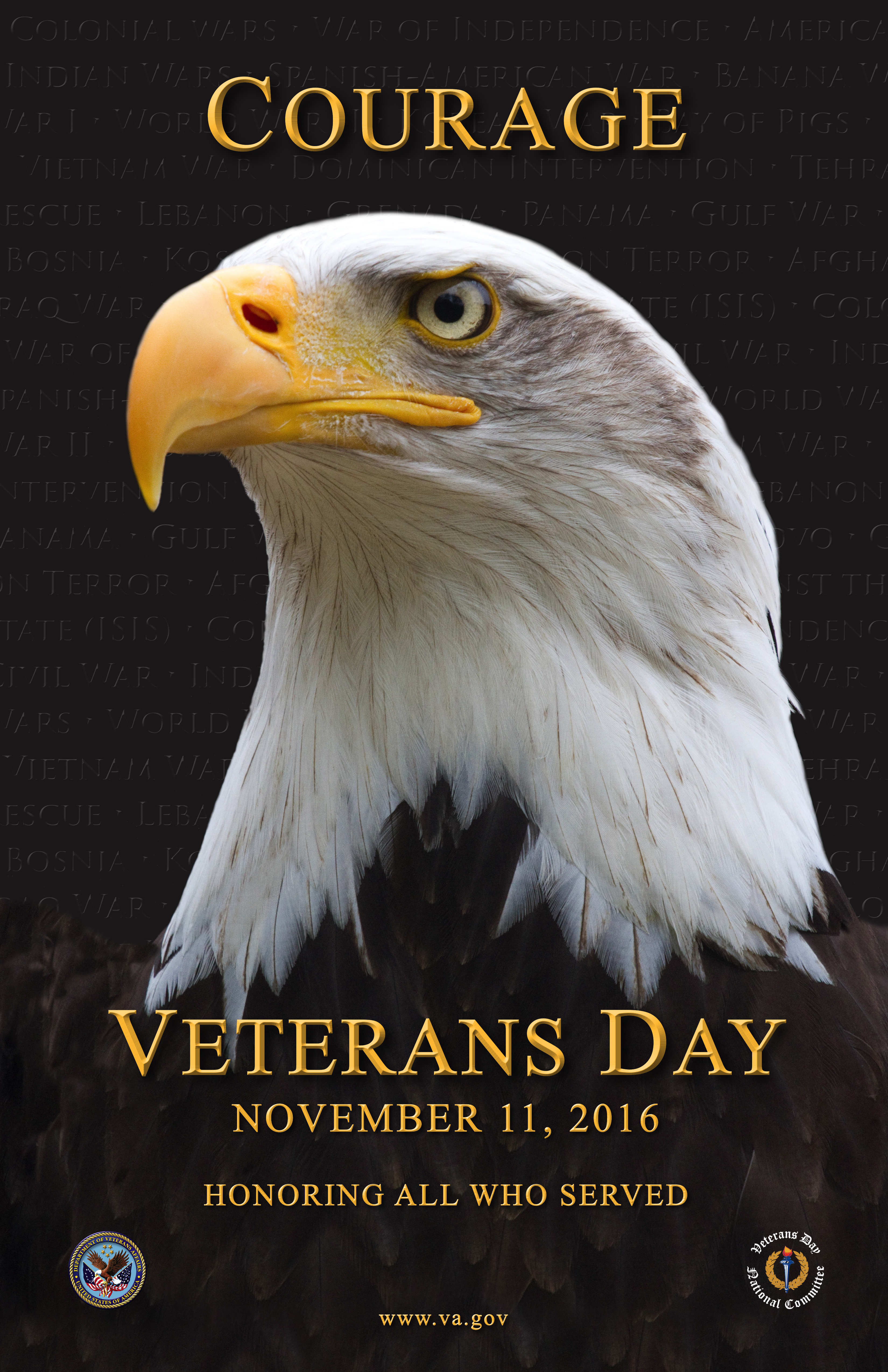
For one, I didn’t post the Veterans Administration’s annual Veterans Day poster, and it’s a very nice one this year:

Veterans Day poster for 2016. Look carefully, you'll see the names of past military engagements in which veterans may have fought, in the background behind the very sharp photo of the head of a bald eagle, our national symbol.

Veterans Day poster for 2016. Look carefully, you’ll see the names of past military engagements in which veterans may have fought, in the background behind the very sharp photo of the head of a bald eagle, our national symbol.

In world history or U.S. history, I usually stop for the day to talk about the origins of Veterans Day in Armistice Day, the day the guns stopped blazing to effectively end fighting in World War I. For several reasons, including mnemonic, the treaty called for an end to hostilities on the “11th hour of the 11th day of the 11th month” of 1918. Your state’s history standards probably has that phrase somewhere, but the history behind it is what students really find interesting.

Original documents and good history can be found at the Library of Congress online collections.

The Allied powers signed a ceasefire agreement with Germany at Rethondes, France, at 11:00 a.m. on November 11, 1918, bringing the war later known as World War I to a close.

President Wilson proclaimed the first Armistice Day the following year on November 11, 1919, with the these words: “To us in America, the reflections of Armistice Day will be filled with solemn pride in the heroism of those who died in the country’s service and with gratitude for the victory, both because of the thing from which it has freed us and because of the opportunity it has given America to show her sympathy with peace and justice in the councils of the nations…” Originally, the celebration included parades and public meetings following a two-minute suspension of business at 11:00 a.m.

Co. E, 102nd U.S.A. Curtiss Studio, photographers, c1917. Panoramic Photographs. Prints & Photographs Division

Between the world wars, November 11 was commemorated as Armistice Day in the United States, Great Britain, and France. After World War II, the holiday was recognized as a day of tribute to veterans of both wars. Beginning in 1954, the United States designated November 11 as Veterans Day to honor veterans of all U.S. wars. British Commonwealth countries now call the holiday Remembrance Day.

Online holdings of the National Archives and Records Administration (NARA) provide rich sources of information on America’s military, and on veteran’s day. NARA leans to original documents a bit more than the Library of Congress. For Veterans Day 2016, NARA featured an historic photo form 1961:

 President John F. Kennedy Lays a Wreath at the Tomb of the Unknown Soldier as part of Veterans Day Remembrances, Arlington National Cemetery, Arlington, Virginia, 11/11/1961 Series: Robert Knudsen White House Photographs, 1/20/1961 - 12/19/1963. Collection: White House Photographs, 12/19/1960 - 3/11/1964 (Holdings of the @jfklibrary)

NARA caption: President John F. Kennedy Lays a Wreath at the Tomb of the Unknown Soldier as part of Veterans Day Remembrances, Arlington National Cemetery, Arlington, Virginia, 11/11/1961 Series: Robert Knudsen White House Photographs, 1/20/1961 – 12/19/1963. Collection: White House Photographs, 12/19/1960 – 3/11/1964 (Holdings of the @jfklibrary)

For teachers, that page also features this:

For Veterans Day, explore the many resources in the National Archives about veterans and military service.

(Well, actually it’s for everyone. But teachers love those kinds of links, especially AP history teachers who need documents for “Document-Based Questions” (DBQs).

On one page, the Veterans Administration makes it easy for teachers to plan activities; of course, you need to start some of these weeks before the actual day:

For Teachers & Students

Hope your Veterans Day 2016 went well (remember to bring in your flag at home!).

Get ready for Veterans Day 2017 — the 11th day of the 11th month.


Save

Save

Save

Save

Save


President Obama’s Veterans Day Proclamation, 2016

November 11, 2016

A message written by First Lady is seen on a U.S. Marine Corps flag at Walter Reed National Military Medical Center in Bethesda, Md., April 4, 2012.

A message written by First Lady is seen on a U.S. Marine Corps flag at Walter Reed National Military Medical Center in Bethesda, Md., April 4, 2012. From a White House blog post, “5 Ways You Can Thank a Veteran.”

Fly your U.S. flags today for Veterans Day.

From the office of the Press Secretary of the White House:

The White House
Office of the Press Secretary
For Immediate Release, November 08, 2016

Presidential Proclamation — Veterans Day, 2016

VETERANS DAY, 2016

BY THE PRESIDENT OF THE UNITED STATES OF AMERICA

A PROCLAMATION

America has long stood as a beacon of hope and opportunity, and few embody that spirit here at home and beyond our borders more than the members of our Armed Forces. Soldiers, Sailors, Airmen, Marines, and Coast Guardsmen are part of an unbroken chain of brave patriots who have served our country with honor and made tremendous sacrifices so that we may live free. On Veterans Day, we salute the women and men who have proudly worn the uniform of the United States of America and the families who have served alongside them, and we affirm our sacred duty as citizens to express our enduring gratitude, both in words and in actions, for their service.

Our country has the best-trained and best-equipped military force in the world, and we need to make sure we have the most supported and respected veterans in the world. We are a Nation that leaves no one behind, and my Administration has made historic investments to provide veterans access to the resources and education they need to share in our Nation’s promise when they return home. Partnering with community leaders across America, First Lady Michelle Obama and Dr. Jill Biden’s Joining Forces initiative works to ensure our country’s heroes can thrive by combatting veteran homelessness, promoting their emotional well-being, and advancing employment training and placement — and we have made great progress. Today, the unemployment rate for veterans is lower than the national average, and veteran homelessness has been nearly cut in half since 2010. We also recognize that some of these courageous men and women have faced and overcome profound challenges, both physically and emotionally, in defense of our freedom. We must continue to provide high quality health care to our veterans and make sure they have the support they have earned and deserve.

The example our Nation’s veterans set throughout their lives is a testament to the drive and perseverance that define the American character. Let us uphold our obligations to these heroic individuals and never forget those who paid the ultimate price for our liberty. On this day and throughout the year, may we sustain their lasting contributions to our Nation’s progress and carry forward their legacy by building a future that is stronger, safer, and freer for all.

With respect for, and in recognition of, the contributions our service members have made to the cause of peace and freedom around the world, the Congress has provided (5 U.S.C. 6103(a)) that November 11 of each year shall be set aside as a legal public holiday to honor our Nation’s veterans.

NOW, THEREFORE, I, BARACK OBAMA, President of the United States of America, do hereby proclaim November 11, 2016, as Veterans Day. I encourage all Americans to recognize the valor and sacrifice of our veterans through appropriate public ceremonies and private prayers, and by observing 2 minutes of silence for our Nation’s veterans. I call upon Federal, State, and local officials to display the flag of the United States and to participate in patriotic activities in their communities. I call on all Americans, including civic and fraternal organizations, places of worship, schools, and communities to support this day with commemorative expressions and programs.

IN WITNESS WHEREOF, I have hereunto set my hand this eighth day of November, in the year of our Lord two thousand sixteen, and of the Independence of the United States of America the two hundred and forty-first.

BARACK OBAMA

First Lady Michelle Obama, in support of the Joining Forces initiative, greets members of the military following remarks at Al Udeid Air Base in Qatar, Nov. 3, 2015. (Official White House Photo by Amanda Lucidon)

First Lady Michelle Obama, in support of the Joining Forces initiative, greets members of the military following remarks at Al Udeid Air Base in Qatar, Nov. 3, 2015. (Official White House Photo by Amanda Lucidon)

Save

Save

Save


2016’s Dakota statehood days – fly your flags

November 2, 2016

North Dakota's commemorative quarter depicts the American bison, perhaps the quintessential prairie symbol.

North Dakota’s commemorative quarter depicts the American bison, perhaps the quintessential prairie symbol.

South Dakota's commemorative quarter interestingly focuses on human alterations to the area -- the carved presidential busts on Mt. Rushmore, wheat introduced by immigrant farmers, and the Chinese pheasant, an exotic species introduced for hunting.

South Dakota’s commemorative quarter interestingly focuses on human alterations to the area — the carved presidential busts on Mt. Rushmore, wheat introduced by immigrant farmers, and the Chinese pheasant, an exotic species introduced for hunting.

Residents of North Dakota and South Dakota should fly their U.S. flags today in honor of your states’ being admitted to the union, on November 2, 1889.

Most sites note simply that both states were admitted on the same day; some sites, especially those that lean toward North Dakota, claim that state is Number 39, because President Harrison signed their papers first, after shuffling to avoid playing favorites.

Does anyone really care?

How much do you really know about the Dakotas?

More:

Save


November 2016 dates to fly the flag

November 1, 2016

An election day in Philadelphia, 1815. Display of the national flag runs to the earliest days of the U.S. republic.

An election day in Philadelphia, 1815. Display of the national flag runs to the earliest days of the U.S. republic. “John Lewis Krimmel, ELECTION DAY AT THE STATE HOUSE, (1815). Courtesy the Historical Society of Pennsylvania”

Eight events spread over six different days come with urgings to fly the U.S. flag in November: Six states celebrate statehood, Veterans Day falls as always on November 11, and Thanksgiving Day on November 24.

Did I say eight? 2016 is a federal election year; we fly flags at polling places on election day, so that makes nine events — but election day falls on Montana’s statehood day, so it’s still just six days. You may fly your flag at home on election day, too.

Two states, North Dakota and South Dakota, celebrate their statehood on the same date. Washington’s statehood day falls on Veterans Day, November 11 — so there are only six days covering eight events.

In calendar order for 2015, these are the seven days:

  • North Dakota statehood day, November 2 (1889, 39th or 40th state)
  • South Dakota statehood day, November 2 (1889, 39th or 40th state) (shared with North Dakota)
  • Election day, November 8 (nationwide)
  • Montana statehood day, November 8 (1889, 41st state)
  • Veterans Day, November 11
  • Washington statehood day, November 11 (1889, 42nd state) (shared with Veterans Day)
  • Oklahoma statehood day, November 16 (1907, 46th state)
  • North Carolina statehood day, November 21 (1789, 12th state)
  • Thanksgiving Day, fourth Thursday in November (November 24 in 2016)

Most Americans will concern themselves only with Veterans Day and Thanksgiving Day. Is flying the U.S. flag for statehood day a dying tradition?

More:

Yes, this is mostly an encore post. Fighting ignorance requires patience.

Yes, this is mostly an encore post. Fighting ignorance requires patience.

Save

Save