Bear facts

September 18, 2009

A grizzly mauled a sheepherder and killed some sheep and dogs, along the Upper Green River in Wyoming.

Ralph Maughn’s blog has a lively and informative discussion on the incident, and on bears and bear protection in general.

For all the hard work they do, North American sheepherders sure seem to me to get short shrift in U.S. markets.  When was the last time you could find anything but New Zealand lamb at your supermarket?  And I ask this from Texas, the largest sheep producing state in the U.S. (with very few grizzlies).

While you’re at Maughn’s blog, look at this piece of good news:  You don’t have to eat ’em.


Best burger in the nation

September 6, 2009

Sophia Dembling wrote about it in today’s Dallas Morning News:  The Owl Burger, from the Owl Café — this one in San Antonio, New Mexico.

It’s the best burger in the world, I think.  It reminds me, and it’s a painful memory.

Back in better younger days, before I’d left American Airlines, Kathryn and I made one last run to Salt Lake City to retrieve the last of the stuff in storage.  It was a motley combination of stuff, mostly hers, that we couldn’t fit into our apartments on Capitol Hill in Washington, and then that we just didn’t need during law school.  The monthly storage bill finally got to be a burr after we’d settled in Dallas, and we had room for the stuff in the house.

We gave the kids a vacation with Grandma and Grandpa, flew to Salt Lake, rented a much-too-large truck (the smaller one we reserved wasn’t in), loaded up and headed out.

A drive from Salt Lake to Dallas can be dull as dishwater, but we worked to add some spice.  “Adventure in Moving,” the old U-Haul slogan ran — and one usually works to avoid such adventures at all costs.  But this was different.  This was planned adventure.  We took the Xtreme Scenic Route™, through Southwestern landscapes that squeeze the creationism out of the most fundamentalist Christians.

The first night we camped in Torrey, Utah, at the edge of Capitol Reef National Park.  Someone recommended a local Mexican restaurant in an old farmhouse, a place that was really top notch, as demonstrated by the autographed photo in thanks from Robert Redford behind the cash register.  Redford knows almost all of the great places to eat, and stop and look, in Utah and much of the Four Corners area (ask me about Redford and Dick Cavett in Farmington, New Mexico, sometime).  Great dinner in a great place.

(Can I remember the name of the restaurant more than 20 years later?  Not at all.  I could drive to it . . . if it’s still there.  Perhaps this is its successor.  If so, it’s gotten a lot fancier, and to me, less charming.  You don’t expect such fine dining in such a small town.)

Coyotes started to howl about 2:00 a.m.  We hadn’t bothered to pitch a tent, the weather being what it almost always is in Utah in the summer.  I don’t know how long I sat up, looked at the stars and listened to the coyotes all around the canyon, next to Kathryn as she slept.  It was one of those nights you remember for the rest of your life.

Coyotes sang til dawn.

Capitol Reef N.P. demands more than one night’s stay — we had both been there before, though, and our task was moving furniture.   From Torrey we drove through Capitol Reef and on to the Moqui Dugway, about an 1,100-foot drop down off the Mogollon Rim, on the way to Monument Valley.

Moqui Dugway, from the rim -- see the road at the bottom, in the middle of the picture

Moqui Dugway, from the rim — see the road at the bottom, in the middle of the picture.  The sign reads “Mokee Dugway Elev. 6,425 Ft. – 1,100 Ft Drop Next 3 Miles”

Remember, this was a big truck.  It was over 20 feet long, but just how much over I don’t remember.  I do remember that when we stopped at the overlook at the top, some guy on a Harley came over to ask if we were going to “try to drive down,” and when we said yes, he said he was betting we would make it, and he had some good money riding on it.  He wished us luck.

A note in the visitor center at Natural Bridges National Monument explains, now:

MOKEE (MOKI, MOQUI) DUGWAY

SAN JUAN COUNTY, UT.

The Mokee Dugway is located on Utah Route 261 just north of Mexican Hat, UT. It was constructed in 1958 by Texas Zinc, a mining company, to transport uranium ore from the “Happy Jack” mine in Fry Canyon, UT. to the processing mill in Mexican Hat. The three miles of unpaved, but well graded, switchbacks descend 1100 feet from the top of Cedar Mesa (on which you are now standing). The State of Utah recommends that only vehicles less than 28 feet in length and 10,000 pounds in weight attempt to negotiate this steep (10% grade), narrow and winding road.

Here’s the Moqui Dugway (or Moki, depending on how much paint the sign maker has):

The Moqui Dugway -- no place for too-big trucks, or trailers - photo from Craig Holl at Midwestroads.com

The Moqui Dugway — no place for too-big trucks, or trailers – photo from Craig Holl at Midwestroads.com

We waited until there was no traffic coming from the bottom for several miles, and started down.  About six switchbacks down we encountered a long, crew-cabbed duelly pickup towing about a 30-foot cabin cruiser boat.  Fortunately we found a wide spot so he could get by, though it took him what seemed like a half-hour to make one turn in the road, and I swear he had wheels spinning in air at one point.

If the motorcycleman did indeed wager on us, he won.

The Mittens, sandstone formations in Monument Valley, Navajoland - Wikipedia image

The Mittens, sandstone formations in Monument Valley, Navajoland – Wikipedia image

We camped again at the Monument Valley Tribal Park, on the Navajo Nation.  The Mittens dominated the skyline; I remember the frustration at being unable to capture the beauty of the place through the lens of a 35-mm SLR on any film.  Images could not be big enough, exposures could not do justice to the color and natural beauty of the place.  In some SUVs and RVs in the campground, people retired to watch television in their vehicles.  They were probably the same ones who pulled out at 6:00 a.m., unable to wait to watch the sunrise complete its glorious stretch across the desert.

The third day we planned to stop and see my widowed Aunt Fay in Farmington, New Mexico.  For a couple of years in college I had the pleasure of doing air pollution research in and around Farmington after the Four Corners Power Plant was in operation, and before the San Juan Power Station came on line.   Uncle Harry Stewart, my mother’s brother, lived there and worked with El Paso Natural Gas.  Weekends I spent with Harry and Fay and their friends the Woodburys.  Harry died a few years earlier — I hadn’t seen Fay in 15 years at least.

But first, I got us stuck in the sand about 50 miles west of Farmington.  We pulled off the road to check the map — off the road meant “into the sand,” though it looked firm from the highway.  Tow trucks were 80 miles away.  A passing woman drove me 40 miles to the home of a Navajo Tribal Policeman, and back; by the time we got back a passing couple from Tucson, Arizona, and a couple of local guys with shovels had dug away feet of sand to hard soil and stone; we gunned it out of the barrow and onto the road.  (How it works today, with cell phones and satellite phones — I hope it works better.)

We had a nice visit with Aunt Fay.

Owl Cafe at night, Albuquerque, New Mexico. Owl Cafe image (?) TripAdvisor

Owl Cafe at night, Albuquerque, New Mexico. Owl Cafe image

There is no way to avoid scenery between Farmington and Albuquerque.  We pulled into the intersection of Interstates 25 and 40 in Albuquerque near 8:00 p.m., found a hotel, and were happy to find a decent-looking café nearby, with an odd, 50-foot owl at one end.  The Owl Cafe.

Who possibly could have guessed?

We seemed to be among the last people there.  It was not crowded.  I probably had a beer.  And I ordered a burger.  “Owl burger?” the waitress asked.  “Made from owls?” I asked back.

She explained it had a touch of a green chile sauce on it.  Sounded good.

She came back.  “I mean, it’s hot.  You’re not from New Mexico, right?”  I stuck with it.

Wow.

I mean, WOW!  It’s made from sirloin — moist and tender, not overcooked.  The bun is fresh, heavy and yeasty.  And I think it was the green chile stuff — heaven!  I told Kathryn I thought it might be the best burger anywhere.

Now, I’ve had some good burgers at roadhouses and fancy restaurants.  I’ve had burgers in the burger outlets near the stockyards of Greeley, Colorado, Fort Worth, Kansas City and Chicago.  I’ve had aged and marinated burgers at little joints around the Saranac Lakes of New York.  I’ve had burgers at restaurants overlooking the cities of Phoenix, San Francisco, Seattle, Indianapolis, New York and Denver.

And if I’ve eaten one Big H from Hires Drive-in in Salt Lake City, I’ve had a hundred (and would like a hundred more).  I used to argue that the Big H was the El Supremo of burgers.

The Owl Burger topped them all.

When I finished the Owl Burger, I ordered apple pie, and I wondered out loud if I should just have another burger instead.

In the morning, we found the place open for breakfast.  I joked about having another Owl Burger for breakfast — and it was on the menu.  But I didn’t.  I had some great egg dish.

Before we got out of Albuquerque, I regretted not having another Owl Burger.  All day long as we drove to Dallas I thought about that burger I didn’t have.

I’ve thought about that burger now for the better part of two decades.  The closest I’ve come to the Owl Café is a couple of passes through Albuquerque’s airport on the way to other places.

I opened the paper this morning, and there was that burger!

Owl Burger, from the Owl Cafe in San Antonio, New Mexico (photo from ABQStyle.com -- not from the online DMN)

Owl Burger, from the Owl Cafe in San Antonio, New Mexico (photo from ABQStyle.com — not from the online DMN)

Alas, according to Dembling in the DMN, management of the Albuquerque Owl Café differs now from the San Antonio Owl Café — can the burger recipes be the same?  Do we now have to make the drive to San Antonio (New Mexico)?

•Owl Bar & Café, State Highway 1 and U.S. Highway 380, San Antonio, N.M.; 575-835-9946. There’s an Owl Café in Albuquerque, but it isn’t under the same management.

The San Antonio site has some history related to development of the atomic bomb and the nearby Trinity bomb site.  One could study history, and have an historic burger at the same time.  I’ve wondered:  If the Germans had had Owl Burgers, would they have gotten the A-bomb first?  It’s that good.

[I did get excited three years ago to read that another Owl was open in San Antonio, Texas — but reading the article, I discerned that the author was unaware of a San Antonio in the Land of Enchantment.  Geographical error, gustatory disappointment.  If any of my students are reading this, that’s why you have to know geography — so you don’t drive to San Antonio, Texas, and find yourself 542 miles off target (thanks to Geobytes for the distance calculation).]

Be polite:  Please share!

Add to FacebookAdd to NewsvineAdd to DiggAdd to Del.icio.usAdd to StumbleuponAdd to RedditAdd to BlinklistAdd to TwitterAdd to TechnoratiAdd to Furl

Save


Forgotten anniversaries: Microwave oven patent

January 26, 2009

Some history really does need to be rewarmed.

January 24 marks the anniversary of the granting of the patent for the microwave oven, “Method of treating foodstuffs.” Do your texts even refer to this by-product of World War II?  What benefits of microwave ovens can your students come up with?  Will they offer the apocryphal question about how Native Americans could possibly have invented popcorn with their wood-fired microwave ovens?

Dr. Percy L. Spencer noted that a chocolate bar in his shirt pocket had melted when he was working around an operating radar tube, at Raytheon Corp., during World War II (the patent application for microwave cooking was filed on October 8, 1945).  With a little experimentation, he determined the microwaves from the radar tube were rapidly cooking things — think exploding egg, think popping corn.

Drawing from the patent of the microwave oven, granted to Percy L. Spencer on January 24, 1950; courtesy the Southwest Museum of Engineering, Communications and Computation

Drawing from the patent of the microwave oven, granted to Percy L. Spencer on January 24, 1950; courtesy the Southwest Museum of Engineering, Communications and Computation

One of the problems Spencer had to overcome was that radar tubes cooked foods way too fast.  He had to tune the magnetron tubes to produce wavelengths with less energy, to heat food more slowly so the cooking could be controlled.  Spencer explained this process of invention in the first page of text on the patent itself.

Perhaps one could create an interesting DBQ with only patents, tracing radio and radar through the microwave oven.

This is one device you probably can demonstrate  safely  in any history classroom.

Resources:

Tip of the old scrub brush to Rhapsody in Book’s Weblog.


A no-bourbon Christmas

December 26, 2008

You can’t buy bourbon in Dallas on Christmas day.

We planned pork tenderloin with apricot/bourbon filling.  Wonderful recipe.

But we needed a cup of bourbon, and when we got to the liquor cabinet, we had only about a quarter cup left in a bottle.

We aren’t bourbon drinkers.  The last time we used bourbon was the last time we cooked pork tenderloin with apricot/bourbon filling . . .

So at about 10:00 a.m. I headed out of our nearly-dry end of the county to a precinct rife with liquor stores.  If any place was selling bourbon on Christmas day, it would likely be among this small city of liquor stores just off I-35, near the sinning areas of Harry Hines Blvd. and a couple of truck stops.

A mile down the road the new quickee mart was open, selling beer and wine.  No hard liquor in this precinct, though.

Liquor store by I-35 near Dallas - photo on Flickr by Futurowoman

Liquor store by I-35 near Dallas - photo on Flickr by Futurowoman (Polaroid photo?)

12 miles up the road, past the doomed Texas Stadium, I passed four liquor stores at one exit, all dark.  At the next exit, the gas station at a liquor store was open.  The main liquor store next door was dark, but I was hopeful.

Inside, one man with an obvious need for a hit of something bargained with one employee over the price of a can of malt liquor.  Another customer queried the other counter man about where he could get a ribbon for the can of beer he’d just bought for his girlfriend, sleeping outside in the car.  Merry Christmas, baby.

No ribbons.  It would be an unwrapped, un-beribboned can of beer.

“What are the chances of finding some bourbon?” I asked.   The guy looked at me like I came from Mars.  His store was selling cheap alcohol in tiny amounts to people down on their luck, but of me he wanted to know:  “What are you doing with bourbon so early in the day?”

Cooking, I told him.

“You won’t find any today.  State law.  All the stores are closed.”

The sauce would have been better with more bourbon, I think.  What else would I be doing with bourbon on Christmas morning?


Thanksgiving 2008 – Fly your flag today

November 27, 2008

Thanksgiving? Texas had it first. No kidding (unless you count the Vinlanders, who probably were grateful to be out of Greenland, but left no records that they ever actually had a feast to say so — but see the comments in the posts linked at various places).

Last year, Mrs. Bathtub was in the hospital. We sprang her before dinner, but barely.  This year, #2 son is off in the wilds of Wisconsin — the first Turkey Day he’s spent away from home and family.  We empathize with the families the first colonizers left behind.

Still, there will be dinner with the family, thanks for the endurance of storms and trials, reflections on good times past, and hopes for the future.

Thanksgiving is a national holiday, one of the 18 days designated by Congress as a “Fly the flag” day.  It’s been a historic year.  It’s a good day to fly the flag.

So, in keeping with that spirit of remembrance, it’s reprise post stuff mostly, today. If you need more, go here:

Google's Thanksgiving logo, 2007

Here’s the main reprise post, text below (there were some good comments in 2006); Margaritas and nachos do sound good, don’t they?
___________________________
Patricia Burroughs has the story — you New Englanders are way, way behind.

Palo Duro Canyon in a winter inversion

Palo Duro Canyon during inversion, Winter 2001, site in 1541 of the first Thanksgiving celebration in what would become the United States. Go here: www.visitamarillotx.com/Gallery/index3.html, and here: www.tpwd.state.tx.us/park/paloduro/

Update, 11/27/2006: Great post here, “Top 10 Myths About Thanksgiving.”

_______________________

Resources for 2007:

Google's 2008 Thanksgiving logo - click here for search on "Thanksgiving"

Google's 2008 Thanksgiving logo - click for search on "Thanksgiving"


Frozen North economics: Where supply, demand and distribution are important problems

September 6, 2008

Especially you economics teachers, look at this very carefully:

Six cans of juice, at a store on Baffin Island - photo from Tales from the Arctic

Six cans of juice, at a store on Baffin Island - photo from Tales from the Arctic

How much do you pay for juice at your local market?

“The High Cost of Northern Living” at Arctic Economics points to Tales from the Arctic and “Believe me now?”

How much per ounce?

Kennie (at Tales from the Arctic) features a bunch of unbelievable prices.  Getting goods to towns in the far north of North America, in Canada and Alaska, is a major production.  Transportation and handling kick prices up a bit.

We’ll find out how alert Sarah Palin is when somebody asks her the price of a gallon of milk . . .

More seriously, economics teachers might find some object lessons in these photos, and a good presentation on supply and demand, and the costs of distribution.

Milk at $8.50 a gallon? Even in Canadian currency, that burns.

I wonder:  Do prices like these make economics any easier to teach to high school kids?  Does the urgency of high prices make the subject more relevant?

Tip of the frozen scrub brush to Arctic Economics, of course.


Teddy Roosevelt at the Minnesota State Fair

August 21, 2008

It’s state fair time!

Which state fair has the most fried foods? Which state fair has the oddest fried foods? You can make nominations in comments.

State fairs drive local economies, sometimes, and occasionally a bit of history gets made there. Certainly they are places where culture and history are on display.

Minnesota’s State Fair is so good even Teddy Roosevelt visited — it’s been an almost annual event since 1859. I’ll bet Roosevelt had a good time, though I wonder if the Fair served him a bag of their famous mini-donuts — 388,000 bags of donuts served last year (do they rival corny dogs?).

Then Vice President Theodore Roosevelt tell Americans our foreign policy should be to

Then Vice President Theodore Roosevelt tell Americans our foreign policy should be to “speak softly, and carry a big stick!” September 3, 1901. President William McKinley was shot on September 6, and died just over a week later; Roosevelt was sworn in as president on September 14.

Check out Minnesota’s State Fair with this 21-question interactive quiz by Dave Braunger at the Minneapolis Star-Tribune — see how well you know or can guess Minnesota history, and compare it to your own state fair if you’re not in Minnesota.

Corny dog, called a Pronto Pup, at the Minnesota State Fair. Pronto Pups are wan copies of Fletcher's Corny Dogs, from the Texas State Fair. Image from Travel.Garden.Eat

Corny dog, called a Pronto Pup, at the Minnesota State Fair. Pronto Pups are wan copies of Fletcher’s Corny Dogs, from the Texas State Fair. Image from Travel.Garden.Eat


Utah beer brewers have a wicked sense of humor

July 5, 2008

Three decades out of Utah, who could have seen this coming?

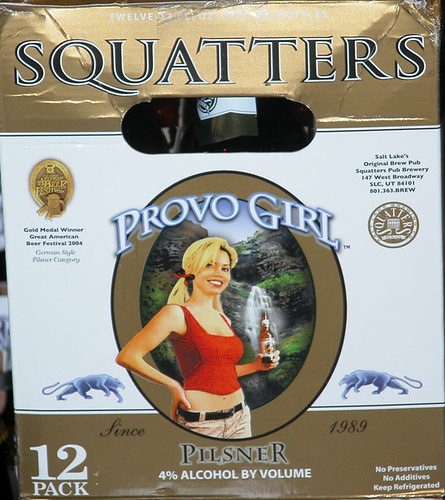
Utah beer brewers make good beer, and they have a wicked sense of humor.  Yes, that’s “Provo Girl,” as in the town where the LDS Church’s Brigham Young University calls home.  And that winsome woman is smiling before Bridal Veil Falls of Provo Canyon.  Let’s just say there’s a lot of history in that drawing.

Face it, brewing beer in a Mormon-dominated state is spitting into the wind anyway (Mormons don’t drink beer, for religious reasons).

Brewers must make money from non-Mormons, and from tourists.  Maybe that explains the proliferation of labels that rather stick it to the local religious authorities.  Humor seems to be a favored marketing device.

Other labels to watch for :


Texas was thankful first

November 22, 2007

Thanksgiving? Texas had it first. No kidding (unless you count the Vinlanders, who probably were grateful to be out of Greenland, but left no records that they ever actually had a feast to say so — but see the comments in the posts linked at various places).

Mrs. Bathtub is in the hospital. Nothing major, but it appears the staff who should have signed her out yesterday all headed off for Turkey Day and may not return until mid-December, so Mrs. Bathtub languishes at the expense of the insurance companies because security is tight and there are only enough sheets to get her down two stories, and she’s on the third floor (and the people-with-unknown-fathers at the hospital have sealed the door to the balcony anyway — that’s got to get you thinking). So Mr. Bathtub is frantically reading the back of the Libby’s Pumpkin can, and you can imagine what antics are up in the kitchen today. Blogging will be sparse.

So it’s reprise post stuff, mostly, today. If you need more, go here:

Google's Thanksgiving logo, 2007

Here’s the main reprise post, text below (there were some good comments last year); Margaritas and nachos do sound good, don’t they?
___________________________
Patricia Burroughs has the story — you New Englanders are way, way behind.

Palo Duro Canyon in a winter inversion

Palo Duro Canyon during inversion, Winter 2001, site in 1541 of the first Thanksgiving celebration in what would become the United States. Go here: www.visitamarillotx.com/Gallery/index3.html, and here: www.tpwd.state.tx.us/park/paloduro/

Update, 11/27/2006: Great post here, “Top 10 Myths About Thanksgiving.”

_______________________

Resources for 2007:


Legendary hoaxes: Neiman Marcus cookie recipe

September 30, 2007

Neiman Marcus cookies, Evans Caglage/Dallas Morning News photo, food styling by Jane Jarrell

[Substitute photo from Desserts by Juliette, dessertsbyjuliette.com]

Photo: Evans Caglage for the Dallas Morning News; food styling by Jane Jarrell [photo no longer available; substitute photo from Desserts by Juliette]

Caption: “When the legend wouldn’t die, Kevin Garvin created a cookie worthy of the Neiman Marcus name.”

Snopes.com and other sites debunk the old urban legend about the woman who was charged “two-fifty” for a chocolate chip cookie recipe at Neiman Marcus’ stores — but in defense of mainstream media, let it be noted that the Dallas Morning News does it up right, repeating the recipe, fact-checking the story, and actually baking the cookies and providing that mouth-watering photo above (et tu, Pavlov?)

The story began circulating in the late ’80s and spread quickly.

Although Neiman’s denied the story – in fact, the company said it had never served cookies in its restaurants – it kept gaining momentum. Finally, with the help of the Internet and e-mail, it became The Urban Legend That Would Not Die.

Inquiries about the costly recipe kept coming in until, finally, the store tasked its bakers to come up with a recipe worthy of the NM reputation. It was perfected in 1995 by Kevin Garvin and is on the company Web site, www.neimanmarcus.com. Free. It also is in the Neiman Marcus Cookbook (Clarkson Potter, $45) by Mr. Garvin and John Harrisson.

The store served cookies made from the recipe as part of its 100th anniversary celebration this month.

When victimized by a hoax, make a cookbook and make some money off of it. Of course, it’s a lot nicer being “Neiman Marcus cookied” than being “swift-boated.”

Here’s the Neiman Marcus version of the Neiman Marcus cookie made famous in the hoax:

  • ½  cup (1 stick) butter
  • 1 cup light brown sugar
  • 3 tablespoons granulated sugar
  • 1 large egg
  • 2 teaspoons vanilla extract
  • 1 ¾ cups all-purpose flour
  • ½ teaspoon baking powder
  • ½ teaspoon baking soda
  • ½ teaspoon salt
  • 1 ½ teaspoons instant espresso coffee powder
  • 1 ½ cups semi-sweet chocolate chips

Preheat oven to 300 F. Cream the butter with the sugars until fluffy using an electric mixer on medium speed (approximately 30 seconds).

Beat in the egg and vanilla extract for another 30 seconds.

In a mixing bowl, sift together the flour, baking powder and baking soda and beat into the butter at low speed for about 15 seconds. Stir in the espresso coffee powder and the chocolate chips.

Using a 1-ounce scoop or 2-tablespoon measure, drop cookies onto a greased cookie sheet about 3 inches apart. Gently press down on the dough with the back of a spoon to spread out into a 2-inch circle.

Bake for about 20 minutes, or until nicely browned around the edges. Bake a little longer for a crispy cookie.

Makes 2 dozen cookies.

PER SERVING: Calories 154 (43% fat) Fat 8 g (5 g sat) Cholesterol 20 mg Sodium 119 mg Fiber 1 g Carbohydrates 21 g Protein 2 g

More:

Read the rest of this entry »


Bubba, we’re not in Texas anymore . . .

August 11, 2007

Among other reasons people shouldn’t inject religion into biology is that knowledge of biology can protect one from harm. From Dorigo, at A Quantum Diaries Survivor, in this case, a little mycological knowledge is not only useful to prevent illness, it allows appreciation of beauty:

This morning while following the trail to Malga Nemes, above Passo di Montecroce Comelico, we found a spot of the woods very densely populated with specimens of Amanita Muscaria, a venomous mushroom which has a very esthetic appearance. The intense red color of the cap, covered with white warts, is very distinctive.
Here is a trio which was particularly good looking:

Definitely NOT Texas.

Dorigo is a physicist, and usually very interesting. Don’t take my word for it — go check out his blog.


News from Texas: Tech Meat Team wins national championship

July 19, 2007

Traveling Texas produces its own joys. In the past couple of weeks I’ve been through Wichita Falls, Amarillo, Dalhart, Eastland, Weatherford, Abilene and Lubbock, and a couple score of towns in between.

I loved this headline last week in Texas Tech’s newspaper, The Daily Toreador: “Meat Team wins national championship.”

Who knew there is intercollegiate competition in meat judging? Why isn’t this on ABC or ESPN?

Humor aside, in beef states such skills are critical. Since I love a good steak more than the average person — and I love a good roast beef at least as well — this is the sort of competition I would probably take some interest in, were it covered in daily media outside the affected universities. The team from Tech deserves wider recognition, it seems to me, and I wish Texas newspapers like the Dallas Morning News and Houston Chronicle would give regular coverage to such achievements — not to mention the Lubbock Avalanche-Journal (is that a great name for daily newspaper, or what?)

The competition was held at the 60th annual Reciprocal Meats Conference, at South Dakota State University. Tech’s winning team had to beat another Tech team to get to the championship round, and there they faced another Texas team from Angelo State University in San Angelo (I haven’t made it there yet, this year).

Tech’s two three-person teams began the competition strong, neither losing a round until they faced each other. The team of Megan Mitchell, Travis Chapin and Austin Voyles came out on top, with O’Quinn, Landi Woolley and Matt Sellers falling into the consolation bracket. Because it was a double-elimination competition, each team had to lose twice to be out of the contest.

The Mitchell, Chapin and Voyles team lost one of their rounds later, leaving both teams in the consolation bracket. Winning their way through the consolation bracket, the two teams eventually faced each other once again, and this time O’Quinn, Woolley and Sellers won. They ended up competing against Angelo State University in the finals and emerged victorious.

“It wasn’t really like two teams,” O’Quinn said. “It wasn’t like one Tech team won and the other Tech team lost. It’s just a matter of formality. If all six of us could have been on one team, we would have. We consider ourselves all one team. The Tech team won.”

Rogers noted that combined the teams only lost three rounds.

“Two of our losses were to our own team,” she said. “It really was a group win.”

It was the third national championship for Tech in the competition in the past six years.

Don’t laugh.  Does your university even have a meat judging team?

And while in Lubbock, I had a great chicken-fried steak at River Smith’s. Eat the local fruits, I always say.


Blue Bell’s 100th; ice cream at the Farmers Museum

July 1, 2007

It looks like even the Farmers Museum in Cooperstown, New York, wants to get in on Blue Bell Ice Cream’s 100th anniversary, with a display on ice cream in America.

Good Humor Ice Cream Truck, NYC c 1926; Unilever 1999, via Farmers Museum, Cooperstown


But it’s only coincidence: Cooperstown is outside the Blue Bell distribution area.

Nice idea, though.

See my original post on Blue Bell’s 100th here.


Call for posts, for 3rd Fiesta de Tejas!

May 28, 2007

The 3rd Fiesta de Tejas! will arrive on June 2, five days from today.

If you blog about Texas, or if you read blogs about Texas, please submit the best posts you wrote or the best posts you read, to share with others.   The best way to submit is through the Blog Carnival entry form:  http://blogcarnival.com/bc/submit_1298.html.

The carnival still needs a logo, and we can use some great art (with permission to publish).  Mostly, we need your contributions.

Texas history, Texas music, Texas culture, Texas geography, Texas food — send it along.

(Please feel free to copy this post and put it on your blog.  The more the merrier.)


Blog Carnival submission form - fiesta de tejas!


Useful serendipity – cilantro

April 15, 2007

Cilantro makes a great substitute for watercress in sesame noodles. In Utah and Maryland we found watercress relatively easy to get — pick some up at the supermarket, or in Utah, stop along one of the mountain streams and pick it (not in the National Forest or National Park lands, of course). Down here in Texas, watercress isn’t as easy to come by. Coriander sativum, from UCLA Biomedical Library

Cilantro, on the other hand, is readily available.

Cilantro is also known as Chinese parsley, and as coriander. The herb is originally known from Greece, but is now grown almost world wide, and is a staple in Oriental and Southwest cuisines.

In your social studies classes, are you talking about spices or the spice trade? The Louise M. Darling Biomedical Library at UCLA has some excellent images and solid information on spices, their use and importance.