Quote of the moment: Robert C. Lieberman, “Why the Rich Are Getting Richer: American Politics and the Second Gilded Age”

February 20, 2011

The U.S. economy appears to be coming apart at the seams.  Unemployment remains at nearly ten percent, the highest level in almost 30 years; foreclosures have forced millions of Americans out of their homes; and real incomes have fallen faster and further than at any time since the Great Depression.  Many of those laid off fear that the jobs they have lost — the secure, often unionized, industrial jobs that provided wealth, security and opportunity — will never return.  They are probably right.

Cover of Winner-Take-All Politics, by Jacob Hacker and Paul Pierson

Cover of Winner-Take-All Politics, by Jacob Hacker and Paul Pierson

And yet a curious thing has happened in the midst of all this misery.  The wealthiest Americans, among them presumably the very titans of global finance whose misadventures brought about the financial meltdown, got richer.  And not just a little bit richer; a lot richer.  In 2009, the average income of the top five percent of earners went up, while on average everyone else’s income went down.  This was not an anomaly but rather a continuation of a 40-year trend of ballooning incomes at the very top and stagnant incomes in the middle and at the bottom.  The share of total income going to the top one percent has increased from roughly eight percent in the 1960s to more than 20 percent today.

This what the political scientists Jacob Hacker and Paul Pierson call the “winner-take-all economy.”  It is not a picture of a healthy society.  Such a level of economic inequality, not seen in the United States since the eve of the Great Depression, bespeaks a political economy in which the financial rewards are increasingly concentrated among a tiny elite and whose risks are borne by an increasingly exposed and unprotected middle class.  Income inequality in the United States is higher than in any other advanced democracy and by conventional measures comparable to that in countries such as Ghana, Nicaragua, and Turkmenistan.

Robert C. Lieberman, reviewing the book Winner-Take-All Politics:  How Washington Made the Rich Richer — and Turned Its Back on the Middle Class, by Jacob S. Hacker and Paul Pierson, Simon and Schuster, 2010, 368 pages.  $27.00.; review appears in Foreign Affairs, January/February 2011, pp. 154-158.

More:


Quote of the moment: Jefferson, public education as the protector of freedom

November 23, 2010

South Elevation of the Rotunda, University of Virginia -- Thomas Jefferson design for the university he founded and shepherded - UVA image

Thomas Jefferson. South Elevation of the Rotunda, begun 1818, completed March 29, 1819. Ink and pencil drawing. Courtesy of the Thomas Jefferson Architectural Drawings, University Archives, Special Collections Department, University of Virginia Library

By far the most important bill in our whole code is that for the diffusion of knowledge among the people.  No other sure foundation can be devised for the preservation of freedom, and happiness.

Jefferson in a letter to his mentor George Wythe, from Paris, August 13, 1786; referring to his Bill for the More General Diffusion of Knowledge, proposed in 1779

Excerpted from The Quotable Jefferson, collected and edited by John Kaminski, Princeton University Press, 2006


Red State: You’ll hear the banjoes

November 8, 2010

Somebody linked over to Red State.  What a creepy site.

First, it looks like those old ’50s school films about the creeping “Red Menace,” the way they paint every state Commie Red (no, I know they’re not conscious commies, but let’s call the color what it is).  It’s as if they have no knowledge of history over there, and they’ve never noticed.  It’s pretty clear that they have no desire nor need for white and blue, even to make “red, white and blue.”

Cover of record with "Dueling Banjoes"

If you have it on vinyl, you know what we mean.

Second, they brook no dissent at all.  Their terms of use (no open discussion) show the Red Staters get to decide whether you’re with the Red State Big Brother program — and if for any reason they decide you’re not toeing the party line, you’re vanquished.  No appeals.  “It’s not really an echo chamber, it’s unison singing.”

Third, there is the astonishing sucking sound where brains of skeptics should be.  Pick the stupid side of almost any issue, and it’s represented in spades there.  On the sciency front, for example, Red Staters have no use nor knowledge of Darwin, they think the warming temperatures of the climate are faked, probably by unholy, non-Red Stater weathermen, and they are convinced that the UN and others are using malaria for “population control” — so they favor massive amounts of DDT.

Remember Mr. Urquhart, the Delaware Tea Partier who, by the grace of God, lost the race for the state’s seat in the U.S. House of Representatives, and his claim that “separation of church and state” was Hitler’s idea?  Urquhart appears to drift in the mainstream at Red State.

Try it.  Pick an issue, do a search at Red State to see if they don’t favor the stupid side, and see whether any real facts can get in.  Even the news that shows their positions wrong, say their position against more stimulus, they’ll spin to say it’s the other guy’s fault.

God save us.  It’s a new Red to fear, the new Red Scare.


You have a friend in the Bill of Rights Institute . . .

November 3, 2010

. . . or should have.

Bill of Rights Institute

Click here, "friend" the Bill of Rights Institute

Bill of Rights Institute does good work.  They’re looking for a few friends on Facebook — they want at least 2,010 friends by the end of 2010.

They’re over 1,100 now.  Go see if you can’t get them to their goal by the end of the week, eh?  If you’re on Facebook, go give them the thumbs up.


TARP saved my nation, and all I got was this bitter, cold tea party

October 5, 2010

Remember TARP, the Toxic Asset Relief Program?

Oh, that’s right — we hate it.  Big hole in the federal budget and all.

Then you should be dancing that it died Sunday night, right?  Yeah, that’s right:  TARP expired.

But, maybe we should be lamenting its passage, and celebrating it.  It ended up costing us almost nothing but the problem of having Tea Party, ignorant ingrates involved in the campaign.  It might even have turned a profit.  In any case, it didn’t leave a big hole in the federal budget, and there is little doubt that it saved us from the Greater Depression.

See the story at NPR:

What do we do with the end of TARP?

And what do we do with the news that TARP will not have cost anything like the $700 billion we thought it would? What if it really cost $50 billion, or less?

What if, in the end, the Toxic Asset Relief Program so controversial at birth and vilified throughout its two years of life turns out to have turned a profit for the government and the taxpayer?

We — most of the news media this is — simply don’t know what to do with this news.

The suggestion that TARP did not blow a hole in the federal budget potentially blows a hole in some other presumptions as well. Economists will argue for years over the necessity of TARP, and the rest of us can argue over the bonuses investment bankers still got (and continue to get).But we won’t argue about whether the government could or should have done more to prevent the collapse of the credit markets and the mass failure of banks in 2008. Because the government did do TARP, and those other things did not happen. We did not go back to 1929 or worse. And, unlovely as it may be, TARP remains the closest thing we have to an explanation for that.

Still, the expiration of the program as Sunday turned to Monday passed largely unremarked. And insofar as the media have noticed the story of TARP’s apparently much-reduced cost, that tale has been anything but ballyhooed.

(For an exception, see the package offered Sunday evening by Guy Raz and the crew at Weekend All Things Considered.)

On the last business day before TARP expired, The New York Times and The Washington Post did report the much-reduced cost figures — mentioning the potential for the program to actually make money for taxpayers in the final accounting.  But the Times put the story in the Business Section, and the Post played it on the Federal Page.

What other “common sense” delusions will misdirect this year’s election vote?

What thanks do we get?  What thanks do we give?


Religion-free zone in New York?

August 28, 2010

Thomas Jefferson’s copy of the Qur’an, published in 1764. (courtesy of the Library of Congress). Image via 15-Minute History at the University of Texas at Austin.

Thomas Jefferson’s copy of the Qur’an, published in 1764. (courtesy of the Library of Congress). Image via 15-Minute History at the University of Texas at Austin.

The Center for Inquiry (CFI) joined in the calls to end plans for any worship center for Islam near the site of the destroyed World Trade Center.  But they added a twist.

CFI called for the entire area to be free from religious institutions, since, they say, it was religiously-inspired violence that caused the trouble.  Greg Laden has pithy comments at his blog, as does DuWayne Brayton from the opposite tack (Laden agrees with CFI, sorta, while Brayton thinks they’ve jumped somebody’s shark).

How about it, Joe, how about it Morgan?  Doesn’t this plan meet yours and Sarah Palin’s objections to Cordoba House?

And Glenn Beck in ignorance leads us farther and further from the intentions of the “founders”:

Also at Millard Fillmore’s Bathtub:

Save


What would George Washington say and do about a mosque in Manhattan? (“To bigotry, no sanction”)

August 17, 2010

Double encore post.  And look at the date

August 17, 1790, found U.S. President George Washington traveling the country, in Newport, Rhode Island.

Washington met with “the Hebrew Congregation” (Jewish group), and congregation leader (Rabbi?) Moses Seixas presented Washington with an address extolling Washington’s virtues, and the virtues of the new nation. Seixas noted past persecutions of Jews, and signalled a hopeful note:

Deprived as we heretofore have been of the invaluable rights of free citizens, we now (with a deep sense of gratitude to the Almighty disposer of all events) behold a government erected by the Majesty of the People–a Government which to bigotry gives no sanction, to persecution no assistance, but generously affording to All liberty of conscience and immunities of Citizenship, deeming every one, of whatever Nation, tongue, or language, equal parts of the great governmental machine.

George Washingtons reply to the Newport, RI, Hebrew congregation, August 17, 1790 - Library of Congress image

George Washington's reply to the Newport, RI, "Hebrew congregation," August 17, 1790 - Library of Congress image

President Washington responded with what may be regarded as his most powerful statement in support of religious freedom in the U.S. — and this was prior to the ratification of the First Amendment:

It is now no more that toleration is spoken of as if it was the indulgence of one class of people that another enjoyed the exercise of their inherent natural rights. For happily, the government of the United States, which gives to bigotry no sanction, to persecution no assistance, requires only that they who live under its protection should demean themselves as good citizens, in giving it on all occasions their effectual support.

Below the fold, more history of the events and religious freedom, from the Library of Congress.

Read the rest of this entry »


Michael Kinnamon on Cordoba House and mosque at Ground Zero

August 14, 2010

An essay from a thoughtful Christian about the controversy over building a mosque in Manhattan; Kinnamon notes some of the history that should be considered:

For thousands of families, Ground Zero in southern Manhattan is holy ground. Thousands lost someone they love in the terror attacks of September 11, 2001, and hundreds of thousands know someone who was directly or indirectly scarred by the collapse of the World Trade Center. The emotional investment in Ground Zero cannot be overestimated.

That is precisely why Ground Zero must be open to the religious expression of all people whose lives were scarred by the tragedy: Christians, Jews, Sikhs, Buddhists, Hindus, and more. And Muslims.

No one knows how many Muslims died on 9/11, but they number in the hundreds. One was Salman Hamdani, a 23-year-old New York City police cadet, emergency medical technician and medical student. When Salman disappeared on September 11, law enforcement officials who knew of his Islamic faith sought him out among his family to question him about the attacks. His family lived with the onus of suspicion for six months until Salman’s body was identified. He was found near the North Tower with his EMT bag beside him, situated where he could help people in need.

The point of this now famous story is simple. Not every Muslim at Ground Zero was a terrorist, and not every Muslim was a hero. The vast majority were like thousands of others on September 11: victims of one of the most heinous events of our times.

But for the family of Salman Hamdani and millions of innocent Muslims, the tragedy has been exacerbated by the fact that so many of the rest of us have formed our opinions about them out of prejudice and ignorance of the Muslim faith.

It is that narrow-minded intolerance that has led to the outcry against the building of Cordoba House and Mosque near Ground Zero. It is the same ignorance that has led many to the outrageous conclusion that all Muslims advocate hatred and violence against non-Muslims. It is the same ignorance that has led to hate crimeand systematic discrimination against Muslims, and to calls to burn the Qur’an.

On the eve of Ramadan on August 11, the National Council of Churches, its Interfaith Relations Commission and Christian participants in the National Muslim-Christian Initiative, issued a strong call for respect for our Muslim neighbors.

“Christ calls us to ‘love your neighbor as yourself’ (Matthew 22:39),” the statement said. “It is this commandment, more than the simple bonds of our common humanity, which is the basis for our relationship with Muslims around the world.”

The statement supported building Cordoba House “as a living monument to mark the tragedy of 9/11 through a community center dedicated to learning, compassion, and respect for all people.”

Now the National Council of Churches reaffirms that support and calls upon Christians and people of faith to join us in that affirmation.

The alternative to that support is to engage in a bigotry that will scar our generation in the same way as bigotry scarred our forebears.

Three-hundred years ago, European settlers came to these shores with a determination to conquer and settle at the expense of millions of indigenous peoples who were regarded as sub-human savages. Today, we can’t look back on that history without painful contrition.

One-hundred and fifty years ago, white Americans subjugated black Africans in a cruel slavery that was justified with Bible proof-texts and a belief that blacks were inferior to whites. Today, we look back on that history with agonized disbelief.

Sixty years ago, in a time of war and great fear, tens of thousands of Japanese-Americans were deprived of their property and forced into detention camps because our grandparents feared everyone of Japanese ancestry. Today that decision is universally regarded as an unconscionable mistake and a blot on American history.

Today, millions of Muslims are subjected to thoughtless generalizations, open discrimination and outright hostility because of the actions of a tiny minority whose violent acts defy the teachings of Mohammed.

How will we explain our ignorance and our compliance to our grandchildren?

It’s time to turn away from ignorance and embrace again the words of Christ: Love your neighbor as yourself.

In that spirit, we welcome the building of Cordoba House and Mosque near Ground Zero.

Michael Kinnamon's signature

Michael Kinnamon
General Secretary
National Council of Churches

The Rev. Dr. Michael Kinnamon

The Rev. Dr. Michael Kinnamon, a Disciples of Christ minister who is the General Secretary of the National Council of Churches of Christ in the USA.

The Rev. Dr. Michael Kinnamon, a Christian Church (Disciples of Christ) clergyman and a long-time educator and ecumenical leader, is the ninth General Secretary of the National Council of Churches of Christ in the USA.

The NCC is the ecumenical voice of America’s Orthodox, Protestant, Anglican, historic African American, evangelical and traditional peace churches. These 36 communions have 45 million faithful members in 100,000 congregations in all 50 states.

More:

Also, at Millard Fillmore’s Bathtub:


Memorial Day 2010: Fly your flag, study history, honor the dead

May 29, 2010

(Much of this post is encore material, from Memorial Day 2009.)

Please fly your flag this weekend, and especially Monday, to honor those who gave up their lives in defense of the nation and our freedoms.

Memorial Day, traditionally observed on May 30, now observed the last Monday in May, honors fallen veterans of wars. Traditionally, family members visit the cemetery where loved ones are interred and leave flowers on the grave.

Memorial Day honors people who died in defense of the nation.  Armed Forces Day honors those who serve currently, celebrated  the third Saturday in May.  Veterans Day honors the veterans who returned.

On Memorial Day itself, flags on poles or masts should be flown at half-staff from sunrise to noon. At noon, flags should be raised to full-staff position.

When posting a flag at half-staff, the flag should be raised to the full-staff position first, with vigor, then slowly lowered to half-staff; when retiring a flag posted at half-staff, it should be raised to the full staff position first, with vigor, and then be slowly lowered. Some people attach black streamers to stationary flags, though this is not officially recognized by the U.S. Flag Code.

On Memorial Day, 3:00 p.m. local time is designated as the National Moment of Remembrance.

Got another week of school? Here’s a quiz about the history of Memorial Day that might make a warm-up, provided by Carolyn Abell writing in the Tifton (Georgia) Gazette:

1. Memorial Day was first officially proclaimed by a general officer. His name was: A. Robert E. Lee; B. John A. Logan; C. Douglas MacArthur D. George Washington.

2. The first state to officially recognize Memorial Day was A. Virginia; B. Rhode Island; C. New York; D. Georgia.

3. The use of poppies to commemorate Memorial Day started in A. 1870 B. 1915 C. 1948; D. 1967.

4. The original date of Memorial Day was A. May 30; B. July 4; C. May 28; D. Nov 11.

5. Which U.S. Senator has tried repeatedly to pass legislation that would restore the traditional day of Memorial Day observance? A. John McCain B. Ted Kennedy C. Saxby Chambliss D. Daniel Inouye.

The answers, again provided by the Tifton Gazette:

OK, now for the answers. General John Logan, national commander of the Grand Army of the Republic, proclaimed May 30, 1968 as Memorial Day in his General Order Number 11, issued on May 5, 1868. The purpose was to honor the dead from both sides in the War Between the States. Subsequently flowers were placed on the graves of both Union and Confederate soldiers in Arlington National Cemetery on May 30 of that year.

New York was the first state to officially recognize the Memorial Day, in 1873. Southern states, though paying tribute to their dead on separate dates, refused to use May 30 as the official date until after World War I, when the holiday was broadened to honor those who died in any war.

In 1915 a woman named Moina Michael, inspired by the poem, “In Flanders Fields,” (by Canadian Colonel John McRae) began wearing red poppies on Memorial Day to honor our nation’s war dead. The tradition grew and even spread to other countries. In 1922 the VFW became the first veterans’ organization to sell the poppies made by disabled veterans as a national effort to raise funds in support of programs for veterans and their dependents. In 1948 the US Post Office issued a red 3-cent stamp honoring Michael for her role in founding the national poppy movement.

As stated above, May 30 was the original Memorial Day. In 1971, with the passage of the national Holiday Act, Congress changed it so that Memorial Day would be celebrated on the last Monday of May. Some citizens feel that turning it into a “three-day weekend” has devalued the importance and significance of this special holiday. In fact, every time a new Congress has convened since 1989, Senator Daniel Inouye of Hawaii has introduced a bill to the Senate calling for the restoration of May 30th as the day to celebrate Memorial Day.

In his 1999 introductory remarks to the bill, Senator Inouye declared:

“Mr. President, in our effort to accommodate many Americans by making the last Monday in May, Memorial Day, we have lost sight of the significance of this day to our nation. Instead of using Memorial Day as a time to honor and reflect on the sacrifices made by Americans in combat, many Americans use the day as a celebration of the beginning of summer. My bill would restore Memorial Day to May 30 and authorize the flag to fly at half mast on that day.

In addition, this legislation would authorize the President to issue a proclamation designating Memorial Day and Veterans Day as days for prayer and ceremonies honoring American veterans. This legislation would help restore the recognition our veterans deserve for the sacrifices they have made on behalf of our nation.” (from the 1999 U.S. Congressional Record).

Flat at half-staff, U.S.Capitol in background - from Flag Bay

Other sources:

Image of flag and U.S. Capitol from Flags Bay.


Happy birthday, Mr. Jefferson

April 13, 2010

April 13 should be a holiday, don’t you think?  Religious Freedom Day, or Public Education Day, or Self-evident Truths Day — something to honor Thomas Jefferson.

Catherine Sherman wonderfully explains why we should celebrate Jefferson’s birthday.  Go see.


Social studies train wreck at Texas State Board of Education: Live! A Nation at Risk

January 13, 2010

Steve Schafersman will live blog the hearings on social studies standards before the Texas State Board of Education (SBOE) today, at Evo-Sphere.  Schafersman is president of Texas Citizens for Science, and a long-time activist for better education in Texas on all topics.

Rapid updates or live-blogging should be available at the blog of the Texas Freedom Network, TFN Insider.

It’s Item #6 on the SBOE agenda, with a title that tips off the trouble:

Item #6 — Public Hearing Regarding Proposed Revisions to 19 TAC Chapter 113, Texas Essential Knowledge and Skills for Social Studies, and Chapter 118, Texas Essential Knowledge and Skills for Economics with Emphasis on the Free Enterprise System and Its Benefits.

Schafersman e-mailed an introduction to the meeting:

Some say the Social Studies public testimony by the religious right, liberals, etc., then the SBOE debate, motions to amend, votes, etc. is a bigger circus than adopting the science standards. Judge for yourself. You can watch the entire circus, carnival, and sideshow on the webcast video at http://www.texasadm in.com/cgi- bin/tea.cgi

This is Texas democracy in action, when sullen and tight-lipped State Board members listen to public testifiers for 3 minutes each and profoundly ignore them since they already know what they are going to do. But I, at least, feel better after speaking so I don’t later feel responsible for the crappy amendments, changes, and policies that come out of this horrible Board because I did nothing. The proposed Social Studies standards written by the panels composed of teachers and professors are excellent (when have I heard this before), but the SBOE can’t wait to shamelessly impose their own Religious Right agenda on them.

You’ll recall that SBOE has at every possible turn disregarded the advice of famous and serious historians, respected free-market-advocating economists, geographers and educators on these standards.  Economists, for example, want Texas kids to learn about “capitalism,” since that’s what it’s called by economists and policy makers, and colleges.  SBOE thinks “capitalism” sounds too subversive, and wishes instead to require Texas kids to learn about “free enterprise” instead.

‘A rose by any other name’ you think, until you start thinking of how Texas kids do on standardized tests, college admission exams, and the punchline on the joke, about Texas kids being told not to study capitalism.  No siree, no capitalism in the fictional home of J. R. Ewing, never mind the real-life capitalists like T. Boone Pickens or H. Ross Perot (Jr. and Sr.).

In Dallas, the city prepares to name a street after Cesar Chavez, the great Hispanic union organizer and advocate for working Americans.  In Austin, SBOE works to strike all mentions of Chavez, because they dislike the politics of heroes of our ethnic minorities (soon to be a majority in Texas).  In Washington historians and policy-makers follow the legacy of Thurgood Marshall, the great civil rights attorney and first African-American to sit on the U.S. Supreme Court.  In Austin, SBOE thinks Marshall should be left out of history books.  Many of us suspect he’s anathema to the white right-wing in Austin:  A smart, successful and noble man of color.

Mel and Norma Gabler died years ago, but their history lingers in the halls of education policy in Austin.  It’s Shakespearean.

This is a massive battle.  David Barton worked for 30 years to gut history standards nationally to teach a history of America that never was, and as the official religionist appointee of the right-wing SBOE members, he stands on the brink of accomplishing much of the revisionism he’s advocated.  See the Texas Tribune story on the issue, “Hijacking History.”

Generally we shouldn’t negotiate with terrorists, Ronald Reagan said.  At the SBOE, we’ve put the terrorists in charge of history and economic curricula — if not the terrorist themselves, at least the terrorists’ camels’ noses.  Texas’s process has earned flashing red-light, claxon-sounding repeating of the words of Ronald Reagan’s Commission on Excellence in Education:  If a foreign nation did this to us, we’d consider it an act of war [excerpt below the fold].

Make no mistake about it.  SBOE’s goal is to roll back any of the reforms left from Reagan’s Commission’s work.  Our nation is more at risk from foreign competition than ever before.  SBOE plans to give away a bit more of our future to China, this week.

Our saving grace is the general incompetence of SBOE members to make significant reform in Texas’s wounded schools, reeling from unworkable and damaging requirements under the No Child Left Behind Act and a testing program that severely limits what can be taught in any social studies course other than those bastions of learning left in International Baccalaureate programs and Advanced Placement courses (estimates are that between 5% and 10% of Texas high school students can take one of those good courses).  Whatever silliness, craziness or lies SBOE orders to  be taught, it can’t be taught and tested well.  Inertia preventing change works to save America in this case.

In business, most CEOs at least appreciate the value of having good front-line employees who are the ones who really deliver the service or product and produce the profit of the enterprise (even if they don’t treat those employees so well as the employees deserve).  Education may be the last bastion of flogging the horse that should be pulling the cart instead.  In this case, having well-trained teachers in the classroom is the last hope for Texas, Texas parents and Texas students — and Texas’s economic future and future in liberty.  Teachers are the last defense of freedom in Texas.  Today SBOE will make another assault on the ramparts that protect the teachers in their work.

When will the French fleet arrive to lend aid?  Will it arrive at all?  And if it arrives, will Texas kids know better than to shoot at the ships?

Carol Haynes, who claims to have a doctorate in some discipline, told the board how to rewrite the standards to completely change the history of the civil rights movement in their last hearing on the topic.  According to Haynes, apparently, Dr. Martin Luther King, Jr., was opposed to civil rights and Barry Goldwater was in favor — the Board didn’t offer to correct her revisionism, but instead asked her to go beyond her three minutes in fawning acceptance. This appears to be SBOE’s approval of various Other Universe hypotheses offered by Star Trek, allowing any damned thing at all to be taught as history (except the right stuff).  Haynes is scheduled to testify again (#128), probably very late at night, but perhaps in time for the 10:00 p.m. Texas television news broadcasts.  Oy.

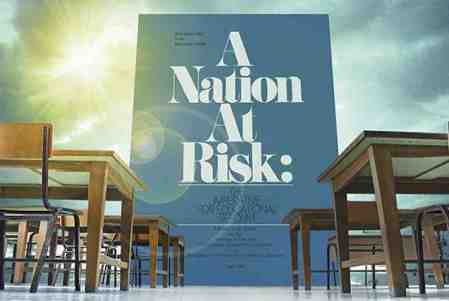
Excerpt from the Report of the Commission on Excellence in Education, A Nation at Risk, below the fold.
ae_summer2015mehta_opener-1100x736

Cover of A Nation at Risk: The Imperative for Educational Reform, the 1983 report that started the education reform mess. AFT graphic.

Stand up for your nation, it’s children and future; sound the alarm:

Add to FacebookAdd to NewsvineAdd to DiggAdd to Del.icio.usAdd to StumbleuponAdd to RedditAdd to BlinklistAdd to TwitterAdd to TechnoratiAdd to Furl


Read the rest of this entry »


Baltimore ponders where to put bust of Frank Zappa, symbol of freedom

December 29, 2009

Ending the Cold War brought no end of benefits to the U.S., including Baltimore’s little civic problem:  Where should Baltimore put a bust of Frank Zappa, donated by Lithuanians to his birth city in honor of his standing for freedom?

Frank Zappa bust, donated by Lithuanians, to City of Baltimore - Baltimore Sun photo

Striking bust of Frank Zappa donated to the City of Baltimore by Lithuanians, in honor of Zappa's representing freedom to Lithuanians during the Cold War

More than a year ago, Baltimore accepted a bust of Baltimore native Frank Zappa. Valued at $50,000, the bust was a gift from a Lithuanian Zappa fan club.

Since then, officials have been debating where to put it.

Why Zappa?  Why Baltimore?

His family lived in the 4600 block of Park Heights Ave., then moved to Edgewood in Harford County. Zappa’s father, a chemist and mathematician, had a job nearby at Aberdeen Proving Ground. They moved to California when Frank was 10.

Until they met last night, some members of the Baltimore Public Art Commission, which voted unanimously to accept the gift of the bronze sculpture – valued at about $50,000 – were also unaware of Zappa’s connection to Charm City.

However, the donors of the bust, who come from much farther afield – in fact, from a nation Zappa never visited – are well aware of his background.

“We’re honored to have a chance to present this Frank Zappa monument to the city of Baltimore,” said Saulius Paukstys, 43, the president of one of the biggest and arguably most dedicated Frank Zappa fan clubs in, of all places, the Republic of Lithuania. “As an artist, and much more than that, he has meant a great deal to the Lithuanian people.”

If Zappa has been something of an unknown prophet in his own land, people like Paukstys, a photographer, have long held him in high regard as a symbol of free expression in the post-Cold War former Soviet bloc.

“Before 1990, you have to remember, [Lithuanians] could not criticize society,” Paukstys said through an interpreter. “Frank Zappa was a voice of freedom.”

After 1990, when Western music became available in their home country, Paukstys and friends like Saulius Pilinkus, an art historian, often gathered to listen to Zappa’s music. The fan club they started eventually numbered more than 300. Most were well-educated aesthetes who appreciated the fact that Zappa was more than a rock-and-roll star: He was a symphonic composer, a fact that appealed to a people whose love of classical music is part of their history.

Zappa’s followers number in the millions in the U.S.  People who don’t see eye-to-eye on much of anything else agree on Zappa’s genius.  Even old sobersides California Judge Ben Davidian is a Zappa fan.  (He was especially fond of Zappa’s deeply philosophical question about a Salt Lake City fan’s letter:  “Suzy Creamcheese, what’s gotten into you?”)

Zappa’s bust will be one more very good reason to visit Baltimore, in addition to crab cakes, Babe Ruth’s house, the C&O Museum and Sabatino’s.


20 years ago, the Berlin Wall fell – reverse domino effect

November 9, 2009

High school sophomores in Texas study world history, and juniors study U.S. history. At 16 and 17 years old, they have difficulty figuring out the fuss over the Berlin Wall. It’s just pictures in their textbook.

The Wall was already three or four years gone when they were born. They don’t remember living with the Soviet Union at all — it’s been Russia to them for their entire lives.

I have some hopes that the celebrations set for this week will aid their understanding, on the 20th anniversary of the breaching and destruction of the wall.

Dominoes set for celebration of the Berlin Wall's destruction.  AP photo by Herbert Knosowski, via Canadian Broadcast System

Caption from CBC: "Dominoes are placed where the Berlin Wall once stood in front of the Brandenburg Gate in the German capital. (Herbert Knosowski/Associated Press)"

An enormous line of giant dominoes is set up along the line where the old wall stood — to be toppled on November 9, the anniversary of the official breaching of the wall.

It’s the “domino theory” in reverse.

About 1,000 plastic foam dominoes will fall to the ground Monday along the route where the Berlin Wall once stood to mark the 20th anniversary of the crumbling of the Cold War barrier.

The 2.3-metre-high blocks, painted by schoolchildren, stretch for 1.5 kilometres in a path near the Brandenburg Gate and the German parliament.

Former Polish leader Lech Walesa, whose pro-democracy movement Solidarity played a key role in ending communism in Eastern Europe, will tip the first domino at 8 p.m. local time.

I made one visit to the wall, late on a night in 1988.  American Airlines explored the possibility of taking over the service authorized from Munich to Berlin.  Soviet and East German rules required passenger flights to stay at a very uncomfortable 10,000 feet.  Pan Am had the route, but Pan Am was in trouble.  We spent a day with Berlin airport authorities and real estate agents trying to figure out how to set up a reservations office and other ground facilities.  European airports tended to force foreign carriers to share gate facilities, which was a problem, and we devoted a lot of time to gathering data for computer lines.

But then, after a smashing dinner of sausage and German-style potatoes in a great, small Berlin pub, we talked our taxi driver into giving us a tour of the wall.  He drove a spot near the Brandenburg gate, and there on a chain link fence keeping westerners from the wall were eight fresh wreaths.  Eight people had died trying to cross from East Berlin to West Berlin in the previous six months.  One wreath for each death.

Just over a year later, the Berlin Wall itself would be gone.

West Berlin acted much like a normal, western European city.  But the wall was there as a constant reminder of the oppression on the other side, a dull fog to constantly dim even the sunniest day.

Old posts on the Berlin Wall here at the bathtub are suddenly popular — usually they get a lot of hits after March when U.S. schools get to the post-World War II era, the Cold War and the Berlin airlift.  I imagine the current popularity has something to do with the anniversary.

I hope somebody has some great video of the dominoes toppling.

Dominoes acerbicly note the irony:  While the U.S. feared nations would fall under communism in a “domino effect,” especially in Southeast Asia (Indochina), communism broke up in a domino effect, as one communist-dominated country after another found freedom near the end of the Cold War.  Why has no one done a serious essay on the domino effect of freedom?

More news and resources:

Famous sign warning visitors leaving West Berlin

A sign of old times, now unneeded

Viral dominoes: Help spread the news:

Add to FacebookAdd to NewsvineAdd to DiggAdd to Del.icio.usAdd to StumbleuponAdd to RedditAdd to BlinklistAdd to TwitterAdd to TechnoratiAdd to Furl


Ideas are incombustible: Banned Books Week 2009

September 22, 2009

Banned Books Week 2009 is set for September 26 through October 3.

Which banned book will you read just to poke the eye of the censors, and to wave the flag of freedom and liberty?

Ellen Hopkins wrote several controversial books, including Burned which is out of favor in Pocatello, Idaho, close to my birthplace.*  She has written a Banned Books Week Manifesto, which she recites in the video.  You can read an interview with Ms. Hopkins at the site of the National Coalition Against Censorship (NCAC).

___________________

*  Does Millard Fillmore’s Bathtub have any readers in Pocatello?  Pocatello readers:  Do you know of anyplace you can get a copy of Burned to read, in Pocatello?

Banned Books Week resources:

Encourage others to read banned books, too:

Add to FacebookAdd to NewsvineAdd to DiggAdd to Del.icio.usAdd to StumbleuponAdd to RedditAdd to BlinklistAdd to TwitterAdd to TechnoratiAdd to Furl


El Grito de Dolores, September 16 (2009 edition)

September 16, 2009

An encore post, repeated:

No, Cinco de Mayo is not Mexico’s “Independence Day.”

It’s amazing what is not available on video for use in the classroom.

Texas kids have to study the “Grito de Dolores” in the 7th grade – the “Cry from Dolores” in one translation, or the “Cry of Pain” in another (puns in Spanish! Do kids get it?). Father Miguel Hidalgo y Castillo made the speech on September 16, 1810, upon the news that Spanish authorities had learned of his conspiracy to revolt for independence. The revolution had been planned for December 8, but Hidalgo decided it had to start early.

This date is celebrated in Mexico as Independence Day. Traditionally the President of Mexico issues an update on the Grito, after the original bell that Father Hidalgo used is rung, near midnight.

Hidalgo himself was captured by the Spanish in 1811, and executed.

Father Hidalgo issues the Grito

Statue of Father Hidalgo in Dolores, Mexico.

It’s a great story. It’s a good speech, what little we have of it (Hidalgo used no text, and we work from remembered versions).

Why isn’t there a good 10- to 15-minute video on the thing for classroom use? Get a good actor to do the speech, it could be a hit. Where is the video when we need it?

Update for 2008: Glimmerings of hope on the video front:  Amateur videos on YouTube provide some of the sense of what goes on in modern celebrations.

And, see this re-enactment from Monterrey:

Update for 2009: The Library of Congress’s Wise Guide for September features the history of the day:

The Grito de Dolores (“Cry of/from Dolores”) was the battle cry of the Mexican War of Independence, uttered on September 16, 1810, by Miguel Hidalgo y Costilla, a Roman Catholic priest from the small town of Dolores, near Guanajuato, Mexico.

“My Children, a new dispensation comes to us today…Will you free yourselves? Will you recover the lands stolen 300 years ago from your forefathers by the hated Spaniards? We must act at once.”

Although many mistakenly attribute the Cinco de Mayo holiday as the celebration of Mexican independence, Sept. 16 was the day the enthusiastic Indian and mestizo congregation of Hidalgo’s small Dolores parish church took up arms and began their fight for freedom against Spain.

Touring Turn-of-the-Century America: Photographs from the Detroit Publishing Company, 1880-1920” has a rich collection of photographs of Mexico. To view these pictures, search the collection on “Mexico.”

Portals to the World contains selective links providing authoritative, in-depth information about the nations and other areas of the world. Resources on Mexico include information on the country’s history, religion, culture and society to name a few.

September is also a notable month for Hispanic culture with the celebration of Hispanic Heritage Month Sept 15 – Oct. 15. Sept. 15 is significant because it is the anniversary of independence for Latin American countries Costa Rica, El Salvador, Guatemala, Honduras and Nicaragua. In addition to Mexico’s independence day on Sept. 16, Chile recognizes its independence day Sept.18. Also, Columbus Day or Día de la Raza, which is Oct. 12, falls within this 30-day period.

The theme for the 2009 Hispanic Heritage Month is “Embracing the Fierce Urgency of Now!” To coincide with the celebration, the Library and several partners present a website honoring Hispanic culture and people.

Viva la república! Viva el Cura Hidalgo! Una página de Gloria, TITLE TRANSLATION: Long live the republic! Long live Father Hidalgo! A page of glory. Between 1890 and 1913. Prints and Photographs Division. Reproduction Information: Reproduction Nos.: LC-USZ62-98851 (b&w film copy neg.), LC-DIG-ppmsc-04595 (digital file from original, recto), LC-DIG-ppmsc-04596 (digital file from original, verso); Call No.: PGA - Vanegas, no. 123 (C size) [P&P] Catalog Record: http://hdl.loc.gov/loc.pnp/ppmsc.04595A street in Guanajuato, Mexico. Between 1880 and 1897. Prints and Photographs Division. Reproduction Information: Reproduction No.: LC-D418-8481 (b&w glass neg.); Call No.: LC-D418-8481 <P&P>[P&P] Catalog Record: http://hdl.loc.gov/loc.pnp/det.4a27131

Specifically on the Grito de Dolores, see the Library of Congress’s American Memory Project:

Cry of Dolores

My Children, a new dispensation comes to us today…Will you free yourselves? Will you recover the lands stolen three hundred years ago from your forefathers by the hated Spaniards? We must act at once.Cry of Dolores, attributed to Father Miguel Hidalgo y Costilla, September 16, 1810.

The Palace from the Cathedral, city of Mexico
The [National] Palace from the Cathedral, city of Mexico,
William Henry Jackson, photographer,
between 1880 and 1897.
Touring Turn-of-the-Century America: Photographs from the Detroit Publishing Company, 1880-1920

Early on the morning of September 16, 1810, Father Miguel Hidalgo y Costilla summoned the largely Indian and mestizo congregation of his small Dolores parish church and urged them to take up arms and fight for Mexico’s independence from Spain. His El Grito de Dolores, or Cry of Dolores, which was spoken—not written—is commemorated on September 16 as Mexican Independence Day.

Father Hidalgo was born into a moderately wealthy family in the city of Guanajuato, northwest of Mexico City, in 1753. He attended the Jesuit College of San Francisco Javier, received a bachelor’s degree from the University of Mexico in 1774, and was ordained into the priesthood in 1778. He soon earned the enmity of the authorities, however, by openly challenging both church doctrine and aspects of Spanish rule by developing Mexican agriculture and industry.

In 1803, Hidalgo accepted the curacy of the small parish of Dolores, not far from his native city of Guanajuato. Between 1803 and 1810, he directed most of his energy to improving the economic prospects of his parishioners. He also joined the Academia Literaria, a committee seeking Mexico’s independence from Spain.

Guanajuato, Mexico
Guanajuato, Mexico,
William Henry Jackson, photographer,
between 1880 and 1897.
Touring Turn-of-the-Century America: Photographs from the Detroit Publishing Company, 1880-1920

In September 1810, Spanish authorities learned of the group’s plot to incite a rebellion. On September 13, they searched the home of Emeterio González in the city of Queretaro where they found a large supply of weapons and ammunition. Warned of his impending arrest, Hidalgo preempted authorities by issuing the El Grito de Dolores on the morning of September 16. Attracting enthusiastic support from the Indian and mestizo population, he and his band of supporters moved toward the town of San Miguel.

The rebel army encountered its first serious resistance at Guanajuato. After a fierce battle that took the lives of more than 500 Spaniards and 2,200 Indians, the rebels won the city. By October, the rebel army, now 80,000 strong, was close to taking Mexico City. Hidalgo, fearful of unleashing the army on the capital city, hesitated, then retreated to the north. He was captured in Texas, then still a part of the Spanish empire, and executed by firing squad on July 31, 1811. After ten more years of fighting, a weakened and divided Mexico finally won independence from Spain with the signing of the Treaty of Córdoba on August 24, 1821.

Learn more about Mexico:

Resources, other material:

Share this bit of history:

Add to FacebookAdd to NewsvineAdd to DiggAdd to Del.icio.usAdd to StumbleuponAdd to RedditAdd to BlinklistAdd to TwitterAdd to TechnoratiAdd to Furl
