History on the hoof: Richardson in North Korea

April 10, 2007

New Mexico Gov. Bill Richardson, taking time out from his trailing presidential campaign to try to get remains of American soldiers from North Korea, appears to have won an agreement from North Korea to stop production of nuclear weapons.

1. Praise to the Bush administration for making necessary arrangements on financing.

2. Can we send Richardson to Iraq, Iran, Syria and Palestine? Soon?

More seriously, this is a key bit of history in process. High school teachers woud do well to watch newspapers over the next few days to gather stories which will reveal background from the Korean War, foreign policy history going back at least 30 years, and stories about nuclear proliferation which may come in handy for several years before textbooks can catch up.

Somewhere the ghost of Lloyd Bucher is smiling, I think.


Chief victim of global warming today: The U.S.

April 3, 2007

The Earth Policy Institute looks at numbers of people running from the effects of global warming and concludes that the U.S. has more global warming refugees than any other nation today, ironically. The U.S. is also the largest emitter of greenhouse gases blamed for the human component of global warming.

EPI estimates at least 250,000 people fled New Orleans and surrounding areas after Hurricane Katrina, in the single largest migration prompted by the effects of global warming.

In a press release, EPI’s president Lester R. Brown said:

Those of us who track the effects of global warming had assumed that the first large flow of climate refugees would likely be in the South Pacific with the abandonment of Tuvalu or other low-lying islands. We were wrong. The first massive movement of climate refugees has been that of people away from the Gulf Coast of the United States.

Hurricane Katrina, which made landfall in late August 2005, forced a million people from New Orleans and the small towns on the Mississippi and Louisiana coasts to move inland either within state or to neighboring states, such as Texas and Arkansas. Although nearly all planned to return, many have not.

Financial markets act as if global warming is a fact, even with a few deniers still hanging on and the Bush administration’s not moving very fast as if it were concerned: Insurance companies refuse to issue new policies for homes for people living in certain hurricane-prone areas.

The market has spoken: Global warming is a problem we need to act against.

Tip of the old scrub brush to Stolen Moments: A green digest.


Geography learning, on-line

March 22, 2007

Do your students have access to computers?

Test Your Geography Knowledge may seem a little elementary; alas — or maybe “hooray!” — it goes over exactly the sort of simple stuff I find too many high school students don’t have:  Basic political geography.   It beats Microsoft’s solitaire for in-class timewasting.  (This is a show-off site for a programmer and company, Lizard Point; look at other stuff at the site, and think of what you can do with it.)

That site has a link to Quiz School.  On-line quizzes, that you invent, that you can put into your classroom weblog — wonderful idea.  What can you do with this tool?  (It wouldn’t hurt you at all to post links to your quizzes here, would it?)

Back to geography:  You’ll also want to check out Sheppard Software, and the collection of geography games there.  The variety of games is quite outstanding — I even found one related to forestry.

Tip of the old scrub brush to SSBG’s blogroll.


Quote of the moment: W. C. Lowdermilk, soil erosion

March 20, 2007

Soil erosion in Virginia, photo by W. C. Lowdermilk

Soil erosion in Virginia, photo by W. C. Lowdermilk “Figure 15. — A formerly productive field in Virginia that has been cut to pieces by gully erosion. About 50 million acres of good farm land in the United States have been ruined for further practical cultivation by similar types of erosion.”


From Conquest of the Land through 7,000 Years, by W. C. Lowdermilk, its first director, a soil conservation publication of the U.S. Soil Conservation Service, first issued in about 1939:

When in Palestine in 1939, I pondered the problems of the use of the land through the ages. I wondered if Moses, when he was inspired to deliver the Ten Commandments to the Israelites in the Desert to establish man’s relationship to his Creator and his fellow men — if Moses had foreseen what was to become of the Promised Land after 3,000 years and what was to become of hundreds of millions of acres of once good lands such as I have seen in China, Korea, North Africa, the Near East, and in our own fair land of America — if Moses had foreseen what suicidal agriculture would do to the land of the holy earth — might not have been inspired to deliver another Commandment to establish man’s relation to the earth and to complete man’s trinity of responsibilities to his Creator, to his fellow men, and to the holy earth.

When invited to broadcast a talk on soil conservation in Jerusalem in June 1939, I gave for the first time what has been called an “Eleventh Commandment,” as follows: Thou shalt inherit the Holy Earth as a faithful steward, conserving its resources and productivity from generation to generation. Thou shalt safeguard thy fields from soil erosion, thy living waters from drying up, thy forests from desolation, and protect thy hills from overgrazing by thy herds, that thy descendants may have abundance forever. If any shall fail in this stewardship of the land, thy fruitful fields shall become sterile stony ground and wasting gullies, and thy descendants shall decrease and live in poverty or perish from off the face of the earth.


Belgium breaking up? Who gets the beer?

January 22, 2007

Town Hall in Leuven, Belgium

Town Hall in Leuven, Belgium; image from Katholieke Universiteit Leuven

Did I really miss this last month?  A television  network in Belgium, RTBF, started out the morning reporting on the breakup of Belgium.  Rather contrary to the rules of hoaxes set up by Orson Welles and the Mercury Theatre, no mention of a dramatization was made for at least a half-hour.

And of course, it was all a hoax.  The network said they wanted to generate discussion about how Belgium works, etc., etc.   Not everyone was happy with the kickoff to discussion.

I have no particular dog in that fight, though I’m fond of Belgium.  My wife spent a year studying in Louvin (Louvain, Leuven) (before I knew her), and we have wonderful photos.  My own business trip to Brussells was less than 24 hours, though we conducted our business in lightning fashion and were able to spend the evening in a wonderfully lit historic square sampling several brands of beer — okay, many brands.  We all made it to the Oh-Dark-thirty airplane home the next morning (some in better shape than others).

It’s always an eye-opener to learn how little most people know about the country, though it plays a huge role in the European Union, in NATO, and in the history of the 20th century, especially World Wars I and II.

Now it appears even Belgians don’t know whether their nation would break up or not.  Jacques Brel is no longer alive and well.

More:


Free Inconvenient Truth for teachers

December 23, 2006

    Update: As of February 11, 2007, all 50,000 free copies have been given away. You may register for other giveaways and contests of Participate.net

.

Participate.net is giving away 50,000 copies of the movie on climate change, An Inconvenient Truth.

First 50,000 teachers who ask. Go here: http://www.participate.net/educators/pub_files/ait-block_dvd.jpg

One more way Al Gore is ahead of his time.


Ranan Lurie cartoon competition: Sabat, African tsunami

December 22, 2006

Most readers here are from the United States. I wager you didn’t see this cartoon when it was first published:

"Tsunami," by Alberto Sabat, La Nacion in Argentina. Winner of the Lurie-UN Cartoon award, 2007.

“Tsunami,” by Alberto Sabat, La Nacion in Argentina

This cartoon won the 2006 Ranan Lurie Award for editorial cartooning, an international competition supported by the United Nations Correspondents Association (other 2006 winners here). The title of the cartoon is “African Tsunami.”

The cartoonist is Alberto Sabat, the cartoon was published in La Nacion in Argentina. The award is named after the outstanding cartoonist Ranan Lurie, who himself was once nominated for a Nobel Peace Prize for his cartoons that promoted peace and understanding.

Political cartoons make classrooms interesting, and often provoke students to think hard and talk a lot about things they should be thinking and talking about. These links provide more sources of classroom material — please remember to note copyright information.

Tip of the old scrub brush to Reclaiming Space.

Update, December 2007: 2007 Lurie Awards announced; my post here, all the 2007 winners at the Lurie Awards site here.

Update, December 2008:  2008 awards post.

Update December 2009:  2009 awards listed here.

Share this post:

Add to FacebookAdd to NewsvineAdd to DiggAdd to Del.icio.usAdd to StumbleuponAdd to RedditAdd to BlinklistAdd to TwitterAdd to TechnoratiAdd to Furl


“Man dancing”: Checking the facts

December 2, 2006

If you haven’t seen it, you may be in a minority that includes mostly people without internet access.

The story behind it is rather innocent and charming. Matt Harding, a young American computer programmer working in Australia, decided to spend a year touring the world. Somewhere along the line he got the idea to shoot video of himself dancing in various places. He posted in on YouTube. A chewing gum company saw the thing, and for reasons known only to public relations freaks and geniuses, called Matt to do it again, with better production quality, for a bit of publicity. So there are two videos of Matt Harding dancing, in exotic and interesting places.

Especially if this is new to you, you’re skeptical. Good. Kempton’s Blog was similarly skeptical, and did some research on the video, and on Matt.

Is there a lesson plan in here for history and other social studies? I think so. This can go directly to the issue of how we know what we know, and what are primary and secondary sources for history, as tested in Texas’s Assessment of Knowledge and Skills (TAKS).

There are several ways to use these videos, when I sit down to think about them for a moment, listed below the fold. Read the rest of this entry »


Colorado flag flap update

August 26, 2006

Update, August 28:  Interesting discussion at The Education Wonks.

The 7th grade world geography teacher in Lakewood, Colorado, Eric Hamlin, reached a compromise agreement with the school district over the display of foreign flags in his classroom, according to a couple of reports I heard last night after I posted on the controversy.  The World, a co-production of BBC, Public Radio International and WGBH in Boston, carried a thorough report, in audio.

But then he decided to resign from the school anyway, according to Matthew Rothschild at the online ProgressiveDenver Post columnist Jim Spencer added a few details, including the very temporary way the flags were mounted (the Colorado law bans “permanent” displays).  Lots of comments, including the text of the law, at Reason.com’s Hit and Run. (I have the complete text of the law below the fold.)

It would be difficult to write parody like this. Read the rest of this entry »


Flagging enthusiam in Colorado

August 25, 2006

One wishes this were a Dave Barry column, but of course, it’s not.  It’s a report from Denver’s Channel 7 news, the ABC affiliate.

A middle school teacher in Lakewood, Colorado, has been suspended for hanging flags in the world geography room.  They were the flags of Mexico and China. 

No kidding.  Colorado has a law against “permanent” display of foreign flags.  I write it off to mass Dobson disease.

“Under state law, foreign flags can only be in the classroom because it’s tied to the curriculum. And the principal looked at the curriculum, talked to the teacher, and found that there was really no curriculum coming up in the next few weeks that supported those flags being in the classroom,” said Jeffco Public Schools spokeswoman Lynn Setzer.

But Hamlin said although his curriculum may not speak specifically about those flags, they are used as reference tools for world geography.

“It’s much along the lines of a science teacher who puts up a map of the solar system. They may not spend every day and every lesson talking about Mars, but they want the students to see that and to see the patterns of the planets and the order, and the students will observe that and absorb that learning visually,” Hamlin said.

It’s a silly law, unjustly applied in this case.  Pray for sanity to come back to Colorado.

(Tip o’ the backscrub brush to Flashpoint.)


Berlin Wall’s 45th

August 13, 2006

August 13, 2006, is the 45th “anniversary” of the erection of the Berlin Wall, the totem of the Cold War that came down in 1989, pushing the end of the Cold War. Residents of Berlin awoke on this day in 1961 to find the communist government of East Germany erecting what would become a 96-mile wall around the “western quarters” of the city — not so much to lay siege to the westerners (that had been tried in 1948, frustrated by the Berlin Airlift) as to keep easterners from “defecting” to the West. The Brandenburg Gate was closed on August 14, and all crossing points were closed on August 26.

From 1961 through 1991 1989, teachers could use the Berlin wall as a simple and clear symbol for the differences between the communist Eastern Bloc, the Soviet Union and her satellite states, and the free West, which included most of the land mass of Germany, England, France, Italy, the United States and other free-market nations — the North Atlantic Treaty Organization (NATO) countries. I suspect most high school kids today know very little about the Wall, why it was there, and what its destruction meant, politically.

This era of history is generally neglected in high school. Many courses fail to go past World War II; in many courses the Cold War is in the curriculum sequenced after the ACT, SAT and state graduation examinations, so students and teachers have tuned out.

But the Wall certain had a sense of drama to it that should make for good lessons. When I visited the wall, in early 1988, late at night, there were eight fresh wreaths honoring eight people who had died trying to cross the Wall in the previous few weeks (in some places it was really a series of walls with space in between to make it easier for the East German guards to shoot people trying to escape) — it’s an image I never forget. Within a year after that, East Germans could travel through Hungary to visit the West, and many “forgot” to return. Within 18 months the wall itself was breached.

The Wall was a great backdrop for speeches, too — President John F. Kennedy visited Berlin in June 1963, and expressed his solidarity with the walled-in people of both West and East Berlin, with the memorable phrase, “Ich bin ein Berliner, which produced astounding cheers from the tens of thousands who came to hear him. There are a few German-to-English translators who argue that some of the reaction was due to the fact that “Berliner” is also an idiomatic phrase in Berlin for a bakery confection like a jelly doughnut — so Kennedy’s words were a double entendre that could mean either “I am a citizen of Berlin,” or “I am a jelly doughnut.”  [Be sure to see the comments below, from Vince Treacy (9/28/2010).]  Ronald Reagan went to the same place Kennedy spoke to the Berlin Wall, too, to the Brandenburg Gate, in his famous June 1987 speech which included a plea to the Soviet Union’s Premier Mikhail Gorbachev: “Mr. Gorbachev, tear down this wall!”
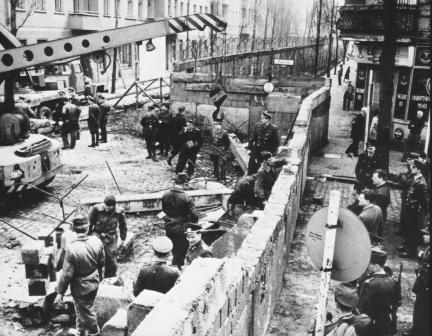
Construction of the Berlin Wall, photol collected by Corey S. Hatch

Construction of the Berlin Wall in August 1961 –photo from University of Utah, by Corey Hatch.

Update March 9, 2007: Berlin Airlift information and lesson plans are available from the Truman Library, here, here and here.

Update November 9, 2009: Notes on the 20th anniversary of the fall of the Wall

Please share this post:

Add to FacebookAdd to NewsvineAdd to DiggAdd to Del.icio.usAdd to StumbleuponAdd to RedditAdd to BlinklistAdd to TwitterAdd to TechnoratiAdd to Furl


Vouchering to Gomorrah

August 5, 2006

Libertarian-bent lawyer Tim Sandefur posts this note at Panda’s Thumb:

Neal McCulskey of the Cato Institute and Matthew Yglesias of The American Prospect have a debate going over whether school choice programs would help resolve the evolution/creationism controversy. Here’s McCulskey’s first post, Yglesias’ reply, and McCulskey’s rebuttal.

Vouchers. Parental choice is an issue across the curriculum, but it is especially poignant in sex education, biology, and history. In those three areas there are national movements to direct curricula, some of the movements in each area based on a great deal of misinformation and disinformation.

Read the rest of this entry »


Applied history

July 31, 2006

Here’s a profession where history reading is a critical skill:

Robert Young writes down the measurements recorded by state-of-the-art digital equipment held by survey party chief Barry Brown.

Photo by J. G. Domke, special to Ft. Worth Star-Telegram.

Caption: Robert Young writes down the measurements recorded by state-of-the-art digital equipment held by survey party chief Barry Brown.

See excerpts of the story, about George Washington’s profession, below the fold.

Read the rest of this entry »


Buck Snort (Back from the Wilderness)

July 16, 2006

I’m back from Tennessee, and I see the world moved on nicely while I was out of electronic communication range.

Does anyone know how Buck Snort, Tennessee, got its name? (It’s at exit 152 of Interstate 40.)