Meanwhile, in the evolution debates, where we find the Mother of All Denialism . . .

June 29, 2011

Other fronts in the War on Education may have earned more attention here in the Bathtub, lately — and in state legislatures.  Threats from the dilution and elimination of good, hard science courses continue to pose problems, especially from creationists and their shyer, camouflage troops from the Chapel of Intelligent Design.

We need to stay aware of the creationist/creationism threat.  At its heart, creationism requires adherents to reject the facts of science, to reject the workings of science, and to reject the functions of debate about what is real, and what is not.  It is to me a rather simple discussion of the quality of evidence.

Eugenie Scott and her colleagues from the National Center for Science Education provide a great update in what is going on, with a great video, and an informative and troubling explanation of the links between creationism and the “unbelievers” in climate change.

Be sure to watch the first ten minutes, to see the video update on the fight to keep good science education in schools, especially the teaching of evolution.


Blame global warming for wild weather? NASA says, “Blame La Nada”

June 27, 2011

Here’s what NASA said:

What’s to Blame for Wild Weather? “La Nada”

Such sheets of fire, such bursts of horrid thunder,
Such groans of roaring wind and rain, I never
Remember to have heard; man’s nature cannot carry
The affliction nor the fear
… from Shakespeare’s Tragedy of King Lear

June 21, 2011: Record snowfall, killer tornadoes, devastating floods: There’s no doubt about it. Since Dec. 2010, the weather in the USA has been positively wild. But why?

Some recent news reports have attributed the phenomenon to an extreme “La Niña,” a band of cold water stretching across the Pacific Ocean with global repercussions for climate and weather. But NASA climatologist Bill Patzert names a different suspect: “La Nada.”

“La Niña was strong in December,” he says. “But back in January it pulled a disappearing act and left us with nothing – La Nada – to constrain the jet stream. Like an unruly teenager, the jet stream took advantage of the newfound freedom–and the results were disastrous.”

Wild Weather (La Nina, 558px)

The blue and purple band in this satellite image of the Pacific Ocean traces the cool waters of the La Niña phenomenon in December 2010. (from Ocean Surface Topography Mission (OSTM)/Jason-2 satellite, Credit: NASA JPL)

La Niña and El Niño are opposite extremes of a great Pacific oscillation. Every 2 to 7 years, surface waters across the equatorial Pacific warm up (El Niño) and then they cool down again (La Niña). Each condition has its own distinct effects on weather.

The winter of 2010 began with La Niña conditions taking hold. A “normal” La Niña would have pushed the jet stream northward, pushing cold arctic air (one of the ingredients of severe weather) away from the lower US. But this La Niña petered out quickly, and no El Niño rose up to replace it. The jet stream was free to misbehave.

“By mid-January 2011, La Niña weakened rapidly and by mid-February it was ‘adios La Niña,’ allowing the jet stream to meander wildly around the US. Consequently the weather pattern became dominated by strong outbreaks of frigid polar air, producing blizzards across the West, Upper Midwest, and northeast US.”1

The situation lingered into spring — and things got ugly. Russell Schneider, Director of the NOAA-NWS Storm Prediction Center, explains:

“First, very strong winds out of the south carrying warm, moist air from the Gulf of Mexico met cold jet stream winds racing in from the west. Stacking these two air masses on top of each other created the degree of instability that fuels intense thunderstorms.”

Extreme contrasts in wind speeds and directions of the upper and lower atmosphere transformed ordinary thunderstorms into long-lived rotating supercells capable of producing violent tornadoes.2

Wild Weather (La Nada, 558px)

This satellite image, taken in April 2011, reveals La Niña’s rapid exit from the equator near the US coast. The cool (false-color blue) water was gone by early spring. (from Ocean Surface Topography Mission (OSTM)/Jason-2 satellite, Credit: NASA JPL)

In Patzert’s words, “The jet stream — on steroids — acted as an atmospheric mix master, causing tornadoes to explode across Dixie and Tornado Alleys, and even into Massachusetts.”

All this because of a flaky La Niña?

“La Niña and El Niño affect the atmosphere’s energy balance because they determine the location of warm water in the Pacific, and that in turn determines where huge clusters of tropical thunderstorms form,” explains Schneider. “These storms are the main energy source from the tropics influencing the large scale pattern of the jet stream that flows through the US.”

In agreement with Patzert, he notes that the very strong and active jet stream across the lower US in April “may have been related to the weakening La Niña conditions observed over the tropical Pacific.”

And of course there’s this million dollar question: “Does any research point to climate change as a cause of this wild weather?”

“Global warming is certainly happening,” asserts Patzert, “but we can’t discount global warming or blame it for the 2011 tornado season. We just don’t know … Yet.”3

What will happen next? And please don’t say, “La Nada.”

Author: Dauna Coulter | Editor: Dr. Tony Phillips | Credit: Science@NASA

End Notes

(1) Other atmospheric factors also contributed to the inflow of frigid polar air, says Patzert. One of the most significant was a weakening in the whirlpool motion of the air around the North Pole. As a result of this weakening, more cold air flowed away from the pole and down toward the states. Climatologists call this an “arctic oscillation.”

(2) Imagine a paddle wheel oriented like a Ferris wheel and placed in winds that that are much stronger at the top than at the bottom. The wheel will spin in the direction of the strong winds above. This spring, these strong, turning winds led to ongoing rotation of the supercells themselves. So we ended up with intense rotation and updraft close to Earth’s surface — conditions ripe for strong tornadoes.

(3) On May 26, 2011, Patzert posted a comment about this topic on Andrew Revkin’s The New York Times’ DOT EARTH Blog, “Demography, Design, Atom Bombs and Tornado Deaths.” See comment 6 at this URL.

Looks to me as if the people at NASA are saying we should go slow, and not rush to blame our weather woes on climate change. Climate change “skeptics” should be so skeptical.


Annals of global warming: Al Gore didn’t invent it, Isaac Asimov explained in 1989

June 8, 2011

Amber Jenkins wrote over at NASA’s site:

I stumbled upon this video earlier today. It’s Isaac Asimov, famous science fiction writer and biochemist, talking about global warming — back in January 1989. If you change the coloring of the video, the facial hair style, and switch out Asimov for someone else, the video could pretty much have been made today.

Asimov was giving the keynote address at the first annual meeting of The Humanist Institute. “They wanted me to pick out the most important scientific event of 1988. And I really thought that the most important scientific event of 1988 will only be recognized sometime in the future when you get a little perspective.”

What he was talking about was the greenhouse effect, which, he goes on to explain, is “the story everyone started talking about [in 1988], just because there was a hot summer and a drought.” (Sound familiar, letting individual weather events drive talk of whether the Earth’s long-term climate is heating up or cooling down??)

The greenhouse effect explains how certain heat-trapping (a.k.a. “greenhouse”) gases in our atmosphere keep our planet warm, by trapping infrared rays that Earth would otherwise reflect back out into space. The natural greenhouse effect makes Earth habitable — without our atmosphere acting like an electric blanket, the surface of the earth would be about 30 degrees Celsius cooler than it is now.

The problem comes in when humans tinker with this natural state of affairs. Our burning of fossil fuels (coal, oil and gas) constantly pumps out carbon dioxide — a heat-trapping gas — into the atmosphere. Our cutting down of forests reduces the number of trees there are to soak up some of this extra carbon dioxide. All in all, our atmosphere and planet heats up, (by about 0.6 degrees Celsius since the Industrial Revolution) with the electric blanket getting gradually thicker around us.

“I have been talking about the greenhouse effect for 20 years at least,” says Asimov in the video. “And there are other people who have talked about it before I did. I didn’t invent it.” As we’ve stressed here recently, global warming, and the idea that humans can change the climate, is not new.

As one blogger notes, Asimov’s words are as relevant today as they were in 1989. “It’s almost like nothing has happened in all this time.” Except that Isaac Asimov has come and gone, and the climate change he spoke of is continuing.

Asimov’s full speech can be seen here.

Scientists have been on the job that long, yes.  Al Gore didn’t invent global warming or climate change, contrary to the working beliefs of much of the “no human warming” crowd.

One of the commenters at Jenkins’ blog put things in perspective:

Jim
January 8, 2011 – 10:22 PST

Interestingly, 1988 was
• the last year that we were not in ecological overshoot
• the last year we were at 350 Parts per million CO2
• the publication date of Joseph Tainter’s he Collapse of Complex Societies http://intersci.ss.uci.edu/wiki/index.php/The_Collapse_of_Complex_Societies


Quote of the moment: Why does the Clean Air Act mention “climate?” – Naomi Oreskes

June 3, 2011

From “The Invention of Lying” at the American Prospect:

This is ultimately about regulation — its’ about the proper role of government — and what we’re seeing in Congress right now is nothing new. We saw it back in the Newt Gingrich years. It’s about gutting the regulatory structure of the federal government and the main agenda now is to gut the EPA. The Supreme Court ruled very clearly that the EPA does have legal authority — not just authority, legal responsibility — to regulate carbon dioxide under the Clean Air Act.

You know, no journalist has ever asked me why the Clean Air Act, signed in 1973, mentions climate.

Q:  Why does the Clean Air Act mention climate?

Thank you. Because people already knew back in the 1960s that pollution could change the climate.

– Naomi Oreskes to Robert S. Eshelman, “The Invention of Lying,” The American Prospect, June 3, 2011


LA Times on the Texas drought

May 29, 2011

Contrary to the Warming Contrarians (WCs), Texas is still in a drought — a bad one.

Vodpod videos no longer available.

LA Times on the Texas drought, posted with vodpod

Oddly, the great story on the Texas drought that showed up in the Dallas Morning News last week, does not show up on their website.  Because this is a climate change-related issue, I think we should track it.

Tip of the old scrub brush to Michael Tobis at Only In It For The Gold.


Chronic drought complicated by chronic denialism

May 26, 2011

Which is worse:  To be in the depths of a drought, or to deny drought where it exists?

I ask the question because, as one cannot tear one’s eyes away from a train wreck about to occur, I watch Steve Goddard’s blog.  Occasionally Steve or one of his fellow travelers says something so contrary to reality or fact that I can’t resist pointing it out.

In some discussion over there, Goddard suggested that because there is above-average snowpack around Salt Lake City and in Northern Utah, Lake Powell’s decade-long struggle with extreme drought is over.  Therefore, to Goddard, global warming does not exist.

(No, I’m not really exaggerating.  Seriously.  Go look.  No one there seems to have ever had a course in logic, nor in English composition and essay writing.  If Al Gore got svelte, one suspects half the commenters there would never be able to speak again.)

It is true that this year, contrary to the past decade, snowpack is high along the Wasatch Front and in the Uinta Mountains of Utah, and in Wyoming and Colorado areas that drain into the Green and Colorado Rivers.  Consequently, forecasters say that Lake Powell may gain a few feet of depth this year.  Powell is down about 50 feet, however, and even a record snowpack won’t erase the effects of drought on the lake.  (Yeah, I know:  The Wasatch doesn’t drain into the Colorado system — it drains to the Great Salt Lake, as indeed do many of the streams that have great snowpack in Utah — so a lot of the record snowpack won’t get within 400 miles of Lake Powell.  That’s geography, and it would be one more area that commenters would embarrass themselves in.  Don’t ask the pig to sing if you aren’t going to spend the time to teach it; if you need the aphorism on teaching pigs to sing, look it up yourself.)

Since Lake Powell won’t lose a lot of elevation this year, the Goddardites (Goddardians?  Goddards?  Goddardoons?) pronounce the U.S. free of drought.

Right.

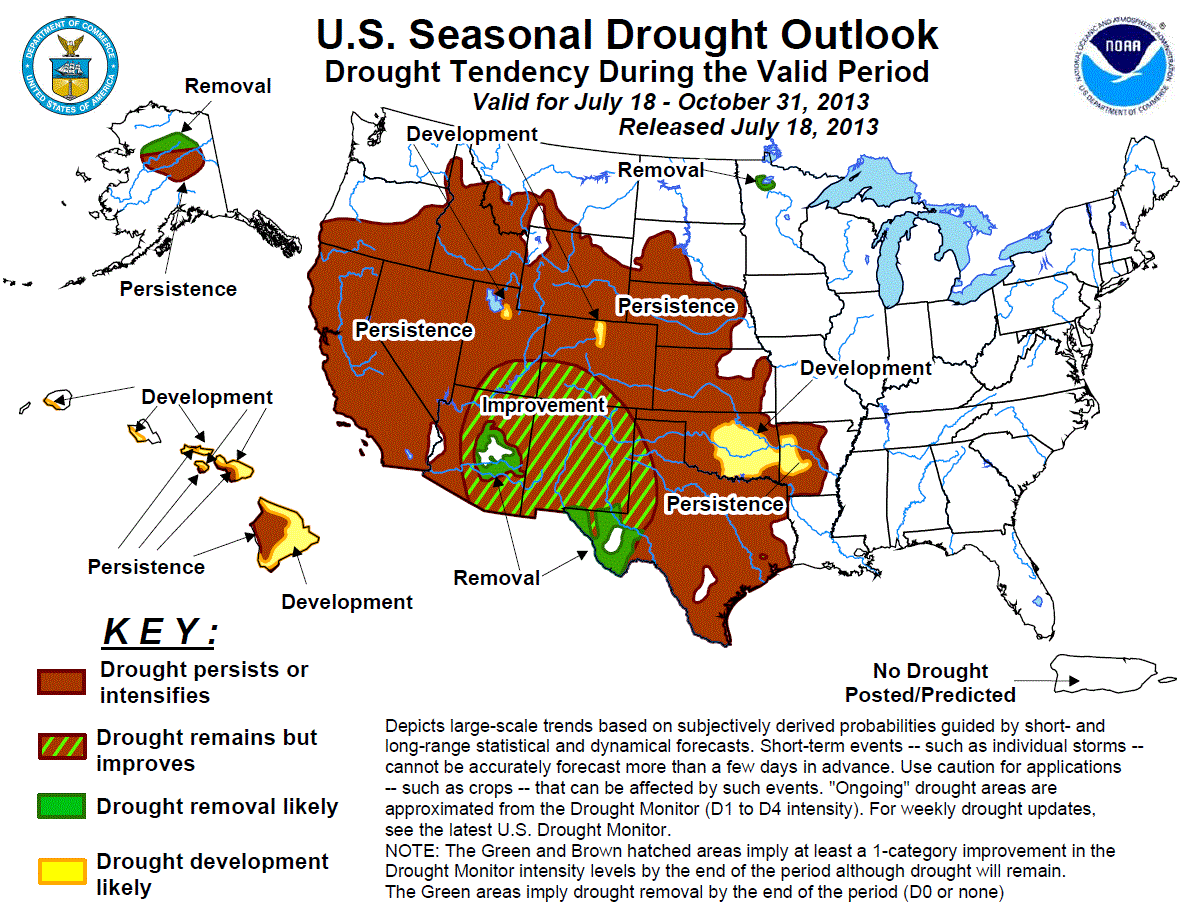
Check it out for yourself, Dear Reader.  Here’s an animation from the National Drought Center, showing drought measurements in the contiguous 48 states plus Alaska and Hawaii, over the past 12 weeks:

Drought in the U.S., 12 weeks ending May 17, 2011, National Drought Mitigation Center, U of Nebraska-Lincoln

Drought in the U.S., 12 weeks ending May 17, 2011, National Drought Mitigation Center, U of Nebraska-Lincoln - click on map for a larger version at the Drought Monitor site.

Here’s the drought outlook map from the Climate Prediction Center at NOAA:

U.S. Seasonal Drought Outlook Map, released May 19, 2011, NOAA and the Climate Prediction Center

U.S. Seasonal Drought Outlook Map, released May 19, 2011, NOAA and the Climate Prediction Center - click image for a larger version at NOAA's site.

It would be wonderful were these droughts to break soon.  But that is very unlikely.

So, why would anyone deny it?

Then, just to indicate the bait-and-switch logic these guys use, Goddard came back with a claim that the 1956 drought in Texas was worse, as if that means the current drought doesn’t exist.  Fore reasons apparent only to those whose heads get pinched by tinfoil hats, he also notes the CO2 levels for 1956.  I think I know what point he’s trying to make, but someone should tell him that apples are not oranges, and comparing apples and oranges to pomegranates doesn’t increase the supply of tennis balls.

Let’s just stick to the facts.  The experts who must operate the dams and lakes and get water to Mexico on schedule say the drought along the Colorado persists.  Who are we to gainsay them?

Resources:  

GEOSat photos of Lake Powell and drought, 2000 to 2004 - Dr. Paul R. Baumann, SUNY - Oneonta College

GEOSat photos of Lake Powell and drought, 2000 to 2004 - Dr. Paul R. Baumann, SUNY - Oneonta College


Anecdotal evidence: Malaria spreads to Tanzania highlands, warming climate blamed

April 16, 2011

Here’s one story that critics of science and scientists who study global warming will try to avoid mentioning:  Malaria’s spread in Tanzania appears to be due to deforestation plus a warming climate that altered historic rainfall patterns.

It’s anecdotal evidence, partly.  The case reinforces the point Al Gore made in An Inconvenient Truth, that climate change can smooth the path for the spread of diseases like malaria.

Via AllAfrica.com, from The Citizen in Dar es Salaam (Sunday Citizen News):

Malaria Threatens Nation’s Highlands

Felix Mwakyembe, 6 March 2011

Opinion

Mbeya — Tanzania’s southern highlanders have long worried about pneumonia and other respiratory illnesses brought on by the cool, wet weather. But as climate change contributes to warmer temperatures in the region, residents are facing a new health threat: malaria.

In Rungwe, a highland district in the south-western Mbeya region bordering Malawi and Zambia, malaria is fast replacing coughs, fever and pneumonia as the most serious local health problem. The change has taken by surprise the region’s residents, who live over 1,000 metres (3,200 feet) above sea level and outside Tanzania’s traditional malarial zones.

Ms Asha Nsasu, 32, of Isebe village, had no idea she had contracted malaria when she was sent to Makandana District Hospital in late December. “I felt weak. I thought it was pneumonia,” Nsasu said. “Then they told me it was malaria.”

In 2009, health centres in Rungwe district reported 100,966 malaria cases, a jump of 25 per cent from 2006, hospital records show.

Malaria is now the biggest public health threat facing Rungwe district, which lies about 940 kilometres (590 miles) southwest of Dar es Salaam, according to the Tukuyu Medical Research Centre, part of the National Institute for Medical Research. One third of outpatients visiting the hospital were diagnosed with the mosquito-borne illness in 2007, according to records from that year, making it the most common disease for outpatients.

Most highland areas in Tanzania are experiencing a growing burden of malaria cases, officials at the Tukuyu Centre said. Climatic changes brought on in part by local environmental degradation are contributing to the growing prevalence of malaria in the district, said Mr Gideon Ndawala, Rungwe district’s malaria coordinator.

“People have cleared the forests, rain has decreased, temperatures have risen,” Mr Ndawala said in an interview. “(When) I first reported on the district in 1983, it was very cold and it rained throughout the year except from mid-September to early November. The weather was not favourable for mosquito breeding,” he said.

Now, however, temperatures are higher and rain more erratic, he said, and mosquito populations – which thrive on warmer temperatures and breed in pools of stagnant water – are on the rise. Worst hit by the surge in malaria are Tukuyu district town, Ikuti, Rungwe Mission and Ilolo, according to district health officials.

Half a century ago, these traditionally cool areas saw no mosquitoes and did not register any malaria cases, but now the weather is warmer, said Mr Ambakisye Mwakatobe, a 76-year-old man from Bulyaga village in Rungwe.

“In the past, we never saw mosquito nets here. I saw a net for the first time at the age of 20, when I joined Butimba Teachers College in 1957,” he said, in an interview at his village home.

Mzee Mwakatobe said cases of malaria began to appear several decades ago but residents did not relate them to warming temperatures, believing the mosquitoes instead were arriving on buses from lower regions.

“It was in the 1970s when we started getting malaria here. I thought it was the buses from Kyela and Usangu that brought mosquitoes,” he admitted. But “the weather also started to change in those years,” he said.

A half-century ago, “it was very cold here and it rained throughout the year. Three things were compulsory: a sweater, pullover or heavy jacket; an umbrella or raincoat; and gumboots,” he added. “There was frost all day long and cars had to put their lights on.

“But today things have changed,” he said. “Look, now we even put on light shirts. There is no need for sweaters, gumboots or umbrellas.”

Scientists agree that the changing weather is feeding into Rungwe’s worsening malaria problem.

“Up until 1960, districts like Rungwe, Mbeya, Mufindi, Njombe, Makete and Iringa in the southern highland regions were malaria free. Today is quite different – malaria prevalence is high,” said Mr Akili Kalinga, a research scientist at Tukuyu Medical Research Centre.

Malaria accounts for 30 per cent of the burden of disease in Tanzania and is a huge drain on productivity, according to a report produced by research scientists for the Sixth Africa Malaria Day in 2006. In response to the rising malaria caseload, the government is taking steps to stem the disease’s expansion.

Measures include public health education in newly vulnerable districts on home cleanliness and water storage, how to eliminate the places of still water where mosquitoes live and breed, and the use of mosquito nets and fumigation, said Dr Sungwa Ndagabwene, Rungwe’s medical officer.

“The government is taking serious measures to fight malaria. We started with a ‘mosquito nets for all’ campaign – saying every person should sleep under bed nets,” Mr Ndagabwene said.

The government also has begun spraying the inside of homes with insecticide, first in the Kagera Region and now throughout the Lake zone, near Lake Victoria, he said. It plans to expand the spraying programme, which has helped cut malaria transmission in Zanzibar, to the rest of the Tanzania’s malaria-affected regions.

Such spraying programmes aim to kill mosquitoes that land on the inside walls of homes. Spraying can protect homes for between four to ten months depending on the insecticide, according to the World Health Organisation (WHO).

WHO has approved 12 insecticides it considers safe for such spraying programmes, including DDT – a controversial endocrine disruptor that has proved one of the most effective ways to control mosquito populations but that has also been linked to environmental damage and health problems including cancer.

Mr Ndagabwene said spraying the chemical only indoors limited its environmental impact. WHO officials have said they believe the benefits of using the pesticide outweigh its risks. The Stockholm Convention bans the use of DDT but exempts countries that choose to use the chemical to control malaria.

Tanzania is one of the world’s worst malaria-affected countries, recording 14 to 18 million clinical cases annually and 60,000 deaths, 80 per cent of them in children under five years old, according to a 2010 malaria reduction plan put together by USAID.

Children under five and pregnant women are most affected by the disease, official health figures show. (AlertNet)

The author is a freelance writer based in Dar es Salaam

More:


More wisdom: From Burlington, Vermont, grassroots ideas on fighting global warming

April 10, 2011

Another local newspaper op-ed, this time from Burlington, Vermont (yeah, I know — a Gannett paper — still, smaller than Dallas). This comes from the March 4 edition of the Burlington Free Press’s “I Believe” series:

I Believe: ‘We have a responsibility to learn about climate change

by Joan Knight

“If politicians remain at loggerheads, citizens must lead.”
— Dr. James E. Hansen, physicist, director of NASA Goddard Institute

I was impressed when I attended a recent meeting with a group of volunteer activists forming a Vermont chapter of the Citizens Climate Lobby. This group is different, I thought. It might actually work. As a newly retired 72-year-old, I was looking for a new focus, and found it.

Religious groups use the word “creation.” Most people say “nature.” Academics speak of global ecology. Deep ecologists who view Earth as one living being say “Gaia,” in reverential tones, meaning our planet and its atmosphere is a living “body.” Its “cells” include us humans, plants, forests, microbes. All life is tied together by dynamic, interdependent relationships. Most native peoples sense that all beings are like sisters and brothers — members of the same family.

I understand. It started for me as a young child with what Rachel Carlson called a sense of wonder. Grasses back-lit by the setting sun; starfish in tide pools crawling about among colorful mats of living plants and fungi. It was a more spiritual experience than was going to church under parental orders. Nature really mattered.

Growing older, I revered the writing of Rachel Carson, David Brower, John Muir, Aldo Leopold, Wendell Berry and so many more. I still feel abiding love for it all. I believe in Earth as a planetary living being.

It is clear that our family of All Beings is suffering.

Climate change. Global warming. Is it real? Is it a problem? Why are the changes happening? There is controversy about the answers to these questions. The collapse of climate and energy legislation last year in Congress was a relief to some in big business.

Natural laws or physics and chemistry are in action. The climate is warming faster than it ever has. Weather patterns are strange and tragic. Species are becoming extinct. Predictions of the end of nature (Bill McKibben’s 1984 book title) are common now. What if the scientists are right? We don’t need all the answers to figure out that something awful is going on.

Can we slow down the rate of change? Yes. Can we stop the climate from warming too much? It’s not likely, but I believe we must try. Should we let it happen while we enjoy our greenhouse-gas-producing lifestyles? Some family members deny the reality that their loved one has a serious illness and is likely to die prematurely. We humans have an interesting default to denial. This does happen. Might some of us, similarly, deny that our planet is critically ill?

Most of us agree that conservation of energy and resources is good for us and for the environment. We are changing our personal lifestyles. We have changed our light bulbs to compact fluorescents; we vacation closer to home; we’re working to improve the efficiency of our buildings.

Many of us also become members of environmental organizations. We read their magazines, put in bird feeders to enjoy nature, donate money and sign petitions in the attempt to show our legislators how we would like them to vote. Here in Vermont, we even talk with state legislators and are proud we are the “green state” — cherishing our remaining cows in pastoral landscapes and our forests for both wildlife and recreation. We’re thankful our delegation to the Congress “gets it.”

There are many grassroots activists successfully influencing lawmakers on a town and state level. But we know that states tend to make changes in laws and budgets in response to constraints brought on by federal legislation and financing. Are there ways to really influence federal representatives and senators? Paid lobbyists do it on a massive scale. Money speaks. But what about us?

The Citizens Climate Lobby believes in an approach by which ordinary people influence the federal “deciders” enough to sometimes change their votes. The influential people take the trouble to learn about and appreciate some things an individual legislator has done, seek to discover common ground, listen respectfully and talk in a collaborative way. After discovering what information would be relevant, they come back to provide it. In this comfortable way of relating, ordinary people do make a difference.

As citizens of this country we have a responsibility to learn about climate change, solutions and how to take part in the democratic process. We can sit down for a conversation and tell our legislators what we care about and why. We can write letters. It’s really our job as citizens to share these thoughts with our legislators, if we ever hope to be truly represented by them.

That’s where the new Citizens’ Climate Lobby comes in. The group gives us the tools we need. There is a monthly conference call with a leading thinker who will help keep us informed of the latest issues, and an opportunity to practice speaking with each other about those issues. We work together to help our legislators hear the non-confrontational message: We want a healthy planet for our kids and grandkids.

If I dare to step forward to lobby my representative, I want to learn how, to practice, to feel supported by kindred spirits, to know it’s OK to make mistakes and keep on gaining new knowledge and skills. I’m up for it. And I hope many of you will consider joining us as we begin making our voices heard where it matters most.

Check out the Citizens Climate Lobby website, and get information about how to join in on the next national conference call. This one will be focused on messaging — the importance of context and delivery. This organization seeks to empower each of us to have breakthroughs in our personal power, to be heard and to be counted. It feels good to be a part of a supportive web of passionate citizens.

Join us. Talk with an active member on the phone, go to the website (www.citizensclimatelobby.org), find the lobby on Facebook.

It’s not too late to make a difference. We have been lazy in hoping someone else would do the right thing, that sending a check to an organization and signing an online petition was enough. It’s time for folks, including myself, to step up and be heard.

Real grass roots politics, from a woman concerned enough about the issue to think historically, and to read broadly about it.

Citizenship is wonderful to behold, when it is practiced so nobly and elegantly.

What else might we learn, if we really listened to the people?

Citizens Climate Lobby masthead

Masthead for the home page of Citizens Climate Lobby - click to see


Only in small towns, where leaders have time to think . . .

April 7, 2011

Years ago when I staffed a U.S. senator’s office, one of my tasks was to look through all the weekly newspapers in the state.    Back then subscriptions were cheap, and most senators would take out a subscription to these weeklies more to flatter the editors and publishers than to read.  We put them to use, first checking to see whether the clipping services were getting all the clips (mostly), and then on a hunch, to see what issues were raging in the state, well below the radar of the big city daily newspapers and broadcast outlets.

You can learn a lot.

Many of those old weekly newspapers are gone, now, victims to local populations that turn over in every recession, and to electronic news gathering services — and to general alienation:  People are not so sure they want to know what their neighbors are up to, these days.  Heck, many people aren’t sure they want to know their neighbors.

My own electronic news gatherers occasionally pull out something to think about from a minor news outlet.  For example, below is an opinion piece out of the Carrboro Citizen from Dan Coleman, a member of the town council in Carrboro, North Carolina.  I gather from the paper it is rather close to Chapel Hill, the home of the University of North Carolina (I haven’t checked a map).

But look at what this guy says.  He questions the wisdom of Adam Smith.  Adam Smith! It appears Coleman wasn’t led astray by all those Adam Smith neckties that were so popular in the Reagan administration.  He questions the true need for profits from corporations, and he wonders if there isn’t a higher duty for a corporation.

How many others like Dan Coleman are there, out there in America, relatively sane on all other accounts, and thinking?

How many bottom lines do we really need?

April 7, 2011 | Posted in: Opinion | 0 Responses

By Dan Coleman

Did you know that Carrboro’s Town Code incorporates a principle devised by Shell Oil? That’s right, the same Shell Oil that has been accused of human rights violations in Nigeria, including summary execution, crimes against humanity, torture, inhumane treatment and ­collaborating in the execution of Nigerian activist Ken Saro-Wiwa. The same Shell Oil that has despoiled the Niger delta and was responsible for the largest freshwater oil spill ever.

With a record like this, it is little wonder that Shell came up with one of the corporate world’s more effective public relations concepts of recent years: the Triple Bottom Line (TBL), also known as People, Planet, Profit. It’s as if Shell was saying, sure you can criticize our environmental and humanitarian record but don’t forget, we have to make a profit.

Efforts to value people have dogged profiteering for over a century. The late 19th and early-to-mid-20th centuries were marked by many thousands of strikes by workers, more than 1,400 in the year 1886 alone. Many of these were met by violent strikebreakers backed up at times by military force. This is a struggle that continues in 2011 in Wisconsin and other states.

William Blake, Biography Online

William Blake

Through the efforts of these men and women, much of value was created: the weekend, workplace-safety standards, health care for workers, vacation and sick leave, etc. And each of these was wrested from the one bottom line that corporate America really cares about.

Despite William Blake offering the image of “dark satanic mills” as far back as 1804, the environmental impacts of industrial capitalism began to be understood with Rachel Carson’s 1962 publication of The Silent Spring. Within a decade, there was Earth Day, the Environmental Protection Agency, the Clean Water Act and much more, each a challenge to the profit-focused priorities of capital.

Given the pre-eminent importance of profit-maximization, it is not surprising that corporations touting the Triple Bottom Line often oppose measures to combat global warming, oppose workers’ rights and oppose regulatory mechanisms to protect the health of people and planet.

History has taught us that Adam Smith was wrong when he offered the justification for prioritizing profit that “by pursuing his own interest [the businessman] frequently promotes that of the society more effectually than when he really intends to promote it.” If Smith were correct, companies like Shell would not have such a devastating impact on society and nature. In part, this impact results from profit being measured in a short timeframe, a year or even a quarter of a year, while sustainability requires a vision spanning, as the Iroquois put it, as much as seven generations.

But Smith was right that profit ought to serve human well-being. Therefore, it must be understood within an ethical system that places people and planet first. This holds true for the vague term “stakeholder value” that some, including Carrboro, use instead of profit. Who are the stakeholders if not people and planet?
The TBL offers nothing to help us navigate the inevitable contradictions between profit on the one hand and people/planet on the other. But, really, why should we have any social or political bottom lines at all?

It was social ecologist Murray Bookchin who bemoaned the cultural turn to the “grubby language” of the market economy, which has “replaced our most hallowed moral and spiritual expressions. We now ‘invest’ in our children, marriages, and relationships. … We live in a world of ‘trade-offs’ and we ask for the ‘bottom line’ of any emotional ‘transaction.’”

There are a variety of frameworks that speak to a more fundamental commitment to the well-being of all life. In an 1854 speech, Chief Seattle offered the notion of a web of life: “Humankind has not woven the web of life. We are but one thread within it. Whatever we do to the web, we do to ourselves.”

Aldo Leopold, in Arizona

Aldo Leopold, in Arizona, Arizona State Parks image

A century after Chief Seattle, Aldo Leopold articulated his land ethic in Sand County Almanac, “A thing is right when it tends to preserve the integrity, stability and beauty of the biotic community. It is wrong when it tends otherwise.” The biotic community, of course, includes humans.

We need the ability to truly place people and planet first and to reject the false, self-serving homilies offered by those who spread pavement and poverty in pursuit of the almighty dollar. Rather than seek simplistic nostrums, we may have to take the time to look hard at each decision, and bring a clear ethical sensibility, like that of Seattle or Leopold, to bear.

Dan Coleman is a member of the Carrboro Board of Aldermen.

Coleman may want to check the provenance of the Chief Seattle quote — but the thought is solid.

What do you think?


Annals of global warming: Records from Mauna Loa show continuing rise in atmospheric CO2

March 26, 2011

NOAA's Mauna Loa Observatory, NOAA photo, 1982, Cmdr. John Bortniak

NOAA's Mauna Loa Observatory, from NOAA At the Ends of the Earth Collection, 1982 NOAA photo by Commander John Bortniak

John Adams observed, and Ronald Reagan was fond of quoting, “Facts are stubborn things . . .”

Here are the facts on atmospheric carbon dioxide (CO2):


Monthly CO2 levels since 1960, Mauna Loa Observatory (Scripps Inst of Oceanography)

Mauna Loa Observatory, Scripps Institution of Oceanography, UCSD (University of Calfornia-San Diego); CO2 concentrations in parts per million (ppm)

As described at the Scripps Institution of Oceanography site:

Description:
Monthly average atmospheric carbon dioxide concentration versus time at Mauna Loa Observatory, Hawaii (20°N, 156°W) where CO2 concentration is in parts per million in the mole fraction (p.p.m.). The curve is a fit to the data based on a stiff spline plus a 4 harmonic fit to the seasonal cycle with a linear gain factor.

Data from Scripps CO2 Program.

For perspective, here’s a chart from Scripps that shows why there is concern over current levels of CO2:

CO2 over the past 420,000 years - Scripps Institution of Oceanography

CO2 over the past 420,000 years - Scripps Institution of Oceanography

Resources, More:


Another Brazilian wins Lurie Cartoon Award from UN Correspondents

March 20, 2011

2010’s Lurie Award Winner for cartooning was another Brazilian — as in 2007.  The subject is global warming, with a wistful look at what might happen:

Lurie Award Winner, 2010 - Raimundo Waldez Da C. Duarte in Amazonia, in Brazil

Lurie Award Winner, 2010 - Raimundo Waldez Da C. Duarte in the publication Amazonia, in Brazil

Ice continues to melt at the South Pole, alas.  How to break it to the penguins?

Cartoonist Raimundo Waldez Da C. Duarte, Amazonia, Brazil

Cartoonist Raimundo Waldez Da C. Duarte, Amazonia, Brazil

Raimundo Waldez Da C. Duarte took $10,000  from the award.  He cartoons for Amazonia in Brazil.

You may view the 1st, 2nd and 3rd place cartoons, and ten citations for excellence, at the Lurie Award site.


Is global warming/climate change a problem? Get the facts

March 15, 2011

Want solid information on climate change (global warming) and the problems it poses?

Several opportunities present themselves, from the National Academies of Science, America’s premiere science advisory group:

America’s Climate Choices Final Report in Review

The final report of the America’s Climate Choices suite of studies is in the final stages of peer review and will be released this Spring.  An official release date will be announced as soon as possible.  The report is authored by the Committee on America’s Climate Choices, which was responsible for providing overall direction, coordination, and integration of the America’s Climate Choices activities.

Related Activities at The National Academies

warming_world_cover
Warming World, a publication from the National Academies of Science

“Warming World: Impacts by Degree” Explains Findings of NRC Report

Emissions of carbon dioxide from the burning of fossil fuels have ushered in a new epoch, beginning to be called the Anthropocene, during which human activities will largely determine the evolution of Earth’s climate. That’s one of the main conclusions from Climate Stabilization Targets: Emissions, Concentrations, and Impacts over Decades to Millennia (NRC, 2011) an expert consensus report released last July and published this year.  Now a new 36-page booklet based on the report, “Warming World: Impacts by Degree” is available to help policymakers, students, and the general public better understand the report’s important conclusions.

The report concludes that, because carbon dioxide is so long-lived in the atmosphere, increases in this gas can effectively lock the Earth and many future generations in a range of impacts, some of which could be severe. Therefore, emission reduction choices made today matter in determining impacts that will be experienced not just over the next few decades, but also into the coming centuries and millennia.  Policy choices can be informed by recent advances in climate science that show the relationships among increasing carbon dioxide, global warming, related physical changes, and resulting impacts. The report identifies (and quantifies when possible) expected impacts per degree of warming, including those on streamflow, wildfires, crop productivity, the frequency of very hot summers, and sea-level rise and its associated risks and vulnerabilities.

Order free copies of the booklet at http://dels.nas.edu/materials/booklets/warming-world.


Report Sets Research Agenda to Study Earth’s Past Climate

Without a reduction in emissions, by the end of this century atmospheric carbon dioxide could reach levels that Earth has not experienced for more than 30 million years. Critical insights into how Earth’s atmosphere, oceans, and ecosystems would function in this high carbon dioxide environment are contained in the records of Earth’s geological past, concludes Understanding Earth’s Deep Past: Lessons for Our Climate Future, a National Research Council report from the Board on Earth Sciences that was released on March 1, 2011.

“Ancient rocks and sediments hold the only records of major, and at times rapid, transitions across climate states and offer the potential for a much better understanding of the long-term impact of climate change,” said Isabel Montañez, chair of the committee that wrote the report and a professor in the department of geology at the University of California, Davis. The research could also yield information on the tipping points for climate change–the threshold of greenhouse gas accumulation in the atmosphere at which abrupt climate change will occur.

The report sets out a research agenda for an improved understanding of Earth system processes during the transition to a warmer world. High-priority research initiatives include gaining a better understanding of the sensitivity of climate to increased atmospheric carbon dioxide, the amount of sea-level rise as the ice sheets melt, and the resilience of ecosystems to climate change.


Webinar on Transportation and Climate Change

On Thursday, March 24 from 2:00-3:00 p.m., the National Academies Transportation Research Board will host the first of a 2-part webinar series that looks the threats of climate change to transportation facilities and operations and at resources for adapting. The cost of the webinar is $109 (the webinars are free to employees of TRB sponsors). To sign up and/or to learn more, please visit http://www.trb.org/ElectronicSessions/Blurbs/164935.aspx.

Also, you can always check out the website for the Board on Atmospheric Sciences and Climate (BASC), a joint project of the National Academy of Sciences, National Academy of Engineering, Institute of Medicine, and National Research Council.


Green Hell? Milloy slanders Ruckelshaus as “mass murderer”

March 10, 2011

This week, EPA bashing took front and center on the performance stage that passes as Congress these days.  There is a school of thought that thinks EPA should be eviscerated because EPA is carrying out the mandate an earlier Congress gave it, to clean up the air.  Especially, the recent assailants claim, EPA should not try to reduce carbon emissions, because clean air might cost something.

Steven Milloy, making stuff up and passing it as fact

Steven Milloy, who makes crude and false claims against William Ruckelshaus, a great lawyer and the hero of the Saturday Night Massacre. Why does Milloy carry such a pathetic grudge?

Wholly apart from the merits, or great lack of merits to those arguments, the anti-EPA crowd is just ugly.

78-year-old William Ruckelshaus, the Hero of the Saturday Night Massacre, a distinguished lawyer and businessman, and the founding Director of EPA who was called back to clean it up after the Reagan administration scandals, granted an interview on EPA bashing to Remapping Debate, an ambitious, independent blog from the Columbia School of Journalism designed to provide information essential to policy debates that too-often gets overlooked or buried.  [Remapping Debate sent a note that they are not affiliated with CSJ; my apologies for the error.]

Ruckelshaus, as always, gave gentlemanly answers to questions about playing politics with science, and bashing good, honest and diligent government workers as a method of political discourse.

Steven Milloy, one of the great carbuncles on the face of climate debate or any science issue, assaulted Ruckelshaus at Milloy’s angry, bitter blog, Green Hell.  Milloy calls Ruckelshaus “a mass-murderer,” a clear invitation for someone to attack the man. Milloy wrote, cravenly:

He’s the 20th century’s only mass murderer to survive and thrive (as a venture capitalist) in the 21st century.

Milloy owes Ruckelshaus an apology and a complete retraction.  I rather hope Ruckelshaus sues — while Milloy will claim the standards under New York Times vs. Sullivan as a defense, because Ruckelshaus is a public figure, I think the only question a jury would have to deal with is how much malice aforethought Milloy exhibits.  Malice is obvious.  Heck, there might not even be a question for a jury — Milloy loses on the law (nothing he claims against Ruckelshaus is accurate or true in any way).

This is much more damning than what got two NPR officials to lose their jobs.

Who will stand up for justice here?  Rep. Upton?  Rep. Boehner?  Anthony Watts?

I tried to offer a correction, and since then have written Milloy demanding an apology and retraction — neither comment has surfaced yet on Milloy’s blog.  Here’s the truth Milloy hasn’t printed:

No, Sweeney did not rule that DDT is not a threat to the environment. He said quite the opposite. Sweeney wrote, in his ruling:

20. DDT can have a deleterious effect on freshwater fish and estuarine organisms when directly applied to the water.

21. DDT is used as a rodenticide. [DDT was used to kill bats in homes and office buildings; this was so effective that, coupled with accidental dosing of bats from their eating insects carrying DDT, it actually threatened to wipe out some species of bat in the southwest U.S.]

22. DDT can have an adverse effect on beneficial animals.

23. DDT is concentrated in organisms and can be transferred through food chains.

On that basis, two federal courts ruled that DDT must be taken off the market completely. Sweeney agreed with the findings of the courts precisely, but he determined that the law did not give him the power to order DDT off the market since the newly-proposed labels of the DDT manufacturers restricted use to emergency health-related tasks. With the benefit of rereading the two federal courts’ decisions, Ruckelshaus noted that the courts said the power was already in the old law, and definitely in the new law. [See, for example, EDF v. Ruckelshaus, 439 F. 2d 584 (1971)]

DDT was banned from use on crops in the U.S. as an ecosystem killer. It still is an ecosystem killer, and it still deserves to be banned.

Ruckelshaus’s order never traveled outside the U.S. DDT has never been banned in most nations of the world, and even though DDT has earned a place on the list of Dirty Dozen most dangerous pollutants, even under the Persistent Organic Pollutants Treaty of 2001, DDT is available for use to any country who wishes to use it.

Please get your facts straight.

Would you, Dear Reader,  help spread the word on Facebook, Reddit, Twitter, or any other service you have, that the Brown Lobby has gone too far in it’s error-based propaganda against clean air and those who urge a better environment?  Please?


Science ethics: Ten biggest science paper retractions of 2010

January 18, 2011

Science uses a tough system to correct errors and prevent frauds.  Peer-review makes it difficult to get a paper into a journal, period, let alone one with hoaxed-up data or conclusions.  Still, out of the tens of thousands of serious science papers published each year, a few sneak through that shouldn’t, sometimes due to researcher error, sometimes due mix-ups in peer review, sometimes — rarely — due to outright fraud.

In the past 15 months political action to fight global warming took huge hits around December 2009 when a few thousand e-mails were hacked from computers at the Hadley Climate Research Unit in England, one of the leading groups in climate research that indicates a warming Earth.   Critics of Hadley made great hay about how the alleged wrong-doing in the e-mails meant that all climate research was wrong, or at least questionable.

So, I was greatly interested to stumble across this article in The Scientist, which lists what that magazine calls the “Top Retractions of 2010” — papers retracted for errors and ethical reasons.

None of the top retractions had anything to do with climate research.  One of the most under-reported stories of 2010 was that the claims of error and fraud by climate scientists were, themselves, hoaxes.  Looking at the list of top retractions, unless you were really looking for the climate papers, you might never notice.

Most of the retractions were in medicine and health.  Several were in cancer research.  False science in climate studies does not appear to be a major problem, measured by retractions.

Those who accuse climate scientists falsely don’t really have anything to retract in a formal sense.  They did no science work that was published.

When do people wake up and realize that global warming is a real problem, and we shouldn’t be fooled by political smears of the scientists who discover the data?


Lens incompetence: Watts Up looks through the wrong end of the telescope

December 27, 2010

The wags and denialists over at Anthony Watts’ joint are up to their old tricks, accusing others of their own errors.  Today it’s a guest post by Bernie Lewin, in which he claims that climate warming was all psychological, a “scare”:

Yet we can find precedents to this science-base scare in many health scares of recent decades, and also in environmental scares since the DDT cancer scare triggered by Silent Spring, politicised by the EDF and legalized by the newly formed EPA. (See Scared to Death which finds a repeating pattern to these science-based scares.)

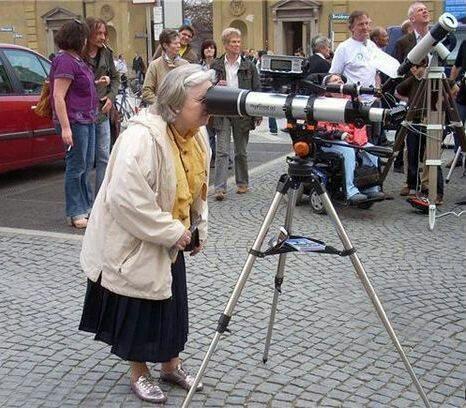
Woman looking through the wrong end of a telescope

This woman might be corrected; global warming denialists will staunchly insist she knows what she’s doing and doesn’t need YOUR advice.

He fails to even think that Rachel Carson was right.  Lewin demonstrates incompetence at history, law and science, and the first point of the Scout Law, all in one sentence.

So much error.  So little time to correct.

  1. Carson didn’t claim DDT caused cancer. She noted that we create thousands of chemicals that may cause cancer, that cancers were rising in frequency, and that there was no testing of the new substances prior to their marketing.   Was there a DDT/cancer scare?  Lewin doesn’t offer any evidence.  (We had to correct Matt Ridley on this a couple of weeks ago — see his post here.)
  2. EDF (Environmental Defense Fund, now known as Environmental Defense) was on DDT without Carson — suing to stop DDT spraying (for no good reason) on Long Island in 1968.  EDF relied on science that was courtroom ready.  (I had misremembered the year of EDF’s suit in an earlier version of this post; my apologies to the two or three who may have read it.)  EDF’s suits established, on the basis of science, that DDT is an uncontrollable poison in the wild.  Lewin ignores science and law in his off-hand indictment of Carson’s book and ED.
  3. EPA didn’t act against DDT until 1972.  EPA banned DDT use on agricultural crops in the U.S. because DDT kills non-target species and, basically, entire ecosystems.  EPA was specific:  The ban had nothing to do with cancer.  Once again, Lewin ignores history, science and law.

So, in Lewin’s guest post, we see the pattern that continues at Watts’s place — unfair and wrong indictments of science, ignorance of history, little understanding of law.

All while trying to mock scientists:  ‘Of course scientists are almost always wrong,’ Watts’s blog argues, once again.

Watts won’t let me correct his errors there, even though he’s still coddling those who misdescribe Rachel Carson as a mass murderer, while denying he does it himself.  Consequently his readers won’t be alerted to this post because Watts or his minions will edit out the automatic ping his blog gets that this post is here.  Propaganda promoting falsehood can’t stand the sunlight of fact and truth.

Just because there’s a scare doesn’t mean there’s not a reason to be scared.  DDT is a deadly toxin, so long-lived that it almost cannot ever be eradicated from the environment.  It kills everything small, quickly, unless so much of it is used that the small things evolve quickly to be resistant and immune to it.

So, if we are to assume, as Lewin wrote, that the anti-warming bunch is to warming what the campaign against Rachel Carson by the DDT manufacturers was to DDT’s harms, we get a hint of what’s really up at Watts Up:  Any anti-warming claim is a hoax.  Why put it so cryptically, if that’s what they meant to say?

When Lewin looks at the history of DDT and Rachel Carson, he’s looking at the false history, and he draws the wrong conclusions.  Should we trust a guy so sloppy with the facts to be right on anything else?