What news organizations need to know about “no-fly” zones over disaster areas

April 4, 2013

Lots of chatter around the internet today on the discovery that the Federal Aviation Agency posted a notice making the area over the oil spill in Arkansas off limits to aircraft.

Some people claimed they were certain that it was because Exxon-Mobil paid to get a special favor; others wondered why the government would be complicit in such a deal. Several of the comments linked to aerial photos of the spill, and said ‘obviously’ Exxon Mobil doesn’t want photos of the severity  of the spill to get out.  Bill McKibben’s tweet alerted me to the controversy (take a look at that video, too).

Actually, it’s common procedure to make sport flying and other unnecessary flying over disasters, off limits — FAA has a special set of regulations for that.  Rescuers and disaster fighters, and relief workers,  don’t want sight-seers on visual flight rules posing hazards to flights necessary to work on disaster relief or clean up of a spill of a toxic or hazardous substance.

But this doesn’t mean that news organizations cannot fly — in fact, there is a special regulation to ALLOW news aircraft over the zone, for photography and other reports.

Here’s the notice at FAA’s website (I’m sure that link will be unworkable in a few weeks):

FAA notification, NOTAMs notice of Mayflower, Arkansas, temporary flight restrictions; screen grab April 3, 2013.

FAA notification, NOTAMs notice of Mayflower, Arkansas, temporary flight restrictions; screen grab April 3, 2013.

Most announcements of restrictions of any public activity by a federal agency contain a notice of from where the agency draws that authority; I didn’t include it in the screen grab, but FAA notes the authority flows from Title 14 CFR section 91.137(a)(2).  That’s the Code of Federal Regulations, the set of volumes that list all the regulations the federal government has.  This was also published in the Federal Register — and I suspect the NOTAMs is also published there — but CFR is the more permanent set of books for finding government rules.

In the interests of open government, of course the FAA makes these rules available online.  They are available at several sites.  Here’s the meat of the regulation:

Section 2. Temporary Flight Restrictions in the Vicinity of Disaster/Hazard Areas (14 CFR Section 91.137)

19-2-1. PURPOSE

This section prescribes guidelines and procedures regarding the management of aircraft operations in the vicinity of disaster/hazard areas in accordance with 14 CFR Section 91.137. TFRs issued under this section are for disaster/hazard situations that warrant regulatory measures to restrict flight operations for a specified amount of airspace, on a temporary basis, in order to provide protection of persons or property in the air or on the ground.

19-2-2. RATIONALE

TFRs in accordance with 14 CFR Section 91.137 are issued when necessary to:

a. 14 CFR 91.137(a)(1) – Protect persons and property on the surface or in the air from an existing or imminent hazard associated with an incident on the surface when the presence of low flying aircraft would magnify, alter, spread, or compound that hazard.

b. 14 CFR 91.137(a)(2) – Provide a safe environment for the operation of disaster relief aircraft.

c. 14 CFR 91.137(a)(3) – Prevent an unsafe congestion of sightseeing and other aircraft above an incident or event that may generate a high degree of public interest.

NOTE-
This provision applies only to disaster/hazard incidents of limited duration that would attract an unsafe congestion of sightseeing aircraft.

Specific  rules of restrictions, who in the FAA declares them, who can grant waivers, and to who the restrictions apply, get spelled out following that  part.

Notice that, generally, these restrictions apply only to flights below 1,000 feet.  A good camera in a television station’s helicopter can get a lot of great shots from 1,000 feet out (three football fields) — this is a distance often seen in the videos of police car chases.  So it’s not a complete ban.

Savvy news organizations will know how to get news photos using the specific exemption for news aircraft, with procedures spelled out so the FAA knows it’s a news gathering operation; I’ve put the critical clauses in red:

c. Section 91.137(a)(3). Restrictions issued in accordance with this section prohibit all aircraft from operating in the designated area unless at least one of the following conditions is met:

1. The operation is conducted directly to or from an airport within the area, or is necessitated by the impracticability of VFR flight above or around the area due to weather or terrain, and the operation is not conducted for the purpose of observing the incident or event. Notification must be given to the ATC facility that was specified in the NOTAM for coordination with the official in charge of the activity.

2. The aircraft is operating under an ATC approved IFR flight plan.

3. The aircraft is carrying incident or event personnel, or law enforcement officials.

4. The aircraft is carrying properly accredited news representatives and, prior to entering that area, a flight plan is filed with FSS or the ATC facility specified in the NOTAM. Flight plans must include aircraft identification, type, and color; radio frequencies to be used; proposed times of entry to and exit from the TFR area; the name of news media or organization and purpose of flight.

Well-run news organizations already know this; in an age when more and more news rooms operate on a shoe string, it may be that this information about how to cover disasters is not passed along in the newsroom, though.  So I’m reposting it here, so you’ll know, so news organizations now, so environmental reporters can get a copy of the regulations  to carry with them when they head out to cover spills, fires, floods, and other disasters.

I’m waiting, too.  It’s only a matter of time until somebody figures out a local kid has a good radio control helicopter, and it can carry a GoPro camera; or until a local news station invests in a news-gathering drone.  Here in Texas, we’ve already had one environmental disaster uncovered by a drone operated by a guy just checking on real estate.

If you see some footage of the disaster filmed on or after April 3, would you let us know, in comments?

And spread the word to any reporters you know.

More:

Amateur video of the spill:


I get email (sorta): How long could U.S. survive without a president?

March 31, 2013

A brilliant and vexing former student, Bryan Sabillon, asked a question — on Facebook:

Remember how you said America can’t go two hours without a president? What’s the worst that can happen if it just so happens to take three-four hours? Or is it uneventful?

Interesting question — to me, at least, and maybe even to Bryan.  Here’s my response, with a few links added:

Did I say that? (Some context would be nice. No I don’t remember saying that.)

Technically, can’t happen now with the 25th Amendment and succession laws; if a president dies, another is there, probably without regard to swearing in.

A few historical examples suggest no big problem; these are nullified if missiles are in the air at that moment, though:

1. When Tyler succeeded Harrison 1 (first death of president in office), John Tyler was more than 24 hours out of Washington. Worse, many people thought that while the duties of the president fell to the VP under the Constitution, that should be a temporary condition settled by a special election. Despite all this uncertainty, nothing bad happened in the interim.

U.S. Sen. David Rice Atchison, from Missouri; photo by Matthew Brady

U.S. Sen. David Rice Atchison, from Missouri; photo taken by photographer Mathew Brady at the United States Capitol at Washington, D.C., March 1849. Courtesy of the Beinecke Rare Book & Manuscript Library, Yale University, via Wikipedia. Photo taken the same month some say Atchison was acting President, for one day.

2. On March 4, 1849, [James K.] Polk’s term expired. But it was Sunday, and incoming Pres. Zachary Taylor refused to be inaugurated on Sunday. So did incoming VP Millard Fillmore. Some argue that David Rice Atchison, the President Pro Tempore of the Senate and then-third in line for the presidency under the laws then existing, was president for one day. He didn’t claim that, but in any case, spent most of the day sleeping, as the outgoing Senate had been working late for several previous nights. Some argue that because the Senate had adjourned sine die on its last session, not even Atchison was president. In any case, nothing happened.

President of the Senate Vice President Chester...

Official Senate bust, President of the Senate, Vice President Chester A. Arthur (it’s a bust; he was not really that pallid) Photo from Wikipedia

3. When [James] Garfield was shot, he did not die immediately, but hung on for more than a month before infection took him. Vice President Chester A. Arthur did not assume duties of president, nor did anyone else, in that period. A lot of stuff got delayed, but no big deal. Government continued during the long dying process, and until Arthur was sworn in.

4. Similarly, when [William] McKinley was shot, they thought he’d survive. VP Teddy Roosevelt took off to hunt in the Adirondacks. When McKinley took a turn for the worse, guides had to be dispatched to find Teddy climbing a mountain (Mt. Marcy); by the time he got to Buffalo, McKinley had been dead for several hours. Nothing of consequence happened as a result of there being no president on hand (and they were in Buffalo, New York, not Washington, anyway).

5. Woodrow Wilson suffered a stroke on October 2, 1919, that left him blind in one eye and unable to walk. He was kept out of the presence of the VP and cabinet for months; when he finally returned to cabinet meetings in 1920, he was clearly unable to function as president. It’s an interesting case with his second wife essentially taking over the office under the guise of intermediary and care giver to the president. This one may have had some consequences – the Senate never did ratify the Treaty of Versailles, for which Wilson was campaigning when he was stricken, and so the U.S. never joined the League of Nations, dooming it to failure years later as World War II erupted. But perhaps Wilson couldn’t have gotten it ratified had he been fully active, anyway. Perhaps Wilson could have influenced the election of 1920, which Warren G. Harding won (who would die of a heart attack in San Francisco, making Calvin Coolidge president). But all of that is pure conjecture.

6. The funniest (in retrospect) was when Ronald Reagan was shot. At a press conference at the White House as Reagan was being prepped for surgery, a reporter asked some cabinet officials “who is in charge?” Perhaps reacting too much to the question as a challenge to whether the government was leaderless and vulnerable, Secretary of State Al Haig grabbed the microphone and said “I’m in charge here!” In reality, Vice President George H. W. Bush was in full communication mode of the modern presidency; control of the “football,” the nuclear strike code case which accompanies the president at all times, could have been an issue, but was not.

President Obama waving

President Obama at an airport; the Marine in the background looks to be carrying the “nuclear football.” Photo from Cryptome (Is this an AP photo? Anyone know?)

Under the 25th Amendment and the Succession Act, it’s difficult to imagine how the U.S. could be without a president at any time; the confusion around the death or disability of a president offers a window of a de facto gap, but that should last only minutes under the procedures and precautions now in effect (some of which we saw on 9/11).

Worst that could happen now? If missiles were incoming, and confusion over who has control of the football went on for more than 10 minutes, a retaliatory strike could be late in getting launched. It takes about 15 minutes for intercontinental ballistic missiles to get to their downward path, or to register on known radar, so a ten minute delay might be encouraging to a Russia that hoped to knock out the U.S. before a retaliatory strike could occur; but that’s probably not realistic. And, even that would be of no great consequence if the secret “missile net” many people think the U.S. has, actually exists.

Is this a class question, or are you involved in some odd drinking game again?

(Update:  Sheesh.  Turns out he just saw “Olympus Has Fallen,” and wondered.

Everyone knows we’re really safe, so long as Morgan Freeman is anywhere near the presidency, even Speaker of the House.)

(Anyone else seen the movie?  Is it a scenario not already contemplated under the 25th Amendment?)

More:

Voice of America video on Al Haig’s life, featuring the famous quote:


“Return to Madison,” urges James Madison U president on the great man’s birthday

March 22, 2013

What would Madison do?

James Madison’s work, not only on the Constitution, but on making the Constitution and new government work, and on creating the foundation pilings for that Constitution and society, should make his words and ideas key points of study for us, and his principles should be our guiding principles much more than they are today.

Madison is the forgotten founder, I’ve argued.

JMU President J. R. Alger and others present wreaths at tomb of James Madison, March 16, 2013 (Madison's birthday)

JMU press release caption: JMU President Jon Alger, second from left, presents a wreath at the tomb of President James Madison in honor of his 262nd birthday.

James Madison University President Jon Alger spoke at the ceremonies honoring Madison’s birthday last Saturday, March 16, at Madison’s mountain home, Montpelier, Virginia (a few miles from Jefferson’s Monticello).  In his speech, Alger urged a return to civility in discussion of politics, a return to focus on important ideas and the processes by which we discuss them, and make decisions in our national government.

Alger’s remarks deserve a much wider audience, I think.  I asked JMU for a copy, and they pointed to the university’s website where the entire speech is posted.  I repost it here.  Please spread the word.

Jon Alger’s Montpelier remarks

President Jonathan R. Alger
James Madison University
Remarks on the Occasion of James Madison’s 262nd Birthday
March 16, 2013
at James Madison’s Gravesite, Montpelier
Orange, Virginia
(Remarks interrupted by rain)

Good afternoon.  Honored guests, members of the Montpelier Board of Directors, President Imhoff and Montpelier staff, members of the James Madison University Board of Visitors, faculty, students and alumni, family, friends and fellow Madison enthusiasts, it is my great honor to speak at this hallowed place.  On this day 262 years ago, James Madison was born.  Perhaps more so than any other president or founder, James Madison is responsible for the creation and miraculous endurance of our republic.  Known as the Father of the U.S. Constitution, James Madison’s contributions to our nation should be remembered by every American.  The sacred fire of liberty lit by Madison’s ideas burns to this day and draws us here to honor him.

I came to Montpelier for the first time only a few months ago.  As a great admirer of James Madison, to me the trip here felt like a pilgrimage.  When the mansion first came into view as we made our way up the long sweeping drive, I was struck by the majesty of the moment—as we feel when in the presence of greatness.  During that visit, Montpelier board president Greg May invited me to speak at this annual event as we strode down a pathway that Madison himself must have walked many times.  I could not have been more honored.

Indeed, this is a dream come true for me.  As a political science major and history minor in college, I read many of the same texts Madison himself studied—as well as some of Madison’s own work.  Even as a young child, I admired the creative genius of our forefathers.  While other kids had stuffed animals or model airplanes displayed in their bedrooms, on my dresser I proudly exhibited a set of small ceramic statues of the American presidents.  I like to root for underdogs and was always partial to Madison, because his was the shortest statue.  Today his picture hangs proudly in my office.

As many of you know, Montpelier and James Madison University have long had a special bond.  It began when Dr. Clarence Geier, an archaeologist at Madison, arranged an archaeology field school here at Montpelier more than 25 years ago.  Our students and faculty have been coming to Montpelier ever since and have participated in digs all across the grounds. (Except for right here, of course.  They are not allowed to dig in this particular area.  You never know with undergraduates!)

From then the relationship between our two institutions has blossomed.  This past November a bus containing JMU faculty, staff and me – as well as my wife Mary Ann and daughter Eleanor – came here to spend a day brainstorming with the Montpelier leadership and staff on ways to deepen our relationship even further. The primary objective of this deeper relationship is to bring more attention to James Madison and his ideas.  This objective reflects the missions of our two great institutions, but it must go beyond those gathered here today.  As a nation, we are in great need of what I will call a Return to Madison.

It is true that, during the past few years, more and more American citizens are professing respect for the U.S. Constitution.  The document was read on the floor of the U.S. House of Representatives for only the second time in history this past January.  In fact, Representative Bob Goodlatte of Virginia’s Sixth District – JMU’s district – opened the reading with a delivery of the document’s Preamble.  That’s a good start, but as a nation we must go much further.  For this newfound reverence toward the U.S. Constitution to elevate us as a nation, we must explore and gain a deeper understanding of the principles on which the U.S. Constitution is based.  We must Return to Madison.

Now, by suggesting this return, I don’t mean that we become a nation of history buffs (although that would be OK with me).  Rather, a Return to Madison would provide us with very real and practical insights into how we as a society should confront issues facing us all.

Starting with a realistic view of human nature, Madison believed that politics was driven by “interest,” not by “virtue.”  In his excellent work, The Sacred Fire of Liberty, Madison scholar Lance Banning captured this core principle.  He wrote, “Madison did not assume that a republic could depend upon a superhuman readiness to sacrifice self-interest to the common good. Taking humans for the interested, opinionated creatures they are, Madison asserted that in a pluralistic, large republic, partial interests would be counterbalanced by competing interests.”

This was not new political thinking, of course.  During the 16th century in Florence, Machiavelli (whose work was more nuanced than is often remembered today) explored what he called the “effectual truth” of politics.  In other words, as Paul Rahe writes in his book, Machiavelli’s Liberal Republican Legacy, “[I]n order to avoid their ruin and achieve their preservation, men should govern themselves in accordance with how they do behave rather than in the distorting light of how they ought to.”

So Madison’s great innovation was to devise a system of government that sought to create political and civic conditions allowing the interests of individual citizens, groups, regions and other entities to balance one another so that no one of them could overtake the rest.  He recognized that we would be a society with diverse perspectives and experiences, and that we needed a structure to allow that diversity to flourish.

Today – while publicly professing faith in the Constitution as a document – we seem to have forgotten this essential element.  Far too often, our public discourse on the important challenges of our time degenerates into shallow shouting matches and name-calling in which we cry for the elimination of opposing views on political, social, economic and cultural issues. The people we despise across the political aisle, the fools on the television spouting their ridiculously wrongheaded opinions, the heathens who believe in a different god than we do – we not only hold them in utter contempt, we behave as if we want their ideas extinguished.  And if they were extinguished – oh, if only they were extinguished – we believe the world would be a better place.  If only we all agreed on everything – wouldn’t that be great!  Yet we must be careful what we wish for.  If that kind of wish were to come true, not only would our lives be much more boring—but our society would stop progressing and stagnate.

A Return to Madison would shine a light on the fact that the strength of our republic relies on the existence of opposing ideas and perspectives.  Voices who advocate for Wall Street and others who focus on Main Street?  They need each other.  Republicans and Democrats need each other.  Without the diversity of ideas and opinions, our civic balance would tilt and our system eventually would topple.  The great man we honor today knew this was true.  We as a society need to embrace this notion and continue debating the important issues of the day, but with reason and civility—not with hatred and hopes for total domination.  We need each other.  And I believe that spreading the understanding that our great Constitution is based squarely on this principle could lead to greater social harmony.  Boy, do we need a Return to Madison.

Madison’s Federalist 10 is recognized the world over as one of the great examples of political thought in history.  You might remember that Madison published the Federalist with Alexander Hamilton and John Jay in newspapers while the states were considering whether to ratify the proposed Constitution.  Of these 85 essays, Madison’s 10th is widely considered to be one of the best, and it’s about balancing competing interests.  I love it for the philosophy it expresses, but also because it contains one of his most elegant turns of a phrase.  If you’ve read much Madison, you know that his writing can be (to be honest) dense and elliptical.  He is not often quoted in today’s sound-bite culture.  But in the Federalist 10 he wrote, “liberty is to faction what air is to fire…”  Think about that for a moment.  “Liberty is to faction, what air is to fire…”  Madison was making the point that liberty creates a nourishing environment for faction.  At the time, great fear existed that too much liberty could lead to dangerous factions emerging.  Madison was resolute, however, and he completes the idea by writing, “But it could not be a less folly to abolish liberty, which is essential to political life, because it nourishes faction, than it would be to wish the annihilation of air, which is essential to animal life, because it imparts to fire its destructive agency.”

Madison is saying that even though liberty allows faction to thrive, it should not be curtailed.  He goes on to observe, “As long as the reason of man continues fallible, and he is at liberty to exercise it, different opinions will be formed.”

Thus even as Madison advocated for liberty despite its dangers, he was sure to remind his Federalist readers that man’s passionately held views are imperfect.  Therefore, if we claim to respect our Constitution and if we understand this fundamental premise, we have a responsibility to change the tone of much of our civic dialogue.  Now, to be clear, I am not arguing that we should hold our views any less dear.  Passion leads great people to act. And I am not suggesting that we all adopt a relativist perspective – right and wrong do exist.  As enlightened as Madison and his colleagues were for their time on so many issues, for example, even they were unable to come to grips with the tragic injustice of slavery

If Madison were here today, however, I believe he would remind us of our human limitations when we encounter and react to opinions that differ from our own.  We can all benefit from trying to listen to and understand the views of others with civility and respect, even as we hold and espouse our own cherished points of view.  As the president of the university named for James Madison, I feel strongly that our institution of higher education can best honor his legacy by embracing the diversity of perspectives and backgrounds in our society, while fostering and modeling civil and respectful discourse on the great issues of our time.  That is part of the reason why I began my own presidency with a “Listening Tour” to hear, and learn from, the richly diverse voices and opinions of our university community.

In my inaugural address yesterday at the university, I called for James Madison University to be the national model for the engaged university—an institution that combines a commitment to teaching and learning with a conviction that all humans are interconnected.  This combination embodies James Madison’s ideals.  If we enlighten ourselves through education and believe that we all are connected – even with those with whom we might passionately disagree – we honor Madison.  I intend for this idea to be a hallmark of my administration at JMU.

Another hallmark will be to continue deepening the relationship between the university and Montpelier.  Some of the ideas generated during our visit here in November already are taking shape.  For instance, staff in our department of History and our Adult Degree Program are working with faculty here in the Center for the Constitution to create a course about James Madison and his ideas that includes online and in-person instruction, as well as visits here. The course will be available to JMU students and the general public.  As we celebrated Madison Week on our campus these past few days, Montpelier has honored our university by loaning us several artifacts from its own collection.  These exchanges are reminders of the man to whom we owe so much.  Our educational initiatives can go a long way to motivate those who profess their faith in the U.S. Constitution to deepen their understanding of its underlying principles, and thus inspire a Return to Madison.

Let me share with you a personal story of my own heightened sense of Madison’s, and Montpelier’s, significance.  While inside the house, I was surprised by how moved I was when I sat in the modest room that is believed to be Madison’s study.  The thought that I was in the very room where James Madison read Machiavelli and Locke and Montesquieu and all the others; the room where he synthesized thousands of years of thinking into a framework for our most important founding document; the room looking west toward unsettled lands of great promise; the room in which James Madison addressed civilization’s most intractable problem – how to govern ourselves – I was filled with a sense of wonder and awe.

Yet another way in which the university will connect with Montpelier and its legacy will be to honor the memory of Dolley Madison, the great woman buried beside our 4th President.  Dolley was herself an intellectual and social force who played a profound leadership role by convening people of different backgrounds for civil discourse.  In fact, Yale University historian Catherine Allgor wrote, “Dolley’s assumption that compromise would be the salvation of the system marks her as one of the most sophisticated politicians of her time.”  Through a new initiative called Women for Madison, our university will celebrate the vital role women play in leadership and cultivating a culture of philanthropy.

Finally, as an advocate of education and an ardent student himself, I believe Madison would have enjoyed meeting today’s students who benefit from his legacy in this free and civil society.  I wonder how he would have felt meeting students attending the university named for him. We have several with us today – can you come and join me here?

As many of you know, JMU has a robust study abroad program. I will tour several of our study abroad programs this summer for the first time as president, and my second stop will be Florence, the great city where republican thought reemerged during the 16th century.  Machiavelli was the most influential Florentine political thinker of that time, and his work influenced Madison greatly.  In fact, Machiavelli appears in one of James Madison’s adolescent “commonplace” books.  A commonplace book was like an academic diary.  Students during the era when Madison grew up dutifully filled their commonplace books with notes, quotations and poetry.

Students of our era – such as these fine students – and I will visit Machiavelli’s gravesite at the Basilica di Santa Croce in central Florence this summer. We will take with us the moving experience of being here at James Madison’s gravesite, and reflect on the republican ideal with which both men—and so many other people throughout history—have grappled.  It is quite fitting that students attending a university named for James Madison make this journey, connect these two places and contemplate their meaning.

With this symbolic gesture, we hope to inspire all the students of James Madison University, the visitors to James Madison’s Montpelier and all who bear witness, to Return to Madison.  Let’s go from this ceremony with a renewed sense of our roles as citizens, and of the power we have to live the ideals James Madison handed down to us through the ages.  Thank you

Who in Congress listens?  Who in media and commentary listens?  Who in the academic life listens?

More:

Fireworks at James Madison U, at inauguration of President Jonathan R. Alger

Fireworks over James Madison University, on the inauguration of new University President Jonathan R. Alger, in early March 2013. Despite the somewhat tenuous links to this post, I like the photograph. Image from JMU’s UBeTheChange blog.


Quote of the moment repeat: Robert C. Lieberman, “Why the Rich Are Getting Richer: American Politics and the Second Gilded Age”

February 20, 2013

What? You missed this, on February 20, 2011? Well, here it is again. Please pay attention this time.

The U.S. economy appears to be coming apart at the seams.  Unemployment remains at nearly ten percent, the highest level in almost 30 years; foreclosures have forced millions of Americans out of their homes; and real incomes have fallen faster and further than at any time since the Great Depression.  Many of those laid off fear that the jobs they have lost — the secure, often unionized, industrial jobs that provided wealth, security and opportunity — will never return.  They are probably right.

Cover of Winner-Take-All Politics, by Jacob Hacker and Paul Pierson

Cover of Winner-Take-All Politics, by Jacob Hacker and Paul Pierson

And yet a curious thing has happened in the midst of all this misery.  The wealthiest Americans, among them presumably the very titans of global finance whose misadventures brought about the financial meltdown, got richer.  And not just a little bit richer; a lot richer.  In 2009, the average income of the top five percent of earners went up, while on average everyone else’s income went down.  This was not an anomaly but rather a continuation of a 40-year trend of ballooning incomes at the very top and stagnant incomes in the middle and at the bottom.  The share of total income going to the top one percent has increased from roughly eight percent in the 1960s to more than 20 percent today.

This what the political scientists Jacob Hacker and Paul Pierson call the “winner-take-all economy.”  It is not a picture of a healthy society.  Such a level of economic inequality, not seen in the United States since the eve of the Great Depression, bespeaks a political economy in which the financial rewards are increasingly concentrated among a tiny elite and whose risks are borne by an increasingly exposed and unprotected middle class.  Income inequality in the United States is higher than in any other advanced democracy and by conventional measures comparable to that in countries such as Ghana, Nicaragua, and Turkmenistan.

Robert C. Lieberman, reviewing the book Winner-Take-All Politics:  How Washington Made the Rich Richer — and Turned Its Back on the Middle Class, by Jacob S. Hacker and Paul Pierson, Simon and Schuster, 2010, 368 pages.  $27.00.; review appears in Foreign Affairs, January/February 2011, pp. 154-158.

More:

Two years later, even more:


Lyndon Johnson as visionary: Great Society, speech at University of Michigan

January 25, 2013

President Lyndon B. Johnson during commencemen...

President Lyndon B. Johnson during commencement exercises at the University of Michigan on May 22, 1964 (Photo via Wikipedia, or LBJ Museum and Library in Austin, Texas)

May 22, 1964 — Lyndon Johnson laid out his vision of a much better America. At the University of Michigan Johnson discussed what a great nation in the 20th and 21st centuries should be, the Great Society speech.

This is the Lyndon Johnson speech Republicans wish had never been given, and which they hope to ignore as much as possible, laying out dreams for a better American they hope to frustrate.

More information from the LBJ Library in Austin:

Audio from President Johnson’s speech at the University of Michigan May 22, 1964, also called “the Great Society speech.” Audio is WHCA_83_2, photo is c387-8-wh64. Both are in the public domain. For more images of this speech, please see http://youtu.be/WqP037Pe5i0, which is B Roll of the same speech.

Full text of this speech at the University of Michigan is available at The American Presidency Project, at the site of the University of California – Santa Barbara (UCSB).

January 4, 1965 — Lyndon Johnson laid out the legislative plan for the Great Society.  Back then, even after crushing defeats in the 1964 elections, Republicans shared Johnson’s and the Democrats’ dreams for a better America.

Full text of this 1965 State of the Union speech can be found at The American Presidency Project at the UCSB.

From calls for international peace to a call for great expansion of federal support of education, to calls for aid for the sick and aged, is there a single area where the GOP agrees today?

How can we get the GOP to dream again?

More:


GPO Bookstore clearance sale! (Underground Railroad for kids)

January 24, 2013

One of my great joys in working in a Congressional office was the delivery of a lot of the publications that were available through the GPO, the General Printing Office. Not just Congressional hearings and dull reports, but some excellent volumes on a wide variety of topics — back when America was exceptional (before the Republicans started claiming God made America exceptional, and not hard work by Americans), most Congressional offices kept a list of people who wanted the annual Department of Agriculture farming bulletin.  It was a sort of compendium of state-of-the-art practices, predictions on soils conditions and weather, and an encyclopedia of what the government could do to help farmers out (mostly a list of county agriculture extension agents).

A lot of this activity reflected the Roosevelt-Truman-Eisenhower-Kennedy-Johnson view that government should serve the people, and good information was like diamonds.

Those days are gone

GPO still publishes some great stuff, though.

Got a note in e-mail that GPO is having a clearance/overstock sale.  As an example, this Junior Ranger workbook on the Underground Railroad — reduced to $3.00 from $6.00.  Ages 5 to 12, or kindergarten to 7th grade.

Need some supplements for your elementary or middle school classrooms?  Want just one to steal ideas from?

Discovering the Underground Railroad: Junior Ranger Activity Book

Publisher: Interior Dept., National Park Service, Southeast Region

Description: Provides activities for children ages 5-12 to learn about the history of the underground railroad and the Emancipation Proclamation. Children who finish the age-appropriate activities can send in to the National Underground Railroad Network to Freedom Program to receive a free Junior Ranger badge from the National Park Service. Gently covers topics including: the meaning of freedom and slavery; the hardships and daily life of slaves; the importance and travel routes of the “Underground Railroad;” safe refuge choices; key dates and laws relating to slavery and emancipation; and key figures including Harriet Tubman, Frederick Douglass and abolitionists Levi and Catharine Coffin, among others.

Year/Pages: 2011: 20 p.; ill.

Price: $6.00 $3.00

Of course there are a lot of other books on sale; go see.

(Oh, and a nasty little secret? The material on the Underground Railroad is in the public domain, and the booklet is available in a .pdf version, online, for free.)

Among books on sale you might find of interest:

More:


Quote of the moment, still, again: Oliver Wendell Holmes, Jr., on taxes as the price for civilization

January 12, 2013

It seems we need to keep reminding people of this.

The frequently quotable Oliver Wendell Holmes, Jr., circa 1930. Edited photograph from the Library of Congress Prints and Photographs Division. Original photo by Harris & Ewing. LC-USZ62-47817.  Copyright expired.

The frequently quotable Oliver Wendell Holmes, Jr., circa 1930. Edited photograph from the Library of Congress Prints and Photographs Division. Original photo by Harris & Ewing. LC-USZ62-47817. Copyright expired.

I like paying taxes. With them I buy civilization.

Justice Oliver Wendell Holmes, Jr., attributed. (see Felix Frankfurter, Mr. Justice Holmes and the Supreme Court, Harvard University Press, 1961, page 71.)

Did Holmes say that?

The quote was all over the internet in early October 2008 (and later), after New York Times op-ed writer Tom Friedman noted it in his column criticizing Alaska Gov. Sarah Palin for her assertion that paying taxes is not patriotic.

I found reference to the quote in a book about eminent economists, through Google Scholar:

Eminent Economists: Their Life Philosophies
By Michael Szenberg
Published by Cambridge University Press, 1993
320 pages

On page 201, Szenberg refers Holmes’s view of “taxation as the price of liberty.” In a footnote, he points to Justice Frankfurter’s book. The quote is dolled up a little. According to Szenberg’s footnote:

More precisely, he rebuked a secretary’s query of “Don’t you hate to pay taxes?” with “No, young fellow, I like paying taxes, with them I buy civilization.”

Frankfurter is a reliable source. It’s likely Holmes said something very close to the words Friedman used.

This is mostly an encore post.

Urge others to give a dime and give a damn for civilization:

Add to FacebookAdd to NewsvineAdd to DiggAdd to Del.icio.usAdd to StumbleuponAdd to RedditAdd to BlinklistAdd to TwitterAdd to TechnoratiAdd to Furl

More:


Annals of global warming: 333rd consecutive month above 20th century average temperature

December 17, 2012

Exit polling called this trend 20 years ago; is everybody else ready yet?

333 months of worldwide temperature averages above the 20th century average — a kid younger than 27.5 years has never lived through a single month cooler than the 20th century average for that month.  We’re well into the second generation of people who know nothing but global warming.

A reasonable and smart person might note that one does not need to be a student of advanced statistics to spot a trend here.

Read the NOAA report (you may have to select “November 2012”):

Global temperature highlights: November

  • The combined average temperature over global land and ocean surfaces for November was the fifth highest on record for November, at 56.41°F (13.67°C) or 1.21°F (0.67°C) above the 20th century average. The margin of error associated with this temperature is ±0.13°F (0.07°C).
  • November marked the 36th consecutive November and 333rd consecutive month with a global temperature above the 20th century average. The last below-average temperature November was November 1976 and the last below-average temperature month was February 1985.
  • The global land temperature was the sixth warmest November on record, at 2.03°F (1.13°C) above the 20th century average. The margin of error is ±0.20°F (0.11°C).

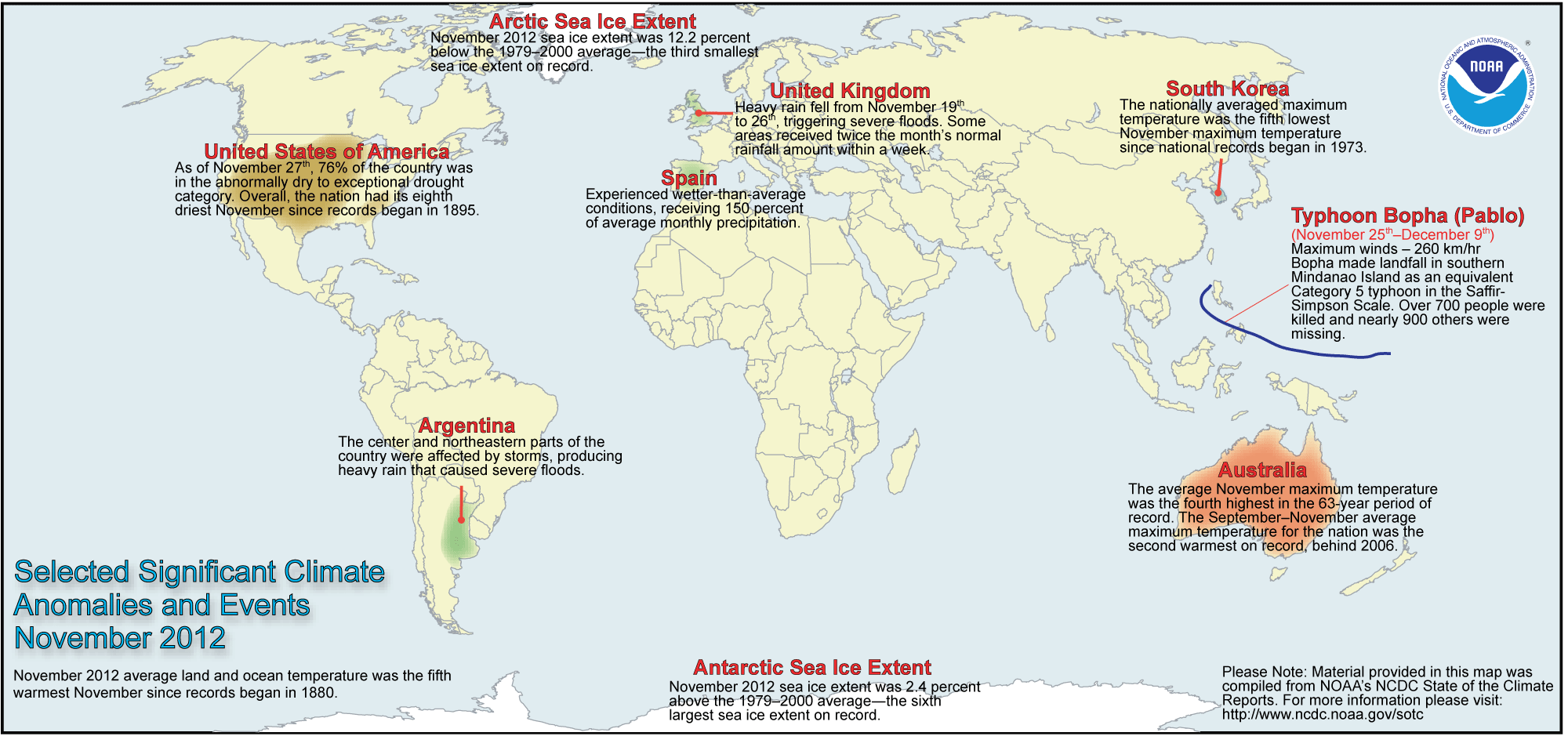
Just a look at the extremes in November should be alarming, especially if you live in the USA.

NOAA chart of climate anomalies and events, November 2012

Selected Significant Climate Anomalies and Events, November 2012; click for larger, more-easily-viewed image

More evidence that Michael Mann‘s “hockey stick” graph is vindicated; more evidence that we should not regard James Hansen as we did Cassandra, but should instead heed his warnings.

More:


Cliffhanger avoidance, from Robert Reich

November 30, 2012

Economist/policy wonk/good guy Robert Reich sends along notes on the discussions in Washington (at his Facebook site, and at his personal site) (links added here for your benefit and ease of use):

Robert Reich

Rhodes Scholar, former Secretary of Labor and UC Berkeley Prof. Robert Reich

Apparently the bidding began this afternoon. According to the Wall Street Journal (which got the information from GOP leaders), Tim Geithner met with Republican leaders and made the following offer:

— $1.6 trillion in additional tax revenues over the next decade, from limiting tax deductions on the wealthy and raising tax rates on incomes over $250,000 (although those rates don’t have to rise as high as the top marginal rates under Bill Clinton)

— $50 billion in added economic stimulus next year

— A one-year postponement of pending spending cuts in defense and domestic programs

— $400 billion in savings over the decade from Medicare and other entitlement programs (the same number contained in the President’s 2013 budget proposal, submitted before the election).

— Authority to raise the debt limit without congressional approval.

The $50 billion in added stimulus is surely welcome. We need more spending in the short term in order to keep the recovery going, particularly in light of economic contractions in Europe and Japan, and slowdowns in China and India.

But by signaling its willingness not to raise top rates as high as they were under Clinton and to cut some $400 billion from projected increases in Medicare and other entitlement spending, the White House has ceded important ground.

Republicans obviously want much, much more.

The administration has taken a “step backward, moving away from consensus and significantly closer to the cliff, delaying again the real, balanced solution that this crisis requires,” said Senate Minority Leader Mitch McConnell (R., Ky.) in a written statement. “No substantive progress has been made” added House Speaker John Boehner (R., Ohio).

No surprise. The GOP doesn’t want to show any flexibility. Boehner and McConnell will hang tough until the end. Boehner will blame his right flank for not giving him any leeway — just as he’s done before.

It’s also clear Republicans will seek whatever bargaining leverage they can get from threatening to block an increase in the debt limit – which will have to rise early next year if the nation’s full faith and credit is to remain intact.

Meanwhile, the White House has started the bidding with substantial concessions on tax increases and spending cuts.

Haven’t we been here before? It’s as if the election never occurred – as if the Republicans hadn’t lost six or seven seats in the House and three in the Senate, as if Obama hadn’t won reelection by a greater number of votes than George W. Bush in 2004.

And as if the fiscal cliff that automatically terminates the Bush tax cuts weren’t just weeks away.

But if it’s really going to be a repeat of the last round, we might still be in luck. Remember, the last round resulted in no agreement. And no agreement now may be better than a bad agreement that doesn’t raise taxes on the wealthy nearly enough while cutting far too much from safety nets most Americans depend on.

If Republicans won’t budge and we head over the fiscal cliff, the Clinton tax rates become effective January 1 – thereby empowering the White House and Democrats in the next congress to get a far better deal.

Watch that space.

It’s especially interesting to me how House Minority Leader Nancy Pelosi (D-California) and Senate Majority Leader Harry Reid (D-Nevada) will work to get a solution, if the GOP continues its blockade to almost all action.

More:


School House Rock update: Reforms on “I’m Only A Bill,” the story of making laws

October 12, 2012

Remember the old School House Rock?  Disney finally put all of the old episodes out on DVD and Blu-Ray.  Short songs with animation explaining grammar (“Conjunction Junction”), or math, or history, or economics.

Schoolhouse Rock!

Schoolhouse Rock! (Photo credit: Wikipedia)

One of the most popular was a later production that explained how a bill becomes law in the U.S. Congress, “I’m Just A Bill.”  You may remember how it was parodied by The Simpsons, too, and others.

It’s been updated by Fiore, now including the influence of the “American Legislative Exchange Council,” or ALEC, a Koch-brothers funded frat for conservative state legislators:

Maybe not suitable for elementary school classrooms; probably too violent for high schools, too.

More:


El Grito de Dolores, September 16 (2012 edition)

September 16, 2012

An encore post, repeated:

No, Cinco de Mayo is not Mexico’s “Independence Day.”

It’s amazing what is not available on video for use in the classroom.

Texas kids have to study the “Grito de Dolores” in the 7th grade – the “Cry from Dolores” in one translation, or the “Cry of Pain” in another (puns in Spanish! Do kids get it?). Father Miguel Hidalgo y Castillo made the speech on September 16, 1810, upon the news that Spanish authorities had learned of his conspiracy to revolt for independence. The revolution had been planned for December 8, but Hidalgo decided it had to start early.

This date is celebrated in Mexico as Independence Day. Traditionally the President of Mexico issues an update on the Grito, after the original bell that Father Hidalgo used is rung, near midnight.

Hidalgo himself was captured by the Spanish in 1811, and executed.

Father Hidalgo issues the Grito

Statue of Father Hidalgo in Dolores, Mexico.

It’s a great story. It’s a good speech, what little we have of it (Hidalgo used no text, and we work from remembered versions).
It’s important to Texas history, too — it’s difficult to imagine Tejians getting independence from Spain in quite the same way they won it from Mexico.

Why isn’t there a good 10- to 15-minute video on the thing for classroom use? Get a good actor to do the speech, it could be a hit. Where is the video when we need it?

Update from 2008: Glimmerings of hope on the video front:  Amateur videos on YouTube provide some of the sense of what goes on in modern celebrations.

And, see this re-enactment from Monterrey:

Update from 2009: The Library of Congress’s Wise Guide for September features the history of the day:

The Grito de Dolores (“Cry of/from Dolores”) was the battle cry of the Mexican War of Independence, uttered on September 16, 1810, by Miguel Hidalgo y Costilla, a Roman Catholic priest from the small town of Dolores, near Guanajuato, Mexico.

“My Children, a new dispensation comes to us today…Will you free yourselves? Will you recover the lands stolen 300 years ago from your forefathers by the hated Spaniards? We must act at once.”

Although many mistakenly attribute the Cinco de Mayo holiday as the celebration of Mexican independence, Sept. 16 was the day the enthusiastic Indian and mestizo congregation of Hidalgo’s small Dolores parish church took up arms and began their fight for freedom against Spain.

Touring Turn-of-the-Century America: Photographs from the Detroit Publishing Company, 1880-1920” has a rich collection of photographs of Mexico. To view these pictures, search the collection on “Mexico.”

Portals to the World contains selective links providing authoritative, in-depth information about the nations and other areas of the world. Resources on Mexico include information on the country’s history, religion, culture and society to name a few.

September is also a notable month for Hispanic culture with the celebration of Hispanic Heritage Month Sept 15 – Oct. 15. Sept. 15 is significant because it is the anniversary of independence for Latin American countries Costa Rica, El Salvador, Guatemala, Honduras and Nicaragua. In addition to Mexico’s independence day on Sept. 16, Chile recognizes its independence day Sept.18. Also, Columbus Day or Día de la Raza, which is Oct. 12, falls within this 30-day period.

The theme for the 2009 Hispanic Heritage Month was “Embracing the Fierce Urgency of Now!” To coincide with the celebration, the Library and several partners present a website honoring Hispanic culture and people. [Nice idea, calling it “Heritage Month” instead of “History Month;” maybe we can change February to “Black Heritage Month,” and study Hispanic and black history every day.]

Viva la república! Viva el Cura Hidalgo! Una página de Gloria, TITLE TRANSLATION: Long live the republic! Long live Father Hidalgo! A page of glory. Between 1890 and 1913. Prints and Photographs Division. Reproduction Information: Reproduction Nos.: LC-USZ62-98851 (b&w film copy neg.), LC-DIG-ppmsc-04595 (digital file from original, recto), LC-DIG-ppmsc-04596 (digital file from original, verso); Call No.: PGA - Vanegas, no. 123 (C size) [P&P] Catalog Record: http://hdl.loc.gov/loc.pnp/ppmsc.04595A street in Guanajuato, Mexico. Between 1880 and 1897. Prints and Photographs Division. Reproduction Information: Reproduction No.: LC-D418-8481 (b&w glass neg.); Call No.: LC-D418-8481 <P&P>[P&P] Catalog Record: http://hdl.loc.gov/loc.pnp/det.4a27131

Specifically on the Grito de Dolores, see the Library of Congress’s American Memory Project:

Cry of Dolores

My Children, a new dispensation comes to us today…Will you free yourselves? Will you recover the lands stolen three hundred years ago from your forefathers by the hated Spaniards? We must act at once.Cry of Dolores, attributed to Father Miguel Hidalgo y Costilla, September 16, 1810.

The Palace from the Cathedral, city of Mexico
The [National] Palace from the Cathedral, city of Mexico,
William Henry Jackson, photographer,
between 1880 and 1897.
Touring Turn-of-the-Century America: Photographs from the Detroit Publishing Company, 1880-1920

Early on the morning of September 16, 1810, Father Miguel Hidalgo y Costilla summoned the largely Indian and mestizo congregation of his small Dolores parish church and urged them to take up arms and fight for Mexico’s independence from Spain. His El Grito de Dolores, or Cry of Dolores, which was spoken—not written—is commemorated on September 16 as Mexican Independence Day.

Father Hidalgo was born into a moderately wealthy family in the city of Guanajuato, northwest of Mexico City, in 1753. He attended the Jesuit College of San Francisco Javier, received a bachelor’s degree from the University of Mexico in 1774, and was ordained into the priesthood in 1778. He soon earned the enmity of the authorities, however, by openly challenging both church doctrine and aspects of Spanish rule by developing Mexican agriculture and industry.

In 1803, Hidalgo accepted the curacy of the small parish of Dolores, not far from his native city of Guanajuato. Between 1803 and 1810, he directed most of his energy to improving the economic prospects of his parishioners. He also joined the Academia Literaria, a committee seeking Mexico’s independence from Spain.

Guanajuato, Mexico
Guanajuato, Mexico,
William Henry Jackson, photographer,
between 1880 and 1897.
Touring Turn-of-the-Century America: Photographs from the Detroit Publishing Company, 1880-1920

In September 1810, Spanish authorities learned of the group’s plot to incite a rebellion. On September 13, they searched the home of Emeterio González in the city of Queretaro where they found a large supply of weapons and ammunition. Warned of his impending arrest, Hidalgo preempted authorities by issuing the El Grito de Dolores on the morning of September 16. Attracting enthusiastic support from the Indian and mestizo population, he and his band of supporters moved toward the town of San Miguel.

The rebel army encountered its first serious resistance at Guanajuato. After a fierce battle that took the lives of more than 500 Spaniards and 2,200 Indians, the rebels won the city. By October, the rebel army, now 80,000 strong, was close to taking Mexico City. Hidalgo, fearful of unleashing the army on the capital city, hesitated, then retreated to the north. He was captured in Texas, then still a part of the Spanish empire, and executed by firing squad on July 31, 1811. After ten more years of fighting, a weakened and divided Mexico finally won independence from Spain with the signing of the Treaty of Córdoba on August 24, 1821.

Learn more about Mexico:

Resources, other material:

Even More (2012):

Share this bit of history:  Tweet about it, note it on your Facebook page, or spread the word some other way.


Romney/Ryan: U.S. can’t afford to be great any more

August 11, 2012

Democrats assembled some quick looks at federal budgeting with Paul Ryan and Mitt Romney:

Someone with a handle LLORT3 maybe put it concisely:  “We need healthcare, not wealthcare.”

The lines for the election seem to me to very well drawn:  Back to the Gilded Age, or on to the 21st century.

What do you think?  Did Romney just double down on a Marie Antoinette economy?  Will more than 20% of Americans vote to screw the middle class like that?

Related information:


Infographics creation by students, as a tool of learning

May 13, 2012

Infographic-a-Day describes this TEDx video (I added the links):

Perhaps one of the bigest and most listened to advocates of using infographics and data vis in the classroom is Diana Laufinberg, from The Science Leadership Academy. Diana, a History teacher, is a long time user of geographic information systems (GIS). She has recently, however, started helping her students to create their own infographics from complex issues that are part of her course of study and/or part of current events.

Here is a video of Diana’s talk at a recent TEDx…

Tip of the old scrub brush to David Warlick at 2¢ Worth.


Right-wingers mistake humorous Audi ad for Obama policy; embarrassment should follow

April 30, 2012

. . . but perhaps won’t.  I swear it seems as if someone has a concession at Tea Party functions selling self-lobotomy kits, and they’re selling like $10 iPhones.

File this in the “Whom the gods destroy, they first make mad” department, with loss of sense of humor as a key symptom.

You may have seen this ad during the Super Bowl, and though you may have cringed a bit at the way it tweaks people who show concerns about the environment and who urge cleaning up pollution, you probably found it pretty humorous.

But over at the Club the Constitution Constitution Club site, they appear to think it’s an ad from the Obama administration’s Department of Homeland Security.

So some hoaxster with the apt handle The Rat at Club the Constitution Constitution Club dug up a dull, run-of-the-mill document out of the Department of Homeland Security that talks about DHS policies on working to implement the government’s environmental justice policies.  “Environmental justice” is shorthand for “don’t dump garbage or toxic pollution in or close to the homes of poor people just because they are unlikely to have lawyers at the moment.”

Then The Rat flew off the handle, a truly head-exploding, insane Gish-Gallop rant about Homeland Security:

In its just-released Environmental Justice Strategy document, the DHS says the idea is to “include environmental justice practices in our larger mission efforts involving federal law enforcement and emergency response activities” and to incorporate environmental justice in “securing the homeland.” Roll that around in your head for awhile:

“Federal law enforcement” agents conducting “emergency response activities” in the name of “environmental justice” for the purpose of “securing the homeland.” The Green Police. Oh. My. God.

You couldn’t make up craziness like this guy, The Rat, could you? He clearly has no clue about the history of environmental justice (and is Google-challenged on top of that) — or he’s venally working to make people believe falsehoods.  What’s the harm in including “environmental justice practices in our larger mission?”

Does this Rat, who appears to be a complete idiot, fail to understand that “emergency response activities” are commonplace, and occur whenever an 18-wheeler carrying a load of chemicals turns over on the freeway?  Does The Rat fail to understand that spills need to be cleaned up?  (Real rats are very clean creatures, actually.  While they live in filthy, they do not prefer it, and they keep their dens very clean.  This is one way a real rat, say Rattus Norvegicus, or Rattus rattus, is superior to this faux rat.)

Here’s the description of the Audi advertisement from Auto123.com, showing none of the insanity the right wingers try to insert:

As reported by Audi

HERNDON, Va.
,– Green Police, the Audi Super Bowl ad, provides an uncommon avenue for green advocates, anteaters, Styrofoam, the legendary rock band Cheap Trick and the 2010 Green Car of the Year to find their inner connectivity.

How all of these rather disparate elements come together hasn’t been revealed yet by Audi. But in the end they will provide an entertaining look at how we all face a dizzying array of choices that can impact the environment. Some of these choices are easier than others. But, the Green Police ad will show, one of the best choices is driving the Audi A3 TDI, which won the prestigious 2010 Green Car of the Year award presented by Green Car Journal at the Los Angeles Auto Show in December.

The Audi Green Police ad will air Super Bowl Sunday in the fourth quarter of the largest television event of the year. But Super Bowl ad followers, Audi aficionados and others can get sneak peeks at what’s coming.

Audi released a teaser edit of the Green Police Super Bowl ad today, which highlights the crucial role anteaters can play in keeping the planet green. Think Styrofoam. One Super Bowl reviewer online is already betting the Audi Green Police ad will win top honors for “Best Use of an Unusual Animal in a Super Bowl Ad.” Audi disclaimer: No anteaters were harmed in the filming of the Green Police Super Bowl ad. To find that teaser video, go to www.facebook.com/audi.

Another preview of the Audi Green Police ad is the available download of the theme song of the spot. The legendary rock group Cheap Trick returned to the recording studio to remake their smash hit “Dream Police” into “Green Police.” Fans also can find that download by going to the Audi Facebook page.

For Audi, the Super Bowl has been a premium platform for promoting the performance and prestige of its cars the past three years. But underlying the fun of this year’s Green Police Super Bowl ad is a serious message: If 30% of Americans drove clean diesel cars like the Audi A3 TDI, the nation could reduce oil consumption by 1.5 million barrels a day. What’s more, clean diesel engines reduce CO2 emissions by 30%.

“Those are real-world benefits that the A3 TDI offers for today’s concerns about fuel consumption and greenhouse gas,” said Scott Keogh, Audi of America Chief Marketing Officer. “Super Bowl ads are all about fun, but the best ads point consumers to products that enrich their lives. That’s what we’ve done with the Green Police.”

Got that?  It’s a straight up, funny-as-anything Super Bowl ad pushing Audi’s TDI Diesel engined cars.

Have the right-wingers genuinely lost their humor senses?  Are they so shallow in their reading they didn’t catch the humor?  Can’t they tell a joke from reality?

In contrast, environmental justice is, by now, a rather well-established movement to marry civil rights laws and anti-pollution laws to prevent poor neighborhoods from being unfairly burdened by pollution, in a drive to clean up pollution for the benefit of all.  It’s an old enough concept that it goes by its initials, EJ.  See Wikipedia’s quick and concise entry:

The United States Environmental Protection Agency defines EJ as follows:

Environmental Justice is the fair treatment and meaningful involvement of all people regardless of race, color, national origin, or income with respect to the development, implementation, and enforcement of environmental laws, regulations, and policies. EPA has this goal for all communities and persons across this Nation [sic]. It will be achieved when everyone enjoys the same degree of protection from environmental and health hazards and equal access to the decision-making process to have a healthy environment in which to live, learn, and work.[5]

The United States Department of Transportation defines three fundamental EJ principles for the Federal Highway Administration and the Federal Transit Administration as follows:

  1. To avoid, minimize, or mitigate disproportionately high and adverse human health and environmental effects, including social and economic effects, on minority populations and low-income populations.
  2. To ensure the full and fair participation by all potentially affected communities in the transportation decision-making process.
  3. To prevent the denial of, reduction in, or significant delay in the receipt of benefits by minority and low-income populations.[6]

Could a serious-minded American citizen disagree with anything in those two definitions?  That’s right out of the Boy Scout Manual, it’s Leave No Trace writ large — it’s been the policy of the U.S. government since the early 1970s, proposed by Republicans as a means to conserve our nation’s lands, waters, and other resources.

There is nothing in the DHS environmental justice policy statement to suggest the agency will do anything more than worry about whether the agency itself is environmentally friendly, and fair to minority populations in the dumping of its wastes.  Actually, there is nothing in the document opposed to pollution — only statements outlining that every group in the agency is responsible for following policy.  The document says, in too many words, that no one can use the excuse, “It was the custodian’s job to see the used fluorescent light tubes were disposed properly.”

That crazy right wing!  They just get more and more distanced from reality the closer the election looms!

Links to the post at Club the Constitution Constitution Club, with the implied allegation that Obama will be sending cops out to fine you and your local gendarmerie for using Styrofoam cups, make up a new Anti-Green Wall of Shame, made by unthinking people spouting off about what they do not know:

More than a dozen blogs, operated by at least a dozen bloggers — all of whom conserved a great deal of energy by failing to use any of their gray matter neurons before parroting a hoax.  Oy.  (My experience is that most of those blogs are terrified that someone will leave an opposing opinion in comments — if you successfully post a comment at any of those blogs, will you let us know in comments?  The Ghost of Stalin stalks heavily among the blogs of the unthinking right.)

How many people will be suckered by this hoax?  More than a dozen so far, and counting.

P.S.:  The Audi advertisement was for the 2010 Super Bowl; that’s some digging.

Update, May 3:  A few wags at the original site now claim it’s parody, that they know it’s not so.  Alas, they don’t post that, and as you can see by the update above, other anti-American Clean Air types continue to pile on, not hesitating to attack our national government for fun.


Fruits of the Republican War on Education

January 16, 2012

You didn’t think it was working already?

This story appeared in the Los Angeles Times, which is why Republicans discourage newspaper publishing, and why they discourage programs to teach people to read well and remember history.

In South Carolina, a discrepancy on federal spending

Campaigning Republicans draw cheers with their calls for cuts to government programs. But the state benefits from such programs to a greater extent than many others.

By Alana Semuels, Los Angeles Times

January 14, 2012, 7:55 p.m.

Reporting from Beaufort, S.C.—

When Rick Santorum stood in front of voters at a yacht club in this small town and pledged to slash government spending, especially entitlement programs, Nancy Garvin knew she had found her candidate.

Garvin, 54, said she was sick of seeing government squander money through agencies that don’t do anything, and wants expenditures cut “in half.”

Washington is throwing money away through a lot of wasteful spending,” she said, sitting at a picnic table beneath trees draped in graying Spanish moss.

But Garvin, whose husband, a carpenter, has been out of work for four years, depends on the very government she wants to see cut back. She collects disability insurance — it is what she and her husband have survived on as he’s looked for work. Her mother is on Social Security. Garvin herself used to work as a nurse at a hospital where many patients paid for services through Medicaid, another program using federal money.

Garvin’s views are similar to those of many Republican voters in this conservative state, where candidates pledging to cut government spending were met with resounding applause last week, and where former Gov. Mark Sanford tried to refuse federal stimulus funding on principle.

South Carolina and its residents benefit from government spending, more so than many other states. For every dollar the state pays in federal taxes, it receives $1.35 in federal government benefits. By contrast, California receives only 78 cents for every dollar it pays in taxes.

“We get more back from the federal government than we send in terms of revenue,” said Doug Woodward, an economics professor at the University of South Carolina. “But I’m not sure that a lot of voters would even care if they heard that. When they say they want to see less spending in the state, they’re referring to entitlement programs.”

Much of the money spent in South Carolina goes to the programs that make up a big chunk of the federal budget — defense, Social Security and Medicaid. The state has seven military bases, and received $7 billion in Defense Department spending in 2010. One in five residents in South Carolina receives Social Security benefits — compared with just 13% in California. As an aging state, South Carolina will be more dependent on federal programs such as Social Security in the coming decade, according to AARP.

“People want to see lower government spending, especially on the Republican side,” said Karen Kedrowski, a politics professor at Winthrop University in Rock Hill, S.C. “But when they’re asked specifically about high-dollar items, including Social Security and defense, they are not willing to accept significant cuts.”

Kedrowski’s university recently polled South Carolina Republicans to ask about reducing the deficit by making cuts to government programs: 73% of voters said they weren’t willing to have their current Social Security or Medicare benefits reduced to address budget concerns. More than half said they weren’t willing to cut defense spending either.

It’s not just wealthy Republican voters in the Palmetto State who say they eschew entitlement programs, Kedrowski said.

“There’s also a disproportionate number of low-income people who vote Republican because they respond to the populist messages, even when it is against their economic interests to do so,” she said.

Sheila Barton, 56, runs a floral shop in Pickens, a town that Rick Perry visited recently to stroll down Main Street and shake hands with store owners and residents.

“Americans don’t want a government that’s playing a bigger role in their lives,” Perry had said at a speech earlier that morning. “No one’s ever come up to me and said, ‘We sure need to have more government in our lives.'”

Barton agrees — in principle.

“There’s a lot of things that are wasteful,” she said, but when pressed to name some, she said she couldn’t really think of any off the top of her head. Defense spending should be increased, she said, and people who have paid into Social Security should receive their benefits. And local government programs need more funding, she said — she’s currently a guardian for local children through the court system.

There is some evidence that South Carolina’s opposition to government spending might further strangle the state’s already weak economy — if it leads to cuts in Social Security. Roberto Gallardo of the Southern Rural Development Center says that economies in many small towns in South Carolina are increasingly dependent on Social Security payments.

The percentage of total personal income in South Carolina coming from Social Security’s Old-Age, Survivors and Disability Insurance programs was 7.6% in 2009, up from 3.8% in 1970. South Carolina ranks eighth in the nation on the group’s Social Security Dependency Index, which measures how reliant local economies are on Social Security payments for job creation and consumer spending. Neighboring North Carolina ranked 23rd.

That means candidates have to walk a fine line here — promising to cut government to alleviate voters’ fears, while still preserving the programs that require most of the spending. How else to appeal to such voters as Clifton Anderson of Camden, who went to see Rick Santorum speak in a diner in Ridgeway?

“His ideas of downsizing government are most important to me,” said Anderson, about Santorum. He continued, in the next breath: “I also like his idea about strengthening defense.”

alana.semuels@latimes.com

Copyright © 2012, Los Angeles Times