Lesson plans on presidential inaugurations: Free download on January 13 & 14

January 12, 2009

New lesson plans and other materials from the Bill of Rights Institute, on presidential inaugurations.  Even better if you’re a cheapskate like me, you can download the inauguration lessons for free, but only on January 13 and 14, 2009.

Bill of Rights Institute

Free-for a limited time only!

Bring the historic Presidential Inauguration of 2009 into your classroom! “Presidential Inauguration: History, Tradition, and the Constitution” helps your students learn more about Inauguration Day from constitutional, historical, and current perspectives.

Those of you who own Being an American: Exploring the Ideals that Unite Us, Second Edition can use your unique passwords to access the lesson at any time. If you do not own the curriculum, you can download the lesson for free for two days only: January 13-14, 2009. Download your lesson at www.BillofRightsInstitute.org/today!

To buy Being an American, Second Edition, which gives you a full week of lessons and access to all past and future Web-based materials, click here.

Best deal, especially for U.S. history, spend the $20 and buy the full set of plans.

Also, check out these 25 inauguration videos from the past, at HotChalk.


Happy Hubble Day! Look up

December 30, 2008

Ultraviolet image of the Andromeda Galaxy, first known to be a galaxy by Edwin Hubble on December 30, 1924 - Galaxy Evolution Explorer image courtesy NASA

Ultraviolet image of the Andromeda Galaxy, first known to be a galaxy by Edwin Hubble on December 30, 1924 - Galaxy Evolution Explorer image courtesy NASA

Today is a good day to celebrate the universe in all it’s glory – December 30. Below, mostly an encore post.

This year for Hubble Day, Wired picked up on the story (with a gracious link to last year’s post here at the Bathtub).  Wired includes several links to even more information, a good source of information.

Hubble was the guy who showed us the universe is not only bigger than we imagined, it’s probably much bigger and much more fantastic than we can imagine. Hubble is the guy who opened our imaginations to the vastness of all creation.

How does one celebrate Hubble Day?  Here are some suggestions:

  • Easier than Christmas cards:  Send a thank-you note to your junior high school science teacher, or whoever it was who inspired your interest in science.  Mrs. Hedburg, Mrs. Andrews, Elizabeth K. Driggs, Herbert Gilbert, Mr. Willis, and Stephen McNeal, thank you.
  • Rearrange your Christmas/Hanukkah/KWANZAA lights in the shape of the Andromeda Galaxy — or in the shape of any of the great photos from the Hubble Telescope (Andromeda Galaxy pictured above; Hubble images here)

    A few of the images from the Hubble Telescope

    A few of the images from the Hubble Telescope

  • Go visit your local science museum; take your kids along – borrow somebody else’s kids if you have to (take them along, too)
  • Spend two hours in your local library, just looking through the books on astronomy and the universe
  • Anybody got a good recipe for a cocktail called “The Hubble?”  “The Andromeda?”  Put it in the comments, please

The encore post, from last year:

December 30, 1924, Edwin Hubble announced the results of his observations of distant objects in space.

PBS

Edwin Hubble - source: PBS

In 1924, he announced the discovery of a Cepheid, or variable star, in the Andromeda Nebulae. Since the work of Henrietta Leavitt had made it possible to calculate the distance to Cepheids, he calculated that this Cepheid was much further away than anyone had thought and that therefore the nebulae was not a gaseous cloud inside our galaxy, like so many nebulae, but in fact, a galaxy of stars just like the Milky Way. Only much further away. Until now, people believed that the only thing existing ouside the Milky Way were the Magellanic Clouds. The Universe was much bigger than had been previously presumed.

Later Hubble noted that the universe demonstrates a “red-shift phenomenon.” The universe is expanding. This led to the idea of an initial expansion event, and the theory eventually known as Big Bang.

Hubble’s life offered several surprises, and firsts:

Hubble was a tall, elegant, athletic, man who at age 30 had an undergraduate degree in astronomy and mathematics, a legal degree as a Rhodes scholar, followed by a PhD in astronomy. He was an attorney in Kentucky (joined its bar in 1913), and had served in WWI, rising to the rank of major. He was bored with law and decided to go back to his studies in astronomy.

In 1919 he began to work at Mt. Wilson Observatory in California, where he would work for the rest of his life. . . .
Hubble wanted to classify the galaxies according to their content, distance, shape, and brightness patterns, and in his observations he made another momentous discovery: By observing redshifts in the light wavelengths emitted by the galaxies, he saw that galaxies were moving away from each other at a rate constant to the distance between them (Hubble’s Law). The further away they were, the faster they receded. This led to the calculation of the point where the expansion began, and confirmation of the big bang theory. Hubble calculated it to be about 2 billion years ago, but more recent estimates have revised that to 20 billion years ago.

An active anti-fascist, Hubble wanted to joined the armed forces again during World War II, but was convinced he could contribute more as a scientist on the homefront. When the 200-inch telescope was completed on Mt. Palomar, Hubble was given the honor of first use. He died in 1953.

“Equipped with his five senses, man explores the universe around him and calls the adventure Science.”

That news on December 30, 1924, didn’t make the first page of the New York Times. The Times carried a small note on February 25, 1925, that Hubble won a $1,000 prize from the American Academy for the Advancement of Science.

(Does anyone have a suitable citation for that video?  Where did it come from?  Who produced it?  Is there more somewhere?)

Happy Hubble Day!  Look up!

Resources:


Texas Statehood, December 29, 1845

December 29, 2008

163 years ago today: Rub your pet armadillo’s belly, slaughter the fatted longhorn, crank up the barbecue pit with the mesquite wood, put Willie Nelson and Bob Wills on the mp3 player, put the “Giant” DVD on the television, and raise your glass of Lone Star Beer (or Pearl, or Shiner Bock, or Llano Wine).

Texas was admitted to the union of the United States of America on December 29, 1845.

President Polks Authorization to Affix the Great Seal to Texas Statehood - Texas Memorial Museum, University of Texas at Austin

President Polk's Authorization to Affix the Great Seal to Texas Statehood - Texas Memorial Museum, University of Texas at Austin

The text reads:

I hereby authorize and direct the Secretary of State to affix the Seal of the United States to an authenticated copy of “an act to extend the laws of the United States over the State of Texas and for other purposes” approved Dec. 29, 1845 dated this day, and signed by me and for so doing this shall be his warrant.

James K. Polk
Washington, Dec. 29, 1845

Great Seal of the United States of America - State Archives Division, Texas State Library

Great Seal of the United States of America - State Archives Division, Texas State Library

Resources:


Incomplete history and Willie Nelson

December 27, 2008

Fort Worth Weekly did a story on Willie Nelson’s living in Fort Worth in the 1950s.  The writer drove by Willie’s old haunts.

But no pictures? No directions on how to get to the future shrines?  How is the National Register of Historic Places supposed to find the things?

The Weekly was doing what might amount to a local sidebar on Willie Nelson: An Epic Life, Joe Nick Patoski’s biography of the composer and singer.  The Weekly needs to learn a bit about including web links, and especially about including photographs!

(Who’s going to get Patoski’s book, get the addresses, and post photos?)

Accuracy note: I linked to Robert Hilburn’s review of the book in the Los Angeles Times; he has another version of the story of Willie’s first wife, Martha, sewing him in the bedsheets when he came home drunk, then beating him with a broom.  Hilburn’s review is worth reading just to get this story from another view.


Who invented Santa Claus, and the Night Before Christmas?

December 24, 2008

An encore post from 2007

Thomas Nast invented Santa Claus? Clement C. Moore didn’t write the famous poem that starts out, “‘Twas the night before Christmas, and all through the house . . . ?”

The murky waters of history from Millard Fillmore’s Bathtub soak even our most cherished ideas and traditions.

But isn’t that part of the fun of history?

Santa Claus delivers to Union soldiers, "Santa Claus in Camp" - Thomas Nast, Harper's Weekly, Jan 3, 1863

Thomas Nast’s first published drawing featuring Santa Claus; for Harper’s Weekly, “A Journal of Civilization,” January 3, 1863 Nast portrayed the elf distributing packages to Union troops: “Santa Claus in camp.” Nast (1840-1904) was 23 when he drew this image.

Yes, Virginia (and California, too)! Thomas Nast created the image of Santa Claus most of us in the U.S. know today. Perhaps even more significant than his campaign against the graft of Boss Tweed, Nast’s popularization of a fat, jolly elf who delivers good things to people for Christmas makes one of the great stories in commercial illustration. Nast’s cartoons, mostly for the popular news publication Harper’s Weekly, created many of the conventions of modern political cartooning and modeled the way in which an illustrator could campaign for good, with his campaign against the graft of Tammany Hall and Tweed. But Nast’s popular vision of Santa Claus can be said to be the foundation for the modern mercantile flurry around Christmas.

Nast is probably ensconced in a cartoonists’ hall of fame. Perhaps he should be in a business or sales hall of fame, too.  [See also Bill Casselman’s page, “The Man Who Designed Santa Claus.]

Nast’s drawings probably drew some inspiration from the poem, “Account of a Visit from St. Nicholas,” traditionally attributed to Clement C. Moore, a New York City lawyer, published in 1822. The poem is among the earliest to describe the elf dressed in fur, and magically coming down a chimney to leave toys for children; the poem invented the reindeer-pulled sleigh.

Modern analysis suggests the poem was not the work of Moore, and many critics and historians now attribute it to Major Henry Livingston, Jr. (1748-1828) following sleuthing by Vassar College Prof. Don Foster in 2000. Fortunately for us, we do not need to be partisans in such a query to enjoy the poem (a complete copy of which is below the fold).

The Library of Congress still gives Moore the credit. When disputes arise over who wrote about the night before Christmas, is it any wonder more controversial topics produce bigger and louder disputes among historians?

Moore was not known for being a poet. The popular story is that he wrote it on the spur of the moment:

Moore is thought to have composed the tale, now popularly known as “The Night Before Christmas,” on December 24, 1822, while traveling home from Greenwich Village, where he had bought a turkey for his family’s Christmas dinner.

Inspired by the plump, bearded Dutchman who took him by sleigh on his errand through the snow-covered streets of New York City, Moore penned A Visit from St. Nicholas for the amusement of his six children, with whom he shared the poem that evening. His vision of St. Nicholas draws upon Dutch-American and Norwegian traditions of a magical, gift-giving figure who appears at Christmas time, as well as the German legend of a visitor who enters homes through chimneys.

Again from the Library of Congress, we get information that suggests that Moore was a minor celebrity from a well-known family with historical ties that would make a good “connections” exercise in a high school history class, perhaps (”the link from Aaron Burr’s treason to Santa Claus?”): (read more, below the fold)

Clement Moore was born in 1779 into a prominent New York family. His father, Benjamin Moore, president of Columbia University, in his role as Episcopal Bishop of New York participated in the inauguration of George Washington as the nation’s first president. The elder Moore also administered last rites to Alexander Hamilton after he was mortally wounded in a tragic duel with Aaron Burr.

A graduate of Columbia, Clement Moore was a scholar of Hebrew and a professor of Oriental and Greek literature at the General Theological Seminary in Manhattan. [See comment from Pam Bumsted below for more on Moore.] He is said to have been embarrassed by the light-hearted verse, which was made public without his knowledge in December 1823. Moore did not publish it under his name until 1844.

Tonight, American children will be tucked in under their blankets and quilts and read this beloved poem as a last “sugarplum” before slipping into dreamland. Before they drift off, treat them to a message from Santa, recorded by the Thomas Edison Company in 1922.

Santa Claus Hides in Your Phonograph
By Arthur A. Penn, Performed by Harry E. Humphrey.
Edison, 1922.
Coupling date: 6/20/1922. Cutout date: 10/31/1929.
Inventing Entertainment: The Motion Pictures and Sound Recordings of the Edison Companies

Listen to this recording (RealAudio Format)

Listen to this recording (wav Format, 8,471 Kb)

But Henry Livingston was no less noble or historic. He hailed from the Livingtons of the Hudson Valley (one of whose farms is now occupied by Camp Rising Sun of the Louis August Jonas Foundation, a place where I spent four amazing summers teaching swimming and lifesaving). Livingston’s biography at the University of Toronto site offers another path for a connections exercise (”What connects the Declaration of Independence, the American invasion of Canada, the famous poem about a visit from St. Nick, and George W. Bush?”):

Henry Livingston Jr. was born in Poughkeepsie, New York, on Oct. 13, 1748. The Livingston family was one of the important colonial and revolutionary families of New York. The Poughkeepsie branch, descended from Gilbert, the youngest son of Robert Livingston, 1st Lord of Livingston Manor, was not as well off as the more well-known branches, descended from sons Robert and Philip. Two other descendants of Gilbert Livingston, President George Walker Herbert Bush and his son, President-Elect George W. Bush, though, have done their share to bring attention to this line. Henry’s brother, Rev. John Henry Livingston, entered Yale at the age of 12, and was able to unite the Dutch and American branches of the Dutch Reformed Church. At the time of his death, Rev. Livingston was president of Rutgers University. Henry’s father and brother Gilbert were involved in New York politics, and Henry’s granduncle was New York’s first Lt. Governor. But the law was the natural home for many of Henry’s family. His brother-in-law, Judge Jonas Platt, was an unsuccessful candidate for governor, as was his daughter Elizabeth’s husband, U.S. Supreme Court Justice Smith Thompson. Henry’s grandson, Sidney Breese, was Chief Justice of the Illinois Supreme Court.

Known for his encyclopedic knowledge and his love of literature, Henry Livingston was a farmer, surveyor and Justice of the Peace, a judicial position dealing with financially limited criminal and civil cases. One of the first New Yorkers to enlist in the Revolutionary Army in 1775, Major Henry Livingston accompanied his cousin’s husband, General Montgomery, in his campaign up the Hudson River to invade Canada, leaving behind his new wife, Sarah Welles, and their week-old baby, on his Poughkeepsie property, Locust Grove. Baby Catherine was the subject of the first poem currently known by Major Livingston. Following this campaign, Livingston was involved in the War as a Commissioner of Sequestration, appropriating lands owned by British loyalists and selling them for the revolutionary cause. It was in the period following Sarah’s early death in 1783, that Major Livingston published most of his poems and prose, anonymously or under the pseudonym of R. Ten years after the death of Sarah, Henry married Jane Patterson, the daughter of a Dutchess County politician and sister of his next-door neighbor. Between both wives, Henry fathered twelve children. He published his good-natured, often occasional verse from 1787 in many journals, including Political Barometer, Poughkeepsie Journal, and New-York Magazine. His most famous poem, “Account of a Visit from St. Nicholas,” was until 2000 thought to have been the work of Clement Clarke Moore (1779-1863), who published it with his collected poems in 1844. Livingston died Feb. 29, 1828.

More on Henry Livingston and his authorship of the Christmas poem here.

Thomas Nast, Merry Old Santa Claus, Harper's Weekly, Jan 1, 1881


Our views of Santa Claus owe a great deal also to the Coca-Cola advertising campaign. Coca-Cola first noted Santa’s use of the drink in a 1922 campaign to suggest Coke was a year-round drink (100 years after the publication of Livingston’s poem). The company’s on-line archives gives details:

In 1930, artist Fred Mizen painted a department store Santa in a crowd drinking a bottle of Coke. The ad featured the world’s largest soda fountain, which was located in the department store of Famous Barr Co. in St. Louis, Mo. Mizen’s painting was used in print ads that Christmas season, appearing in The Saturday Evening Post in December 1930.

1936 Coca-Cola Santa cardboard store display

  • 1936 Coca-Cola Santa cardboard store display

Archie Lee, the D’Arcy Advertising Agency executive working with The Coca-Cola Company, wanted the next campaign to show a wholesome Santa as both realistic and symbolic. In 1931, The Coca-Cola Company commissioned Michigan-born illustrator Haddon Sundblom to develop advertising images using Santa Claus — showing Santa himself, not a man dressed as Santa, as Mizen’s work had portrayed him.
1942 original oil painting - 'They Remembered Me'

  • 1942 original oil painting – ‘They Remembered Me’

For inspiration, Sundblom turned to Clement Clark Moore’s 1822 poem “A Visit From St. Nicholas” (commonly called “‘Twas the Night Before Christmas”). Moore’s description of St. Nick led to an image of Santa that was warm, friendly, pleasantly plump and human. For the next 33 years, Sundblom painted portraits of Santa that helped to create the modern image of Santa — an interpretation that today lives on in the minds of people of all ages, all over the world.

Santa Claus is a controversial figure. Debates still rage among parents about the wisdom of allowing the elf into the family’s home, and under what conditions. Theologians worry that the celebration of Christmas is diluted by the imagery. Other faiths worry that the secular, cultural impact of Santa Claus damages their own faiths (few other faiths have such a popular figure, and even atheists generally give gifts and participate in Christmas rituals such as putting up a decorated tree).

For over 100 years, Santa Claus has been a popular part of commercial, cultural and religious life in America. Has any other icon endured so long, or so well?

Add to FacebookAdd to NewsvineAdd to DiggAdd to Del.icio.usAdd to StumbleuponAdd to RedditAdd to BlinklistAdd to TwitterAdd to TechnoratiAdd to Furl

________________________
Below:
From the University of Toronto Library’s Representative Poetry Online

Major Henry Livingston, Jr. (1748-1828)

Account of a Visit from St. Nicholas

1 ‘Twas the night before Christmas, when all thro’ the house,
2 Not a creature was stirring, not even a mouse;
3 The stockings were hung by the chimney with care,
4 In hopes that St. Nicholas soon would be there;
5 The children were nestled all snug in their beds,
6 While visions of sugar plums danc’d in their heads,
7 And Mama in her ‘kerchief, and I in my cap,
8 Had just settled our brains for a long winter’s nap –
9 When out on the lawn there arose such a clatter,
10 I sprang from the bed to see what was the matter.
11 Away to the window I flew like a flash,
12 Tore open the shutters, and threw up the sash.
13 The moon on the breast of the new fallen snow,
14 Gave the lustre of mid-day to objects below;
15 When, what to my wondering eyes should appear,
16 But a miniature sleigh, and eight tiny rein-deer,
17 With a little old driver, so lively and quick,
18 I knew in a moment it must be St. Nick.
19 More rapid than eagles his coursers they came,
20 And he whistled, and shouted, and call’d them by name:
21 “Now! Dasher, now! Dancer, now! Prancer, and Vixen,
22 “On! Comet, on! Cupid, on! Dunder and Blixem;
23 “To the top of the porch! to the top of the wall!
24 “Now dash away! dash away! dash away all!”
25 As dry leaves before the wild hurricane fly,
26 When they meet with an obstacle, mount to the sky;
27 So up to the house-top the coursers they flew,
28 With the sleigh full of Toys — and St. Nicholas too:
29 And then in a twinkling, I heard on the roof
30 The prancing and pawing of each little hoof.
31 As I drew in my head, and was turning around,
32 Down the chimney St. Nicholas came with a bound:
33 He was dress’d all in fur, from his head to his foot,
34 And his clothes were all tarnish’d with ashes and soot;
35 A bundle of toys was flung on his back,
36 And he look’d like a peddler just opening his pack:
37 His eyes — how they twinkled! his dimples how merry,
38 His cheeks were like roses, his nose like a cherry;
39 His droll little mouth was drawn up like a bow.
40 And the beard of his chin was as white as the snow;
41 The stump of a pipe he held tight in his teeth,
42 And the smoke it encircled his head like a wreath.
43 He had a broad face, and a little round belly
44 That shook when he laugh’d, like a bowl full of jelly:
45 He was chubby and plump, a right jolly old elf,
46 And I laugh’d when I saw him in spite of myself;
47 A wink of his eye and a twist of his head
48 Soon gave me to know I had nothing to dread.
49 He spoke not a word, but went straight to his work,
50 And fill’d all the stockings; then turn’d with a jerk,
51 And laying his finger aside of his nose
52 And giving a nod, up the chimney he rose.
53 He sprung to his sleigh, to his team gave a whistle,
54 And away they all flew, like the down of a thistle:
55 But I heard him exclaim, ere he drove out of sight –
56 Happy Christmas to all, and to all a good night.

Remember the Pueblo, the crew and Commander Bucher, and the Great Hoaxes of 1968

December 24, 2008

They are safely back on American soil.  Except for the boat, the U.S.S. Pueblo, which remains in North Korea, the biggest bauble for a failed North Korean government that clings to power at the price of the lives of its people.

 General Charles H. Bonesteel III, U.S. Army, Commander-in-Chief, United Nations Command, (left) and Rear Admiral Edwin M. Rosenberg, USN, Commander Task Force 76, (right) greet members of Pueblos crew as they arrive at the U.N. Advance Camp, Korean Demilitarized Zone, on 23 December 1968, following their release by the North Korean government. USS Pueblo (AGER-2) and her crew had been captured off Wonsan on 23 January 1968. Note Christmas decorations.  Official U.S. Navy Photograph.

General Charles H. Bonesteel III, U.S. Army, Commander-in-Chief, United Nations Command, (left) and Rear Admiral Edwin M. Rosenberg, USN, Commander Task Force 76, (right) greet members of Pueblo's crew as they arrive at the U.N. Advance Camp, Korean Demilitarized Zone, on 23 December 1968, following their release by the North Korean government. USS Pueblo (AGER-2) and her crew had been captured off Wonsan on 23 January 1968. Note Christmas decorations. Official U.S. Navy Photograph.

40 years ago, yesterday, the crew of the Pueblo was repatriated, after 11 months of grueling prison time, and torture, and hoaxes that best demonstrate American views on authority.

Harry Iredell, one of the most active chroniclers of the Pueblo, wrote:

On December 23rd, 11 months to the day of their capture, the crew of the PUEBLO walked, one every 15 seconds, across the Bridge of no Return to freedom and the opportunity to live the rest of their lives.

I had expected to write a lot more about 1968 through this year, the 40th anniversary — but events overtake a part-time blogger, often, and I am no exception.

I would like to see some recognition given to the crew of Pueblo at the end of this year.  They deserve it for their great service to our nation, in the first place.

But in the second place, their story is a talisman of what happened to the U.S. in that stormy year, a year that I believe was one of the most traumatic in U.S. history.  It was a year of bad news mostly, from Vietnam, in civil rights with the assassination of Rev. Dr. Martin Luther King, Jr., and in politics with the assassination of New York’s Sen. Robert F. Kennedy. on the night he won the California primary in the presidential race. One reason we think to remember the good news of Apollo 8 at the end of the year, is that the rest of 1968 was so bad.  Apollo 8’s stunning success in the last week of the year was a refreshing and hopeful contrast to the despairing news from the rest of the year.  Even the release of the Pueblo crew did not erase the bad taste from the capture, and their torture by North Korea.

Here is what I wrote about 1968 a while ago, in “Penetration however slight:  More on a good and noble hoax — the U.S.S. Pueblo” :

1968 was depressing.

What was so bad? Vietnam manifested itself as a quagmire. Just when Washington politicians predicted an end in sight, Vietcong militia launched a nationwide attack in South Vietnam on the Vietnamese New Year holiday, Tet, at the end of January. Civil rights gains stalled, and civil rights leaders came out in opposition to the Vietnam war. President Johnson fared poorly in the New Hampshire primary election, and eventually dropped out of the race for the presidency (claiming he needed to devote time to making peace in Vietnam). Labor troubles roiled throughout the U.S., including a nasty strike by garbage collectors in Memphis. It didn’t help to settle the strike that the sanitation workers were almost 100% African American, the leadership of Memphis was almost 100% white, and race relations in the city were not so good as they might have been – the strike attracted the efforts of the Southern Christian Leadership Conference, and Martin Luther King, Jr. – who was assassinated there in early April. In response, riots broke out in 150 American cities.

Two months later, in June, with the Vietnam War as a very divisive issue, the presidential campaign was marked by great distress of voters and increasing polarization. Sen. Robert F. Kennedy appeared to pull into the lead when he won the California primary in June, but he was assassinated that night. Tens of thousands of anti-war protesters, angry at President Johnson, showed up at the Democratic National Convention in Chicago – with Johnson out of the race, the protests were essentially for show. Mayor Richard J. Daley took offense at the protesters, and Chicago policemen, who considered themselves the political opposites of the shaggy-haired protesters, attacked the protesters with clubs and tear gas. A national commission later called it a “police riot.” Vice President Hubert Humphrey could not make his opposition to the Vietnam War known soon enough or broadly enough, and had a tough campaign against Republican, former Vice President Richard Nixon, who promised that he had a “secret” peace plan for Vietnam. Nixon won in a squeaker. Nixon had no secret peace plan.

At the end of the year, the U.S. got a feel-good story out of the Apollo Project, when NASA launched Apollo 8, which orbited the Moon on Christmas Eve.

Throughout the year, there was the continuing sore of Americans held captive by the Republic of North Korea.

Commander Lloyd M. Bucher and the men of the U.S.S. Pueblo were captured by a superior force of North Korean gunboats on January 23, 1968, a few days before the Tet Offensive. The capture and 11 months of captivity were a trial for the 84 men, and an embarrassment for the U.S. Tortured and unable to effect an escape, Bucher and his men did the next best thing: They played hoaxes that made the North Koreans look silly.

Among other things, Cmdr. Bucher had signed a confession demanded (by torture) by North Korea. When news of this confession was revealed in the western press, observers were concerned that a U.S. citizen would succumb to making what was regarded as a false confession, but a coup for communist totalitarians. The texts of the confessions and other material from the captives, however, revealed something quite different. The confessions were written or edited largely by Bucher and the crew, and to an American with any familiarity with popular culture, they were hilarious.

My recollection was that at least one of the confessions was that the Pueblo had indeed penetrated North Korean territorial waters, but it was phrased to make it sound like the definition of rape offered in the Uniform Code of Military Justice (UCMJ). I could not find any record of that confession on the internet.

At some length, I succeeded in getting a copy of the out-of-print autobiography of Cmdr. Bucher, to check my memory of the confessions. The book is out of print. I found a couple of copies at a used book vendor, very inexpensive, through Amazon.com. However, shortly after ordering the books, I was informed by both the Post Office and the vendor that the books had been destroyed by sorting machinery. Fortunately, they had been shipped separately, and one finally arrived.

Unfortunately, the “Final, final confession” does not contain what I recall. However, the book revealed that after the writing of the “Final, final,” Bucher’s crew was asked to write more – apologies to the people of North Korea, and other propaganda documents. It was in those documents that the text I recalled, appeared.

2008 marks 40 years since that terrible year, 40 years since the Pueblo incident. For the sake of posterity, and to aid your lesson plans, here is the part of the confessions I recall which has not been available lately.

Bucher: My Story, Commander Lloyd M. Bucher, USN, with Mark Rascovich, Doubleday 1970, Dell 1971; p. 342

We did in fact get away with a composition that matched my Final, Final Confession for brazen kidding of the KORCOMS, and which far surpassed it in subtlety. Blended into the standard Communist verbosity were such lines of our own as:

“We, as conscientious human beings who were cast upon the rocks and shoals of immorality by the tidal waves of Washington’s naughty policies know that neither the frequency nor the distances of these transgressions into the territorial waters of this sovereign peace-loving nation matter because penetration however slight is sufficient to complete the act. (“Rocks and Shoals” is Navy slang for the Uniform Code of Military Justice and the last line contains the essential definition of rape.)

This was both delivered over film and TV and published in the “Ping-pong Times.” The Glorious General was well pleased and set the same team to working on the next letter.

North Korea was anxious to cash in on the propaganda opportunities of the confessions and other material, and spread these documents as far as their naïve public relations offices could. Eventually, in late November or early December, a photograph of the captives, intended to show them healthy and having a good time, was distributed to newspapers. In the photo, the crew were shown smiling on a basketball court, holding a basketball, with a few of their North Korean guards. The photo was not published widely in the United States, however, because almost to a man, the crew were displaying what they had told the North Koreans was a “Hawaiian good luck symbol” – extended middle fingers. U.S. papers thought the photo inappropriate. European papers published it, however, and eventually Time Magazine ran the photo, with an explanation.

When news got back to Pyong Yang that the North Koreans had been hoaxed, the North Koreans instituted a week of beatings and torture. Within a couple of weeks, however, the North Koreans handed over the crew back to the U.S., at Panmunjon. U.S. officials were convinced that their signing an insincere confession got the Pueblo crew released. Anyone who ever read O. Henry’s Ransom of Red Chief suspected the North Koreans got the crew out of North Korea before they could hoax the government completely away.

Fortunately, Lloyd Bucher and the crew of the Pueblo did not follow H. L. Mencken’s advice after the Fillmore Bathtub hoax, and swear off hoaxes completely.

The “confessions” were hoaxes, great and glorious hoaxes in the best “Kilroy was here” spirit of American fighting forces.  Unsure that they wouldn’t be executed, after being tortured, American Navy people still had the piss and vinegar to kick their captors in the ass.

A Navy Yeoman Second Class holds a U.S. flag, to be used to drape the coffin of Seaman Duane Hodges, who was killed when USS Pueblo  (AGER-2) was captured by the North Koreans off Wonsan on 23 January 1968. Seaman Hodges body was returned to American custody with the ships other crewmen, at the Korean Demilitarized Zone, 23 December 1968.  Official U.S. Navy Photograph

A Navy Yeoman Second Class holds a U.S. flag, to be used to drape the coffin of Seaman Duane Hodges, who was killed when USS Pueblo (AGER-2) was captured by the North Koreans off Wonsan on 23 January 1968. Seaman Hodges' body was returned to American custody with the ship's other crewmen, at the Korean Demilitarized Zone, 23 December 1968. Official U.S. Navy Photograph

There ought to be a special medal for that sort of stuff.  There isn’t.  More people should know and remember the story.  Not enough do.

Resources:

At Millard Fillmore’s Bathtub

Other sources


Historic winds of December

December 17, 2008

In English, it’s just one letter difference between “winds” and “wings.”  An encore post, commemorating one historic event from December 17 involving both winds and wings:

December 17, written in the wind

Wright Bros. flyer at Kittyhawk, first flight

Photo from Treasures of the Library of Congress; “First Flight” by John T. Daniels (d. 1948); this is a modern gelatin print from the glass negative.

Ten feet in altitude, 120 feet traveled, 12 seconds long. That was the first flight in a heavier-than-air machine achieved by Orville and Wilbur Wright of Dayton, Ohio, at Kittyhawk, North Carolina, on December 17, 1903.

From the Library of Congress:

On the morning of December 17, 1903, Wilbur and Orville Wright took turns piloting and monitoring their flying machine in Kill Devil Hills, North Carolina. Orville piloted the first flight that lasted just twelve seconds. On the fourth and final flight of the day, Wilbur traveled 852 feet, remaining airborne for 57 seconds. That morning the brothers became the first people to demonstrate sustained flight of a heavier-than-air machine under the complete control of the pilot.

No lost luggage, no coffee, no tea, no meal in a basket, either.

Resources on the Wright Brothers’ first flight:


2008 Lurie/UN Award winning political cartoons

December 13, 2008

Judges returned their ballots — the winners of the 2008 Ranan Lurie Political Cartoon Awards have been announced at the United Nations.

First place to a Greek cartoonist, Michael Kountouris of Eleftheros Typos:

Michael Kountoris, Eleftheros Typos, 1st place in the Lurie/UN Cartoon Awards, 2008

Michael Kountoris, Eleftheros Typos, 1st place in the Lurie/UN Cartoon Awards, 2008

Of the 13 cartoons, 1st, 2nd, 3rd and honorable mentions, at least six touch on environmental topics.  Is this a representation of a the cartoons published in the past year?

All the cartoons honored deserve your viewing — go see them here.

The award is offered annually by the UN Correspondents Association in honor of Ranan Lurie, who probably still is the most widely syndicated cartoonist in history.  A sample of Lurie’s work, below the fold.

Read the rest of this entry »


Pearl Harbor, “A day that will live in infamy”

December 7, 2008

Encore post, from December 7, 2006.


1941 AP file photo, small boat rescues victims from U.S.S. West Virginia

Associated Press 1941 file photo of a small boat assisting in rescue of Pearl Harbor attack victims, near the U.S.S. West Virginia, as the ship burns.

Today is the 65th [67th] anniversary of Japan’s attack on the U.S.’s Pacific Fleet at Pearl Harbor, Hawaii.

Our local newspaper, The Dallas Morning News, has a front-page story on survivors of the attack, who have met every five years in reunion at Pearl Harbor. Today [2006] will be their last official reunion. The 18-year-olds who suffered the attack, many on their first trips away from home, are in their 80s now. Age makes future reunions impractical.

From the article:

“We’re like the dodo bird. We’re almost extinct,” said Middlesworth, now an 83-year-old retiree from Upland, Calif., but then – on Dec. 7, 1941 – an 18-year-old Marine on the USS San Francisco.

Nearly 500 survivors from across the nation were expected to make the trip to Hawaii, bringing with them 1,300 family members, numerous wheelchairs and too many haunting memories.

Memories of a shocking, two-hour aerial raid that destroyed or heavily damaged 21 ships and 320 aircraft, that killed 2,390 people and wounded 1,178 others, that plunged the United States into World War II and set in motion the events that led to atomic bombings of Hiroshima and Nagasaki.

“I suspect not many people have thought about this, but we’re witnessing history,” said Daniel Martinez, chief historian at the USS Arizona Memorial. “We are seeing the passing of a generation.”

Another article notes the work of retired history professor Ron Marcello from the University of North Texas, in Denton, in creating oral histories from more than 350 of the survivors. This is the sort of project that high school history students could do well, and from which they would learn, and from which the nation would benefit. If you have World War II veterans in your town, encourage the high school history classes to go interview the people. This opportunity will not be available forever.

There is much to be learned, Dr. Marcello said:

Dr. Marcello said that in doing the World War II history project, he learned several common themes among soldiers.

“When they get into battle, they don’t do it because of patriotism, love of country or any of that. It’s about survival, doing your job and not letting down your comrades,” he said. “I heard that over and over.”

Another theme among soldiers is the progression of their fear.

“When they first got into combat, their first thought is ‘It’s not going to happen to me.’ The next thought is ‘It might happen to me,’ and the last thought is ‘I’m living on borrowed time. I hope this is over soon,’ ” Dr. Marcello said.

Dr. Marcello said the collection started in the early 1960s. He took charge of it in 1968. Since Dr. Marcello has retired, Todd Moye has taken over as the director.

Other sources:

While this is not one of the usual dates listed by Congress, you may fly your U.S. flag today.

End of 2006 post —

Other resources (2007):

USS Missouri Memorial – Main Battery - from the Panoramas of World War II site

USS Missouri Memorial – Main Battery - from the Panoramas of World War II site


Mark Twain and Nikola Tesla

November 29, 2008

I like this photo of Mark Twain.

November 30 is the anniversary of the birth of Mark Twain, born 1835 (a year of an appearance of Halley’s Comet).  The photo was taken in the spring of 1894 in the laboratory of inventor Nikola Tesla, and originally published to illustrate an article in the legendary Century Magazine, by T.C. Martin called “Tesla’s Oscillator and Other Inventions,” in the April 1895 issue.

Mark Twain, in the laboratory of Nikola Tesla, 1894 - photo in public domain to the best of my knowledge

Mark Twain, in the laboratory of his friend, the inventor Nikola Tesla, 1894 - photo in public domain to the best of my knowledge (See Wikimedia)

Who is that to Twain’s right in the photo?  Tesla?


Hudson’s Half Moon

November 25, 2008

New Yorkers, Vermonters and Candadians continue to celebrate 400 years since Hudson and Champlain, and 200 years since Robert Fulton brought steam power to the Hudson’s commercial ways.

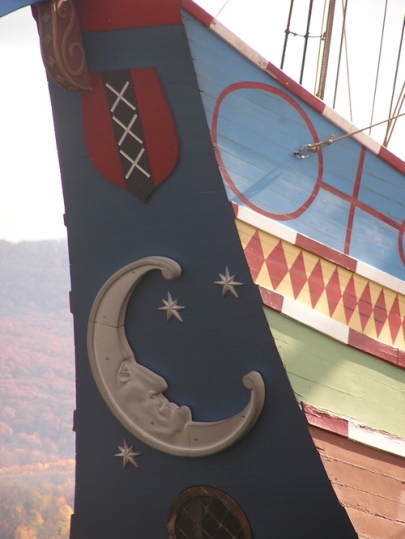
Tugster: A Waterblog features some nice shots, and a couple of stunning shots, of the reconstruction of Henry Hudson’s ship, Half Moon.  Great stuff for presentations, and he likes to share.

Tugster is an outstanding repository of images of tugboats, ships and other things related to the commerce of Greater New York Harbor, and boats on the water generally.  Tugster’s collection of images should be regular source material for teachers of history, economics, geography and government.

A Waterblog

Stern of Half Moon, Henry Hudson's ship; from Tugster: A Waterblog

Notice how the figurehead frightens even the trees to blazing red.

A Waterblog

Bowsprite of Henry Hudson's Half Moon, via Tugster: A Waterblog

Tugster tells us that Henry Hudson himself is blogging, channeling across 400 years — perhaps tired of duckpins with his crew in the Adirondacks (hello, Rip van Winkel!).  Can your students correspond with Henry Hudson?

Resources:


Arc of history under the St. Louis Arch

November 7, 2008

This is just so, so, so delicious.

Look at this photo.  It’s a shot of the crowd gathered in St. Louis on October 19 to see and hear Barack Obama — about 100,000 people.  Study the buildings in the photo.

Supporters of Barack Obama rally in St. Louis, Missouri, on October 19, 2008

Supporters of Barack Obama rally in St. Louis, Missouri, on October 19, 2008

See the building with the green dome?  Recognize it?

Elizabeth Kaeton wrote at Telling Secrets:

If you look in the distance there, you can see a building with a greenish-copper dome. That’s the Old St. Louis Courthouse. For years and years, slaves were auctioned on the steps of that courthouse.

The Old Courthouse used to be called the St. Louis State and Federal Courthouse.

Back in 1850, two escaped slaves named Dred and Harriett Scott had their petition for freedom overturned in a case there. Montgomery Blair took the case to the US Supreme Court on Scott’s behalf and had Chief Justice Roger Taney throw it out because, as he wrote, the Scotts were ‘beings of an inferior order, and altogether unfit to associate with the white race, either in social or political relations, and so far inferior that they had no rights which the white man was bound to respect.’

Hard to imagine, isn’t it?

What is rather uplifting is that, 158 years later, the man who will most likely be the first black US President was able to stand outside this very same courthouse and gather that crowd. Today, America looked back on one of the darkest moments in its history, and resoundingly told Judge Taney to go to hell.

That case is the first one I thought of when Sarah Palin got caught by Katie Couric unable to explain Supreme Court decisions with which she might have disagreed.  In re Dred Scott is right at the top of my list, and generally on the tip of my tongue.  We fought a great and bloody war to overturn that decision, amended the Constitution, bore another 100 years of atrocities, then passed the Civil Rights Act of 1964 and the Voting Rights Act of 1965, all to blot out the dreadful decision those conservative, activist judges wrought on the nation.

Kaeton posted the photo and comments last Saturday, before Freedom Tuesday when we voted as nation to clean up even more of the mess of the Dred Scott case.

History teachers:  I’ll wager that’s a photo you can get cheap, to blow up to poster size for your classrooms.  You ought to do it.  Students should not only understand history, they ought also be able to take delight in watching it unfold, especially when justice comes out of the unfolding.

Found the photo and post, with a tip of the old scrub brush to Blue Oregon, while looking at the astounding number of literary and history allusions in Obama’s unique victory speech, in which he talked about Americans trying to “bend the arc of history.”  I knew I’d heard that line before.  It’s from Martin Luther King, who saidm “The arc of history is long, but it bends toward justice.”  (Where did he say that?  When?)

Those allusions, and the speech, may be a topic for another post.

Resources:


Election Day 2008: Fly the flag, vote

November 4, 2008

Saint Louis Art Museum, St. Louis, Missouri George Caleb Bingham (American, 1811–1879). The County Election, 1852. Oil on canvas. 38 x 52 in. (96.5 x 132.1 cm). Gift of Bank of America.

Saint Louis Art Museum, St. Louis, Missouri George Caleb Bingham (American, 1811–1879). The County Election, 1852. Oil on canvas. 38 x 52 in. (96.5 x 132.1 cm). Gift of Bank of America.

Every polling place should be flying the U.S. flag today.  You may fly yours, too.  In any case, if you have not voted already, go vote today as if our future depends upon it, as if our nation expects every voter to do her or his duty.

Today the nation and world listen to the most humble of citizens.  Speak up, at the ballot box.

The whole world is watching.


U.S.S. Reuben James sunk October 31, 1941

October 31, 2008

October 31 hosts several famous anniversaries.  It is the anniversary of Nevada’s statehood (an October surprise by Lincoln for the 1864 campaign?).  It is the anniversary of the cleaving of western, catholic Christianity, as the anniversary of Martin Luther’s tacking his 95 theses to the door of the church in Wittenburg, Germany in 1517, the formal start of the Reformation.  Maybe the original Christian trick or treat.

U.S.S. Reuben James sinking, October 31, 1941 - National Archives photo

U.S.S. Reuben James sinking, October 31, 1941 - National Archives photo

October 31 is also the anniversary of the sinking of the World War I era Clemson-class, four-stack destroyer, U.S.S. Reuben James, by a German U-boat. Woody Guthrie memorialized the sad event in the song, Reuben James, recorded by the Almanac Singers with Pete Seeger (see also here, and here), and later a hit for the Kingston Trio.  The Reuben James was sunk on October 31, 1941 — over a month before the Japanese attack on Pearl Harbor. Details via Wikipedia (just to make you school librarians nervous):

USS Reuben James (DD-245), a post-World War I four-stack Clemson-class destroyer, was the first United States Navy ship sunk by hostile action in World War II and the first named for Boatswain’s Mate Reuben James (c.1776–1838), who distinguished himself fighting in the Barbary Wars.

This history figures into the current presidential campaign in a small way:  One of the internet hoax letters complaining about Barack Obama claims that the U.S. entered World War II against Germany although the Germans had not fired a single round against the U.S.  The 115 dead from the crew of 160 aboard the James testify to the inaccuracy of that claim, wholly apart from the treaty of mutual defense Germany and Japan were parties to, which required encouraged Germany to declare war upon any nation that went to war with Japan (see comments from Rocky, below).  After the U.S. declaration of war on Japan, Germany declared war on the U.S., creating a state of war with Germany.

This history also reminds us that many Americans were loathe to enter World War II at all.  By October 1941, Japan had been occupying parts of China for ten years, and the Rape of Nanking was four years old.  The Battle of the Atlantic was in full swing, and the Battle of Britain was a year in the past, after a year of almost-nightly bombardment of England by Germany.  Despite these assaults on friends and allies of the U.S., and the losses of U.S. ships and merchant marines, the U.S. had remained officially neutral.

Many Americans on the left thought the sinking of the Reuben James to be the sort of wake-up call that would push Germany-favoring Americans to reconsider, and people undecided to side with Britain.  The political use of the incident didn’t have much time to work.  Five weeks later Japan attacked Pearl Harbor, and by the end of 1941, the U.S. was at war with the Axis Powers.

Letter to the U.S. Navy asking the fate of friends aboard the U.S.S. Reuben James, November, 1941

Letter to the U.S. Navy asking the fate of friends aboard the U.S.S. Reuben James, November, 1941

Telegram informing his family of the death of Gene Guy Evans, of Norfolk, Virginia, lost in the torpedoing of the U.S.S. Reuben James

Telegram informing his family of the death of Gene Guy Evans, of Norfolk, Virginia, lost in the torpedoing of the U.S.S. Reuben James

The Kingston Trio sings, as the names of the dead scroll:


Harappa and Mohenjodaro sources

October 5, 2008

The Maharajah of Cashmere  The Illustrated London News  December 18, 1875  [From a longer story on the Prince of Wales visit to India in 1875.] With regard to the Maharajah of Cashmere, whose residence and political relations, beneath the Himalayas and in the Valley of the Upper Indus, are very remote from Bombay, we defer any notice of him till the Prince of Wales goes to visit him in Cashmere. The portrait of this Maharajah is from a photograph by Messrs. Bourne and Shepherd, of India.
The Maharajah of Cashmere The Illustrated London News December 18, 1875 (From a longer story on the Prince of Wales visit to India in 1875.) – “With regard to the Maharajah of Cashmere, whose residence and political relations, beneath the Himalayas and in the Valley of the Upper Indus, are very remote from Bombay, we defer any notice of him till the Prince of Wales goes to visit him in Cashmere. The portrait of this Maharajah is from a photograph by Messrs. Bourne and Shepherd, of India.”

World history teachers, bookmark this site:  Harappa.com

It’s a rich site about India and Pakistan, and includes information and images about the Harappa and Mohenjo-Daro civilizations.

Great images for your classrooms, or for your students’ projects.

Tip of the old scrub brush to John Maunu teaching AP World History in Grosse Ile, Michigan.

(Full text of description of site from the Asian Studies WWW Monitor below the fold.)

Read the rest of this entry »