Washington Times felled by DDT poisoning

June 9, 2010

Washington Times‘ owner, the Unification Church, put the paper up for sale earlier this year — tired of losing north of $30 million a year on the thing.  It appears that, in a cost-cutting move, the paper has laid off all its fact checkers and most of its editors.

And anyone with a brain.

DDT use in the U.S. peaked in 1959, with 70 million pounds of the stuff used in that year.  This ad comes from about that time.

DDT use in the U.S. peaked in 1959, with 70 million pounds of the stuff used in that year. This ad for a French product containing DDT comes from about that time.

How do we know?

Our old friend Stephen Milloy complains about Time Magazine’s “50 Worst Inventions” list, including, especially the listing of DDT, as discussed earlier.  It’s wrong, and silly.  Good fact checkers, and good editors, wouldn’t let such claptrap make it into print.

Milloy packed an astounding number of whoppers in a short paragraph about DDT:

From 1943 through its banning by the EPA in 1972, DDT saved hundreds of millions of lives all over the world from a variety of vector-borne diseases. Even when Environmental Protection Agency Administrator (and closeted environmental activist) William D. Ruckelshaus banned DDT in 1972, he did so despite a finding from an EPA administrative law judge who, after seven months and 9,000 pages of testimony, ruled that DDT presented no threat of harm to humans or wildlife. Today, a million children die every year from malaria. DDT could safely make a tremendous dent in that toll.

Let us count the errors and falsehoods:

1.  DDT was used against typhus from 1943 through about 1946, and against bedbugs; it saved millions, but not hundreds of millions. Death tolls from typhus rarely rose over a million a year, if it ever did.  Bedbugs don’t kill, they just itch.  If we add in malaria after 1946, in a few years we push to four million deaths total from insect-borne diseases — but of course, that’s with DDT being used.  If we charitably claim DDT saved four million lives a year between 1943 and 1972, we get a total of 117 million lives saved.  But we know that figure is inflated a lot.

Sure, DDT helped stop some disease epidemics.  But it didn’t save “hundreds of millions of lives” in 29 years of use.  The National Academy of Sciences, in a book noting that DDT should be banned because its dangers far outweigh its long-term benefits, goofed and said DDT had saved 500 million lives from malaria, and said DDT is one of the most beneficial chemicals ever devised by humans.  500 million is the annual infection rate from malaria, with a high of nearly four million deaths, but in most years under a million deaths.  Malaria kills about one of every 500 people infected in a year.  That’s far too many deaths, but it’s not as many lives saved as Milloy claims.

NAS grossly overstated the benefits of DDT, and still called for it to be banned.

The question is, why is Milloy grossly inflating his figures?  Isn’t it good enough for DDT to be recognized as one of the most beneficial substances ever devised?

My father always warned that when advertisers start inflating their claims, they are trying to hide something nasty.

2.  Ruckelshaus didn’t ban DDT on his own — nor was he a “closeted” environmentalist. He got the job at EPA because he was an outstanding lawyer and administrator, with deep understanding of environmental issues — his environmentalism was one of his chief qualifications for the job.  (Maybe Milloy spent the ’70s in a closet, and assumes everyone else did, too?)  But EPA acted only when ordered to act by two different federal courts (Judge David Bazelon ordered an end to all use of DDT at one of the trials).  At trial, DDT had been found to be inherently dangerous and uncontrollable.  Both courts were ready to order DDT banned completely, but stayed those orders pending EPA’s regulatory hearings and action.

In fact, regulatory actions against DDT began in the 1950s; by 1970, scientific evidence was overwhelming (and it has not be contradicted:

The U.S. Department of Agriculture, the federal agency with responsibility of regulating pesticides before the formation of the U.S. Environmental Protection Agency in 1970, began regulatory actions in the late 1950s and 1960s to prohibit many of DDT’s uses because of mounting evidence of the pesticide’s declining benefits and environmental and toxicological effects. Rachel Carson’s book Silent Spring in 1962 stimulated widespread public concern over the dangers of improper pesticide use and the need for better pesticide controls.

In 1972, EPA issued a cancellation order for DDT based on adverse environmental effects of its use, such as those to wildlife, as well as DDT’s potential human health risks. Since then, studies have continued, and a causal relationship between DDT exposure and reproductive effects is suspected. Today, DDT is classified as a probable human carcinogen by U.S. and international authorities. This classification is based on animal studies in which some animals developed liver tumors.

DDT is known to be very persistent in the environment, will accumulate in fatty tissues, and can travel long distances in the upper atmosphere. Since the use of DDT was discontinued in the United States, its concentration in the environment and animals has decreased, but because of its persistence, residues of concern from historical use still remain.

3.  Judge Sweeney ruled that DDT is dangerous to humans and especially wildlife, but that DDT’s new, Rachel-Carson-friendly label would probably protect human health and the environment. EPA Administrative Law Judge Edmund Sweeney presided at the hearings in 1971.  As in the two previous federal court trials, DDT advocates had ample opportunity to make their case.  32 companies and agencies defended the use of DDT in the proceeding.  Just prior to the hearings, DDT manufacturers announced plans to relabel DDT for use only in small amounts, against disease, or in emergencies, and not in broadcast spraying ever.  This proved significant later.

Judge Sweeney did not find that DDT is harmless.  Quite to the contrary, Sweeney wrote in the findings of the hearing:

20.  DDT can have a deleterious effect on freshwater fish and estuarine organisms when directly applied to the water.

21.  DDT is used as a rodenticide. [DDT was used to kill bats in homes and office buildings; this was so effective that, coupled with accidental dosing of bats from their eating insects carrying DDT,  it actually threatened to wipe out some species of bat in the southwest U.S.]

22.  DDT can have an adverse effect on beneficial animals.

23.  DDT is concentrated in organisms and can be transferred through food chains.

DDT use in the U.S. had dropped from a 1959 high of 79 million pounds, to just 12 million pounds by 1972.  Hazards from DDT use prompted federal agencies such as the Department of Agriculture and Department of Interior to severely restrict or stop use of the stuff prior to 1963.  Seeing the writing on the wall, manufacturers tried to keep DDT on the market by labeling it very restrictively.  That would allow people to buy it legally,  and then use it illegally, but such misuse can almost never be prosecuted.

Sweeney wrote that, under the new, very restrictive label, DDT could be kept on the market.  Ruckelshaus ruled that EPA had a duty to protect the environment even from abusive, off-label use, and issued a ban on all agricultural use.

4.  More DDT today won’t significantly reduce malaria’s death toll. Milloy fails to mention that DDT use against malaria was slowed dramatically in the mid-1960s — seven years before the U.S. banned spraying cotton with it — because mosquitoes had become resistant and immune to DDT.  DDT use was not stopped because of the U.S. ban on spraying crops; DDT use was reduced because it didn’t work.

Milloy also ignores the fact that DDT is being used today.  Not all populations of mosquitoes developed immunity, yet.  DDT has a place in a carefully-managed program of “integrated vector management,” involving rotating several pesticides to ensure mosquitoes don’t evolve immunity, and spraying small amounts of the pesticide on the walls of houses where it is most effective, and ensuring that DDT especially does not get outdoors.

To the extent DDT can be used effectively, it is being used.  More DDT can only cause environmental harm, and perhaps harm to human health.

Most significantly, Milloy grossly overstates the effectiveness of DDT.  Deaths from malaria numbered nearly 3 million a year in the late 1950s; by the middle 1960s, the death rate hovered near 2 million per year.  Today, annual death rates are under a million — less than half the death rate when DDT use was at its peak.  Were DDT the panacea Milloy claims, shouldn’t the death numbers go the other way?

Milloy gets away making wild, misleading and inaccurate claims when editors don’t bother to read his stuff, and they don’t bother to ask “does this make sense?”  Nothing Milloy claims could be confirmed with a search of PubMed, the most easily accessible, authoritative data base of serious science journals dealing with health.

Obviously, Washington Times didn’t bother to check.  Were all the fact checkers let go?

Even more lunatic

Milloy also attacked the decision to get lead out of gasoline.  Ignoring all the facts and the astoundingly long history of severe health effects from lead pollution, Milloy dropped this stinking mental turd:

As to leaded gasoline, we can safely say that leaded gasoline helped provide America and the world with unprecedented freedom and fueled tremendous prosperity. We don’t use leaded gasoline in the United States anymore, but more because people simply don’t like the idea of leaded gasoline as opposed to any body of science showing that it caused anybody any harm. It’s the dose that makes the poison, and there never was enough lead in the ambient environment to threaten health.

The U.S. found that getting lead out of gasoline actually improved our national IQ.  Lead’s health effects were so pervasive, there was an almost-immediate improvement in health for the entire nation, especially children, when lead was removed.  Denying the harms of tetraethyl lead in gasoline goes past junk science, to outright falsehood.

What is Milloy’s fascination with presenting deadly poisons as “harmless?”  Why does he hate children so?

Why do publications not catch these hallucination-like errors and junk science promotions when he writes them?

Antidote to DDT poisoning in humans:  Spread the facts:

Add to FacebookAdd to NewsvineAdd to DiggAdd to Del.icio.usAdd to StumbleuponAdd to RedditAdd to BlinklistAdd to TwitterAdd to TechnoratiAdd to Furl


Adventures in Condor land: Moonrise over Hopper Ranch

June 8, 2010

Moon over Hopper Ranch, by Amanda Holland

Moon over Hopper Ranch, by Amanda Holland

Kathryn’s cousin Amanda Holland writes from her great adventure helping to rescue the California Condor, with this photo of the Moon, behind clouds and haze, over the mountains, from Hopper Ranch.

Here’s where I feel the pangs of leaving biology behind for rhetoric, then politics and law.  Probably the best part of research in biology was the places one had to go.  The best adventures involve getting to and back from the places researchers must go to get data or samples.

And now, with electronic cameras and cards that will easily accommodate 1,000 photos, images are easy to capture.

Some of the images I wish I could get back:  Moonrise over Shiprock*; the rattlesnake who liked to hide in the equipment box at the New Mexico Agriculture Experiment Station; the field of asparagus at the Experiment Station, poking up through the desert for the first time (I wonder if they decided to grow asparagus); thunderstorms at Shiprock and over Kimberly, New Mexico; sunrise in Huntington Canyon, Utah; looking nearly into Nevada through crystal air after a summer thunderstorm near Seeley Mountain.  There are a lot more, really.

Adventures past: We remember them warmly.  Getting out in the wild, doing the hard, grunt work necessary to learn about endangered species, or save them, or just improve conservation practices, is close to godliness, and among the greatest pleasures life can offer.

More:

  • See this photo of Shiprock and Moon, probably by a photography named William Stone; this photo of Shiprock and storm, by Radeka, is good, too; at one time my job was to drive from Farmington, New Mexico, past the Shiprock everyday, to get air pollution samples.  The Shiprock rivals Mt. Timpanogos in my personal pantheon of great mountains I grew up with.

Dan Valentine – “Call me anti-American”

June 7, 2010

By Dan Valentine

Dear Hattip:

Call me anti-American.

When I was in high school, I entered an essay contest, sponsored by the Veterans of Foreign Wars, called Voice of Democracy.  I wrote about socialism, communism, and capitalism, and how all three were good systems.  With a hundred-or-so people!  Add five or ten more folks to the mix and all three tend to get corrupted.  All three have little or nothing to do with democracy.  I was awarded a prize.

Call me anti-American.

I joined the Navy to avoid going to Vietnam.  My three good friends at the time joined the Army.  They were sent to New Jersey.  The Almighty, She’s got a sense of humor.  I was sent to ‘Nam.

After boot camp, I caught a flight to Guam to catch my assigned ship, the USS Tanner, a survey ship.  It was at sea at the time, steaming from Pearl Harbor.  I caught pneumonia, killing time, in a sudden downpour on Gab-Gab Beach waiting for it.  Sent to the Naval Hospital to recoup.  The wards were filled with Marines, soldiers, sailors, and the like, with major combat wounds.  Some missing an arm; others, a leg.  Pneumonia or not, I was well enough to swing a mop.  So I was given the duty to sweep, swab, and buff the corridors and rooms.  The least I could do.

Call me anti-American.

I recovered, caught my ship.  To Vietnam.  Assigned to deck force.  Hell on earth, in small quarters.  If there’s a Devil, he or she taught boatswain mates all he or she knows.  And then some.

“Just out of boot camp?”  There were a handful of us.  “Welcome to the fleet!”  Initiation time.  One seaman apprentice, while chipping, sanding, and painting the side of the ship, was repeatedly lowered by chortling boatswain mates, down and up, down and up, repeatedly, into the water below, swarming with barracudas.  From that day forward, he was called Screamin’ Wiley.  Another was stripped naked and smeared with butter all over his exposed body, private parts included.  He was forever-after called Butterball.

I was assigned to stand mid-watch in the crow’s nest.  In a wind-storm.  I’m afraid of heights.  How did they know?  Their kind always knows.  Clouds fast-approaching were grumbling, lightning streaks flashing.  I was scared to death.  When the winds got to be too much, they brought me down.  I planted my feet firmly on the deck, smiling, happy as hell.  From then on, I was known as Smiley Face.  When I was first learning to man the helm (it was part of our duties, among others), a boatswain mate would stand nearby and kick me in the butt with his boot–wham!–whenever I went off course the slightest.  “Keep it on course, Smiley Face.”  Wham!  You soon learn to keep on course.

Call me anti-American.

I served two tours in Vietnam.  I was there the night the Tet Offensive began.  Tracer rounds flying.  One night I was standing the starboard or port watch when I thought I saw a swimmer in the water getting closer and closer to the ship.  With explosives?  General quarters!  Boats were lowered and percussion bombs were tossed all night long.  They never found a body.  If there was a swimmer, I like to think he or she is escorting American tourists around, telling them war stories, just as Americans in his or her shoes would.

Call me anti-American.

Another time I was on day-watch when a Vietnamese junk approached.  The Officer of the Deck, bullhorn in hand, warned those on aboard the junk to turn away.  I was told, if need be, to shoot the fellow at the helm, dead, on command.  The junk turned around.  To this day, I don’t know if I could have carried out the order.

Call me anti-American.

In Vietnam I wrote a book of short essays in my off-hours called Military Moods.  (Moments of Truth; Ports of Call; Christmas:  The Loneliest Day of the Year; etc.  One was:  Love Letter to a Country.)

Call me anti-American.

When the Tanner was decommissioned–my book of essays my ticket “outta here!”–I got assigned to the USS Canopus, a submarine tender, which supplied nuclear attack submarines with nuclear missiles to attack with.

I met the ship in Bremerton, WA, and we sailed to GITMO for a month-long series of sea exercises, preparing for future possible attacks, both chemical and nuclear.  As the ship’s journalist, with no duties other than to put out the ship’s newspaper, cruise book, and hometown news releases, I was assigned to save the Old Glory from radiation or chemical exposure.  Officers timed us with a clock-watch.  Drill after drill, I was killed, and I told myself if there ever was an attack, I was not going to die retrieving a piece of cloth.  But, being young at the time, I probably would have.  That’s why they draft nineteen-year olds.  When there is a draft.

Call me anti-American.

In the 80s, I worked for Sen. Orrin Hatch (R-Utah), in Washington, D.C., for half a decade.  Whenever there was a speech to be written “from the heart” (Flag Day, Memorial Day, Fourth of July, Veterans Day, both Washington’s and Lincoln’s birthdays, I was the one called upon to write it.

When a Senate colleague died, Republican or Democrat, I was the one called upon to write the floor statement “from the heart”.  The New York Times picked up one and reprinted parts of it, saying, “Such eloquence is seldom heard on the Chamber floor.”

Call me anti-American.

In the 90s, when my dad died and, later, when my mom died, I had their sealed-ashes placed in Arlington National Cemetery.  My dad–he was wounded on Guadalcanal–would have liked that.

Call me anti-American.

I was in Salt Lake when 9/11 happened.  I had canceled my flight back to New York to see a touring musical at the Capitol Theatre, or I would have been there when it happened.  When I did return, a week later, it just so happened to be the first day the subways were running again.  I caught one into town from the airport.  Dead silence all the way.  No one spoke a word.  Everyone was stunned.

I had moved up to the Upper West Side, two blocks from Lincoln Center, a couple of blocks to Central Park.  My New York ID, though, still listed my first home address there.  On Duane Street in Tribeca, only a stone’s throw away from the Towers.

I showed an armed National Guardsman my ID and walked to where the Towers once stood.  On the way, I stopped to take a look at my former residence.  There was a National Guardsman standing close by the entrance, armed and ready.

Across the street was a firehouse.  The firefighters there were the first to be called to the scene after the first plane hit the first building.  They were lucky.  They didn’t lose a single man or woman.

Further down the street, by Ground Zero, women were having their photos taken, hugging firemen, the nation’s new heroes.

The next day, I seriously thought about going to see an eye doctor.  I could barely see.  It was due to the debris in the air.

One day, shortly after, I paused on a street corner before crossing and motioned for a cabbie, speeding to catch the light before it turned, to continue on by.  He put his foot on the brake and motioned for me to cross.  I motioned for him to drive by.  He motioned for me cross.  Etc.  He was mid-eastern.

Call me anti-American.

Such courtesy between strangers and nationalities lasted, I’d say, less than a week.

Later on, one evening, I stopped for a drink at the Russian Tea Room.  Took a seat at the bar by a couple, sitting speechless and stunned, as everyone in town was.  The two paid their tab and left.  The bartender said, “That was Mel Brooks and Anne Bancroft.”  Elbow to elbow and I hadn’t even noticed.

Now paying some attention, I glanced around to see two older ladies at the end of the bar, enjoying themselves, laughing, drinking champagne.  They looked rather bedraggled.  But lots of folks did that first week or so.  That, and you never know who’s got money and who doesn’t in New York.  They could very well have been ga-zillionaires.

They weren’t.

They didn’t have a dime on ’em.  When they began to depart, without paying, a cocktail waitress blocked their path.  The bartender called the cops.  Two were there just like that!  There was a battle of wills.  Both women started kicking and scratching.  One of the cops had to physically throw one to the floor, cuffing her hands behind her.  He came over to me and asked if he could have my drink.  Sure!  He poured the contents on the scratches on his arm.

Call me anti-American.

March or April, 2010.  In Houston at an ATM drive-thru.  My dearest friend and I.  Waiting behind a souped-up pick-up with dark tinted windows.  On the back bumper, a sticker that read:  f-Obama.

I told my friend, Quick, get a pic of it, along with the license plate, on her cell camera, so we could call some city or county or state or federal agency.  But the vehicle zoomed off.  Scary stuff.  I fear for Obama’s life.

Call me anti-American.

Call me a little twerp, too.  Childish, self-hating, revolting, juvenile, and beyond shame.

I’ve been called worse.  When my son was four or so, he called me a bastard.  Out of the blue.  He’d heard it from his mother’s mum.  A truer statement has probably never been said about me.  I’ve done some terrible things in my life, looking back.  One or two beyond shame.  A good many of us, by the time we reach our 60s, have.

My dearest friend’s step-dad once called me “the stupidest person” he had “ever known” in his “entire life”, glaring at me with pure hatred from across a table at an International Pancake House one morning near NASA.  He was so mad I could see he wanted to take me by the neck and strangle me to death right then and there.  If Bin Laden had been eating pancakes in the booth next to us, her step-dead would have killed me first.  We were talking politics.  He’s a Republican.

But enough already.

Hattip, I wish you well.

Call me anti-American.

[Editor’s note:  View Hattip’s comment here.]


Remembering D-Day, in 2010

June 6, 2010

Encore posts:

D-Day:  66 years ago today

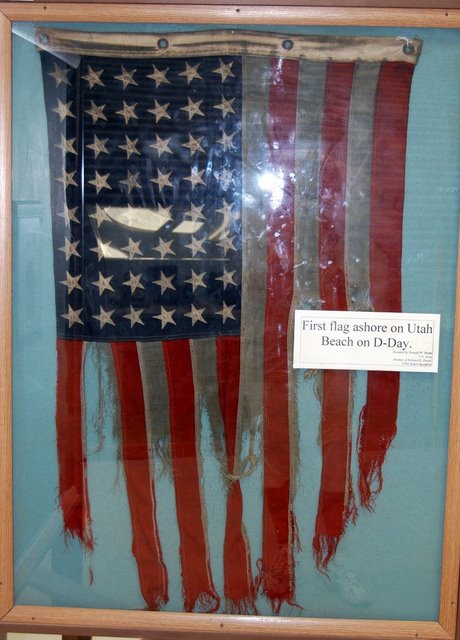
First Flag on Utah Beach, June 6, 1944

First U.S. flag on Utah Beach, Normandy, D-Day, June 6, 1944; Pima Air Museum, Tucson, Arizona

This mostly an encore post. A reader sent an e-mail with a question: Does U.S. law suggest the flying of the U.S. flag on the anniversary of D-Day?

Today is the 66th anniversary of the Invasion of Normandy in World War II, a date generally called D-Day. No, you don’t have to fly your flag. This is not one of the days designated by Congress for flag-flying.

But you may, and probably, you should fly your flag. If you have any D-Day veterans in your town, they will be grateful, as will their spouses, children, widows and survivors. A 22-year-old soldier on the beach in 1944 would be 87 today, if alive. These men and their memories of history fade increasingly fast. Put your flag up. You may be surprised at the reaction.

If you do run into a D-Day veteran, ask him about it. Keep a record of what he says.

First Wave at Omaha:  The Ordeal of the Blue and the Gray by Ken Riley:  Behind them was a great invasion armada and the powerful sinews of war. But in the first wave of assault troops of the 29th (Blue and Gray) Infantry Division, it was four rifle companies landing on a hostile shore at H-hour, D-Day -- 6:30 a.m., on June 6, 1944. The long-awaited liberation of France was underway. After long months in England, National Guardsmen from Virginia, Maryland and the District of Columbia found themselves in the vanguard of the Allied attack. In those early hours on the fire-swept beach the 116th Infantry Combat Team, the old Stonewall Brigade of Virginia, clawed its way through Les Moulins draw toward its objective, Vierville-sur-Mer. It was during the movement from Les Moulins that the battered but gallant 2d Battalion broke loose from the beach, clambered over the embankment, and a small party, led by the battalion commander, fought its way to a farmhouse which became its first Command post in France. The 116th suffered more than 800 casualties this day -- a day which will long be remembered as the beginning of the Allies Great Crusade to rekindle the lamp of liberty and freedom on the continent of Europe.  Image from National Guard Heritage series, from which the caption was borrowed.

"First Wave at Omaha: The Ordeal of the Blue and the Gray" by Ken Riley: Behind them was a great invasion armada and the powerful sinews of war. But in the first wave of assault troops of the 29th (Blue and Gray) Infantry Division, it was four rifle companies landing on a hostile shore at H-hour, D-Day -- 6:30 a.m., on June 6, 1944. The long-awaited liberation of France was underway. After long months in England, National Guardsmen from Virginia, Maryland and the District of Columbia found themselves in the vanguard of the Allied attack. In those early hours on the fire-swept beach the 116th Infantry Combat Team, the old Stonewall Brigade of Virginia, clawed its way through Les Moulins draw toward its objective, Vierville-sur-Mer. It was during the movement from Les Moulins that the battered but gallant 2d Battalion broke loose from the beach, clambered over the embankment, and a small party, led by the battalion commander, fought its way to a farmhouse which became its first Command post in France. The 116th suffered more than 800 casualties this day -- a day which will long be remembered as the beginning of the Allies' "Great Crusade" to rekindle the lamp of liberty and freedom on the continent of Europe. Image from National Guard Heritage series, from which the caption was borrowed.

Quote of the moment: Eisenhower on D-Day

Eisenhower talks to troops of invasion force, June 5 -- before D-Day[Encore post from 2007.]

Soldiers, Sailors, and Airmen of the Allied Expeditionary Force: You are about to embark upon the Great Crusade, toward which we have striven these many months. The eyes of the world are upon you.

Order of the Day, 6 June, 1944 (some sources list this as issued 2 June)

mmm


Who is that woman with Sen. Watkins, Sec. Benson and President Eisenhower?

June 5, 2010

Minor mystery, but still, it nags.

Who is the woman in this photo?  This is a chance to play history detective.

Sen. Arthur V. Watkins, Sec. of Agriculture Ezra Taft Benson, President Eisenhower, and unidentified woman, 9-9-1958, Shipler Photography image via Utah Hist Soc

Utah Sen. Arthur V. Watkins, Sec. of Agriculture Ezra Taft Benson, and President Dwight D. Eisenhower, with unidentified woman, on September 9, 1958. Photo by Shipler Commercial Photography, scanned at Marriott Library from the collection of the Utah Historical Society (which holds the rights).

I stumbled across the photo at the on-line archives of the Utah Historical Society.  At the time of this picture, Watkins was running for re-election in a race he would lose in November, in a three-way vote split, to Democrat Frank E. Moss.  Watkins had run afoul of very conservative Utah politics when he chaired the Senate select committee that investigated Sen. Joseph McCarthy, and recommended censure of McCarthy.

Ezra Taft Benson served as Eisenhower’s Secretary of Agriculture for the full eight years of Eisenhower’s administration.  Benson was an arch conservative, closely affiliated with the extreme right-leaning John Birch Society, which officially regarded Eisenhower as a bit of a traitor. Benson later served as President of the Church of Jesus Christ of Latter-day Saints (LDS, or Mormon).

Oddly, the picture doesn’t identify the woman.  She’s in a wheel chair.  The large stone columns suggest this is a government building, or monument.  The microphone is set at the level of the woman, so obviously she was speaking at this event, whatever it was.  In an election year, such a scene might be played out in the state of the election, Utah — but I suspect it was a Washington, D.C., venue (was Eisenhower in Utah in 1958?).  Shipler Photography was a Utah company, though — what would they be doing in Washington?

Who is that woman?  What was the event?  Where was it?

_______________

Update: Best guess so far:  Louise Lake, a polio victim from Salt Lake City, and “handicapped American of the year” for 1958. See comments.


Typewriter of the moment: Wallace Stegner

June 4, 2010

Wallace Stegner and his typewriter - KUED image

Wallace Stegner and his typewriter – KUED image (via What Fresh Hell Is This?)

Wallace Stegner's books, KUED imageI’ve lived with Wallace Stegner’s work since I first got to the University of Utah.  Stegner was the biographer of Bernard DeVoto, whose works I read in a couple of different classes.

More important, Stegner wrote about the West and wild spaces and places, and how to save them — and why they should be saved.

Salt Lake City’s and the University of Utah’s KUED produced a program on Stegner in 2009 — he graduated from and taught at Utah — a film that wasn’t broadcast on KERA here in Dallas, so far as I can find..

In conjunction with the University of Utah, KUED is honoring alumni Wallace Stegner – the “Dean” of western writers. WALLACE STEGNER, a biographical film portrait, celebrates the 2009 centennial of his birth. Wallace Stegner was an acclaimed writer, conservationist, and teacher. He became one of America’s greatest writers. His books include the Pulitzer Prize-winning “Angle of Repose” and “Beyond the Hundredth Meridian.” His “The Wilderness Letter” became the conscience of the conservation movement. Wallace Stegner mentored a generation’s greatest writers including Ken Kesey, Edward Abbey, and Larry McMurtry. Former Supreme Court Justice Sandra Day O’Connor was a student.

It’s difficult to tell from the photo, but his typewriter here looks a lot like a Royal.

Have you seen the film?

More:


Encore quote of the moment: George Washington on religious freedom

June 3, 2010

August 17, 1790, found U.S. President George Washington traveling the country, in Newport, Rhode Island.

Washington met with “the Hebrew Congregation” (Jewish group), and congregation leader (Rabbi?) Moses Seixas presented Washington with an address extolling Washington’s virtues, and the virtues of the new nation. Seixas noted past persecutions of Jews, and signalled a hopeful note:

Deprived as we heretofore have been of the invaluable rights of free citizens, we now (with a deep sense of gratitude to the Almighty disposer of all events) behold a government erected by the Majesty of the People–a Government which to bigotry gives no sanction, to persecution no assistance, but generously affording to All liberty of conscience and immunities of Citizenship, deeming every one, of whatever Nation, tongue, or language, equal parts of the great governmental machine.

George Washingtons reply to the Newport, RI, Hebrew congregation, August 17, 1790 - Library of Congress image

George Washington's reply to the Newport, RI, "Hebrew congregation," August 17, 1790 - Library of Congress image

President Washington responded with what may be regarded as his most powerful statement in support of religious freedom in the U.S. — and this was prior to the ratification of the First Amendment:

It is now no more that toleration is spoken of as if it was the indulgence of one class of people that another enjoyed the exercise of their inherent natural rights. For happily, the government of the United States, which gives to bigotry no sanction, to persecution no assistance, requires only that they who live under its protection should demean themselves as good citizens, in giving it on all occasions their effectual support.

Below the fold, more history of the events and religious freedom, from the Library of Congress.

Read the rest of this entry »


So, on June 2, 1924, all American Indians became citizens of the U.S.

June 2, 2010

English colonists, and then citizens of the new United States of America, regarded Native Americans as foreign groups, people of other lands. It’s part of a history of bad relations and bad faith between peoples on this continent that we gloss over with the good relations and good faith.

The whole story is important.  It’s been told, and told well, at the Library of Congress:

On June 2, 1924, Congress enacted the Indian Citizenship Act, which granted citizenship to all Native Americans born in the U.S. The right to vote, however, was governed by state law; until 1957, some states barred Native Americans from voting. In a WPA interview from the 1930s, Henry Mitchell describes the attitude toward Native Americans in Maine, one of the last states to comply with the Indian Citizenship Act:

One of the Indians went over to Old Town once to see some official in the city hall about voting. I don’t know just what position that official had over there, but he said to the Indian, ‘We don’t want you people over here. You have your own elections over on the island, and if you want to vote, go over there.

‘”The Life of Henry Mitchell,”
Old Town, Maine,
Robert Grady, interviewer,
circa 1938-1939.
American Life Histories, 1936-1940

Native Americans During Mathematics Class

Native Americans During Mathematics Class at Indian School, Carlisle, Pennsylvania

Native Americans During Mathematics Class, (detail)
Indian School, Carlisle, Pennsylvania,
Frances Benjamin Johnston, photographer, 1903.
Prints and Photographs Division

Previously, the Dawes Severalty Act (1887) had shaped U.S. policy towards Native Americans. In accordance with its terms, and hoping to turn Indians into farmers, the federal government redistributed tribal lands to heads of families in 160-acre allotments. Unclaimed or “surplus” land was sold, and the proceeds used to establish Indian schools where Native-American children learned reading, writing, and the domestic and social systems of white America. By 1932, the sale of both unclaimed land and allotted acreage resulted in the loss of two-thirds of the 138 million acres that Native Americans had held prior to the Dawes Act.

In addition to the extension of voting rights to Native Americans, the Secretary of the Interior commission created the Meriam Commission to assess the impact of the Dawes Act. Completed in 1928, the Meriam Report described how government policy oppressed Native Americans and destroyed their culture and society.

The poverty and exploitation resulting from the paternalistic Dawes Act spurred passage of the 1934 Indian Reorganization Act. This legislation promoted Native-American autonomy by prohibiting allotment of tribal lands, returning some surplus land, and urging tribes to engage in active self-government. Rather than imposing the legislation on Native Americans, individual tribes were allowed to accept or reject the Indian Reorganization Act. From 1934 to 1953, the U.S. government invested in the development of infrastructure, health care, and education, and the quality of life on Indian lands improved. With the aid of federal courts and the government, over two million acres of land were returned to various tribes.

American Indians of the Pacific Northwest

Salish man
Salish Man Named Paul Challae and Small Child,
Montana,
date unknown.

Salish couple

Salish Man and Woman Sitting on Rocks, Montana (?) (date unknown.)

Salish Man and Woman Sitting on Rocks,
Montana [?],
date unknown. 

Salish Woman and Children

Salish Woman and Children

Salish Woman and Children,
St. Ignatius Mission, Montana.
1924.

American Indians of the Pacific Northwest integrates over 2,300 photographs and 7,700 pages of text relating to Native Americans of two cultural areas of the Pacific Northwest. Many aspects of life and work — including housing, clothing, crafts, transportation, education, and employment, are illustrated in this collection drawn from the extensive holdings of the University of Washington Libraries, the Cheney Cowles Museum/Eastern Washington State Historical Society, and the Museum of History and Industry in Seattle.

And doesn’t that just frost the tar out of the birthers?  Herbert Hoover just five years later chose Charles Curtis to be  his vice presidential candidate, and Curtis served for four years.  Curtis, born in the Kansas Territory before it was a state, came from Native American ancestry.


Dan Valentine: Economic recovery? Check the cigarette butts and panty hose

May 30, 2010

By Dan Valentine

Good news! “The economy is growing again!” So said President Obama, just the other day.

Of course, his opponents would have you believe otherwise. But there are certain solid economic indicators that prove him right.

Like, for instance, cigarette butts.

That’s the word from a little-known tobacco expert who calls himself West Virginia Slim. When the economy went bust, he took time off from his job to tour North America–by thumb–after he found a pink slip on the desk of his corner office overlooking Broad & Wall.

I ran into him outside of Hussong’s Cantina here in Ensenada, said to be the oldest bar in the west. He was smoking a Cuban cigar.

And he says he has definite proof that the U.S. economy is, in the words of the President, “picking up considerable speed”. He can tell by the half-smoked cigarette butts strewn across the land.

“After the bust,” he told me during an exclusive interview, ‘cigarette butts flicked on the side of the nation’s streets were short. People took more puffs and got the most out of each cigarette before tossing it.”

But ever since Obama took office, he has noticed that the cigarette butts are getting, slowly but surely, longer. “People are throwing ‘em away, half-smoked,” he says.

30-foot cigarette butt in London - National Geographic photo

30-foot cigarette butt in London, England. Is this an indicator that England is undergoing a huge recovery? National Geographic photo

And this, he assures me, is definite proof, regardless of what the naysayers say, that good times are upon us.

Slim isn’t the only economic wizard who says so. A woman by the name of Gertrude, who made jillions in the stock market before she lost jillions in the market, can prove without a doubt that the country is, in Obama’s words, “beginning to turn the corner.”

Gertrude, who now makes a living as a waitress–she was here to buy duty-free Tequila to take back over the border–uses the “Parsley Principle” to judge prosperity, or the lack of it.

“During the last few months of Bush’s presidency,” says Gertrude, “customers ate the funny little green garnishes that chefs like to place on the sides of dishes as tho’ they were going out of style. Fact is, we couldn’t keep enough parsley in stock during the last days of the Bush Administration.”

But now, in Obama’s second year, very few people, if any, eat the tiny, little parsley garnishes. And this, she says, is a sure-sign that, in Obama’s words: ‘the worst of the storm is over.’”

Another economist, who uses a somewhat different barometer, says times are getting “much” better.

Her name is Olive. She spends a good part of her day going through suit pockets. She works in a dry cleaning establishment in L.A. It’s her job to empty the pockets of the suits before they are dry cleaned.

Says this full-time pocket-picker: “When times are good, people leave all sorts of coins in their pockets. But during bad times, practically no money can be found at all.”

Since the stimulus package was passed, says Olive, “the pocket-picking has been mighty good.” So good that she could afford a 3-day cruise from San Diego to Ensenada on the “Fun Ship”!

Interior of Hussong's Cantina, Ensenada, Mexico

Economics seminar at Hussong's Cantina, Ensenada, Mexico

Another little-known economic expert, a cop from Chicago, told me that he can measure the economic atmosphere of the nation by pantyhose.

He told me this over several rounds of Margaritas. (Some people drive hundreds of miles to visit the birthplace of Abe Lincoln. He flew hundreds of miles, here to Ensenada, to visit the birthplace of the Margarita. But, anyway …

Said this Chicago cop, after years on the force, “When times are good, bank robbers tend to wear expensive, luxury pantyhose over their heads to cover up their mugs. They like the confident, silky-soft feel that expensive pantyhose give them during a hold-up.”

But when times are bad bank robbers tend to buy generic or no-brand pantyhose for a bank job.

“I remember one time,” he told me, “during the last days of the Bush years, we arrested this bank robber at the scene of the crime and he had several runs in the pair of pantyhose pulled over his face. I really felt embarrassed for the fella.”

But the cop added: “Right now, since Obama took over, you hardly ever see a bank robber with runs.”

Add to FacebookAdd to NewsvineAdd to DiggAdd to Del.icio.usAdd to StumbleuponAdd to RedditAdd to BlinklistAdd to TwitterAdd to TechnoratiAdd to Furl


Wikipedia loses Sen. Arthur V. Watkins – can you help with the rescue?

May 30, 2010

Utah Sen. Arthur V. Watkins on the cover of Time Magazine, 1954; copyright Time, Inc.

Utah Sen. Arthur V. Watkins on the cover of Time Magazine, 1954 (copyright Time, Inc.) Can Wikipedia find enough information here to add to Watkins’s biography?  Are we really to believe a Time cover subject has disappeared from history?

Utah’s Sen. Arthur V. Watkins, a Republican, made the history books in 1954 when he chaired a special committee of the U.S. Senate that investigated actions by Wisconsin’s Sen. Joseph McCarthy with regard to hearings McCarthy conducted investigating communists in the U.S. Army.

This is all the biography at Wikipedia is, now, in May 2010:

Arthur Vivian Watkins (December 18, 1886 – September 1, 1973) was a Republican U.S. Senator from 1947 to 1959. He was influential as a proponent of terminating federal recognition of American Indian tribes.

[edit] References

  • Klingaman., William The Encyclopedia of the McCarthy Era, New York : Facts on File, 1996 ISBN 0816030979. Menominee Termination and Restoration [1]

[edit] External links

What is there is of little use.  It doesn’t even mention the work Watkins is most famous for, the brave action that brought him fame and electoral defeat, the censure of Sen. Joseph McCarthy during the Red Scare.  As a biography, it’s insultingly small, trivial, and misleading.

Here in Texas we have a school board that wishes to promote Joe McCarthy to hero status, to sweep under the rug the actual history of what he did, the inaccurate and vicious claims he made against dozens of people including his own colleagues in the U.S. Senate.  Good, readily available biographies of the people who stopped McCarthy, and good, readily available histories of the time can combat that drive for historical revisionism.

Wikipedia, in its extreme drive to prevent error, is preventing history in this case.  Wikipedia is no help.  For example, compare the article on Watkins with the article on Vermont Sen. Ralph Flanders, the man who introduced the resolution of censure against McCarthy. Flanders’s article is enormous by comparison, and no better documented. Why the snub to Watkins?

It’s odd.  Here I am providing a solid example of the evils of Wikipedia to warm the cockles of the heart of Douglas Groothuis, if he has a heart and cockles.   Facts and truth sometimes take us on strange journeys with strange traveling companions, even offensive companions.  Ultimately, I hope Wikipedia will wake up and choose to reinstate a useful and revealing biography of Watkins, to make Groothuis frostier than usual.

What to do?

Here is what follows, eventually below the fold:  I’ve copied one of the old biographies of Watkins from Wikipedia. Much of the stuff I recognize from various sources.  If there are inaccuracies, they are not intentional, nor are they done to impugn the reputation of any person (unlike the purging of Watkins’ biography, which unfortunately aides the dysfunctional history revisionism of Don McLeroy and the Texas State Soviet of Education).  I have provided some links to on-line sources that verify the claims.

Can you, Dear Reader, provide more and better links, and better accuracy?  Please do, in comments.  Help rescue the history around Sen. Watkins from the dustbin.

Will it spur Wikipedia to get its biographer act together and fix Watkins’s entry?  Who knows.

Here is the Wikipedia bio, complete with editing marks, and interspersed with some of my comments and other sources:

”’Arthur Vivian Watkins”’ (December 18, 1886 – September 1, 1973) was a Republican [[United States Senate|U.S. Senator]] from 1947 to 1959. He was influential as a proponent of terminating [[Federally recognized tribes|federal recognition]] of [[Native Americans in the United States|American Indian]] [[Indian tribe|tribes]] in order to allow them to have the rights of citizens of the United States.

Watkins’s life is available in basic outline form at a number of places on-line.  A good place to start is with the biographical directory of past members available from the U.S. Congress.  These sketches are embarrassingly short, but Watkins’s entry is four times the size of the Wikipedia entry, with about 20 times the information.  There is the Utah History Encyclopedia, with an article by Patricia L. Scott.  Her biography is copied by the Watkins Family History Society.

Watkins was born in [[Midway, Utah]]. He attended [[Brigham Young University]] (BYU) from 1903 to 1906, and [[New York University]] (NYU) from 1909 to 1910. He graduated from [[Columbia University Law School]] in 1912, and returned to Utah. There he was admitted to the bar the same year and commenced practice in [[Vernal, Utah]].

He engaged in newspaper work in 1914 (”The Voice of Sharon”, which eventually became the ”Orem-Geneva Times”, a weekly newspaper in [[Utah County, Utah|Utah County]].) [Sharon is an area in what is now Orem, Utah; the local division of the Church of Jesus Christ of Latter-day Saints is called the Sharon Stake, where Watkins was a member. ]In 1914 Watkins was appointed assistant county attorney of [[Salt Lake County, Utah|Salt Lake County]]. He engaged in agricultural pursuits 1919-1925 with a <span style=”white-space:nowrap”>600&nbsp;acre&nbsp;(2.4&nbsp;km²)</span> [[ranch]] near [[Lehi, Utah | Lehi]].

Watkins served as district judge of the Fourth Judicial District of Utah 1928-1933, losing his position in the [[Franklin Delano Roosevelt|Roosevelt]] Democratic landslide in 1932. An unsuccessful candidate for the [[Republican Party (United States)|Republican]] nomination to the Seventy-fifth Congress in 1936, Watkins was elected as a Republican to the [[United States Senate]] in 1946, and reelected in 1952. He served from January 3, 1947, to January 3, 1959. An [[Elder (LDS Church)|elder]] in [[The Church of Jesus Christ of Latter-day Saints]], Watkins was widely respected in Utah. {{Fact|date=August 2007}}

In 1954, Watkins chaired the committee that investigated the actions of Wisconsin Senator [[Joseph McCarthy]] to determine whether his conduct as Senator merited censure. As Chairman, Watkins barred [[television]] cameras from the hearings, and insisted that McCarthy conform to Senate protocol. When McCarthy appeared before the Watkins committee in September 1954 and started to attack Watkins, the latter had McCarthy expelled from the room.

This material comes from an oft-repeated, probably cut-and-pasted story, such as this biography of Watkins at the alumni association of his old high school, the experimental Brigham Young High.  It is confirmed in a thousand places, and one wonders why Wikipedia thought it undocumented, or inaccurate.  See Time’s contemporary report, for example (with a co-starring turn from a young Sen. Sam Ervin, D-North Carolina — the man who would later chair the Senate’s Watergate hearings).

The committee recommended censure of Senator McCarthy. Initially, the committee proposed to censure McCarthy over his attack on General [[Ralph Zwicker]] and various Senators, but Watkins had the charge of censure for the attack on General Zwicker dropped. The censure charges related only to McCarthy’s attacks on other Senators, and excluded from criticism McCarthy’s attacks on those outside of the Senate.

Watkins’s appearance on the cover of Time was the October 4, 1954, edition, reporting McCarthy’s censure.  The story accompanying that cover is here.  The Senate Resolution censuring McCarthy is designated as one of the 100 most important documents in American history by the National Archives and Records Administration — see the document and more history, here.  See more at the Treasures of Congress exhibit’s on-line version.

McCarthy’s anti-communist rhetoric was popular with Utah’s electorate, however. Former [[Governor of Utah|Utah Governor]] [[J. Bracken Lee]] took the opportunity in 1958 to oppose Watkins for the nomination in the senatorial election. Though Watkins won the Republican [[primary election|primary]], Lee ran as an [[independent (politics)|independent]] in the [[general election]]. This caused a split in the Republican vote and allowed Democrat [[Frank E. Moss]] to win the seat. Lee went on to a long career as [[mayor]] of [[Salt Lake City, Utah|Salt Lake City]]. Moss served three terms in the Senate, losing to Republican [[Orrin Hatch]] in 1976.

I’m not sure why Wikipedia’s editors rejected that historical paragraph.  Most of the points can be confirmed on Wikipedia, just following who sat where in the Senate.  Time Magazine covered the election shenanigans of 1958, with an article, “Feud in the desert,” detailing the fight between Watkins and Lee — July 14, 1958.

Watkins served as chair of the [[United States Senate Committee on Indian Affairs|Senate Interior Committee Subcommittee on Indian Affairs]]. He advocated [[Indian termination policy|termination]] of [[List of Native American Tribal Entities|Indian Tribal Entities]] in the belief that it was better for tribal members to be integrated into the rest of American life. He believed that they were ill-served by depending on the federal government for too many services.

Watkins called his policy the “freeing of the Indian from wardship status” and equated it with the Emancipation Proclamation, which freed slaves during the Civil War. Watkins was the driving force behind termination. His position as chairman of the Senate Subcommittee on Indian Affairs gave him tremendous leverage to determine the direction of federal Indian policy. His most important achievement came in 1953 with passage of House Concurrent Resolution No. 108, which stated that termination would be the federal government’s ongoing policy. Passage of the resolution did not in itself terminate any tribes.

That had to be accomplished one tribe at a time by specific legislation. The [[Bureau of Indian Affairs]] (BIA) began to assemble a list of tribes believed to have developed sufficient economic prosperity to sustain themselves after termination. The list was headed by the Menominee Tribe of Wisconsin. One reason the BIA chose the Menominee was that the tribe had successful forestry and lumbering operations which the BIA believed could support the tribe economically. Congress passed an act in 1954 that officially called for the termination of the Menominee as a federally recognized Indian tribe.

Termination for the Menominee did not happen immediately. Instead, the 1954 act set in motion a process that would lead to termination. The Menominee were not comfortable with the idea, but they had recently won a case against the government for mismanagement of their forestry enterprises, and the $8.5 million award was tied to their proposed termination. Watkins personally visited the Menominee and said they would be terminated whether they liked it or not, and if they wanted to see their $8.5 million, they had to cooperate with the federal government{{Fact|date=February 2009}}. Given this high-handed and coercive threat{{POV assertion|date=June 2009}}, the tribal council reluctantly agreed.

To set an example, Watkins pushed for termination of Utah Indian groups, including the Shivwits, Kanosh, Koorsharem, and Indian Peaks Paiutes. Once a people able to travel over the land with freedom and impunity, they were forced to deal with a new set of unfamiliar laws and beliefs. He terminated them without their knowledge or consent.

After Watkins left the Senate, he served as a member of the U.S. Indian Claims Commission from 1959 to 1967. He retired to Salt Lake City, and in 1973, to Orem.

In 1969 Watkins published a book about his investigation of McCarthy, ”Enough Rope: The Inside Story of the Censure of Senator Joe McCarthy by his Colleagues: The Controversial Hearings that Signaled the End of a Turbulent Career and a Fearsome Era in American Public Life”, (Englewood Cliffs, New Jersey: Prentice-Hall, 1969).

It’s astounding to me that mentions of Watkins’s book would be struck by Wikipedia, as if it were questionable that Watkins and the book ever existed.  Did the editor who cut that reference doubt sincerely?

Caption from the Utah Historical Society: Arthur Watkins (seated, center), a United States Senator from Utah, is shown here at a book signing for his book, "Enough Rope" at Sam Weller's Bookstore."Enough Rope" was a book about Joe McCarthy and the red scare. Rights management Digital Image (c) 2004 Utah State Historical Society. All Rights Reserved. (use here allowed by UHS, for education)

Caption from the Utah Historical Society: Arthur Watkins (seated, center), a United States Senator from Utah, is shown here at a book signing for his book, “Enough Rope” at Sam Weller’s Bookstore.”Enough Rope” was a book about Joe McCarthy and the red scare. Rights management Digital Image (c) 2004 Utah State Historical Society. All Rights Reserved. (use here allowed by UHS, for education)

State and local historical groups curate remarkable collections of images, now digitized and available free, online.  The Utah Historical Society offers a wealth of images in their collection.  Among them, we find a 1969 photograph of former-Sen. Watkins at a book signing at Sam Weller’s Zion Bookstore, the Salt Lake City monument to bookophilia and still one of the best bookstores in the world.  (Mormons read a lot, but Weller’s is not an official outlet of Mormon ideas; the store is a bastion of learning in a learned culture that pushes the envelope by challenging that culture at many turns; Weller’s bookstore is a nightmare to people who wish to cover up history).  Watkins is the guy seated at the table signing books — the other two men are not identified.  What more proof would one need of the existence of the book?

The book is referenced at the U.S. Congress biographical guideYou can find it at Amazon.com, though you’d have to buy it used or remaindered (hey! Call Sam Weller’s Zion Bookstore!)

A project of the [[United States Bureau of Reclamation|U.S. Bureau of Reclamation]], the Arthur V. Watkins Dam north of [[Ogden, Utah]], created Willard Bay off of the [[Great Salt Lake]]

U.S. Bureau of Reclamation, Christopher J. McCune, “The Weber Basin Project,” Historic Reclamation Projects Book; accessed May 29, 2010.  Scientific Commons lists Watkins’s papers, at Brigham Young University.  That listing can lead you to the Western Waters digital library, which contains an astonishing amount of information, including photos and newspaper clippings.   Watkins’s lifelong work in water and irrigation was the spur to name the BuRec dam after him.  (The Western Waters Digital Project is a good exemplar of the exquisite detail possible in a publicly-available, online archive.)

Watkins died in [[Orem, Utah]].

His son, Arthur R. Watkins, was a professor of German at [[Brigham Young University]] for more than 25 years.

I offered material to Wikipedia’s article on Watkins more than two years ago, when I discovered the article was little more than a repeat of the Congressional biography guide.  At the time I had a couple of inquiries from reporters and others watching elections in Utah, especially the reelection of Orrin Hatch, to the seat Watkins held (from 1946 to today, that seat has been held by just three people, Watkins, Ted Moss, and Hatch).  It was historical curiosity.

Recently in Texas we’ve seen that absence of good history can lead to distortions of history, especially distortions in the history to be taught in public schools.  It would serve the evil ends of the Texas Taliban were Arthur V. Watkins to be “disappeared” from history.  (See this astoundingly biased account from a guy named Wes Vernon; according to Vernon, McCarthy was improperly lynched.)

Let’s not let that happen, at least, not at Wikipedia.

_____________

Update: A reader more savvy than I in the ways of Wikipedia has restored most of the old biography.  Now it’s an effort to beef up references.

Wow.  Ask, and it’s done.  Good friends make things much better.

Add to FacebookAdd to NewsvineAdd to DiggAdd to Del.icio.usAdd to StumbleuponAdd to RedditAdd to BlinklistAdd to TwitterAdd to TechnoratiAdd to Furl

Save

Save


Dan Valentine – Moses parts the Red Sea, in Nashville

May 29, 2010

By Dan Valentine

Back to Nashville again and my one-night stand. (Never been fond of one-night stands. Who can stand that long?)

The doors of Operation Stand Down opened up. I had an MCI calling card on me with a few remaining minutes on it, in case an emergency should arise. Standing at a pay phone, I called my sister, Valerie, in France. Told her my predicament.

“Broke!!! Danny, how can you be broke?”

“I only have a few minutes on my card, Val.”

“Homeless! Danny, how did you become homeless!”

“Val, you’re using up my few remaining minutes.”

“Nashville! What are you doing in Nashville?”

(To be fair to my sister, I had said almost the very same things to my brother, Jimmy, when he was in need. If you’ve never been homeless, you don’t have a clue.)

“Money?!” she said. “I don’t have any.”

That was news to me. Last I heard she was a millionaire. Just like I once was. Well, stuff happens, as they say.

“Just $600! For the hostel here. For a month’s stay.”

Well, to make a long, minute-munching call short, she said she’d see what she could do.

Tossing my card in the nearest trash–no remaining minutes left–I made my way to the hostel where I had stayed for a month before going bust. I told Ron, the owner, my plight. Told him my sister was sending money. He offered me board and breakfast in exchange for helping out at the hostel.

That morning I had waffles with Nutella. Most enjoyable, to say the least.

I had a Net 10 cell phone, with minutes on it. Not usable for calls overseas. I phoned an old friend from my New York days. Don’t ask me why.

“Danny!!!” She was happy to hear from me. She is a composer. Very talented. She’s a graduate from the Manhattan School of Music. We were teamed together at the BMI Musical Workshop. We collaborated on what I think are some very good songs. Only one prob: She’s a multiple. Besides her wonderful, talented self, she has some six different, distinct personalities. Each with her/his own, individual name. Of course!

And only one writes music!

One personality acts as protector, one is an elderly woman, one is a little boy, one manages all the others. The last, a very important role–time-consuming!

Not to disturb anyone, I walked from the hostel, cell in hand, to the end of the block, telling her my plight of the last few nights, when suddenly a “crazy black man”, brandishing a baseball bat in his fist, came storming out of the bushes, screaming obscenities and more at me. My talking must have disturbed his sleep–what little sleep a homeless person gets. I could sympathize.

He was in attack mode. I backed away, told my former New York partner what was happening. She could hear him screaming at me. “Gotta go,” I said. “Call you right back.”

He chased me to the edge of the hostel grounds. Like a fool, I screamed, “Help, police! Someone call the police!”

A couple came out of one of the dorms. Saw me. Saw him. Stepped back inside.

Lesson learned: Never shout Police! Shout Fire!

Finally, after what seemed an eternity, the enraged man shouted one or two more remaining things on his mind and walked down the street, out of view, with his bat.

Whew! Close call! I phoned my friend back. And she (the protector, the manager, pick one from a hat) said, “I’m sorry, Danny, but I can’t take the stress!”

She can’t take the stress?!!

“I’m at a very sensitive time in my life.”

So is I!!, to coin a phrase.

“I’d prefer it if you wouldn’t call. Take care, Danny.” Don’t take any wooden nickels.

Click.

A couple of days later I’m walking down a busy street in Nashville, close by Vanderbilt University, when I hear a booming voice in back of me. “Mutherf**kers, clear the way. I’m comin’ through.”

I recognized the voice immediately. It was him! Baseball bat in hand.

He walked by, not knowing me from Adam. Just another white man in a sea of white faces. The enemy. All of us, a major threat. One call on a cell and he could be arrested. For what? Pick a charge out of a white cop’s helmet. Whites are given warnings. I was. Black men are rounded up, locked up, and the key thrown away. It happens! That little bit of knowledge alone can make you crazy.

I watched him walk down the street, head held high, shoulders back, baseball bat in hand. Proud. Bottom of the ninth. Team down four-zip. Bases loaded. Two outs.

Without hesitation, all along the boulevard, couples window-shopping; coeds on their way to class (on their cells, tweeting, of course); businessmen and women scurrying to luncheons; camera-toting tourists, with sites to pose in front; they all cleared a wide, wide path for him.

Moses, baseball bat in hand, parting the Red Sea.

And I like to think: It gave him great joy!


Republicans snub Vietnam vet (again – Connecticut this time)

May 29, 2010

Details here, with Gail Collins.


Memorial Day 2010: Fly your flag, study history, honor the dead

May 29, 2010

(Much of this post is encore material, from Memorial Day 2009.)

Please fly your flag this weekend, and especially Monday, to honor those who gave up their lives in defense of the nation and our freedoms.

Memorial Day, traditionally observed on May 30, now observed the last Monday in May, honors fallen veterans of wars. Traditionally, family members visit the cemetery where loved ones are interred and leave flowers on the grave.

Memorial Day honors people who died in defense of the nation.  Armed Forces Day honors those who serve currently, celebrated  the third Saturday in May.  Veterans Day honors the veterans who returned.

On Memorial Day itself, flags on poles or masts should be flown at half-staff from sunrise to noon. At noon, flags should be raised to full-staff position.

When posting a flag at half-staff, the flag should be raised to the full-staff position first, with vigor, then slowly lowered to half-staff; when retiring a flag posted at half-staff, it should be raised to the full staff position first, with vigor, and then be slowly lowered. Some people attach black streamers to stationary flags, though this is not officially recognized by the U.S. Flag Code.

On Memorial Day, 3:00 p.m. local time is designated as the National Moment of Remembrance.

Got another week of school? Here’s a quiz about the history of Memorial Day that might make a warm-up, provided by Carolyn Abell writing in the Tifton (Georgia) Gazette:

1. Memorial Day was first officially proclaimed by a general officer. His name was: A. Robert E. Lee; B. John A. Logan; C. Douglas MacArthur D. George Washington.

2. The first state to officially recognize Memorial Day was A. Virginia; B. Rhode Island; C. New York; D. Georgia.

3. The use of poppies to commemorate Memorial Day started in A. 1870 B. 1915 C. 1948; D. 1967.

4. The original date of Memorial Day was A. May 30; B. July 4; C. May 28; D. Nov 11.

5. Which U.S. Senator has tried repeatedly to pass legislation that would restore the traditional day of Memorial Day observance? A. John McCain B. Ted Kennedy C. Saxby Chambliss D. Daniel Inouye.

The answers, again provided by the Tifton Gazette:

OK, now for the answers. General John Logan, national commander of the Grand Army of the Republic, proclaimed May 30, 1968 as Memorial Day in his General Order Number 11, issued on May 5, 1868. The purpose was to honor the dead from both sides in the War Between the States. Subsequently flowers were placed on the graves of both Union and Confederate soldiers in Arlington National Cemetery on May 30 of that year.

New York was the first state to officially recognize the Memorial Day, in 1873. Southern states, though paying tribute to their dead on separate dates, refused to use May 30 as the official date until after World War I, when the holiday was broadened to honor those who died in any war.

In 1915 a woman named Moina Michael, inspired by the poem, “In Flanders Fields,” (by Canadian Colonel John McRae) began wearing red poppies on Memorial Day to honor our nation’s war dead. The tradition grew and even spread to other countries. In 1922 the VFW became the first veterans’ organization to sell the poppies made by disabled veterans as a national effort to raise funds in support of programs for veterans and their dependents. In 1948 the US Post Office issued a red 3-cent stamp honoring Michael for her role in founding the national poppy movement.

As stated above, May 30 was the original Memorial Day. In 1971, with the passage of the national Holiday Act, Congress changed it so that Memorial Day would be celebrated on the last Monday of May. Some citizens feel that turning it into a “three-day weekend” has devalued the importance and significance of this special holiday. In fact, every time a new Congress has convened since 1989, Senator Daniel Inouye of Hawaii has introduced a bill to the Senate calling for the restoration of May 30th as the day to celebrate Memorial Day.

In his 1999 introductory remarks to the bill, Senator Inouye declared:

“Mr. President, in our effort to accommodate many Americans by making the last Monday in May, Memorial Day, we have lost sight of the significance of this day to our nation. Instead of using Memorial Day as a time to honor and reflect on the sacrifices made by Americans in combat, many Americans use the day as a celebration of the beginning of summer. My bill would restore Memorial Day to May 30 and authorize the flag to fly at half mast on that day.

In addition, this legislation would authorize the President to issue a proclamation designating Memorial Day and Veterans Day as days for prayer and ceremonies honoring American veterans. This legislation would help restore the recognition our veterans deserve for the sacrifices they have made on behalf of our nation.” (from the 1999 U.S. Congressional Record).

Flat at half-staff, U.S.Capitol in background - from Flag Bay

Other sources:

Image of flag and U.S. Capitol from Flags Bay.


Why Texas social studies standards matter: Tea Party misuse of history

May 27, 2010

Something to think about from “The Tea Party Challenge,” by Erik Christiansen and Jeremy Sullivan, at Inside Higher Ed:

When considering the political scene of the moment, it is difficult not to see how historical allegory plays an important role in the public spectacle known as the Tea Party movement. From the name itself, an acronym (Taxed Enough Already) that fuses current concerns to a patriotic historical moment, to the oral and written references by some of its members to Stalin and Hitler, the Tea Party appears to be steeped (sorry) in history. However, one has only to listen to a minute of ranting to know that what we really are talking about is either a deliberate misuse or a sad misunderstanding of history.

Misuse implies two things: first, that the Partiers themselves know that they are attempting to mislead, and second, that the rest of us share an understanding of what accurate history looks like. Would that this were true. Unfortunately, there is little indication that the new revolutionaries possess more than a rudimentary knowledge of American or world history, and there is even less reason to think that the wider public is any different. Such ignorance allows terms like communism, socialism, and fascism to be used interchangeably by riled-up protesters while much of the public, and, not incidentally, the media, nods with a fuzzy understanding of the negative connotations those words are supposed to convey (of course some on the left are just as guilty of too-liberally applying the “fascist” label to any policy of which they do not approve). It also allows the Tea Partiers to believe that their situation – being taxed with representation – somehow warrants use of “Don’t Tread On Me” flags and links their dissatisfaction with a popularly elected president to that of colonists chafing under monarchical rule.

While the specifics of the moment (particularly, it seems, the fact of the Obama presidency) account for some of the radical resentment, the intensity of feeling among the opposition these days seems built upon a total lack of historical perspective.

It’s worth a read at Inside Higher Ed.

Tip of the old scrub brush to the May History Carnival at the Vapour Trail.


Dan Valentine – From the files

May 27, 2010

By Dan Valentine

I had to toss most of my writing when I become homeless again, box after box, file after file, each filled to capacity with hand-scribbled note upon note on menus, cocktail napkins, matchbook covers, etc.

I was hoping I had transcribed much of it onto my laptop. Not to be. Tho’ I did find file upon file with other notes. Files tagged D.C., Dad, Driving, Mom, Vietnam, 1950s, Hatch, NYC, so on and so on.

(My friend swims. I take notes.)

From the Friendswood, TX. file: “Goodbye, Motel 6! It’s been real!! My bestest friend to the dogs: ‘Girls, we’re moving.’ Excited. “Yes, we’re moving.”

From the Friendswood file: “3 bed, 2 bath, heated in ground pool, ceramic tile throughout, granite counter tops, 2 car detached garage, covered porch, 14,4050 sq. ft. treed lot, formal living room, formal dining room; refrigerator, washer, and dryer, 2,111 sq. ft, built in 1969, in the Wedgewood neighborhood.”

From the file: “Woke up to hear a woodpecker pecking in the backyard, the sound leaf-blowers in front …”

From the file: “Watched (my friend) swim: one arm floating out of the water, the other following. The dogs barking and chasing after her on the side of the pool. A Rockwell painting.

From the file: “Vote for Delay signs are popping up all over our neighborhood. Delay!! He’s our representative.

From the file: “Not a place where you take a stroll. Had a beer can thrown at my head from a passing car. Couple of weeks ago, a firecracker.”

I had forgotten about that. That’s why I take notes.

From the file: “I-Hop. Dinner. Gay waiter took our order. Black, with two earrings. Name tag: Peaches. Wife to her husband in next booth: ‘And they let him have his name on his name tag? I mean, this is a family restaurant, for f**k sake!’ Idea for sit-com: Peaches in Pearland. Black Will and Grace, Texas-style.”

From the file: Texan complaining in the supermarket check-out line about how much it had cost him to fill up his SUV. Gas was getting so expensive that he’d given up driving his truck at night and was using his motorcycle instead.”

From the file: “Line for future song: Clearing brush gives Texans a rush”

From the file:

“Sign: Moving boxes. (I picture people inside chasing after them.)

“Sign on back of school bus: Watch for Children. (As if they may harm you.)

“Sign in window: Office space available. Welcome to month-to-month! Says it all about the present times. You know it! We know it! Let’s not play games! Your business is going to fail!)”

From the file: “Mosquitoes out in force.”

From the file: “For sure, Texans are friendly. I’m standing at the urinal in the Men’s room at the Olive Garden when a jovial Texan bursts through the door. ‘Howdy!–as if he were greeting a buddy at a rodeo.’”

From the file: “Idea for the perfect Texas business: Bar-B-Que Motors.”

From the file: “Mosquitoes everywhere.”

From the file: “Just returned from Veterans Hospital. Took me 40 buses. Houston. No decent transit system. And proud of it!”

From the file: “Bumper sticker seen on back of car: Vote against Metro-rail! Stop the homeless before they get to our neighborhoods.”

And so on and so on …