#1 hoax site on the web

July 5, 2009

This may be the #1 hoax site on the web:  Martinlutherking.org. Certainly it is a site dangerous for children, because it cleverly purports to be an accurate history site, while selling voodoo history and racism.

A racist group bought the domain name (note the “.org” suffix), and they’ve managed to keep it.  The site features a drawing of Martin Luther King, Jr., on the first page.  The racist elements are subtle enough that unwary students and teachers may not recognize it for the hoax site it is.

It is both racist and hoax:  Note the link to a racist argument on “Why the Martin Luther King, Jr., holiday should be repealed;”  note the link to a hoax page, “Black invention myths.”

Students, nothing on that site should be trusted. Teachers, warn students away from the site.  You may want to use that site as a model of what a bad site looks like, and the importance of weighing the credibility of any site found on the web.

Why do I even mention the racist, hoax site? Because it comes upi #3 on Google searches for “Martin Luther King.”  Clearly a lot of people are being hoodwinked into going to that site.  I’ve seen papers by high school students citing the site, with teachers unaware of the site’s ignoble provenance.

Update: The site is owned by Stormfront, a white supremicist organization.

Here are a few good sites on the Rev. Dr. Martin Luther King, Jr.; you can help things by clicking on each one of these sites, and by copying this list with links and posting it on your blog:

More resources:


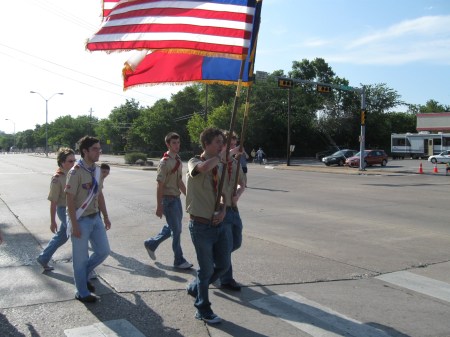
Scouts show the colors, Duncanville, Texas

July 4, 2009

Scouts from Troop 355 and Pack 494 carry the colors in the Duncanville, Texas, 4th of July parade

Scouts from Troop 355 and Pack 494 carry the colors in the Duncanville, Texas, 4th of July parade


Fly your flag today, July 4, 2009

July 4, 2009

Soldiers raise the U.S. flag at a base in Afghanistan, 2003

Soldiers raise the U.S. flag at a base in Afghanistan, 2003

It’s the 233rd anniversary of the announcement of the Declaration of Independence.  The resolution calling for independence of the 13 colonies passed the Continental Congress on July 2, 1776.  The Declaration would be Thomas Jefferson’s crowning achievement, outshining even his presidency and the Louisiana Purchase.   John Adams wrote to his wife, Abigail, that July 2 would forever be marked by patriotic displays.

But the Declaration, which gave teeth to the resolution, was adopted on July 4.  Adams didn’t miss a beat.  Who quibbles about a couple of days when the celebrating is so good?

Adams and Jefferson were two of the five-member committee the Congress had tasked to write a declaration.  Adams and Ben Franklin quickly determined to leave it up to Jefferson, who had a grand flair with words, and who had just written a couple of stirring documents for Virginia.  Roger Sherman and Robert Livingston, the other two members, went along.

Adams and Jefferson became friends only later, when they both served the nation at war as ambassadors to France, and then for Adams, to England.  A widower, Jefferson was taken in by Abigail Adams who worried about him.  After the war, Jefferson was in England when Adams was to meet King George III in a grand ceremony in which the king would accept the credentials of all the ambassadors of foreign nations to England.  As the king strode down the line, each ambassador or delegation would bow, the king would acknowledge them, the papers would be passed, and the king would move on.  Adams and Jefferson bowed.  King George moved on, ignoring them completely.

In such a case of such a snub, the snubbed foreigners usually made a quick exit.  Adams and Jefferson did not.  They stood at attention as if the king had treated them like all the rest, reversing the snub.

Back in America in peacetime, Adams and Jefferson fell out.  Jefferson favored a more limited federal government; Adams favored a more powerful one.  By the end of Washington’s second term, party politics had been well developed.  Adams defeated Jefferson in the election of 1796.  As was the law then, Jefferson was vice president; but Adams kept Jefferson out of all government affairs.  Perhaps because he didn’t have Jefferson to help, Adams’s presidency did not go well.  In the rematch election in 1800, one of  the bitterest fights ever, Jefferson’s party defeated Adams.  The gleeful Democratic-Republican electors all voted one ballot for Jefferson, the presidential candidate, and one ballot for Aaron Burr, the party’s vice presidential candidate.

Alas, that produced a tie vote in the electoral college.  Adams’s party, the Federalists, still held the House of Representatives before the new Congress came in.  A tie vote goes to the House for decision.  They could not bring themselves to vote for Jefferson, and the deadlock continued for 37 ballots.  Finally Jefferson’s arch enemy Alexander Hamilton intervened, explaining that Burr was clearly the greater scoundrel, and the House elected Jefferson.  Adams slunk out of town, avoiding the inauguration.

It wasn’t until after 1809 when Benjamin Rush hoodwinked Jefferson into writing to Adams, and Adams to Jefferson, that the two became friendly again.  For the next 17 years Jefferson and Adams carried on perhaps the greatest series of correspondence in history between two great minds.  Letters went out almost daily.  They discussed the weather, their families, old times, farming — but especially the republic they had been most instrumental in creating, and how it might be preserved, and prosper.  Eventually the letters became harder to read, both because their eyesight was failing, and because their penmanship deteriorated, too.

The ideas, however, flowed like a river.

Both men took ill early in 1826.  This was a landmark year, 50 years since the Declaration of Independence.  In Massachusetts, a grand display of fireworks was to cap off a day of feasting and celebration.  Adams hoped he might attend.  In Virginia, a week before, it became clear Jefferson was too ill to venture even as close as Charlottesville for the celebration.  Jefferson slept through most of July 3, but awoke about 9:00 p.m., and asked, “This is the fourth?”  It was not.  These are the last significant, recorded words of Jefferson.  He awoke at about 4:00 a.m. on the Fourth of July, 1826, but could not make a rally.  He died at 12:50 in the afternoon.

Adams, too, was too ill to attend the celebrations.  In the late afternoon or early evening of the Fourth, he awoke, and heard the celebration in the town.  Almost as if he had worked just to live to see that particular day, he checked the date.  Realizing he was near the end, happy that he’d seen 50 years after the Declaration, and unaware of the events earlier that day in Virginia, Adams said, “Thomas Jefferson still survives.”

Fly your flag today. Remember John Adams and Thomas Jefferson.  Remember their great work in creating the nation that protects our freedoms today.  Remember their great friendship.  Write a letter to a good friend you’ve not written to lately.

It’s the Fourth of July.  Their spirit survives in us, as we celebrate, and as we remember why we celebrate.


Happy birthday, Kathryn!

July 4, 2009

Fireworks in Texas - supposedly in Addison, but I cant figure where

Fireworks in Texas - supposedly in Addison, but I can't figure where

I used to tell the kids their mother was so beloved that the town set off fireworks every year on her birthday.  They probably didn’t believe the cause, but the town did, indeed, set off fireworks on her birthday.  I don’t always do the best planning, but at least I don’t ever forget Kathryn’s birthday — I cannot forget it.

We saw a lot of great displays on the Fourth of July in Washington, D.C., and a fantastic show one year out on the water in Baltimore’s harbor, right over Fort McHenry where Francis Scott Key was inspired to write his now-famous poem.  One year with brother Wes and his wife, Momie, we watched bluebirds all day, and then stayed for the fireworks at the Yorktown Battlefield, where Cornwallis was cut off by George Washington and the Continental Army with a grand assist from the French fleet.

We’ve seen great shows in Dallas, a bunch of shows in Duncanville, Texas, and Ogden, Utah, and we saw a part of a show in Addison, Texas, before the rain and wind shut it down (no, I can’t figure out where that photo came from, either) — and that doesn’t count all those shows before we met.  New York City, Hyde Park, from the parking lot of the Veterans Administration Hospital in Salt Lake City, overlooking Liberty Park, Derks Field, and a dozen other displays across the valley; from Wahkara Ridge, high up in Payson Canyon, catching the displays from Payson, Springville, Spanish Fork and Provo, Utah; and right there in Cougar Stadium in Provo.  Ohio, Michigan, Idaho, upper New York State, and probably a few other places we’ve forgotten about.  Great fireworks displays every one.

Last year we camped at the Coral Pink Sand Dunes State Park in Utah on the Fourth of July — no gunpowder fireworks, just the Milky Way and the most spectacular stars you can imagine, perched on 80-foot sand dunes where voices carried 150 yards with no shouting.  The decision not to drive back into Kanab for their show was a good idea.

This year?  Heck, we’ve already had some fireworks — Kathryn’s mother made a quick trip to an emergency room Friday, and we’ve had to rejuggle the dinner arrangements just a bit for tomorrow.  But the knockwursts and bratwursts from Kuby’s are in the refrigerator; the potato salad’s halfway done.  The beans will cook up most of the morning.  The flags will wave from their new poles.

The kids are home.  Buddy the border setter has his sedatives, so maybe the illegal fireworks around the neighborhood won’t make him a total wreck; and we can choose between a Grucci show at the Cotton Bowl or the local fireworks two miles away — or maybe the fireworks at the U.S. Capitol again, this time on PBS, with a glass of champagne.

The nation may not be setting off all those fireworks just for you, Kathryn, but they should be — and the coincidence can’t be explained except by divine intervention, eh?  Happy birthday, sweetie!


Sarah Palin will resign?

July 3, 2009

The only thing that comes to my mind is the old saw about how to survive in a tough neighborhood — act crazier than a hopped-up loon.  No one wants to cross the crazy guy.

Of course, neither will the neighborhood generally unite to elect the crazy guy to the city council.

Palin will resign, she says, at the end of the month.  Yeah, Larry Craig promised to resign, too.

Grandmother’s ghost said I should  check to see whether she’s been to Argentina lately.  Now she’s quietly singing “Don’t cry for me, Wasilla.”

At least she didn’t say “You won’t have Sarah Palin to kick around anymore.”  Since Richard Nixon, that line’s been better reserved for zombie movies.

Say what?


Cicada hawks a month early – another sign of climate change?

July 2, 2009

Well I remember summer camp as a Boy Scout, annually at Maple Dell, a few miles up Payson Canyon, Utah.  Troop 17 camped the week of July 4th, by tradition.  Most other troops avoided that week so families could get together on the holiday — there would be half the usual number of Scouts, and we had a lot more opportunities to hit the rifle range, archery range, rowboats and canoes.  Over four years, we noticed that the annual cicada invasion would usually start near the end of that week, as the Utah heat started its march toward August records.  It was a good week to camp, to avoid the heat and the astounding noise of those insects.

As an Explorer, and junior camp staff member later, I spent entire summers at Maple Dell.  We’d start in early June, when the Payson River still ran icy from the snow runoff, and when our sleeping bags would be coated with frost in the morning.  Cicadas in July said it was warming.  Cicadas in August screamed it was hot — sometimes near 100° F, a dramatic shift from the frost just eight weeks earlier.

In Maryland, one year we lived through the confluence of the 13-year and 17-year locusts, which are related to cicadas. (Bug Girl?  You out there?  Help me out on these details.)  The adults would literally coat trees.  They’d mate and die, and fall to the street, where cars would smush them — driving was more treacherous than driving on ice.  What few predators there were — and the predators seemed awfully few in relation to the billion locusts per acre — would eat their fill, and then ignore the rest of the mob.  The locusts came earlier than the cicadas, as I recall — but still later in the summer.

A post I wrote two years ago has been getting a lot of hits. In late July 2007 I wrote of the return of the cicada hawks, here in Dallas.  Each summer since, about the time the cicada hawks return, people start cruising the web to find out how to get rid of them, mostly (don’t, they’re practically harmless).   As I watched the traffic counts, I noticed that I had posted it on July 20 back in 2007.  I wrote that the wasps had been around for about ten days, then.  Last year I posted a welcome to the wasps on July 8.

Cicada killers at Boisenberry Lane, Dallas

Cicada killer wasps on Boisenberry Lane, Dallas, 2008 - copyright Ed Darrell

I saw my first cicada-killer wasp in 2009 about  June 10.  We didn’t have cicadas, then, that I could find.  The cicadas started buzzing on June 21, the first day of summer.  Our backyard is quite busy with cicada hawks right now, tracking down the cicadas and digging the holes in which to store the cicada zombies.

I hate to crash the denialists’ parties, but it sure seems to me that this cicada season thing is moving up.  The tilt of the Earth is still 23°.  The amount of daylight is the same.  What factors other than climate warming would cause these insects to come earlier each year?  What’s your experience?

More information:


100 Tall Texans

July 2, 2009

The exhibit left the George H. W. Bush Presidential Library in March 2007 — but the good folks who run the library left an on-line version.  It’s a gallery of 100 photographic portraits of important Texans.  Click on the photo, you get a short biography of each person.

Red Adair, pioneer in putting out oil field fires - Image from George H. W. Bush Presidential Library

Red Adair, pioneer in putting out oil field fires - Image from George H. W. Bush Presidential Library

Red Adair holds the first spot on the list, and ZZ Top occupies the last (the list is alphabetical).  The list is eclectic, and useful.  The list focuses on the 20th century, leaving out the usual Texas luminaries Austin, Houston and de Zavala, and that’s good.  This is a great list for junior high Texas history students to use, for learning Texas history, or for selecting the “famous Texan” who will be the subject of their biography project.

A handful of these people are commonly reported on in classrooms.  Most are not, however. You’ll learn more about Texas folklore and Texas’s Mexican heritage in music from these short biographies than you can learn in many Texas history courses.   Adair to ZZ Top, including John Henry Faulk, John Nance Garner, Walter Cronkite, Bobby Layne, Janis Joplin, Scott Joplin, Michael DeBakey, George Foreman, Lydia Mendoza, Sam “Lightnin'” Hopkins, Hector Garcia, and Bessie Coleman, and 86 others.  All the major Texas industries are represented, and all parts of Texas.  If a student knew all of these people, the student would have a heck of a bunch of Texas knowledge.

Bessie Coleman, worlds first licensed black pilot - image from the George H. W. Bush Presidential Library

Bessie Coleman, world's first licensed black pilot - image from the George H. W. Bush Presidential Library

Use this exhibit to broaden your knowledge of Texas history, or to invent new teaching points.  A savvy teacher could use these to create 100 bell ringers, I suspect — and do a lot more.

It would be great if the library were to publish a poster featuring the 100 portraits.  Anybody in College Station listening?

How do you use this exhibit in your classroom?


July 1, Independence Day for four African nations

July 1, 2009

They could get together for one huge party, eh?  Well, maybe not Somalia.   Found this list on Wikipedia:


June 28 coincidence?

July 1, 2009

I noticed two events that share a day, though five years apart, and I wonder whether it was coincidence.

Pure coincidence, or macabre planning by diplomats?  Anyone know?


A rainbow fell on Brooklyn

June 30, 2009

Stars on Alabama, a rainbow fell on Brooklyn — somebody ought to write a song about it.

Rainbow over Brooklyn, June 29, 2009 - photo by JOKelly

Rainbow over Brooklyn, June 29, 2009 - photo by JOKelly

Photo by JimmyOKelly.  Go see the stuff Kelly has posted at FLICKR, before he gets famous.  Poetry in photography.  Nice collection of others’ shots, too.


Grand Canyon airplane disaster, June 30, 1956

June 30, 2009

This is completely an encore post from a year ago today; still thinking about those airplanes and the Grand Canyon.

[2008] Today’s the 52nd [53rd] anniversary of a horrendous accident in the air over the Grand Canyon. Two airliners collided, and 128 people died.

In 1956 there was no national radar system. When commercial flights left airports, often the only contact they had with any form of air traffic control was when the pilots radioed in for weather information, or for landing instructions. Especially there was no system to avoid collisions. As this 2006 story in the Deseret News (Salt Lake City) relates, the modern air traffic control system was spurred mightily by this tragedy.

About 9 a.m. Saturday, June 30, [1956], the TWA flight bound for Kansas City, Mo., and the United flight bound for Chicago left Los Angeles International Airport within three minutes of each other. The TWA flight, carrying 70 people, filed a flight plan to cruise at 19,000 feet. The United flight, with 58 people on board, planned to cruise at 21,000 feet.

About 20 minutes into the flight, TWA pilot Capt. Jack Gandy requested permission to climb to 21,000 feet. An air traffic controller in Salt Lake City turned down Gandy’s request. Then Gandy asked to fly “1,000 on top,” meaning at least a thousand feet above the clouds, which that morning were billowing as high as 30,000 feet. That request was granted.

By the time both planes were over the Grand Canyon, the pilots were flying in and out of the clouds, on visual flight rules and off their prescribed flight plans, apparently typical in those days as pilots veered off course to play tour guide.

No one knows exactly what happened.

It was the last big accident before instigation of the “black box,” so investigators had to piece together details from debris on the ground.

They decided that the left wing and propeller of the United plane hit the center fin of the TWA’s tail and cut through the fuselage, sending Flight 2 nose-first into the canyon, two miles south of the juncture of the Colorado and Little Colorado rivers. The United DC- 7, which had lost most of its left wing, began spiraling down. Capt. Robert Shirley radioed Salt Lake City a garbled message that controllers understood only after they slowed down the recording: “Salt Lake, ah, 718 . . . we are going in.” Flight 718 smashed into a cliff on Chuar Butte.

The accident plays a key role in a Tony Hillerman mystery, Skeleton Man — Hillerman writes about two Navajo Nation policemen.

I’m thinking of the crash today for two reasons. I’m off for a tour of canyons, including both rims of the Grand Canyon, in the next two weeks. The last time I was there was 1986, with the President’s Commission on Americans Outdoors. We flew in on a Twin Otter, coming up from Phoenix, over the Roosevelt Dam, up over the Mogollon Rim, over the Glen Canyon Recreation area and stopping it Page. From Page to Grand Canyon, we took full advantage of the huge windows in the Otter — seeing first hand the sights that the controversial tourist flights were designed to reveal. Safety was a key concern, and we talked about it constantly with the pilots.

A few weeks later, on June 18, 1986, that DeHavilland Twin Otter collided with a Bell Jet Ranger helicopter over the Canyon. 25 people died in that crash.

I have flown over the Canyon a dozen times since then — no longer will airliners dip down to give passengers a better view, not least because airliners cruise tens of thousands of feet higher now than they did then. I think of those airplane accidents every time I see the Canyon.

We’re driving in. We’ll spend a day and a half on the South Rim, and another couple of nights on the North Rim. We’re taking our time on the ground. But if we had time, and we could afford it, I’d love to get up in an airplane or helicopter to see the Canyon from the air again.

Updates, 2009:


Using Twitter in the classroom, for coursework

June 27, 2009

Older son Kenny nears graduation there, but we still get the newsletters to parents bragging on the school, and there is much to brag about.  The Good Folks at the University of Texas at Dallas asked us to share this story.  It’s right up the alley of a blog that worries about education, so share it I will.

After all, when was the last time you heard a teacher raving about students using their cell phones and Twitter during class? (Yes, I’m about three weeks behind the curve on this.)

Here’s the story from the press office at UTD:

ATEC Student’s Twitter Video Makes Waves

Project Documents History Prof’s Use of Popular Service as a Teaching Tool

June 11, 2009

An Arts and Technology student’s video account of a professor’s classroom experiment with Twitter is making waves on the World Wide Web, capturing thousands of viewers on YouTube and prompting an article in U.S. News & World Report.

UT Dallas graduate student Kim Smith’s video, “The Twitter Experiment,” shows how Dr. Monica Rankin, assistant professor of history in the School of Arts and Humanities, uses Twitter to engage her 90-student history class in discussion.  The communication application helps overcome the logistical issues involved in having scores of students interact in a short time span and encourages shy students to participate in the course.

“The video is a living example of what my Content Creation and Collaboration course with Dan Langendorf was all about: using emerging media technologies as a tool for education, collaboration with other fields, and documenting the experience for everyone to have access to,” said Smith.

Twitter is a social networking and micro-blogging service that lets users send and read each others’ updates, known as tweets, in short posts of 140 characters or less.   The Twitter video was a course project for Smith’s digital video class.

The video, which took roughly 20 hours to record and edit, was shot during two class periods, one at the beginning of the semester and one at the end. Classmate Joe Chuang helped with the video and editing.

The collaboration of Smith and Rankin began when Smith documented a class trip to Guanajuato, Mexico, in 2008. They kept in touch via Facebook, and developed the idea of using Twitter in the classroom at the beginning of the Spring 2009 semester.

Smith worked out details on Twitter with Emerging Media and Communication (EMAC) faculty members Dr. Dave Parry and Dean Terry, who referred her to individuals who had done similar experiments.  To get students comfortable with using Twitter in a classroom setting, Smith created a simple how-to video and attended class to help Rankin introduce the idea to her students.

The video was first released on Facebook; Terry and Parry both tweeted about it on Twitter and it went global within 48 hours.  New-media icon Howard Rheingold tweeted about it, which helped it further circulate in the “Twitterverse.”

“I have gotten several direct messages from people saying that they were more ‘traditional’ and would not have considered using the social networking and micro-blogging tools in this way, but opened their minds after seeing the video,” said Smith.

A few weeks later Smith posted the video on YouTube, and an entirely different wave of viewers picked up on it.  On Monday, June 1, “The Twitter Experiment” registered 500 views in a few hours. Read Write Web and other popular blogs had picked up the video, causing views to skyrocket.

“I love my classes and experience at UT Dallas and want to master how to use what I learn in EMAC to help professors like Dr. Rankin, who are willing to consider new technologies intelligently and experiment with what they offer,” said Smith.


Media Contact: Karah Hosek, UT Dallas, 972-883-4329, karah.hosek@utdallas.edu
or the Office of Media Relations, UT Dallas, 972-883-2155, newscenter@utdallas.edu

UTD, where the football team is still undefeated.  Seriously, have you thought about using twitter in class, for coursework?  Please tell us the story in comments.

Meanwhile, I’m wondering just how I could make this work, in a district where cell phone use by students is against the rules (ha!), and where students are discouraged from using laptops in class.  In Irving ISD, where every high school kid gets a laptop, this could offer some great possibilities (anybody from Irving reading this; anybody try it yet?).  I’ll have to check to see if our network can handle such traffic, and I’ll have to get an account on Twitter; we have 87 minute class blocks, and smaller classes, but it’s tougher to get kids to discuss in high school.

With the layoffs in Dallas ISD, support for new technology tricks in classrooms is essentially non-existent.  Can I do this as a guerrilla teaching project and make it work before I get caught?

I may have to get some of these people at UTD on the phone.  If you’ve already overcome these problems, put that in comments, too, please.


Michael Shermer’s baloney detection kit

June 25, 2009

Hmmmm.  May have to use this to start out the history classes next year, on the topic of “How do we know what we know?”

Michael Shermer explains the tools we use to detect baloney.  Shermer is the editor of Skeptic magazine; here he speaks in a video produced by the Richard Dawkins Foundation for Reason and Science, via Boing! Boing!:


Can your 9-year old kid help her rescuers?

June 23, 2009

This kid is from Heber, Utah — odds are he’s a Mormon, and he’s a Cub Scout.  Wolf elective #23 includes “Tell what to do if you get lost.”  But it’s an elective for a 7-year old, and in panic, a 9-year old may not remember.  We hope that this training will be part of the Outdoorsman requirement for a second-year Webeloes Scout, at age 10 or 11, but this kid wasn’t there yet.

Utah, showing Daggett County - from Pioneer, Utahs online library

Utah, showing Daggett County - from Pioneer, Utah's online library

So, this story from the Salt Lake Tribune is a morality tale.  One of the morals is that we need to drill our kids on what to do if they get lost, in the city, or in the wild:


Search crews found lost hiker, 9, after he left behind clues

Updated: 06/22/2009 10:51:25 AM MDT

Daggett County search crews found a missing 9-year-old hiker Sunday night thanks to a footprint, a granola bar wrapper, pieces of his raincoat and a backpack that he left behind as he wandered through the Ashley National Forest.Grayson Wynne’s first words to his father, Kynan: “Happy Father’s Day.”

Grayson, from Heber City, was hiking Saturday evening toward Daggett Lake to camp for a couple of days with his family when he was separated from the group.

Search and rescue teams, family members and volunteers — totaling more than 100 people — looked for Wynne on Saturday night and Sunday morning. Some rode horses or mules, others walked.

Grayson said he thought about his parents, prayed and cried while he was lost. He told searchers he spent the night under a log and didn’t get much sleep. He could hear searchers yelling his name but could not tell from which direction they were coming.

Searchers found a granola bar wrapper about 300 yards off of the main trail, and family members recognized the snack matched those Grayson had in his backpack. Rescuers also found a small footprint by a creek bed early Sunday, about 400 yards from the granola wrapper, the sheriff’s office said in a news release.

They later found Grayson’s black backpack, which he later told crews he left behind the night before because it was getting too heavy.

Based on Grayson’s belongings, Daggett County searchers said it appeared the boy was

following the creek, so they focused the rescue effort in specific areas along the water.A helicopter flew a bloodhound and her handler to the spot where the backpack was found. Before they could begin searching for Grayson, he heard the helicopter and headed for a meadow where he hoped the pilot would see him.

Grayson waved his last piece of yellow rain slicker to get the helicopter crew’s attention. He had been tearing the jacket apart and leaving behind chunks to trace his footsteps.

As he waved his slicker, two searchers rode up on horseback and found him in the meadow.

Grayson was taken to the command center, where he was checked by medical teams and reunited with his family. The boy’s feet were wet and cold, but he was in “good health and spirits,” the Sheriff’s Office said.

“This search was successful due to the many searchers and volunteers, and to Grayson for being such a strong little boy with a lot of common sense,” the Sheriff’s Office said in a news release.

I’m not entirely sure where the family was — in addition to the Ashley National Forest, there is the Flaming Gorge National Recreation Area in tiny Daggett County, in Utah’s northeast corner, for families to hike and camp in.

Daggett County was the last of the 29 counties in Utah to be organized, cut out of the much larger Uintah County.  I know the story well.  My maternal grandfather was one of the organizers of the county and the loser of the first election for sheriff (a great story of the power of women voting, for another time).  My mother was born in a the chicken coop her family lived in, in Manila, as her father was building what was to be the biggest house in the county (and the first with rooms set aside for indoor plumbing).


Folk Alley’s 100 essential folk songs

June 22, 2009

fp

First, the list.  Discussion and explanation later:

Folk Alley’s The 100 Essential Folk Songs

1. “This Land Is Your Land” – Woody Guthrie
2. “Blowin’ in the Wind” – Bob Dylan
3. “City of New Orleans” – Steve Goodman
4. “If I Had a Hammer” – Pete Seeger
5. “Where Have All the Flowers Gone” – The Kingston Trio
6. “Early Morning Rain” – Gordon Lightfoot
7. “Suzanne” – Leonard Cohen
8. “We Shall Overcome” – Pete Seeger
9. “Four Strong Winds” – Ian and Sylvia
10. “Last Thing on My Mind” – Tom Paxton
11. “The Circle Game” – Joni Mitchell
12. “Tom Dooley” – The Kingston Trio (Trad)
13. “Both Sides Now” – Joni Mitchell
14. “Who Knows Where the Time Goes” – Sandy Denny
15. “Goodnight Irene” – The Weavers (Trad)
16. “Universal Soldier” – Buffy Sainte-Marie
17. “Don’t Think Twice, It’s Alright” – Bob Dylan
18. “Diamonds and Rust” – Joan Baez
19. “Sounds of Silence” – Simon & Garfunkel
20. “The Wreck of the Edmund Fitzgerald” – Gordon Lightfoot
21. “Alice’s Restaurant” – Arlo Guthrie
22. “Turn, Turn, Turn!” – The Byrds (Pete Seeger)
23. “Puff the Magic Dragon” – Peter, Paul and Mary
24. “Thirsty Boots” – Eric Anderson
25. “There But for Fortune” – Phil Ochs
26. “Across the Great Divide” – Kate Wolf
27. “The Night They Drove Old Dixie Down” – The Band (Robbie Robertson)
28. “The Dutchman” – Steve Goodman
29. “Matty Groves” – Fairport Convention (Trad)
30. “Pastures of Plenty” – Woody Guthrie
31. “Canadian Railroad Trilogy” – Gordon Lightfoot
32. “Ramblin’ Boy” – Tom Paxton
33. “Hello in There” – John Prine
34. “The Mary Ellen Carter” – Stan Rogers
35. “Scarborough Fair” – Martin Carthy (Trad)
36. “Freight Train” – Elizabeth Cotton
37. “Like a Rolling Stone” – Bob Dylan
38. “Paradise” – John Prine
39. “Northwest Passage” – Stan Rogers
40. “And the Band Played Waltzing Matilda” – Eric Bogel
41. “Changes” – Phil Ochs
42. “Streets of London” – Ralph McTell
43. “Gentle on My Mind” – John Hartford
44. “Barbara Allen” – Shirley Collins (Trad)
45. “Little Boxes” – Malvina Reynolds
46. “The Water Is Wide” – Traditional
47. “Blue Moon of Kentucky” – Bill Monroe
48. “No Regrets” – Tom Rush
49. “Amazing Grace” – Odetta (Trad)
50. “Catch the Wind” – Donovan
51. “If I Were a Carpenter” – Tim Hardin
52. “Big Yellow Taxi” – Joni Mitchell
53. “House of the Rising Sun” – Doc & Richard Watson (Trad)
54. “Kisses Sweeter Than Wine” – The Weavers
55. “Tangled Up in Blue” – Bob Dylan
56. “The Boxer” – Simon and Garfunkel
57. “Someday Soon” – Ian and Sylvia
58. “[500?] Miles” – Peter, Paul and Mary
59. “Masters of War” – Bob Dylan
60. “Wildwood Flower” – Carter Family
61. “Can the Circle Be Unbroken” – Carter Family
62. “Can’t Help but Wonder Where I’m Bound” – Tom Paxton
63. “Teach Your Children” – Crosby, Stills Nash & Young
64. “Deportee” – Woody Guthrie
65. “Tecumseh Valley” – Townes Van Zandt
66. “Mr. Bojangles” – Jerry Jeff Walker
67. “Cold Missouri Waters” – James Keeleghan
68. “The Crucifixion” – Phil Ochs
69. “Angel from Montgomery” – John Prine
70. “Christmas in the Trenches” – John McCutcheon
71. “John Henry” – Traditional
72. “Pack Up Your Sorrows” – Richard and Mimi Farina
73. “Dirty Old Town” – Ewan MacColl
74. “Caledonia” – Dougie MacLean
75. “Gentle Arms of Eden” – Dave Carter
76. “My Back Pages” – Bob Dylan
77. “Arrow” – Cheryl Wheeler
78. “Hallelujah” – Leonard Cohen
79. “Eve of Destruction” – Barry McGuire
80. “Man of Constant Sorrow” – Ralph Stanley (Trad)
81. “Shady Grove” – Traditional
82. “Pancho and Lefty” – Townes Van Zandt
83. “Old Man” – Neil Young
84. “Mr. Tambourine Man” – Bob Dylan
85. “American Tune” – Paul Simon
86. “At Seventeen” – Janis Ian
87. “Bridge Over Troubled Water” – Simon & Garfunkel
88. “Road” – Nick Drake
89. “Tam Lin” – Fairport Convention (Trad)
90. “Ashokan Farewell” – Jay Ungar and Molly Mason
91. “Desolation Row” – Bob Dylan
92. “Love Is Our Cross to Bear” – John Gorka
93. “Hobo’s Lullaby” – Woody Guthrie
94. “Urge for Going” – Tom Rush
95. “Return of the Grievous Angel” – Gram Parsons
96. “Chilly Winds” – The Kingston Trio
97. “Fountain of Sorrow” – Jackson Browne
98. “The Times They Are A-Changin'” – Bob Dylan
99. “Our Town” – Iris Dement
100. “Leaving on a Jet Plane” – John Denver

Folk Alley is the name of an online stream from Kent State University’s WKSU, an NPR-affiliated station that offers several genres of music and public affairs programs. A 24-hour stream of folk music is rare, and the programmers probably are among the best qualified to assemble a list like this — even though it is popularly voted. NPR described it:

Folk Alley, the 24-hour online stream of Kent State University’s WKSU, has never hopped on or off any folk-music bandwagons. Which, in turn, makes it a perfect place to explore the genre’s many permutations, from bare-bones acoustic protest music to the many forms of electric roots music that followed. Folk Alley recently spent eight weeks polling its listeners in search of a master list of “The 100 Most Essential Folk Songs.” The results — found here in the form of a printable list and a continuous music mix, streamed in no particular order — are fodder for debate, discussion and discovery.

You can listen to the songs on the list from the WKSU feed, here.

If you are a fan of folk music, you probably have a few bones to pick with the list, no?

It is a modern list.  It is heavy on compositions since 1960 — admittedly a heyday for folk music, and a great time that produced a lot of material to write folk songs about.  I wonder and worry whether some of these songs are really so much in the folk tradition.  I love the Byrds version of Pete Seeger’s “Turn, Turn, Turn,” a song my band covered years ago and which makes me yearn to be back in the band with Leon Anderson shooting out the dissected chords from his electric 12-string guitar.  But it’s a rock and roll song.  It’s a modern composition.

Of course, it’s a modern composition from an ancient tune, Seeger says (“Twinkle, Twinkle, Little Star”) with lyrics adapted from one of the oldest folk traditions we have (Ecclesiastes in the Bible).  A fair reading notes there is a lot of gray area there, with no bright lines.

Still, I think there are notable omissions that really should be there.

For example, the Shaker song, “A Gift to be Simple,” is as much in the folk tradition as anything there.  But it also is the inspiration for a wonderful classical composition by Aaron Copeland.  Shouldn’t it be listed just for that reason alone, let alone its influence on other singers, writers and songs?

One can make  a similar argument for “Greensleeves,” which inspired entire collections of folk versions and classical compositions.

I think history is slighted, too. I can see why “Yankee Doodle” might be overlooked, it’s so ubiquitous.  But should it be overlooked?  How about the Civil War song, “John Brown’s Body.”  What summer camper won’t sing something based on that this year?  Heck, if we’re including Neil Young’s “Old Man,” why not some Irving Berlin?  “Over There” and “You’re in the Army Now, Mr. Jones,” have no less stature in history and folk music.

How about a Stephen Foster tune?  “Camptown Races” alone should outshine 40 or 50 songs on the list.

Jackson Browne’s “Fountain of Sorrow” as a folk song?  If we allow him in, why not the Rolling Stones’ “Salt of the Earth,” even if you have to list it as a Joan Baez performance?

I’m wondering about the list of “100 Great Folk Songs that Didn’t Make the List?”

I’m also looking at my collection, and wondering if I shouldn’t rush to the local CD shops and internet to supplement some of these great songs on the list that I don’t have.  Somebody borrowed my Phil Ochs — 20 years ago?

What great folk songs do you know that are missing from the list, that probably ought to be there?  List them in comments — let’s not let our heritage be reduced to an inadequate list!  (The people at WKSU are really super — check out their own comments list, with a lot of suggestions for tunes that should be there, and others that should not.)

More grist

Add to FacebookAdd to NewsvineAdd to DiggAdd to Del.icio.usAdd to StumbleuponAdd to RedditAdd to BlinklistAdd to TwitterAdd to TechnoratiAdd to Furl

Save