Creationist success: Thermodynamicophobia strikes climate change denialists

August 17, 2008

Every once in a while we get a glimpse of what the future would be like if the creationists ruled education and could teach some of the fantastic things they believe to be true as fact.

For example, creationists have for years complained that the basic chemistry of life somehow violates what chemists and physicists know as the “laws” of thermodynamics. Patient explanations of what we know about how photosynthesis works, and how animals use energy, and what the laws of thermodynamics actually are, all fall on deafened ears.

Comes Jennifer Marohasy, an Australian blogger at The Politics and Environment Blog, with this fantastic explanation about how the well-established notion of radiative equilibrium, simply doesn’t work.

“For the Earth to neither warm or cool, the incoming radiation must balance the outgoing.”

Not really.

No, really. Go read the post. And see these critiques, at Tugboat Potemkin, where problems with the rules of the principle of Conservation of Energy are noted, and Deltoid, where LOLCats makes a debut in explaining physics to the warming denialists.

Then go back and read the comments at Marohasy’s blog.

It’s not just the confusion of terms, like treating watts as units of heat. There’s an astonishing lack of regard for cause and effect in history, too:

Conservation of energy: it’s not just a phrase. The theory of radiative equilibrium arose early in the 19th century, before the laws of thermodynamics were understood.

Probably didn’t mention it here before, but Marohasy is also one of those bloggers who suffers from DDT poisoning. Among other things, she and Aynsley Kellow (whose book she recommends) use an astounding confabulation of history to claim DDT wasn’t harming birds at all, completely ignoring more than 1,000 research studies to the contrary (and not one in support of their claim).

Suggestion for research: Is the denialism virus that affects creationists, DDT advocates, and climate denialists, the same one, or are there slight variations? A virus seems the most charitable explanation, unless one wishes to blame prions.

Creationist physics, denialism in meteorology, physics, chemistry, and history. It makes a trifecta winner look like he’s not trying.

See also:


Spectacular waterfall discovered in Peru – adventurers off to document it

August 16, 2008

Gocta was unknown until a few years ago — to the outside world. Local Peruvians knew about it, but said little. Gocta turned out to be the third highest waterfall in the world

Lightning has struck Peru again: A week ago an expedition left paved-road civilization to document another very high waterfall, perhaps higher than Gocta, whose existence was only recently discovered, outside of local residents — who said nothing because they feared the reaction of the outside world, or they just didn’t think that anyone else would be particularly interested. The expedition includes “representatives of the sub-regional direction of Bagua Grande and Utcubamba, from Utcubamba’s National Institute of Culture, a topographer of the provincial municipality and a cameraman.”

Perus Gocta, the third-highest waterfall in the world - Alberto Pintado photo

Peru's Gocta, the third-highest waterfall in the world - Alberto Pintado photo

A local explorer, Obed Cabanillas Silva, who seems to be coordinating local efforts to make the cataract known, said there are “stone structures” on the path to the waterfall. Could there be undiscovered, uncharted ruins of former How does the rest of the world miss a waterfall higher than a 250-story building? Here’s a Google Earth challenge — how many other giant waterfalls are there in Peru, “undiscovered” by the rest of the world? Remember the recent discovery of an impact crater in Australia?

The expedition of “discovery” set off a week ago — can you beat them to the thing, on Google Earth, or with any other LandSat image? (The few pieces of data on the specific location I have are at the bottom of this post.)

Gocta itself came to light in 2005 when a German engineer working on a water project close by, persuaded the Peruvian government to survey the uncharted, unnamed waterfall. When the surveyors came back with a report the thing was 2,532 feet hight, the German, Stefan Ziemandorff, checked his National Geographic Guide, figured it was third largest in the world, and had the good sense to call a press conference to let everyone else know. (Ziemandorff first heard of the cataract in 2002.)

World Waterfall Database is more picky. They rank Gocta at #16 right now — something about free fall, flow amounts, other measures.

The discovery of Gocta produced documentation of other spectacular water features nearby, Catarata Yumbilla (870 m) and Cataratas la Chinata (580 m). One might wonder about what methodical search of the area might find.

Read the rest of this entry »


VJ Day, the end of World War II – August 15, 1945

August 15, 2008

Today is the 63rd anniversary of “Victory Japan” Day, or VJ Day. On that day Japan announced it would surrender unconditionally.

President Harry Truman warned Japan to surrender, unconditionally, from the Potsdam Conference, in July. Truman warned that the U.S. had a new, horrible weapon. Japan did not accept the invitation to surrender. The announced surrender came nine days after the U.S. dropped an atomic bomb on Hiroshima, and six days after a second bomb was dropped on Nagasaki. The actual surrender occurred on September 2, 1945, aboard the battleship U.S.S. Missouri, anchored in Tokyo Harbor.

Celebrations broke out around the world, wherever U.S. military people were, and especially across the U.S., which had been hunkered down in fighting mode for the previous four years, since the attack on Pearl Harbor by the Japanese on December 7, 1941.

I posted some of the key images of the day a year ago (go see), and repost one of my favorites here.

An unnamed U.S. sailor boldly celebrates Japans surrender with an unnamed, passing nurse, in Times Square, New York, August 15, 1945 - Alfred Eisenstadt, Life Magazine

Alfred Eisenstaedt's iconic photo of the Kiss in Times Square, V-J Day 1945.

Resources:


Will Rogers and Wiley Post crash in Alaska, 1935

August 15, 2008

Will Rogers, images from Will Rogers Museums, Oklahoma

Will Rogers, images from Will Rogers Museums, Oklahoma

After Mark Twain died, America found another great humorist, raconteur, story-teller, who tickled the nation’s funny-bone and pricked the collective social conscience at the same time. Will Rogers is most famous today for his sentiment that he never met a man he didn’t like. In 1935, he was at the height of his popularity, still performing as a lariat-twirling, Vaudeville comedian who communed with presidents, and kept his common sense. He wrote a daily newspaper column that was carried in 500 newspapers across America.  Rogers was so popular that Texas and Oklahoma have dueled over who gets the bragging rights in claiming him as a native son.

Will Rogers ready to perform.  Photo taken prior to 1900 - Wikimedia

Will Rogers ready to perform. Photo taken prior to 1900 - Wikimedia

Wiley Post was known as one of the best pilots in America. He gained fame by being the first pilot to fly solo around the world. Post was famous for his work developing new ways to fly at high altitudes. Post was born in Texas and moved to Oklahoma. He lost an eye in an oil-field accident in 1924, then used the settlement money to buy his first airplane. He befriended Will Rogers when flying Rogers to an appearance at a Rodeo, and the two kept up their friendship literally to death.

Post asked Rogers to come along on a tour of the great unknown land of Alaska, where Post was trying to map routes for mail planes to Russia. Ever adventurous, Rogers agreed — he could file his newspaper columns from Alaska by radio and telephone. On August 15, 1935, their airplane crashed near Point Barrow, Alaska, killing them both.

Wiley Post, first to fly solo around the world, in an early pressure suit for high-altitude flying - Wikimedia photo

Wiley Post, first to fly solo around the world, in an early pressure suit for high-altitude flying - Wikimedia photo

On August 15, 2008, a ceremony in Claremore, Oklahoma, will honor the two men on the 73rd anniversary of their deaths. About 50 pilots from Oklahoma, Missouri, Kansas and Arkansas will fly in to the Claremore Airport for the Will Rogers-Wiley Post Fly-In Weekend. Oklahoma Lt. Gov. Jari Askins will offer a tribute.

Rogers was 56, leaving behind his wife, Betty, and four children. Post, 36, left a widow.

Rogers’ life is really quite legendary. Historian Joseph H. Carter summed it up:

Will Rogers was first an Indian, a cowboy then a national figure. He now is a legend.
Born in 1879 on a large ranch in the Cherokee Nation near what later would become Oologah, Oklahoma, Will Rogers was taught by a freed slave how to use a lasso as a tool to work Texas Longhorn cattle on the family ranch.
As he grew older, Will Rogers’ roping skills developed so special that he was listed in the Guinness Book of Records for throwing three lassos at once: One rope caught the running horse’s neck, the other would hoop around the rider and the third swooped up under the horse to loop all four legs.
Will Rogers’ unsurpassed lariat feats were recorded in the classic movie, “The Ropin’ Fool.”
His hard-earned skills won him jobs trick roping in wild west shows and on the vaudeville stages where, soon, he started telling small jokes.
Quickly, his wise cracks and folksy observations became more prized by audiences than his expert roping. He became recognized as being a very informed and smart philosopher–telling the truth in very simple words so that everyone could understand.
After the 10th grade, Will Rogers dropped out of school to become a cowboy in a cattle drive. He always regretted that he didn’t finish school, but he made sure that he never stopped learning–reading, thinking and talking to smart people. His hard work paid off.
Will Rogers was the star of Broadway and 71 movies of the 1920s and 1930s; a popular broadcaster; besides writing more than 4,000 syndicated newspaper columns and befriending Presidents, Senators and Kings.
During his lifetime, he traveled around the globe three times– meeting people, covering wars, talking about peace and learning everything possible.
He wrote six books. In fact he published more than two million words. He was the first big time radio commentator, was a guest at the White House and his opinions were sought by the leaders of the world.
Inside himself, Will Rogers remained a simple Oklahoma cowboy. “I never met a man I didn’t like,” was his credo of genuine love and respect for humanity and all people everywhere. He gave his own money to disaster victims and raised thousands for the Red Cross and Salvation Army.

Post’s legacy is significant, too. His employer, Oklahoma oil man F. C. Hall, encouraged Post to push for aviation records using Hall’s Lockheed Vega, and Post was happy to comply. Before his history-making trip around the world, he had won races and navigation contests. NASA traces the development of the space-walking suits worn by astronauts to Post’s early attempts for flight records:

For Wiley Post to achieve the altitude records he sought, he needed protection. (Pressurized aircraft cabins had not yet been developed.) Post’s solution was a suit that could be pressurized by his airplane engine’s supercharger.

First attempts at building a pressure suit failed since the suit became rigid and immobile when pressurized. Post discovered he couldn’t move inside the inflated suit, much less work airplane controls. A later version succeeded with the suit constructed already in a sitting position. This allowed Post to place his hands on the airplane controls and his feet on the rudder bars. Moving his arms and legs was difficult, but not impossible. To provide visibility, a viewing port was part of the rigid helmet placed over Post’s head. The port was small, but a larger one was unnecessary because Post had only one good eye!

Last photo of Will Rogers (in the hat) and Wiley Post, in Alaska in 1935 (from Century of Flight)

Last photo of Will Rogers (in the hat) and Wiley Post, in Alaska in 1935 (from Century of Flight)

Tip of the old scrub brush to Alaska bush advocate Pamela Bumsted.

Resources:


Need your help: Call Bush, tell him to let veterans vote

August 14, 2008

The thing with the flag? That was sorta funny. It was meant as humor.

This isn’t funny: The Bush administration is actively working to stop injured and ill veterans in Veterans Administration facilities from registering to vote.

These actions are most likely violations of the Voting Rights Act (under Section 2, or Section 11 – not my area of expertise, alas), but don’t expect Bush’s Justice Department to prosecute. These actions violate the VA’s own rules on helping veterans to vote. More pragmatically, there isn’t time for a big fight before the election. Veterans will be stopped from voting unless there is action now.

There is an easier, simpler solution — though we’re late. Bush should just rescind the order, encourage all veterans to vote, and help voter registration drives and attempts to get absentee ballots injured and ill veterans in VA facilities.

Susan Byseiwicz is Connecticut’s Secretary of State, the person charged with making sure the state’s voting system works. Among other things, she tries to get people to register to vote:

WHAT is the secretary of Veterans Affairs thinking? On May 5, the department led by James B. Peake issued a directive that bans nonpartisan voter registration drives at federally financed nursing homes, rehabilitation centers and shelters for homeless veterans. As a result, too many of our most patriotic American citizens — our injured and ill military veterans — may not be able to vote this November.

I have witnessed the enforcement of this policy. On June 30, I visited the Veterans Affairs Hospital in West Haven, Conn., to distribute information on the state’s new voting machines and to register veterans to vote. I was not allowed inside the hospital.

Outside on the sidewalk, I met Martin O’Nieal, a 92-year-old man who lost a leg while fighting the Nazis in the mountains of Northern Italy during the harsh winter of 1944. Mr. O’Nieal has been a resident of the hospital since 2007. He wanted to vote last year, but he told me that there was no information about how to register to vote at the hospital and the nurses could not answer his questions about how or where to cast a ballot.

Just a minor glitch, an information vacuum waiting to be filled? Go back and reread the last sentence in her second paragraph: “I was not allowed inside the hospital,” to register veterans to vote, she said.

Connecticut’s attorney general, Richard Blumenthal, and I wrote to [Veterans Affairs] Secretary [James B.] Peake in July to request that elections officials be let inside the department’s facilities to conduct voter education and registration. Our request was denied.

The department offers two reasons to justify its decision. First, it claims that voter registration drives are disruptive to the care of its patients. This is nonsense. Veterans can fill out a voter registration card in about 90 seconds.

Second, the department claims that its employees cannot help patients register to vote because the Hatch Act forbids federal workers from engaging in partisan political activities. But this interpretation of the Hatch Act is erroneous. Registering people to vote is not partisan activity.

If the department does not want to burden its staff, there are several national organizations with a long history of nonpartisan advocacy for veterans and their right to vote that are eager to help, as are elected officials like me.

The department has placed an illegitimate obstacle in the way of election officials across the country and, more important, in the way of veterans who want to vote.

Read the rest of her plea, which was carried in the New York Times last Monday, August 11.

And then take action. Bills have already been filed in Congress to force the Department of Veterans Affairs to allow veterans in its hospitals to register and vote. Frankly, time is running out. Many of these veterans will have to vote absentee — they need to be registered and have about a month to get the ballots and mail them back. There are 82 days to the election. Time is short.

So: Call George Bush and tell him to let veterans in hospitals register, and vote. George’s phone number for comments is 202-456-1111; if for any reason that does not work for you, try the general switchboard at 202-456-1414. Tell Bush I said to say “Howdy.”

The White House won’t put you through to George, but they will tally your opinion. If they give you a hard time, ask them: Why is George Bush afraid of the votes of wounded and ill veterans?

Ready to do more to support our veterans? Call the Secretary of Veterans Affairs: [::grumble:: Just try to find a general phone number for VA. Still looking. It appears the Secretary of Veterans Affairs doesn’t give a damn about veterans — they can’t call him, you can’t call him either. Still looking.]

Or you may write Sec. Peake at his office:

The Honorable James B. Peake
Secretary
U.S. Department of Veterans Affairs
810 Vermont Avenue NW
Washington, DC 20420

I do not recommend on-line messages, since they clog a bureaucracy that should be helping veterans, but VA does not make it easy to contact them. If you wish to write an electronic message to the VA, try here.

“The federal government should be doing everything it can to support our nation’s veterans who have served us so courageously. There can be no justification for any barrier that impedes the ability of veterans to participate in democracy’s most fundamental act, the vote,” Sec. of State Byseiwicz said.

Absolutely.

This is no small group. Veterans in hospitals are numerous enough to swing elections in many districts, and nationally. They fought for our nation, and they deserve to have their voices heard, and their votes registered.

In her request, [California Secretary of State Debra] Bowen cited a 1994 executive order by President Bill Clinton requiring federal agencies to undertake the responsibility of registration when asked to do so by state election officials. A spokeswoman for Ms. Bowen said she was considering litigation.

More than 100,000 people reside for a month or longer at the V.A. campuses nationally, a number that has grown in recent years as more soldiers return wounded from the war.

In California, the federal Department of Veterans Affairs runs eight major medical centers and 11 nursing homes that provide care for more than 200,000 veterans.

What would George Washington do?

More resources:

Tip of the old scrub brush to Ed Brayton at Dispatches From the Culture Wars.


An account of bioaccumulation of pesticides — dangers of DDT explained

August 14, 2008

Even short-time readers know of the problems of DDT advocates, denialists who seen to think we can poison our way to health — or worse, that we can poison others, in Africa, to health.

Here’s a voice from the other side, an Australian anti-pesticide, go-back-to-nature site, that tells a dramatic story from California:  The Permaculture Institute, “Pesticides, and You.” Clear Lake offered a dramatic example of the dangers of bioaccumulating chemicals, especially pesticides like DDT.

Without endorsing everything this group urges, I will say the clear, simple explanation of the events at Clear Lake is accurate, worth reading, and worth remembering.  It’s what Rachel Carson sounded the alarm to warn us about, and but for the movement spurred partly by her book, Silent Spring, it’s what we would have faced at countless other locations.

Update 2014, California grebes:  Mating grebes engage in the “weed dance,” where they present each other with nest-building materials. Photo: madesonphotography.com, via BayNature.org

Update 2014, California grebes: Mating grebes engage in the “weed dance,” where they present each other with nest-building materials. Photo: madesonphotography.com, via BayNature.org


900,000

August 14, 2008

Millard Fillmore’s Bathtub passed the 900,000 clicks mark about 8 a.m. Central Time.

Thanks to readers.

Dear Readers, leave more comments! Anonymous visitors, you know who you are.  Exercise your right to free speech, here, at Millard Fillmore’s Bathtub.

As people like Emma Goldman were prevented from speaking, societies formed to protect the right to free speech. A pamphlet created by Alden Freeman alerted people to the fight for free speech. It contains a tongue-in-cheek New York Times account of his attempt to hold a meeting where Emma Goldman could speak freely and without police restriction.

"As people like Emma Goldman were prevented from speaking, societies formed to protect the right to free speech. A pamphlet created by Alden Freeman alerted people to the fight for free speech. It contains a tongue-in-cheek New York Times account of his attempt to hold a meeting where Emma Goldman could speak freely and without police restriction."

From UC Berkeley’s Digital Library, The Emma Goldman Papers, “The Fight for Free Speech.”  Curriculum and lesson plans for high school and middle school classes.


Institute for Creation Research: Still fraudulent after all these years

August 13, 2008

Sometime in the spring I let a long-running discussion with pastor Joe Leavell taper off. I thought I’d be back to it more quickly. It’s that sort of summer.

In one of his last posts, Joe said he’d been to a lecture by some folks from the Institute for Creation Research, the same bunch that tried to hornswoggle Texas into letting them grant graduate degrees in science education and biology for teaching creationism to their students instead, as a way of injecting creationism into the schools stealthily but still illegally. Texas refused to give them the authorityICR promises to appeal and sue for the privilege.

Joe said:

The response was rather lengthy, but they talked about the research that they have been doing over the past 7-8 years or so and the difference accredited scientists that are working for them. They also claimed that creationists get criticized for not writing peer reviewed articles in journals, but they claimed that they had submitted countless articles over the years and they all get rejected. They simply can’t get printed, was the claim, so they print their own stuff. They also pointed me to the RATE project, which honestly, without knowing a ton about science (though I do know some), is very convincing to me.

Here’s the link:
https://www.icr.org/rate/

The main argument that I found convincing was the presence of helium in the rocks which wouldn’t be there if the rocks were millions of years old. They said they’ve been working on this project about 8 years and have spent $1.5 million on it. They also submitted all of their research to top labs in the country to make sure they weren’t accused of “fudging” the evidence. Check it out (if you have time) and let me know what you come up with.

I’ll be brief in my response here, at least to start: Same old fraud, not even new wineskins.

Dr. Russell Humphreys, a famous creationism crank (to serious geologists and other scientists), claims that the amount of helium he detected in some zircon crystals was so high that the crystals could not be more than a few thousands of years old, rather than the millions of years old all other dating methods by all other scientists produce. Humphreys’ findings have never been submitted to any science journal for publication, but were instead distributed to donors to a creationist ministry.

Oh, Joe: These guys depend on a lack of normal skepticism and a lack of knowledge to perpetrate these frauds on honest Christians. I do wish more Christians would hold their feet to the fire.

A few observations:

First, this project exhibits most of Bob Parks’ seven warning signs of bogus science. Those signs are:

  1. The discoverer pitches the claim directly to the media. In this case, to media and donors.
  2. The discoverer says that a powerful establishment is trying to suppress his or her work. This thread runs through all ICR work. Humphreys’ later attempts at character assassination against his critics specifically for their critiques of the RATE project are exactly the warning sign of bogus science that we should expect, from bogus science. (See the final three paragraphs here.)
  3. The scientific effect involved is always at the very limit of detection. This sign, not so much.
  4. Evidence for a discovery is anecdotal. In place of the usual description of methodologies used so other scientists can replicate the measurement, we get a story about samples for other purposes, purloined for this measurement. Most of the critical references to the conclusion were unpublished, or revealed only in crank science publications.
  5. The discoverer says a belief is credible because it has endured for centuries. See the paper: “Many creationists believed . . .”
  6. The discoverer has worked in isolation. In this case, it’s difficult to know for certain; there is no methodology, no statement of where the work was carried, by whom, and no peer review. No other labs appear to be working on these issues. Dollars to doughnuts this work at government laboratories in Oak Ridge and Los Alamos is not catalogued in the labs’ work records, nor is it reported to Congress. Not only working in isolation, but completely on the sly.
  7. The discoverer must propose new laws of nature to explain an observation. Humphreys had earlier proposed diffusion rates far in excess of anything measured, and in this case, he assumes similar, completely uncorroborated conclusions.

Second, the conclusions have been challenged (“debunked” might be a better description) by scientists who know the subject matter. There’s a thorough discussion on Talk.Origins, by Kevin Henke (at the University of Kentucky); to summarize, there is no reason to think that helium could get out of those zircon crystals at depth, especially under the pressures at the depths the samples were recovered from; plus there are other problems:

Throughout Humphreys (2005), Dr. Humphreys stresses that his YEC conclusions must be correct because his Figure 2 shows a supposedly strong correlation between his “creation model” and vacuum helium diffusion measurements from Humphreys (2003a, 2004). However, Dr. Humphreys’ diagram has little scientific merit. First of all, his helium diffusion experiments were performed under a vacuum rather than at realistic pressures that model the subsurface conditions at Fenton Hill (about 200 to 1,200 bars; Winkler, 1979, p. 5). McDougall and Harrison (1999), Dalrymple and Lanphere (1969) and many other researchers have already shown that the diffusion of noble gases in silicate minerals may decrease by at least 3-6 orders of magnitude at a given temperature if the studies are performed under pressure rather than in a vacuum. Secondly, because substantial extraneous helium currently exists in the subsurface of the Valles Caldera, which is only a few kilometers away from the Fenton Hill site, Dr. Humphreys needs to analyze his zircons for 3He, and quartz and other low-uranium minerals in the Fenton Hill cores for extraneous 4He. Thirdly, chemical data in Gentry et al. (1982b) and Zartman (1979) indicate that Humphreys et al. and Gentry et al. (1982a) may have significantly underestimated the amount of uranium in the Fenton Hill zircons, which could reduce many of their Q/Q0 values by at least an order of magnitude and substantially increase Humphreys et al.‘s “creation dates.” Dr. Humphreys needs to perform spot analyses for 3He, 4He, lead, and uranium on numerous zircons from all of his and R. Gentry’s samples so that realistic Q/Q0 values may be obtained.

The “dating” equations in Humphreys et al. (2003a) are based on many false assumptions (isotropic diffusion, constant temperatures over time, etc.) and the vast majority of Humphreys et al.‘s critical a, b, and Q/Q0 values that are used in these “dating” equations are either missing, poorly defined, improperly measured or inaccurate. Using the best available chemical data on the Fenton Hill zircons from Gentry et al. (1982b) and Zartman (1979), the equations in Humphreys et al. (2003a) provide ridiculous “dates” that range from hundreds to millions of “years” old (average: 60,000 ± 400,000 “years” old [one significant digit and two standard deviations] and not 6,000 ± 2,000 years as claim by Humphreys et al., 2004). Contrary to Humphreys (2005), his mistakes are not petty or peripheral, but completely discredit the reliability of his work.

I think ICR is affect loaded. For years they argued that because there is so little helium in the atmosphere, the Earth cannot be very old. Helium gas floats to the top of the atmosphere and drifts off into space, so there can never be a large accumulation of the stuff in the air. ICR is making a similar argument here: That helium must migrate out of rocks and drift away. Alas, there isn’t much support for the claim that helium cannot be contained in a rock matrix, especially under significantly greater pressures achieved in large rock masses, deep underground. There are a lot of examples of gases being trapped in rocks; that helium in the air drifts away does not mean helium in rock will drift away.

Third, the RATE project tends to rely on disproven or highly questionable claims, rather than solid science. The claims of polonium haloes once were published in a reputable journal, but retracted by the journal after scientists trying to replicate the results discovered that the author had sampled much newer magma intrusions in granite*, and not the base granite at all (* that is, lava that squeezed into cracks in the granite). ICR continues on as if the paper had not been found faulty, as if the results had never been retracted. In any other context, this would be considered academic fraud at best. Were it done as research under a federal grant, it would be a felony.

Fourth, there is the issue of whether RATE can do anything other than fog up the area. One of the original goals of RATE was to date the rocks from Noah’s flood. As you know, claims that such a flood ever occurred are regarded as crank science among geologists. After several years of discussion and meetings, RATE participants announced they had been unable to distinguish which rocks on Earth are pre-flood, and which are post flood. Consequently, dating the rocks of the flood was precluded because they could not be found, reliably (or at all!).

This is long-term scam stuff, Joe. How many little old ladies and upstanding men in how many congregations have given how many millions of dollars to this quackery? Imagine what good could have been done had those dollars gone to honest enterprise among Christians.

Joe, does this stuff make you angry? It should. ICR confesses to have spent $1.5 million in this project over eight years — ostensibly a science project, and yet not one single publishable science paper out of it.

This is academic fraud of the most foul kind, to me. It angers me that ICR carries on these frauds with money contributed by trusting Christians. One has a right to expect better ethics from people who claim to be engaged in ministry for Jesus, I believe.


Leonidas and the 300: died August 11, 480 B.C.

August 12, 2008

300 popped up on some channel last night, and we got a time delay recording to watch it, which I did, mostly.  Interesting stylization.  Cartoonish characterizations, which one should expect from a movie intended as homage to the graphic novel that directly spawned it.

A monument to Leonidas I - Inscription, Molon Lave, which roughly translates to Come and get it!

A monument to Leonidas I - Inscription, "Molon Lave," which roughly translates to "Come and get it!"

Several sources dated the climax of the battle as August 11, 480 B.C. — 2488 years ago yesterday. (The battle is said to have occurred during the Olympics that year, too.)

World history classes dig through that period of history in the first semester.  Teachers, it’s time to think about how we’re going to facilitate this history this year.  As always, some bright student will wave a hand in the air and ask, “Mr. Darrell!  How do they know what happened if no one survived, and nobody had their Sony videocorder?”

At least one other student in the course of the day will be surprised to discover the movie wasn’t a filmed-on-the-spot documentary.  But apart from that, how do we know the events well enough to pin it down to one day?  And, since the Greeks surely didn’t use the Gregorian calendar, since it wasn’t invented until the 18th century — how do we know the date?

The short answer is “Herodotus.”  The longer answer may resonate better:  This is one dramatic battle in a year-long fight for the history of the world.  The Greeks were understandably and justifiably proud that they had turned back Xerxes’s armies and navy (The Battle of Salamis, a bit after Thermopylae).  So, these events were preserved in poetry, in the chronicles, in song, in sculpture, and in every other medium available to the Greeks.  Your AP English students will probably tell you the movie reminds them of The Iliad.  There’s an entré for discussion.

Turning points in history:  Had Xerxes succeeded in avenging his father’s, Darius’s, defeats, and subjugated the Greeks, history would be much different.  The culture the Romans built on, the trading patterns from east to west and around the Mediterranean, the technologies, the myths, and the stories of the battles, would be different. (Remember, one of Darius’s defeats was at the Battle of Marathon, from which we get the modern marathon racing event, the traditional close of the modern Olympics.)

How do we know?

How do you handle that question?  Tell us in comments, please.

Resources and commentary on Thermopylae, Leonidas, and the 300:


The very secret Darwin letter you never hoped to see

August 11, 2008

You can see it here, at the Sneer Review.

What do you think? Is Darwin outed forever?

Gotta run. Someone is knocking at the door — Mencken’s Ghost, probably.

Could be Ben Stein, I suppose.

Tip of the old scrub brush to Kevin Fisher, Texas Citizens for Science.


Planning for an end to the conflict: Whatever happened to the U.S. Institute of Peace?

August 11, 2008

Whatever happened to the U.S. Institute of Peace?

I asked that question as I read a post over at Jon Taplin’s Blog, “The Cost of Empire Conversion.

Here’s the website for USIP. Here’s a video introduction:

Remember the old gospel tune, “Ain’t gonna study war no more?”   Time to sing it louder, and implement the idea.


Northern Ireland creationists push ID for schools

August 11, 2008

Ireland’s economy makes a bright spot on the Emerald Isle.  Ireland no longer appears the backward, backwater it was for much of the 20th century, producing people angry enough to write fantastically.

Northern Ireland?  How can one small island contain such contradictions?  Today, when religiously-fueled backwardness rears its head, it’s more often from the counties of Northern Ireland, the counties England still rules.  It seems that religionists in the northern counties want to keep their area away from the economic success of the south, fighting against almost all advances in economics, technology, and thinking.

That’s the case with the most recent outbreak of creationist tom foolery.

In a recent eruption, Democratic Unionist Party called for intelligent design to be given equal time in public schools.  Better, one guy says, get rid of evolution in science classes altogether, according to a story in The Irish Times (the good reporting and writing still comes from the southern counties).  Heck, he’d probably be happy to get rid of science classes altogether.

Mervyn Storey, who chairs the Stormont education committee, said his “ideal” would be the removal of evolutionary teaching from the curriculum altogether.

“This is not about removing anything from the classroom, although that would probably be the ideal for me, but this is about us having equality of access to other views as to how the world came into existence and that I think is a very, very important issue for many parents in Northern Ireland.”

Mr Storey has also challenged education minister Caitríona Ruane to apply her principles of “equality” to the issue.

“She tells us she’s all for equality; surely if that is the case, you can’t have one set of interpretations being taught at the expense of others,” he told the Belfast News Letter.

Creationists take a position that even the radical Sinn Fein disavows.  When your advocacy is outside the bounds of the radicals, it’s time to reevaluate.

Northern Ireland is already riven by religiously-driven strife.  Creationism wants to throw gasoline on that fire.  Pray for the peacemakers and scholars to win.

(Full text of The Irish Times story below the fold.)

Read the rest of this entry »


In the Utah desert, a GPS is no substitute for common sense

August 10, 2008

A cardinal rule of driving the western U.S. is this: Don’t head off through the mountains or desert without knowing how you’re going to get back, or get to the next smattering of civilization.

Why? Old friend Peter B. Pope once trekked a chunk of Wyoming with another friend, and they had a bit of an altitude sickness scare. After three days above 9,000 feet, they realized they needed to get down, and that was a problem — miles of hiking. Help?

They picked that area of Wyoming to hike because the USGS topographical map showed no roads at all in that section. Real adventure territory. The only way to get help was to get out, and what they needed, really, was just to get out.

Or, consider the sign that used to greet travelers leaving Green River, Utah, going west on U.S. Highway 50: “No services for next 140 miles.” I once stopped to help a guy who had run out of gas 42 miles into that stretch. He confessed he’d seen the sign, but thought a bit less than a quarter-tank of gas in his old gas guzzler would do it. It hadn’t occurred to him it also meant no food or water, or towns, or telephones (I wonder if that road has cell coverage now). He was thinking of walking back for gas. 42 miles. It was well over 100°. I’m sure the highway patrol could have found him before he died.

Maps help. A compass is good. Having the skills of a First Class Boy Scout to use the map and compass together also benefits travelers.

If you have a compass, you still need a map; if you have a GPS, you still need to know whether the roads are passable. In short, you need to know where you’re going, how to get there, and whether you have the equipment to make the trip.

Comes this story from the Associated Press, in USA Today, about a “convoy” of people who thought they’d use a GPS to navigate the back country from Bryce Canyon National Park to the Grand Canyon. The only appropriate response is the one Will Smith’s character gave the woman whose husband had been killed so his skin could be used as a disguise by a giant interstellar cockroach in “Men In Black.” He said: “I mean . . . damn!”

Old friend, John Hollenhorst’s story of the incident on KSL-TV (Channel 5) carries pictures and maps that show just how foolish is the assumption that “a GPS and a cell phone are all they need to get by.”

Vodpod videos no longer available.

more about “ksl.com – Deputies rescue tourists lo…“, posted with vodpod

(KSL ought to let Hollenhorst play the expert on this story — he’s an Eagle Scout and once was an accomplished outdoorsman himself, perhaps still is.)

The group took off heading south from Grosvenor Arch, a natural arch south of the National Geographic-named Kodachrome Basin State Park. To get to Kodachrome Basin, you travel ten miles on unpaved roads. Going south out of Kodachrome Basin to Grosvenor Arch, you find the roads get less well-maintained. The maps show nothing but dirt roads, though some maps show a rather major dirt road that connects with Highway U.S. 89 east of Kanab, Utah, on the way to Page, Arizona. Most highway maps probably don’t convey the reality of the situation. This is the landscape you find:

White Cliffs in the Grand Staircase/Escalante National Monument (BLM photo)

White Cliffs in the Grand Staircase/Escalante National Monument (BLM photo)

It’s not exactly friendly to non-four-wheel-drive vehicles. It’s not friendly to any vehicle.

You don’t see a lot of roads in the 50 or 70 miles you can see, either. Roads that go through that area are unpaved, often unauthorized, and shouldn’t be on any map. Hollenhorst painted the scene:

The Californians ventured into one of the roughest and most remote landscapes in the United States. They believed their GPS unit would lead them back to a paved highway. They wound up desperately calling relatives in California in the middle of the night.

Yes, Virginia — and New York, and California — there really are places like that in America.

One relative, Esther Lahiji, said, “They ran out of gas and they lost their way. It was dark at night. And thank God they could charge their cell phones in their cars.”

The convoy of four vehicles, containing 13 adults and 10 children, had visited Bryce Canyon and Kodachrome Basin. But it left pavement to visit Grosvenor Arch. Using a GPS unit, they tried to reconnect to a paved road far to the south. But they got lost in a network of dirt roads, which Kane County Sheriff Lamont Smith says often lead nowhere.

“Those little spurs, those little dirt sandy spurs go out to the cliffs and dead-end,” he said.

With one vehicle stuck in sand and others running out of gas, they couldn’t go back. And heat was an issue, especially for the children.

The group stumbled into an area with cell phone coverage skipping from a distant tower — an area of accidental coverage (weather can change such coverage patterns — they are hit and miss, at best). They were able to phone for help.

After they called for help by cell phone, rescuers delivered food, water and gasoline and escorted them out.

Sheriff Smith says tourists just shouldn’t rely on a GPS unit in such rugged country.

“If you go off the pavement, you either need to ask the locals where the road goes or which roads to take, or else just stay on the paved roads, because a lot of these roads just don’t go anywhere,” he said.

Need we say it? Out there, one may not find locals to talk to. Last time Kathryn and I visited Kodachrome Basin, there were no other parties camping there — in August, at the height of the tourist season. South of the park? Are you serious? (We didn’t visit Kodachrome this summer.)

From Grosvenor Arch, to get to the Grand Canyon, go north back to Utah State Road 12; it’s about 20 miles. Then go east, through Tropic, Utah, and past the entrance to Bryce Canyon National Park to U.S. Highway 89 (about 30 miles). Highway 89 south to Kanab is another of the most spectacular drives in America, through miles and miles of millions of years of petrified sand dunes — white, red, ochre, maroon, purple and chocolate cliffs, juniper-pinyon desert, pink sands, green cottonwoods, and nice paved roads.

You can stop for coffee in Kanab, in the afternoon at a book/outdoors outfitter/coffee shop, Willow Canyon Outdoor (we stopped three different days — it’s a great cup of good coffee in an area more than 200 miles from the nearest Starbucks; which Starbucks may have the New York Times, Willow Canyon will have the latest High Country News to read; we picked up a couple of CDs of Beethoven for the drive, and had I had more sense, I could have gotten some good trekking poles there).

From Willow Canyon Outdoor, it’s about 40 miles to where that dirt road from Bryce Canyon enters U.S 89, if you survive the drive. It’ll take you two to three hours to make the drive and get coffeed up on paved road if you take the long way — this group from California spent several times that amount of time, and risked their lives.

Paved roads, great scenery, good coffee, nice drive, or you can eat dust and threaten your life. You choose.

Resources:


Disaster at Arches National Park

August 10, 2008

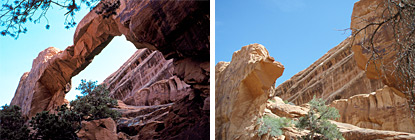
Wall Arch, 12th largest, one of the better-known and most-seen natural arches in Arches National Park, Utah, collapsed.

Wall Arch, before and after collapse - National Park Service photos

Wall Arch, before and after collapse – National Park Service photos

“Not being a geologist, I can’t get very technical but it just went kaboom,” [Arches NP] Chief Ranger Denny Ziemann said. “The middle of the arch just collapsed under its own weight. It just happens.”

Wall Arch, located along the popular Devils Garden Trail, was 71 feet tallwide and 33 1/2 feet widetall, ranking it 12th in size among the known arches inside the park. Lewis T. McKinney first reported and named Wall Arch in 1948.

No one reported observing the arch collapse and there were no visitor injuries, the National Park Service said.

Read the report from the Salt Lake Tribune.

Some tourist on Sunday, August 3, or Monday, August 4, got the last photograph of Wall Arch still standing. Was it you? Were you close? Give us a shout in the comments if so.

Other resources:

x

Other blogs and later reports:


Quote of the moment: Mark Twain, and a majority in favor

August 9, 2008

Hain’t we got all the fools in town on our side? and ain’t that a big enough majority in any town?

— Mark Twain (Samuel Langhorn Clemens),
Adventures of Huckleberry Finn

Mark Twain, Library of Congress image

Mark Twain, Library of Congress image