‘Twas DDT nearly killed the beast

December 20, 2007


This University of Buffalo South Campus resident keeps a watchful eye over the nesting box in the Mackay tower that was custom-designed by UB facilities staff. - See more at: http://www.buffalo.edu/news/news-releases/arts-and-culture.host.html/content/shared/university/news/news-center-releases/2010/04/11203.html#sthash.hqz74P1J.dpuf

This University of Buffalo South Campus resident keeps a watchful eye over the nesting box in the Mackay tower that was custom-designed by UB facilities staff. – See more at: http://www.buffalo.edu/news/news-releases/arts-and-culture.host.html/content/shared/university/news/news-center-releases/2010/04/11203.html#sthash.hqz74P1J.dpuf

It was DDT that nearly did in the peregrine falcon, not habitat destruction, not hunters, not egg collectors.

Dr. [Tom] Cade, who said he had been fascinated by falcons from childhood and who did his Ph.D. dissertation on the peregrine and gyrafalcon in Alaska, recalled that at first the peregrine’s plight was mistakenly attributed to overdevelopment, molestation by falconers, collection of its brown speckled eggs by admirers and wanton killing by people who simply did not like falcons. But at a conference at the University of Wisconsin in 1965, experts realized that the crash of falcons was a worldwide problem, and, as Rachel Carson suggested in ”The Silent Spring,” DDT was probably the main culprit.

DDT is an organochloride compound that breaks down into DDE, a highly persistent chemical that is stored in the fat of animals that consume it, especially predators like peregrines that are at the top of the food chain. DDE interferes with the deposition of calcium in the shells of the birds’ eggs, leaving them too fragile to survive incubation by females weighing two or three pounds.

Remarkable story of the dedication of one ornithologist, a successful program to revive an endangered species, and serendipity with a happy ending, in an often-overlooked article by science writer Jane Brody at the New York Times, February 15, 2000.

Junk science advocates claim that DDT did no serious damage to birds; the story of the peregrine falcon indicates that DDT was the major culprit in a worldwide decline of raptors. (This is direct refutation of claims by Steven Milloy and the late Gordon Edwards.)

Apart from the rebuttal points, Brody’s story tells how scientists work, how they make mistakes and recover, and how luck plays a huge role in some endeavors.

Peregrine falcons were delisted from the endangered species list in 2000, due largely to the success of Tom Cade’s captive breeding program, coupled with a decline in DDT in the wild after DDT use was restricted.


Test pressures hammer social studies instruction

December 19, 2007

He’s obviously a bright kid. He’s got good grades. It’s honors U.S. history, which is supposed to be rigorous, to prepare the kid for college studies.

But we’re drawing blanks from the kid on basic stuff: What’s the significance of 1776? Jamestown is in what state? Who was the commanding general of the American Revolution, George Washington or Abraham Lincoln? During the Civil War, on which side did Robert E. Lee fight? Or was he that dude from the Revolutionary War? Was the 1849 Gold Rush in Texas or California?

During the practice tests, he’s got all the skills: Two-colored markers to analyze the reading passages, circles and arrows to show which parts are important to consider. He can break the test question and reading down into all the “proper” parts, it’s a testing procedure he’s been practicing since third grade. After 8 years, he knows it well.

But he’s not sure whether the British fought in the American Civil War.

It’s a composite picture, but not composite enough for any of us to breathe the relief sigh. Too many students I get in class do not have the basic facts down that they need to make sense of anything else in the history course — or economics or geography course — that they struggle in now.

Many of these students have good test scores, too. The test doesn’t phase them, but their performance is not what it ought to be. Instead of acing the annual state exam, they take a couple of hours and complain that it’s a stupid exam with stupid questions.

We’ve taught them “tricks” to analyze the test questions, but they don’t have the background in the subject that they should have in order to quickly answer basic questions. The tricks get them through an exam, but it’s a poor substitute for knowing the material.

How does this happen?

Many schools across the nation have shorted social studies. Confronting pressure to raise average school test scores, basic social studies has been cut back in elementary and middle grades (kids know that stuff anyway, right?). Social studies is crowded out of the curriculum in favor of testing skills, or instruction in science and math.

I suspect much of the instruction in science and math is similarly shallow. Students learn how to analyze the test question, but they don’t know how to do the math required.

We know that students learn more when they spend more time on the learning tasks. Learning time is reduced for testing skills instruction.

Social studies take the hit particularly hard. According to a commentary by Judith Pace of the University of San Francisco, in Education Week this week (subscription may be required):

Surveys have reported reduced instructional time in various states, and organizations such as the National Council for the Social Studies have responded with letters and statements to Congress. Social studies educators have begun to lobby their lawmakers. But the apparent mainstream acceptance of drastic reductions in the amount of time and attention given to one of elementary education’s core academic subjects is shocking. We are in danger of losing a generation of citizens schooled in the foundations of democracy—and of producing high school graduates who are not broadly educated human beings.

In my own state of California, where history/social studies is not tested until 8th grade, this trend began with the state’s Public Schools Accountability Act of 1999, and has accelerated with the No Child Left Behind law. The social studies squeeze occurs disproportionately in low-performing schools with large minority and low-income populations that are under intense pressure to raise scores. And this, too, has alarming implications for educational opportunity and civic participation.

(More of Light’s commentary below the fold.)

One of the old saws of the quality movement in industry (now sadly abandoned in too many places) is “You get what you measure.” We measure average achievement. Consequently, we stifle outstanding achievement, and we don’t give most of the children the background they need to be good citizens.

I see it in students who just don’t know the basics. We should not need to spend time teaching that Abraham Lincoln was not at the Constitutional Convention, but was president during the Civil War.

Improving test scores may be hurting students’ core knowledge in essential areas.

What do we do about it? Comments are open, of course.

Read the rest of this entry »


Typewriter of the moment: Flannery O’Connor

December 18, 2007

Flannery O'Connor's typewriter at her farm Andalusia, near Milledgeville, GA - NY Times photo

Photo by Susana Raab for The New York Times; caption: “The writer Flannery O’Connor’s desk and typewriter in her bedroom at Andalusia, her farm near Milledgeville, Ga. She was a master of the Southern Gothic.”

From the Travel section article of the New York Times, February 4, 2007, by Lawrence Downes:

I was met at the door by Craig R. Amason, the executive director of the Flannery O’Connor-Andalusia Foundation, the nonprofit organization set up to sustain her memory and preserve her home. When the affable Mr. Amason, the foundation’s sole employee, is not showing pilgrims around, he is raising money to fix up the place, a project that is a few million dollars short of its goal. The foundation urgently wants to restore the house and outbuildings to postcard-perfection, to insure its survival. Last year the Georgia Trust for Historic Preservation placed Andalusia on its list of most endangered places in the state.

For now, the 21-acre property is in a captivating state of decay.

There is no slow buildup on this tour; the final destination is the first doorway on your left: O’Connor’s bedroom and study, converted from a sitting room because she couldn’t climb the stairs. Mr. Amason stood back, politely granting me silence as I gathered my thoughts and drank in every detail.

This is where O’Connor wrote, for three hours every day. Her bed had a faded blue-and-white coverlet. The blue drapes, in a 1950’s pattern, were dingy, and the paint was flaking off the walls. There was a portable typewriter, a hi-fi with classical LPs, a few bookcases. Leaning against an armoire were the aluminum crutches that O’Connor used, with her rashy swollen legs and crumbling bones, to get from bedroom to kitchen to porch.

There are few opportunities for so intimate and unguarded a glimpse into the private life of a great American writer. Mr. Amason told me that visitors sometimes wept on the bedroom threshold.


Typewriter and quote of the moment: David McCullough

December 17, 2007

I bought my Royal Standard typewriter in 1965. It was secondhand. I have written everything I’ve ever had published on it, and there is nothing wrong with it.

Giambarba photo of historian David McCullough and his typewriter

  • Pulitzer-winner David McCullough, defending his refusal to write on a computer during a Dallas book-signing.

(Found in Dallas Morning News, Alan Peppard, “Salutations, Year in Review, Local Celebrities,” December 17, 2007, page 1E, in graphic on page 4E)

More from McCullough on typing, and on writing, reading and understanding history, below the fold.

Read the rest of this entry »


December 17, written in the wind

December 17, 2007

Wright Bros. flyer at Kittyhawk, first flight

Photo from Treasures of the Library of Congress; “First Flight” by John T. Daniels (d. 1948); this is a modern gelatin print from the glass negative.

Ten feet in altitude, 120 feet traveled, 12 seconds long. That was the first flight in a heavier-than-air machine achieved by Orville and Wilbur Wright of Dayton, Ohio, at Kittyhawk, North Carolina, on December 17, 1903.

From the Library of Congress:

On the morning of December 17, 1903, Wilbur and Orville Wright took turns piloting and monitoring their flying machine in Kill Devil Hills, North Carolina. Orville piloted the first flight that lasted just twelve seconds. On the fourth and final flight of the day, Wilbur traveled 852 feet, remaining airborne for 57 seconds. That morning the brothers became the first people to demonstrate sustained flight of a heavier-than-air machine under the complete control of the pilot.

No lost luggage, no coffee, no tea, no meal in a basket, either.

Resources on the Wright Brothers’ first flight:


Quote of the moment: Housman, “accuracy a duty” in history

December 16, 2007

Poet A. E. Housman, with a book - Bryn Mawr College photo


Poet A. E. Housman in 1910, portrait photo by E. O. Hoppé

. . . accuracy is a duty and not a virtue.

A. E. Housman, English poet (1859-1936), Manilius (The Richards Press, 1930), p. xxii ll. 27 sqq


Google the phrase “accuracy is a duty” plus Housman.* You will get several dozen hits.

Historians are fond of citing it, though I suspect that few have actually read Housman’s version of the line. The idea is that historians should not get kudos for accuracy, because in their trade, accuracy is not a virtue, but instead is the baseline duty. Housman arrived at that conclusion in comparing versions of translations of Manilius, and he made the comment in the preface to fifth volume of his own translation of the works of Roman poet Marcus Manilius. Housman’s five volumes were published between 1903 and 1930.

The full quote lacks the punch of the usual truncations, however. The Housman Society in Britain was kind to track down the precise quote and the citation.

p. xxii ll. 27 sqq. I did not quote Brechart’s accuracy, because accuracy is a duty and not a virtue; but if I could have seen the shameful carelessness’ of Breiter and van Wageningen I should have said with emphasis, as I do now, that he was very accurate indeed.

Admit it — like me you were probably unaware that Housman had ever translated Manilius. Perhaps you were unaware that Manilius existed (don’t ask me to recite anything he wrote).
Historians have this further problem: Housman probably was talking about the accuracy of the translation, not accuracy in recording history.

One more quote that has been dragooned into duty in fields unrelated to its usual use. Got a problem with that?

The statement is good advice in every field I can think of.

Update: Go see Elektratrig’s report of Housman’s send-up of Greek tragedy. Well worth the click, just for edification.

*  And if you check it now, you’ll see the search is skewed by this very post; it’s the Heisenberg Principle of the internet.


How a carnival should be done: 4 Stone Hearth

December 15, 2007

By now you should have learned this is not a place from which to get clockwork notes about blog carnivals to read. Sometimes I look at a carnival, and finding not much to interest me, I assume in all hubris that you won’t find much there, either. More often I get bogged down doing other things and just forget to note some.

I post about carnivals here when I think there is good material.

So, I gotta tell you: Run see the current 4 Stone Hearth, posted at remote central. It’s #29, and it’s a doozey.

4 Stone hearth image, 12-2007, dolmen in snow

For your geography classes, make a note here of Britain’s pyramid, “the inside story.” Didn’t know Britain had a pyramid?

See what I mean? How can you ignore stuff like that?

There are posts about volcanoes, posts about excavating shell mounds and prehistoric garbage dumps (no, Mr. Dembski, no Pebbles cereal boxes), your standard skeleton moving fees story, polyandrous sex and sexual dimorphism among human ancestors, and a couple of notes about the flooding of the Black Sea (“Noah’s flood”) and what that did to human civilization. And a bunch of other stuff.
This isn’t a kids’ carnival in any way. For your geography and history students, there is a lot of material in this one carnival about prehistory, material that simply will not be in the textbooks (but probably should be).

Great stuff. It’ll take a while to wade through all of it, and you will find material that will excite your students in class.

The next Four Stone Hearth is set for December 19th, at The Greenbelt.


Quote of the moment: Wolfgang Pauli, “not even wrong.”

December 14, 2007

Wolfgang Pauli, before 1945 - Nobel Foundation photo
Photograph of Wolfgang Pauli, circa 1929; photo from Nobel Foundation.

That’s not right. It’s not even wrong.

From Wikipedia:

Wolfgang Pauli (1900-1958), as quoted by R. Peierls

Peierls (1960) writes of Pauli, “… a friend showed him the paper of a young physicist which he suspected was not of great value but on which he wanted Pauli’s views. Pauli remarked sadly ‘That’s not right. It’s not even wrong'”.  (Peierls  R  (1960). “Wolfgang Ernst Pauli, 1900-1958”. Biographical memoirs of fellows of the Royal Society 5: 174-92. Royal Society (Great Britain))

Pauli won the Nobel Prize in Physics in 1945:  “At this stage of the development of atomic theory, Wolfgang Pauli made a decisive contribution through his discovery in 1925 of a new law of Nature, the exclusion principle or Pauli principle. The 1945 Nobel Prize in Physics has been awarded to Pauli for this discovery.”


Bill of Rights Day, December 15

December 14, 2007

Courtesy the Bill of Rights Institute, a few “did you knows” about the Bill of Rights:

Did You Know?

The Bill of Rights was ratified December 15, 1791.
__

Congress adopted twelve amendments, of which only ten were ratified by the states by 1791.
__

Over 200 years later, one more of the original twelve, concerning compensation for Congress was ratified on May 7, 1992, becoming the Twenty-Seventh Amendment.
__

James Madison wrote the Bill of Rights and was inspired, in part, by the Virginia Declaration of Rights, written by George Mason.
__

The Bill of Rights initially applied only to the federal government; however, the Supreme Court, through the Fourteenth Amendment, has incorporated some portions to apply to the states.
__

Only 17 amendments have been ratified since the adoption of the Bill of Rights.


Carnival!

December 13, 2007

Oh, boy, are we behind.

Here’s the latest Carnival of Education, at the Colossus of Rhodey. Considering the angst in Texas over science standards, and the recent angst in Utah over vouchers, and the national angst over science and math performance, it’s really a rather tame bunch of posts. Great stuff, though, in about every other one.

The 59th History Carnival was put up on December 2 at Westminster Wisdom. We’ve already missed a third of the month we had to read it! In the vein of “how do we know what we know,” the carnival points to Judith Weingarten’s musings/essay/research on the connection (if there is one) between the words “tiger” and “Tigris.” No, not “tigress.” See? You’re hooked on history already. And what can we do with “The Further adventures of Ben Franklin’s ghost?” (Ghost — hell’s bells! — son James was born on Ben Franklin’s birthday; that’s gotta be an omen of good, right?)

We need to get in the carnival mood . . .


DDT no silver bullet; environmentalists, medical care not monsters

December 13, 2007

Paul Driessen wrote a book, Eco-Imperialism, that in essence blames environmentalists for every case of malaria in Africa since 1962. It is possible, that overreaction to environmental concerns by African governments and by Africans in the path of malaria parasites has indeed caused some delay in decreasing malaria infections. I have not seen any convincing evidence to make that case.

But it is untrue that environmentalists advocate policies intended to hurt Africans. It is untrue that DDT is a silver bullet that meanie environmentalists refuse to let African governments use — environmentalists do not have the power to tell African governments what the governments can or cannot do. Plus, it’s unfair to the point of gross distortion to blame environmentalists for the many problems which still exist that prevented the eradication of malaria 40 years ago and continue to frustrate efforts to reduce the frequency and mortality of the disease.

I assume Driessen is well-intentioned, though I have no first hand information about his motivations.

With that assumption, let me ascribe to simple error the many problems of his recent column for an on-line magazine perhaps aptly named spiked.

Driessen calls for an “all-out war on malaria.” That would be good.

But then he accuses environmentalists of standing in the way of such a war.

False blame calling cures not a single case of malaria, nor kills a single malaria-carrying mosquito. If Driessen wishes to fight malaria, there are a lot of people who would like to help. We can start to fight malaria, any time. [More after the fold.]

Read the rest of this entry »


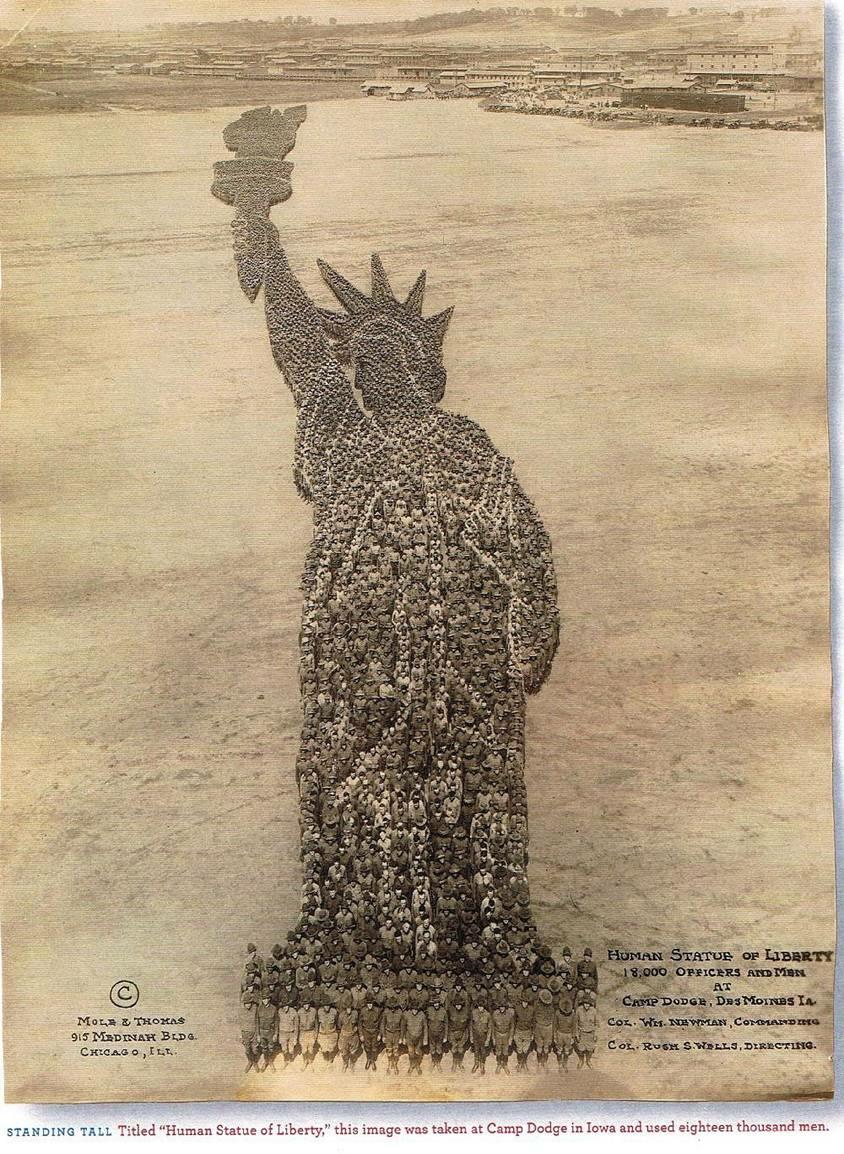
Human Liberty Bell: Tribute to photos of Mole & Thomas

December 12, 2007

Surely you’ve seen some of these photos; if you’re a photographer, you’ve marveled over the ability of the photographer to get all those people to their proper positions, and you’ve wondered at the sheer creative genius required to set the photos up.

Like this one, a depiction of the Liberty Bell — composed of 25,000 officers and men at Fort Dix, New Jersey. The photo was taken in 1918.

Mole & Thomas photo, Human Liberty Bell The Carl Hammer Gallery in Chicago featured an exhibit of these monumental photos in April and May, 2007:
The outbreak of World War I and its inherent violence engendered a new commitment by the world’s photographers to document every aspect of the fighting, ending an era of In A Patriotic Mole, A Living Photograph, Louis Kaplan, of Southern Illinois University, writes, “The so-called living photographs and living insignia of Arthur Mole [and John Thomas] are photo-literal attempts to recover the old image of national identity at the very moment when the United States entered the Great War in 1917.

Mole’s [and Thomas’s] photos assert, bolster, and recover the image of American national identity via photographic imaging. Moreover, these military formations serve as rallying points to support U.S. involvement in the war and to ward off any isolationist tendencies. In life during wartime, [their] patriotic images function as “nationalist propaganda” and instantiate photo cultural formations of citizenship for both the participants and the consumers of these group photographs.”

The monumentality of this project somewhat overshadows the philanthropic magnanimity of the artists themselves.Instead of prospering from the sale of the images produced, the artists donated the entire income derived to the families of the returning soldiers and to this country’s efforts to re-build their lives as a part of the re-entry process.

Eventually, other photographers, appeared on the scene, a bit later in time than the activity conducted by Mole and Thomas, but all were very clearly inspired by the creativity and monumentality of the duo’s production of the “Living” photograph.

One of the most notable of those artists was Eugene Omar Goldbeck. He specialized in the large scale group portrait and photographed important people (Albert Einstein), events, and scenes (Babe Ruth’s New York Yankees in his home town, San Antonio) both locally and around the world (Mt. McKinley). Among his military photographs, the Living Insignia projects are of particular significance as to how he is remembered.

Using a camera as an artist’s tool, using a literal army as a palette, using a parade ground as a sort of canvas, these photographers made some very interesting pictures. The Human Statue of Liberty, with 18,000 men at Camp Dodge, Iowa?


statue-of-liberty-human-camp-dodge-from-snopes.jpg

Most of these pictures were taken prior to 1930. Veterans who posed as part of these photos would be between 80 and 100 years old now. Are there veterans in your town who posed for one of these photos?


Good photographic copies of some of these pictures are available from galleries. They are discussion starters, that’s for sure.

Some questions for discussion:

  1. Considering the years of the photos, do you think many of these men saw duty overseas in World War I.
  2. Look at the camps, and do an internet search for influenza outbreaks in that era. Were any of these camps focal points for influenza?
  3. Considering the toll influenza took on these men, about how many out of each photo would have survived the influenza, on average?
  4. Considering the time, assume these men were between the ages of 18 and 25. What was their fate after the Stock Market Crash of 1929? Where were they during World War II?
  5. Do a search: Do these camps still exist? Can you find their locations on a map, whether they exist or not?
  6. Why do the critics say these photos might have been used to build national unity, and to cement national identity and will in time of war?
  7. What is it about making these photos that would build patriotism? Are these photos patriotic now?

These quirky photos are true snapshots in time. They can be used for warm-ups/bell ringers, or to construct lesson plans around.

Tip of the old scrub brush to Gil Brassard, a native, patriotic and corporate historian hiding in Baton Rouge, Louisiana.


How to tell if someone is wrong about DDT and Rachel Carson

December 12, 2007

Here is one surefire way to tell someone is bluffing, and perhaps doing a bit of planned prevarication, about Rachel Carson and the safety of DDT: Look for a footnote like this:

31 Sweeney EM. EPA Hearing Examiner’s recommendations and findings concerning DDT hearings. 25 April 1972 (40 CFR 164.32).

Why is that a sign of a bluff?

The volume and paging, “40 CFR 164.32,” is a reference to the Code of Federal Regulations. One knows that codes do not contain hearing records, and sure enough, this one does not. 40 CFR covers the rules of administrative hearings in federal agencies, but there is nothing whatsoever in that entire chapter about DDT, or birds, or chemical safety.

40 CFR is the chapter of the Code of Federal Regulations that pertains to the rules, regulations and procedures of the Environmental Protection Agency (EPA); it does not contain transcripts of regulatory hearings.

40 CFR is the chapter of the Code of Federal Regulations that pertains to the rules, regulations and procedures of the Environmental Protection Agency (EPA); it does not contain transcripts of regulatory hearings.  Anyone who cites a hearing to this publication is giving you a bogus citation, probably to promote bogust history and bogus science.

If that citation shows up in a screed against environmentalists, or against Rachel Carson, or urging that we spray poison till the cows come home to die, you can be pretty sure that the person offering it has copied it wholesale from Steven Milloy’s junk science purveyor shop, and that the person has not read it at all.  If the person has a law degree, or was ever a librarian or active in interscholastic debate, you can be pretty sure the person knows the citation is wrong, and is insulting you by listing it, knowing it’s unlikely you’ll ever find it in your local library.

(What is the accurate citation for the hearings? I’m not sure; but 40 CFR is not it. See the current section of CFR below the fold — it’s one page, not more than 100 pages.)

I have posted about this before. The hearings Judge Sweeney presided over were conducted early in the existence of the EPA. They were conducted under court orders requiring EPA to act. The transcripts are not in usual legal opinion publications, so far as I have been able to find. Many claims have been made about the hearings, most of the claims are false. Jim Easter at Some Are Boojums did the legwork and extracted a copy of the actual decision out of EPA’s library. He’s posted it at his blog, so you can see. Check the pages — “40 CFR” is a bogus citation, designed to keep you from learning the truth.

So the footnote is intended to make the gullible or innocent think there is a reference, where there is no reference.

But read the analysis of the hearings at Some Are Boojums. It is more than just the citation is wrong. Contrary to Internet Legend claims, Sweeney did not determine that DDT was harmless. Sweeney determined that DDT usage provided some benefits that outweighed the harms, considering the dramatically reduced use of DDT then allowed. DDT use had been severely restricted prior to the Sweeney hearings; Sweeney was not looking at all uses, nor even at historic uses. Sweeney was looking at dramatically reduced DDT use under the registrations then allowed. His conclusions of “no harm” where he actually concluded that, were based on greatly reduced use of DDT. This finding cannot be used today to urge an expansion of use — or should not be so used, by honest people.

Not to mention that at Caosblog, footnotes are not even listed in the text. The listing of the footnotes is a gratuitous error, there is no footnote 31 in the text.

Read the rest of this entry »


Founders online, great interactive site

December 12, 2007

Our friends and benefactors at the Bill of Rights Institute put up a great branch of their site, Founders Online. A grant from the Shelby Cullom Davis Foundation made the project possible.

Bill of Rights Institute logo

Check it out:

John Adams | Samuel Adams | Alexander Hamilton | Patrick Henry
Thomas Jefferson | James Madison | GeorgeMason | Gouverneur Morris
James Otis | Thomas Paine | George Washington | John Witherspoon

This page should be a first stop for your students doing biographies on any of these people, and it should be a test review feature for your classes that they can do on the internet at home, or in class if you’re lucky enough to have access in your classroom.

Good on-line sources are still too rare. This is stuff you can trust to be accurate and appropriate for your students. Send a note of thanks to the Bill of Rights Institute, and send your students to the site.

Just in time for Bill of Rights Day, December 15 . . .


How do we know what we know?

December 10, 2007

Especially in science — how do we know what we know?

A charitable trust in Britain called Sense About Science makes a start on explaining peer review, the process scientists use in science journals to referee what is accurate and what is not.

The site looks legitimate, though I’m no great judge of British scientists (see the board of trustees and advisors).

The site has several sets of debunking material, debunking things like “alternative” treatments for malaria, plus an 8-page pamphlet on how peer review works.

See especially these publications (available in downloadable .pdf):

The booklets are available free, but I’ll wager they were intended for British consumption — I’m not sure they’d mail them across the Atlantic.

It’s worth a look. See any problems with using that pamphlet in a classroom? I am very interested if you find a problem with any of the materials there.