Trump’ s middle America voters hurt still. Tax cuts make them hurt more, and. Trade war can’t help.
Trump has abandoned Americans.
Tip of the old scrub brush to Greg Sargent @ThePlumLineGS.
Trump’ s middle America voters hurt still. Tax cuts make them hurt more, and. Trade war can’t help.
Trump has abandoned Americans.
Tip of the old scrub brush to Greg Sargent @ThePlumLineGS.
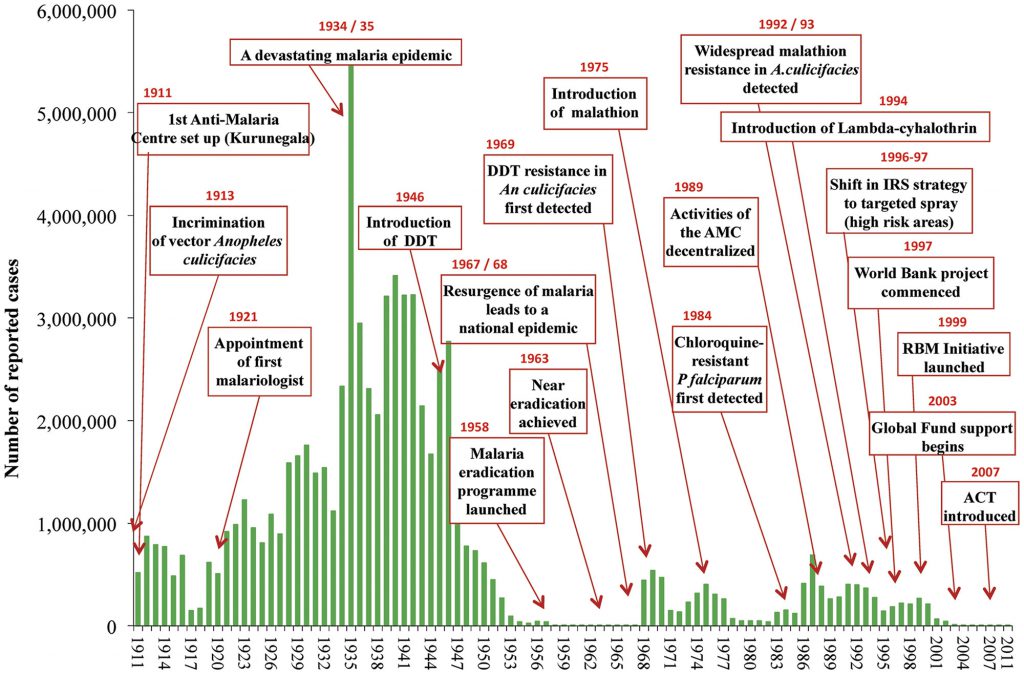
Sri Lanka pushed malaria out of the country, and is certified by the World Health Organization (WHO) as malaria-free, as of September 2016.
If you follow the fight against malaria, this may not be news to you. If you’re a victim of the pro-DDT, anti-WHO and anti-Rachel Carson hoaxes, you may be surprised.
Sri Lanka once got malaria to almost nothing, with heavy use of DDT in Indoor Residual Spraying. Then the budget hawks stopped the anti-malaria program (“Success!”) to save money. Malaria came roaring back as it will when vigilance relaxes — but by then the mosquitoes were mostly resistant to DDT, and a civil war kept the nation from mounting any public health campaigns in much of the country.
With the advent of new medicines, ABC therapy, and new methods to diagnose the disease, and using bednets and targeted pesticides other than DDT, Sri Lanka beat the disease. The news was carried in Britain’s The Guardian.
The World Health Organisation has certified that Sri Lanka is a malaria-free nation, in what it called a truly remarkable achievement.
WHO regional director Poonam Khetrapal Singh said in a statement that Sri Lanka had been among the most malaria-affected countries in the mid-20th century.
But, the WHO said, the country had begun an anti-malaria campaign that successfully targeted the mosquito-borne parasite that causes the disease, not just mosquitoes. Health education and effective surveillance also helped the campaign.
https://www.theguardian.com/society/2016/sep/05/sri-lanka-malaria-free-world-health-organisation
This is a blow to the anti-WHO pro-DDT forces. Sri Lanka has been a key story in their tales of how only DDT could fix malaria, stories told long after DDT stopped working. One more example shot down.
More:
Tip of the old scrub brush to The Guardian.
 3 Comments |
  DDT, History, Malaria, Public health, WHO - World Health Organization | Tagged: DDT, History, Malaria, Public health, Science, Sri Lanka |
  Permalink
 Posted by Ed Darrell
What are you doing about it?
In 2018, Spring is early in the west and east, but later than normal in the southeast. Overall, springs come earlier these days.

A map of plant growth, including the emergence of leaves and blooms, updated daily tracks the arrival of spring compared to normal seasonal timing over a 50-year period. USGS
Generally, since 1900, spring has arrived a few minutes earlier every year, on average. But each spring is unique, and in 2018 variation covers almost 40 days, 20 days on either side of a “normal” spring arrival in a location.
Yale Environment 360 explains the observations and consequences.
The early spring arrival coincides with a slew of other odd weather trends happening across the globe, from a heat wave in the Arctic, where temperatures reached 43 degrees Fahrenheit in February, to a cold snap in Europe.
An early spring comes with consequences: Disease-carriers such as ticks and mosquitoes emerge sooner, the USGS warns, and it can trigger a longer, more intense pollen season. In addition, if flowers bloom earlier than normal, it “can disrupt the critically important link between wildflowers and the arrival of birds, bees, and butterflies” that is critical to the pollination of crops and other plants, the USGS wrote.
While generally these trackers show the earlier springs over decades, I am delighted by the dramatic variation in some places. Where we live in Dallas, for example, spring is delayed this year — according to the maps. Sure enough, last year most of our spring-blossoming trees were already abloom, only to lose blossoms for fruit in later winds and cold. See my post from last year on Mexican plums, link below. This year the Mexican plum is budded, but not blossoming yet.
In contrast, the daffodil/narcissus plants are up earlier than usual, some already blossoming. Again, in the past two years they’ve been even earlier.
More:
Tip of the old scrub brush to Yale Environment 360’s Twitter feed.

Members of the New York City Fire Department carry 343 U.S. flags honoring the 343 NYFD members killed on 9/11, in the St. Patrick’s Day Parade. New York Post caption: “Despite the cold and gray morning, parade-goers turned out for St. Patrick’s Day to celebrate Irish heritage in New York City on March 17, 2014. FDNY members set the pace as they marched down 5th Avenue holding American flags for the annual event. SHANNON STAPLETON/Reuters”
I usually put up a post near the first of the month listing the occasions upon which U.S. laws urge us to fly Old Glory. March sometimes slips by without such a post.
No good reason, other than in most years, March offers no regular national commemorations upon which flag flying is urged. The odd year is when Easter comes early. Easter is one of the holidays the Flag Code says flags should be flown.
But, most years, Easter falls in April, as it does in 2018.
The Flag Code urges residents of states to fly the U.S. flag on the anniversary of their state’s entering the union, on statehood day. Those are the only dates in March, most years. In March, we have four statehood days in the first four days of the month. If I dawdle, we miss most of the dates.
Flag fly dates, for March (some already past, in 2018):
Many St. Patrick’s Day revelers and parade marchers display the U.S. flag, but it’s not an official U.S. observance.
I keep hoping, but I get little traction for a law urging flying the flag to observe Freedom Day, on the birth anniversary of the Father of the Constitution, James Madison (he was born March 16, 1751).

People gathered on the lawn of James Madison’s home in Montpelier, Virginia, to display the U.S. flag in a card display, 2011. AP photo?
Much irony, and great history, in the U.S. colors being shown so dramatically on St. Patrick’s Day, a day relatively uncommemorated in Ireland, and commemorated in the U.S. chiefly to help overcome bias against Irish immigrants.
Some irony in the unmarked birthday of the Father of the Constitution.
Sure, you may fly the U.S. flag every day in March. You need not wait for sanction from a Presidential Proclamation or a Congressional Resolution. You may fly the flag every day. (Just follow flag etiquette when you do.)
I’ll try to keep up better, next year. (I said that last year.)

U.S. colors led the St. Patrick’s Day parade in Seattle, Washington, in 2014. Photo from IrishClub.org
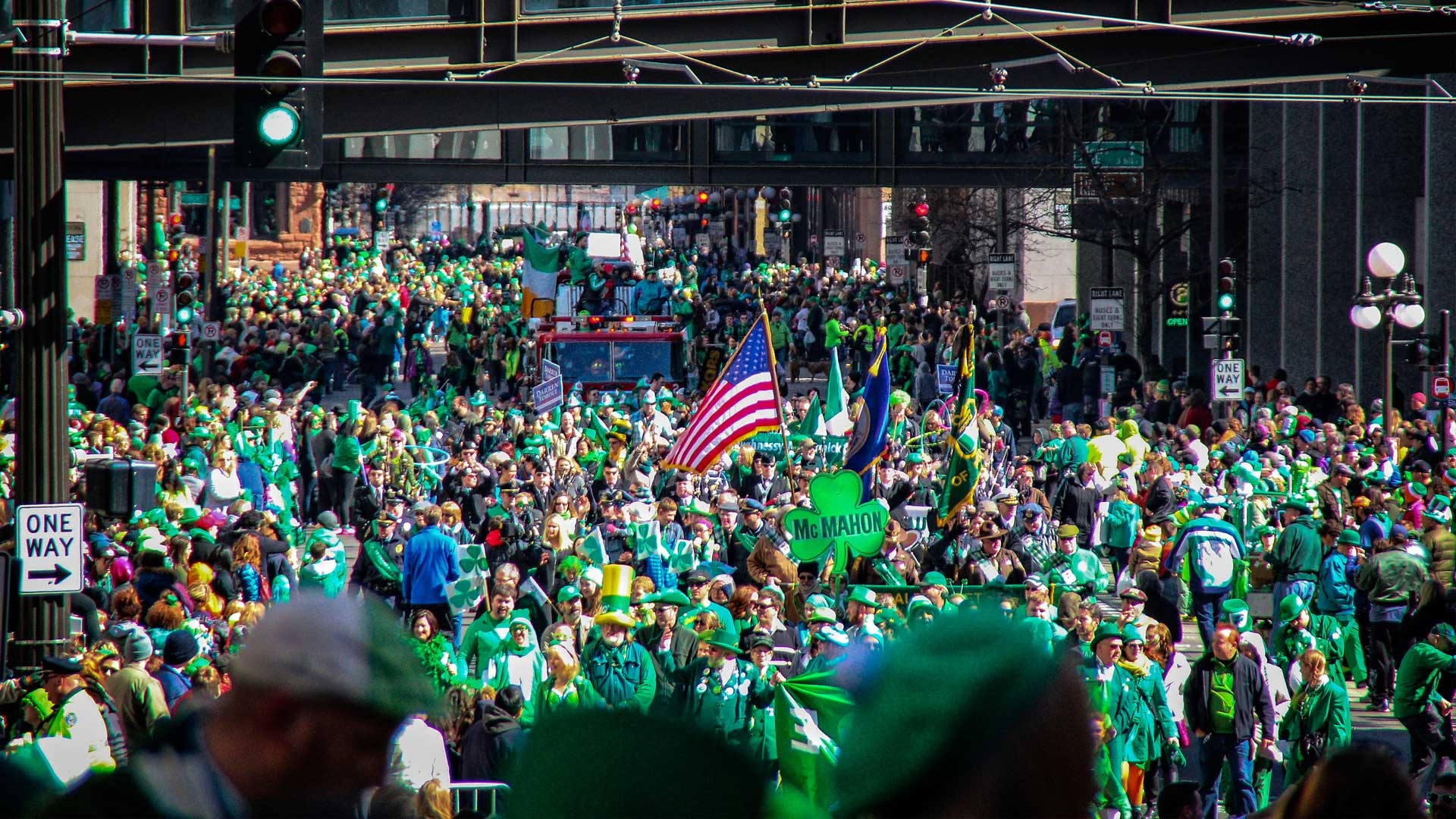
U.S. colors stood out in a field of green at the St. Paul, Minnesota, St. Patrick’s Day parade, 2015(?). Photo from VisitStPaul.com.
More

Yes, this is a bit of an encore post. Defeating ignorance takes patience and perseverance.
2 Comments | Flag etiquette, Fly your flag today, History | Tagged: Flag Code, flag display, Fly your flag today, History, March | Permalink
Posted by Ed Darrell
Want to help? Give them a text.
And that post in turn links to this one from Shannon Watts, founder of Moms Demand Action:
You don’t need to be a member of Twitter to see the posts and links, so you could go read the thread on Twitter using the links above. But it may be easier if I just give you Ms. Watts’s thread here.
Shannon Watts, founder of #Everytown and #MomsDemandAction
In the past five years, we’ve defeated hundreds of bad gun lobby bills, like guns in K-12 schools, guns on college campuses, permitless carry, and expanding Stand Your Ground.
And we’ve passed good bills, like strengthening background check laws in eight states; and strengthening domestic violence laws in 25 states to keep guns away from domestic abusers. Passing Red Flag Laws, and laws that enhance the NICS system.
In the recent November elections, eight out of eight of the candidates MomsDemand endorsed won their races. Thirteen of our volunteers ran in electoral races across the country and nine of them won – and hundreds more plan to run in upcoming elections.
We’ve been successful because we’re relentless. Every time guns are discussed in a statehouse or in Congress, we’re in the audience showing lawmakers we’re watching them. And we give our business only to companies with policies that keep our families and communities safe.
MomsDemand is the grassroots arm of Everytown. We have a chapter in every state, 70,000+ active volunteers, and more than 4 million supporters. We are the David to the NRA‘s Goliath, and we will win. Join us.
Leave a Comment » | History | Permalink
Posted by Ed Darrell
I do not recall a more repugnant abuse of wounded or sick people in a campaign ad, than Donald Trump’s fundraiser featuring a young kid wounded in the mass shooting in Florida.

Trump campaign newsletter first page. Image via @mattmfm

Trump’s repugnant campaign letter, page 2 — showing the offensive photo of Trump with a shooting victim. Tradition, and in some places campaign laws, forbid use of such victim photos to raise money or campaign.

Page 3 of Trump’s campaign letter, asking for contributions or purchases from the campaign store.

Page four of the campaign newsletter, making clear this repugnant money appeal is from the Trump campaign.
2 Comments | History | Permalink
Posted by Ed Darrell
As Bill McKibben notes, something seems amiss with this chart.

Chart from data from the National Snow and Ice Data Center (NSIDC) showing sea ice in the Bering-Chukchi Sea; 2018’s ice decline in red. Graphic by Zachary Labe.
The U.S. National Snow and Ice Data Center in Boulder, Colorado, track ice in the Arctic. The chart shows extent of sea ice in square kilometers, with a comparison of about the past 20 years.
In red, you see what is happening to the ice in 2018 — a dramatic melt, a dramatic plunge in the amount of sea ice.
Arctic Circle area temperatures rose dramatically above normal temperatures for winter in the past few weeks, by 25 to 40 degrees Fahrenheit (see report in the Sydney Morning Herald). Such dramatic increases frequently result when a weakened jet stream fails to keep cold Arctic air in the Arctic — and the polar vortex slips to give some temperate latitude land incredible freezes. The colds that get reported on the news and touted by science dissenters as evidence Global Warming does not occur, are the result of those heat blobs in the Arctic.
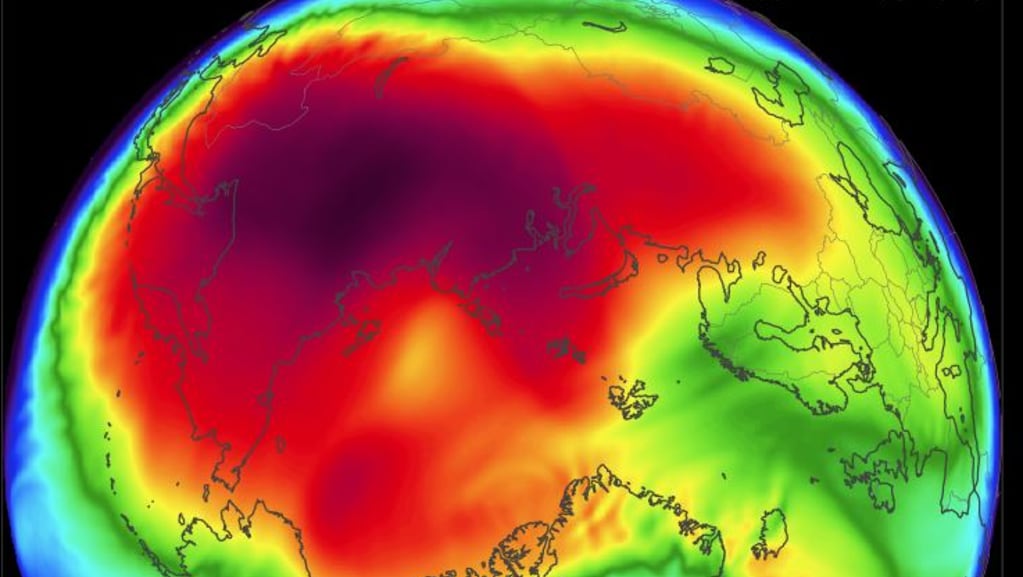
Sydney (Australia) Morning Herald reports: Arctic temperatures in February 2018 are averaging well above normal, and peaking up to 25 degrees higher than normal. Photo: globalweatherlogistics.com
Tipping points are not always discernable in real time. This may be an exception.
Time to act, people!
Tip of the old scrub brush to Bill McKibben, of course.
Leave a Comment » | Climate change, climate_change, Global warming, History, Science | Tagged: Bering-Chukchi Sea, Bill McKibben, Climate change, Global warming, History, Science | Permalink
Posted by Ed Darrell
What will we tell our grandchildren we did when we realized Earth was heating too much and too fast?
Time to act is now.

Phillis Wheatley at the Boston Women’s Memorial; Lucy Stone Abigail Adams in the background.
Phillis Wheatley lived as a slave in Boston, Massachusetts, during the American Revolution. Because she wrote so well, she avoided many of the problems of slavery until her master died. She died a few years later, in poverty, never achieving the fame or income she deserved.
She wrote about the Love of Freedom:
. . . in every human Breast, God has implanted a Principle, which we call Love of Freedom; it is impatient of Oppression, and pants for Deliverance … the same Principle lives in us.
Letter to the Reverend Samson Occom, February 11, 1774
Wheatley is featured in a stunning sculpture in Boston’s Women’s Memorial, with Abigail Adams and Lucy Stone.

Boston Women’s Memorial at the Commonwealth Avenue Mall, featuring Phillis Wheatley, Lucy Stone and Abigail Adams.
More:
3 Comments | America's founding, American Revolution, History, Poetry, Slavery | Tagged: American Revolution, History, Phillis Wheatley, Poetry, Slavery | Permalink
Posted by Ed Darrell
What will we tell our grandchildren we did to save the planet, when we heard this news?
One third of the ice gone, in about one week BEFORE spring.
Leave a Comment » | History | Permalink
Posted by Ed Darrell

Graphic from Finance Monthly
We’ve seen the studies that people who get suckered by hoaxes, when confronted with the facts, defend the hoax.
So we shouldn’t be surprised that a little further research shows that faked news stories generally fall into the memory of people, even after they’ve seen the debunkings and acknowledge the hoax.
We can still hate it, but we shouldn’t be surprised.
First impressions stick, and they color our judgments of people and news (and history) even after we learn the impression was given to us incorrectly. We can’t fix errors of judgment easily. Scientific American’s blog reports on several pieces of research into the phenomena.
Which means, it’s not enough to just counter fake news and hoaxes. We have to prevent them from being the first out of the starting gate, and get accurate information out early.
Leave a Comment » | History | Permalink
Posted by Ed Darrell
Leave a Comment » | History | Permalink
Posted by Ed Darrell

From the Sons and Daughters of Oregon Pioneers: A Stamp printed in 1959 for the Oregon Centennial shows a covered Wagon and Mount Hood Oregon
Flags are flying in Oregon and Arizona on Valentine’s Day 2018?
It’s statehood day in both of those states.
Legally, nothing stops a resident from flying the U.S. flag following protocol on any day. Yes, you may fly your U.S. flag on Valentine’s Day.
The Flag Code urges flying the flag on the day a state achieved statehood, too.
For Oregon and Arizona, there is an expectation that residents will fly their flags. Oregon came into the union on February 14, 1859; Arizona joined the Republic as a state in 1912.

President William Howard Taft signed the papers accepting Arizona into statehood, on February 14, 1912. He still finished third behind Democrat Woodrow Wilson and Bullmoose Party’s Teddy Roosevelt in that fall’s elections. Photo found at Mrs. Convir’s page, Balboa Magnet School (Can you identify others in the photo? Who is the young man?)
/GettyImages-157332408-56a81d775f9b58b7d0f0cae4.jpg)
Arizona’s state flag waves in the blue – From TripSavvy: On February 14, 1912, Taft signed the proclamation making Arizona the 48th state, and the last of the contiguous states to be admitted to the union. It was the last of the 48 contiguous states to be admitted to the union.
More:
Some of this material was borrowed, with express permission, from last year’s post at Millard Fillmore’s Bathtub.
Leave a Comment » | Flag etiquette, Fly your flag today, History, Statehood | Tagged: Arizona, Flag Code, Flag etiquette, Fly your flag today, History, Oregon, Statehood, valentines day | Permalink
Posted by Ed Darrell
/https://public-media.smithsonianmag.com/filer/Abraham-Lincoln-and-Charles-Darwin-new-631.jpg)
From Smithsonian Magazine’s 2009 article, “How Lincoln and Darwin Shaped the World.” Illustration by Joe Ciardiello.
On this day in 1809, just a few hours apart, Charles Darwin and Abraham Lincoln were born.
What are the odds of historic coincidences like that?
Lincoln’s birthday is still listed in law as a date to fly the U.S. flag, though we’ve changed the celebration to the following week and the generic President’s Day, closer to George Washington’s real birthday, February 22. President’s Day is celebrated on the third Monday in February.
So, you may certainly fly your flag today. (You may fly your flag any day, but you get the idea.)
News will feature more celebrations of Darwin than Lincoln, today, I predict — Darwin Day is a worldwide celebration by science nerds.
Both Lincoln and Darwin worked to end slavery. Darwin probably had more of an idea that racial discrimination had no science basis. Lincoln had more political sway. After Lincoln and Darwin, science and human rights advanced greatly, because of their work.
More:
Leave a Comment » | 1861-1865, Abraham Lincoln, Charles Darwin, Civil Rights, Evolution, Fly your flag today, History, Human Rights | Tagged: Abraham Lincoln, Charles Darwin, Civil War, Evolution, Fly your flag today, History, Human Rights | Permalink
Posted by Ed Darrell
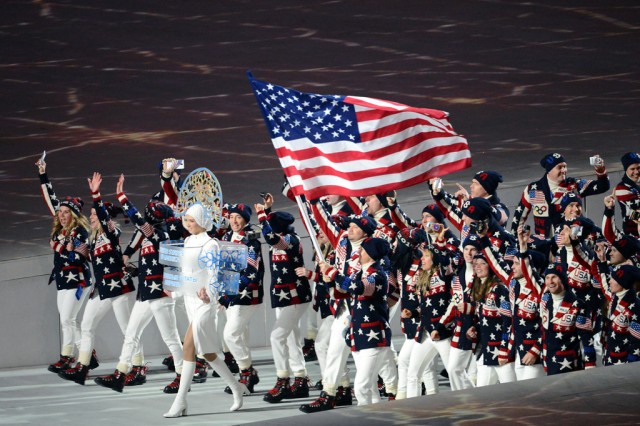
Lots of flag waving in February of Winter Olympics years, like 2018. Caption from the U.S. Army: Todd Lodwick carries the flag of the United States of America, which flies directly over the head of former U.S. Army World Class Athlete Program bobsledder Steven Holcomb, reigning Olympic champion four-man bobsled driver, as Team USA marches into Fisht Olympic Stadium during the Opening Ceremony of the 2014 Olympic Winter Games, Feb. 7, 2014, in Sochi, Russia. Army WCAP luger Sgt. Preston Griffall (right behind lady in white) and WCAP bobsledders Sgt. Justin Olsen, Capt. Chris Fogt and Sgt. Dallas Robinson also are among the lead group of Americans (Photo Credit: Tim Hipps, IMCOM Public Affairs)
You want to mark your calendar so you remember to put your U.S. flag up on those dates designated by law and tradition, right?
You may fly your flag on state holidays, too — which of those dates do we see in February? Is there a good list?
Though we don’t mark it usually, February 14 is the anniversary of the first recognition of the Stars and Stripes by a foreign government, in 1778. The French fleet recognized the ensign carried by Capt. John Paul Jones, at Quiberon Bay — painting of the event is at the top of this post.
February 23 is the anniversary of the raising of the U.S. flag on Iwo Jima, in 1945 — 72 years ago. We should probably watch for proclamations to fly the flag on that date, an anniversary made more important simply because so few survivors of from among the veterans of that war and that fight can be expected to live to see the 80th anniversary. Regardless any official, formal proclamation to fly the flag for the Iwo Jima events, you may always fly your flag.
Please visit earlier posts at Millard Fillmore’s Bathtub, on the death of Joe Rosenthal, the photographer who took the widely-released iconic photo; on the death of Charles Lindberg, pictured in the first flag-raising on Mt. Suribachi; on the death of Raymond Jacobs, the last-surviving veteran from the flag raisings; and on my visit to the Sunset Parade at the Iwo Jima-themed U.S. Marine Memorial overlooking Washington, D.C.
A Youtube poster edited a part of the Army’s documentary, “To the Shores of Iwo Jima,” showing the flag raising on film, and added in some other images for a less-than-three-minute look. (Alas, that edited version is gone — here’s the full 20-minute movie; propaganda at its best, for noble purposes.)
Winter Olympics kick off in South Korea in early February — there will be much U.S. flag waving, especially if the U.S. athletes perform as well as many expect and win medals. Olympics events, both summer and winter, often provide large public forums for improper flag display, too — but we ignore that, since no disrespect is intended, usually.
Wave your flag!
More:

Caption from the U.S. Navy, via Wikipedia: Photo #: 80-G-K-21225 (color) “First Recognition of the American Flag by a Foreign Government,” 14 February 1778. Painting in oils by Edward Moran, 1898. It depicts the Continental Navy Ship Ranger, commanded by Captain John Paul Jones, receiving the salute of the French fleet at Quiberon Bay, France, 14 February 1778. Earlier in the month, after receipt of news of the victory at Saratoga, France recognized the independence of the American colonies and signed a treaty of alliance with them. The original painting is in the U.S. Naval Academy Museum, Annapolis, Maryland. Official U.S. Navy Photograph, now in the collections of the National Archives. [A larger version is available for download at Wikipedia.]
Yes, this is an encore post. Defeating ignorance takes patience and perseverance.
3 Comments | Fly your flag today, History, U.S. Flag | Tagged: Fly your flag today, History, U.S. Flag | Permalink
Posted by Ed Darrell
You are currently browsing the archives for the History category.


Ed Darrell on Texas's Colorado River


Come on in, the water's fine. Come often: Cleanliness is next to godliness.





 Millard Fillmore's Bathtub
